Shark Culling Crisis: Public Opinion and Government Response
VerifiedAdded on 2023/06/10
|10
|2170
|431
Report
AI Summary
This report delves into the controversial shark culling procedure implemented by the Western Australian government in 2014, examining the public's negative reaction and the government's crisis management efforts. It analyzes the factors that fueled public opposition, the effectiveness of government strategies, and key lessons learned from the case. The report also applies Grunig's four models of Public Relations to the situation, evaluating their relevance. Furthermore, it explores the impact of social media on the government's reputation, highlighting the potential for improved communication and damage control. The conclusion emphasizes the ineffectiveness of the government's approach and the importance of incorporating public opinion and effective public relations strategies, particularly through the use of digital media, to mitigate future crises and maintain a positive public image.
Running head: ISSUES IN CRISIS MANAGEMENT
Issues in Crisis Management
Name of the University:
Name of the Student:
Author Note:
Issues in Crisis Management
Name of the University:
Name of the Student:
Author Note:

Paraphrase This Document
Need a fresh take? Get an instant paraphrase of this document with our AI Paraphraser
1ISSUES IN CRISIS MANAGEMENT
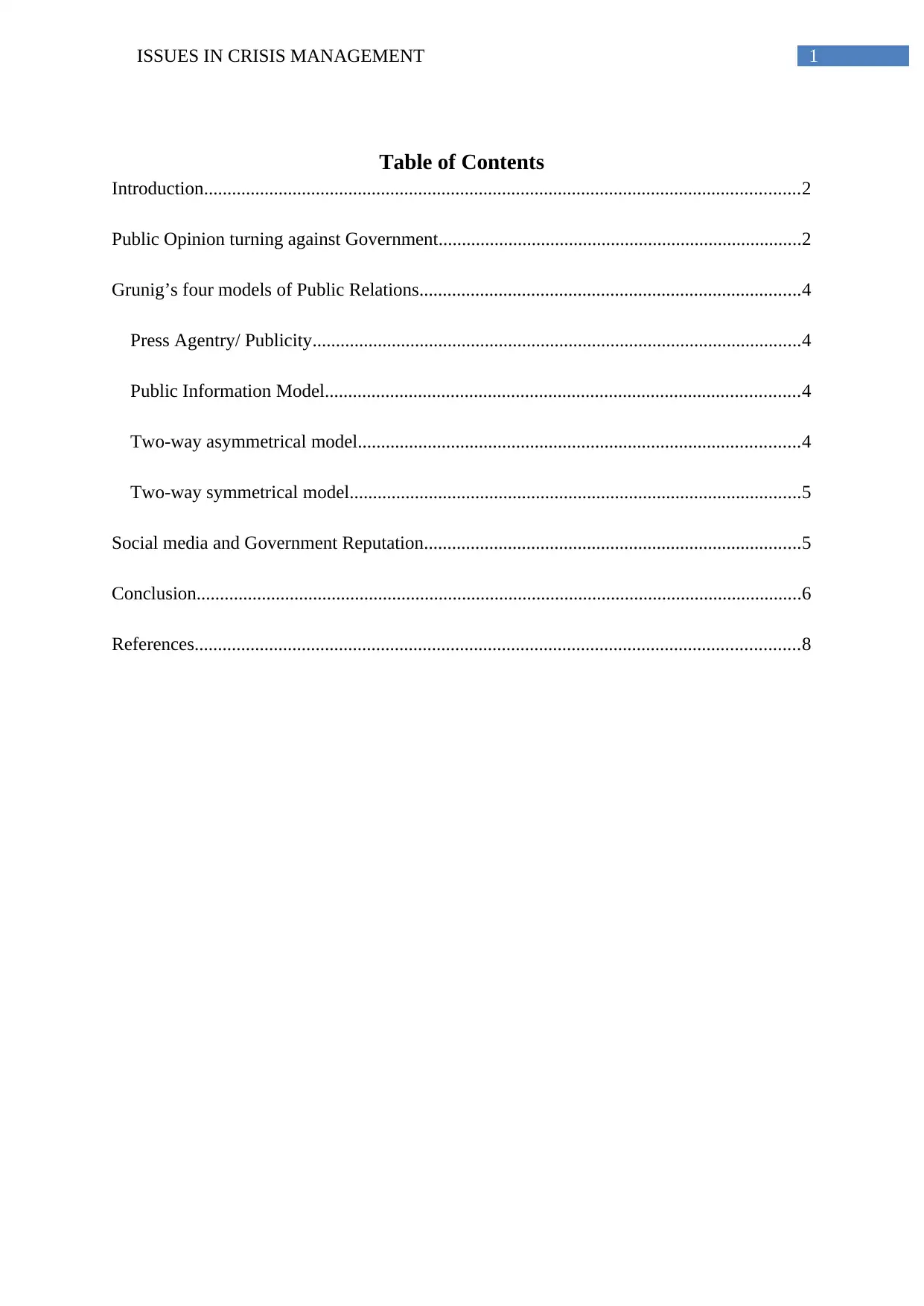
Table of Contents
Introduction................................................................................................................................2
Public Opinion turning against Government..............................................................................2
Grunig’s four models of Public Relations..................................................................................4
Press Agentry/ Publicity.........................................................................................................4
Public Information Model......................................................................................................4
Two-way asymmetrical model...............................................................................................4
Two-way symmetrical model.................................................................................................5
Social media and Government Reputation.................................................................................5
Conclusion..................................................................................................................................6
References..................................................................................................................................8
Table of Contents
Introduction................................................................................................................................2
Public Opinion turning against Government..............................................................................2
Grunig’s four models of Public Relations..................................................................................4
Press Agentry/ Publicity.........................................................................................................4
Public Information Model......................................................................................................4
Two-way asymmetrical model...............................................................................................4
Two-way symmetrical model.................................................................................................5
Social media and Government Reputation.................................................................................5
Conclusion..................................................................................................................................6
References..................................................................................................................................8
2ISSUES IN CRISIS MANAGEMENT
Introduction
The study aims at covering several aspects related to the shark culling procedure. It
also aims at the procedure of getting rid of sharks, adopted by Western Australian
Government. In the year 2014, the government officials of Western Australia took a major
decision of killing sharks for minimizing the human attacks at the beach side. The decision
was being taken by the government officials for countering the attacks of the sharks, which
took place at the Australian beaches. Majority of the tourists were being attacked by the
sharks, which led to the negative circumstances (Parsons 2016). The study will give a deeper
analysis to the things, which happened. It will discuss about certain factors that has caused
the public turn against Western Australian Government, the effectiveness of the government
efforts at managing the whole issue and the lessons of this case. In addition to this, it will
discuss about Grunig’s four models of Public Relations in accordance with the shark culling
case. Lastly, it will also discuss about the advent of digital media and its usage in building
reputation.
Public Opinion turning against Government
In December 2014, the government officials of Western Australia took the major
decision of killing sharks all along the ocean line as well as in the waters of western coastal
lines. The core purpose was to trap the sharks and kill them, to minimize the risks of human
attacks. The overall process was regarded as rude and violent. This shark culling debate
continued in the Australia as the shark bites on surfers or bathers became a sensitive reality.
These are community-wide and personal tragedies, which changed the public opinion against
the government officials. The goal was to minimize the accidents that took place at the beach
side, by killing the sharks (Austin and Pinkleton 2015).
Introduction
The study aims at covering several aspects related to the shark culling procedure. It
also aims at the procedure of getting rid of sharks, adopted by Western Australian
Government. In the year 2014, the government officials of Western Australia took a major
decision of killing sharks for minimizing the human attacks at the beach side. The decision
was being taken by the government officials for countering the attacks of the sharks, which
took place at the Australian beaches. Majority of the tourists were being attacked by the
sharks, which led to the negative circumstances (Parsons 2016). The study will give a deeper
analysis to the things, which happened. It will discuss about certain factors that has caused
the public turn against Western Australian Government, the effectiveness of the government
efforts at managing the whole issue and the lessons of this case. In addition to this, it will
discuss about Grunig’s four models of Public Relations in accordance with the shark culling
case. Lastly, it will also discuss about the advent of digital media and its usage in building
reputation.
Public Opinion turning against Government
In December 2014, the government officials of Western Australia took the major
decision of killing sharks all along the ocean line as well as in the waters of western coastal
lines. The core purpose was to trap the sharks and kill them, to minimize the risks of human
attacks. The overall process was regarded as rude and violent. This shark culling debate
continued in the Australia as the shark bites on surfers or bathers became a sensitive reality.
These are community-wide and personal tragedies, which changed the public opinion against
the government officials. The goal was to minimize the accidents that took place at the beach
side, by killing the sharks (Austin and Pinkleton 2015).
⊘ This is a preview!⊘
Do you want full access?
Subscribe today to unlock all pages.

Trusted by 1+ million students worldwide
3ISSUES IN CRISIS MANAGEMENT
However, shark hunts and shark culling was not being accepted by the public and they
considered this whole situation as ruthless. The government officials of the Western Australia
decided to spend over two million dollars, to track, trap, catch and destroy the sharks that
would prevent them from coming into the local waters. Herald Sun reported on the new poll
of West Australian website, which found around 82% of the respondents were against the
new killing plan and only around 13% supported the killing. Majority of the public was
against the decision of shark culling as it would reduce their population and make the species
a vulnerable one.
In addition to this, the massive catching and killing of the species led to the
destruction of marine life, wildlife as well as national values. The government’s initiatives of
managing the whole situation were not that effective as it led to the destruction of marine
population. In this process of trapping the sharks and killing them, the entire aquatic life got
affected. This entire process resulted in a nationwide debate. The individuals were totally
against the idea of reducing the population and destroying aquatic life (Guth and Marsh
2016).
The reports from the government officials revealed that the marine life species, which
were trapped and killed in the fish nets included whales, dugongs, dolphins and turtles as
well. According to the reports, nearly 61% of the marine life got impacted and killed in the
fish nets and maximum of them were the non-target species. Later on, it increased t0 64%.
Therefore, it can be said that the government efforts were not at all effective, in terms of
sustainability (Kunczik 2016). The key lessons of this case are that the officials lacked
effective strategic points and implementation, which resulted into such crisis. Moreover,
handling the overall situation by consulting good public relation personnel could have
assisted in managing the crisis in the most effective manner (Doorley and Garcia 2015).
However, shark hunts and shark culling was not being accepted by the public and they
considered this whole situation as ruthless. The government officials of the Western Australia
decided to spend over two million dollars, to track, trap, catch and destroy the sharks that
would prevent them from coming into the local waters. Herald Sun reported on the new poll
of West Australian website, which found around 82% of the respondents were against the
new killing plan and only around 13% supported the killing. Majority of the public was
against the decision of shark culling as it would reduce their population and make the species
a vulnerable one.
In addition to this, the massive catching and killing of the species led to the
destruction of marine life, wildlife as well as national values. The government’s initiatives of
managing the whole situation were not that effective as it led to the destruction of marine
population. In this process of trapping the sharks and killing them, the entire aquatic life got
affected. This entire process resulted in a nationwide debate. The individuals were totally
against the idea of reducing the population and destroying aquatic life (Guth and Marsh
2016).
The reports from the government officials revealed that the marine life species, which
were trapped and killed in the fish nets included whales, dugongs, dolphins and turtles as
well. According to the reports, nearly 61% of the marine life got impacted and killed in the
fish nets and maximum of them were the non-target species. Later on, it increased t0 64%.
Therefore, it can be said that the government efforts were not at all effective, in terms of
sustainability (Kunczik 2016). The key lessons of this case are that the officials lacked
effective strategic points and implementation, which resulted into such crisis. Moreover,
handling the overall situation by consulting good public relation personnel could have
assisted in managing the crisis in the most effective manner (Doorley and Garcia 2015).
Paraphrase This Document
Need a fresh take? Get an instant paraphrase of this document with our AI Paraphraser
4ISSUES IN CRISIS MANAGEMENT
Grunig’s four models of Public Relations
Grunig’s four models of Public Relations in relation with the shark culling issue;
Press Agentry/ Publicity
The press agentry publicity model mainly follows a communication style that is one-
way. In this type of communication, the information flows only from the sender to the
receiver. The sender is however, not much concerned regarding the feedback of the second
party, their reviews and more. In this model, the public relations personnel enhance the
organizational reputation among the stakeholders, employees, target audiences and others
through manipulation. This model emphasizes upon the creation of positive image through
reasoning and arguments. The Western Australian Government officials have adopted this
model as their communication was one-way.
Public Information Model
The public information model emphasizes on enhancing and maintaining the
reputation of the company or organization by simply circulating meaningful and relevant
information among the public. The public relations personnel mainly rely on news release,
press releases and other mode of communication, to communicate with the target audience.
However, the case of Western Australia in no way adopted this model, as the public relations
officer did not take the public opinion into consideration and moreover, they were also not
being provided with appropriate information.
Two-way asymmetrical model
The two-way asymmetrical model is regarded as something that is less manipulative
in nature than press agentry model. However, this model successfully discusses about the
bigger cause of the organizations (Seitel 2017). The Western Australian Government officials
took a wrong step of killing the sharks, which was not at all effective. The whole situation
Grunig’s four models of Public Relations
Grunig’s four models of Public Relations in relation with the shark culling issue;
Press Agentry/ Publicity
The press agentry publicity model mainly follows a communication style that is one-
way. In this type of communication, the information flows only from the sender to the
receiver. The sender is however, not much concerned regarding the feedback of the second
party, their reviews and more. In this model, the public relations personnel enhance the
organizational reputation among the stakeholders, employees, target audiences and others
through manipulation. This model emphasizes upon the creation of positive image through
reasoning and arguments. The Western Australian Government officials have adopted this
model as their communication was one-way.
Public Information Model
The public information model emphasizes on enhancing and maintaining the
reputation of the company or organization by simply circulating meaningful and relevant
information among the public. The public relations personnel mainly rely on news release,
press releases and other mode of communication, to communicate with the target audience.
However, the case of Western Australia in no way adopted this model, as the public relations
officer did not take the public opinion into consideration and moreover, they were also not
being provided with appropriate information.
Two-way asymmetrical model
The two-way asymmetrical model is regarded as something that is less manipulative
in nature than press agentry model. However, this model successfully discusses about the
bigger cause of the organizations (Seitel 2017). The Western Australian Government officials
took a wrong step of killing the sharks, which was not at all effective. The whole situation
5ISSUES IN CRISIS MANAGEMENT
worsened as the public began to raise their voice against the ruthless killing of the sharks.
The government officials conducted this sort of communication to establish a public relation
and to persuade the individuals to believe that the fact of killing sharks would solve the issue.
Two-way symmetrical model
The two-way symmetrical model is considered to be the most healthy and progressive
method of building relations with the public. It is the model in which both the parties get
highly benefitted, as their welfare is taken into consideration. Moreover, in this type of public
relations, public relations is build by taking the well being of the individuals into account,
rather than manipulating the facts or persuading them. This helps in building positive
relations with the individuals (Grunig 2017). However, it can be stated that the Western
Australian Government officials did not use this model into account and thus, they had to
face severe consequences later.
Social media and Government Reputation
It can be stated that the entire situation of shark culling undertaken by the Western
Australian Government officials led to several impacts and that too in a negative manner. The
relation between the government and the public worsened the situation more and the
individuals started demanding a proper solution. The public kept on alleging the government
officials for taking inappropriate measures and asked them to stop such ruthless activities of
killing the shark population. The Western Australian Government officials could have saved
their reputation by utilizing the social media websites in an appropriate as well as effective
manner (Kiesenbauer, Burkert and Zerfass 2015).
The government officials could have saved their image or reputation by organizing
online survey methods or digital surveys through social media websites and applications.
This would have helped them in gaining an understanding of the public opinion regarding the
worsened as the public began to raise their voice against the ruthless killing of the sharks.
The government officials conducted this sort of communication to establish a public relation
and to persuade the individuals to believe that the fact of killing sharks would solve the issue.
Two-way symmetrical model
The two-way symmetrical model is considered to be the most healthy and progressive
method of building relations with the public. It is the model in which both the parties get
highly benefitted, as their welfare is taken into consideration. Moreover, in this type of public
relations, public relations is build by taking the well being of the individuals into account,
rather than manipulating the facts or persuading them. This helps in building positive
relations with the individuals (Grunig 2017). However, it can be stated that the Western
Australian Government officials did not use this model into account and thus, they had to
face severe consequences later.
Social media and Government Reputation
It can be stated that the entire situation of shark culling undertaken by the Western
Australian Government officials led to several impacts and that too in a negative manner. The
relation between the government and the public worsened the situation more and the
individuals started demanding a proper solution. The public kept on alleging the government
officials for taking inappropriate measures and asked them to stop such ruthless activities of
killing the shark population. The Western Australian Government officials could have saved
their reputation by utilizing the social media websites in an appropriate as well as effective
manner (Kiesenbauer, Burkert and Zerfass 2015).
The government officials could have saved their image or reputation by organizing
online survey methods or digital surveys through social media websites and applications.
This would have helped them in gaining an understanding of the public opinion regarding the
⊘ This is a preview!⊘
Do you want full access?
Subscribe today to unlock all pages.
Trusted by 1+ million students worldwide
6ISSUES IN CRISIS MANAGEMENT
shark culling incident. The story of shark culling in Western Australia shed a negative light
on the public relations in the new era of social media. The public relations personnel did not
take any necessary steps for preventing the issue. Moreover, the ineffectiveness of the public
relations personnel led to such a crisis situation. In addition to this, conducting a proper
survey would have helped them in understanding public opinion regarding the issue (Protess
and McCombs 2016).
In addition to this, it could have helped in saving several human lives by making the
surfers and bathers aware of the incident. Killing the sharks is not the ultimate solution; rather
necessary steps of preventing them would have been more suitable. This could have helped in
shaving several lives including the marine life as well. With the advent of digital media,
communicating with the public has become easier (Theaker 2017). From the public polls
conducted on the social media websites, the government officials could have gained
necessary information regarding public opinion and their feedbacks (Xifra and Heath 2015).
Moreover, it would have helped in saving the marine life population. In addition to
this, it would have made the relations between the public and the government better. The
debate on the shark culling remains unsettled due to the inappropriate use of social media
websites. Therefore, proper initiatives need to be taken by the public relations personnel by
constantly updating the public regarding the issues. Furthermore, it is important to take the
public opinion into consideration, before taking any major step (Valentini 2015). Thus, the
social media websites would have assisted in handling the whole situation in a better manner.
Conclusion
To conclude, the whole situation of shark culling in the Western Australia has been
discussed in the entire report. The study has thrown light on the ineffectiveness of the public
relations personnel in handling the entire situation. Grunig’s four models of public relations
shark culling incident. The story of shark culling in Western Australia shed a negative light
on the public relations in the new era of social media. The public relations personnel did not
take any necessary steps for preventing the issue. Moreover, the ineffectiveness of the public
relations personnel led to such a crisis situation. In addition to this, conducting a proper
survey would have helped them in understanding public opinion regarding the issue (Protess
and McCombs 2016).
In addition to this, it could have helped in saving several human lives by making the
surfers and bathers aware of the incident. Killing the sharks is not the ultimate solution; rather
necessary steps of preventing them would have been more suitable. This could have helped in
shaving several lives including the marine life as well. With the advent of digital media,
communicating with the public has become easier (Theaker 2017). From the public polls
conducted on the social media websites, the government officials could have gained
necessary information regarding public opinion and their feedbacks (Xifra and Heath 2015).
Moreover, it would have helped in saving the marine life population. In addition to
this, it would have made the relations between the public and the government better. The
debate on the shark culling remains unsettled due to the inappropriate use of social media
websites. Therefore, proper initiatives need to be taken by the public relations personnel by
constantly updating the public regarding the issues. Furthermore, it is important to take the
public opinion into consideration, before taking any major step (Valentini 2015). Thus, the
social media websites would have assisted in handling the whole situation in a better manner.
Conclusion
To conclude, the whole situation of shark culling in the Western Australia has been
discussed in the entire report. The study has thrown light on the ineffectiveness of the public
relations personnel in handling the entire situation. Grunig’s four models of public relations
Paraphrase This Document
Need a fresh take? Get an instant paraphrase of this document with our AI Paraphraser
7ISSUES IN CRISIS MANAGEMENT
has been discussed in the entire report and linked with the shark culling case study. Last but
not the least; the report has also thrown light on how the government could have saved their
image with the help of digital media.
has been discussed in the entire report and linked with the shark culling case study. Last but
not the least; the report has also thrown light on how the government could have saved their
image with the help of digital media.
8ISSUES IN CRISIS MANAGEMENT
References
Austin, E.W. and Pinkleton, B.E., 2015. Strategic public relations management: Planning and
managing effective communication campaigns (Vol. 10). Routledge.
Doorley, J. and Garcia, H.F., 2015. Reputation management: The key to successful public
relations and corporate communication. Routledge.
Grunig, J.E., 2017. Symmetrical presuppositions as a framework for public relations theory.
In Public relations theory(pp. 17-44). Routledge.
Guth, D.W. and Marsh, C., 2016. Public relations: A values-driven approach. Pearson.
Kiesenbauer, J., Burkert, A. and Zerfass, A., 2015. Mentoring in public relations: An
international study on mentoring programmes of professional associations. Communication
ethics in a connected world, pp.367-390.
Kunczik, M., 2016. Images of nations and international public relations. Routledge.
Parsons, P.J., 2016. Ethics in public relations: A guide to best practice. Kogan Page
Publishers.
Protess, D. and McCombs, M.E. eds., 2016. Agenda setting: Readings on media, public
opinion, and policymaking. Routledge.
Seitel, F.P., 2017. Practice of Public Relations. Pearson Education.
Theaker, A., 2017. What is public relations?. In The Public Relations Strategic Toolkit (pp.
17-27). Routledge.
Valentini, C., 2015. Is using social media “good” for the public relations profession? A
critical reflection. Public Relations Review, 41(2), pp.170-177.
References
Austin, E.W. and Pinkleton, B.E., 2015. Strategic public relations management: Planning and
managing effective communication campaigns (Vol. 10). Routledge.
Doorley, J. and Garcia, H.F., 2015. Reputation management: The key to successful public
relations and corporate communication. Routledge.
Grunig, J.E., 2017. Symmetrical presuppositions as a framework for public relations theory.
In Public relations theory(pp. 17-44). Routledge.
Guth, D.W. and Marsh, C., 2016. Public relations: A values-driven approach. Pearson.
Kiesenbauer, J., Burkert, A. and Zerfass, A., 2015. Mentoring in public relations: An
international study on mentoring programmes of professional associations. Communication
ethics in a connected world, pp.367-390.
Kunczik, M., 2016. Images of nations and international public relations. Routledge.
Parsons, P.J., 2016. Ethics in public relations: A guide to best practice. Kogan Page
Publishers.
Protess, D. and McCombs, M.E. eds., 2016. Agenda setting: Readings on media, public
opinion, and policymaking. Routledge.
Seitel, F.P., 2017. Practice of Public Relations. Pearson Education.
Theaker, A., 2017. What is public relations?. In The Public Relations Strategic Toolkit (pp.
17-27). Routledge.
Valentini, C., 2015. Is using social media “good” for the public relations profession? A
critical reflection. Public Relations Review, 41(2), pp.170-177.
⊘ This is a preview!⊘
Do you want full access?
Subscribe today to unlock all pages.
Trusted by 1+ million students worldwide
9ISSUES IN CRISIS MANAGEMENT
Xifra, J. and Heath, R.L., 2015. Reputation, propaganda, and hegemony in Assyriology
studies: A Gramscian view of public relations historiography. Journal of Public Relations
Research, 27(3), pp.196-211.
Xifra, J. and Heath, R.L., 2015. Reputation, propaganda, and hegemony in Assyriology
studies: A Gramscian view of public relations historiography. Journal of Public Relations
Research, 27(3), pp.196-211.

1 out of 10


Your All-in-One AI-Powered Toolkit for Academic Success.
+13062052269
info@desklib.com
Available 24*7 on WhatsApp / Email
![[object Object]](/_next/static/media/star-bottom.7253800d.svg)
Unlock your academic potential
Copyright © 2020–2026 A2Z Services. All Rights Reserved. Developed and managed by ZUCOL.