6IM501 - Issues in Global Business: Evaluating Japan's Economy
VerifiedAdded on 2024/05/31
|18
|5033
|75
Report
AI Summary
This report critically evaluates Japan's economic position in the global market, addressing both domestic and international issues impacting its future. It analyzes recent developments such as rapid aging, declining population, public sector debts, R&D investments, FDI attraction, linguistic barriers, globalization facilitation, and political instability. The report further prioritizes three key points for the new government: improving urban lives and global competitiveness, creating public-private collaborations, and preparing towns for rapid population aging. Recommendations are provided to address these challenges and enhance Japan's global economic standing; the report is available on Desklib, a platform offering study tools and solved assignments for students.
BA (Hons) in Business Management
Issues in Global Business and Strategic Concepts
6IM501
Issues in the Global Business Affecting Japan
A Critical Evaluation of Japan’s Economic Position in Global Market
A critically evaluation of the current position of the Japanese economy
A critical analysis of domestic and international issues that need to be
addressed and the implications of these issues on Japan’s global position in
the future
Submitted by:
ID No:
Issues in Global Business and Strategic Concepts
6IM501
Issues in the Global Business Affecting Japan
A Critical Evaluation of Japan’s Economic Position in Global Market
A critically evaluation of the current position of the Japanese economy
A critical analysis of domestic and international issues that need to be
addressed and the implications of these issues on Japan’s global position in
the future
Submitted by:
ID No:

Paraphrase This Document
Need a fresh take? Get an instant paraphrase of this document with our AI Paraphraser
EXECUTIVE SUMMARY
The following report concentrates on the global business issues that are affecting Japan in the
global market. The report critically evaluates the current position of Japan in the global
economic place. Issues can be domestic at certain terms and can be international; such issues
highly show contribution on affecting the position of Japan in the future to work in the global
market. The following report summarizes these effective points and the reasons that influence
such rising issues in Japan. In order to resolve the issues and the take necessary strategic
steps, it is important to understand the issues and the concepts accordingly. Therefore the
report is done to concentrate on such findings and take the necessary steps required.
The following report concentrates on the global business issues that are affecting Japan in the
global market. The report critically evaluates the current position of Japan in the global
economic place. Issues can be domestic at certain terms and can be international; such issues
highly show contribution on affecting the position of Japan in the future to work in the global
market. The following report summarizes these effective points and the reasons that influence
such rising issues in Japan. In order to resolve the issues and the take necessary strategic
steps, it is important to understand the issues and the concepts accordingly. Therefore the
report is done to concentrate on such findings and take the necessary steps required.
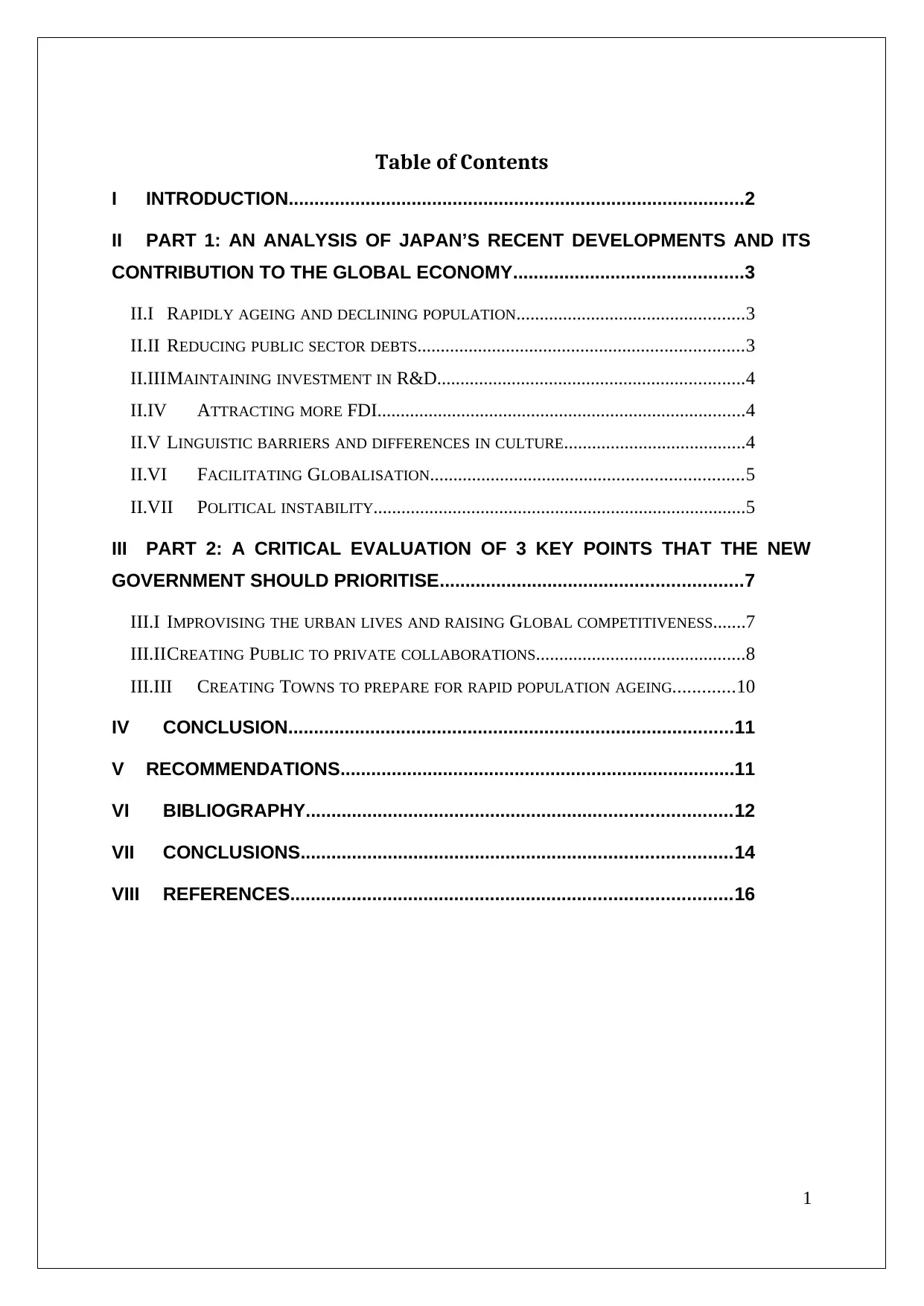
Table of Contents
I INTRODUCTION.........................................................................................2
II PART 1: AN ANALYSIS OF JAPAN’S RECENT DEVELOPMENTS AND ITS
CONTRIBUTION TO THE GLOBAL ECONOMY.............................................3
II.I RAPIDLY AGEING AND DECLINING POPULATION.................................................3
II.II REDUCING PUBLIC SECTOR DEBTS......................................................................3
II.IIIMAINTAINING INVESTMENT IN R&D..................................................................4
II.IV ATTRACTING MORE FDI...............................................................................4
II.V LINGUISTIC BARRIERS AND DIFFERENCES IN CULTURE.......................................4
II.VI FACILITATING GLOBALISATION...................................................................5
II.VII POLITICAL INSTABILITY................................................................................5
III PART 2: A CRITICAL EVALUATION OF 3 KEY POINTS THAT THE NEW
GOVERNMENT SHOULD PRIORITISE...........................................................7
III.I IMPROVISING THE URBAN LIVES AND RAISING GLOBAL COMPETITIVENESS.......7
III.IICREATING PUBLIC TO PRIVATE COLLABORATIONS.............................................8
III.III CREATING TOWNS TO PREPARE FOR RAPID POPULATION AGEING.............10
IV CONCLUSION.......................................................................................11
V RECOMMENDATIONS.............................................................................11
VI BIBLIOGRAPHY...................................................................................12
VII CONCLUSIONS....................................................................................14
VIII REFERENCES......................................................................................16
1
I INTRODUCTION.........................................................................................2
II PART 1: AN ANALYSIS OF JAPAN’S RECENT DEVELOPMENTS AND ITS
CONTRIBUTION TO THE GLOBAL ECONOMY.............................................3
II.I RAPIDLY AGEING AND DECLINING POPULATION.................................................3
II.II REDUCING PUBLIC SECTOR DEBTS......................................................................3
II.IIIMAINTAINING INVESTMENT IN R&D..................................................................4
II.IV ATTRACTING MORE FDI...............................................................................4
II.V LINGUISTIC BARRIERS AND DIFFERENCES IN CULTURE.......................................4
II.VI FACILITATING GLOBALISATION...................................................................5
II.VII POLITICAL INSTABILITY................................................................................5
III PART 2: A CRITICAL EVALUATION OF 3 KEY POINTS THAT THE NEW
GOVERNMENT SHOULD PRIORITISE...........................................................7
III.I IMPROVISING THE URBAN LIVES AND RAISING GLOBAL COMPETITIVENESS.......7
III.IICREATING PUBLIC TO PRIVATE COLLABORATIONS.............................................8
III.III CREATING TOWNS TO PREPARE FOR RAPID POPULATION AGEING.............10
IV CONCLUSION.......................................................................................11
V RECOMMENDATIONS.............................................................................11
VI BIBLIOGRAPHY...................................................................................12
VII CONCLUSIONS....................................................................................14
VIII REFERENCES......................................................................................16
1
⊘ This is a preview!⊘
Do you want full access?
Subscribe today to unlock all pages.

Trusted by 1+ million students worldwide
I INTRODUCTION
The aim of this report is to examine Japan’s recent developments that are contributing in the
Global economy. Global economies are the wide spread of capitalism across the national
boundaries, it refers to the economies that are considered by the different countries in order to
contribute as a single economic system. Such contribution refers the independency that the
country has become in the global market place. The following report will briefly analyse the
recent developments of Japan including the certain points on rapid ageing and declining
population within the country. Such developments attract FDI while influencing the facts to
maintain the research and development in business process. Other factor like instability in
political background and barriers that is faced by the Japan in terms to differences in the
culture plays the part to contribute in global economy. It has also focused on the three major
areas that the new government needs to prioritize depending on the current situation of the
economy in Japan.
2
The aim of this report is to examine Japan’s recent developments that are contributing in the
Global economy. Global economies are the wide spread of capitalism across the national
boundaries, it refers to the economies that are considered by the different countries in order to
contribute as a single economic system. Such contribution refers the independency that the
country has become in the global market place. The following report will briefly analyse the
recent developments of Japan including the certain points on rapid ageing and declining
population within the country. Such developments attract FDI while influencing the facts to
maintain the research and development in business process. Other factor like instability in
political background and barriers that is faced by the Japan in terms to differences in the
culture plays the part to contribute in global economy. It has also focused on the three major
areas that the new government needs to prioritize depending on the current situation of the
economy in Japan.
2
Paraphrase This Document
Need a fresh take? Get an instant paraphrase of this document with our AI Paraphraser
II PART 1: AN ANALYSIS OF JAPAN’S RECENT DEVELOPMENTS AND
ITS CONTRIBUTION TO THE GLOBAL ECONOMY
II.I RAPIDLY AGEING AND DECLINING POPULATION
The population ageing is highly influences the economic growth that is measured by GDP per
capita in Japan (Shirai, 2012). The main reason that is concerned to the growth in aging
population is because of the high life expectancy in Japan. There as it can be identified that
the overall population in Japan is decreasing due to low fertility rates. Such decrease of
young workers has affected the work force in Japan in early 1980’s. The labour market of
Japan has shown the rising pressure in fulfilling the demands for the potential worker. The
younger generation’s group has reduced the quantity and hence affected the economy status
in the Japan. The declining of the working population has shown the impact in the national
economy of the country. The declination of the aged cohorts in the working place might lead
in decreasing economy.
II.II REDUCING PUBLIC SECTOR DEBTS
As Japan is currently achieving the current surplus in the accounts while attracting the capital
inflows into Japan, such current account surplus is used by the public sectors like Volvo to
buy the governments bonds. The country generally does not rely on the finances obtained
from the external means of its public sector debts. The main area of much higher percentage
of Japan’s public sector is done with the domestic means. As the seventy percent of the
finances is held by Bank of Japan and the rest is manipulated by the trusts held by the
Japanese and investment funds. As the private sectors like household and corporate has
hugely shown the contribution on appetite in order to purchase the government bonds has
influenced the domestic savings relatively higher. The interests rates on bonds is clearly low
in Japan hence the payments of interests on the debt is lower. The vulnerability in the global
economy is still there as if the current surplus count diminishes the external surplus will also
diminish with reducing the domestic purchases in the bonds. Lower inflation rate has also
affected the tax in nationwide consumer price (Tachibanaki, 2016).
3
ITS CONTRIBUTION TO THE GLOBAL ECONOMY
II.I RAPIDLY AGEING AND DECLINING POPULATION
The population ageing is highly influences the economic growth that is measured by GDP per
capita in Japan (Shirai, 2012). The main reason that is concerned to the growth in aging
population is because of the high life expectancy in Japan. There as it can be identified that
the overall population in Japan is decreasing due to low fertility rates. Such decrease of
young workers has affected the work force in Japan in early 1980’s. The labour market of
Japan has shown the rising pressure in fulfilling the demands for the potential worker. The
younger generation’s group has reduced the quantity and hence affected the economy status
in the Japan. The declining of the working population has shown the impact in the national
economy of the country. The declination of the aged cohorts in the working place might lead
in decreasing economy.
II.II REDUCING PUBLIC SECTOR DEBTS
As Japan is currently achieving the current surplus in the accounts while attracting the capital
inflows into Japan, such current account surplus is used by the public sectors like Volvo to
buy the governments bonds. The country generally does not rely on the finances obtained
from the external means of its public sector debts. The main area of much higher percentage
of Japan’s public sector is done with the domestic means. As the seventy percent of the
finances is held by Bank of Japan and the rest is manipulated by the trusts held by the
Japanese and investment funds. As the private sectors like household and corporate has
hugely shown the contribution on appetite in order to purchase the government bonds has
influenced the domestic savings relatively higher. The interests rates on bonds is clearly low
in Japan hence the payments of interests on the debt is lower. The vulnerability in the global
economy is still there as if the current surplus count diminishes the external surplus will also
diminish with reducing the domestic purchases in the bonds. Lower inflation rate has also
affected the tax in nationwide consumer price (Tachibanaki, 2016).
3
II.III MAINTAINING INVESTMENT IN R&D
The main factor that has shown the Japan’s Research and developments performance is
strong but shows some declination in certain factors. As per the nature Index 2017 Japan has
termed lower values in the recent performance of research and its investment on it
(Mendenhall et al., 2017). The adoption of the growth strategy by the government has
focused on the economic importance concerning the innovations while aiming to raise the
GDP to 600 trillion Yen and hence increasing the investment in research and development by
4.4 trillion yen. The strategy on adoption of the public or private research and development
investment strategic expansion program (PRISM) stating to establish the academic
partnerships in the research areas is effectively concentrated upon. Turning the society to the
super society is aim selected by PRISM in Japan. Contributions on public demand such as
robotics, artificial intelligence and quantum optics are to be done to puh the cyberspace
qualities with the world.
II.IV ATTRACTING MORE FDI
The main purpose of growth of global direct investment is to increase the liberalizations
within the investment policies and revitalize the publically owned industries in concerning
countries all around globe (Maddison, 2013). The acceptance of Foreign Direct Investment
has effectively promote the economic growth within the country while increasing the capital
investment , production , employment in the industry, imports and exports to other
geographical boundaries. In the concerned case of the country, Japan economy is low as the
labour input and the saving rate has decreasing data in terms to reducing in age of the
population. Therefore the government recognizes the importance of foreign direct investment
in the country to outrage the certain rising issues in the economic growth of the country.
VOLVO has shown high investment in the Japan to manufacture the vehicles that has
effectively shown the certain qualitative aspects of the product and hence influenced the
economic growth (Wakasugi, 2018).
II.V LINGUISTIC BARRIERS AND DIFFERENCES IN CULTURE
4
The main factor that has shown the Japan’s Research and developments performance is
strong but shows some declination in certain factors. As per the nature Index 2017 Japan has
termed lower values in the recent performance of research and its investment on it
(Mendenhall et al., 2017). The adoption of the growth strategy by the government has
focused on the economic importance concerning the innovations while aiming to raise the
GDP to 600 trillion Yen and hence increasing the investment in research and development by
4.4 trillion yen. The strategy on adoption of the public or private research and development
investment strategic expansion program (PRISM) stating to establish the academic
partnerships in the research areas is effectively concentrated upon. Turning the society to the
super society is aim selected by PRISM in Japan. Contributions on public demand such as
robotics, artificial intelligence and quantum optics are to be done to puh the cyberspace
qualities with the world.
II.IV ATTRACTING MORE FDI
The main purpose of growth of global direct investment is to increase the liberalizations
within the investment policies and revitalize the publically owned industries in concerning
countries all around globe (Maddison, 2013). The acceptance of Foreign Direct Investment
has effectively promote the economic growth within the country while increasing the capital
investment , production , employment in the industry, imports and exports to other
geographical boundaries. In the concerned case of the country, Japan economy is low as the
labour input and the saving rate has decreasing data in terms to reducing in age of the
population. Therefore the government recognizes the importance of foreign direct investment
in the country to outrage the certain rising issues in the economic growth of the country.
VOLVO has shown high investment in the Japan to manufacture the vehicles that has
effectively shown the certain qualitative aspects of the product and hence influenced the
economic growth (Wakasugi, 2018).
II.V LINGUISTIC BARRIERS AND DIFFERENCES IN CULTURE
4
⊘ This is a preview!⊘
Do you want full access?
Subscribe today to unlock all pages.
Trusted by 1+ million students worldwide
The main area that highly concentrates to the linguistic barriers obtaining within the Japanese
culture is the language barrier that is created linguistically from Indo- European Languages
that has been identified as the other sources of Japanese creating the miscommunication with
the foreigners (Tenzer et al., 2014). The fact that rises the barrier is most of the foreigners has
issues in learning the language and hence has difficulties to speak Japanese and having poor
command in the language. Such barriers have affected the communication process within the
industries that are regulating in Japan. As such issues have also affected the people in Japan
to the situation where the individuals working in the place is regarded as a different aspect in
view, from the people working around. Such cultural differences lead the misinterpretation of
any instructions and knowledge in the industry hence reflecting the issues within the market
place.
II.VI FACILITATING GLOBALISATION
Globalization generally refers to the dependence on the economic growth that tie up globally
while resulting the cross broader influences in the capital and the work force, Increase in
commodities and the services through the import and export trading and expansion of foreign
investments regulates the fascinating globalization in Japan (Malcolm, 2013). In order to
commute the services across the border to conduct activities and hence increasing the
economic growth it is quit recognizable by the Japan to increase the trading with the Europe
and other countries. But the lack of dynamism in Japan has shown certain factors that lacked
the globalization within the country. Such as the overseas asset management was never been
an option to the households of Japan, interest rates to borrow from the oversees was quite
high and weak corporate sectors in fund demand is seen due to stagnant economic and excess
debt problem, the international activities used to appear dwindling as the sectors are
withdrawing their centres and the domestic investors refraining the capital transactions in
conducting to international bodies.
II.VII POLITICAL INSTABILITY
One of the greatest concerns that effect the economic growth in Japan is the political
instability in Tokyo. As this factor highly stimulates the fact on increase in instability
influences the declining performances in economy (Ward, 2015). Declination of the industrial
5
culture is the language barrier that is created linguistically from Indo- European Languages
that has been identified as the other sources of Japanese creating the miscommunication with
the foreigners (Tenzer et al., 2014). The fact that rises the barrier is most of the foreigners has
issues in learning the language and hence has difficulties to speak Japanese and having poor
command in the language. Such barriers have affected the communication process within the
industries that are regulating in Japan. As such issues have also affected the people in Japan
to the situation where the individuals working in the place is regarded as a different aspect in
view, from the people working around. Such cultural differences lead the misinterpretation of
any instructions and knowledge in the industry hence reflecting the issues within the market
place.
II.VI FACILITATING GLOBALISATION
Globalization generally refers to the dependence on the economic growth that tie up globally
while resulting the cross broader influences in the capital and the work force, Increase in
commodities and the services through the import and export trading and expansion of foreign
investments regulates the fascinating globalization in Japan (Malcolm, 2013). In order to
commute the services across the border to conduct activities and hence increasing the
economic growth it is quit recognizable by the Japan to increase the trading with the Europe
and other countries. But the lack of dynamism in Japan has shown certain factors that lacked
the globalization within the country. Such as the overseas asset management was never been
an option to the households of Japan, interest rates to borrow from the oversees was quite
high and weak corporate sectors in fund demand is seen due to stagnant economic and excess
debt problem, the international activities used to appear dwindling as the sectors are
withdrawing their centres and the domestic investors refraining the capital transactions in
conducting to international bodies.
II.VII POLITICAL INSTABILITY
One of the greatest concerns that effect the economic growth in Japan is the political
instability in Tokyo. As this factor highly stimulates the fact on increase in instability
influences the declining performances in economy (Ward, 2015). Declination of the industrial
5
Paraphrase This Document
Need a fresh take? Get an instant paraphrase of this document with our AI Paraphraser
and manufacturing industries concerning the employments is affected with such instability in
Japan. The scandals concerning to the Abe and Japan has raised the political instability in
higher forms. Political instability generally refers as the propensity of the government
collapse in due times, as per Keiichi Tsunekawa the political scientist noted the average
tenure of Japanese prime minister was 1048 days and declined in next year’s where the 13 of
the 16 prime ministers has served the country in less than two years. Such changing of
governments once a year for approximately the two decades has consistently influenced the
political instability in the country. Scandal on political donations acceptance by the
companies has frequently received by the government subsidies has shown the act against the
laws. Restoring the lustre of Abe’s government has rising questions to establish the political
stability again.
6
Japan. The scandals concerning to the Abe and Japan has raised the political instability in
higher forms. Political instability generally refers as the propensity of the government
collapse in due times, as per Keiichi Tsunekawa the political scientist noted the average
tenure of Japanese prime minister was 1048 days and declined in next year’s where the 13 of
the 16 prime ministers has served the country in less than two years. Such changing of
governments once a year for approximately the two decades has consistently influenced the
political instability in the country. Scandal on political donations acceptance by the
companies has frequently received by the government subsidies has shown the act against the
laws. Restoring the lustre of Abe’s government has rising questions to establish the political
stability again.
6
III PART 2: A CRITICAL EVALUATION OF 3 KEY POINTS THAT THE
NEW GOVERNMENT SHOULD PRIORITISE
Evaluating the three major points that the government of Japan should prioritise are to
improvise the urban lives and raise the global competitiveness of cities in Japan, public to
private collaborations to frame work and foster the new talent and creating towns in order to
prepare for the rapid population ageing (Batini et al., 2012). The concerned points are
critically evaluated below:
III.I IMPROVISING THE URBAN LIVES AND RAISING GLOBAL
COMPETITIVENESS
It is important to understand the factors that the growing industries in urban life and
economic globalisation the government of Japan needs to revitalize the large cities
accordingly to raise the global competiveness globally (Gordon, 2012). It is necessary to
focus on the problems faced by the cities of Japan as declining areas of the local cities and
declination of international competitiveness in large cites. Changing the policies in the urban
development from “restraining urbanization” to lading resources in accumulation is highly
considerable. Building the areas with job efficiency opportunities, housing availability,
education facilities and medical support are necessary corners to be developed by the
government. Promoting the maintenance of the streets and building to create a barrier free
environment is essential to develop and to prepare the population aging measures. To achieve
the objective both the private sectors and the government should act accordingly to increase
the efforts in the improvements. The government should allow the pilot projects that aim to
build future cities in Japan. Evaluating the important corners the following seven areas are
need to be focused on.
It is necessary to be understood the importance of the development in the urban areas
and to work on them accordingly to increase the development plans as a national
projects.
Improvement should be done on the weak zones or the cities that faces the disasters
while changing the congested areas of the places in urban cities to improved
7
NEW GOVERNMENT SHOULD PRIORITISE
Evaluating the three major points that the government of Japan should prioritise are to
improvise the urban lives and raise the global competitiveness of cities in Japan, public to
private collaborations to frame work and foster the new talent and creating towns in order to
prepare for the rapid population ageing (Batini et al., 2012). The concerned points are
critically evaluated below:
III.I IMPROVISING THE URBAN LIVES AND RAISING GLOBAL
COMPETITIVENESS
It is important to understand the factors that the growing industries in urban life and
economic globalisation the government of Japan needs to revitalize the large cities
accordingly to raise the global competiveness globally (Gordon, 2012). It is necessary to
focus on the problems faced by the cities of Japan as declining areas of the local cities and
declination of international competitiveness in large cites. Changing the policies in the urban
development from “restraining urbanization” to lading resources in accumulation is highly
considerable. Building the areas with job efficiency opportunities, housing availability,
education facilities and medical support are necessary corners to be developed by the
government. Promoting the maintenance of the streets and building to create a barrier free
environment is essential to develop and to prepare the population aging measures. To achieve
the objective both the private sectors and the government should act accordingly to increase
the efforts in the improvements. The government should allow the pilot projects that aim to
build future cities in Japan. Evaluating the important corners the following seven areas are
need to be focused on.
It is necessary to be understood the importance of the development in the urban areas
and to work on them accordingly to increase the development plans as a national
projects.
Improvement should be done on the weak zones or the cities that faces the disasters
while changing the congested areas of the places in urban cities to improved
7
⊘ This is a preview!⊘
Do you want full access?
Subscribe today to unlock all pages.
Trusted by 1+ million students worldwide
structures. Measures to be taken in certain areas to improve the earthquake resistance
standards in the affected cities and increasing the expansion of earthquake resistant
structure. Expanding the refugee assistance to clear the concerned areas where the
frequent flood can be seen is need to focus upon.
Shortening the time of Commuting to achieve the comfortable environment in the
urban regions is necessary to be prioritized by the government of Japan. Such as t
promote the building of a houses closer to the areas of business activities shortens the
commuting timings in the process. Designated areas and the executing comprehensive
transportation is to be worked by the cross ministry forces.
Promotion of Pilot projects to form the future cities in Japan is also a concerning a
factor to be propertied. Establishing the committees that can inspect the qualification
of the project should be considered to upraise the standards of the urban development
in the cities of Japan.
Accessibility of international reinforcement for twenty four hours is necessary to
enhance the interaction with foreign countries or the global world. Expansion on the
functions on the Narita Airport and extending the working hours as per the shifts is
important such as the twenty four hour operation at the airport of Haneda.
Automobile linked road facilities and networks in order to increase the connectivity to
the airport and the business areas is necessary to develop the objective.
Constructing the technologically developed equipments to promote the underground
cable and utilizing the opportunities to improvise the landscapes of the cities and
enhance the usage of underground space.
III.II CREATING PUBLIC TO PRIVATE COLLABORATIONS
In the present century it is important to understand the collaboration of public- private
frameworks that utilizes the funds and the human resources to acknowledge the fact owned
by the concerned universities , institutions of public research and the private companies is
need to be created. Introducing the R&D centres in the areas it is necessary to implement the
concerned universities to regulate such research and development pros effectively in the
country (Miyazaki, 2018). Introduction of venture offices in the universities is to be focused
upon in order to bring the synergy within the public and private sectors. Education system
8
standards in the affected cities and increasing the expansion of earthquake resistant
structure. Expanding the refugee assistance to clear the concerned areas where the
frequent flood can be seen is need to focus upon.
Shortening the time of Commuting to achieve the comfortable environment in the
urban regions is necessary to be prioritized by the government of Japan. Such as t
promote the building of a houses closer to the areas of business activities shortens the
commuting timings in the process. Designated areas and the executing comprehensive
transportation is to be worked by the cross ministry forces.
Promotion of Pilot projects to form the future cities in Japan is also a concerning a
factor to be propertied. Establishing the committees that can inspect the qualification
of the project should be considered to upraise the standards of the urban development
in the cities of Japan.
Accessibility of international reinforcement for twenty four hours is necessary to
enhance the interaction with foreign countries or the global world. Expansion on the
functions on the Narita Airport and extending the working hours as per the shifts is
important such as the twenty four hour operation at the airport of Haneda.
Automobile linked road facilities and networks in order to increase the connectivity to
the airport and the business areas is necessary to develop the objective.
Constructing the technologically developed equipments to promote the underground
cable and utilizing the opportunities to improvise the landscapes of the cities and
enhance the usage of underground space.
III.II CREATING PUBLIC TO PRIVATE COLLABORATIONS
In the present century it is important to understand the collaboration of public- private
frameworks that utilizes the funds and the human resources to acknowledge the fact owned
by the concerned universities , institutions of public research and the private companies is
need to be created. Introducing the R&D centres in the areas it is necessary to implement the
concerned universities to regulate such research and development pros effectively in the
country (Miyazaki, 2018). Introduction of venture offices in the universities is to be focused
upon in order to bring the synergy within the public and private sectors. Education system
8
Paraphrase This Document
Need a fresh take? Get an instant paraphrase of this document with our AI Paraphraser
concerning the internet literacy is highly prioritised to influence the R&D effectively in
Japan.
Expansion of the computer education to every individuals in the areas is also important to be
focused as to build the connection with the global world and help to develop the
infrastructure to the people of Japan in cultivating the ability to acknowledge the
information’s and knowledge and express their skills and perception in other foreign
languages. The following five aspects are the areas that promote the collaboration
frameworks that evaluate the priority of the Japan government should concentrate upon.
The government should concentrate on introducing the public universities that can
efficiently be utilized by the public and the private areas in order to enhance the
establishment of the public-private collaborations centres within the universities. Thus
the implementation of PFI is also necessary to operate the functions concerning the
universities. The efficient officers with high knowledge and understanding are to
appointed in such universities and R&D centres.
While reforming the Research and development centres in the local areas such as the
industrial technology institutes, it is important to concentrate on the closeness of the
collaboration centres with the campus concerned. In order to gather the research
resources it is important to build the centres nearby by the government.
Government of Japan should allow the establishment of fund that accumulates from
the fees from the patent and donations in order to activate the activities done in the
research centres is rooted to the local areas. Allowing the centres to freely use the
donations or the funds as pr the requirement to achieve the efficiency is essential.
Increase of the internet literacy is important to be improved in the education levels.
Government should improvise the accessibility in the education system to update the
areas dramatically. Efforts are to be considered in order to connect the schools and
universities with high speed network systems and build the classrooms education
process with introducing the LAN connections in the places.
Government should focus on the expansion on the teaching faculty by increasing the
qualification criteria’s to outsource the knowledge between the learners. An efficient
teacher can contribute the education of computer and foreign languages education.
9
Japan.
Expansion of the computer education to every individuals in the areas is also important to be
focused as to build the connection with the global world and help to develop the
infrastructure to the people of Japan in cultivating the ability to acknowledge the
information’s and knowledge and express their skills and perception in other foreign
languages. The following five aspects are the areas that promote the collaboration
frameworks that evaluate the priority of the Japan government should concentrate upon.
The government should concentrate on introducing the public universities that can
efficiently be utilized by the public and the private areas in order to enhance the
establishment of the public-private collaborations centres within the universities. Thus
the implementation of PFI is also necessary to operate the functions concerning the
universities. The efficient officers with high knowledge and understanding are to
appointed in such universities and R&D centres.
While reforming the Research and development centres in the local areas such as the
industrial technology institutes, it is important to concentrate on the closeness of the
collaboration centres with the campus concerned. In order to gather the research
resources it is important to build the centres nearby by the government.
Government of Japan should allow the establishment of fund that accumulates from
the fees from the patent and donations in order to activate the activities done in the
research centres is rooted to the local areas. Allowing the centres to freely use the
donations or the funds as pr the requirement to achieve the efficiency is essential.
Increase of the internet literacy is important to be improved in the education levels.
Government should improvise the accessibility in the education system to update the
areas dramatically. Efforts are to be considered in order to connect the schools and
universities with high speed network systems and build the classrooms education
process with introducing the LAN connections in the places.
Government should focus on the expansion on the teaching faculty by increasing the
qualification criteria’s to outsource the knowledge between the learners. An efficient
teacher can contribute the education of computer and foreign languages education.
9
III.III CREATING TOWNS TO PREPARE FOR RAPID POPULATION AGEING
The governments need to concentrate upon the creation of towns to prepare the rapid
population ageing affecting the economic stability in the country. It is important to take
necessary measures on constructing the public spaces for the older residence in the country.
The political shift of policy from uniformly minimum welfare to the diversification of the
welfare by the private sectors is to be considered the following five priorities set up is need to
be focused upon by the government of Japan (McDaniel and Zimmer, 2016).
Designing the infrastructures of the concerned developed railway stations , terminals
of bus stations and areas concerning the belonging cities is to be done in the three
dimensions in order to enable the pedestrians to travel and walk in safer environment.
Promoting the travel connectivity within the regions and th town in terms to railaway
connections, departmental stores and medical supportive stores within the towns is to
be developed by the government to enhance the facilities and bring a barrier free
environment to the proposed town development.
Entrance of the public sectors in such spaces is to be allowed by the government in
such regions to enhance the sectors in to welfare of the citizens in certain terms to
increase the efficient labour flow affecting the economic condition within the country.
Contracting with welfare motives with the private sectors to enable the welfare
services to the concerned people of the area meeting their needs.
It is also essential to build the public multipurpose spaces for the welfare of the aging
population in the town. Setting of the travelling means of transports can effectively
reduce the human involvement and smoothens th work process in much more efficient
way.
Aiding the private sectors to avail the concerned residence and homes to be applied as
rent for the elderly peoples is necessary to construct the barrier free residential
support to the people and hence customizing the ability in much more efficient way.
10
The governments need to concentrate upon the creation of towns to prepare the rapid
population ageing affecting the economic stability in the country. It is important to take
necessary measures on constructing the public spaces for the older residence in the country.
The political shift of policy from uniformly minimum welfare to the diversification of the
welfare by the private sectors is to be considered the following five priorities set up is need to
be focused upon by the government of Japan (McDaniel and Zimmer, 2016).
Designing the infrastructures of the concerned developed railway stations , terminals
of bus stations and areas concerning the belonging cities is to be done in the three
dimensions in order to enable the pedestrians to travel and walk in safer environment.
Promoting the travel connectivity within the regions and th town in terms to railaway
connections, departmental stores and medical supportive stores within the towns is to
be developed by the government to enhance the facilities and bring a barrier free
environment to the proposed town development.
Entrance of the public sectors in such spaces is to be allowed by the government in
such regions to enhance the sectors in to welfare of the citizens in certain terms to
increase the efficient labour flow affecting the economic condition within the country.
Contracting with welfare motives with the private sectors to enable the welfare
services to the concerned people of the area meeting their needs.
It is also essential to build the public multipurpose spaces for the welfare of the aging
population in the town. Setting of the travelling means of transports can effectively
reduce the human involvement and smoothens th work process in much more efficient
way.
Aiding the private sectors to avail the concerned residence and homes to be applied as
rent for the elderly peoples is necessary to construct the barrier free residential
support to the people and hence customizing the ability in much more efficient way.
10
⊘ This is a preview!⊘
Do you want full access?
Subscribe today to unlock all pages.
Trusted by 1+ million students worldwide

1 out of 18


Related Documents


Your All-in-One AI-Powered Toolkit for Academic Success.
+13062052269
info@desklib.com
Available 24*7 on WhatsApp / Email
![[object Object]](/_next/static/media/star-bottom.7253800d.svg)
Unlock your academic potential
Copyright © 2020–2026 A2Z Services. All Rights Reserved. Developed and managed by ZUCOL.