Costing Assignment - University of Example - Finance Module
VerifiedAdded on 2022/09/18
|8
|1444
|21
Homework Assignment
AI Summary
This assignment solution addresses key costing concepts, including job order costing, activity-based costing, and process costing, with examples from service and manufacturing industries. It explains the importance of these methods and their differences. The solution also covers cost-volume-profit (CVP) analysis, demonstrating how changes in advertising expenses and contribution margin ratios affect operating income. The document analyzes a scenario where increased advertising expenses lead to higher sales, evaluating the financial implications based on different contribution margin ratios. The assignment further differentiates between job costing and process costing, detailing their applications and suitability in various industrial settings.
0COSTING
COSTING
Name of Student
Name of University
Author notes
COSTING
Name of Student
Name of University
Author notes
Paraphrase This Document
Need a fresh take? Get an instant paraphrase of this document with our AI Paraphraser

1COSTING
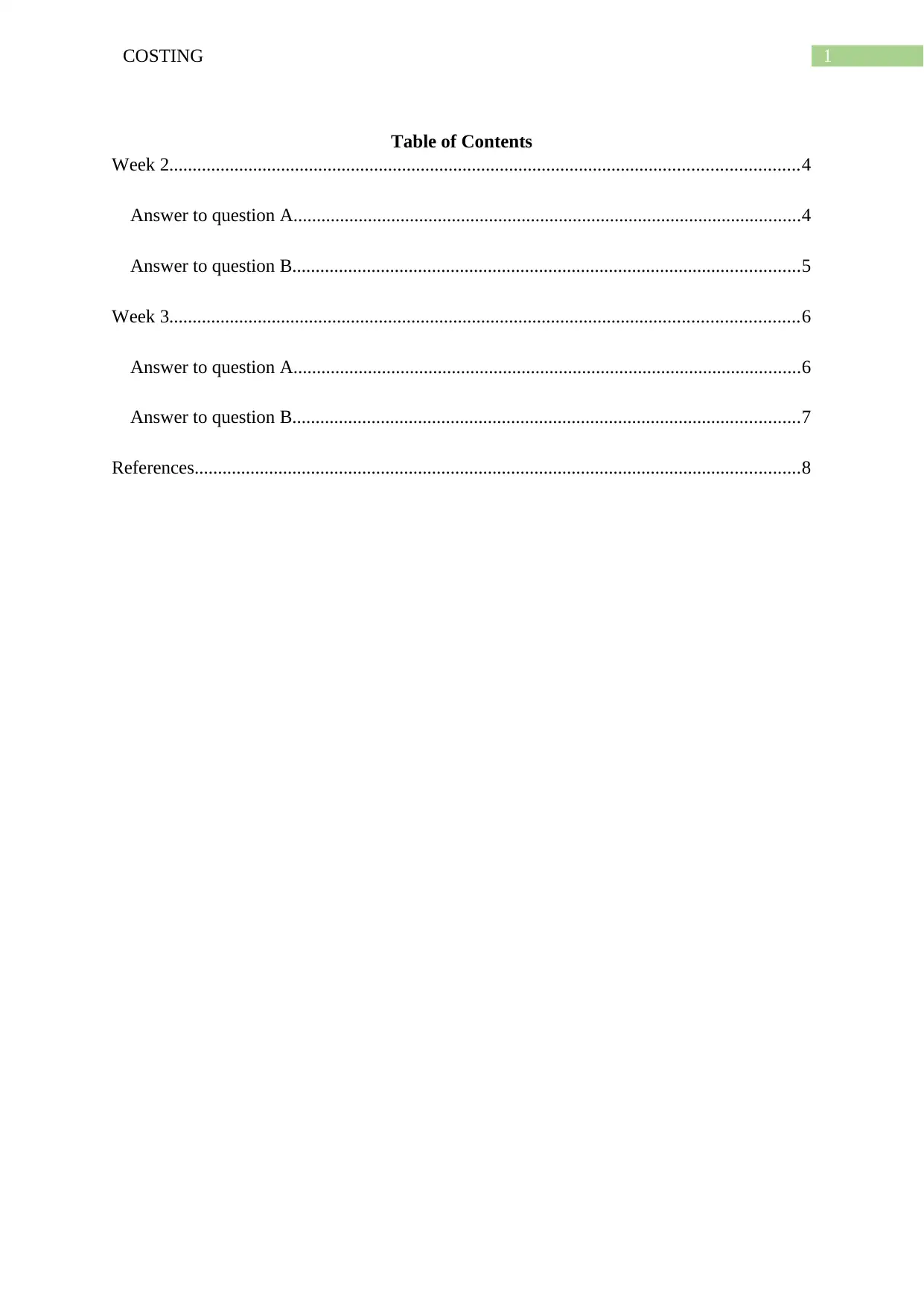
Table of Contents
Week 2.......................................................................................................................................4
Answer to question A.............................................................................................................4
Answer to question B.............................................................................................................5
Week 3.......................................................................................................................................6
Answer to question A.............................................................................................................6
Answer to question B.............................................................................................................7
References..................................................................................................................................8
Table of Contents
Week 2.......................................................................................................................................4
Answer to question A.............................................................................................................4
Answer to question B.............................................................................................................5
Week 3.......................................................................................................................................6
Answer to question A.............................................................................................................6
Answer to question B.............................................................................................................7
References..................................................................................................................................8

2COSTING
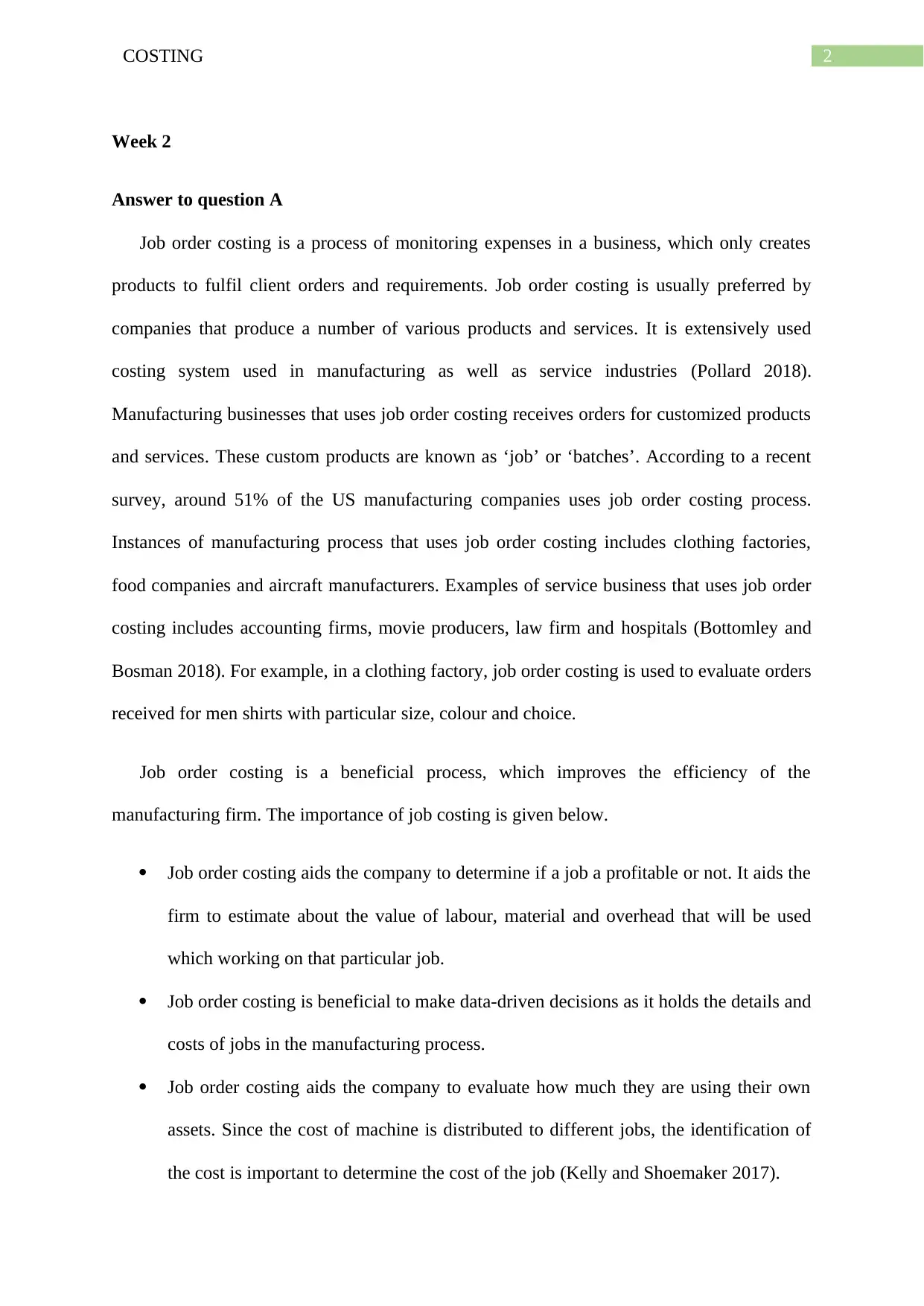
Week 2
Answer to question A
Job order costing is a process of monitoring expenses in a business, which only creates
products to fulfil client orders and requirements. Job order costing is usually preferred by
companies that produce a number of various products and services. It is extensively used
costing system used in manufacturing as well as service industries (Pollard 2018).
Manufacturing businesses that uses job order costing receives orders for customized products
and services. These custom products are known as ‘job’ or ‘batches’. According to a recent
survey, around 51% of the US manufacturing companies uses job order costing process.
Instances of manufacturing process that uses job order costing includes clothing factories,
food companies and aircraft manufacturers. Examples of service business that uses job order
costing includes accounting firms, movie producers, law firm and hospitals (Bottomley and
Bosman 2018). For example, in a clothing factory, job order costing is used to evaluate orders
received for men shirts with particular size, colour and choice.
Job order costing is a beneficial process, which improves the efficiency of the
manufacturing firm. The importance of job costing is given below.
Job order costing aids the company to determine if a job a profitable or not. It aids the
firm to estimate about the value of labour, material and overhead that will be used
which working on that particular job.
Job order costing is beneficial to make data-driven decisions as it holds the details and
costs of jobs in the manufacturing process.
Job order costing aids the company to evaluate how much they are using their own
assets. Since the cost of machine is distributed to different jobs, the identification of
the cost is important to determine the cost of the job (Kelly and Shoemaker 2017).
Week 2
Answer to question A
Job order costing is a process of monitoring expenses in a business, which only creates
products to fulfil client orders and requirements. Job order costing is usually preferred by
companies that produce a number of various products and services. It is extensively used
costing system used in manufacturing as well as service industries (Pollard 2018).
Manufacturing businesses that uses job order costing receives orders for customized products
and services. These custom products are known as ‘job’ or ‘batches’. According to a recent
survey, around 51% of the US manufacturing companies uses job order costing process.
Instances of manufacturing process that uses job order costing includes clothing factories,
food companies and aircraft manufacturers. Examples of service business that uses job order
costing includes accounting firms, movie producers, law firm and hospitals (Bottomley and
Bosman 2018). For example, in a clothing factory, job order costing is used to evaluate orders
received for men shirts with particular size, colour and choice.
Job order costing is a beneficial process, which improves the efficiency of the
manufacturing firm. The importance of job costing is given below.
Job order costing aids the company to determine if a job a profitable or not. It aids the
firm to estimate about the value of labour, material and overhead that will be used
which working on that particular job.
Job order costing is beneficial to make data-driven decisions as it holds the details and
costs of jobs in the manufacturing process.
Job order costing aids the company to evaluate how much they are using their own
assets. Since the cost of machine is distributed to different jobs, the identification of
the cost is important to determine the cost of the job (Kelly and Shoemaker 2017).
⊘ This is a preview!⊘
Do you want full access?
Subscribe today to unlock all pages.

Trusted by 1+ million students worldwide

3COSTING
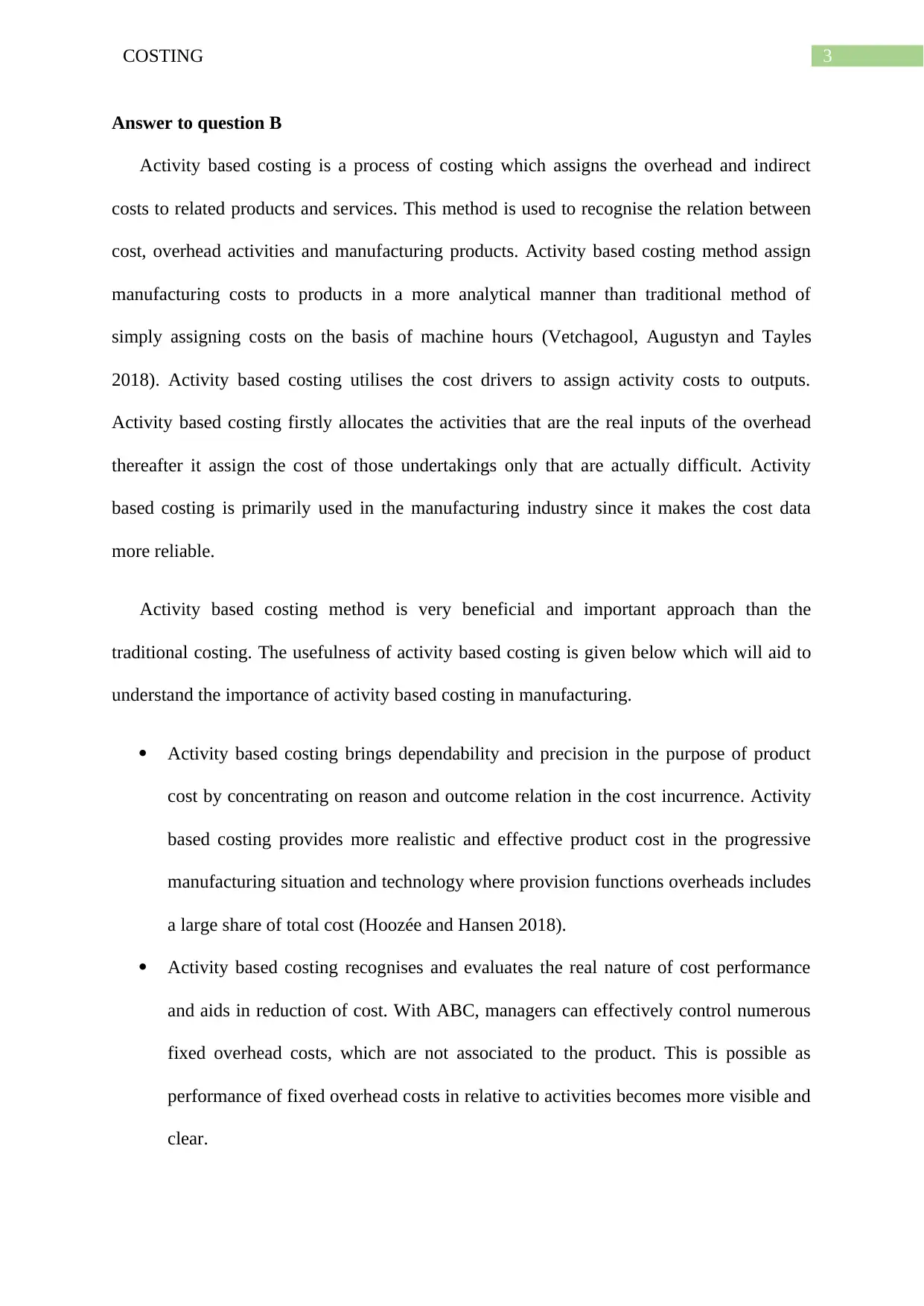
Answer to question B
Activity based costing is a process of costing which assigns the overhead and indirect
costs to related products and services. This method is used to recognise the relation between
cost, overhead activities and manufacturing products. Activity based costing method assign
manufacturing costs to products in a more analytical manner than traditional method of
simply assigning costs on the basis of machine hours (Vetchagool, Augustyn and Tayles
2018). Activity based costing utilises the cost drivers to assign activity costs to outputs.
Activity based costing firstly allocates the activities that are the real inputs of the overhead
thereafter it assign the cost of those undertakings only that are actually difficult. Activity
based costing is primarily used in the manufacturing industry since it makes the cost data
more reliable.
Activity based costing method is very beneficial and important approach than the
traditional costing. The usefulness of activity based costing is given below which will aid to
understand the importance of activity based costing in manufacturing.
Activity based costing brings dependability and precision in the purpose of product
cost by concentrating on reason and outcome relation in the cost incurrence. Activity
based costing provides more realistic and effective product cost in the progressive
manufacturing situation and technology where provision functions overheads includes
a large share of total cost (Hoozée and Hansen 2018).
Activity based costing recognises and evaluates the real nature of cost performance
and aids in reduction of cost. With ABC, managers can effectively control numerous
fixed overhead costs, which are not associated to the product. This is possible as
performance of fixed overhead costs in relative to activities becomes more visible and
clear.
Answer to question B
Activity based costing is a process of costing which assigns the overhead and indirect
costs to related products and services. This method is used to recognise the relation between
cost, overhead activities and manufacturing products. Activity based costing method assign
manufacturing costs to products in a more analytical manner than traditional method of
simply assigning costs on the basis of machine hours (Vetchagool, Augustyn and Tayles
2018). Activity based costing utilises the cost drivers to assign activity costs to outputs.
Activity based costing firstly allocates the activities that are the real inputs of the overhead
thereafter it assign the cost of those undertakings only that are actually difficult. Activity
based costing is primarily used in the manufacturing industry since it makes the cost data
more reliable.
Activity based costing method is very beneficial and important approach than the
traditional costing. The usefulness of activity based costing is given below which will aid to
understand the importance of activity based costing in manufacturing.
Activity based costing brings dependability and precision in the purpose of product
cost by concentrating on reason and outcome relation in the cost incurrence. Activity
based costing provides more realistic and effective product cost in the progressive
manufacturing situation and technology where provision functions overheads includes
a large share of total cost (Hoozée and Hansen 2018).
Activity based costing recognises and evaluates the real nature of cost performance
and aids in reduction of cost. With ABC, managers can effectively control numerous
fixed overhead costs, which are not associated to the product. This is possible as
performance of fixed overhead costs in relative to activities becomes more visible and
clear.
Paraphrase This Document
Need a fresh take? Get an instant paraphrase of this document with our AI Paraphraser

4COSTING
Activity based costing uses several cost drivers that are transaction based other than
volume based. Activity based costing is concerned with all activities in and outside of
the factory to trace overhead and products.
Activity based costing delivers cost driver rates and info on transactional volumes
which are very beneficial to management of an organisation. Management can use
this information for better cost management and performance assessment of
accountability centres (Langfield-Smith et.al 2017).
Week 3
Answer to question A
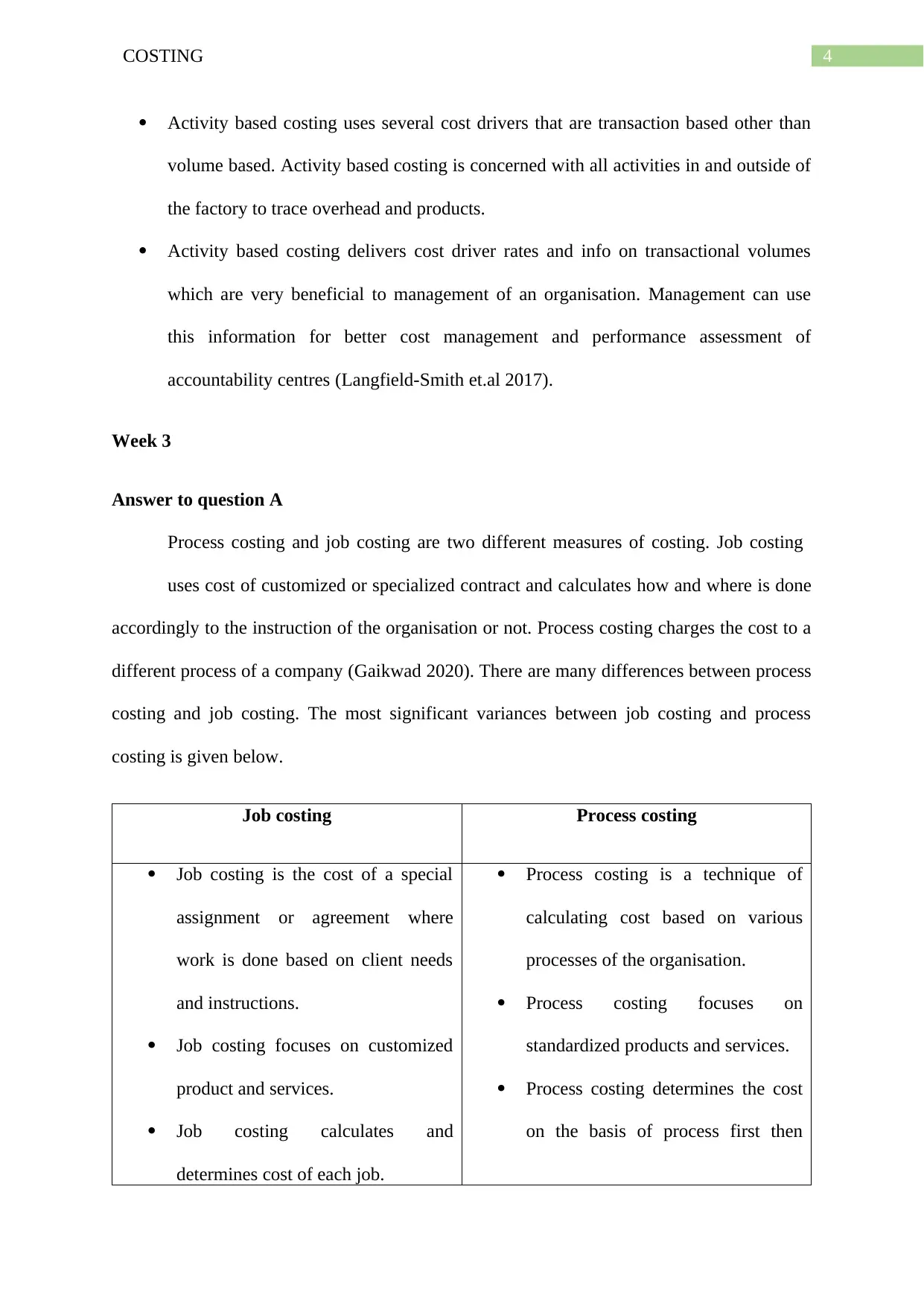
Process costing and job costing are two different measures of costing. Job costing
uses cost of customized or specialized contract and calculates how and where is done
accordingly to the instruction of the organisation or not. Process costing charges the cost to a
different process of a company (Gaikwad 2020). There are many differences between process
costing and job costing. The most significant variances between job costing and process
costing is given below.
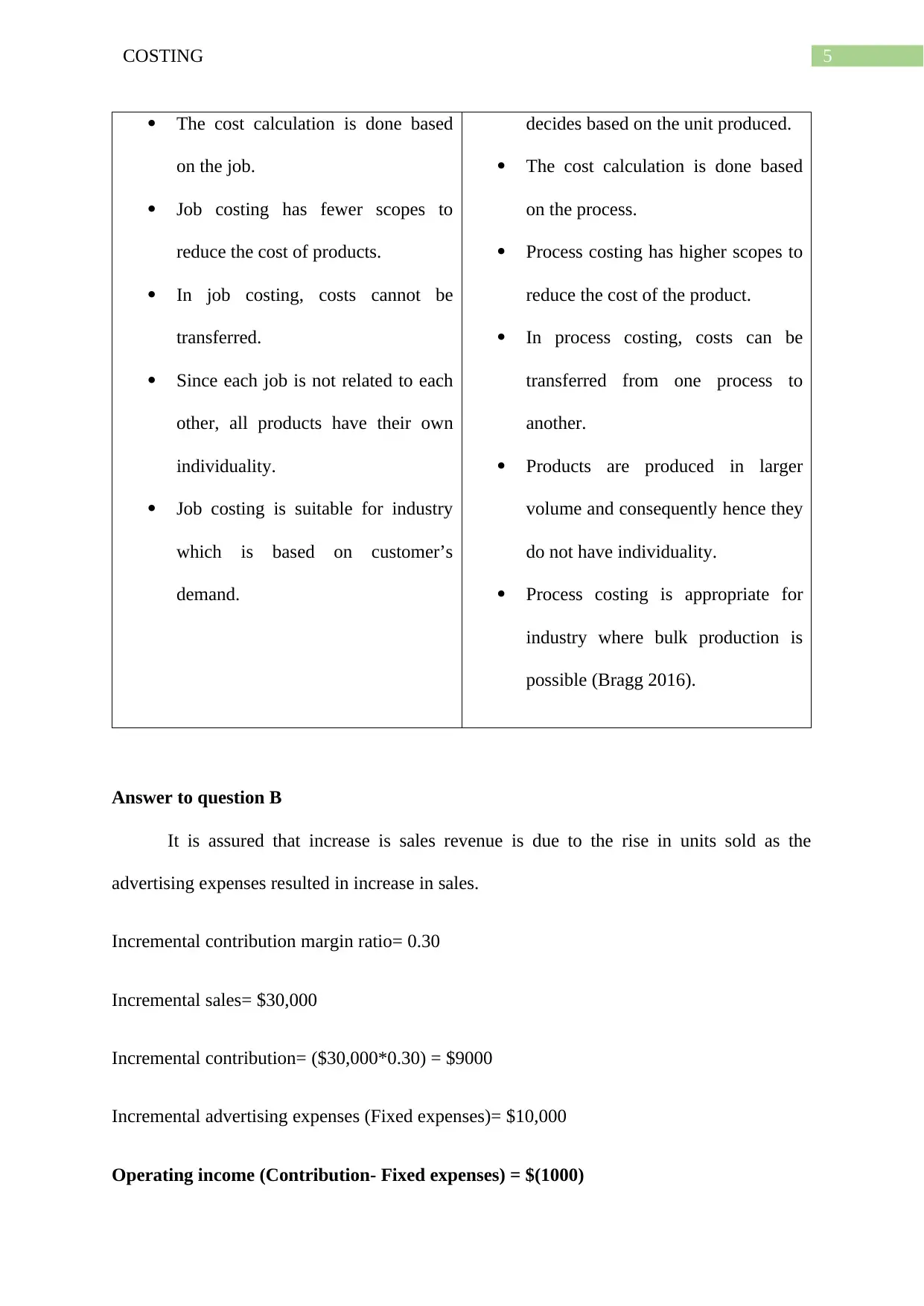
Job costing Process costing
Job costing is the cost of a special
assignment or agreement where
work is done based on client needs
and instructions.
Job costing focuses on customized
product and services.
Job costing calculates and
determines cost of each job.
Process costing is a technique of
calculating cost based on various
processes of the organisation.
Process costing focuses on
standardized products and services.
Process costing determines the cost
on the basis of process first then
Activity based costing uses several cost drivers that are transaction based other than
volume based. Activity based costing is concerned with all activities in and outside of
the factory to trace overhead and products.
Activity based costing delivers cost driver rates and info on transactional volumes
which are very beneficial to management of an organisation. Management can use
this information for better cost management and performance assessment of
accountability centres (Langfield-Smith et.al 2017).
Week 3
Answer to question A
Process costing and job costing are two different measures of costing. Job costing
uses cost of customized or specialized contract and calculates how and where is done
accordingly to the instruction of the organisation or not. Process costing charges the cost to a
different process of a company (Gaikwad 2020). There are many differences between process
costing and job costing. The most significant variances between job costing and process
costing is given below.
Job costing Process costing
Job costing is the cost of a special
assignment or agreement where
work is done based on client needs
and instructions.
Job costing focuses on customized
product and services.
Job costing calculates and
determines cost of each job.
Process costing is a technique of
calculating cost based on various
processes of the organisation.
Process costing focuses on
standardized products and services.
Process costing determines the cost
on the basis of process first then

5COSTING
The cost calculation is done based
on the job.
Job costing has fewer scopes to
reduce the cost of products.
In job costing, costs cannot be
transferred.
Since each job is not related to each
other, all products have their own
individuality.
Job costing is suitable for industry
which is based on customer’s
demand.
decides based on the unit produced.
The cost calculation is done based
on the process.
Process costing has higher scopes to
reduce the cost of the product.
In process costing, costs can be
transferred from one process to
another.
Products are produced in larger
volume and consequently hence they
do not have individuality.
Process costing is appropriate for
industry where bulk production is
possible (Bragg 2016).
Answer to question B
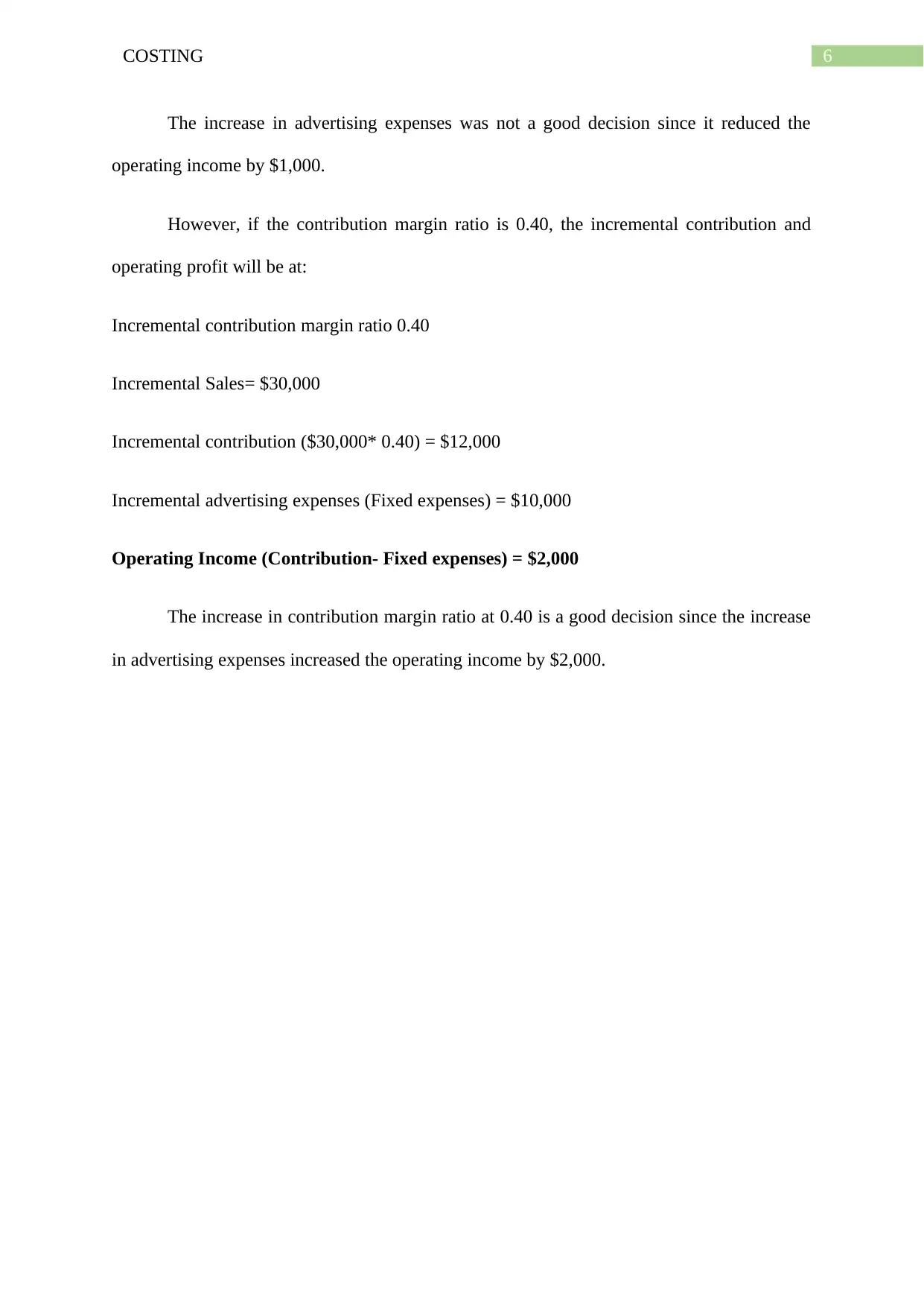
It is assured that increase is sales revenue is due to the rise in units sold as the
advertising expenses resulted in increase in sales.
Incremental contribution margin ratio= 0.30
Incremental sales= $30,000
Incremental contribution= ($30,000*0.30) = $9000
Incremental advertising expenses (Fixed expenses)= $10,000
Operating income (Contribution- Fixed expenses) = $(1000)
The cost calculation is done based
on the job.
Job costing has fewer scopes to
reduce the cost of products.
In job costing, costs cannot be
transferred.
Since each job is not related to each
other, all products have their own
individuality.
Job costing is suitable for industry
which is based on customer’s
demand.
decides based on the unit produced.
The cost calculation is done based
on the process.
Process costing has higher scopes to
reduce the cost of the product.
In process costing, costs can be
transferred from one process to
another.
Products are produced in larger
volume and consequently hence they
do not have individuality.
Process costing is appropriate for
industry where bulk production is
possible (Bragg 2016).
Answer to question B
It is assured that increase is sales revenue is due to the rise in units sold as the
advertising expenses resulted in increase in sales.
Incremental contribution margin ratio= 0.30
Incremental sales= $30,000
Incremental contribution= ($30,000*0.30) = $9000
Incremental advertising expenses (Fixed expenses)= $10,000
Operating income (Contribution- Fixed expenses) = $(1000)
⊘ This is a preview!⊘
Do you want full access?
Subscribe today to unlock all pages.

Trusted by 1+ million students worldwide

6COSTING
The increase in advertising expenses was not a good decision since it reduced the
operating income by $1,000.
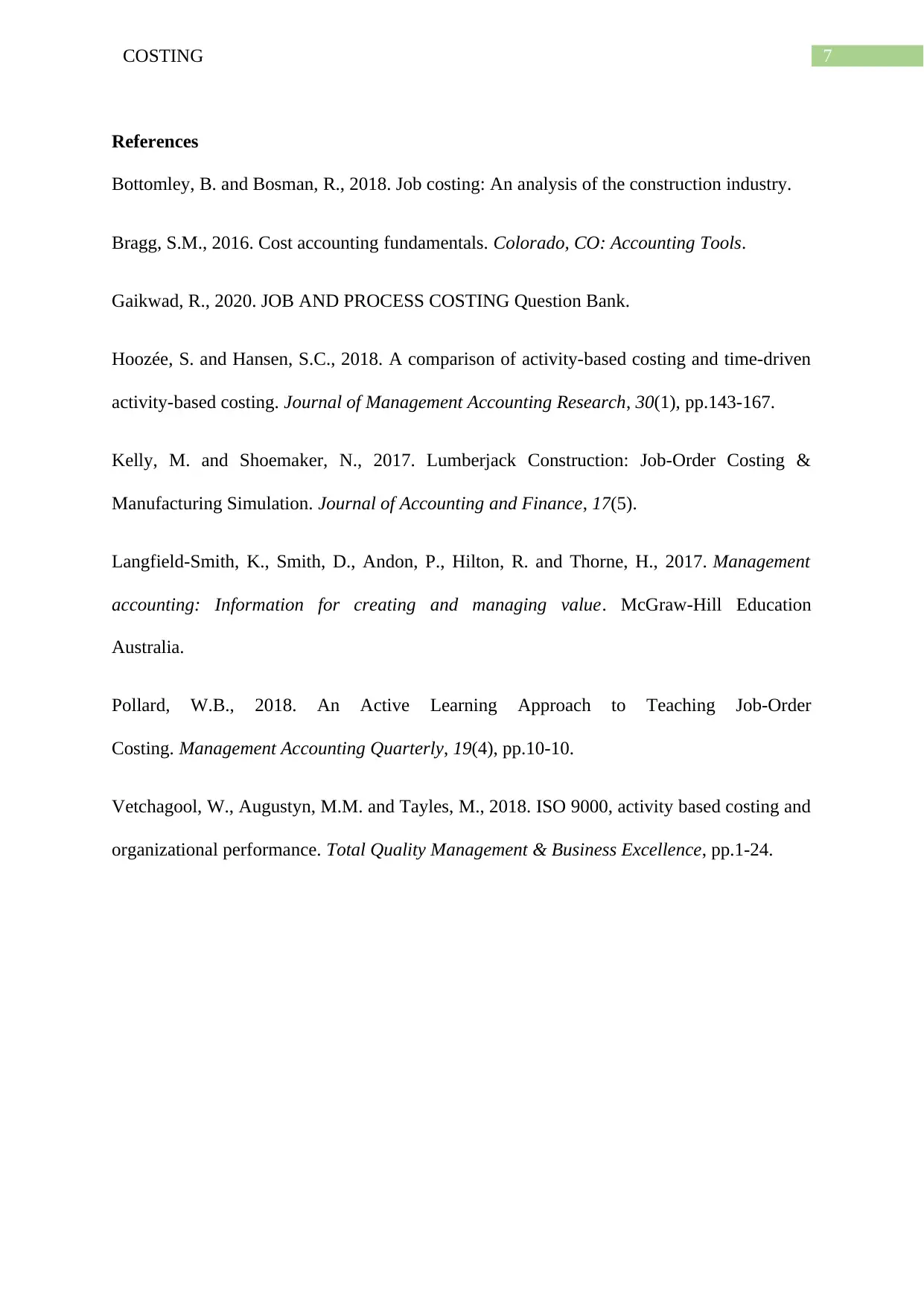
However, if the contribution margin ratio is 0.40, the incremental contribution and
operating profit will be at:
Incremental contribution margin ratio 0.40
Incremental Sales= $30,000
Incremental contribution ($30,000* 0.40) = $12,000
Incremental advertising expenses (Fixed expenses) = $10,000
Operating Income (Contribution- Fixed expenses) = $2,000
The increase in contribution margin ratio at 0.40 is a good decision since the increase
in advertising expenses increased the operating income by $2,000.
The increase in advertising expenses was not a good decision since it reduced the
operating income by $1,000.
However, if the contribution margin ratio is 0.40, the incremental contribution and
operating profit will be at:
Incremental contribution margin ratio 0.40
Incremental Sales= $30,000
Incremental contribution ($30,000* 0.40) = $12,000
Incremental advertising expenses (Fixed expenses) = $10,000
Operating Income (Contribution- Fixed expenses) = $2,000
The increase in contribution margin ratio at 0.40 is a good decision since the increase
in advertising expenses increased the operating income by $2,000.
Paraphrase This Document
Need a fresh take? Get an instant paraphrase of this document with our AI Paraphraser

7COSTING
References
Bottomley, B. and Bosman, R., 2018. Job costing: An analysis of the construction industry.
Bragg, S.M., 2016. Cost accounting fundamentals. Colorado, CO: Accounting Tools.
Gaikwad, R., 2020. JOB AND PROCESS COSTING Question Bank.
Hoozée, S. and Hansen, S.C., 2018. A comparison of activity-based costing and time-driven
activity-based costing. Journal of Management Accounting Research, 30(1), pp.143-167.
Kelly, M. and Shoemaker, N., 2017. Lumberjack Construction: Job-Order Costing &
Manufacturing Simulation. Journal of Accounting and Finance, 17(5).
Langfield-Smith, K., Smith, D., Andon, P., Hilton, R. and Thorne, H., 2017. Management
accounting: Information for creating and managing value. McGraw-Hill Education
Australia.
Pollard, W.B., 2018. An Active Learning Approach to Teaching Job-Order
Costing. Management Accounting Quarterly, 19(4), pp.10-10.
Vetchagool, W., Augustyn, M.M. and Tayles, M., 2018. ISO 9000, activity based costing and
organizational performance. Total Quality Management & Business Excellence, pp.1-24.
References
Bottomley, B. and Bosman, R., 2018. Job costing: An analysis of the construction industry.
Bragg, S.M., 2016. Cost accounting fundamentals. Colorado, CO: Accounting Tools.
Gaikwad, R., 2020. JOB AND PROCESS COSTING Question Bank.
Hoozée, S. and Hansen, S.C., 2018. A comparison of activity-based costing and time-driven
activity-based costing. Journal of Management Accounting Research, 30(1), pp.143-167.
Kelly, M. and Shoemaker, N., 2017. Lumberjack Construction: Job-Order Costing &
Manufacturing Simulation. Journal of Accounting and Finance, 17(5).
Langfield-Smith, K., Smith, D., Andon, P., Hilton, R. and Thorne, H., 2017. Management
accounting: Information for creating and managing value. McGraw-Hill Education
Australia.
Pollard, W.B., 2018. An Active Learning Approach to Teaching Job-Order
Costing. Management Accounting Quarterly, 19(4), pp.10-10.
Vetchagool, W., Augustyn, M.M. and Tayles, M., 2018. ISO 9000, activity based costing and
organizational performance. Total Quality Management & Business Excellence, pp.1-24.
1 out of 8
Related Documents
Your All-in-One AI-Powered Toolkit for Academic Success.
+13062052269
info@desklib.com
Available 24*7 on WhatsApp / Email
Unlock your academic potential
Copyright © 2020–2026 A2Z Services. All Rights Reserved. Developed and managed by ZUCOL.