Allocation of Joint Costs and Decision Making on Product Processing
VerifiedAdded on 2023/05/30
|17
|2120
|433
Homework Assignment
AI Summary
This assignment solution delves into the intricacies of joint cost allocation, a crucial aspect of cost accounting and financial decision-making. It explores various methods for allocating joint costs, including the sales value at split-off point, physical measure, and constant gross margin percentage of net realizable value (NRV) methods. The solution provides detailed calculations and examples for each method, illustrating how joint costs are distributed among joint products. Furthermore, the assignment examines how these cost allocation methods influence decisions regarding the further processing of joint products, analyzing incremental revenues, costs, and net benefits to determine the profitability of additional processing. The solution also provides decision-making on whether to process raw coal or not, considering incremental revenue, costs, and the impact of coal fines, and the analysis includes working notes for all calculations and concludes that joint cost allocation plays a major role in the decision-making process of an entity.
Assignment on the Allocation
Of Joint Cost Allocation &
Decision making on
The further processing
Of Joint product
Prepared By
Student Name:
Student ID:
1
Of Joint Cost Allocation &
Decision making on
The further processing
Of Joint product
Prepared By
Student Name:
Student ID:
1
Paraphrase This Document
Need a fresh take? Get an instant paraphrase of this document with our AI Paraphraser

Executive Summary
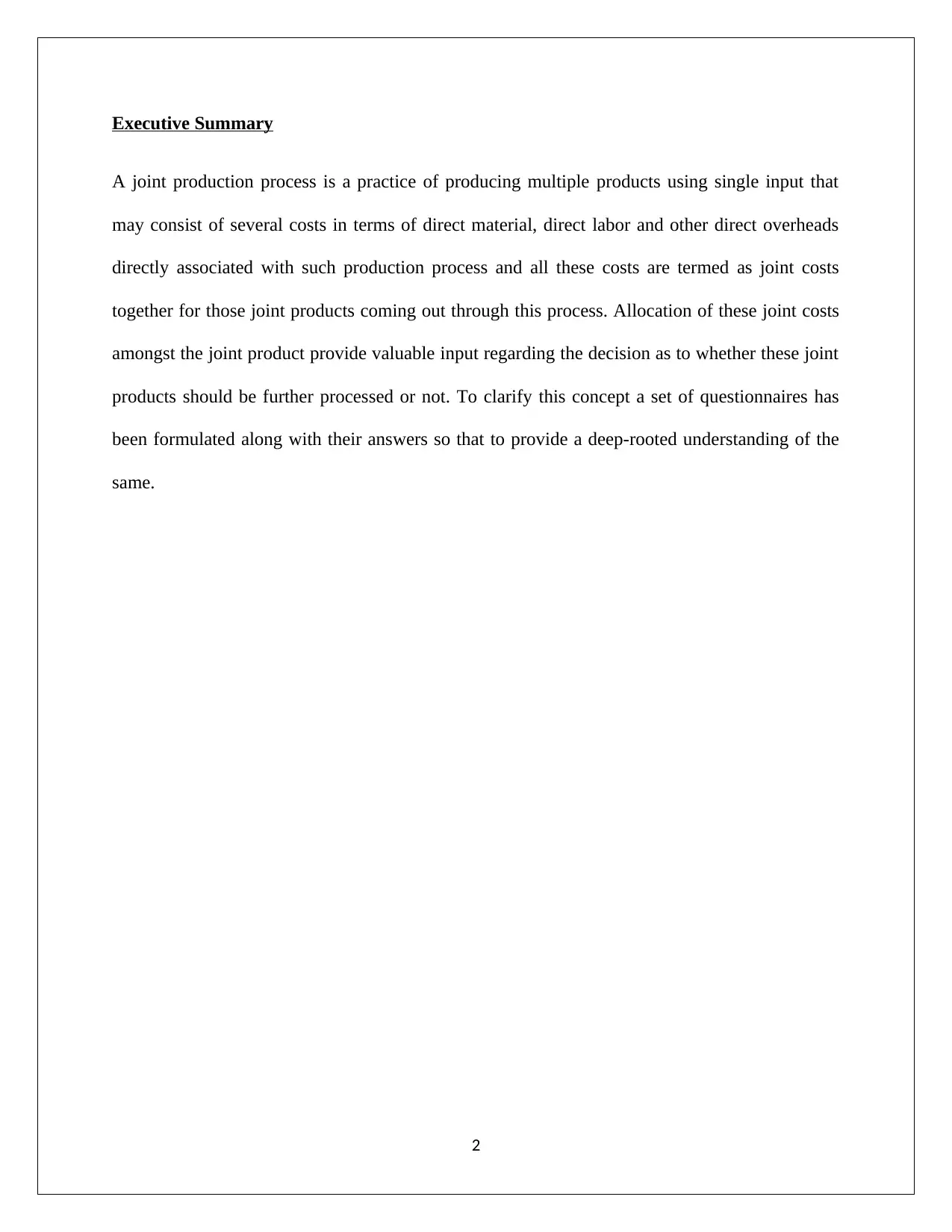
A joint production process is a practice of producing multiple products using single input that
may consist of several costs in terms of direct material, direct labor and other direct overheads
directly associated with such production process and all these costs are termed as joint costs
together for those joint products coming out through this process. Allocation of these joint costs
amongst the joint product provide valuable input regarding the decision as to whether these joint
products should be further processed or not. To clarify this concept a set of questionnaires has
been formulated along with their answers so that to provide a deep-rooted understanding of the
same.
2
A joint production process is a practice of producing multiple products using single input that
may consist of several costs in terms of direct material, direct labor and other direct overheads
directly associated with such production process and all these costs are termed as joint costs
together for those joint products coming out through this process. Allocation of these joint costs
amongst the joint product provide valuable input regarding the decision as to whether these joint
products should be further processed or not. To clarify this concept a set of questionnaires has
been formulated along with their answers so that to provide a deep-rooted understanding of the
same.
2

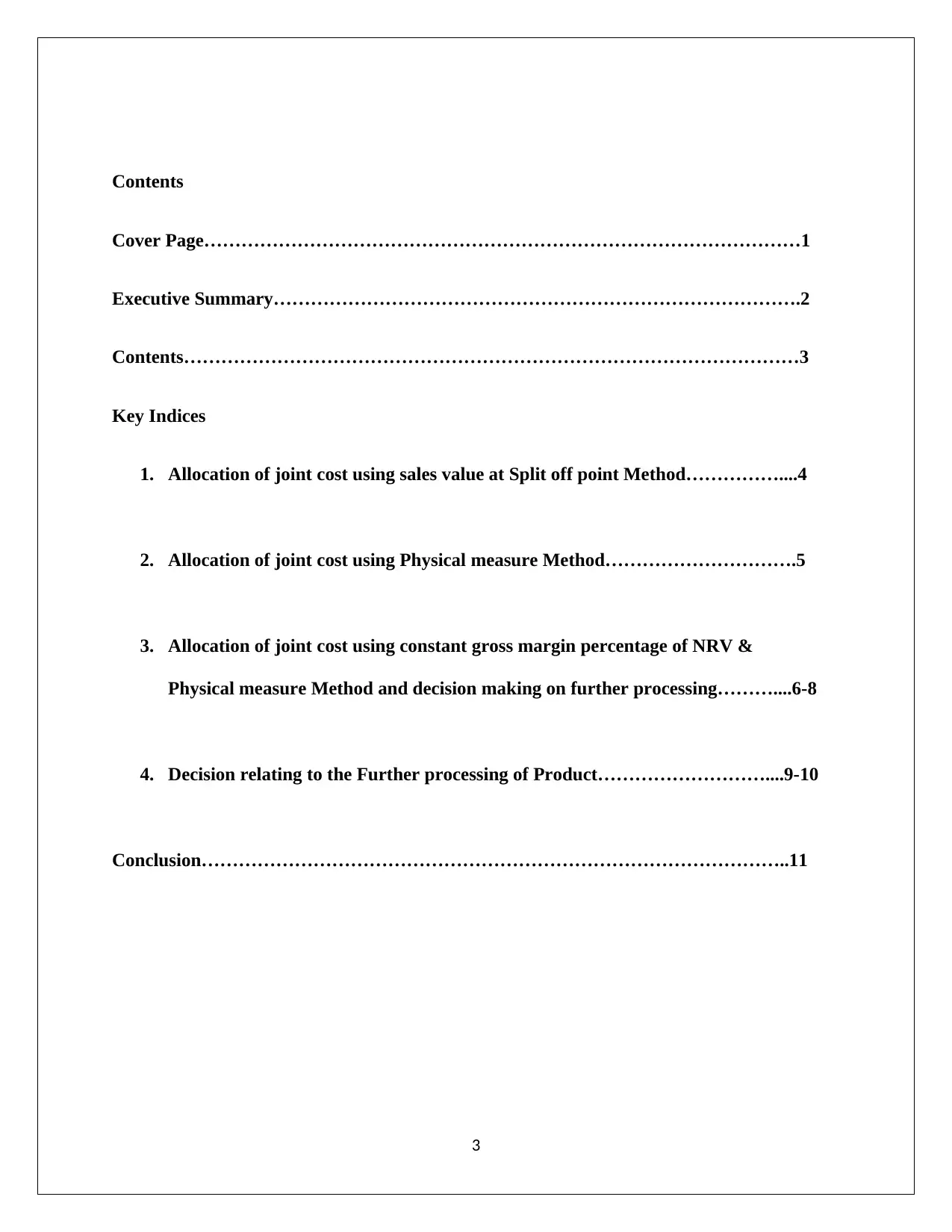
Contents
Cover Page……………………………………………………………………………………1
Executive Summary………………………………………………………………………….2
Contents………………………………………………………………………………………3
Key Indices
1. Allocation of joint cost using sales value at Split off point Method……………....4
2. Allocation of joint cost using Physical measure Method………………………….5
3. Allocation of joint cost using constant gross margin percentage of NRV &
Physical measure Method and decision making on further processing………....6-8
4. Decision relating to the Further processing of Product………………………....9-10
Conclusion…………………………………………………………………………………..11
3
Cover Page……………………………………………………………………………………1
Executive Summary………………………………………………………………………….2
Contents………………………………………………………………………………………3
Key Indices
1. Allocation of joint cost using sales value at Split off point Method……………....4
2. Allocation of joint cost using Physical measure Method………………………….5
3. Allocation of joint cost using constant gross margin percentage of NRV &
Physical measure Method and decision making on further processing………....6-8
4. Decision relating to the Further processing of Product………………………....9-10
Conclusion…………………………………………………………………………………..11
3
⊘ This is a preview!⊘
Do you want full access?
Subscribe today to unlock all pages.

Trusted by 1+ million students worldwide

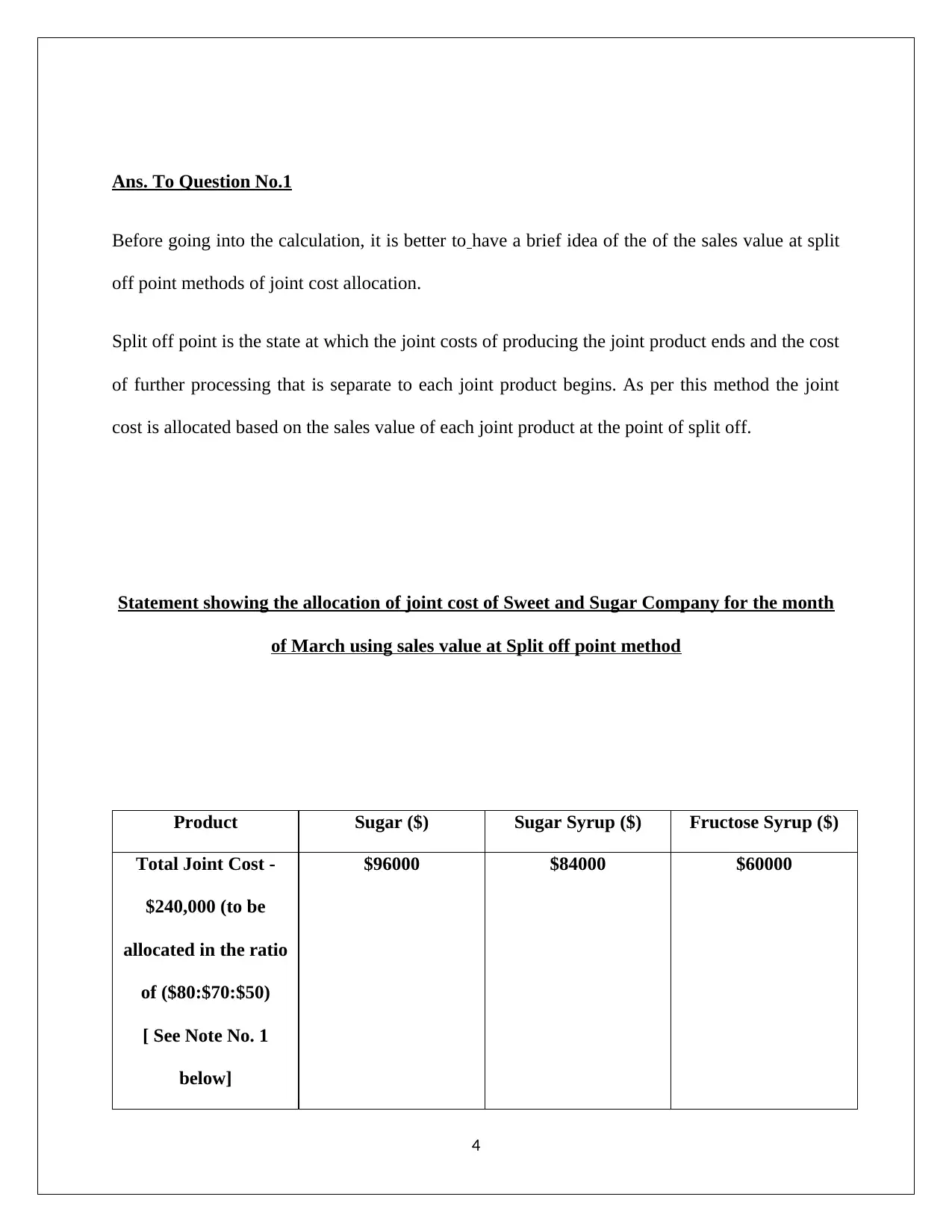
Ans. To Question No.1
Before going into the calculation, it is better to have a brief idea of the of the sales value at split
off point methods of joint cost allocation.
Split off point is the state at which the joint costs of producing the joint product ends and the cost
of further processing that is separate to each joint product begins. As per this method the joint
cost is allocated based on the sales value of each joint product at the point of split off.
Statement showing the allocation of joint cost of Sweet and Sugar Company for the month
of March using sales value at Split off point method
Product Sugar ($) Sugar Syrup ($) Fructose Syrup ($)
Total Joint Cost -
$240,000 (to be
allocated in the ratio
of ($80:$70:$50)
[ See Note No. 1
below]
$96000 $84000 $60000
4
Before going into the calculation, it is better to have a brief idea of the of the sales value at split
off point methods of joint cost allocation.
Split off point is the state at which the joint costs of producing the joint product ends and the cost
of further processing that is separate to each joint product begins. As per this method the joint
cost is allocated based on the sales value of each joint product at the point of split off.
Statement showing the allocation of joint cost of Sweet and Sugar Company for the month
of March using sales value at Split off point method
Product Sugar ($) Sugar Syrup ($) Fructose Syrup ($)
Total Joint Cost -
$240,000 (to be
allocated in the ratio
of ($80:$70:$50)
[ See Note No. 1
below]
$96000 $84000 $60000
4
Paraphrase This Document
Need a fresh take? Get an instant paraphrase of this document with our AI Paraphraser

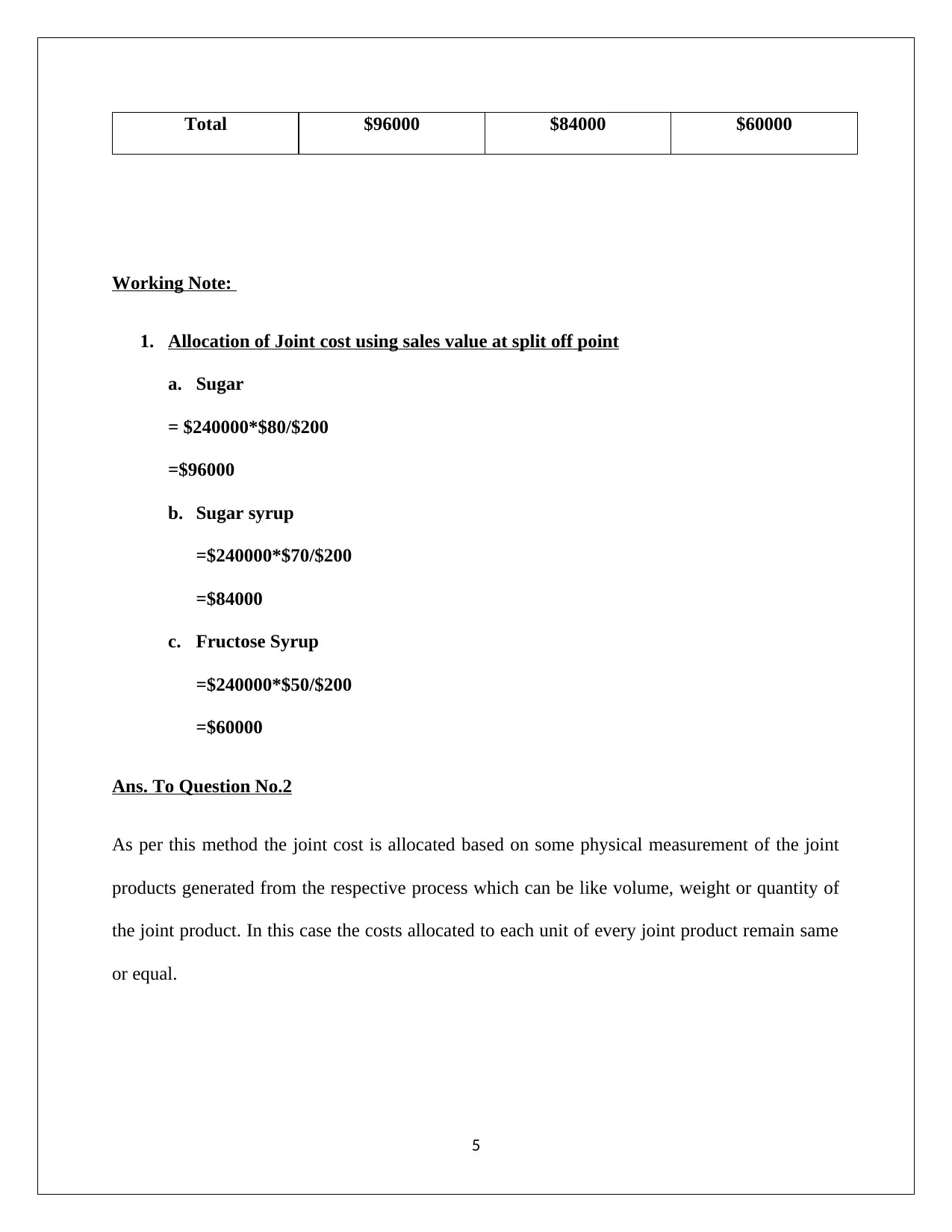
Total $96000 $84000 $60000
Working Note:
1. Allocation of Joint cost using sales value at split off point
a. Sugar
= $240000*$80/$200
=$96000
b. Sugar syrup
=$240000*$70/$200
=$84000
c. Fructose Syrup
=$240000*$50/$200
=$60000
Ans. To Question No.2
As per this method the joint cost is allocated based on some physical measurement of the joint
products generated from the respective process which can be like volume, weight or quantity of
the joint product. In this case the costs allocated to each unit of every joint product remain same
or equal.
5
Working Note:
1. Allocation of Joint cost using sales value at split off point
a. Sugar
= $240000*$80/$200
=$96000
b. Sugar syrup
=$240000*$70/$200
=$84000
c. Fructose Syrup
=$240000*$50/$200
=$60000
Ans. To Question No.2
As per this method the joint cost is allocated based on some physical measurement of the joint
products generated from the respective process which can be like volume, weight or quantity of
the joint product. In this case the costs allocated to each unit of every joint product remain same
or equal.
5

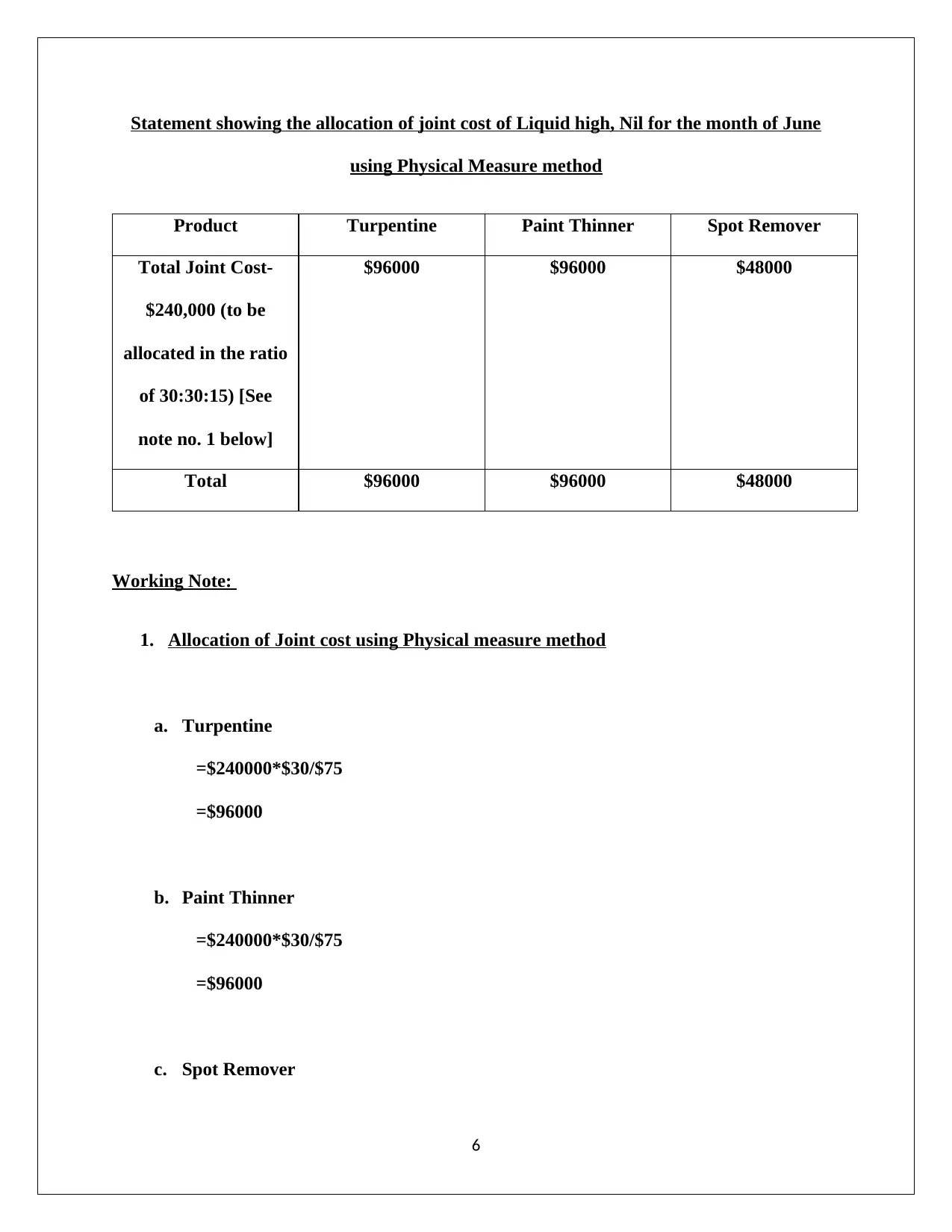
Statement showing the allocation of joint cost of Liquid high, Nil for the month of June
using Physical Measure method
Product Turpentine Paint Thinner Spot Remover
Total Joint Cost-
$240,000 (to be
allocated in the ratio
of 30:30:15) [See
note no. 1 below]
$96000 $96000 $48000
Total $96000 $96000 $48000
Working Note:
1. Allocation of Joint cost using Physical measure method
a. Turpentine
=$240000*$30/$75
=$96000
b. Paint Thinner
=$240000*$30/$75
=$96000
c. Spot Remover
6
using Physical Measure method
Product Turpentine Paint Thinner Spot Remover
Total Joint Cost-
$240,000 (to be
allocated in the ratio
of 30:30:15) [See
note no. 1 below]
$96000 $96000 $48000
Total $96000 $96000 $48000
Working Note:
1. Allocation of Joint cost using Physical measure method
a. Turpentine
=$240000*$30/$75
=$96000
b. Paint Thinner
=$240000*$30/$75
=$96000
c. Spot Remover
6
⊘ This is a preview!⊘
Do you want full access?
Subscribe today to unlock all pages.

Trusted by 1+ million students worldwide

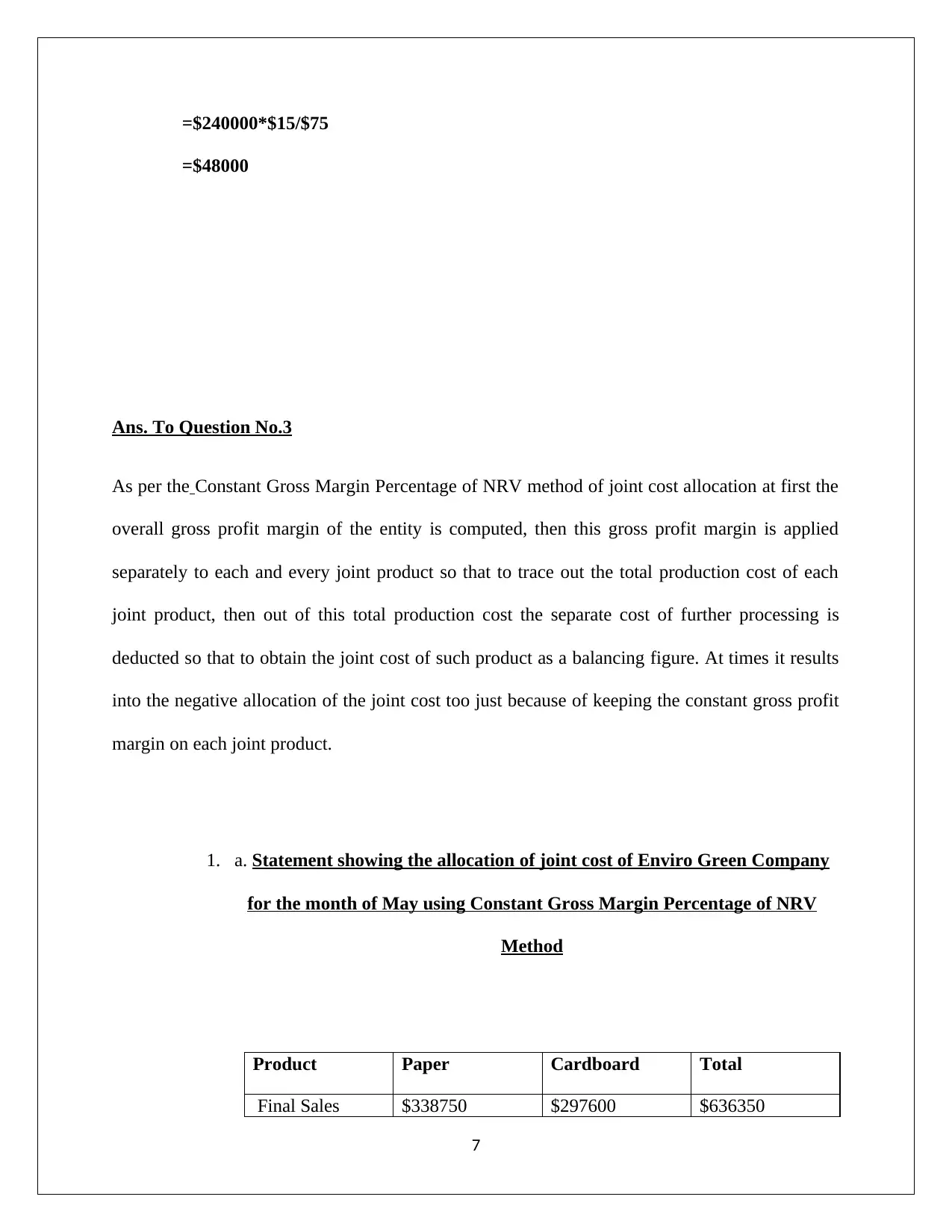
=$240000*$15/$75
=$48000
Ans. To Question No.3
As per the Constant Gross Margin Percentage of NRV method of joint cost allocation at first the
overall gross profit margin of the entity is computed, then this gross profit margin is applied
separately to each and every joint product so that to trace out the total production cost of each
joint product, then out of this total production cost the separate cost of further processing is
deducted so that to obtain the joint cost of such product as a balancing figure. At times it results
into the negative allocation of the joint cost too just because of keeping the constant gross profit
margin on each joint product.
1. a. Statement showing the allocation of joint cost of Enviro Green Company
for the month of May using Constant Gross Margin Percentage of NRV
Method
Product Paper Cardboard Total
Final Sales $338750 $297600 $636350
7
=$48000
Ans. To Question No.3
As per the Constant Gross Margin Percentage of NRV method of joint cost allocation at first the
overall gross profit margin of the entity is computed, then this gross profit margin is applied
separately to each and every joint product so that to trace out the total production cost of each
joint product, then out of this total production cost the separate cost of further processing is
deducted so that to obtain the joint cost of such product as a balancing figure. At times it results
into the negative allocation of the joint cost too just because of keeping the constant gross profit
margin on each joint product.
1. a. Statement showing the allocation of joint cost of Enviro Green Company
for the month of May using Constant Gross Margin Percentage of NRV
Method
Product Paper Cardboard Total
Final Sales $338750 $297600 $636350
7
Paraphrase This Document
Need a fresh take? Get an instant paraphrase of this document with our AI Paraphraser

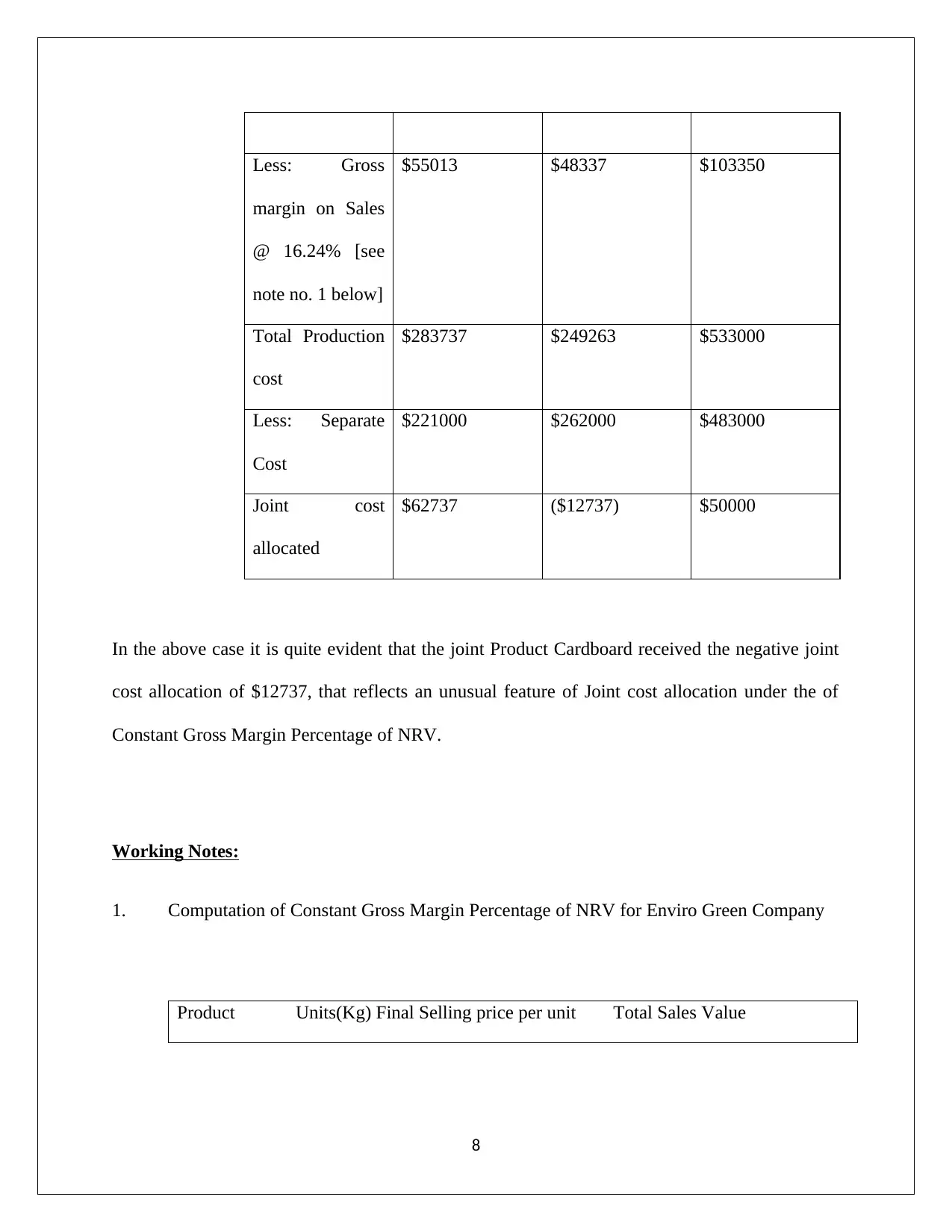
Less: Gross
margin on Sales
@ 16.24% [see
note no. 1 below]
$55013 $48337 $103350
Total Production
cost
$283737 $249263 $533000
Less: Separate
Cost
$221000 $262000 $483000
Joint cost
allocated
$62737 ($12737) $50000
In the above case it is quite evident that the joint Product Cardboard received the negative joint
cost allocation of $12737, that reflects an unusual feature of Joint cost allocation under the of
Constant Gross Margin Percentage of NRV.
Working Notes:
1. Computation of Constant Gross Margin Percentage of NRV for Enviro Green Company
Product Units(Kg) Final Selling price per unit Total Sales Value
8
margin on Sales
@ 16.24% [see
note no. 1 below]
$55013 $48337 $103350
Total Production
cost
$283737 $249263 $533000
Less: Separate
Cost
$221000 $262000 $483000
Joint cost
allocated
$62737 ($12737) $50000
In the above case it is quite evident that the joint Product Cardboard received the negative joint
cost allocation of $12737, that reflects an unusual feature of Joint cost allocation under the of
Constant Gross Margin Percentage of NRV.
Working Notes:
1. Computation of Constant Gross Margin Percentage of NRV for Enviro Green Company
Product Units(Kg) Final Selling price per unit Total Sales Value
8

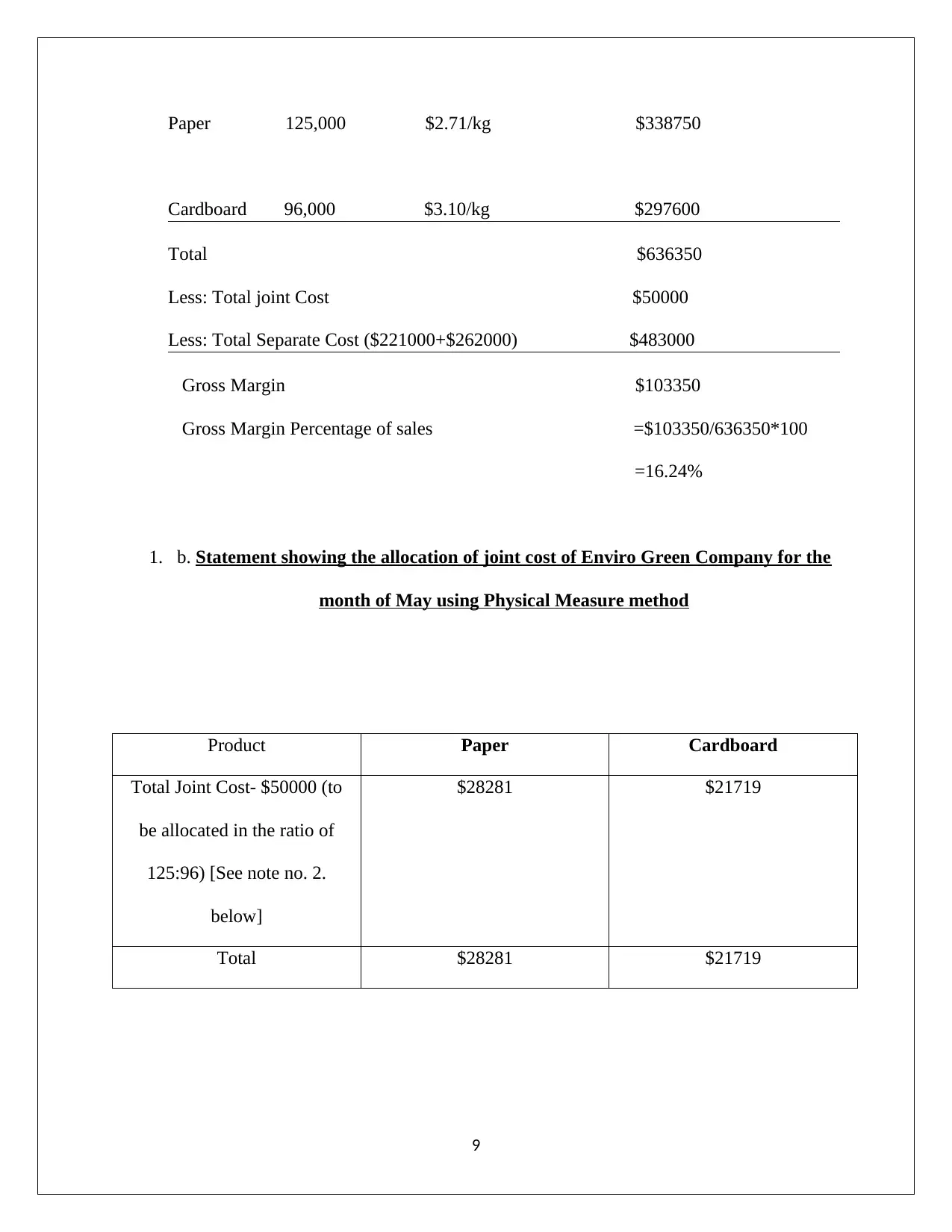
Paper 125,000 $2.71/kg $338750
Cardboard 96,000 $3.10/kg $297600
Total $636350
Less: Total joint Cost $50000
Less: Total Separate Cost ($221000+$262000) $483000
Gross Margin $103350
Gross Margin Percentage of sales =$103350/636350*100
=16.24%
1. b. Statement showing the allocation of joint cost of Enviro Green Company for the
month of May using Physical Measure method
Product Paper Cardboard
Total Joint Cost- $50000 (to
be allocated in the ratio of
125:96) [See note no. 2.
below]
$28281 $21719
Total $28281 $21719
9
Cardboard 96,000 $3.10/kg $297600
Total $636350
Less: Total joint Cost $50000
Less: Total Separate Cost ($221000+$262000) $483000
Gross Margin $103350
Gross Margin Percentage of sales =$103350/636350*100
=16.24%
1. b. Statement showing the allocation of joint cost of Enviro Green Company for the
month of May using Physical Measure method
Product Paper Cardboard
Total Joint Cost- $50000 (to
be allocated in the ratio of
125:96) [See note no. 2.
below]
$28281 $21719
Total $28281 $21719
9
⊘ This is a preview!⊘
Do you want full access?
Subscribe today to unlock all pages.

Trusted by 1+ million students worldwide

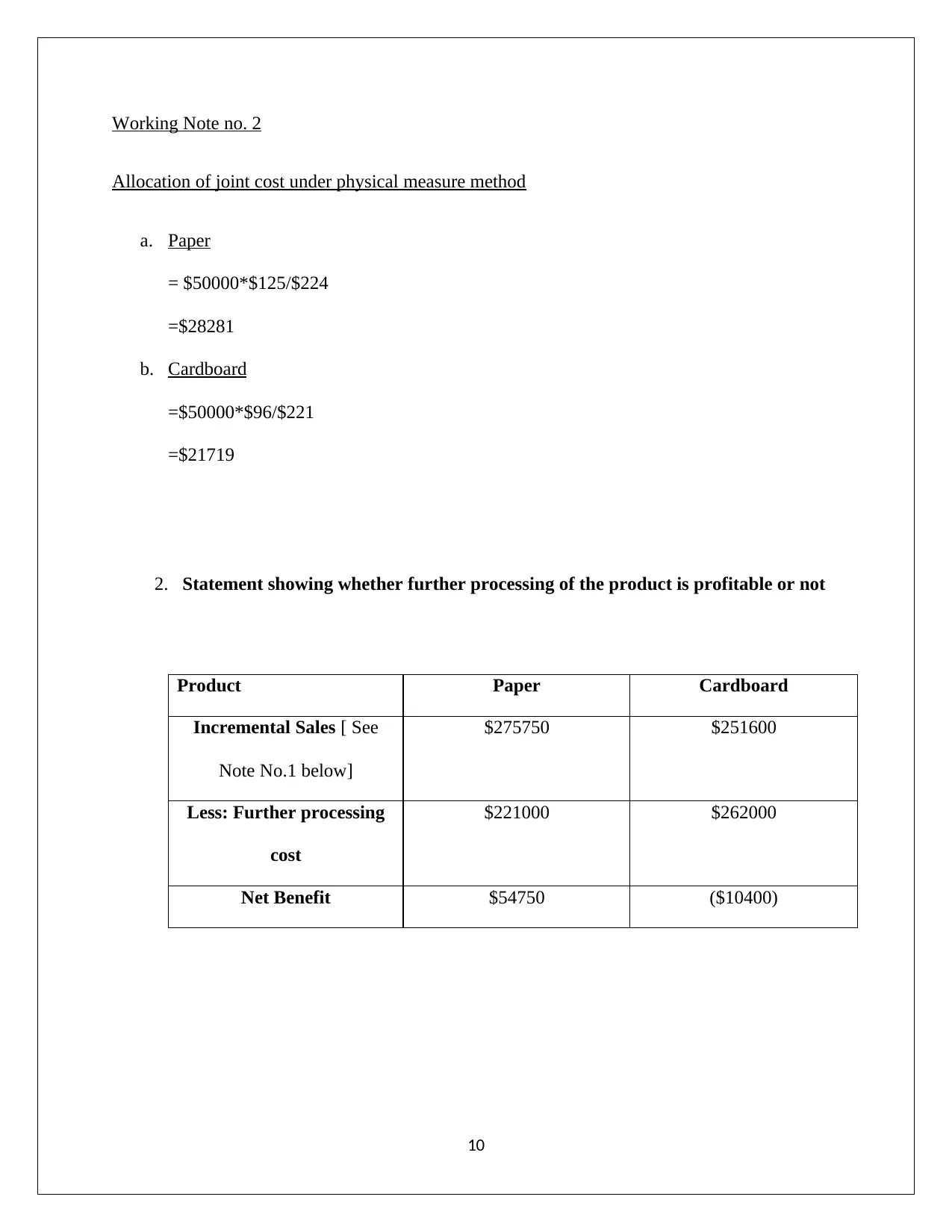
Working Note no. 2
Allocation of joint cost under physical measure method
a. Paper
= $50000*$125/$224
=$28281
b. Cardboard
=$50000*$96/$221
=$21719
2. Statement showing whether further processing of the product is profitable or not
Product Paper Cardboard
Incremental Sales [ See
Note No.1 below]
$275750 $251600
Less: Further processing
cost
$221000 $262000
Net Benefit $54750 ($10400)
10
Allocation of joint cost under physical measure method
a. Paper
= $50000*$125/$224
=$28281
b. Cardboard
=$50000*$96/$221
=$21719
2. Statement showing whether further processing of the product is profitable or not
Product Paper Cardboard
Incremental Sales [ See
Note No.1 below]
$275750 $251600
Less: Further processing
cost
$221000 $262000
Net Benefit $54750 ($10400)
10
Paraphrase This Document
Need a fresh take? Get an instant paraphrase of this document with our AI Paraphraser

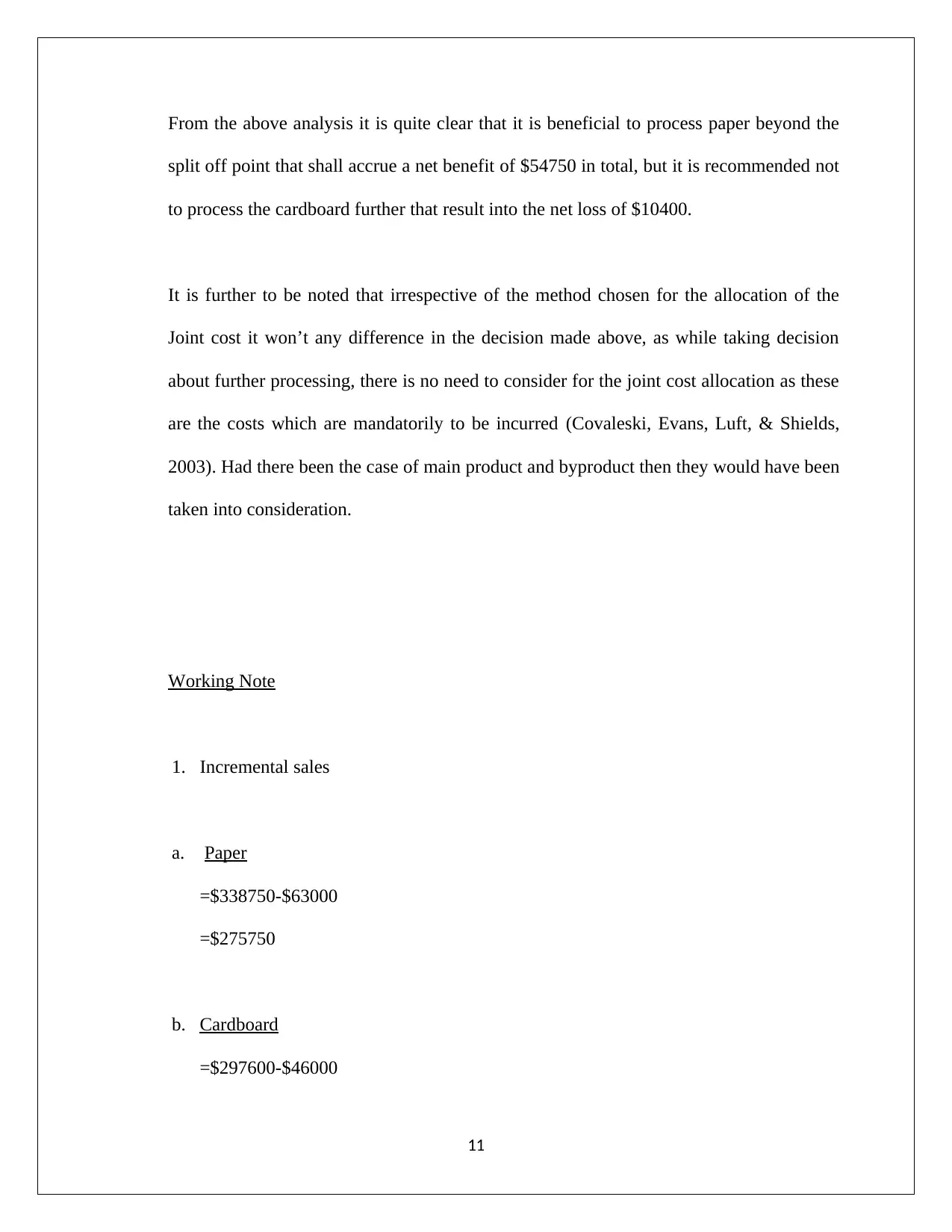
From the above analysis it is quite clear that it is beneficial to process paper beyond the
split off point that shall accrue a net benefit of $54750 in total, but it is recommended not
to process the cardboard further that result into the net loss of $10400.
It is further to be noted that irrespective of the method chosen for the allocation of the
Joint cost it won’t any difference in the decision made above, as while taking decision
about further processing, there is no need to consider for the joint cost allocation as these
are the costs which are mandatorily to be incurred (Covaleski, Evans, Luft, & Shields,
2003). Had there been the case of main product and byproduct then they would have been
taken into consideration.
Working Note
1. Incremental sales
a. Paper
=$338750-$63000
=$275750
b. Cardboard
=$297600-$46000
11
split off point that shall accrue a net benefit of $54750 in total, but it is recommended not
to process the cardboard further that result into the net loss of $10400.
It is further to be noted that irrespective of the method chosen for the allocation of the
Joint cost it won’t any difference in the decision made above, as while taking decision
about further processing, there is no need to consider for the joint cost allocation as these
are the costs which are mandatorily to be incurred (Covaleski, Evans, Luft, & Shields,
2003). Had there been the case of main product and byproduct then they would have been
taken into consideration.
Working Note
1. Incremental sales
a. Paper
=$338750-$63000
=$275750
b. Cardboard
=$297600-$46000
11

= $251600
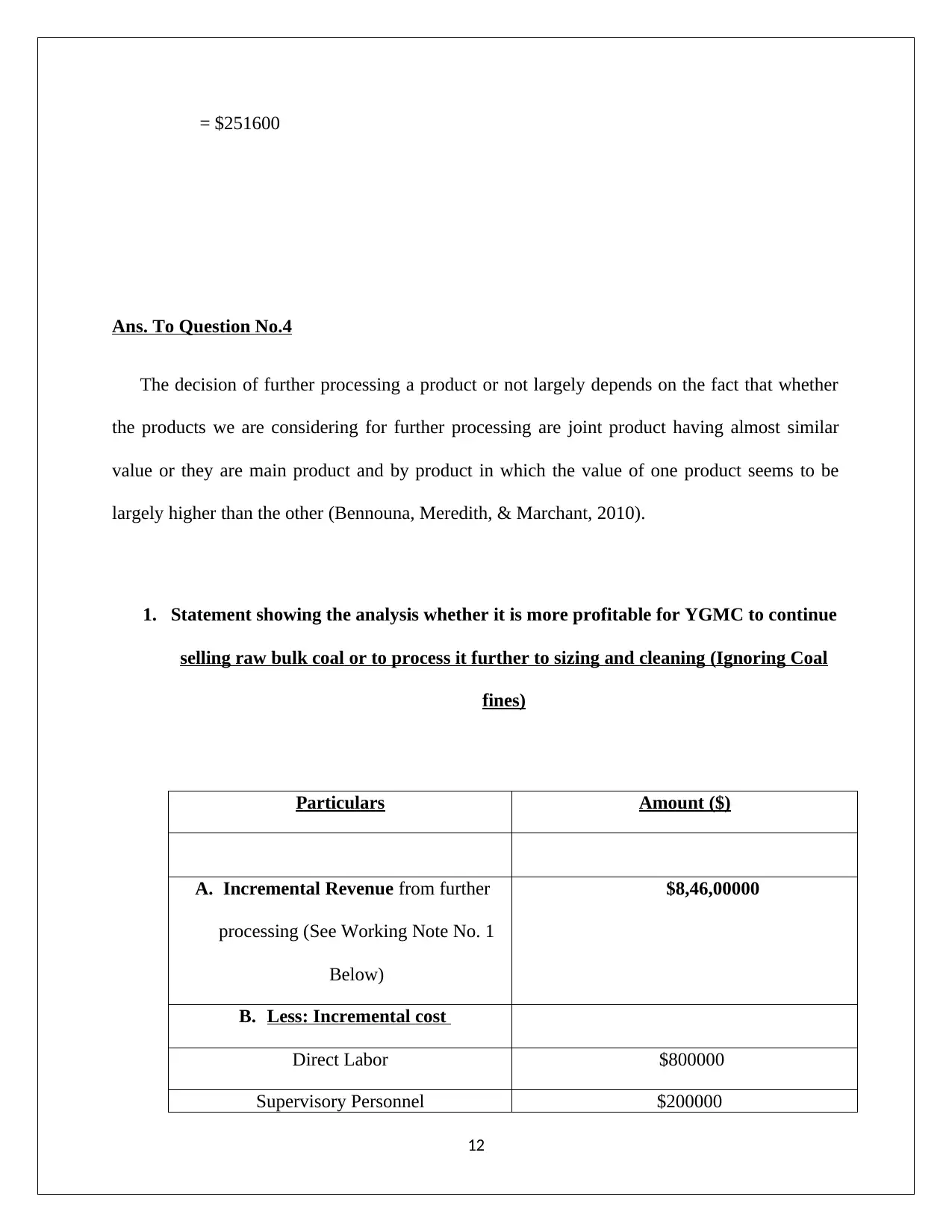
Ans. To Question No.4
The decision of further processing a product or not largely depends on the fact that whether
the products we are considering for further processing are joint product having almost similar
value or they are main product and by product in which the value of one product seems to be
largely higher than the other (Bennouna, Meredith, & Marchant, 2010).
1. Statement showing the analysis whether it is more profitable for YGMC to continue
selling raw bulk coal or to process it further to sizing and cleaning (Ignoring Coal
fines)
Particulars Amount ($)
A. Incremental Revenue from further
processing (See Working Note No. 1
Below)
$8,46,00000
B. Less: Incremental cost
Direct Labor $800000
Supervisory Personnel $200000
12
Ans. To Question No.4
The decision of further processing a product or not largely depends on the fact that whether
the products we are considering for further processing are joint product having almost similar
value or they are main product and by product in which the value of one product seems to be
largely higher than the other (Bennouna, Meredith, & Marchant, 2010).
1. Statement showing the analysis whether it is more profitable for YGMC to continue
selling raw bulk coal or to process it further to sizing and cleaning (Ignoring Coal
fines)
Particulars Amount ($)
A. Incremental Revenue from further
processing (See Working Note No. 1
Below)
$8,46,00000
B. Less: Incremental cost
Direct Labor $800000
Supervisory Personnel $200000
12
⊘ This is a preview!⊘
Do you want full access?
Subscribe today to unlock all pages.

Trusted by 1+ million students worldwide
1 out of 17
Your All-in-One AI-Powered Toolkit for Academic Success.
+13062052269
info@desklib.com
Available 24*7 on WhatsApp / Email
Unlock your academic potential
Copyright © 2020–2026 A2Z Services. All Rights Reserved. Developed and managed by ZUCOL.