Journalism and Politics: A Comparison of Australia and the UK

Verified

Added on  2023/06/07

|4
|788
|79
Essay
AI Summary
This essay provides a comparative analysis of journalism in Australia and the United Kingdom, focusing on the media's treatment of political figures and parties. The paper begins by discussing the UK media's critical stance towards Jeremy Corbyn, highlighting instances of misrepresentation and bias. It then contrasts this with the Australian context, where the media appears less biased, particularly in its coverage of minor party leaders like Mehreen Faruqi. The essay explores the influence of media ownership, specifically Rupert Murdoch's News Corporation, on Australian journalism. The author concludes that Australian journalism is markedly different from its UK counterpart in its approach to challenging the status quo. Finally, it emphasizes that treating minor and major parties differently is acceptable if based on authentic facts and information.
Document Page
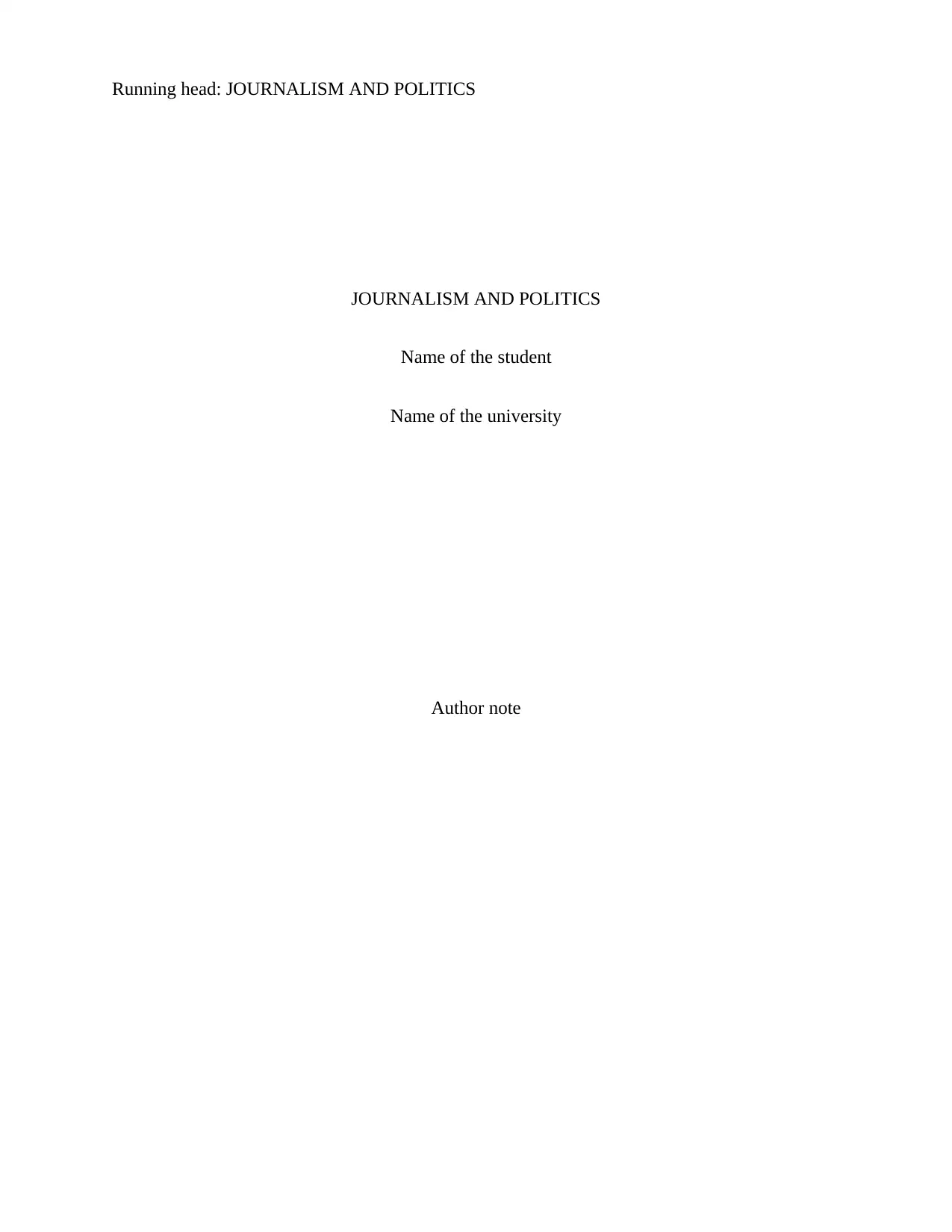
Running head: JOURNALISM AND POLITICS
JOURNALISM AND POLITICS
Name of the student
Name of the university
Author note
tabler-icon-diamond-filled.svg

Paraphrase This Document

Need a fresh take? Get an instant paraphrase of this document with our AI Paraphraser
Document Page
1JOURNALISM AND POLITICS
Introduction
The present paper provides a discussion on the critical nature of journalism in Australia
by analyzing the coverage of Jeremy Corbyn by the United Kingdom media. The paper
specifically discusses the treatment of minor parties in Australia by the media and tries to find
whether these should be treated differently than the major parties.
Discussion
Until recently, the UK media has been extremely critical and antagonistic of Jeremy
Corbyn, leader of the opposition Labor party, states Bart Cammaerts. The report published in
The Independent revealed that 75 per cent of coverage misrepresented Corbyn
(Independent.co.uk 2018). One of the chief reasons for Corbyn being targeted by the media is his
unabashed way of presenting the facts, without any manipulation and most significantly,
challenging the status quo. The author also remarks that the treatment received by Corbyn is not
a new phenomenon but it is the most “destructive, vicious and antagonistic” (Independent.co.uk
2018). The media, he further adds, should be critical and act as a watchdog but not to the extent
of killing off anyone who defies the present state affairs and urges to propose a new kind of
politics.
In the Australian context, journalism seems to be quite bias with the media being divided
into center to right and left. When it comes to challenging the status quo by politicians or
political parties, the Australian media unlike the UK media is least biased. It could be discerned
from the coverage of the minor party leaders like Mehreen Faruqi of the Greens. The Sydney
Morning Herald made Faruqi’s statement as it headline while reporting on her appointment as
the new Greens leader replacing Lee Rhiannon (Smh.com.au 2018). In addition, the newspaper
Document Page
2JOURNALISM AND POLITICS
allotted an entire article of its Lifestyle to Faruqi’s views on multiculturalism in Australia and the
absence of it in the media. The ABC news gave prominence to the news of the formation of the
Samoa First Party with the headline “New Samoa First Party political party wants to challenge
status quo” (Abc.net.au 2018). These instances reveal that journalism in Australia is markedly
different from the journalism in the UK.
It must however be noted that some inclination towards the right-winged or left-winged
politics are evident within the Australian journalism as well. Most of it is due to the influence of
Rupert Murdoch, owner of News Corporations based in the UK. Amongst the media outlets
owned by Murdoch’s company, most are inclined towards right-winged politics. As The
Conversation observes, Murdoch controls almost 70 per cent of the newspapers circulated in the
capital city, it is bound to influence public perception (Theconversation.com 2018).
Analyzing these facts, it is thus evident that Australian journalism is very different from
the UK media in terms of being critical to politicians and political parties. In case of treating
minor and major parties, it depends on newspaper’s adherence to the democratic principles.
Treating differently is acceptable but it should be based on authentic facts and information.
Conclusion
In the end, it should be stated that the Australian journalism does not criticize those who
challenge the status quo, as brutally as the UK journalism does. The paper provided the
discussion on the treatment of UK Labor party leader, Jeremy Corbyn by the country’s media in
analyzing Australian journalism.
Document Page
3JOURNALISM AND POLITICS
References:
Abc.net.au 2018. Samoa: New political party a potential game-changer. [online] ABC Radio
Australia. Available at: http://www.abc.net.au/radio-australia/programs/pacificbeat/samoa-new-
party/10088044 [Accessed 8 Sep. 2018].
Independent.co.uk 2018. We can’t ignore the media bias against Jeremy Corbyn anymore.
[online] The Independent. Available at: https://www.independent.co.uk/voices/jeremy-corbyn-
media-bias-labour-mainstream-press-lse-study-misrepresentation-we-cant-ignore-bias-
a7144381.html [Accessed 8 Sep. 2018].
Smh.com.au 2018. 'I'm in politics because I want to shake up the status quo': The Greens'
Mehreen Faruqi heads to Canberra. [online] The Sydney Morning Herald. Available at:
https://www.smh.com.au/politics/federal/i-m-in-politics-because-i-want-to-shake-up-the-status-
quo-the-greens-mehreen-faruqi-heads-to-canberra-20180817-p4zy3r.html [Accessed 8 Sep.
2018].
Theconversation.com 2018. Murdoch and his influence on Australian political life. [online] The
Conversation. Available at: https://theconversation.com/murdoch-and-his-influence-on-
australian-political-life-16752 [Accessed 8 Sep. 2018].
chevron_up_icon
1 out of 4
circle_padding
hide_on_mobile
zoom_out_icon
[object Object]