Role of Leadership in Knowledge Management Practices
VerifiedAdded on 2023/06/16
|13
|2817
|480
AI Summary
The document discusses the pivotal role of knowledge management (KM) in providing a competitive edge to organizations by aligning it with business objectives to boost productivity. Effective KM practices enable firms to gain advantages regarding products and services offered in the market. The article emphasizes the importance of aligning KM processes with organizational goals to enhance employee productivity. It highlights that upper management must adopt innovative ways for effective KM implementation, thereby ensuring better success within the business process. Key findings from studies such as those by Alegre et al., 2013 and Kim et al., 2014 underscore KM's impact on innovation performance, particularly in high-tech SMEs. Leadership plays a crucial role in fostering a knowledge-sharing culture that enhances creative problem-solving and organizational performance, as indicated by Carmeli et al., 2013. The synthesis of these perspectives underscores the importance of strategic KM practices for sustained business success.
Running head: KNOWLEDGE MANAGEMENT
Knowledge Management
Name of the Student
Name of the University
Author Note
Knowledge Management
Name of the Student
Name of the University
Author Note

Paraphrase This Document
Need a fresh take? Get an instant paraphrase of this document with our AI Paraphraser
1KNOWLEDGE MANAGEMENT
Table of Contents
Introduction........................................................................................................................2
Process and goals of knowledge management.................................................................3
Knowledge Management System......................................................................................4
KM process cycle...............................................................................................................4
Knowledge management in organization..........................................................................7
Organizational strategy and knowledge management......................................................9
KM as a tool in strategic management..............................................................................9
Conclusion.......................................................................................................................10
Reference List..................................................................................................................11
Table of Contents
Introduction........................................................................................................................2
Process and goals of knowledge management.................................................................3
Knowledge Management System......................................................................................4
KM process cycle...............................................................................................................4
Knowledge management in organization..........................................................................7
Organizational strategy and knowledge management......................................................9
KM as a tool in strategic management..............................................................................9
Conclusion.......................................................................................................................10
Reference List..................................................................................................................11
2KNOWLEDGE MANAGEMENT
Introduction
The definition of knowledge can be termed as the personal beliefs of the
individuals, which is justified in terms of measuring it. It can be distinguished in to two
formats such as the tacit and the explicit knowledge. The knowledge that is tacit in
nature depends on the capability of the people to articulate it in different forms. It can be
seen that most of the knowledge are tacit in nature (Wang, Wang & Liang, 2014). This
type of knowledge is developed through the process of trial and error and helps the
organization in knowing the potential of the methods that are being followed in the
system. Most of the knowledge are present within the process of business but has to be
implemented so that it can help in improving the process in a positive way (Lai et al.,
2014).
Explicit knowledge is in the form of words, documents, data that is organized
along with different computer programs. It is important that knowledge management has
to be used in a tacit manner so that it can be used by the other people within the
organization. It is further divided in to ‘know what’, ‘know why’ and ‘know how’. The
‘know what’ knowledge can be specified in to actions that are bought forward with a
stimulus (Ragab & Arisha, 2013). This knowledge helps in calculating the relationship
between the response and the stimulus of the individual. The ‘know why’ knowledge is
the highest form, as it helps in understanding the casual relationship and the uncertainty
levels that are associated with it in a deep manner. The ‘know how’ is the second step
with respect to the first distinction where the programming of the response and the
stimuli has to be calculated (Kim et al., 2014).
Introduction
The definition of knowledge can be termed as the personal beliefs of the
individuals, which is justified in terms of measuring it. It can be distinguished in to two
formats such as the tacit and the explicit knowledge. The knowledge that is tacit in
nature depends on the capability of the people to articulate it in different forms. It can be
seen that most of the knowledge are tacit in nature (Wang, Wang & Liang, 2014). This
type of knowledge is developed through the process of trial and error and helps the
organization in knowing the potential of the methods that are being followed in the
system. Most of the knowledge are present within the process of business but has to be
implemented so that it can help in improving the process in a positive way (Lai et al.,
2014).
Explicit knowledge is in the form of words, documents, data that is organized
along with different computer programs. It is important that knowledge management has
to be used in a tacit manner so that it can be used by the other people within the
organization. It is further divided in to ‘know what’, ‘know why’ and ‘know how’. The
‘know what’ knowledge can be specified in to actions that are bought forward with a
stimulus (Ragab & Arisha, 2013). This knowledge helps in calculating the relationship
between the response and the stimulus of the individual. The ‘know why’ knowledge is
the highest form, as it helps in understanding the casual relationship and the uncertainty
levels that are associated with it in a deep manner. The ‘know how’ is the second step
with respect to the first distinction where the programming of the response and the
stimuli has to be calculated (Kim et al., 2014).
⊘ This is a preview!⊘
Do you want full access?
Subscribe today to unlock all pages.

Trusted by 1+ million students worldwide

3KNOWLEDGE MANAGEMENT
Process and goals of knowledge management
KM can be seen as the planning, controlling and motivating the employees within
the process of business so that the assets that are related to knowledge can be
employed in an effective way. The assets that are related to knowledge come in
different forms such as manuals, patents and other documents that help the employees
in carrying on with the jobs in the best way (Carmeli, Gelbard & Reiter-Palmon, 2013).
The KM process involves the function of acquisition of knowledge along with
refinement and utilizing it in the process of business. These functions help the
organization in operating the systems and provide motivation to the employees to
participate in it. The goal of knowledge management is that it helps in the improvement
of the knowledge assets that are present within the organization so that it can help in
increasing the effectiveness of the organizational behaviors. It also helps in making
better decisions so that the performance of the organization can be improved (Stark,
2015).
These processes help in the organizational activities by letting the manager’s
focus on the goals and objectives that can be achieved through the knowledge
management process. It also provides motivation to the employees so that they can
participate in the business process and create social processes so that it can help in
facilitating the success of the KM (Donate & de Pablo, 2015).
The social processes are inclusive of the practices within the communities that
allow the groups to have a common interest so that a proper network can be
established by allowing people with great expertise collaborate with the less expertise
Process and goals of knowledge management
KM can be seen as the planning, controlling and motivating the employees within
the process of business so that the assets that are related to knowledge can be
employed in an effective way. The assets that are related to knowledge come in
different forms such as manuals, patents and other documents that help the employees
in carrying on with the jobs in the best way (Carmeli, Gelbard & Reiter-Palmon, 2013).
The KM process involves the function of acquisition of knowledge along with
refinement and utilizing it in the process of business. These functions help the
organization in operating the systems and provide motivation to the employees to
participate in it. The goal of knowledge management is that it helps in the improvement
of the knowledge assets that are present within the organization so that it can help in
increasing the effectiveness of the organizational behaviors. It also helps in making
better decisions so that the performance of the organization can be improved (Stark,
2015).
These processes help in the organizational activities by letting the manager’s
focus on the goals and objectives that can be achieved through the knowledge
management process. It also provides motivation to the employees so that they can
participate in the business process and create social processes so that it can help in
facilitating the success of the KM (Donate & de Pablo, 2015).
The social processes are inclusive of the practices within the communities that
allow the groups to have a common interest so that a proper network can be
established by allowing people with great expertise collaborate with the less expertise
Paraphrase This Document
Need a fresh take? Get an instant paraphrase of this document with our AI Paraphraser
4KNOWLEDGE MANAGEMENT
individuals. This is an important process, as the knowledge has to be transmitted to
others through various groups and networks. These processes have to be based more
on the people and less on the level of technology so that it can help in developing better
modes of communication technology (Meihami & Meihami, 2014).
Knowledge Management System
This system is based on the communication and information system on the
computer, which helps in supporting the processes of knowledge management. The
communication and information system (CIS) in the system of knowledge management
have to focus less on the technological advancement and more on the activities of the
humans so that the operations can be carried out in a better way (Stark, 2015). The
information system provides the employees in making choices during the process of
operation in the business and the operation takes place in an automatic manner. An
example of this would be that when the database of the sales is being prepared, the
employees have to prepare the structure and the content and it will operate in an
automatic manner (Alegre, Sengupta & Lapiedra, 2013).
KM process cycle
The process cycle is an important tool that helps in processing the knowledge
management in an organization.
individuals. This is an important process, as the knowledge has to be transmitted to
others through various groups and networks. These processes have to be based more
on the people and less on the level of technology so that it can help in developing better
modes of communication technology (Meihami & Meihami, 2014).
Knowledge Management System
This system is based on the communication and information system on the
computer, which helps in supporting the processes of knowledge management. The
communication and information system (CIS) in the system of knowledge management
have to focus less on the technological advancement and more on the activities of the
humans so that the operations can be carried out in a better way (Stark, 2015). The
information system provides the employees in making choices during the process of
operation in the business and the operation takes place in an automatic manner. An
example of this would be that when the database of the sales is being prepared, the
employees have to prepare the structure and the content and it will operate in an
automatic manner (Alegre, Sengupta & Lapiedra, 2013).
KM process cycle
The process cycle is an important tool that helps in processing the knowledge
management in an organization.
5KNOWLEDGE MANAGEMENT
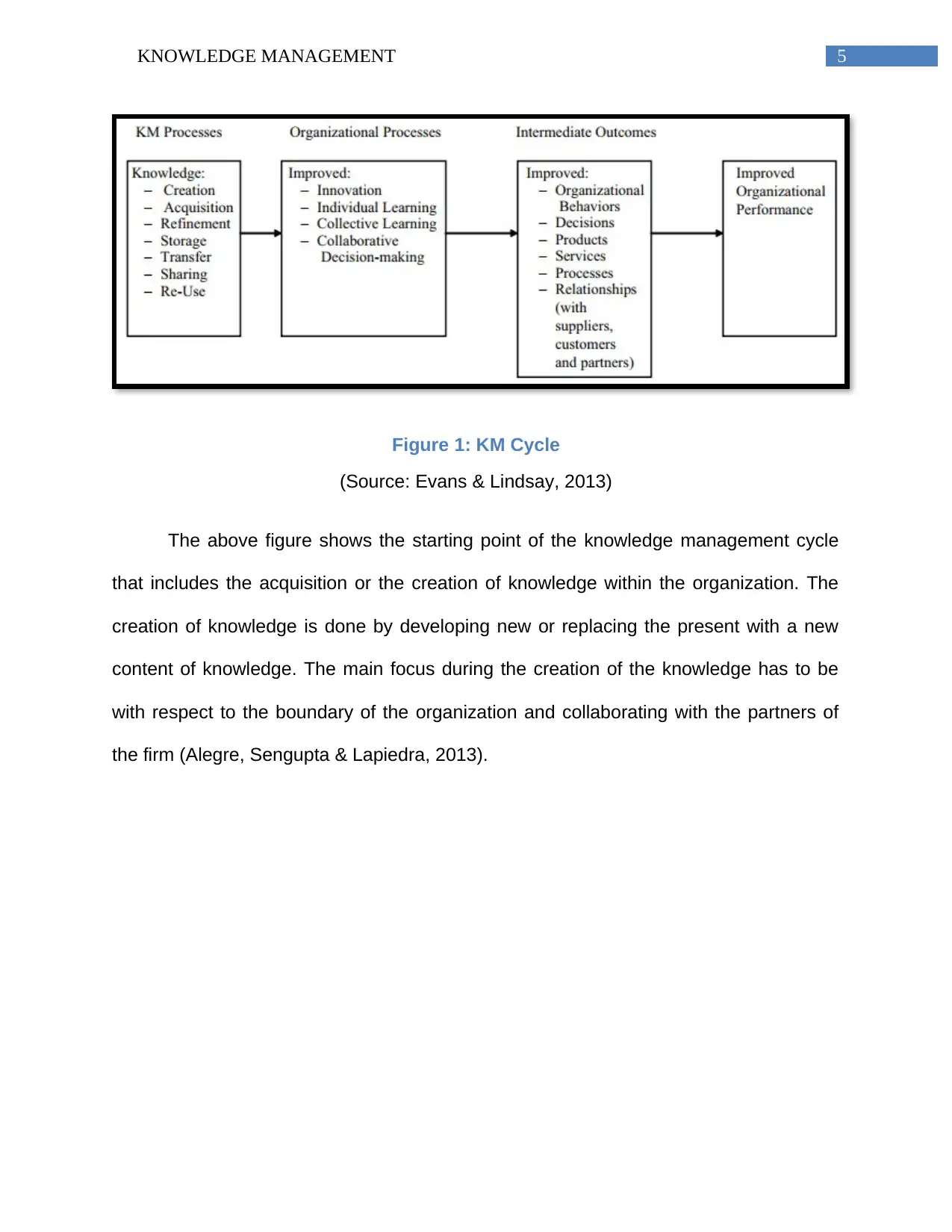
Figure 1: KM Cycle
(Source: Evans & Lindsay, 2013)
The above figure shows the starting point of the knowledge management cycle
that includes the acquisition or the creation of knowledge within the organization. The
creation of knowledge is done by developing new or replacing the present with a new
content of knowledge. The main focus during the creation of the knowledge has to be
with respect to the boundary of the organization and collaborating with the partners of
the firm (Alegre, Sengupta & Lapiedra, 2013).
Figure 1: KM Cycle
(Source: Evans & Lindsay, 2013)
The above figure shows the starting point of the knowledge management cycle
that includes the acquisition or the creation of knowledge within the organization. The
creation of knowledge is done by developing new or replacing the present with a new
content of knowledge. The main focus during the creation of the knowledge has to be
with respect to the boundary of the organization and collaborating with the partners of
the firm (Alegre, Sengupta & Lapiedra, 2013).
⊘ This is a preview!⊘
Do you want full access?
Subscribe today to unlock all pages.
Trusted by 1+ million students worldwide
6KNOWLEDGE MANAGEMENT
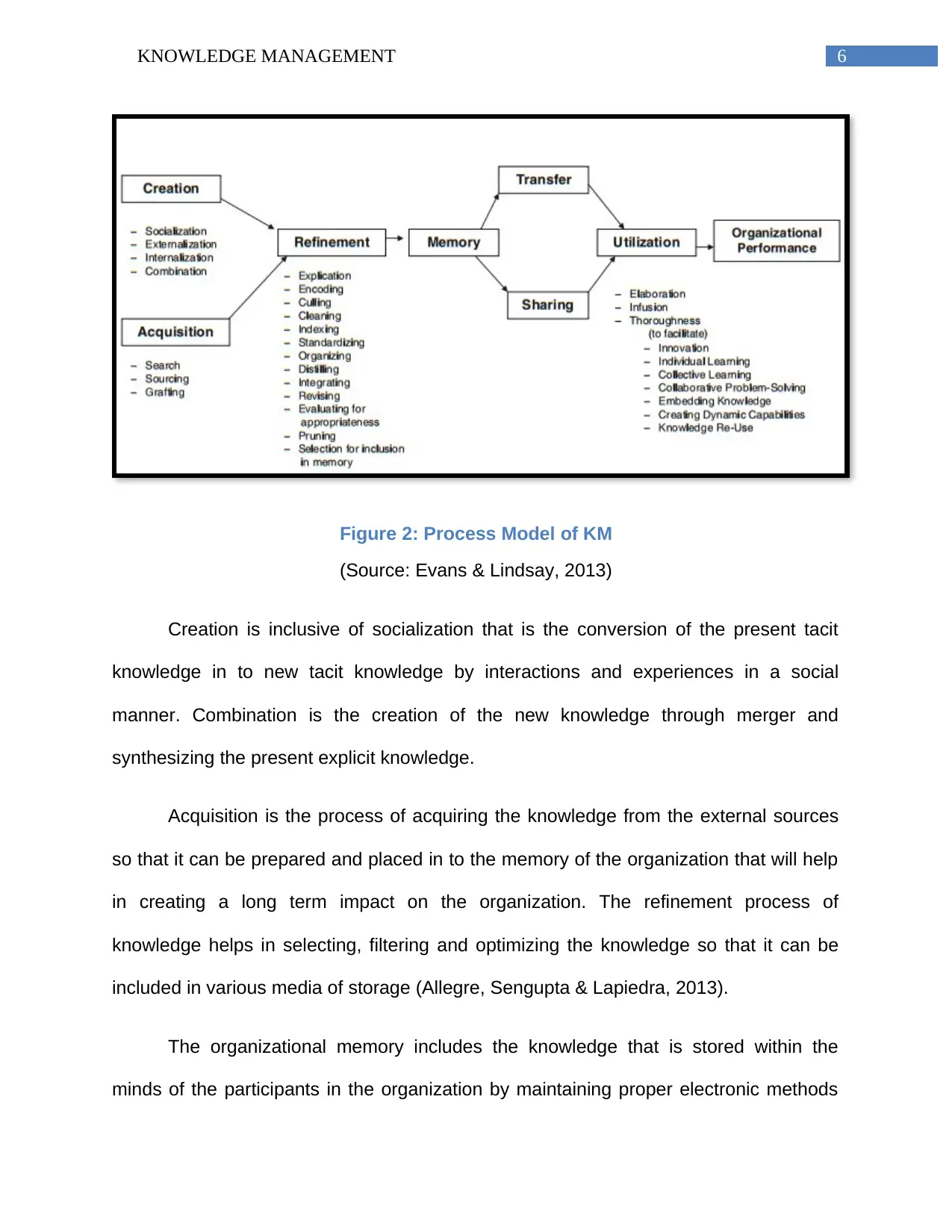
Figure 2: Process Model of KM
(Source: Evans & Lindsay, 2013)
Creation is inclusive of socialization that is the conversion of the present tacit
knowledge in to new tacit knowledge by interactions and experiences in a social
manner. Combination is the creation of the new knowledge through merger and
synthesizing the present explicit knowledge.
Acquisition is the process of acquiring the knowledge from the external sources
so that it can be prepared and placed in to the memory of the organization that will help
in creating a long term impact on the organization. The refinement process of
knowledge helps in selecting, filtering and optimizing the knowledge so that it can be
included in various media of storage (Allegre, Sengupta & Lapiedra, 2013).
The organizational memory includes the knowledge that is stored within the
minds of the participants in the organization by maintaining proper electronic methods
Figure 2: Process Model of KM
(Source: Evans & Lindsay, 2013)
Creation is inclusive of socialization that is the conversion of the present tacit
knowledge in to new tacit knowledge by interactions and experiences in a social
manner. Combination is the creation of the new knowledge through merger and
synthesizing the present explicit knowledge.
Acquisition is the process of acquiring the knowledge from the external sources
so that it can be prepared and placed in to the memory of the organization that will help
in creating a long term impact on the organization. The refinement process of
knowledge helps in selecting, filtering and optimizing the knowledge so that it can be
included in various media of storage (Allegre, Sengupta & Lapiedra, 2013).
The organizational memory includes the knowledge that is stored within the
minds of the participants in the organization by maintaining proper electronic methods
Paraphrase This Document
Need a fresh take? Get an instant paraphrase of this document with our AI Paraphraser
7KNOWLEDGE MANAGEMENT
so that it can be embedded within the process of the business and the relationship
between the suppliers, customers and partners. The above figure presents the impact
on the organization with respect to knowledge on a wider manner, which can be shared
or transferred among the employees. Transfer refers to the communication of
knowledge in a purposive manner so that it can help the employees in gaining better
insights so that the level of productivity can be increased, as the information is sent to a
receiver who is known to the sender of the information (Tseng & Lee, 2014).
After the knowledge is transferred, it is utilized by developing it through various
interpretations and identifying the issues that are present in it so that it can help in
process of innovation and the collective learning attitudes of the individuals so that it
can help in solving the problems (Meihami & Meihami, 2014).
Knowledge management in organization
The organizations have to be competitive so that it can ensure its survival in the
competitive environment, which can be achieved by managing knowledge in an
effective manner. In the globalized world, it is important to manage knowledge in an
efficient way, as most of the work that is carried out is based on information. The
competition among the organizations take place on the basis of knowledge, as the
services and the products are complex to understand. The employees have to undergo
a life-long process of learning so that they can understand the dynamics of the market,
which is competitive due to the rise in the innovation methods. Knowledge management
is important due to the early retirement and the mobility level of employees may lead to
so that it can be embedded within the process of the business and the relationship
between the suppliers, customers and partners. The above figure presents the impact
on the organization with respect to knowledge on a wider manner, which can be shared
or transferred among the employees. Transfer refers to the communication of
knowledge in a purposive manner so that it can help the employees in gaining better
insights so that the level of productivity can be increased, as the information is sent to a
receiver who is known to the sender of the information (Tseng & Lee, 2014).
After the knowledge is transferred, it is utilized by developing it through various
interpretations and identifying the issues that are present in it so that it can help in
process of innovation and the collective learning attitudes of the individuals so that it
can help in solving the problems (Meihami & Meihami, 2014).
Knowledge management in organization
The organizations have to be competitive so that it can ensure its survival in the
competitive environment, which can be achieved by managing knowledge in an
effective manner. In the globalized world, it is important to manage knowledge in an
efficient way, as most of the work that is carried out is based on information. The
competition among the organizations take place on the basis of knowledge, as the
services and the products are complex to understand. The employees have to undergo
a life-long process of learning so that they can understand the dynamics of the market,
which is competitive due to the rise in the innovation methods. Knowledge management
is important due to the early retirement and the mobility level of employees may lead to
8KNOWLEDGE MANAGEMENT
the loss in knowledge in some of the specific areas (Becerra-Fernnandez & Sabherwal,
2014).
Another factor that needs to be considered is the importance of managing the
knowledge so that the organizations can survive in the competitive market. The optimal
operation will help in the effective and efficient creation of product and service delivery
so that the customers can be satisfied, which will help in the success of the
organization. The proper use of KM will help the organization in competing in a better
way with its rivals in the market, as it helps in increasing the capability of innovation,
which will lead to product differentiation in the market. The lack of innovation process
will result in the loss of customers, as the products may not be attractive that may lead
hamper of the level of profit for the organization (Lai et al., 2014).
The factor of globalization has also helped in driving the need for adopting
knowledge management in most of the organization, as it is an useful tool for sharing
and acquiring knowledge, which helps in decreasing the barriers that are related to
culture and structure. It has created a need to manage knowledge for most of the
organization across various countries and continents so that they can attract the
maximum number of customers. The intellectual capital has to be managed in a proper
manner so that the future generations who will be serving in the organization can follow
and innovate it so that maximum returns can be earned by the organization (Ragab &
Arisha, 2013).
Knowledge management helps the organization in sharing important insights
about the organization so that it can help in reducing the work process along with the
the loss in knowledge in some of the specific areas (Becerra-Fernnandez & Sabherwal,
2014).
Another factor that needs to be considered is the importance of managing the
knowledge so that the organizations can survive in the competitive market. The optimal
operation will help in the effective and efficient creation of product and service delivery
so that the customers can be satisfied, which will help in the success of the
organization. The proper use of KM will help the organization in competing in a better
way with its rivals in the market, as it helps in increasing the capability of innovation,
which will lead to product differentiation in the market. The lack of innovation process
will result in the loss of customers, as the products may not be attractive that may lead
hamper of the level of profit for the organization (Lai et al., 2014).
The factor of globalization has also helped in driving the need for adopting
knowledge management in most of the organization, as it is an useful tool for sharing
and acquiring knowledge, which helps in decreasing the barriers that are related to
culture and structure. It has created a need to manage knowledge for most of the
organization across various countries and continents so that they can attract the
maximum number of customers. The intellectual capital has to be managed in a proper
manner so that the future generations who will be serving in the organization can follow
and innovate it so that maximum returns can be earned by the organization (Ragab &
Arisha, 2013).
Knowledge management helps the organization in sharing important insights
about the organization so that it can help in reducing the work process along with the
⊘ This is a preview!⊘
Do you want full access?
Subscribe today to unlock all pages.
Trusted by 1+ million students worldwide
9KNOWLEDGE MANAGEMENT
reduction of time that is taken in training the employees. It also helps the organization in
retaining the intellectual capital so that the turnover of employees can be adapted
according to the change in the market and the environment. Thus, there is an active link
between the best practices that are taken up in the organization along with the
efficiency through which knowledge is managed in the organization (Kim et al., 2014).
Organizational strategy and knowledge management
It is important to align the strategies of knowledge management with that of the
organization so that it can help in the success of the business. The strategy that is taken
up for KM has to be created on the basis of an understanding of the resources that are
available to the organization so that it can help in the creation of values. The strategy
that will be followed within the organization should not be arbitrary and has to depend
on the way it serves the clients and the recruitment of the people within the process
(Donate & de Pablo, 2015).
KM as a tool in strategic management
The role of knowledge management in the organization helps in mapping out the
management strategies that needs to be taken up so that it can function in an effective
manner. The proposition of the knowledge has to be centered on the knowledge that is
based on the capacity of the organization and the competitive advantage that it can get
out of it. The effort of KM helps in exerting better focus on the management of
knowledge so that it can become an asset that will encourage in sharing of knowledge
(Wang, Wang & Liang, 2014).
reduction of time that is taken in training the employees. It also helps the organization in
retaining the intellectual capital so that the turnover of employees can be adapted
according to the change in the market and the environment. Thus, there is an active link
between the best practices that are taken up in the organization along with the
efficiency through which knowledge is managed in the organization (Kim et al., 2014).
Organizational strategy and knowledge management
It is important to align the strategies of knowledge management with that of the
organization so that it can help in the success of the business. The strategy that is taken
up for KM has to be created on the basis of an understanding of the resources that are
available to the organization so that it can help in the creation of values. The strategy
that will be followed within the organization should not be arbitrary and has to depend
on the way it serves the clients and the recruitment of the people within the process
(Donate & de Pablo, 2015).
KM as a tool in strategic management
The role of knowledge management in the organization helps in mapping out the
management strategies that needs to be taken up so that it can function in an effective
manner. The proposition of the knowledge has to be centered on the knowledge that is
based on the capacity of the organization and the competitive advantage that it can get
out of it. The effort of KM helps in exerting better focus on the management of
knowledge so that it can become an asset that will encourage in sharing of knowledge
(Wang, Wang & Liang, 2014).
Paraphrase This Document
Need a fresh take? Get an instant paraphrase of this document with our AI Paraphraser
10KNOWLEDGE MANAGEMENT
As a strategic management tool, it manages the information that is collected from
the expertise of the employees. It also encompasses the explicit knowledge that helps
in reflecting on the business strategy of the organization along with the policies and
guidelines at all the intermediate levels. The activities of knowledge management help
in influencing the performance of the business in a positive manner so that the
organization can gain a competitive advantage in the market. It is important for the
organization in selecting the right process of knowledge management so that it can help
in sharing of the knowledge about the operations that are being carried out in the
business (Carmeli, Gelbard & Reiter-Palmon, 2013).
Conclusion
Thus it can be concluded that the management of knowledge has to be effective
so that it can help the organizations in gaining a competitive advantage regarding the
products and services that are being supplied in the market. It is also necessary that the
process has to be aligned with the objectives of the organization so that it can help the
employees in increasing their level of productivity. The upper management of the
organization have to find ways and means that will help them in adopting KM so that
they can be able to achieve better success within the business process.
As a strategic management tool, it manages the information that is collected from
the expertise of the employees. It also encompasses the explicit knowledge that helps
in reflecting on the business strategy of the organization along with the policies and
guidelines at all the intermediate levels. The activities of knowledge management help
in influencing the performance of the business in a positive manner so that the
organization can gain a competitive advantage in the market. It is important for the
organization in selecting the right process of knowledge management so that it can help
in sharing of the knowledge about the operations that are being carried out in the
business (Carmeli, Gelbard & Reiter-Palmon, 2013).
Conclusion
Thus it can be concluded that the management of knowledge has to be effective
so that it can help the organizations in gaining a competitive advantage regarding the
products and services that are being supplied in the market. It is also necessary that the
process has to be aligned with the objectives of the organization so that it can help the
employees in increasing their level of productivity. The upper management of the
organization have to find ways and means that will help them in adopting KM so that
they can be able to achieve better success within the business process.
11KNOWLEDGE MANAGEMENT
Reference List
AF Ragab, M., & Arisha, A. (2013). Knowledge management and measurement: a
critical review. Journal of Knowledge Management, 17(6), 873-901.
Alegre, J., Sengupta, K., & Lapiedra, R. (2013). Knowledge management and
innovation performance in a high-tech SMEs industry. International Small
Business Journal, 31(4), 454-470.
Becerra-Fernandez, I., & Sabherwal, R. (2014). Knowledge management: Systems and
processes. Routledge.
Carmeli, A., Gelbard, R., & Reiter‐Palmon, R. (2013). Leadership, creative problem‐
solving capacity, and creative performance: The importance of knowledge
sharing. Human Resource Management, 52(1), 95-121.
Donate, M. J., & de Pablo, J. D. S. (2015). The role of knowledge-oriented leadership in
knowledge management practices and innovation. Journal of Business
Research, 68(2), 360-370.
Evans, J. R., & Lindsay, W. M. (2013). Managing for quality and performance
excellence. Cengage Learning.
Kim, T. H., Lee, J. N., Chun, J. U., & Benbasat, I. (2014). Understanding the effect of
knowledge management strategies on knowledge management performance: A
contingency perspective. Information & management, 51(4), 398-416.
Reference List
AF Ragab, M., & Arisha, A. (2013). Knowledge management and measurement: a
critical review. Journal of Knowledge Management, 17(6), 873-901.
Alegre, J., Sengupta, K., & Lapiedra, R. (2013). Knowledge management and
innovation performance in a high-tech SMEs industry. International Small
Business Journal, 31(4), 454-470.
Becerra-Fernandez, I., & Sabherwal, R. (2014). Knowledge management: Systems and
processes. Routledge.
Carmeli, A., Gelbard, R., & Reiter‐Palmon, R. (2013). Leadership, creative problem‐
solving capacity, and creative performance: The importance of knowledge
sharing. Human Resource Management, 52(1), 95-121.
Donate, M. J., & de Pablo, J. D. S. (2015). The role of knowledge-oriented leadership in
knowledge management practices and innovation. Journal of Business
Research, 68(2), 360-370.
Evans, J. R., & Lindsay, W. M. (2013). Managing for quality and performance
excellence. Cengage Learning.
Kim, T. H., Lee, J. N., Chun, J. U., & Benbasat, I. (2014). Understanding the effect of
knowledge management strategies on knowledge management performance: A
contingency perspective. Information & management, 51(4), 398-416.
⊘ This is a preview!⊘
Do you want full access?
Subscribe today to unlock all pages.
Trusted by 1+ million students worldwide

1 out of 13


Related Documents


Your All-in-One AI-Powered Toolkit for Academic Success.
+13062052269
info@desklib.com
Available 24*7 on WhatsApp / Email
![[object Object]](/_next/static/media/star-bottom.7253800d.svg)
Unlock your academic potential
Copyright © 2020–2026 A2Z Services. All Rights Reserved. Developed and managed by ZUCOL.