Knowledge Management Systems: Schools and Communities of Practice
VerifiedAdded on 2023/01/10
|14
|3260
|86
Report
AI Summary
This report delves into the application of Knowledge Management Systems (KMS) within school environments, emphasizing the role of communities of practice. It examines how KMS, incorporating tools like peer assist and knowledge portals, facilitates knowledge sharing among teachers and students. The report highlights the importance of leadership, particularly the principal's role, in fostering trust and encouraging communication within the school's knowledge sharing system. It discusses the implementation of KMS, organizational learning, and the impact of these systems on innovation and knowledge creation. The report also critically analyzes the outcomes of KMS implementation, comparing them with established KM theories, and underscores the significance of organizational culture and memory in successful knowledge management.

Knowledge Management Systems

Paraphrase This Document
Need a fresh take? Get an instant paraphrase of this document with our AI Paraphraser

Abstract
Knowledge sharing system is known to comprise of multiple phases and aspects, and the
communities of practice are one such aspect that proliferates the methods of this system like no
other. This report goes on to discuss the impacts of knowledge sharing system in communities of
practice perspective with a critical discussion of the same when implemented in a school. It
shows the different phases of the system and how relevant they are to the entire learning
opportunity that is the main focal point of this system. In the case of an education system the
knowledge sharing system acts more organically than in any other organization as the school is
an organization of learning and receiving outcomes. The space for individual development, in
turn, impacting corporate development is of great importance her and this report discusses the
role of principals and teachers as an integral part of the knowledge sharing system implemented
in schools.
1
Knowledge sharing system is known to comprise of multiple phases and aspects, and the
communities of practice are one such aspect that proliferates the methods of this system like no
other. This report goes on to discuss the impacts of knowledge sharing system in communities of
practice perspective with a critical discussion of the same when implemented in a school. It
shows the different phases of the system and how relevant they are to the entire learning
opportunity that is the main focal point of this system. In the case of an education system the
knowledge sharing system acts more organically than in any other organization as the school is
an organization of learning and receiving outcomes. The space for individual development, in
turn, impacting corporate development is of great importance her and this report discusses the
role of principals and teachers as an integral part of the knowledge sharing system implemented
in schools.
1
Table of Contents
Introduction......................................................................................................................................3
Literature Review on Community of Practice.................................................................................3
Knowledge Management System....................................................................................................4
A critical discussion of communities of practice in a school’s knowledge sharing system............6
Critical discussion of outcomes of the implementation and compare this against the KM theories
discussed........................................................................................................................................10
Conclusion.....................................................................................................................................12
References......................................................................................................................................13
2
Introduction......................................................................................................................................3
Literature Review on Community of Practice.................................................................................3
Knowledge Management System....................................................................................................4
A critical discussion of communities of practice in a school’s knowledge sharing system............6
Critical discussion of outcomes of the implementation and compare this against the KM theories
discussed........................................................................................................................................10
Conclusion.....................................................................................................................................12
References......................................................................................................................................13
2
⊘ This is a preview!⊘
Do you want full access?
Subscribe today to unlock all pages.

Trusted by 1+ million students worldwide
Introduction
The social learning, which refers to the gathering of knowledge from the interaction between the
human experience and society and nature, needs to be processed and organized to develop a
concrete model of circulating, transforming and propagating knowledge (Illeris, 2018). This
procedure of arranging a practical model of distributing knowledge in a system is known as
Knowledge Management. The analysis below has been developed upon the perspectives of a
community of practice based on a given case which is showing that how a principal of an
institution is leading a procedure of Community of Practice to secure an advanced culture of
Knowledge Management by motivating the teachers and the students (Dalkir, 2013).
Literature Review on Community of Practice
The Community of Practice can be defined as a comprehensive knowledge management
procedure which develops a community with the flow of knowledge, which is enhanced by the
extensive level of, aimed and organized communication to establish a culture of mutual
knowledge sharing which can be implemented for the pragmatic solutions of real cases
(Meyerhoff and Strycharz, 2013).
According to Smith et al. (2017), the theory of Community of Practice by Etienne Wenger has
developed the methodology of social learning and a scientific procedure of knowledge
management. The work the trio has depicted has a significant impact on evaluating and
analyzing the purposes of social learning methodologies to come to an inference regarding how a
community of practice of knowledge management can be useful on the entire process of
learning. The analysis they have gone through has correctly been based upon three significant
questions. The three questions that the paper is investigating are:
To find out the research papers that have used the community of practice as the central
framework of their research.
To find out the papers among the abovementioned works, which have been showing a
possible link between their findings and the theoretical framework of the community of
practice.
3
The social learning, which refers to the gathering of knowledge from the interaction between the
human experience and society and nature, needs to be processed and organized to develop a
concrete model of circulating, transforming and propagating knowledge (Illeris, 2018). This
procedure of arranging a practical model of distributing knowledge in a system is known as
Knowledge Management. The analysis below has been developed upon the perspectives of a
community of practice based on a given case which is showing that how a principal of an
institution is leading a procedure of Community of Practice to secure an advanced culture of
Knowledge Management by motivating the teachers and the students (Dalkir, 2013).
Literature Review on Community of Practice
The Community of Practice can be defined as a comprehensive knowledge management
procedure which develops a community with the flow of knowledge, which is enhanced by the
extensive level of, aimed and organized communication to establish a culture of mutual
knowledge sharing which can be implemented for the pragmatic solutions of real cases
(Meyerhoff and Strycharz, 2013).
According to Smith et al. (2017), the theory of Community of Practice by Etienne Wenger has
developed the methodology of social learning and a scientific procedure of knowledge
management. The work the trio has depicted has a significant impact on evaluating and
analyzing the purposes of social learning methodologies to come to an inference regarding how a
community of practice of knowledge management can be useful on the entire process of
learning. The analysis they have gone through has correctly been based upon three significant
questions. The three questions that the paper is investigating are:
To find out the research papers that have used the community of practice as the central
framework of their research.
To find out the papers among the abovementioned works, which have been showing a
possible link between their findings and the theoretical framework of the community of
practice.
3
Paraphrase This Document
Need a fresh take? Get an instant paraphrase of this document with our AI Paraphraser
To find out the suggestions that these papers have made using the central framework of
communities of practice to develop a compact orientation regarding the development of
social learning in future.
The work has a great significance as it is investigating the model of a community of practice not
only in its abstract theoretical form but also in its pragmatic way of practical implementation and
that is the reason why the question of the further or future development comes in. The
functioning of this model mainly lies upon effective communication and knowledge sharing
techniques. The authors have worked out for a critical understanding on how the information
technology can be used for the community of practice to enhance the growth of the knowledge
management system for advanced social learning (Jewson, 2013).
Knowledge Management System
In business management as KMS (knowledge management system is set of principles which are
applied and used for data-driven objectives for an increase in productivity and intelligent
analysis of the business (Becerra-Fernandez and Sabherwal, 2014). In the case of a company, a
KMS helps with everything starting from the training consisting of staff till orientation as well as
making critical decisions about the business based on the knowledge of the market made
available.
The problem associated with the issues of Knowledge management has been one of the most
debatable topics. The effect of knowledge management systems has probably always been the
most discussed and debated topic within knowledge management (KM) (Holsapple, 2013). In
modern times Knowledge Management is an essential part of the knowledge management
initiative. The impact of multiple aspects of knowledge management is crucial to knowledge
sharing as it does in a community of practice perspective. The theoretical implications of KMS in
an organization is excellent in terms of communities of practice perspective, primarily when it is
rightfully implemented (Laudon and Laudon, 2016).
The network that exists within the community is able to encourage the process of linkages and is
crucial in developing the relationships between the members and thereby receiving community
output in knowledge sharing. The leader is able to lead within the community and encourage the
community, thus building a sense of trust within the organization and wide acceptance among
4
communities of practice to develop a compact orientation regarding the development of
social learning in future.
The work has a great significance as it is investigating the model of a community of practice not
only in its abstract theoretical form but also in its pragmatic way of practical implementation and
that is the reason why the question of the further or future development comes in. The
functioning of this model mainly lies upon effective communication and knowledge sharing
techniques. The authors have worked out for a critical understanding on how the information
technology can be used for the community of practice to enhance the growth of the knowledge
management system for advanced social learning (Jewson, 2013).
Knowledge Management System
In business management as KMS (knowledge management system is set of principles which are
applied and used for data-driven objectives for an increase in productivity and intelligent
analysis of the business (Becerra-Fernandez and Sabherwal, 2014). In the case of a company, a
KMS helps with everything starting from the training consisting of staff till orientation as well as
making critical decisions about the business based on the knowledge of the market made
available.
The problem associated with the issues of Knowledge management has been one of the most
debatable topics. The effect of knowledge management systems has probably always been the
most discussed and debated topic within knowledge management (KM) (Holsapple, 2013). In
modern times Knowledge Management is an essential part of the knowledge management
initiative. The impact of multiple aspects of knowledge management is crucial to knowledge
sharing as it does in a community of practice perspective. The theoretical implications of KMS in
an organization is excellent in terms of communities of practice perspective, primarily when it is
rightfully implemented (Laudon and Laudon, 2016).
The network that exists within the community is able to encourage the process of linkages and is
crucial in developing the relationships between the members and thereby receiving community
output in knowledge sharing. The leader is able to lead within the community and encourage the
community, thus building a sense of trust within the organization and wide acceptance among
4
the members of the city. There are multiple roles that the leader in the community must play
including-
Building trust among members
Energizing the members and the organization through activities
Setting the style of behaviour in the community
Call for frequent discussions in the community
Acting as a relationship manager
The community mainly operates through communication. In the absence of excellent
communication, with the fast pace of exchange of knowledge and the best of the community
practices will be jeopardized. Although it is a fact that a community comprises of smaller groups
of people in different teams, schools or countries, it is essential that it is ensured that the city is
co-located. There can be multiple ways of communicating in a community. The community may
operate synchronously or asynchronously. Similarly, there are multiple community tools
available to facilitate the sharing of knowledge in a community (Kerzner and Kerzner, 2017)
Leaving behind the appointment of a worthy leader there is generally no sort of formal structure
in such communities, in some cases though there can be subgroups which operate under the
watchful eyes of the leader to ensure all allocated tasks in the KMS is fulfilled. There are
multiple levels of participation in a community, including:
Core Members
Guest roles
Supporters
A critical discussion of communities of practice in a school’s knowledge sharing
system
KM tools and techniques are integral parts of community practice in a knowledge sharing system in a
school.KM tools and techniques like peer assist, knowledge portals and knowledge marketplaces
work great for a school system. Peer assist is about gaining insights among the teacher circle or from
teachers outside of the school system while knowledge portals are free conversations are in order to
5
including-
Building trust among members
Energizing the members and the organization through activities
Setting the style of behaviour in the community
Call for frequent discussions in the community
Acting as a relationship manager
The community mainly operates through communication. In the absence of excellent
communication, with the fast pace of exchange of knowledge and the best of the community
practices will be jeopardized. Although it is a fact that a community comprises of smaller groups
of people in different teams, schools or countries, it is essential that it is ensured that the city is
co-located. There can be multiple ways of communicating in a community. The community may
operate synchronously or asynchronously. Similarly, there are multiple community tools
available to facilitate the sharing of knowledge in a community (Kerzner and Kerzner, 2017)
Leaving behind the appointment of a worthy leader there is generally no sort of formal structure
in such communities, in some cases though there can be subgroups which operate under the
watchful eyes of the leader to ensure all allocated tasks in the KMS is fulfilled. There are
multiple levels of participation in a community, including:
Core Members
Guest roles
Supporters
A critical discussion of communities of practice in a school’s knowledge sharing
system
KM tools and techniques are integral parts of community practice in a knowledge sharing system in a
school.KM tools and techniques like peer assist, knowledge portals and knowledge marketplaces
work great for a school system. Peer assist is about gaining insights among the teacher circle or from
teachers outside of the school system while knowledge portals are free conversations are in order to
5
⊘ This is a preview!⊘
Do you want full access?
Subscribe today to unlock all pages.
Trusted by 1+ million students worldwide
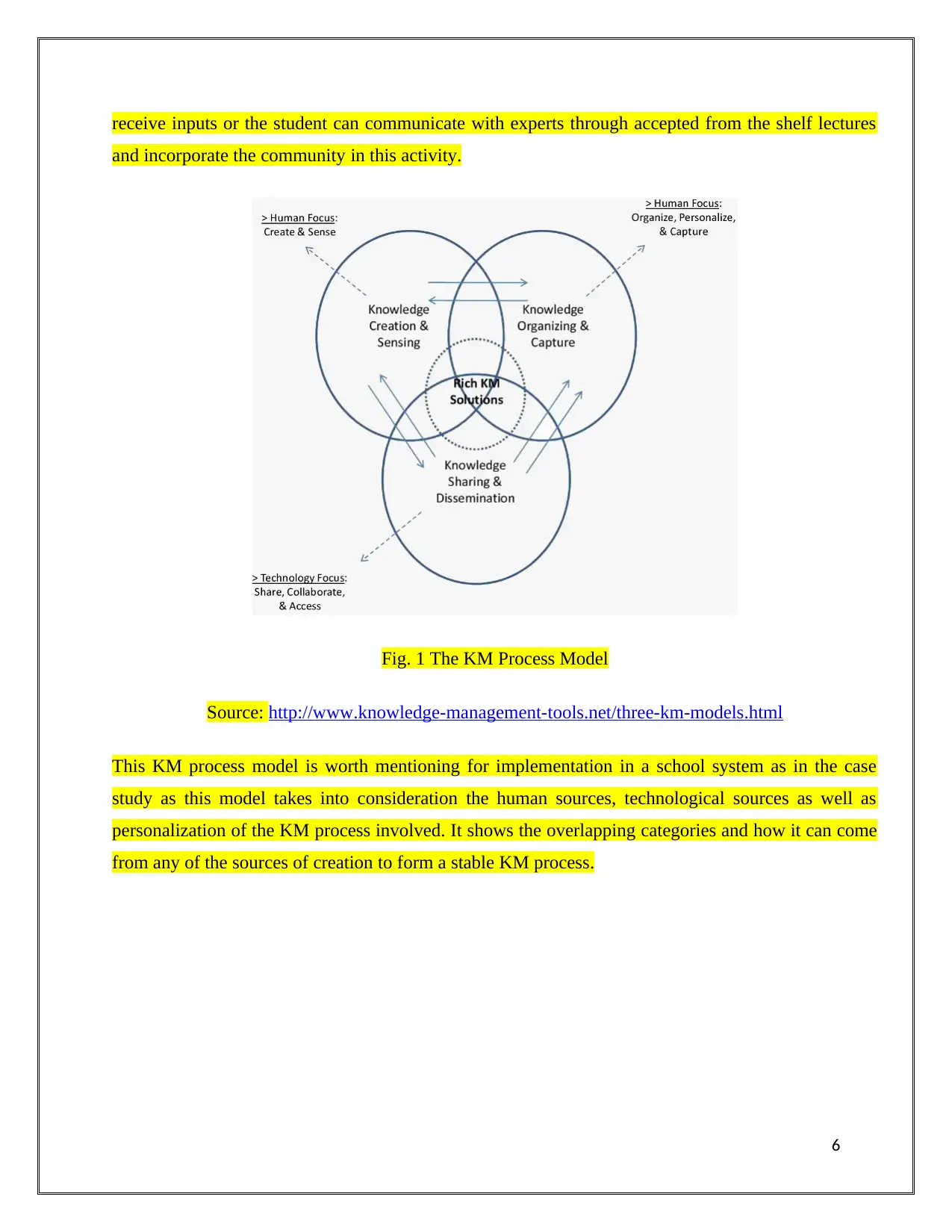
receive inputs or the student can communicate with experts through accepted from the shelf lectures
and incorporate the community in this activity.
Fig. 1 The KM Process Model
Source: http://www.knowledge-management-tools.net/three-km-models.html
This KM process model is worth mentioning for implementation in a school system as in the case
study as this model takes into consideration the human sources, technological sources as well as
personalization of the KM process involved. It shows the overlapping categories and how it can come
from any of the sources of creation to form a stable KM process.
6
and incorporate the community in this activity.
Fig. 1 The KM Process Model
Source: http://www.knowledge-management-tools.net/three-km-models.html
This KM process model is worth mentioning for implementation in a school system as in the case
study as this model takes into consideration the human sources, technological sources as well as
personalization of the KM process involved. It shows the overlapping categories and how it can come
from any of the sources of creation to form a stable KM process.
6
Paraphrase This Document
Need a fresh take? Get an instant paraphrase of this document with our AI Paraphraser
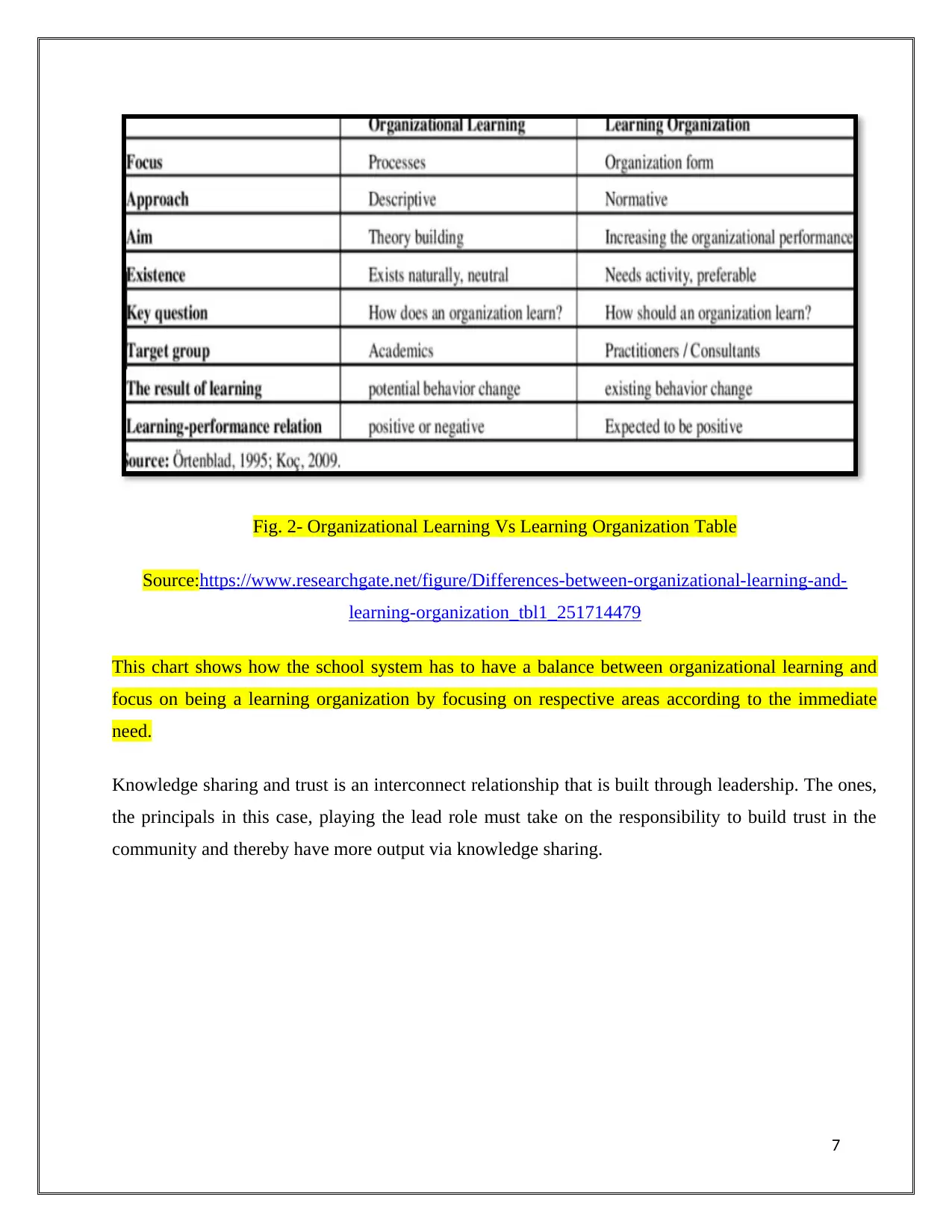
Fig. 2- Organizational Learning Vs Learning Organization Table
Source:https://www.researchgate.net/figure/Differences-between-organizational-learning-and-
learning-organization_tbl1_251714479
This chart shows how the school system has to have a balance between organizational learning and
focus on being a learning organization by focusing on respective areas according to the immediate
need.
Knowledge sharing and trust is an interconnect relationship that is built through leadership. The ones,
the principals in this case, playing the lead role must take on the responsibility to build trust in the
community and thereby have more output via knowledge sharing.
7
Source:https://www.researchgate.net/figure/Differences-between-organizational-learning-and-
learning-organization_tbl1_251714479
This chart shows how the school system has to have a balance between organizational learning and
focus on being a learning organization by focusing on respective areas according to the immediate
need.
Knowledge sharing and trust is an interconnect relationship that is built through leadership. The ones,
the principals in this case, playing the lead role must take on the responsibility to build trust in the
community and thereby have more output via knowledge sharing.
7
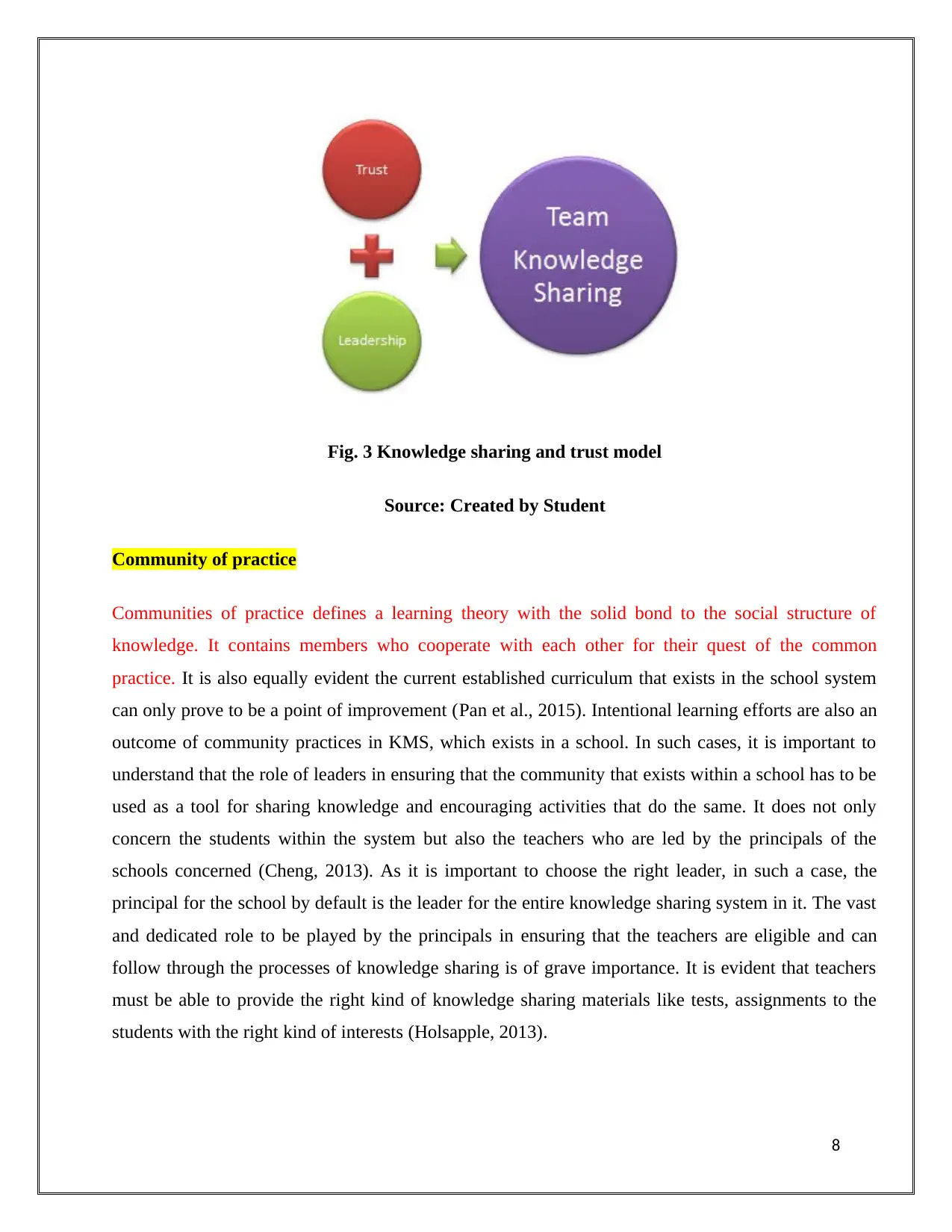
Fig. 3 Knowledge sharing and trust model
Source: Created by Student
Community of practice
Communities of practice defines a learning theory with the solid bond to the social structure of
knowledge. It contains members who cooperate with each other for their quest of the common
practice. It is also equally evident the current established curriculum that exists in the school system
can only prove to be a point of improvement (Pan et al., 2015). Intentional learning efforts are also an
outcome of community practices in KMS, which exists in a school. In such cases, it is important to
understand that the role of leaders in ensuring that the community that exists within a school has to be
used as a tool for sharing knowledge and encouraging activities that do the same. It does not only
concern the students within the system but also the teachers who are led by the principals of the
schools concerned (Cheng, 2013). As it is important to choose the right leader, in such a case, the
principal for the school by default is the leader for the entire knowledge sharing system in it. The vast
and dedicated role to be played by the principals in ensuring that the teachers are eligible and can
follow through the processes of knowledge sharing is of grave importance. It is evident that teachers
must be able to provide the right kind of knowledge sharing materials like tests, assignments to the
students with the right kind of interests (Holsapple, 2013).
8
Source: Created by Student
Community of practice
Communities of practice defines a learning theory with the solid bond to the social structure of
knowledge. It contains members who cooperate with each other for their quest of the common
practice. It is also equally evident the current established curriculum that exists in the school system
can only prove to be a point of improvement (Pan et al., 2015). Intentional learning efforts are also an
outcome of community practices in KMS, which exists in a school. In such cases, it is important to
understand that the role of leaders in ensuring that the community that exists within a school has to be
used as a tool for sharing knowledge and encouraging activities that do the same. It does not only
concern the students within the system but also the teachers who are led by the principals of the
schools concerned (Cheng, 2013). As it is important to choose the right leader, in such a case, the
principal for the school by default is the leader for the entire knowledge sharing system in it. The vast
and dedicated role to be played by the principals in ensuring that the teachers are eligible and can
follow through the processes of knowledge sharing is of grave importance. It is evident that teachers
must be able to provide the right kind of knowledge sharing materials like tests, assignments to the
students with the right kind of interests (Holsapple, 2013).
8
⊘ This is a preview!⊘
Do you want full access?
Subscribe today to unlock all pages.
Trusted by 1+ million students worldwide
Applying knowledge for innovation and new knowledge creation comes through proper sharing of
knowledge. All such techniques go hand in hand to make the knowledge sharing process successful.
Implementing these techniques would help apply current knowledge for innovation and thereby create
new things to derive knowledge from. This is why application of knowledge for innovation and new
knowledge creation is an integral part of the knowledge management strategies.
Knowledge management and organizational culture has a key role to play in implementation of all
tools for reaching desired goals of innovation. This can be done through a healthy organizational
culture of knowledge sharing via the knowledge sharing tools like peer assist and knowledge portals.
Organizational memory is about acquiring new knowledge and skills while retaining it in memory.
This works best through community practices but can also be implemented otherwise through other
technological knowledge sharing tools. This is created through the course of existence in the
organization. This when implemented helps retain more knowledge via the sharing of knowledge.
Critical discussion of outcomes of the implementation and compare this against the
KM theories discussed
The case study based on the perspective of communities of practice shows how the principals
and the chairpersons have a key role to play in acting as leaders for an organizational setting.
Through such practices the teachers are well versed with instructions that they must implement
to help students develop their leadership skills and achievements (Hart, 2013). They allude to
non-canonical and canonical practice that are ideas like espoused theory and theory being used
depicted in the past area. In addition, canonical practice mentions to devotion to formal
procedures and rules, whereas non-canonical indicates to the informal practices which
overwhelm everyday actions.
In this way, learning is observed as originating from the social procedure of developing a
professional, because it provides the individual the social background of being a combined
portion of the community. Moreover, the social structure of personality forms every people's
understanding and view of the world. Along with that, learning and the formation of new
knowledge would then be able to happen in the setting in need of community forum as well as it
can be shared by the social practice. In addition, the purpose isn't to obtain a particular
9
knowledge. All such techniques go hand in hand to make the knowledge sharing process successful.
Implementing these techniques would help apply current knowledge for innovation and thereby create
new things to derive knowledge from. This is why application of knowledge for innovation and new
knowledge creation is an integral part of the knowledge management strategies.
Knowledge management and organizational culture has a key role to play in implementation of all
tools for reaching desired goals of innovation. This can be done through a healthy organizational
culture of knowledge sharing via the knowledge sharing tools like peer assist and knowledge portals.
Organizational memory is about acquiring new knowledge and skills while retaining it in memory.
This works best through community practices but can also be implemented otherwise through other
technological knowledge sharing tools. This is created through the course of existence in the
organization. This when implemented helps retain more knowledge via the sharing of knowledge.
Critical discussion of outcomes of the implementation and compare this against the
KM theories discussed
The case study based on the perspective of communities of practice shows how the principals
and the chairpersons have a key role to play in acting as leaders for an organizational setting.
Through such practices the teachers are well versed with instructions that they must implement
to help students develop their leadership skills and achievements (Hart, 2013). They allude to
non-canonical and canonical practice that are ideas like espoused theory and theory being used
depicted in the past area. In addition, canonical practice mentions to devotion to formal
procedures and rules, whereas non-canonical indicates to the informal practices which
overwhelm everyday actions.
In this way, learning is observed as originating from the social procedure of developing a
professional, because it provides the individual the social background of being a combined
portion of the community. Moreover, the social structure of personality forms every people's
understanding and view of the world. Along with that, learning and the formation of new
knowledge would then be able to happen in the setting in need of community forum as well as it
can be shared by the social practice. In addition, the purpose isn't to obtain a particular
9
Paraphrase This Document
Need a fresh take? Get an instant paraphrase of this document with our AI Paraphraser
knowledge, yet rather to be conceded entree to the community as well as its language and
culture. As a newcomer studies the informal and formal culture as well as values of community,
this case study turns into an authentic part.
In this way, management has to understand the disadvantage, advantage, and the restriction of
communities of practice. In this way, as they are so lightly considered it might be extremely
difficult to know them when the problem ought to be tackled to regulate this some organizations
now are drawing their communities of practice. Moreover, Knowledge management (KM)
system and activities should in this manner be non-disruptive, supportive, and must not
implement standard practice (Wang et al., 2014). Because of the close draws to "doing" and the
cultural aspects, it may need advanced solutions- for example utilizing temporary cross
functional project team which can control knowledge from varied parts, learn, apply it, and the
reallocate the new knowledge back into the communities of individual member.
Organizational culture- From the case study it is evident that chairpersons hold more power to bring
in instructional changes in the organization which oversees the teacher’s learning and effects the
students’ achievements. It shows how an effective organizational culture that uses KM tools and has a
healthy workplace environment can have a positive impact in knowledge sharing (Geisler and
Wickramasinghe, 2015).
Knowledge capture and codification- In terms of knowledge capture through harnessing the tacit
knowledge capture by implementing roadmaps, interviews or assistance from others as in the
case study, from the finding it is self-explanatory how such sessions can systematically have an
effect on the knowledge sharing system.
Knowledge management cycle- As discussed, that organizational knowledge is one that is a
direct result of social interactions as well as knowledge sharing at individual level.
Implementation of this technique through knowledge management cycle would provide a better
sense of the particular topic discussed and only add more to it.
Knowledge management tools- As mentioned in the case study, multiple knowledge
management tools can be directed at a community which can bring instructional changes, in the
case of teachers here, these tools would make the knowledge management cycle easier for every
individual in the community to follow.
10
culture. As a newcomer studies the informal and formal culture as well as values of community,
this case study turns into an authentic part.
In this way, management has to understand the disadvantage, advantage, and the restriction of
communities of practice. In this way, as they are so lightly considered it might be extremely
difficult to know them when the problem ought to be tackled to regulate this some organizations
now are drawing their communities of practice. Moreover, Knowledge management (KM)
system and activities should in this manner be non-disruptive, supportive, and must not
implement standard practice (Wang et al., 2014). Because of the close draws to "doing" and the
cultural aspects, it may need advanced solutions- for example utilizing temporary cross
functional project team which can control knowledge from varied parts, learn, apply it, and the
reallocate the new knowledge back into the communities of individual member.
Organizational culture- From the case study it is evident that chairpersons hold more power to bring
in instructional changes in the organization which oversees the teacher’s learning and effects the
students’ achievements. It shows how an effective organizational culture that uses KM tools and has a
healthy workplace environment can have a positive impact in knowledge sharing (Geisler and
Wickramasinghe, 2015).
Knowledge capture and codification- In terms of knowledge capture through harnessing the tacit
knowledge capture by implementing roadmaps, interviews or assistance from others as in the
case study, from the finding it is self-explanatory how such sessions can systematically have an
effect on the knowledge sharing system.
Knowledge management cycle- As discussed, that organizational knowledge is one that is a
direct result of social interactions as well as knowledge sharing at individual level.
Implementation of this technique through knowledge management cycle would provide a better
sense of the particular topic discussed and only add more to it.
Knowledge management tools- As mentioned in the case study, multiple knowledge
management tools can be directed at a community which can bring instructional changes, in the
case of teachers here, these tools would make the knowledge management cycle easier for every
individual in the community to follow.
10
Knowledge management models- Organizational settings as well as open system settings are
both great ways of knowledge sharing and have different impacts, while organizational setting
pushes for confined knowledge sharing, open systems are not confined in a community (Nonaka
and Toyama, 2015). In this case study the confinement of knowledge sharing can be witnessed
within schools of a district or a more confined region, while that makes learning more compact
and comprehensive an open system would have added more to experience of learning.
Applying knowledge for innovation- Applying knowledge for innovation is another strategy in
this case which has resulted in students and teachers participating more new learning new
outcomes and adding more to the community in terms of knowledge sharing.
Conclusion
The analysis above is defining the fundamentals of the Knowledge Management procedure
mainly focusing upon the questions of a community of practices according to a given case study
where a principal of an institution is developing such a culture of enormous knowledge sharing
atmosphere. The work is consisting of a literature review on the community of practice along
with a critical analysis of the case study. The work is concluding that the functioning of the
knowledge management system can never be carried without a community of practice which is
required to be updated along with the development of technology.
11
both great ways of knowledge sharing and have different impacts, while organizational setting
pushes for confined knowledge sharing, open systems are not confined in a community (Nonaka
and Toyama, 2015). In this case study the confinement of knowledge sharing can be witnessed
within schools of a district or a more confined region, while that makes learning more compact
and comprehensive an open system would have added more to experience of learning.
Applying knowledge for innovation- Applying knowledge for innovation is another strategy in
this case which has resulted in students and teachers participating more new learning new
outcomes and adding more to the community in terms of knowledge sharing.
Conclusion
The analysis above is defining the fundamentals of the Knowledge Management procedure
mainly focusing upon the questions of a community of practices according to a given case study
where a principal of an institution is developing such a culture of enormous knowledge sharing
atmosphere. The work is consisting of a literature review on the community of practice along
with a critical analysis of the case study. The work is concluding that the functioning of the
knowledge management system can never be carried without a community of practice which is
required to be updated along with the development of technology.
11
⊘ This is a preview!⊘
Do you want full access?
Subscribe today to unlock all pages.
Trusted by 1+ million students worldwide

1 out of 14


Related Documents


Your All-in-One AI-Powered Toolkit for Academic Success.
+13062052269
info@desklib.com
Available 24*7 on WhatsApp / Email
![[object Object]](/_next/static/media/star-bottom.7253800d.svg)
Unlock your academic potential
Copyright © 2020–2026 A2Z Services. All Rights Reserved. Developed and managed by ZUCOL.