Case Study: Exploring ApoE Genotyping for Early Cancer Detection
VerifiedAdded on 2023/04/23
|11
|3284
|309
Case Study
AI Summary
This case study examines the potential of using ApolipoE (ApoE) genotyping for early detection of a rare cancer prevalent in young adults. The study focuses on the role of specific ApoE alleles, particularly recessive homozygotes, as strong predictors of the disease. It discusses various genotyping technologies such as fragment length polymorphism, mass spectrophotometry, and DNA microarrays, highlighting their pros and cons, with a preference for mass spectrometry due to its accuracy and cost-effectiveness. The case study also addresses ethical considerations related to genetic testing, including disclosure of diagnosis, family planning, and potential social stigma, especially considering the link between ApoE and Alzheimer's disease. Furthermore, it touches upon the costs associated with testing and the benefits of early cancer detection versus the potential psychological impact of informing individuals about their genetic predisposition to Alzheimer's. The study concludes by emphasizing the potential of mass spectrophotometry in detecting genetic similarities between cancerous symptoms and ApoE alleles, offering insights into the hereditary nature of cancer and its possible link to Alzheimer's disease.

Running head: CASE STUDY SCENARIO
Topic: CASE STUDY SCENARIO
Name of the Student:
Name of the University:
Author Note:
Topic: CASE STUDY SCENARIO
Name of the Student:
Name of the University:
Author Note:

Paraphrase This Document
Need a fresh take? Get an instant paraphrase of this document with our AI Paraphraser
1CASE STUDY SCENARIO
One of the most dreadful diseases which has taken the world by storm is
cancer, killing millions of people with no such available way of prevention or prophylaxis.
According to epidemiological statistics, one of the countries most affected by various forms
of cancers is Korea. More than 224,177 cases have been reported and 1,234,879 cases
reported within a decade especially in 2012. Each year, the rates increase by 3.3% (Jung et
al.,2015). The main problem of cancer being a deadly disease is the uncontrolled rate of
multiplication. The following paragraphs throw light on a possible way of linking the
treatment of cancer with inheritance which simultaneously explores the involvement of
alleles of apolipoE. Hence the formulation of an idea implementing the genotype of the
alleles with suggested technologies and the risks as well as costs associated with such studies
pertaining to human cells is discussed here. Thus an overview of the possible methods of
genotyping and its consequent effects on other diseases genetically linked are described.
Some of the technologies for the genotyping of Apo lipoproteins are described below:
Fragment length polymorphism: Fragment length polymorphism is one of the methods for
genotyping of apolipoE proteins. Genotyping can be done for polymorphism studies of
apolipoE genes followed by reverse techniques for hybridization. Studies reveal that
polymorphism studies have proved effective in showing the allele E4 is significantly higher
than other alleles in patients suffering from psoriasis (Al Harthi et al.,2014). However, this
technology also has its own pros and cons. Techniques like polymorphism help in allowing
many samples to be multiplexed. Moreover, it can process increasing number of samples at
significantly higher speed along with maintenance of quality and number of reads per run. It
is also good for barcode tagging of various amplicons alongside adaptors which allow
samples to be multiplexed. Cons include the promptness of filtering quality for avoiding
diversity overestimation. Moreover, there are various problems related with reproducibility of
One of the most dreadful diseases which has taken the world by storm is
cancer, killing millions of people with no such available way of prevention or prophylaxis.
According to epidemiological statistics, one of the countries most affected by various forms
of cancers is Korea. More than 224,177 cases have been reported and 1,234,879 cases
reported within a decade especially in 2012. Each year, the rates increase by 3.3% (Jung et
al.,2015). The main problem of cancer being a deadly disease is the uncontrolled rate of
multiplication. The following paragraphs throw light on a possible way of linking the
treatment of cancer with inheritance which simultaneously explores the involvement of
alleles of apolipoE. Hence the formulation of an idea implementing the genotype of the
alleles with suggested technologies and the risks as well as costs associated with such studies
pertaining to human cells is discussed here. Thus an overview of the possible methods of
genotyping and its consequent effects on other diseases genetically linked are described.
Some of the technologies for the genotyping of Apo lipoproteins are described below:
Fragment length polymorphism: Fragment length polymorphism is one of the methods for
genotyping of apolipoE proteins. Genotyping can be done for polymorphism studies of
apolipoE genes followed by reverse techniques for hybridization. Studies reveal that
polymorphism studies have proved effective in showing the allele E4 is significantly higher
than other alleles in patients suffering from psoriasis (Al Harthi et al.,2014). However, this
technology also has its own pros and cons. Techniques like polymorphism help in allowing
many samples to be multiplexed. Moreover, it can process increasing number of samples at
significantly higher speed along with maintenance of quality and number of reads per run. It
is also good for barcode tagging of various amplicons alongside adaptors which allow
samples to be multiplexed. Cons include the promptness of filtering quality for avoiding
diversity overestimation. Moreover, there are various problems related with reproducibility of
2CASE STUDY SCENARIO
the implemented technology besides the semi quantitative potential inclusive of techniques
like pyro tag sequencing (De la fuente et al.,2014).
Mass spectrophotometry: Genes like apolipoE are pivotal for diseases like Alzheimer’s
disease. Use of novel methods of mass spectrometry will help in the specification as well as
quantification of the ApolipoE genes through genotyping. Such studies can give a further
insight into the numerous links with status of cognition, age, established biomarkers as well
as cholesterol levels. It further can give us an insight in the comparison between the levels of
cerebrospinal fluid as well as ApolipoE proteins (Martinez-Morillo et al., 2014). According
to various studies conducted for APOE genotyping method on the bass of allele specific
Polymerase Chain Reaction studies states that it is one of the most cost effective and accurate
methods of carrying out such genotypic studies and most importantly it can be applied to
larger samples (Zhong et al., 2016). The major problem of doing mass spectrophotometry for
genotyping of apolipoE genes are as that there can be ambiguous determinations showing
variety of technical issues. Phenotyping is a better alternative although it will not yield the
desired results for genotyping (Hirtz et al., 2016).
DNA microarrays: Other methods for the genotyping of proteins like all the eight proteins of
ApolipoE is the use of DNA microarrays. Genotyping of ApolipoE protein has been done
with respect to perdontitis groups. Microarray assays reveal that they have been found in
accordance with the hardy Weinberg equilibrium. Various bacterial colonization’s has been
found in sub gingival pockets which has been found using periodontal kits with relation to
pathogens. Genetic analysis using mice has shown that deficiency of these proteins lead to
hyperlipidemia (Linhartova et al.,2015). DNA microarrays are mainly used for detection and
methylation and he methylation in various cases . The advantages of using techniques like
microarrays include inexpensive and accurate quantitative data analysis (Taleat, Mathwig,
Sudholter., 2015). The problems faced after undergoing DNA microarrays are detection on
the implemented technology besides the semi quantitative potential inclusive of techniques
like pyro tag sequencing (De la fuente et al.,2014).
Mass spectrophotometry: Genes like apolipoE are pivotal for diseases like Alzheimer’s
disease. Use of novel methods of mass spectrometry will help in the specification as well as
quantification of the ApolipoE genes through genotyping. Such studies can give a further
insight into the numerous links with status of cognition, age, established biomarkers as well
as cholesterol levels. It further can give us an insight in the comparison between the levels of
cerebrospinal fluid as well as ApolipoE proteins (Martinez-Morillo et al., 2014). According
to various studies conducted for APOE genotyping method on the bass of allele specific
Polymerase Chain Reaction studies states that it is one of the most cost effective and accurate
methods of carrying out such genotypic studies and most importantly it can be applied to
larger samples (Zhong et al., 2016). The major problem of doing mass spectrophotometry for
genotyping of apolipoE genes are as that there can be ambiguous determinations showing
variety of technical issues. Phenotyping is a better alternative although it will not yield the
desired results for genotyping (Hirtz et al., 2016).
DNA microarrays: Other methods for the genotyping of proteins like all the eight proteins of
ApolipoE is the use of DNA microarrays. Genotyping of ApolipoE protein has been done
with respect to perdontitis groups. Microarray assays reveal that they have been found in
accordance with the hardy Weinberg equilibrium. Various bacterial colonization’s has been
found in sub gingival pockets which has been found using periodontal kits with relation to
pathogens. Genetic analysis using mice has shown that deficiency of these proteins lead to
hyperlipidemia (Linhartova et al.,2015). DNA microarrays are mainly used for detection and
methylation and he methylation in various cases . The advantages of using techniques like
microarrays include inexpensive and accurate quantitative data analysis (Taleat, Mathwig,
Sudholter., 2015). The problems faced after undergoing DNA microarrays are detection on
⊘ This is a preview!⊘
Do you want full access?
Subscribe today to unlock all pages.

Trusted by 1+ million students worldwide
3CASE STUDY SCENARIO
assortment basis, bleeding where strong signal are often detected in adjacent wells, cross
hybridization studies.
Among all the methods which are discussed for the genotyping analysis of the eight
present alleles, the most preferred method is Mass spectrometry. The most important
advantage is that when combined with enzymatic extension of the primers, specificity levels
are high and are unparalleled to other methods of study. Moreover only hybridization can be
detected. After dispensing of microchips of matrix into well of the chip, diagnosed products
can be well detected by mass spectrometry studies. Moreover, the techniques involved are
cheap and easily affordable which is an important deciding factors in choosing process in
experiments. Several step wise downscaling of the process reduces the cost involved.
Through various research studies it has been found out that use for DNA enrichment,
purification and extraction followed by PCR based addition of studies make the analysis of
oligonucleotides and proteins like apolipoE much more rapid, high throughtput as well as
sensitive . Mass spectrometry studies are also good for techniques like DNA methylation as
well as virus typing methods (Zhu et al.,2018). Moreover DNA microarrays are the preferred
methods for molecular processes like genotyping because of their accuracy and specificity
which is required in sequencing of genes pivotal to the given study.
There has been a proper plan of development with the chosen technology over the
other two methods. Mass spectrometric studies has been done and are preferred over
techniques like fragment length polymorphism or recent methods like DNA microarrays,
because of its high accuracy alongside the short time span taken for carrying out the studies
as well as its increased cost effectiveness regarding the scientific processes. The following
paragraphs encompass the various protocols for the verification as well as the outcomes
which are anticipated for the successful genotyping of apolipoE proteins like ApolipoE and
its implementation in the subsequent diagnosis of diseases like cancer. Finally the strengths
assortment basis, bleeding where strong signal are often detected in adjacent wells, cross
hybridization studies.
Among all the methods which are discussed for the genotyping analysis of the eight
present alleles, the most preferred method is Mass spectrometry. The most important
advantage is that when combined with enzymatic extension of the primers, specificity levels
are high and are unparalleled to other methods of study. Moreover only hybridization can be
detected. After dispensing of microchips of matrix into well of the chip, diagnosed products
can be well detected by mass spectrometry studies. Moreover, the techniques involved are
cheap and easily affordable which is an important deciding factors in choosing process in
experiments. Several step wise downscaling of the process reduces the cost involved.
Through various research studies it has been found out that use for DNA enrichment,
purification and extraction followed by PCR based addition of studies make the analysis of
oligonucleotides and proteins like apolipoE much more rapid, high throughtput as well as
sensitive . Mass spectrometry studies are also good for techniques like DNA methylation as
well as virus typing methods (Zhu et al.,2018). Moreover DNA microarrays are the preferred
methods for molecular processes like genotyping because of their accuracy and specificity
which is required in sequencing of genes pivotal to the given study.
There has been a proper plan of development with the chosen technology over the
other two methods. Mass spectrometric studies has been done and are preferred over
techniques like fragment length polymorphism or recent methods like DNA microarrays,
because of its high accuracy alongside the short time span taken for carrying out the studies
as well as its increased cost effectiveness regarding the scientific processes. The following
paragraphs encompass the various protocols for the verification as well as the outcomes
which are anticipated for the successful genotyping of apolipoE proteins like ApolipoE and
its implementation in the subsequent diagnosis of diseases like cancer. Finally the strengths
Paraphrase This Document
Need a fresh take? Get an instant paraphrase of this document with our AI Paraphraser
4CASE STUDY SCENARIO
of high molecular technologies like Mass spectrophotometric studies and the related potential
in detection of various diseases is discussed.
The use of mass spectrometry can be used for its successful implementation in the
testing and genotyping of all the genes included for eight of the apolipoE proteins. Studies
involving genotyping will provide an accurate details of the genetic make of an organism,
human beings in this case. Alignment of the genotyping studies with mass spectrometry along
with advances processes like MALDI-TOF would give a details about the fundamental
processes in humans linked with the mass of biomolecules. Hence tests can be conducted for
probing into the various molecular processes aligning with the biology of human disorders
like cancers by accessing genotypic details of the apolipoE proteins involved through mass
spectrometric studies. Anticipation of the studies will explore the role of lipoproteins in
diseases like Alzheimer’s and for checking the validity of the participation of the apolipoE
proteins, contamination should be reduced by maximum amount. Firstly, apolipoE proteins
will have to gather by subsequent processes of protein separation, purification and
sequencing. After extraction of the sample has to be prepared for spectrophotometric studies.
Maintaining the quality and reproducibility of the sample. After it, results of mass
spectrometric studies can be analysed for the genotypic studies of the purified protein.
Following it, proper validation and verification of the studies are done using validation
softwares. Moreover, biological testing can be done with the help of biological markers.
The role of the recessive alleles of apolipoE proteins in early detection of cancer has
been anticipated. There is the prevalence of a common cancer seen mainly in young people.
There has been a probable cure for the cancer which not biased for gender. Early detection
studies of cancer has found the presence of recessive allele of apolipoE proteins which shows
signs of inheritance for its link with cancer. If cancer is a hereditary disease then the proper
of high molecular technologies like Mass spectrophotometric studies and the related potential
in detection of various diseases is discussed.
The use of mass spectrometry can be used for its successful implementation in the
testing and genotyping of all the genes included for eight of the apolipoE proteins. Studies
involving genotyping will provide an accurate details of the genetic make of an organism,
human beings in this case. Alignment of the genotyping studies with mass spectrometry along
with advances processes like MALDI-TOF would give a details about the fundamental
processes in humans linked with the mass of biomolecules. Hence tests can be conducted for
probing into the various molecular processes aligning with the biology of human disorders
like cancers by accessing genotypic details of the apolipoE proteins involved through mass
spectrometric studies. Anticipation of the studies will explore the role of lipoproteins in
diseases like Alzheimer’s and for checking the validity of the participation of the apolipoE
proteins, contamination should be reduced by maximum amount. Firstly, apolipoE proteins
will have to gather by subsequent processes of protein separation, purification and
sequencing. After extraction of the sample has to be prepared for spectrophotometric studies.
Maintaining the quality and reproducibility of the sample. After it, results of mass
spectrometric studies can be analysed for the genotypic studies of the purified protein.
Following it, proper validation and verification of the studies are done using validation
softwares. Moreover, biological testing can be done with the help of biological markers.
The role of the recessive alleles of apolipoE proteins in early detection of cancer has
been anticipated. There is the prevalence of a common cancer seen mainly in young people.
There has been a probable cure for the cancer which not biased for gender. Early detection
studies of cancer has found the presence of recessive allele of apolipoE proteins which shows
signs of inheritance for its link with cancer. If cancer is a hereditary disease then the proper
5CASE STUDY SCENARIO
insight into the role of these apolipoE proteins will provide a possible way of reducing
cancer. This is the final anticipation leading to a possible cure of the disease.
Considering the effect of ApolipoE and its connection with Alzheimer’s disease many
ethical issues about the genotyping methods has been considered. Almost two decades
inclusive of intense research has found the role of apolipoE4 in Alzheimer’s disease. It
affects the clearance proceeded by aggregation of Aβ and the slow seeding stage has a strong
impact on the growth of plaque development (Vassar,2016 ). Various ethical considerations
shown taken into account like disclosure of the diagnosis of patients along with results of the
test, proper methods of family planning as well as issues like employment, social stigma is
also equally important. Moreover considerations should be made about genetic mutations
varying in terms of gene expression as well as penetrance (Cauwenberghe, Broeckhoven &
Sleegers et al.,2016). Conductance of preclinical trials leads to the formation of various
policy challenges and trails like disclosing biomarker results and determination of a proper
risk marker ratio in participants who are asymptomatic alongside the policy protection
regarding insurance of the patients (Molinuevo et al.,2016).
Testing of the participation of alleles of apolipoE in the early detection of cancer
need to keep few ethical issues under control. According to studies carried out by researchers,
instructors and lab personnel need to organise for alternative arrangements for the ethical
concerns faced by the students during such educational experiences. The FDA might have
concerns regarding the personal testing systems in genetics providing information which is
medically relevant. They have also sent warning to Genotyping Company temporarily stalling
the process until proper evidence of clinical as well as analytical validity (La Bonte &
Beers,2015). As far as costs of testing are concerned, studies conducted for diagonistics and
screening tests in Germarny estimate the averae cost of treatment of vcervical cancer which
is inclusive of testing of strains ,so no costs have to be assumed for it. Costs can be estimated
insight into the role of these apolipoE proteins will provide a possible way of reducing
cancer. This is the final anticipation leading to a possible cure of the disease.
Considering the effect of ApolipoE and its connection with Alzheimer’s disease many
ethical issues about the genotyping methods has been considered. Almost two decades
inclusive of intense research has found the role of apolipoE4 in Alzheimer’s disease. It
affects the clearance proceeded by aggregation of Aβ and the slow seeding stage has a strong
impact on the growth of plaque development (Vassar,2016 ). Various ethical considerations
shown taken into account like disclosure of the diagnosis of patients along with results of the
test, proper methods of family planning as well as issues like employment, social stigma is
also equally important. Moreover considerations should be made about genetic mutations
varying in terms of gene expression as well as penetrance (Cauwenberghe, Broeckhoven &
Sleegers et al.,2016). Conductance of preclinical trials leads to the formation of various
policy challenges and trails like disclosing biomarker results and determination of a proper
risk marker ratio in participants who are asymptomatic alongside the policy protection
regarding insurance of the patients (Molinuevo et al.,2016).
Testing of the participation of alleles of apolipoE in the early detection of cancer
need to keep few ethical issues under control. According to studies carried out by researchers,
instructors and lab personnel need to organise for alternative arrangements for the ethical
concerns faced by the students during such educational experiences. The FDA might have
concerns regarding the personal testing systems in genetics providing information which is
medically relevant. They have also sent warning to Genotyping Company temporarily stalling
the process until proper evidence of clinical as well as analytical validity (La Bonte &
Beers,2015). As far as costs of testing are concerned, studies conducted for diagonistics and
screening tests in Germarny estimate the averae cost of treatment of vcervical cancer which
is inclusive of testing of strains ,so no costs have to be assumed for it. Costs can be estimated
⊘ This is a preview!⊘
Do you want full access?
Subscribe today to unlock all pages.
Trusted by 1+ million students worldwide
6CASE STUDY SCENARIO
using DRG costs. However the testing model lacks in the differentiation between various
stages of the disease along median cost across all options of treatment and ages and costs of
rehabilitation are also excluded (Kacker et al.,2015).
Account of the benefit of early detection of the cancer versus informing a younger
individual that have a genotype indicating a distinct possibility of predisposition for early
onset Alzheimer’s. There will be an increased benefit for early detection of diseases like
detection of cancer which shows an indirect link with young patients suffering from
Alzheimer’s disease having a tendency of genetic predisposition. One of the major
predisposition factors in young children regarding heritable risks associated with cancer is
inclusive or early onset symptoms like hereditary retinoblastoma as well as those during
adulthood like hereditary pheochromocyotma or paragaanglioma. Diagnostic testing can
include processes like provision of prognostic information, tumour formation, so children
should be careful before exposure to UV rays (Kesserwan et al.,2016). Thus diseases like
cancer which have a probability of being hereditary subsequently passing the recessive alleles
of apolipoE proteins from one generation to other, can been indirectly linked to Alzheimer’s
disease which also shares features related to heredity. Thus, young children may show
predispository factors or signs and symptoms which are similar to that shown by the common
hereditary diseases.
The final product is a MALDI TOF mass spectrophotometer which is capable of
detecting the elements present in the sample highlighting the major components of the
samples involved. Moreover, the accumulated results will focus on the genetic similarities
found in t which have an alignment with the genetic constitution of cancerous symptoms
since the same alleles have been found in cancerous cells. Hence the slight anomalies
between the eight different alleles can simultaneously be detected in the results of such
advanced technological equipment.
using DRG costs. However the testing model lacks in the differentiation between various
stages of the disease along median cost across all options of treatment and ages and costs of
rehabilitation are also excluded (Kacker et al.,2015).
Account of the benefit of early detection of the cancer versus informing a younger
individual that have a genotype indicating a distinct possibility of predisposition for early
onset Alzheimer’s. There will be an increased benefit for early detection of diseases like
detection of cancer which shows an indirect link with young patients suffering from
Alzheimer’s disease having a tendency of genetic predisposition. One of the major
predisposition factors in young children regarding heritable risks associated with cancer is
inclusive or early onset symptoms like hereditary retinoblastoma as well as those during
adulthood like hereditary pheochromocyotma or paragaanglioma. Diagnostic testing can
include processes like provision of prognostic information, tumour formation, so children
should be careful before exposure to UV rays (Kesserwan et al.,2016). Thus diseases like
cancer which have a probability of being hereditary subsequently passing the recessive alleles
of apolipoE proteins from one generation to other, can been indirectly linked to Alzheimer’s
disease which also shares features related to heredity. Thus, young children may show
predispository factors or signs and symptoms which are similar to that shown by the common
hereditary diseases.
The final product is a MALDI TOF mass spectrophotometer which is capable of
detecting the elements present in the sample highlighting the major components of the
samples involved. Moreover, the accumulated results will focus on the genetic similarities
found in t which have an alignment with the genetic constitution of cancerous symptoms
since the same alleles have been found in cancerous cells. Hence the slight anomalies
between the eight different alleles can simultaneously be detected in the results of such
advanced technological equipment.
Paraphrase This Document
Need a fresh take? Get an instant paraphrase of this document with our AI Paraphraser
7CASE STUDY SCENARIO
From the following paragraphs it can be seen that ApolipoE proteins play a pivotal
role in being linked with the heredity of cases involving cancers and showing strong
predictions of the disease. Cancer is a dreadful disease which is recent shown to have link
with the heritable components of the biological systems alongside the expression of 8 alleles
of apolipoE proteins. This can simultaneously affect young patients which shown signs and
symptoms regarding hereditary characteristics thus being indirectly liked to cancerous
symptoms. The aforementioned case study scenario focusses on the various technologies of
genotyping which can subsequently give information on the genetic features of the expression
of the alleles. Thus, a proper developmental plan have been proposed utilizing the best
method of genotyping probing into the details of cancer being genetically linked to the
various predispositions of Alzheimer’s disease shown by children.
From the following paragraphs it can be seen that ApolipoE proteins play a pivotal
role in being linked with the heredity of cases involving cancers and showing strong
predictions of the disease. Cancer is a dreadful disease which is recent shown to have link
with the heritable components of the biological systems alongside the expression of 8 alleles
of apolipoE proteins. This can simultaneously affect young patients which shown signs and
symptoms regarding hereditary characteristics thus being indirectly liked to cancerous
symptoms. The aforementioned case study scenario focusses on the various technologies of
genotyping which can subsequently give information on the genetic features of the expression
of the alleles. Thus, a proper developmental plan have been proposed utilizing the best
method of genotyping probing into the details of cancer being genetically linked to the
various predispositions of Alzheimer’s disease shown by children.
8CASE STUDY SCENARIO
References
Al Harthi, F., Huraib, G. B., Zouman, A., Arfin, M., Tariq, M., & Al-Asmari, A. (2014).
Apolipoprotein E gene polymorphism and serum lipid profile in Saudi patients with
psoriasis. Disease markers, 2014. doi.org/10.1155/2014/239645
Bousman, C. A., Katalinic, N., Martin, D. M., Smith, D. J., Ingram, A., Dowling, N., ... &
Loo, C. K. (2015). Effects of COMT, DRD2, BDNF, and APOE genotypic variation on
treatment efficacy and cognitive side effects of electroconvulsive therapy. The journal of
ECT, 31(2), 129-135. doi: 10.1097/YCT.0000000000000170
de la Fuente, G., Belanche, A., Girwood, S. E., Pinloche, E., Wilkinson, T., & Newbold, C. J.
(2014). Pros and cons of ion-torrent next generation sequencing versus terminal restriction
fragment length polymorphism T-RFLP for studying the rumen bacterial community. PloS
one, 9(7), e101435. doi.org/10.1371/journal.pone.0101435
Hirtz, C., Vialaret, J., Nouadje, G., Schraen, S., Benlian, P., Mary, S., ... & Gabelle, A.
(2016). Development of new quantitative mass spectrometry and semi-automatic
isofocusing methods for the determination of Apolipoprotein E typing. Clinica Chimica
Acta, 454, 33-38.
Jung, K. W., Won, Y. J., Kong, H. J., Oh, C. M., Cho, H., Lee, D. H., & Lee, K. H. (2015).
Cancer statistics in Korea: incidence, mortality, survival, and prevalence in 2012. Cancer
research and treatment: official journal of Korean Cancer Association, 47(2),
127.10.4143/crt.2015.060 doi: 10.4143/crt.2015.060
Kacker, S., Vassallo, R., Keller, M. A., Westhoff, C. M., Frick, K. D., Sandler, S. G., &
Tobian, A. A. (2015). Financial implications of RHD genotyping of pregnant women with
References
Al Harthi, F., Huraib, G. B., Zouman, A., Arfin, M., Tariq, M., & Al-Asmari, A. (2014).
Apolipoprotein E gene polymorphism and serum lipid profile in Saudi patients with
psoriasis. Disease markers, 2014. doi.org/10.1155/2014/239645
Bousman, C. A., Katalinic, N., Martin, D. M., Smith, D. J., Ingram, A., Dowling, N., ... &
Loo, C. K. (2015). Effects of COMT, DRD2, BDNF, and APOE genotypic variation on
treatment efficacy and cognitive side effects of electroconvulsive therapy. The journal of
ECT, 31(2), 129-135. doi: 10.1097/YCT.0000000000000170
de la Fuente, G., Belanche, A., Girwood, S. E., Pinloche, E., Wilkinson, T., & Newbold, C. J.
(2014). Pros and cons of ion-torrent next generation sequencing versus terminal restriction
fragment length polymorphism T-RFLP for studying the rumen bacterial community. PloS
one, 9(7), e101435. doi.org/10.1371/journal.pone.0101435
Hirtz, C., Vialaret, J., Nouadje, G., Schraen, S., Benlian, P., Mary, S., ... & Gabelle, A.
(2016). Development of new quantitative mass spectrometry and semi-automatic
isofocusing methods for the determination of Apolipoprotein E typing. Clinica Chimica
Acta, 454, 33-38.
Jung, K. W., Won, Y. J., Kong, H. J., Oh, C. M., Cho, H., Lee, D. H., & Lee, K. H. (2015).
Cancer statistics in Korea: incidence, mortality, survival, and prevalence in 2012. Cancer
research and treatment: official journal of Korean Cancer Association, 47(2),
127.10.4143/crt.2015.060 doi: 10.4143/crt.2015.060
Kacker, S., Vassallo, R., Keller, M. A., Westhoff, C. M., Frick, K. D., Sandler, S. G., &
Tobian, A. A. (2015). Financial implications of RHD genotyping of pregnant women with
⊘ This is a preview!⊘
Do you want full access?
Subscribe today to unlock all pages.
Trusted by 1+ million students worldwide
9CASE STUDY SCENARIO
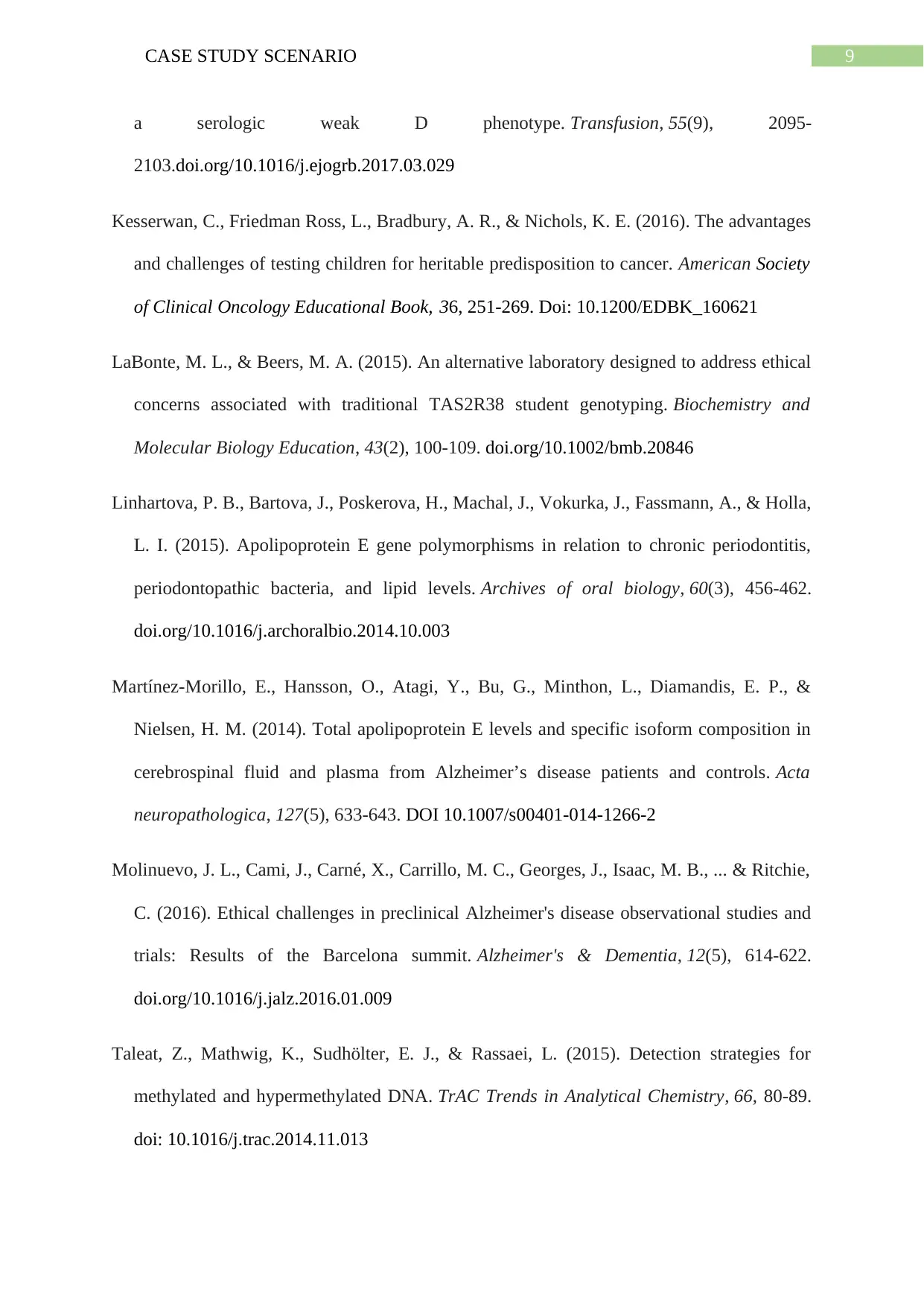
a serologic weak D phenotype. Transfusion, 55(9), 2095-
2103.doi.org/10.1016/j.ejogrb.2017.03.029
Kesserwan, C., Friedman Ross, L., Bradbury, A. R., & Nichols, K. E. (2016). The advantages
and challenges of testing children for heritable predisposition to cancer. American Society
of Clinical Oncology Educational Book, 36, 251-269. Doi: 10.1200/EDBK_160621
LaBonte, M. L., & Beers, M. A. (2015). An alternative laboratory designed to address ethical
concerns associated with traditional TAS2R38 student genotyping. Biochemistry and
Molecular Biology Education, 43(2), 100-109. doi.org/10.1002/bmb.20846
Linhartova, P. B., Bartova, J., Poskerova, H., Machal, J., Vokurka, J., Fassmann, A., & Holla,
L. I. (2015). Apolipoprotein E gene polymorphisms in relation to chronic periodontitis,
periodontopathic bacteria, and lipid levels. Archives of oral biology, 60(3), 456-462.
doi.org/10.1016/j.archoralbio.2014.10.003
Martínez-Morillo, E., Hansson, O., Atagi, Y., Bu, G., Minthon, L., Diamandis, E. P., &
Nielsen, H. M. (2014). Total apolipoprotein E levels and specific isoform composition in
cerebrospinal fluid and plasma from Alzheimer’s disease patients and controls. Acta
neuropathologica, 127(5), 633-643. DOI 10.1007/s00401-014-1266-2
Molinuevo, J. L., Cami, J., Carné, X., Carrillo, M. C., Georges, J., Isaac, M. B., ... & Ritchie,
C. (2016). Ethical challenges in preclinical Alzheimer's disease observational studies and
trials: Results of the Barcelona summit. Alzheimer's & Dementia, 12(5), 614-622.
doi.org/10.1016/j.jalz.2016.01.009
Taleat, Z., Mathwig, K., Sudhölter, E. J., & Rassaei, L. (2015). Detection strategies for
methylated and hypermethylated DNA. TrAC Trends in Analytical Chemistry, 66, 80-89.
doi: 10.1016/j.trac.2014.11.013
a serologic weak D phenotype. Transfusion, 55(9), 2095-
2103.doi.org/10.1016/j.ejogrb.2017.03.029
Kesserwan, C., Friedman Ross, L., Bradbury, A. R., & Nichols, K. E. (2016). The advantages
and challenges of testing children for heritable predisposition to cancer. American Society
of Clinical Oncology Educational Book, 36, 251-269. Doi: 10.1200/EDBK_160621
LaBonte, M. L., & Beers, M. A. (2015). An alternative laboratory designed to address ethical
concerns associated with traditional TAS2R38 student genotyping. Biochemistry and
Molecular Biology Education, 43(2), 100-109. doi.org/10.1002/bmb.20846
Linhartova, P. B., Bartova, J., Poskerova, H., Machal, J., Vokurka, J., Fassmann, A., & Holla,
L. I. (2015). Apolipoprotein E gene polymorphisms in relation to chronic periodontitis,
periodontopathic bacteria, and lipid levels. Archives of oral biology, 60(3), 456-462.
doi.org/10.1016/j.archoralbio.2014.10.003
Martínez-Morillo, E., Hansson, O., Atagi, Y., Bu, G., Minthon, L., Diamandis, E. P., &
Nielsen, H. M. (2014). Total apolipoprotein E levels and specific isoform composition in
cerebrospinal fluid and plasma from Alzheimer’s disease patients and controls. Acta
neuropathologica, 127(5), 633-643. DOI 10.1007/s00401-014-1266-2
Molinuevo, J. L., Cami, J., Carné, X., Carrillo, M. C., Georges, J., Isaac, M. B., ... & Ritchie,
C. (2016). Ethical challenges in preclinical Alzheimer's disease observational studies and
trials: Results of the Barcelona summit. Alzheimer's & Dementia, 12(5), 614-622.
doi.org/10.1016/j.jalz.2016.01.009
Taleat, Z., Mathwig, K., Sudhölter, E. J., & Rassaei, L. (2015). Detection strategies for
methylated and hypermethylated DNA. TrAC Trends in Analytical Chemistry, 66, 80-89.
doi: 10.1016/j.trac.2014.11.013
Paraphrase This Document
Need a fresh take? Get an instant paraphrase of this document with our AI Paraphraser
10CASE STUDY SCENARIO
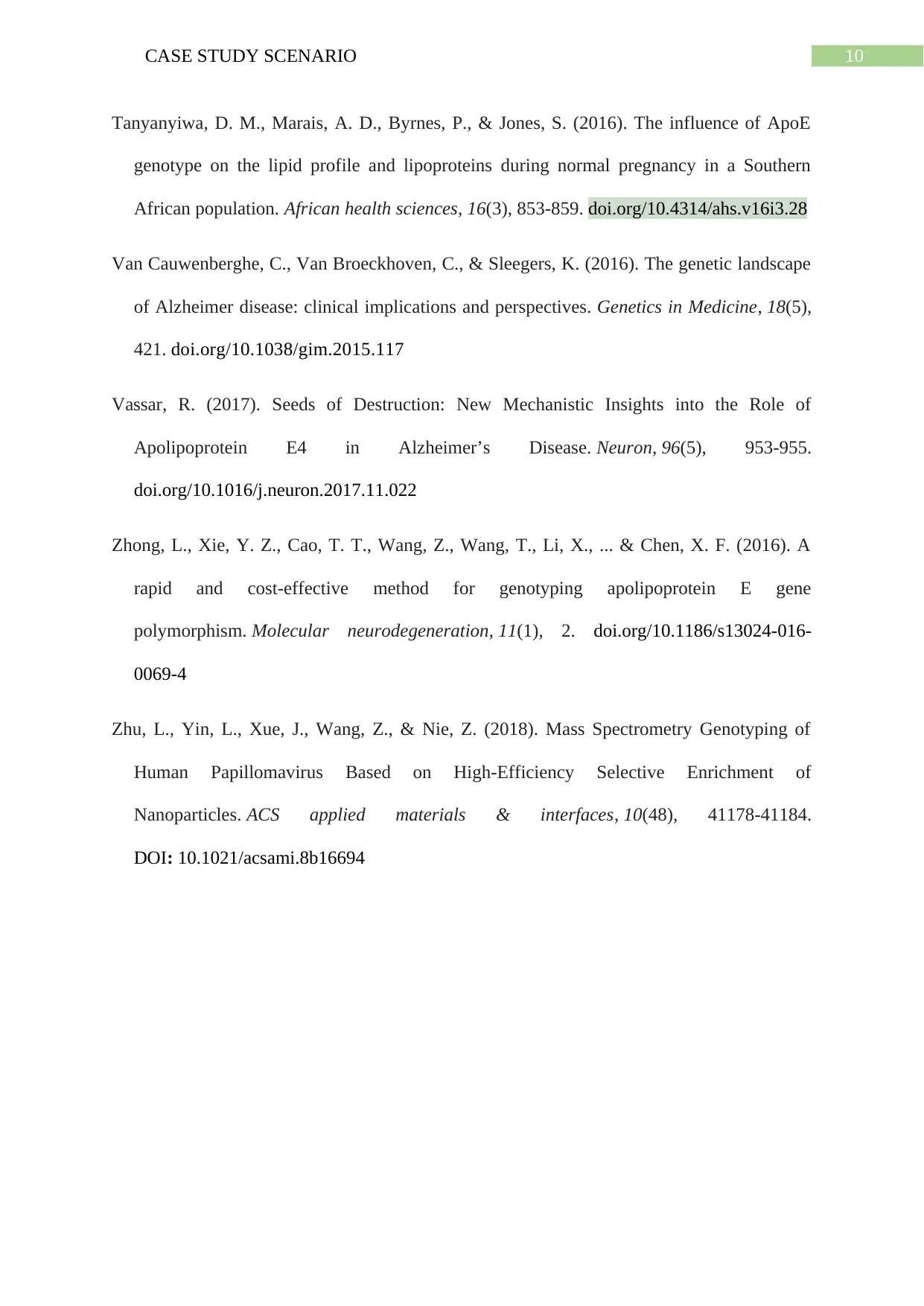
Tanyanyiwa, D. M., Marais, A. D., Byrnes, P., & Jones, S. (2016). The influence of ApoE
genotype on the lipid profile and lipoproteins during normal pregnancy in a Southern
African population. African health sciences, 16(3), 853-859. doi.org/10.4314/ahs.v16i3.28
Van Cauwenberghe, C., Van Broeckhoven, C., & Sleegers, K. (2016). The genetic landscape
of Alzheimer disease: clinical implications and perspectives. Genetics in Medicine, 18(5),
421. doi.org/10.1038/gim.2015.117
Vassar, R. (2017). Seeds of Destruction: New Mechanistic Insights into the Role of
Apolipoprotein E4 in Alzheimer’s Disease. Neuron, 96(5), 953-955.
doi.org/10.1016/j.neuron.2017.11.022
Zhong, L., Xie, Y. Z., Cao, T. T., Wang, Z., Wang, T., Li, X., ... & Chen, X. F. (2016). A
rapid and cost-effective method for genotyping apolipoprotein E gene
polymorphism. Molecular neurodegeneration, 11(1), 2. doi.org/10.1186/s13024-016-
0069-4
Zhu, L., Yin, L., Xue, J., Wang, Z., & Nie, Z. (2018). Mass Spectrometry Genotyping of
Human Papillomavirus Based on High-Efficiency Selective Enrichment of
Nanoparticles. ACS applied materials & interfaces, 10(48), 41178-41184.
DOI: 10.1021/acsami.8b16694
Tanyanyiwa, D. M., Marais, A. D., Byrnes, P., & Jones, S. (2016). The influence of ApoE
genotype on the lipid profile and lipoproteins during normal pregnancy in a Southern
African population. African health sciences, 16(3), 853-859. doi.org/10.4314/ahs.v16i3.28
Van Cauwenberghe, C., Van Broeckhoven, C., & Sleegers, K. (2016). The genetic landscape
of Alzheimer disease: clinical implications and perspectives. Genetics in Medicine, 18(5),
421. doi.org/10.1038/gim.2015.117
Vassar, R. (2017). Seeds of Destruction: New Mechanistic Insights into the Role of
Apolipoprotein E4 in Alzheimer’s Disease. Neuron, 96(5), 953-955.
doi.org/10.1016/j.neuron.2017.11.022
Zhong, L., Xie, Y. Z., Cao, T. T., Wang, Z., Wang, T., Li, X., ... & Chen, X. F. (2016). A
rapid and cost-effective method for genotyping apolipoprotein E gene
polymorphism. Molecular neurodegeneration, 11(1), 2. doi.org/10.1186/s13024-016-
0069-4
Zhu, L., Yin, L., Xue, J., Wang, Z., & Nie, Z. (2018). Mass Spectrometry Genotyping of
Human Papillomavirus Based on High-Efficiency Selective Enrichment of
Nanoparticles. ACS applied materials & interfaces, 10(48), 41178-41184.
DOI: 10.1021/acsami.8b16694

1 out of 11


Your All-in-One AI-Powered Toolkit for Academic Success.
+13062052269
info@desklib.com
Available 24*7 on WhatsApp / Email
![[object Object]](/_next/static/media/star-bottom.7253800d.svg)
Unlock your academic potential
Copyright © 2020–2026 A2Z Services. All Rights Reserved. Developed and managed by ZUCOL.