Civil Engineering Learning Report: Dam Construction and Pore Pressures

Verified

Added on  2022/11/22

|7
|1129
|290
Report
AI Summary
This learning report analyzes the journal article "Pore pressures in concrete dams" (Zee et al., 2011), focusing on the application of the Laplace equation to model piezometric heads and estimate pore pressures within concrete gravity dams. The report uses the Fontana Dam as a case study, exploring how pore pressures influence dam design, stability, and durability. The key findings reveal that pore pressure increases with water depth, necessitating proper drain well placement to mitigate the accumulation of calcium carbonate deposits. The study emphasizes the importance of measurements, mathematical equations, and computer simulations in determining optimal dam design specifications, including drain distances and spacing. The report concludes that pore pressure is a crucial design parameter, essential for ensuring the stability, safety, efficiency, and durability of concrete dams, and highlights the significance of inspection galleries and drain wells in managing pore pressure effects.
Document Page
Lab Report #1 1
Dam Construction, a Case Story
Learning Report #1
Email ID
Submission date
Authored by: your name
tabler-icon-diamond-filled.svg

Paraphrase This Document

Need a fresh take? Get an instant paraphrase of this document with our AI Paraphraser
Document Page
Lab Report #1 2
Article reference: Zee, C. H., Zee, R. & Zee, R., 2011. Pore pressures in concrete dams. Journal
of Geotechnical and Geoenvironmental Engineering, 137(12), pp. 1254-1264.
Online link: https://ascelibrary.org/doi/10.1061/%28ASCE%29GT.1943-5606.0000536
Introduction
The topic presented in this learning report is dam construction. This is a fascinating topic in the
engineering field considering the wide range of applications and benefits of dams. Typically,
dams are constructed to store water for various purposes, reasons and/or uses. However, these
dams can only perform their intended functions satisfactorily and efficiently if they are properly
designed and constructed. The article discussed in this report focuses on pore pressures in
concrete gravity dams (Zee, et al., 2011). This article generally examines how to use Laplace
equation to mathematically represent piezometric heads, which are used to estimate pore
pressure intensities at the drain wells of the dam. The authors of the article used Fontana Dam as
a case study to conduct the study.
As aforementioned, the topic discussed in is this report is very essential in engineering field
because it deals with analysis of an engineering structure (a dam) that is usually designed to
solve societal problems, which is the main obligation of engineers. The article contains
information that can help to understand the manner in which pore pressures influence the design
specifications, stability and durability of concrete gravity dams. Therefore the information herein
can help to design and construct stable, safe, efficient, sustainable and durable concrete dams.
Document Page
Lab Report #1 3
Focused issue
The first issue that the authors have addressed in this article is how to determine piezometric
heads and pore pressures at the drain wells and in dam bodies. This is done using mathematical
equations, particularly Laplace equation that is solved numerically using finite difference
equation. The second issue is how to use pore pressure intensities in determining suitable design
specifications of the dam and identify the best location of drain wells and inspection galleries.
The third issue covered by the authors is how the information about pore pressure intensities and
location of drain wells and inspection galleries can be used to enhance the stability, safety and
durability of concrete dams.
Results and discussion
One of the key findings from the study conducted in the article is that pore pressure at the drain
wells and in dam bodies increases with the increase in depth of water from the surface to the
heel. This means that pore pressure is highest at the heel of the dam hence the need to ensure
proper location of drain wells so as to reduce pore pressures in the dam body. The authors also
found that accumulation of calcium carbonate deposits increases with the increase in depth of
drain wells hence inspection galleries should also be used properly to solve this problem. This
means that calcium carbonate deposits is a serious problem that can significantly affect the
stability, efficiency and durability of dams. This problem increases with the increase in age of
the dam hence it has to be solved by proper location and use of drain wells and inspection
galleries.
It is also important to take measurements and use applicable mathematical equations and
computer programs to simulate the behavior and performance of dams during the design stage.
Document Page
Lab Report #1 4
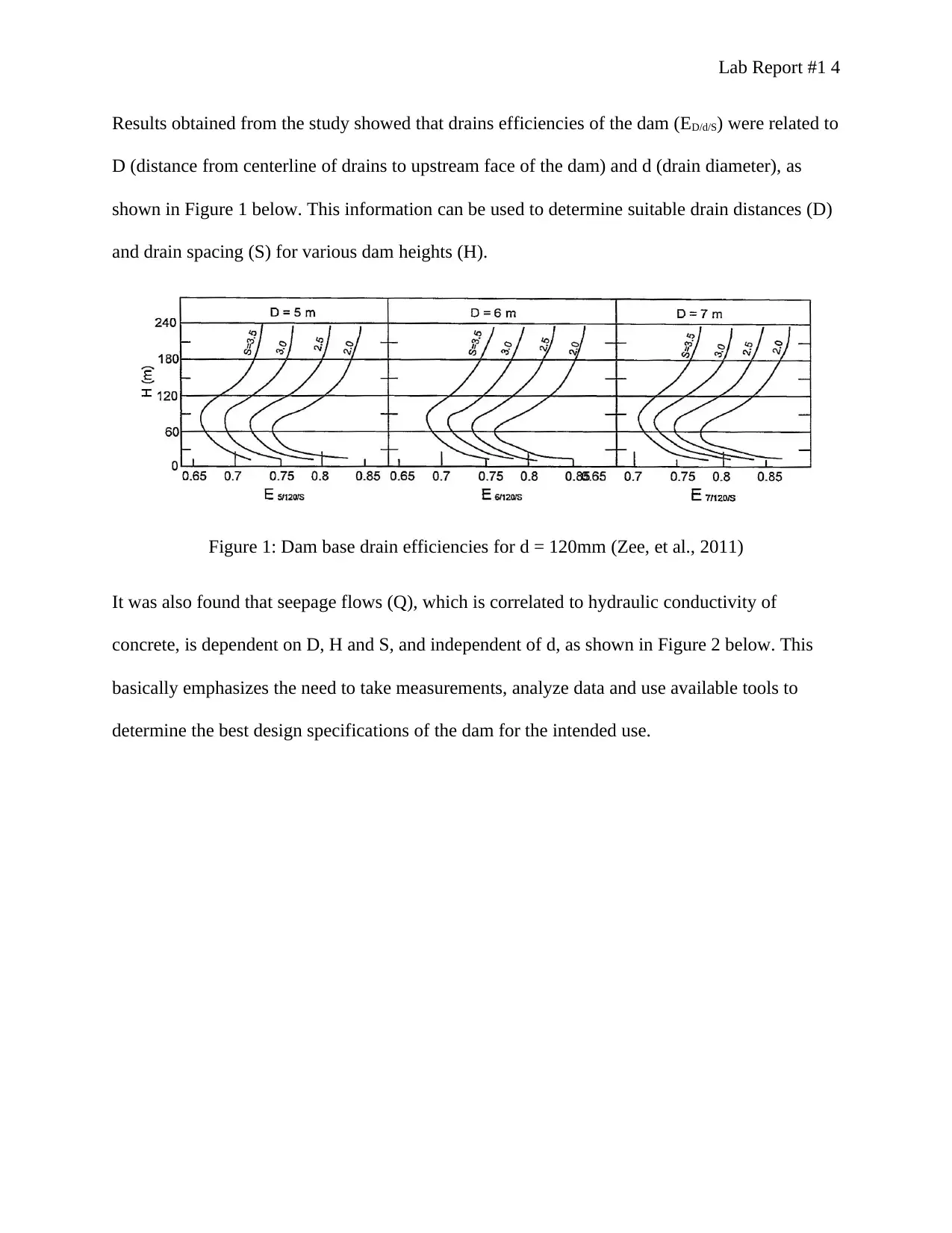
Results obtained from the study showed that drains efficiencies of the dam (ED/d/S) were related to
D (distance from centerline of drains to upstream face of the dam) and d (drain diameter), as
shown in Figure 1 below. This information can be used to determine suitable drain distances (D)
and drain spacing (S) for various dam heights (H).
Figure 1: Dam base drain efficiencies for d = 120mm (Zee, et al., 2011)
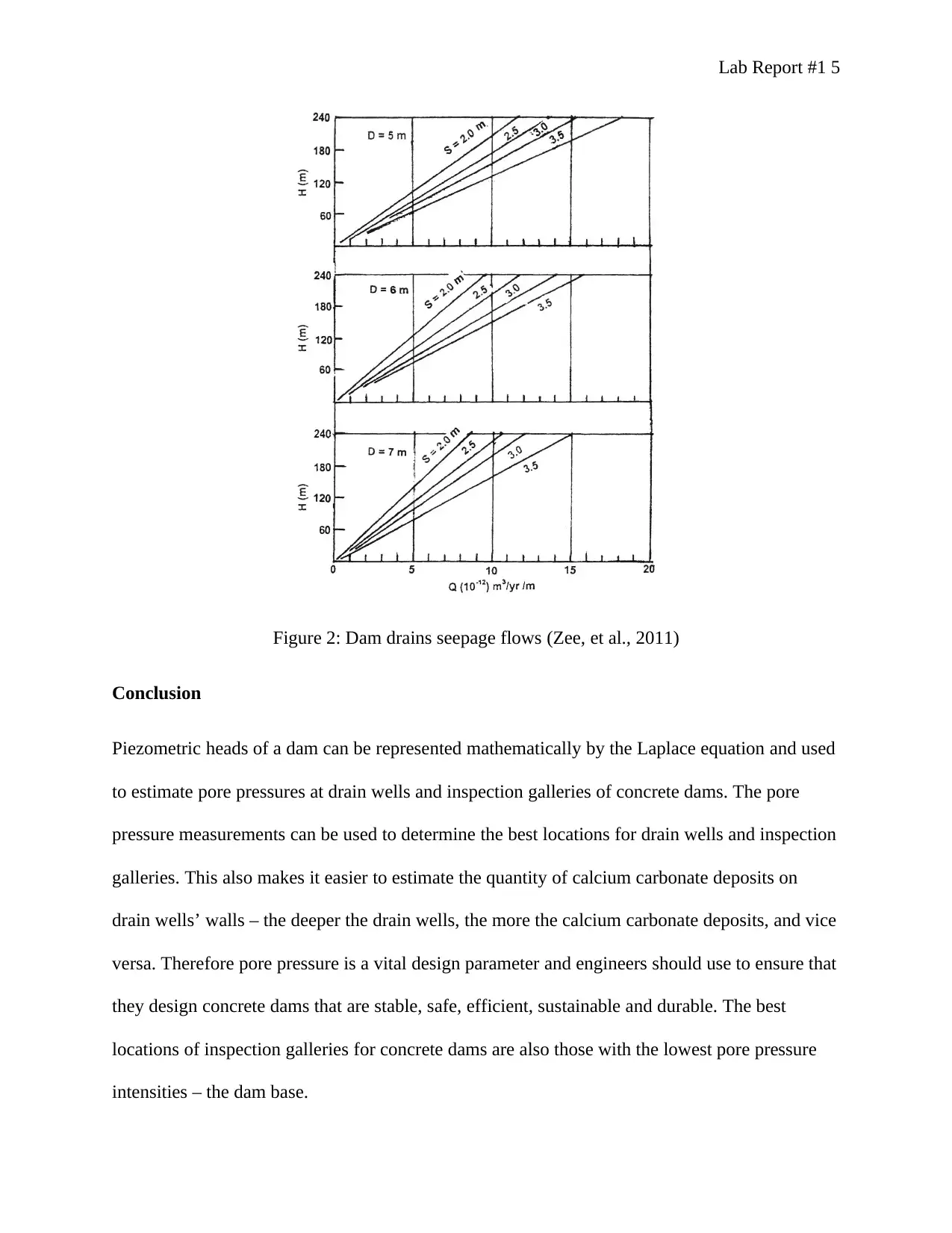
It was also found that seepage flows (Q), which is correlated to hydraulic conductivity of
concrete, is dependent on D, H and S, and independent of d, as shown in Figure 2 below. This
basically emphasizes the need to take measurements, analyze data and use available tools to
determine the best design specifications of the dam for the intended use.
tabler-icon-diamond-filled.svg

Paraphrase This Document

Need a fresh take? Get an instant paraphrase of this document with our AI Paraphraser
Document Page
Lab Report #1 5
Figure 2: Dam drains seepage flows (Zee, et al., 2011)
Conclusion
Piezometric heads of a dam can be represented mathematically by the Laplace equation and used
to estimate pore pressures at drain wells and inspection galleries of concrete dams. The pore
pressure measurements can be used to determine the best locations for drain wells and inspection
galleries. This also makes it easier to estimate the quantity of calcium carbonate deposits on
drain wells’ walls – the deeper the drain wells, the more the calcium carbonate deposits, and vice
versa. Therefore pore pressure is a vital design parameter and engineers should use to ensure that
they design concrete dams that are stable, safe, efficient, sustainable and durable. The best
locations of inspection galleries for concrete dams are also those with the lowest pore pressure
intensities – the dam base.
Document Page
Lab Report #1 6
Lesson learnt
Pore pressure is an essential design parameter of dams and can be predicted using Laplace
equation. This parameter is useful in analyzing accumulation of calcium carbonate on drain wells
and the stability and stress of dams hence it plays a key role in ensuring that the dam is designed
to be stable and strong throughout its lifecycle. The pore pressure also helps in determining the
most suitable locations for dams’ drain wells and inspection galleries.
Agree/disagree
I agree with the findings and conclusions of the authors of this article because pore pressures are
one of the key forces acting on dams hence they have a significant impact on the stability, safety
and durability of concrete dams. Therefore engineers should consider pore pressures as an
essential design parameters of concrete gravity dams and use them to determine the best design
specifications and locations for drain wells and inspection galleries of dams.
References
Zee, C. H., Zee, R. & Zee, R., 2011. Pore pressures in concrete dams. Journal of Geotechnical and
Geoenvironmental Engineering, 137(12), pp. 1254-1264.
Document Page
Lab Report #1 7
chevron_up_icon
1 out of 7
circle_padding
hide_on_mobile
zoom_out_icon
[object Object]