Lake Hydrology: Thermal Stratification and Mixing in Freshwater

Verified

Added on  2023/05/29

|11
|1582
|498
Practical Assignment
AI Summary
This practical assignment delves into the thermal stratification of freshwater lakes, a phenomenon controlled by temperature-driven density gradients. Using a simple lake model (an aquarium), the study investigates stratification and mixing, key physical processes impacting biogeochemical aspects like primary productivity, nutrient cycling, and dissolved oxygen levels. The analysis includes temperature measurements at various depths under different conditions (heating, wind, winter) and calculations of water density at specific temperatures. The assignment further explores the differences between temperate lakes and the effects of extended summers on lake stratification, including potential impacts on primary productivity and oxygen levels. Finally, it calculates the amount of heat absorbed by the lake model under experimental conditions, providing insights into heat transfer and energy balance within lake ecosystems. Desklib is a great platform to find similar solved assignments and study tools.
Document Page
Running head: LAKE HYDROLOGY
LAKE HYDROLOGY
Name of the Student
Name of the University
Author Note
tabler-icon-diamond-filled.svg

Paraphrase This Document

Need a fresh take? Get an instant paraphrase of this document with our AI Paraphraser
Document Page
2LAKE HYDROLOGY
Response to Instruction K
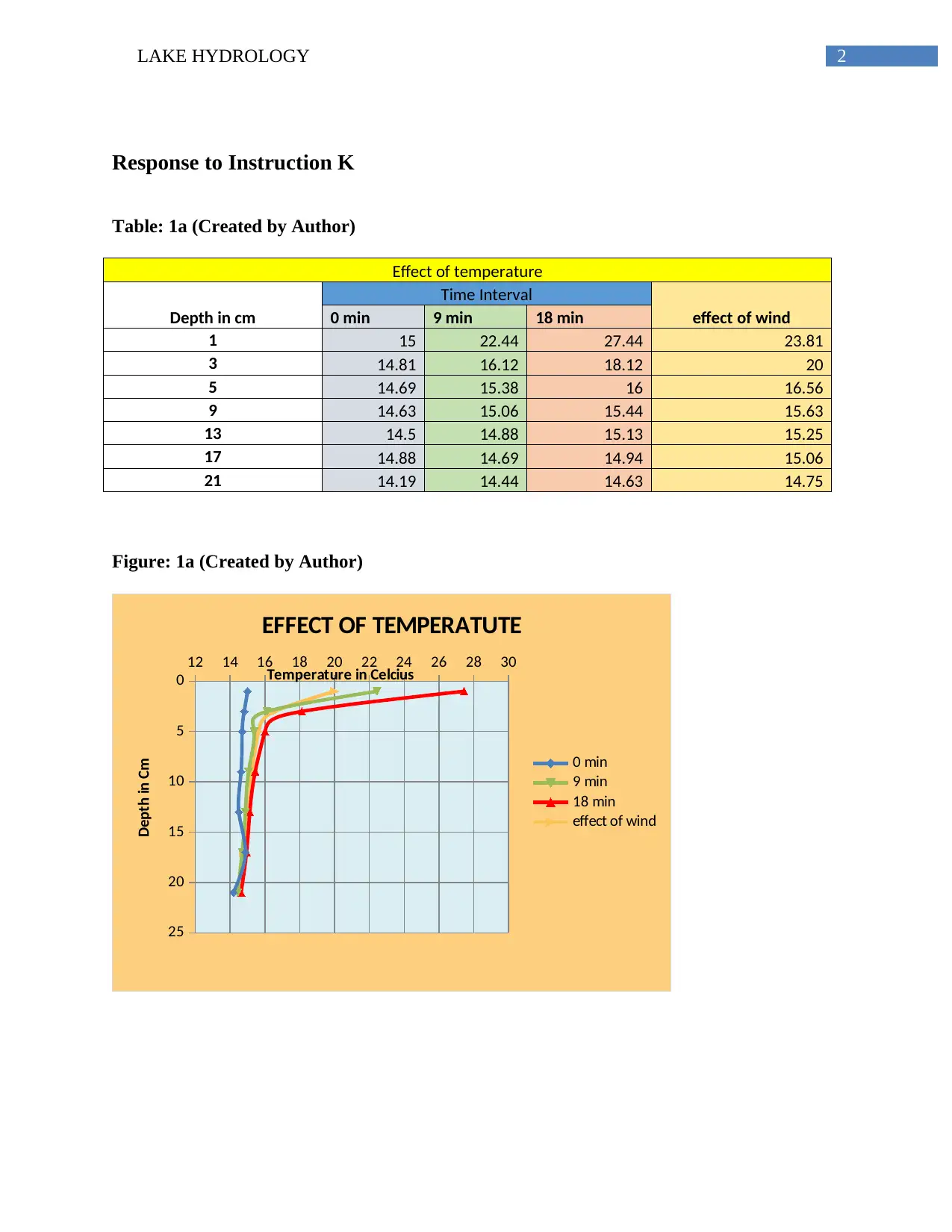
Table: 1a (Created by Author)
Effect of temperature
Depth in cm
Time Interval
effect of wind0 min 9 min 18 min
1 15 22.44 27.44 23.81
3 14.81 16.12 18.12 20
5 14.69 15.38 16 16.56
9 14.63 15.06 15.44 15.63
13 14.5 14.88 15.13 15.25
17 14.88 14.69 14.94 15.06
21 14.19 14.44 14.63 14.75
Figure: 1a (Created by Author)
12 14 16 18 20 22 24 26 28 30
0
5
10
15
20
25
EFFECT OF TEMPERATUTE
0 min
9 min
18 min
effect of wind
Temperature in Celcius
Depth in Cm
Document Page
3LAKE HYDROLOGY
Response to Question no. 1
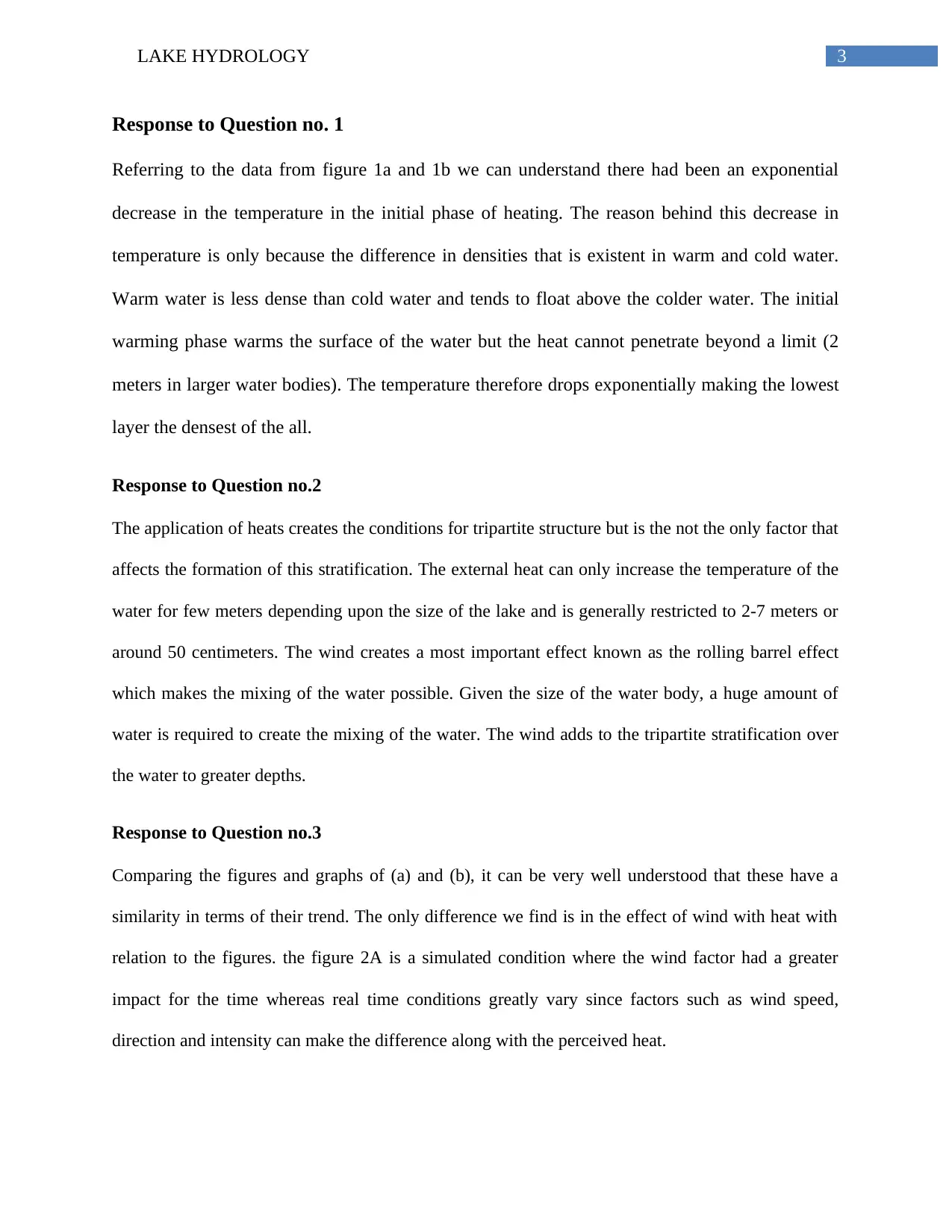
Referring to the data from figure 1a and 1b we can understand there had been an exponential
decrease in the temperature in the initial phase of heating. The reason behind this decrease in
temperature is only because the difference in densities that is existent in warm and cold water.
Warm water is less dense than cold water and tends to float above the colder water. The initial
warming phase warms the surface of the water but the heat cannot penetrate beyond a limit (2
meters in larger water bodies). The temperature therefore drops exponentially making the lowest
layer the densest of the all.
Response to Question no.2
The application of heats creates the conditions for tripartite structure but is the not the only factor that
affects the formation of this stratification. The external heat can only increase the temperature of the
water for few meters depending upon the size of the lake and is generally restricted to 2-7 meters or
around 50 centimeters. The wind creates a most important effect known as the rolling barrel effect
which makes the mixing of the water possible. Given the size of the water body, a huge amount of
water is required to create the mixing of the water. The wind adds to the tripartite stratification over
the water to greater depths.
Response to Question no.3
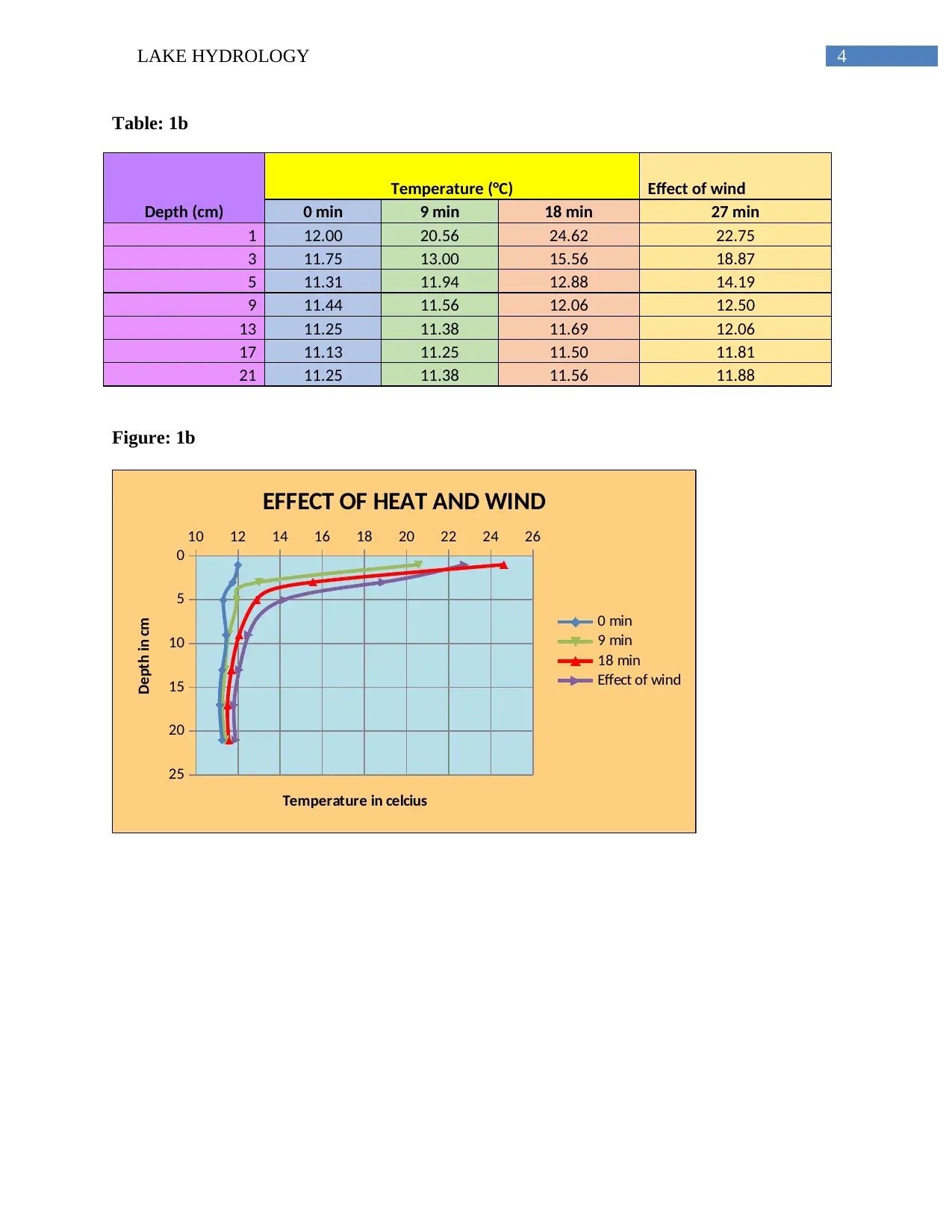
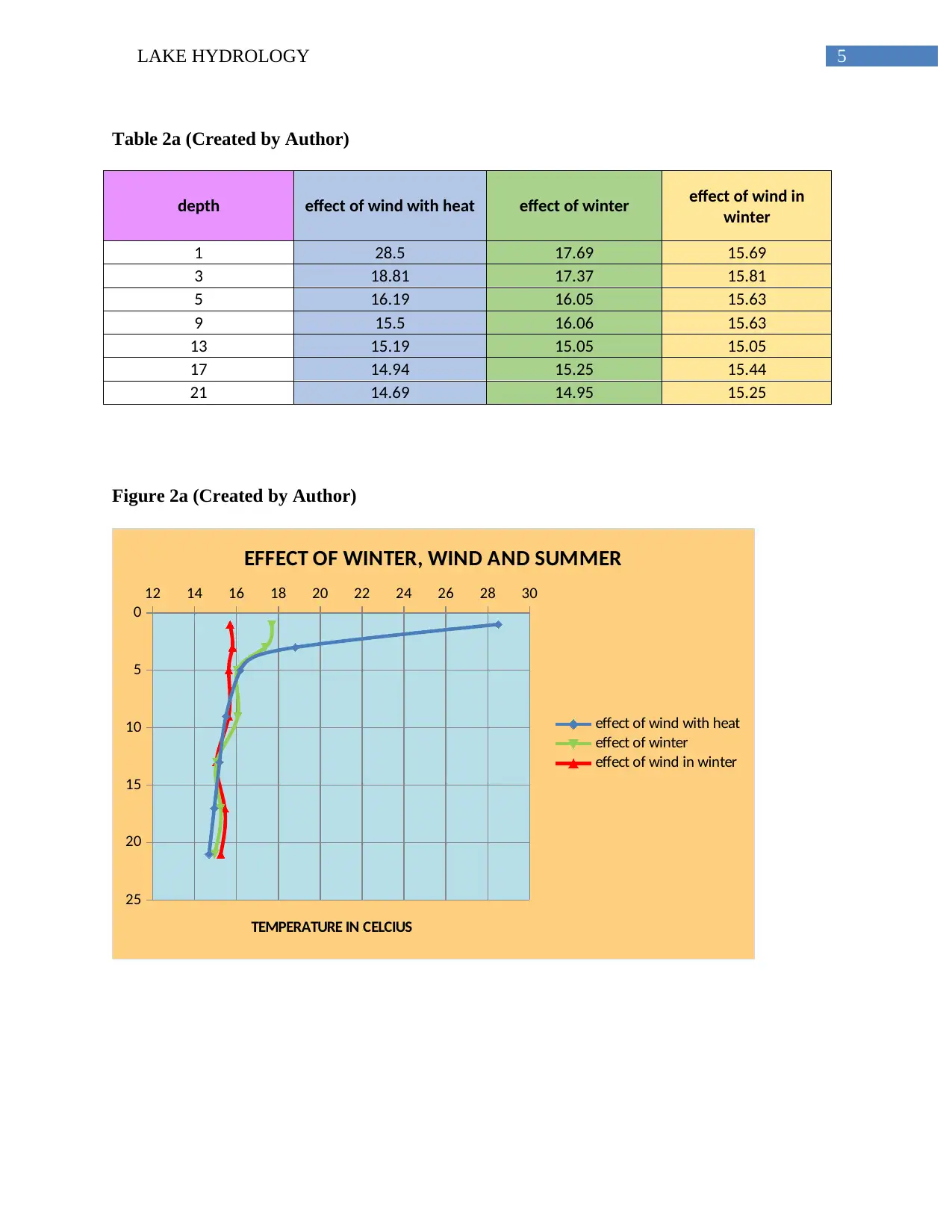
Comparing the figures and graphs of (a) and (b), it can be very well understood that these have a
similarity in terms of their trend. The only difference we find is in the effect of wind with heat with
relation to the figures. the figure 2A is a simulated condition where the wind factor had a greater
impact for the time whereas real time conditions greatly vary since factors such as wind speed,
direction and intensity can make the difference along with the perceived heat.
Document Page
4LAKE HYDROLOGY
Table: 1b
Depth (cm)
Temperature (°C) Effect of wind
0 min 9 min 18 min 27 min
1 12.00 20.56 24.62 22.75
3 11.75 13.00 15.56 18.87
5 11.31 11.94 12.88 14.19
9 11.44 11.56 12.06 12.50
13 11.25 11.38 11.69 12.06
17 11.13 11.25 11.50 11.81
21 11.25 11.38 11.56 11.88
Figure: 1b
10 12 14 16 18 20 22 24 26
0
5
10
15
20
25
EFFECT OF HEAT AND WIND
0 min
9 min
18 min
Effect of wind
Temperature in celcius
Depth in cm
tabler-icon-diamond-filled.svg

Paraphrase This Document

Need a fresh take? Get an instant paraphrase of this document with our AI Paraphraser
Document Page
5LAKE HYDROLOGY
Table 2a (Created by Author)
depth effect of wind with heat effect of winter effect of wind in
winter
1 28.5 17.69 15.69
3 18.81 17.37 15.81
5 16.19 16.05 15.63
9 15.5 16.06 15.63
13 15.19 15.05 15.05
17 14.94 15.25 15.44
21 14.69 14.95 15.25
Figure 2a (Created by Author)
12 14 16 18 20 22 24 26 28 30
0
5
10
15
20
25
EFFECT OF WINTER, WIND AND SUMMER
effect of wind with heat
effect of winter
effect of wind in winter
TEMPERATURE IN CELCIUS
Document Page
6LAKE HYDROLOGY
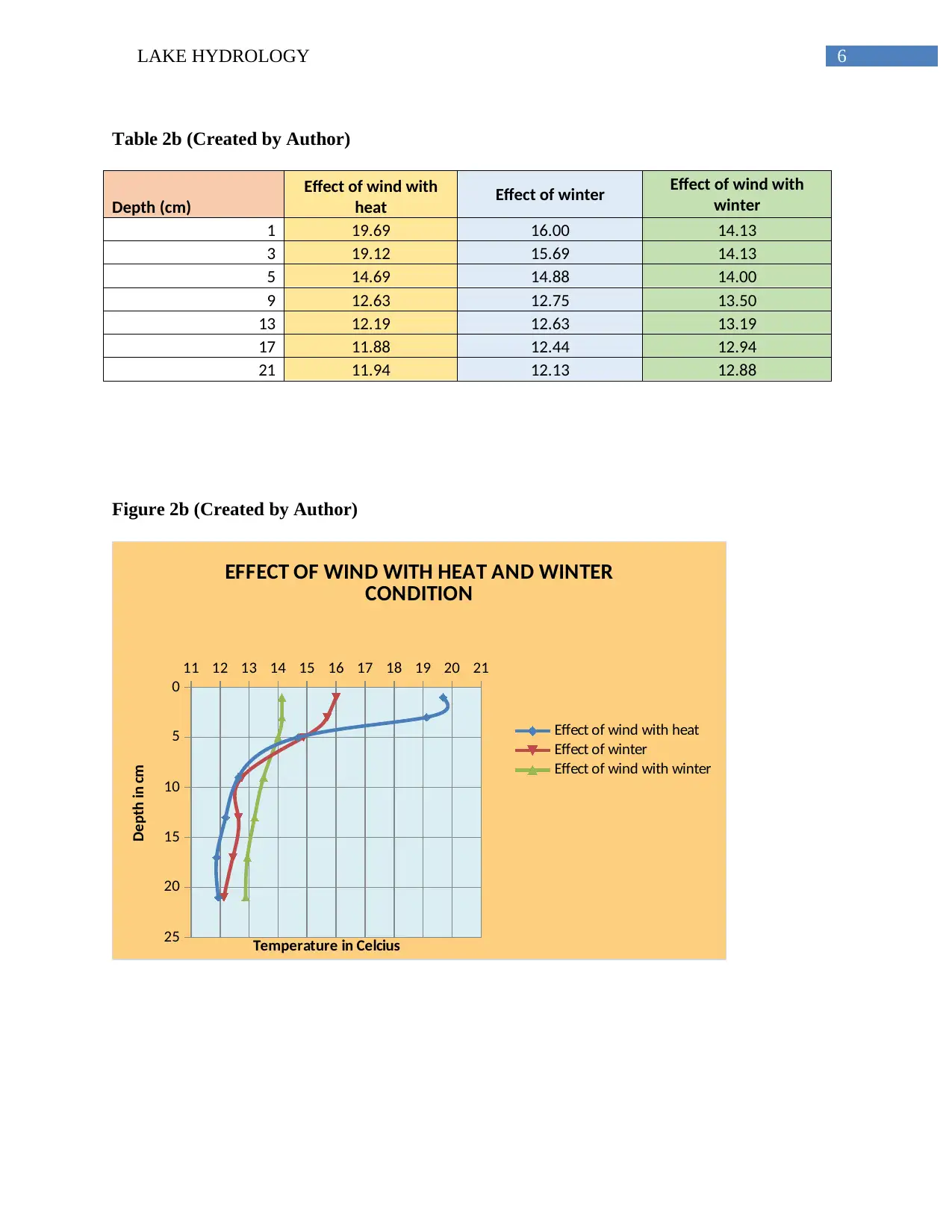
Table 2b (Created by Author)
Depth (cm)
Effect of wind with
heat Effect of winter Effect of wind with
winter
1 19.69 16.00 14.13
3 19.12 15.69 14.13
5 14.69 14.88 14.00
9 12.63 12.75 13.50
13 12.19 12.63 13.19
17 11.88 12.44 12.94
21 11.94 12.13 12.88
Figure 2b (Created by Author)
11 12 13 14 15 16 17 18 19 20 21
0
5
10
15
20
25
EFFECT OF WIND WITH HEAT AND WINTER
CONDITION
Effect of wind with heat
Effect of winter
Effect of wind with winter
Temperature in Celcius
Depth in cm
Document Page
7LAKE HYDROLOGY
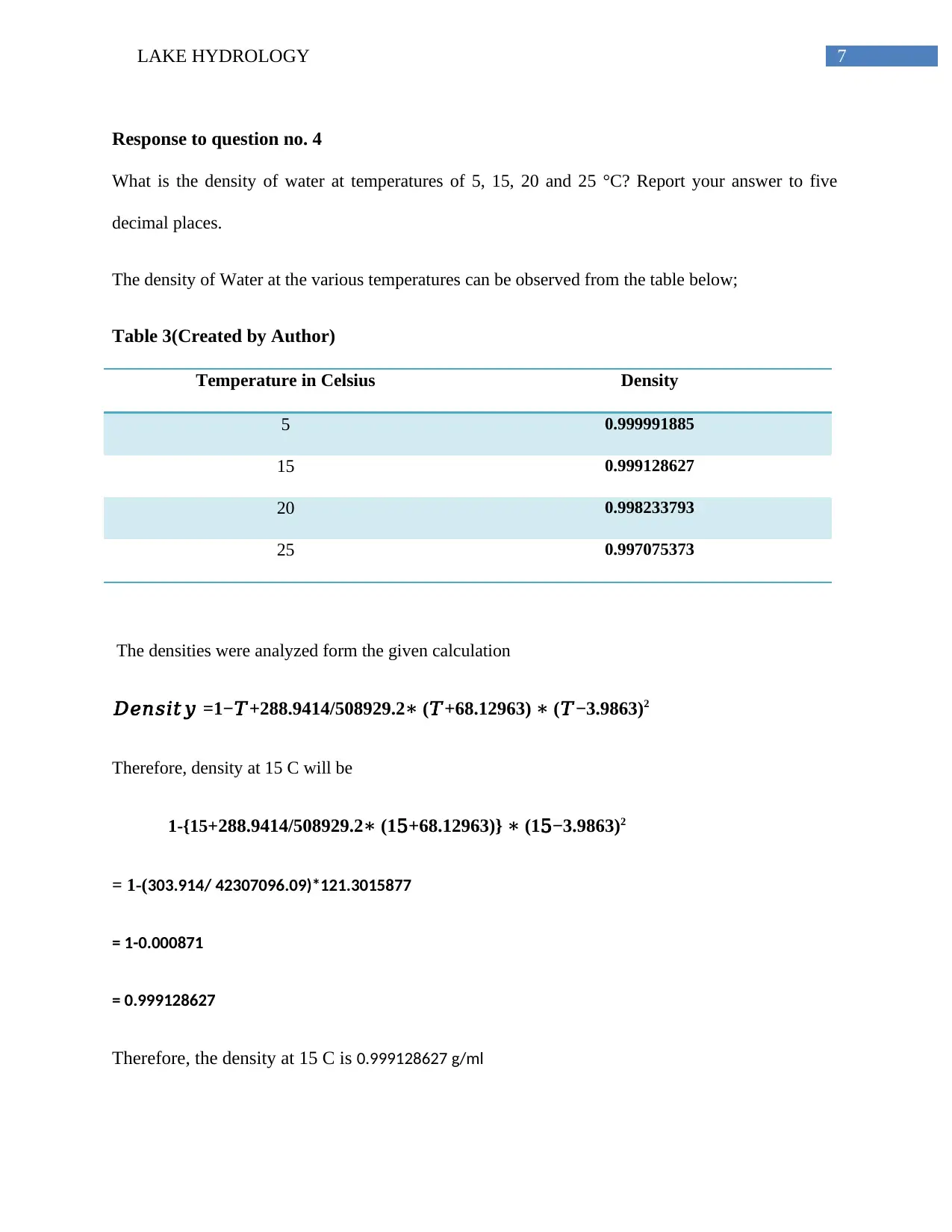
Response to question no. 4
What is the density of water at temperatures of 5, 15, 20 and 25 °C? Report your answer to five
decimal places.
The density of Water at the various temperatures can be observed from the table below;
Table 3(Created by Author)
Temperature in Celsius Density
5 0.999991885
15 0.999128627
20 0.998233793
25 0.997075373
The densities were analyzed form the given calculation
𝐷𝑒𝑛𝑠𝑖𝑡𝑦 =1−𝑇+288.9414/508929.2 ( 𝑇+68.12963) ( 𝑇−3.9863)2
Therefore, density at 15 C will be
1-{15+288.9414/508929.2 (1 5+68.12963)} (1 5−3.9863)2
= 1-(303.914/ 42307096.09)*121.3015877
= 1-0.000871
= 0.999128627
Therefore, the density at 15 C is 0.999128627 g/ml
tabler-icon-diamond-filled.svg

Paraphrase This Document

Need a fresh take? Get an instant paraphrase of this document with our AI Paraphraser
Document Page
8LAKE HYDROLOGY
Response to question no. 5
A) The temperate lake has a greater difference in temperature between epilimnetic and
hypolimnetic zones.
B) The temperate lake has the greatest density difference between epilimnetic and
hypolimnetic layers’ more stable stratification and
C) The temperate lake would exhibit more stable layers being more resistant to mixing
owing to its high temperature difference (Horne, & Goldman, 1994).
Response to question no. 6
During an extended summer, the lake stratification the lake will see lowering of the thermocline
which will increase the primary productivity in the sub surface layers resulting in depleting of the
dissolved oxygen faster than normal. This will eventually deprive the hypolimnion of oxygen and
therefore harming the benthic habitat. We cannot control the stratification of the lake, but we can
reduce the impact of global warming by cutting down on green house gases and afforestation might
help reduce the impact (Kraemer, et al., 2015)
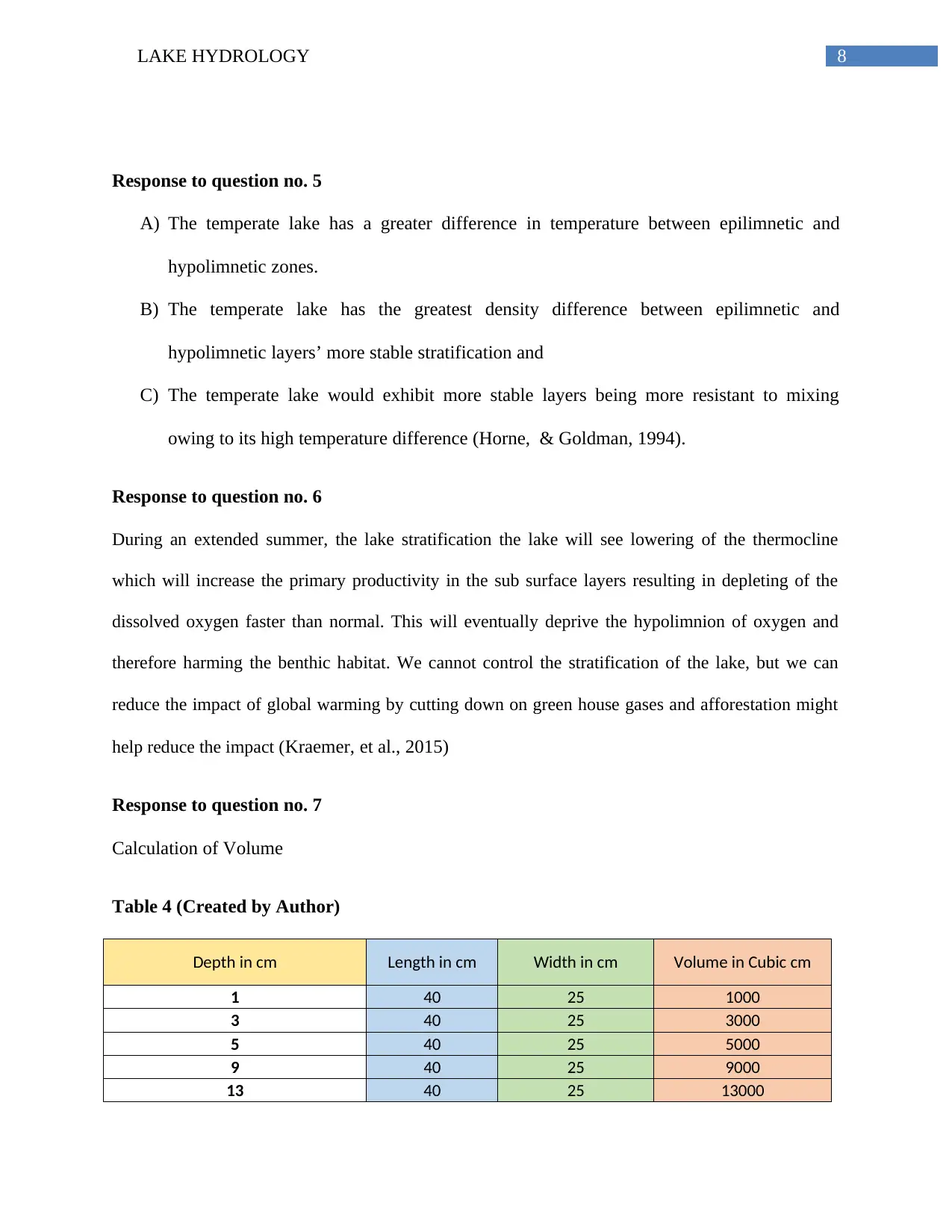
Response to question no. 7
Calculation of Volume
Table 4 (Created by Author)
Depth in cm Length in cm Width in cm Volume in Cubic cm
1 40 25 1000
3 40 25 3000
5 40 25 5000
9 40 25 9000
13 40 25 13000
Document Page
9LAKE HYDROLOGY
17 40 25 17000
21 40 25 21000
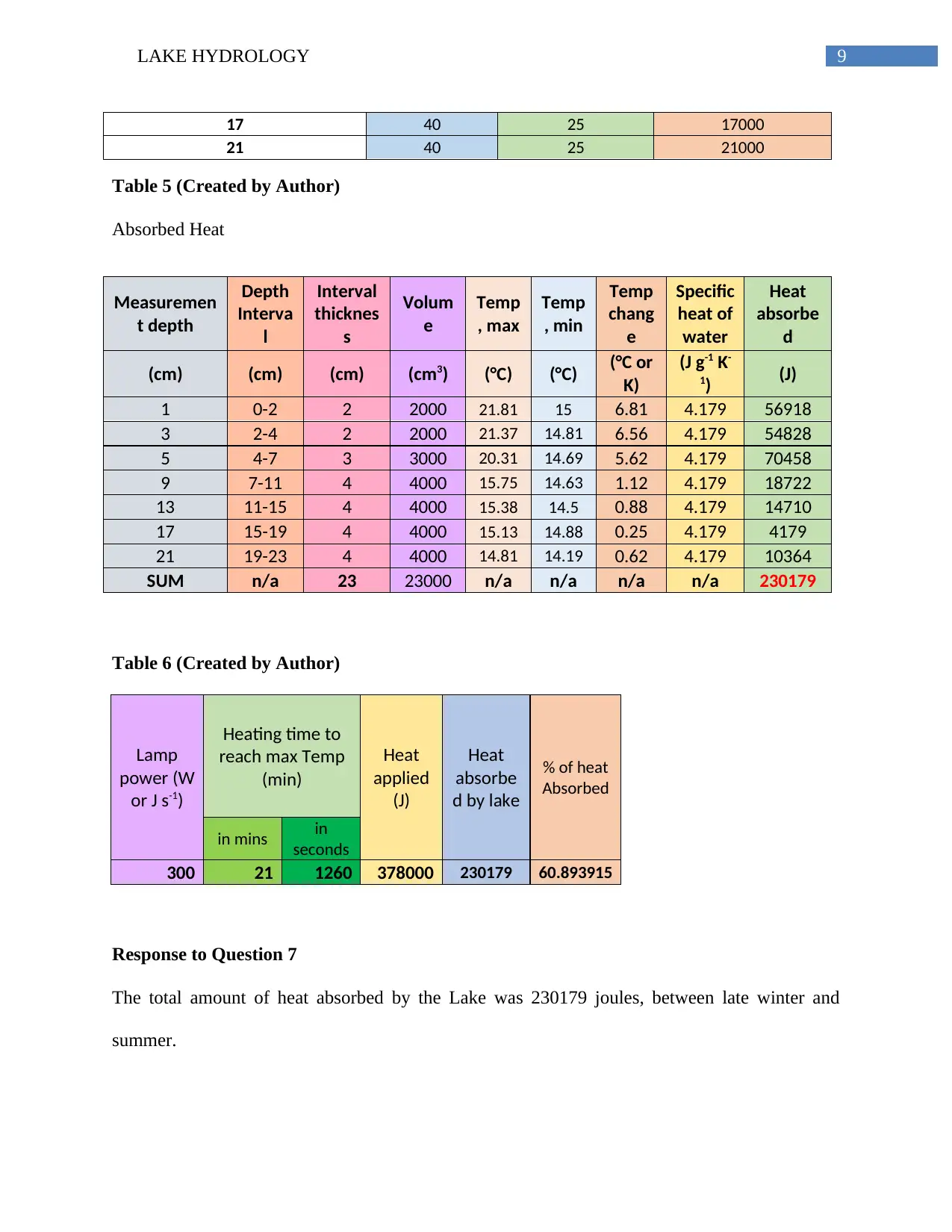
Table 5 (Created by Author)
Absorbed Heat
Measuremen
t depth
Depth
Interva
l
Interval
thicknes
s
Volum
e
Temp
, max
Temp
, min
Temp
chang
e
Specific
heat of
water
Heat
absorbe
d
(cm) (cm) (cm) (cm3) (°C) (°C) (°C or
K)
(J g-1 K-
1) (J)
1 0-2 2 2000 21.81 15 6.81 4.179 56918
3 2-4 2 2000 21.37 14.81 6.56 4.179 54828
5 4-7 3 3000 20.31 14.69 5.62 4.179 70458
9 7-11 4 4000 15.75 14.63 1.12 4.179 18722
13 11-15 4 4000 15.38 14.5 0.88 4.179 14710
17 15-19 4 4000 15.13 14.88 0.25 4.179 4179
21 19-23 4 4000 14.81 14.19 0.62 4.179 10364
SUM n/a 23 23000 n/a n/a n/a n/a 230179
Table 6 (Created by Author)
Lamp
power (W
or J s-1)
Heating time to
reach max Temp
(min)
Heat
applied
(J)
Heat
absorbe
d by lake
% of heat
Absorbed
in mins in
seconds
300 21 1260 378000 230179 60.893915
Response to Question 7
The total amount of heat absorbed by the Lake was 230179 joules, between late winter and
summer.
Document Page
10LAKE HYDROLOGY
378000 joules were applied by the Lamp to reach the maximum temperature over a period of 21
minutes.
Around 60.89% of the applied heat was absorbed by the Lake. The reason behind non absorption
of the total heat is due to several external factors that radiated the amount of the heat. The wind
applied transferred some amount of heat along with the simulated lake was not in a vacuum and
the some amount of heat was dissipated in the environment of the room. The absorption of heat
by the water was also affected by the addition of ice which reduced some of the heat absorbed.
tabler-icon-diamond-filled.svg

Paraphrase This Document

Need a fresh take? Get an instant paraphrase of this document with our AI Paraphraser
Document Page
11LAKE HYDROLOGY
References:
Horne, A. J., & Goldman, C. R. (1994). Lake ecology overview. Limnology. McGraw-Hill Co,
New York, USA.
Kraemer, B. M., Anneville, O., Chandra, S., Dix, M., Kuusisto, E., Livingstone, D. M., ... &
Tamatamah, R. (2015). Morphometry and average temperature affect lake stratification
responses to climate change. Geophysical Research Letters, 42(12), 4981-4988.
Nürnberg, G. K. (1988). A simple model for predicting the date of fall turnover in thermally
stratified lakes. Limnology and Oceanography, 33(5), 1190-1195.
chevron_up_icon
1 out of 11
circle_padding
hide_on_mobile
zoom_out_icon
[object Object]