Adjustable Laptop Tray Table Design Report: Meeting Customer Needs

Verified

Added on  2022/09/02

|5
|790
|13
Report
AI Summary
This report presents the design of an adjustable laptop tray table, addressing the need for an extended working platform. The design prioritizes customer experience, ergonomics, and functionality. The table features four adjustable working surfaces with mouse pads, aluminum alloy stands, and a 180-degree rotation for portability. It can function as a standing desk, sketching board, or gaming table. The design incorporates features like USB-connected cooling fans and pull-out mouse pads. The project followed a detailed procedure including board milling, reshaping, drilling, filling, and painting to create a prototype. The dimensions were designed to meet minimum requirements for portability and comfort, focusing on dimensions for sitting users. The report references patents related to similar designs and emphasizes the importance of customer specifications in the design process.

Document Page
Laptop Tray Table 1
Name of the Class
Professor
Name of the School
City and State
Date
tabler-icon-diamond-filled.svg

Paraphrase This Document

Need a fresh take? Get an instant paraphrase of this document with our AI Paraphraser
Document Page
Laptop Tray Table 2
This paper describes the design of an adjustable laptop tray which caters to extended use. Most
of the laptop tray tables present in the market only provide a platform for a single working unit.
This design is geared towards meeting customer experiences and specifications in creating an
extended tray table that will provide an extended working platform. The idea behind the design is
to create a table that will meet all the necessary conditions for operating a laptop and ensuring
the individuals using it function optimally, (Nash and Bodtker, Steering Solutions IP Holding
Corp, 2016). The project will utilize the existing table design in creating a new table in order to
retain an already established customer experience and improve its design generally including
customer interactions, table functionality ergonomics, aesthetics, sustainability and overall
functionality of the table. The table will consist of four working surfaces with mouse pads
mounted for each working area.
Table quality
Table stands made of aluminum alloy rods with a modern and contemporary design. The stands
are designed to last a lifetime with stability and strength to contain at least 15 kilograms of mass.
The rotation of the working surfaces is 180 degrees for easier adjustability and portability. the
working surfaces are collapsed with each platform adjusted to overly on each other before the
strands are collapsed for portability.
Functionality
The table can be used as a standing desk, sketching board, tv tray, book tray, and gaming table.
Adjustability
Document Page
Laptop Tray Table 3
The working platform and table legs make it possible to adjust the table for users to utilize all
surfaces with each surface having its own autonomous height adjustable knob as the user desires.
This creates an ergonomic environment for group assignments and family on the go situations.
Mouse pad and the cooling fan
Each working surface will have a double hydro bearing fans that will be connected to the USB
ports which will help timely dissipation of heat. The platform will also have a pullout mouse pad
with enough space to place the mouse.
The current tables in the market hardly consider customer requirements during their design. To
ensure optimum customer experiences, the designing of the tray table will keenly focus on
customer specifications and requirements, (Chen 2015). Comfort and general product interaction
with customers will be highly regarded. The tray table will be designed to avoid posture-related
injuries related to electronics operations. this will be achieved by designing a table that will
encourage a proper user posture focusing on the arm positioning while operating the laptop, eye
strain and shoulder positions.
Project procedure schedule
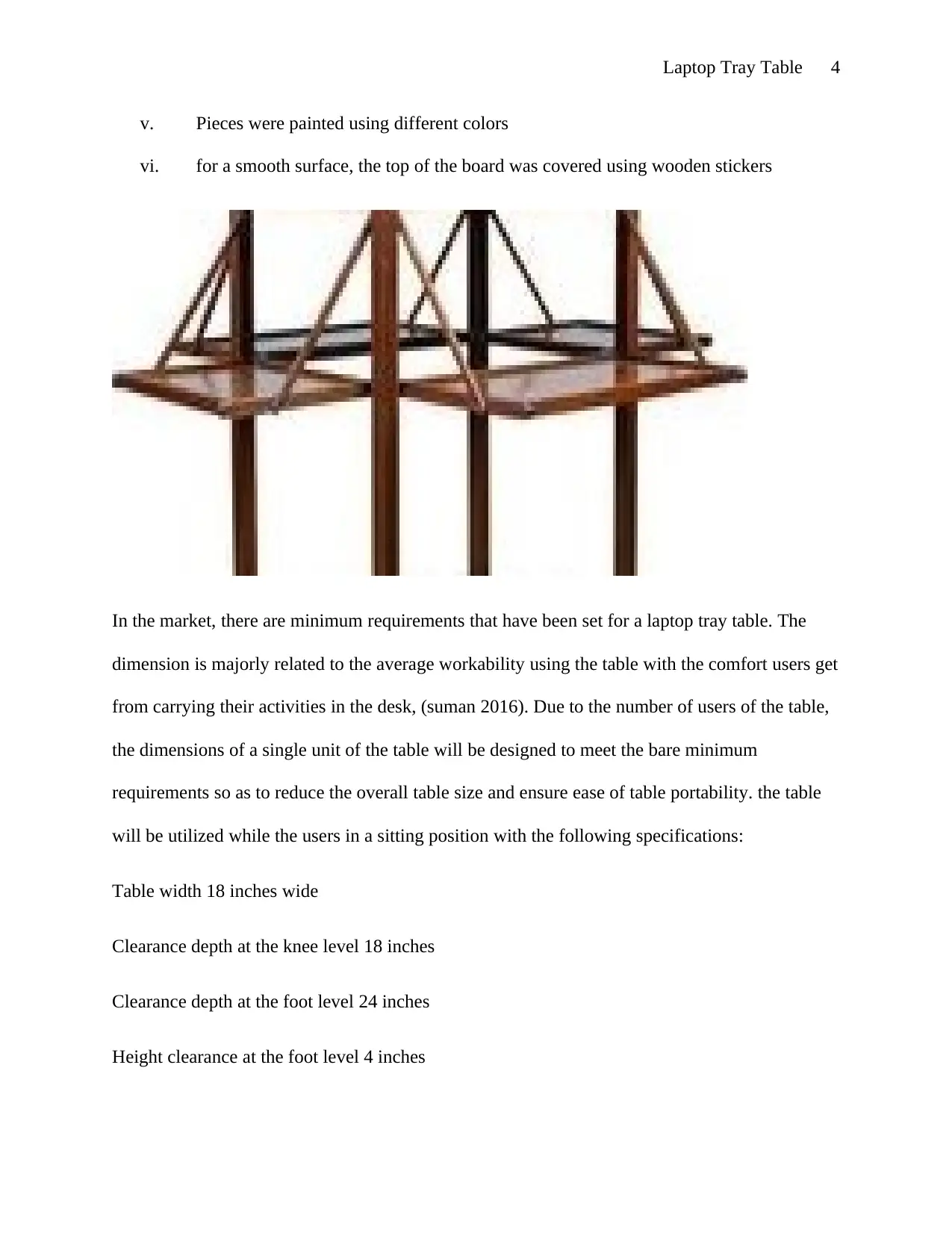
The prototype was made in the ratio of 1:2 giving a relatively larger size for easier construction.
The material used in the manufacturing process was the locally available hard boards. Tools like
saws, drills and rotation knobs. The manufacturing procedure for the prototype are:
i. Board milling- the board pieces were milled in big plates
ii. After milling the pieces, they were reshaped using the electric saw
iii. The different pieces were drilled and fixed to the frames
iv. Fillers were used in clogging the board pores
Document Page
Laptop Tray Table 4
v. Pieces were painted using different colors
vi. for a smooth surface, the top of the board was covered using wooden stickers
In the market, there are minimum requirements that have been set for a laptop tray table. The
dimension is majorly related to the average workability using the table with the comfort users get
from carrying their activities in the desk, (suman 2016). Due to the number of users of the table,
the dimensions of a single unit of the table will be designed to meet the bare minimum
requirements so as to reduce the overall table size and ensure ease of table portability. the table
will be utilized while the users in a sitting position with the following specifications:
Table width 18 inches wide
Clearance depth at the knee level 18 inches
Clearance depth at the foot level 24 inches
Height clearance at the foot level 4 inches
tabler-icon-diamond-filled.svg

Paraphrase This Document

Need a fresh take? Get an instant paraphrase of this document with our AI Paraphraser
Document Page
Laptop Tray Table 5
References
Chen, R., 2015. Collapsible computer laptop table. U.S. Patent 9,062,819.
Nash, R.P. and Bodtker, J.C., Steering Solutions IP Holding Corp, 2016. Steering wheel with
integral tray table. U.S. Patent Application 14/954,018.
Suman, M.J., 2016. Adjustable laptop support for electronic devices. U.S. Patent 9,392,870.
chevron_up_icon
1 out of 5
circle_padding
hide_on_mobile
zoom_out_icon
[object Object]