Law of Succession: Evaluating Grounds to Challenge a Will's Validity
VerifiedAdded on 2023/04/24
|9
|2916
|233
Case Study
AI Summary
This case study delves into the law of succession, specifically focusing on the validity of a will. It examines the key elements required for a will to be considered valid, including testamentary intention and capacity, knowledge and approval of the will's contents, and the absence of fraud or undue influence. The case revolves around Miss Angela Smith, who seeks to challenge her late mother Margaret Smith's will, which disinherited her in favor of a neighbor. The analysis considers whether Margaret Smith possessed the necessary testamentary capacity, given her alleged depression and schizophrenia, and whether she was under any undue influence when making the will. The study further explores legal principles related to suspicious circumstances surrounding the will's execution, the burden of proof in challenging testamentary capacity, and the potential for rectification of a will under the Administration of Justice Act 1982. It also touches on the significance of medical evidence in determining testamentary capacity and the solicitor's duty of care when advising elderly testators.
Law of succession

Paraphrase This Document
Need a fresh take? Get an instant paraphrase of this document with our AI Paraphraser
Table of Contents
Introduction................................................................................................................................2
Main Context..............................................................................................................................2
Conclusion..................................................................................................................................5
1
Introduction................................................................................................................................2
Main Context..............................................................................................................................2
Conclusion..................................................................................................................................5
1
Introduction
The law of succession is mainly concerned with the distribution and disposition of property
belonging to a deceased person. The law assists to examine the disposition of the estate of the
person where she or he had the foresight, wit and mental capacity to draft the valid will. It
also evaluates the necessary requirements for approval and knowledge of the contents of the
valid will. It is also important to determine whether the estate was distributed where the
person died without the valid will. Making a will is considered to be very much important
where the wishes are fulfilled after the person die. A will makes sure that the property,
investments, possessions and property go the causes and people who took care of the
deceased individual1. In the given case, Miss Angela Smith was concern about the estate of
her late mother who died in tragic situations. Her mother Margaret Smith disinherit her
daughter because her daughter rarely visited her and living a puritanical lifestyle. Mrs Smith
wanted to inherit her property to her neighbour Mrs Alice Cooper who look after all her
needs. Angela wanted to know whether her mother was of sound mind when she made her
last will. Her daughter claimed that her mother was suffered from depression and long term
schizophrenic. Mrs Smith died by falling from the Runcorn Bridge into the River Mersey.
Mrs Smith left the substantial state and the will was witnessed by Miss Amanda Cartwright
and Mr Tom Daley. The main issue is whether there any grounds for challenging the will
regarding its validity.
Main Context
Testamentary intention and capacity are needed for making a valid will. The testamentary
intention consists of intention for making a will and intention for making the will that the
deceased person put his or her name. There are two things that need to be considered that are
approval and knowledge and fraud and undue influence. Knowledge and approval show that
the testator should approve the will by recognizing the content2. Fraud and the undue
influence show that the testator should make his or her will free from any fraud exercised or
undue influence. Knowledge and approval are considered to be the fundamental need of
every will and failure of proving the result in the failure of the whole or part of the will. A
1 Miriam Anderson and Esther Arroyo i Amayuelas, The Law Of Succession (7th edn, Europa Law Publishing
2011).
2 Anthony Aust, Handbook Of International Law (5th edn, Cambridge University Press 2010).
2
The law of succession is mainly concerned with the distribution and disposition of property
belonging to a deceased person. The law assists to examine the disposition of the estate of the
person where she or he had the foresight, wit and mental capacity to draft the valid will. It
also evaluates the necessary requirements for approval and knowledge of the contents of the
valid will. It is also important to determine whether the estate was distributed where the
person died without the valid will. Making a will is considered to be very much important
where the wishes are fulfilled after the person die. A will makes sure that the property,
investments, possessions and property go the causes and people who took care of the
deceased individual1. In the given case, Miss Angela Smith was concern about the estate of
her late mother who died in tragic situations. Her mother Margaret Smith disinherit her
daughter because her daughter rarely visited her and living a puritanical lifestyle. Mrs Smith
wanted to inherit her property to her neighbour Mrs Alice Cooper who look after all her
needs. Angela wanted to know whether her mother was of sound mind when she made her
last will. Her daughter claimed that her mother was suffered from depression and long term
schizophrenic. Mrs Smith died by falling from the Runcorn Bridge into the River Mersey.
Mrs Smith left the substantial state and the will was witnessed by Miss Amanda Cartwright
and Mr Tom Daley. The main issue is whether there any grounds for challenging the will
regarding its validity.
Main Context
Testamentary intention and capacity are needed for making a valid will. The testamentary
intention consists of intention for making a will and intention for making the will that the
deceased person put his or her name. There are two things that need to be considered that are
approval and knowledge and fraud and undue influence. Knowledge and approval show that
the testator should approve the will by recognizing the content2. Fraud and the undue
influence show that the testator should make his or her will free from any fraud exercised or
undue influence. Knowledge and approval are considered to be the fundamental need of
every will and failure of proving the result in the failure of the whole or part of the will. A
1 Miriam Anderson and Esther Arroyo i Amayuelas, The Law Of Succession (7th edn, Europa Law Publishing
2011).
2 Anthony Aust, Handbook Of International Law (5th edn, Cambridge University Press 2010).
2
⊘ This is a preview!⊘
Do you want full access?
Subscribe today to unlock all pages.

Trusted by 1+ million students worldwide
testator should approve and know the contents of his or her will. It should be the result of the
application of own mind of the testator to make the will.
Knowledge, approval and ordinarily presents few issues where the testator was of full mental
capacity. When the mental faculties of the testator are failing then she or he needs some help
to understand the terms and conditions of the will which was intended to make. The
complexities are associated with the dispositive provisions that should be taken into account
in order to determine the explanatory assistance level for ensuring that the testator has a full
understanding of provisions of the will3. Thus, the testator should know the content of the
will before approving. In the given case, Mrs Smith made her will stating that she to want to
disinherit her daughter. She also stated that the main reason for making this decision was that
her daughter rarely visits to see her and living her puritanical lifestyle. The will clearly show
that Mrs Smith had the full knowledge of the content and approved it on the basis of her own
intention and view4.
The testator should approve and know the contents of his or her at the time the process
executes. If a will was being prepared and carried out under situations that raise a grounded
suspicion that will not represent the testamentary intentions of the testator. The will would
not be admitted unless the following suspicion is eliminated by appropriate evidence of the
knowledge and approval by the testator5. The case shows that Mrs Smith before making the
will had drunk heavily and also in the meeting she was drinking a cocktail in twenty minutes.
It was also stated by her daughter that she was suffering from depression and schizophrenic
for a long time. The evidence has led to the suspicious circumstances that whether the will
was valid or not. There is no rule that the beneficiary prepared the will cannot be admitted to
the probate. When solicitor was asked for preparing a will as per the wish of the client then it
is essential to depict that the testator had the required knowledge of the content before
approving it.
The testator not having adequate knowledge of the content and approved the will by mistake
then it would not be considered as a valid will. The mistake should be related to words used
in the will and not as per the legal effect. If a testator does not have knowledge of any part of
the content and approve then the whole will is to be considered invalid. After 1982, if a
3 John Barlow and Lesley King, Wills, Administration And Taxation Law And Practice (11th edn, Sweet &
Maxwell 2017).
4 Caroline Sawyer, Principles Of Succession, Wills And Probate (2nd edn, Cavendish Publishing 2019).
5 Andrew Borkowski, Textbook On Succession’ (3rd edn, OUP 2005).
3
application of own mind of the testator to make the will.
Knowledge, approval and ordinarily presents few issues where the testator was of full mental
capacity. When the mental faculties of the testator are failing then she or he needs some help
to understand the terms and conditions of the will which was intended to make. The
complexities are associated with the dispositive provisions that should be taken into account
in order to determine the explanatory assistance level for ensuring that the testator has a full
understanding of provisions of the will3. Thus, the testator should know the content of the
will before approving. In the given case, Mrs Smith made her will stating that she to want to
disinherit her daughter. She also stated that the main reason for making this decision was that
her daughter rarely visits to see her and living her puritanical lifestyle. The will clearly show
that Mrs Smith had the full knowledge of the content and approved it on the basis of her own
intention and view4.
The testator should approve and know the contents of his or her at the time the process
executes. If a will was being prepared and carried out under situations that raise a grounded
suspicion that will not represent the testamentary intentions of the testator. The will would
not be admitted unless the following suspicion is eliminated by appropriate evidence of the
knowledge and approval by the testator5. The case shows that Mrs Smith before making the
will had drunk heavily and also in the meeting she was drinking a cocktail in twenty minutes.
It was also stated by her daughter that she was suffering from depression and schizophrenic
for a long time. The evidence has led to the suspicious circumstances that whether the will
was valid or not. There is no rule that the beneficiary prepared the will cannot be admitted to
the probate. When solicitor was asked for preparing a will as per the wish of the client then it
is essential to depict that the testator had the required knowledge of the content before
approving it.
The testator not having adequate knowledge of the content and approved the will by mistake
then it would not be considered as a valid will. The mistake should be related to words used
in the will and not as per the legal effect. If a testator does not have knowledge of any part of
the content and approve then the whole will is to be considered invalid. After 1982, if a
3 John Barlow and Lesley King, Wills, Administration And Taxation Law And Practice (11th edn, Sweet &
Maxwell 2017).
4 Caroline Sawyer, Principles Of Succession, Wills And Probate (2nd edn, Cavendish Publishing 2019).
5 Andrew Borkowski, Textbook On Succession’ (3rd edn, OUP 2005).
3
Paraphrase This Document
Need a fresh take? Get an instant paraphrase of this document with our AI Paraphraser
testator dies then section 20 Administration of Justice Act 1982 states that the court can order
that will need to be rectified for carrying out the testamentary intentions of the testator6.
Undue influence is a constructive fraud form which means the coercion application in
particular terms needs to be considered to make a will. It can mean the use of physical force
on the person of the testator or emotional pressure like incessantly talking to a feeble and
weak testator in order to make the will under such circumstances.
The legal burden of providing proof of fraud or undue influence lies on the individual
alleging it. In other words, it is not sufficient to depict only the situations attending during the
execution of will with the exercise of fraud or undue influence. Thus, there should be positive
proof of ensuring that fraud or undue influence was exercised. The proof of the relationship
leads to the emergence of presumptions of the undue influence that arise in cases of gifts.
Suspicious circumstances need specific proof of approval and knowledge on the part of the
testator7. Thus, if fraud or undue influence pervades the will then the court would admit to
probate any part of the will. If the fraud or undue influence affects only a part then the judge
may reject that part only and admit the rest of the part to probate. The case depicts that Mrs
Smith was not being influenced or any fraudulent activity carried out during her will process.
The decision of changing the will was taken by her and the process was carried out on the
basis of her wish.
The will is considered to be privileged will if the maker is under the age of 18. The testator or
the maker should be 18 years or more when the will is made. The rule is governed under
section 7 of Wills Act 1837 which was amended under section 3 (1)(a) of the Family Law
Reform Act8. The testamentary capacity states that the testator should have the capacity to
understand the following things:
Effect of his or her wish will be carried out at the time of death.
The extent of the properties of which he or she is disposing.
The extent and nature of claims on her or him.
Not suffering from any mental disorder that is affecting his or her intentions,
behaviour and sense of doing right9.
6 Catherine Colston, Jonathan Galloway and Kirstie Middleton, Modern Intellectual Property Law (5th edn,
Routledge 2010).
7 Graham Dutfield and Uma Suthersanen, Global Intellectual Property Law (7th edn, E Elgar 2008).
8 Malcolm D Evans, International Law (8th edn, Oxford University Press 2018).
9 Linda S. Spedding, Succession: The Law Of Wills And Estates’ (1st edn, Old Bailey Press 1997).
4
that will need to be rectified for carrying out the testamentary intentions of the testator6.
Undue influence is a constructive fraud form which means the coercion application in
particular terms needs to be considered to make a will. It can mean the use of physical force
on the person of the testator or emotional pressure like incessantly talking to a feeble and
weak testator in order to make the will under such circumstances.
The legal burden of providing proof of fraud or undue influence lies on the individual
alleging it. In other words, it is not sufficient to depict only the situations attending during the
execution of will with the exercise of fraud or undue influence. Thus, there should be positive
proof of ensuring that fraud or undue influence was exercised. The proof of the relationship
leads to the emergence of presumptions of the undue influence that arise in cases of gifts.
Suspicious circumstances need specific proof of approval and knowledge on the part of the
testator7. Thus, if fraud or undue influence pervades the will then the court would admit to
probate any part of the will. If the fraud or undue influence affects only a part then the judge
may reject that part only and admit the rest of the part to probate. The case depicts that Mrs
Smith was not being influenced or any fraudulent activity carried out during her will process.
The decision of changing the will was taken by her and the process was carried out on the
basis of her wish.
The will is considered to be privileged will if the maker is under the age of 18. The testator or
the maker should be 18 years or more when the will is made. The rule is governed under
section 7 of Wills Act 1837 which was amended under section 3 (1)(a) of the Family Law
Reform Act8. The testamentary capacity states that the testator should have the capacity to
understand the following things:
Effect of his or her wish will be carried out at the time of death.
The extent of the properties of which he or she is disposing.
The extent and nature of claims on her or him.
Not suffering from any mental disorder that is affecting his or her intentions,
behaviour and sense of doing right9.
6 Catherine Colston, Jonathan Galloway and Kirstie Middleton, Modern Intellectual Property Law (5th edn,
Routledge 2010).
7 Graham Dutfield and Uma Suthersanen, Global Intellectual Property Law (7th edn, E Elgar 2008).
8 Malcolm D Evans, International Law (8th edn, Oxford University Press 2018).
9 Linda S. Spedding, Succession: The Law Of Wills And Estates’ (1st edn, Old Bailey Press 1997).
4
If the testator suffering from delusion and affecting the judgement of the testator then he or
she will not have the testamentary capacity that will result in the invalid will. An individual
suffering from the delusion can be able to make the will on the basis of the situation that the
delusion was on the subject and had no impact on the testamentary provisions10. Testator
should have the testamentary capacity at the time the will was carried out no later and not
earlier. A will can be admitted for probating without proving the capacity if it is not
challenged. The burden proof arises if it is being challenged. It has to be proved that the
testator had the capacity at the time of making the will. If the following burden is not being
proved then it would not be admitted for probating.
The rebuttable presumptions that can help to prove the testamentary capacity to establish the
lack of the testamentary capacity are as follows:
If an executed duly will is rational and the presumption arises that the person had the
testamentary capacity.
If it is being established on the evidence that the following testator is suffering from
the mental disorder that means that he or she would lack the testamentary capacity
before the execution of the will.
When there is doubt in the testamentary capacity then medical evidence should be collected
in order to prove it. Opinions of friends and family are not considered to be reliable because
they may not have been recognized the gradual decrease in the mental illness. A testator has
intoxicated or taken drugs or drinks that made him or her unconscious or do not know what
he or she is doing that there would lack testamentary capacity11. The due diligence can be
practised which is the duty of the solicitor to advise the client should follow appropriately
"golden if the tactless rule" where the solicitor draws the will for the aged testator. When an
elderly testator is suffering from sudden bereavement then giving instructions is considered to
be a risky action. The solicitor, in this case, should address the problem of capacity very
carefully and should ask necessary questions in order to detail filed note.
Under section 1, an individual is assumed to have full capacity until it is being proved that
there was a lack of capacity. Under section 1(3) an individual should not be treated that he or
she is not able to make decisions unless the practicable initiatives have taken to help him or
her. Under section 1(4) an individual is not be treated of making a mere decision because he
10 Andrew Francis and Hedley Marten, Contentious Probate Claims’ (1st edn, Sweet and Maxwell 2019).
11 Clive V Margrave Jones, Mellows: The Law Of Succession (5th edn, Butterworths 1993).
5
she will not have the testamentary capacity that will result in the invalid will. An individual
suffering from the delusion can be able to make the will on the basis of the situation that the
delusion was on the subject and had no impact on the testamentary provisions10. Testator
should have the testamentary capacity at the time the will was carried out no later and not
earlier. A will can be admitted for probating without proving the capacity if it is not
challenged. The burden proof arises if it is being challenged. It has to be proved that the
testator had the capacity at the time of making the will. If the following burden is not being
proved then it would not be admitted for probating.
The rebuttable presumptions that can help to prove the testamentary capacity to establish the
lack of the testamentary capacity are as follows:
If an executed duly will is rational and the presumption arises that the person had the
testamentary capacity.
If it is being established on the evidence that the following testator is suffering from
the mental disorder that means that he or she would lack the testamentary capacity
before the execution of the will.
When there is doubt in the testamentary capacity then medical evidence should be collected
in order to prove it. Opinions of friends and family are not considered to be reliable because
they may not have been recognized the gradual decrease in the mental illness. A testator has
intoxicated or taken drugs or drinks that made him or her unconscious or do not know what
he or she is doing that there would lack testamentary capacity11. The due diligence can be
practised which is the duty of the solicitor to advise the client should follow appropriately
"golden if the tactless rule" where the solicitor draws the will for the aged testator. When an
elderly testator is suffering from sudden bereavement then giving instructions is considered to
be a risky action. The solicitor, in this case, should address the problem of capacity very
carefully and should ask necessary questions in order to detail filed note.
Under section 1, an individual is assumed to have full capacity until it is being proved that
there was a lack of capacity. Under section 1(3) an individual should not be treated that he or
she is not able to make decisions unless the practicable initiatives have taken to help him or
her. Under section 1(4) an individual is not be treated of making a mere decision because he
10 Andrew Francis and Hedley Marten, Contentious Probate Claims’ (1st edn, Sweet and Maxwell 2019).
11 Clive V Margrave Jones, Mellows: The Law Of Succession (5th edn, Butterworths 1993).
5
⊘ This is a preview!⊘
Do you want full access?
Subscribe today to unlock all pages.
Trusted by 1+ million students worldwide
or she carrying out an unwise decision12. Under the section, an individual lacks capacity if he
or she is not able to make a decision by himself or herself in relation to the matter due to the
disturbance or impairment in the functioning of the brain or mind. The section states the
following circumstances in which an individual is not able to make a decision by himself or
herself are as follows:
Understanding the relevant information for making the decision
Retaining the following information
Weighing or using the information as a significant aspect of carrying out the decision
Communicating his or her decision
An individual is not considered to be not able to understand the relevant information to make
the decision if she or he is able to understand the explanation given to her or him in a way
that is proper to her or his situations13. The information related to the decision consists of
information about the foreseeable reasonable results of failing of making the decision and
deciding another or one way.
The validity of the will of Mrs Smith can be challenged on the basis of the testamentary
intention and capacity. The daughter of Mrs Smith claims that her mother was suffering from
long term schizophrenic and depression. The claim has led to a suspicious situation which
needs to be determined and analyzed. The medical process and evidence can assist to
recognize whether Mrs Smith was suffering from mental disorder. If it is being proved that
she was suffering from mental illness then the will is not to be considered as valid. Apart
from this, it was depicted that Mrs Smith had been drunk when she changed her will. The
event also led to suspicious circumstances which need to be analyzed 14. It is important to
determine whether Mrs Smith had the intention to make the following will or not. If Mrs
Smith carried out her decision without having the knowledge of the content and approved the
will then it is considered to be invalid. The solicitor has to make a note which will assist to
show that Mrs Smith knew what she was doing and all the statements were true. If it is
proved that Mrs Smith was in delusion due to the mental illness and also not conscious while
making the decision then the will is not valid15.
12 R. Kerridge, The Law Of Succession (13th edn, Sweet & Maxwell 2016).
13 John J Kirton and Jelena Madunic, Global Law (10th edn, Ashgate 2009).
14 Buckner F Melton, The Law (4th edn, Chelsea House Publishers 2010).
15 Duncan Spiers, Intellectual Property Law (3rd edn, Dundee University Press 2009).
6
or she is not able to make a decision by himself or herself in relation to the matter due to the
disturbance or impairment in the functioning of the brain or mind. The section states the
following circumstances in which an individual is not able to make a decision by himself or
herself are as follows:
Understanding the relevant information for making the decision
Retaining the following information
Weighing or using the information as a significant aspect of carrying out the decision
Communicating his or her decision
An individual is not considered to be not able to understand the relevant information to make
the decision if she or he is able to understand the explanation given to her or him in a way
that is proper to her or his situations13. The information related to the decision consists of
information about the foreseeable reasonable results of failing of making the decision and
deciding another or one way.
The validity of the will of Mrs Smith can be challenged on the basis of the testamentary
intention and capacity. The daughter of Mrs Smith claims that her mother was suffering from
long term schizophrenic and depression. The claim has led to a suspicious situation which
needs to be determined and analyzed. The medical process and evidence can assist to
recognize whether Mrs Smith was suffering from mental disorder. If it is being proved that
she was suffering from mental illness then the will is not to be considered as valid. Apart
from this, it was depicted that Mrs Smith had been drunk when she changed her will. The
event also led to suspicious circumstances which need to be analyzed 14. It is important to
determine whether Mrs Smith had the intention to make the following will or not. If Mrs
Smith carried out her decision without having the knowledge of the content and approved the
will then it is considered to be invalid. The solicitor has to make a note which will assist to
show that Mrs Smith knew what she was doing and all the statements were true. If it is
proved that Mrs Smith was in delusion due to the mental illness and also not conscious while
making the decision then the will is not valid15.
12 R. Kerridge, The Law Of Succession (13th edn, Sweet & Maxwell 2016).
13 John J Kirton and Jelena Madunic, Global Law (10th edn, Ashgate 2009).
14 Buckner F Melton, The Law (4th edn, Chelsea House Publishers 2010).
15 Duncan Spiers, Intellectual Property Law (3rd edn, Dundee University Press 2009).
6
Paraphrase This Document
Need a fresh take? Get an instant paraphrase of this document with our AI Paraphraser
Conclusion
The law of succession shows the distribution of the property of the deceased person. An
individual should have the knowledge about the content in order to make a valid will. The
law states that testamentary intention and testamentary capacity need to be fulfilled in order
to make the will valid. In the given case, the will of Mrs Smith can be challenged on the basis
of the suspicious circumstances. The daughter of Mrs Smith claimed that her mother was
suffering a mental disorder. It was also found that at the time of making the will, Mrs Smith
was drunk. Thus, the will can be challenged on the basis of the circumstances which need to
be examined. There is a burden of proof which means appropriate evidence can assist to solve
the issue.
7
The law of succession shows the distribution of the property of the deceased person. An
individual should have the knowledge about the content in order to make a valid will. The
law states that testamentary intention and testamentary capacity need to be fulfilled in order
to make the will valid. In the given case, the will of Mrs Smith can be challenged on the basis
of the suspicious circumstances. The daughter of Mrs Smith claimed that her mother was
suffering a mental disorder. It was also found that at the time of making the will, Mrs Smith
was drunk. Thus, the will can be challenged on the basis of the circumstances which need to
be examined. There is a burden of proof which means appropriate evidence can assist to solve
the issue.
7
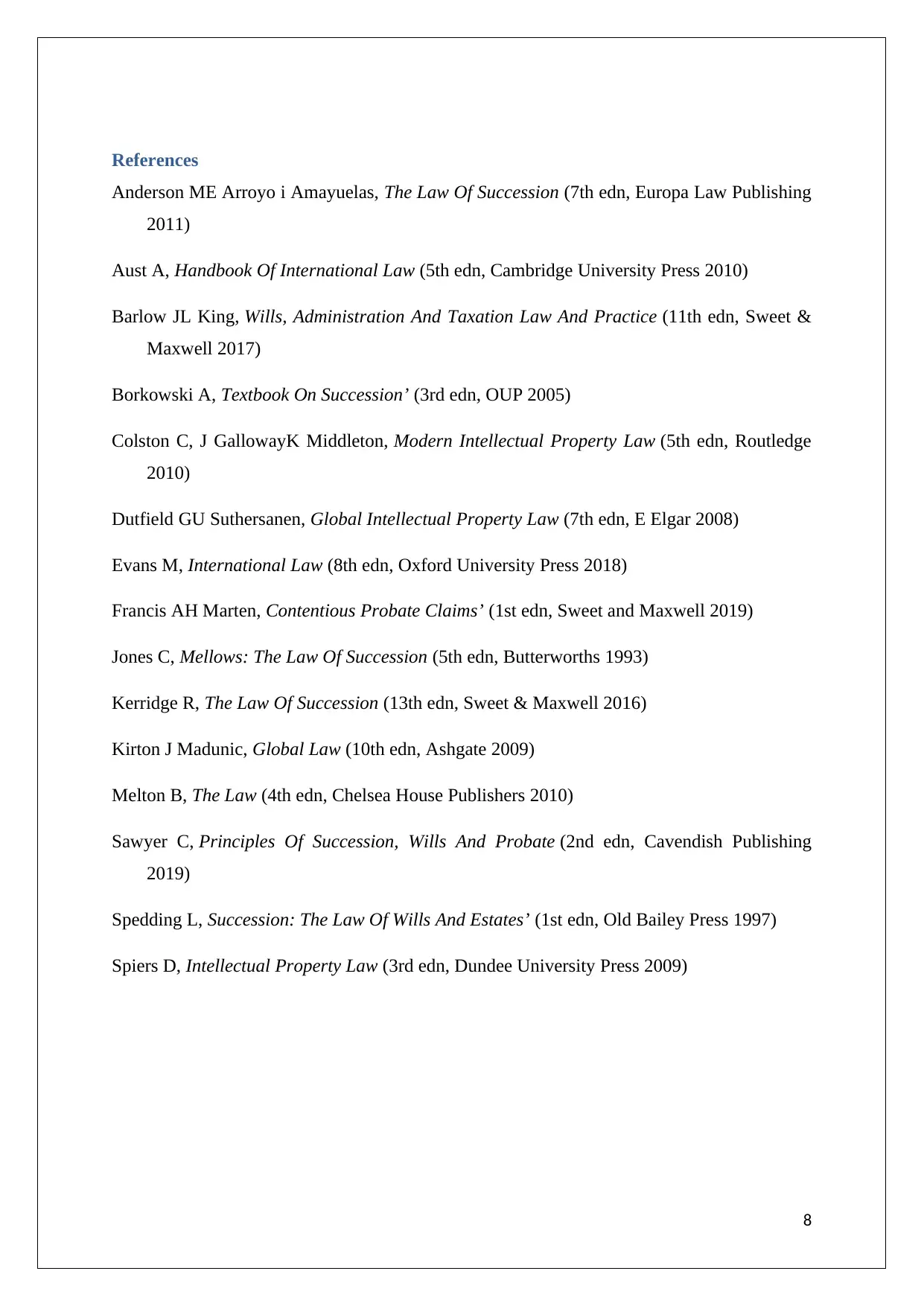
References
Anderson ME Arroyo i Amayuelas, The Law Of Succession (7th edn, Europa Law Publishing
2011)
Aust A, Handbook Of International Law (5th edn, Cambridge University Press 2010)
Barlow JL King, Wills, Administration And Taxation Law And Practice (11th edn, Sweet &
Maxwell 2017)
Borkowski A, Textbook On Succession’ (3rd edn, OUP 2005)
Colston C, J GallowayK Middleton, Modern Intellectual Property Law (5th edn, Routledge
2010)
Dutfield GU Suthersanen, Global Intellectual Property Law (7th edn, E Elgar 2008)
Evans M, International Law (8th edn, Oxford University Press 2018)
Francis AH Marten, Contentious Probate Claims’ (1st edn, Sweet and Maxwell 2019)
Jones C, Mellows: The Law Of Succession (5th edn, Butterworths 1993)
Kerridge R, The Law Of Succession (13th edn, Sweet & Maxwell 2016)
Kirton J Madunic, Global Law (10th edn, Ashgate 2009)
Melton B, The Law (4th edn, Chelsea House Publishers 2010)
Sawyer C, Principles Of Succession, Wills And Probate (2nd edn, Cavendish Publishing
2019)
Spedding L, Succession: The Law Of Wills And Estates’ (1st edn, Old Bailey Press 1997)
Spiers D, Intellectual Property Law (3rd edn, Dundee University Press 2009)
8
Anderson ME Arroyo i Amayuelas, The Law Of Succession (7th edn, Europa Law Publishing
2011)
Aust A, Handbook Of International Law (5th edn, Cambridge University Press 2010)
Barlow JL King, Wills, Administration And Taxation Law And Practice (11th edn, Sweet &
Maxwell 2017)
Borkowski A, Textbook On Succession’ (3rd edn, OUP 2005)
Colston C, J GallowayK Middleton, Modern Intellectual Property Law (5th edn, Routledge
2010)
Dutfield GU Suthersanen, Global Intellectual Property Law (7th edn, E Elgar 2008)
Evans M, International Law (8th edn, Oxford University Press 2018)
Francis AH Marten, Contentious Probate Claims’ (1st edn, Sweet and Maxwell 2019)
Jones C, Mellows: The Law Of Succession (5th edn, Butterworths 1993)
Kerridge R, The Law Of Succession (13th edn, Sweet & Maxwell 2016)
Kirton J Madunic, Global Law (10th edn, Ashgate 2009)
Melton B, The Law (4th edn, Chelsea House Publishers 2010)
Sawyer C, Principles Of Succession, Wills And Probate (2nd edn, Cavendish Publishing
2019)
Spedding L, Succession: The Law Of Wills And Estates’ (1st edn, Old Bailey Press 1997)
Spiers D, Intellectual Property Law (3rd edn, Dundee University Press 2009)
8
⊘ This is a preview!⊘
Do you want full access?
Subscribe today to unlock all pages.
Trusted by 1+ million students worldwide

1 out of 9


Your All-in-One AI-Powered Toolkit for Academic Success.
+13062052269
info@desklib.com
Available 24*7 on WhatsApp / Email
![[object Object]](/_next/static/media/star-bottom.7253800d.svg)
Unlock your academic potential
Copyright © 2020–2026 A2Z Services. All Rights Reserved. Developed and managed by ZUCOL.