Evaluate Implementation Research: TLC Study, Eastern Kentucky
VerifiedAdded on 2023/06/10
|14
|3852
|185
Report
AI Summary
This report critically examines the Terminate Lung Cancer (TLC) study conducted in Eastern Kentucky, assessing its effectiveness as an implementation research project. The analysis focuses on whether the study clearly addresses an implementation question, identifies its primary audiences, provides a detailed description of the implemented interventions (specifically, the use of low-dose computed tomography or LDCT for lung cancer screening), and considers the real-world context in which the research was conducted. The report evaluates the study's methodology, including its mixed-methods approach and the selection of participants, and discusses factors influencing the implementation process, such as economic, educational, and behavioral disparities. Furthermore, the research identifies key outcome variables, such as acceptability and adoption of LDCT screening, and acknowledges limitations, including the limited geographic scope and sample size, suggesting areas for future research to expand the study's findings to a broader population. The report also briefly discusses a research question related to schistosomiasis prevention in Indonesia, outlining a mixed-methods approach and relevant outcome variables.
Section 1
Introduction (please expand the LDCT at least in the introduction)
Among all the deaths occurred by cancer, the number of lung cancer is the highest in
count. Almost 25% cancer patients in USA die due to lung cancer(Cardarelli et al., 2017).
Early detection of the disease provides around 5 years to survive and that too in 55% cases
only, but if the cancer has been spread into the body of patients, then the chances of surviving
reduces to half(Cardarelli et al., 2017). LDCT which is low dose computed tomography is a
screening method which is expected to reduce lung cancer mortality by 20% when compared
to standard X-ray methods used for cancer detection(Cardarelli et al., 2017). But, the main
problem is many people are not aware of the benefit of LDCT for screening
cancers(Cardarelli et al., 2017). So, there was a need of campaigning to let them know about
LDCT screening method. Screening examinations are performed before the appearance of the
symptoms of any disease. In LDCT screening, a sufficient quality image is produced and any
abnormalities in the lungs can be detected. In this method, 90% less ionization radiation is
used. This paper is going to described how research method has been implemented and what
the research outcomes are. It will also depict how the research considered the outcome
variables. The limitations and requirement of further research will also be discussed in detail.
Question concerning implementation(add definition of implementation research and
answer the question)
Implementation research is a multi-method and mixed-method approach in which
qualitative as well as quantitative data analysis technique can be used. This research
investigates research plan is implemented throughout the study. Any research paper keeps a
target to set a research question that concerns about the research implementation. At the time
Introduction (please expand the LDCT at least in the introduction)
Among all the deaths occurred by cancer, the number of lung cancer is the highest in
count. Almost 25% cancer patients in USA die due to lung cancer(Cardarelli et al., 2017).
Early detection of the disease provides around 5 years to survive and that too in 55% cases
only, but if the cancer has been spread into the body of patients, then the chances of surviving
reduces to half(Cardarelli et al., 2017). LDCT which is low dose computed tomography is a
screening method which is expected to reduce lung cancer mortality by 20% when compared
to standard X-ray methods used for cancer detection(Cardarelli et al., 2017). But, the main
problem is many people are not aware of the benefit of LDCT for screening
cancers(Cardarelli et al., 2017). So, there was a need of campaigning to let them know about
LDCT screening method. Screening examinations are performed before the appearance of the
symptoms of any disease. In LDCT screening, a sufficient quality image is produced and any
abnormalities in the lungs can be detected. In this method, 90% less ionization radiation is
used. This paper is going to described how research method has been implemented and what
the research outcomes are. It will also depict how the research considered the outcome
variables. The limitations and requirement of further research will also be discussed in detail.
Question concerning implementation(add definition of implementation research and
answer the question)
Implementation research is a multi-method and mixed-method approach in which
qualitative as well as quantitative data analysis technique can be used. This research
investigates research plan is implemented throughout the study. Any research paper keeps a
target to set a research question that concerns about the research implementation. At the time

Paraphrase This Document
Need a fresh take? Get an instant paraphrase of this document with our AI Paraphraser
of reviewing any paper it is important to check if the paper clearly described the answer of
the question set for implementation research method.
The research was organized in a real-world setting and thus three Eastern Kentucky Regions
were selected in this research method. The sequential mixed method approach was
implemented in the research paper which was conducted in October 2014. In the early studies
it was found that people were not aware of LDCT screening. The research paper depicted a
lung cancer screening campaign was organized. So, the paper was clearly depicting the
concern regarding the research question of implementation strategy.
Primary audience (Lecture 3: Slides 22-26 )
Primary audiences are basically the target audience and they receive a direct communication
in the research strategy. As a primary audience for the research study, two different focus
groups from each region were identified. In the groups, there were people of 55-77 years old
men and women both who were either former or current smokers. A total number of fifty-
four individuals had participated in the study. Even LDCT screening effectiveness was
available in the internet searches, television and newspapers to reach a larger audience (Craig
et al., 2013).
Clear description of the implementation
The main target of the research was to make awareness among the people about the screening
benefit of LDCT to detect cancer in an earlier stage to increase the life expectancy.
Community awareness campaigns were conducted to increase knowledge about the
importance of screening in the detection of lung cancer. The primary goal was to motivate
people so that they can convince their doctors to use LDCT in the screening of cancer. In this
purpose, distribution of 54600 postcards, community newspapers and radio coverage has
been made to reach a wider audience while campaigning for the awareness on LDCT into the
the question set for implementation research method.
The research was organized in a real-world setting and thus three Eastern Kentucky Regions
were selected in this research method. The sequential mixed method approach was
implemented in the research paper which was conducted in October 2014. In the early studies
it was found that people were not aware of LDCT screening. The research paper depicted a
lung cancer screening campaign was organized. So, the paper was clearly depicting the
concern regarding the research question of implementation strategy.
Primary audience (Lecture 3: Slides 22-26 )
Primary audiences are basically the target audience and they receive a direct communication
in the research strategy. As a primary audience for the research study, two different focus
groups from each region were identified. In the groups, there were people of 55-77 years old
men and women both who were either former or current smokers. A total number of fifty-
four individuals had participated in the study. Even LDCT screening effectiveness was
available in the internet searches, television and newspapers to reach a larger audience (Craig
et al., 2013).
Clear description of the implementation
The main target of the research was to make awareness among the people about the screening
benefit of LDCT to detect cancer in an earlier stage to increase the life expectancy.
Community awareness campaigns were conducted to increase knowledge about the
importance of screening in the detection of lung cancer. The primary goal was to motivate
people so that they can convince their doctors to use LDCT in the screening of cancer. In this
purpose, distribution of 54600 postcards, community newspapers and radio coverage has
been made to reach a wider audience while campaigning for the awareness on LDCT into the
medical practices of cancer patients. The research involved an implementation strategy. Two
different regions were selected, in those regions hospitals provided the data for the LDCT
screening, the benefits and usefulness of LDCT were published via awareness campaigns and
media and other elements were also utilised for this purpose. People were asked via telephone
about their knowledge on LDCT. Physicians and non-physicians both were involved in the
implementation strategy of the research (Dotse-Gborgbortsi et al., 2018).
Relation with the real-world(you are also required to identify the implementation
outcome variables (e.g. acceptabilities, adoption, etc.). The sources are below:Lecture 3:
Slides 6-12, 18-20 )
The research was conducted in a real-world setting and a telephonic survey was
conducted to find the outcome measurements. All the participants of the telephonic survey
were asked if they have listened about the screening process earlier via any advertisements or
television or any other media. The acceptability from the stakeholders has been achieved to
confirm that the intervention is agreeable. The hospitals of that region were also included as a
part of the study to check the outcome of using LDCT screening in the medical practice of
lung cancer detection. The sample population included in the research was not enough as
only two specific regions of Kentucky was involved in the measurement process and in the
awareness campaign program. An initial discussion has been conducted as an outcome
variable adoption. The appropriateness of the study has also been checked in order to know
the relevancy of the study with the target audience. The research paper is also looking for
further research analysis to cover up the gap by involving more regions to increase the
sample size to get the more accurate result (Field et al., 2016). Due to limitation in cost, the
TLC campaign also did not include any advertisement for television.
Factors affecting the implementation of research ( pls answer all sub questions and This
question requires you to identify the context or factors influencing on implementation
different regions were selected, in those regions hospitals provided the data for the LDCT
screening, the benefits and usefulness of LDCT were published via awareness campaigns and
media and other elements were also utilised for this purpose. People were asked via telephone
about their knowledge on LDCT. Physicians and non-physicians both were involved in the
implementation strategy of the research (Dotse-Gborgbortsi et al., 2018).
Relation with the real-world(you are also required to identify the implementation
outcome variables (e.g. acceptabilities, adoption, etc.). The sources are below:Lecture 3:
Slides 6-12, 18-20 )
The research was conducted in a real-world setting and a telephonic survey was
conducted to find the outcome measurements. All the participants of the telephonic survey
were asked if they have listened about the screening process earlier via any advertisements or
television or any other media. The acceptability from the stakeholders has been achieved to
confirm that the intervention is agreeable. The hospitals of that region were also included as a
part of the study to check the outcome of using LDCT screening in the medical practice of
lung cancer detection. The sample population included in the research was not enough as
only two specific regions of Kentucky was involved in the measurement process and in the
awareness campaign program. An initial discussion has been conducted as an outcome
variable adoption. The appropriateness of the study has also been checked in order to know
the relevancy of the study with the target audience. The research paper is also looking for
further research analysis to cover up the gap by involving more regions to increase the
sample size to get the more accurate result (Field et al., 2016). Due to limitation in cost, the
TLC campaign also did not include any advertisement for television.
Factors affecting the implementation of research ( pls answer all sub questions and This
question requires you to identify the context or factors influencing on implementation
⊘ This is a preview!⊘
Do you want full access?
Subscribe today to unlock all pages.

Trusted by 1+ million students worldwide
program and provide some further discussion on how the authors looked at these contexts
and factors. Sources are below:
- Lecture 3: Slides 15-17
- Peters2013: Implementation influencing variables, Implementation research
questions
- IR Practical Guide: Chapter 3, What is implementation research & Chapter 6,
how should implementation research be conducted
Context plays the main role in an implementation research. Contextual factors can
influence the outcome of the research intervention. The cultural, social, educational as well as
economic context is very much important in any implementation research and in this research
analysis, the economic, educational and significant behavioural disparities have been
considered as context. Various factors are there which influenced the research procedure.
First of all, the location of the study was not enough to produce a generalized result.
Secondly, advertising methods were targeted to a specific area or region which was a great
barrier to the openness of the research.However, some external ads were discouraging for the
smokers, but this campaign brought courage to the smokers to discuss their health issues with
physicians to completely recover (Infante et al., 2015).
In this research paper many changes have been considered as an outcome over time.
The research has shown many consequences which can take place in the future and the main
positive result is people will be aware of the usefulness of LDCT, but the main negative
outcome is all the hospitals or healthcare organizations should integrate LDTC screening
method into their medical practice if all the people demand for it.
Conclusion
The main aim of the implementation research was to create the awareness among
people about the effectiveness of LDCT as a screening method of lung cancer for the early
and factors. Sources are below:
- Lecture 3: Slides 15-17
- Peters2013: Implementation influencing variables, Implementation research
questions
- IR Practical Guide: Chapter 3, What is implementation research & Chapter 6,
how should implementation research be conducted
Context plays the main role in an implementation research. Contextual factors can
influence the outcome of the research intervention. The cultural, social, educational as well as
economic context is very much important in any implementation research and in this research
analysis, the economic, educational and significant behavioural disparities have been
considered as context. Various factors are there which influenced the research procedure.
First of all, the location of the study was not enough to produce a generalized result.
Secondly, advertising methods were targeted to a specific area or region which was a great
barrier to the openness of the research.However, some external ads were discouraging for the
smokers, but this campaign brought courage to the smokers to discuss their health issues with
physicians to completely recover (Infante et al., 2015).
In this research paper many changes have been considered as an outcome over time.
The research has shown many consequences which can take place in the future and the main
positive result is people will be aware of the usefulness of LDCT, but the main negative
outcome is all the hospitals or healthcare organizations should integrate LDTC screening
method into their medical practice if all the people demand for it.
Conclusion
The main aim of the implementation research was to create the awareness among
people about the effectiveness of LDCT as a screening method of lung cancer for the early
Paraphrase This Document
Need a fresh take? Get an instant paraphrase of this document with our AI Paraphraser

detection to reduce the death rate. In the research implementation strategy, a sample area and
participants were chosen, and the hospitals of that region were also included to find the
outcome variables. Media campaigning along with radio coverage has also been considered
in this research paper. However, true control community was not possible for the research
and the hospitals which were involved were unable to show their maturity enough in finding
the best analysis result but still, a wide a was covered for this campaign and the paper is
looking for further research to establish the fact among a larger audience by involving a
greater sample size and area into the method of research (Moyer, 2014).
Section 2
a. The research question that I would recommended would be
What are the different ways to prevent the effects of schistosomiasis on human
body of Indonesia; A mixed method approach.
This research question will support in the controlling as well as elimination of the
disease across Central Sulawesi Highlands of Indonesia. The objective of the
research will be finding out the root cause of schistosomiasis and the effects of
this disease on human body. The research will then proceed towards finding
different ways to prevent it.Implementation research question is made generally
based on real world setting, and in this research question, the focus will the people
of a particular region of Indonesia (Paci et al., 2017). So, this question is a perfect
implementation research question.
B, This question requires you to identify the appropriate study design (mixed method)
to address your research questions/objectives. The sources are below:
- Lecture 3, Slides 43-52
- Additional references: Jenkin 2001; Victor et al 2004; May and Etkina 2002;
Goldenberg et al 2005
participants were chosen, and the hospitals of that region were also included to find the
outcome variables. Media campaigning along with radio coverage has also been considered
in this research paper. However, true control community was not possible for the research
and the hospitals which were involved were unable to show their maturity enough in finding
the best analysis result but still, a wide a was covered for this campaign and the paper is
looking for further research to establish the fact among a larger audience by involving a
greater sample size and area into the method of research (Moyer, 2014).
Section 2
a. The research question that I would recommended would be
What are the different ways to prevent the effects of schistosomiasis on human
body of Indonesia; A mixed method approach.
This research question will support in the controlling as well as elimination of the
disease across Central Sulawesi Highlands of Indonesia. The objective of the
research will be finding out the root cause of schistosomiasis and the effects of
this disease on human body. The research will then proceed towards finding
different ways to prevent it.Implementation research question is made generally
based on real world setting, and in this research question, the focus will the people
of a particular region of Indonesia (Paci et al., 2017). So, this question is a perfect
implementation research question.
B, This question requires you to identify the appropriate study design (mixed method)
to address your research questions/objectives. The sources are below:
- Lecture 3, Slides 43-52
- Additional references: Jenkin 2001; Victor et al 2004; May and Etkina 2002;
Goldenberg et al 2005
- 2003 Creswell: A Framework for Design
- Mixed Method_Chapter 4
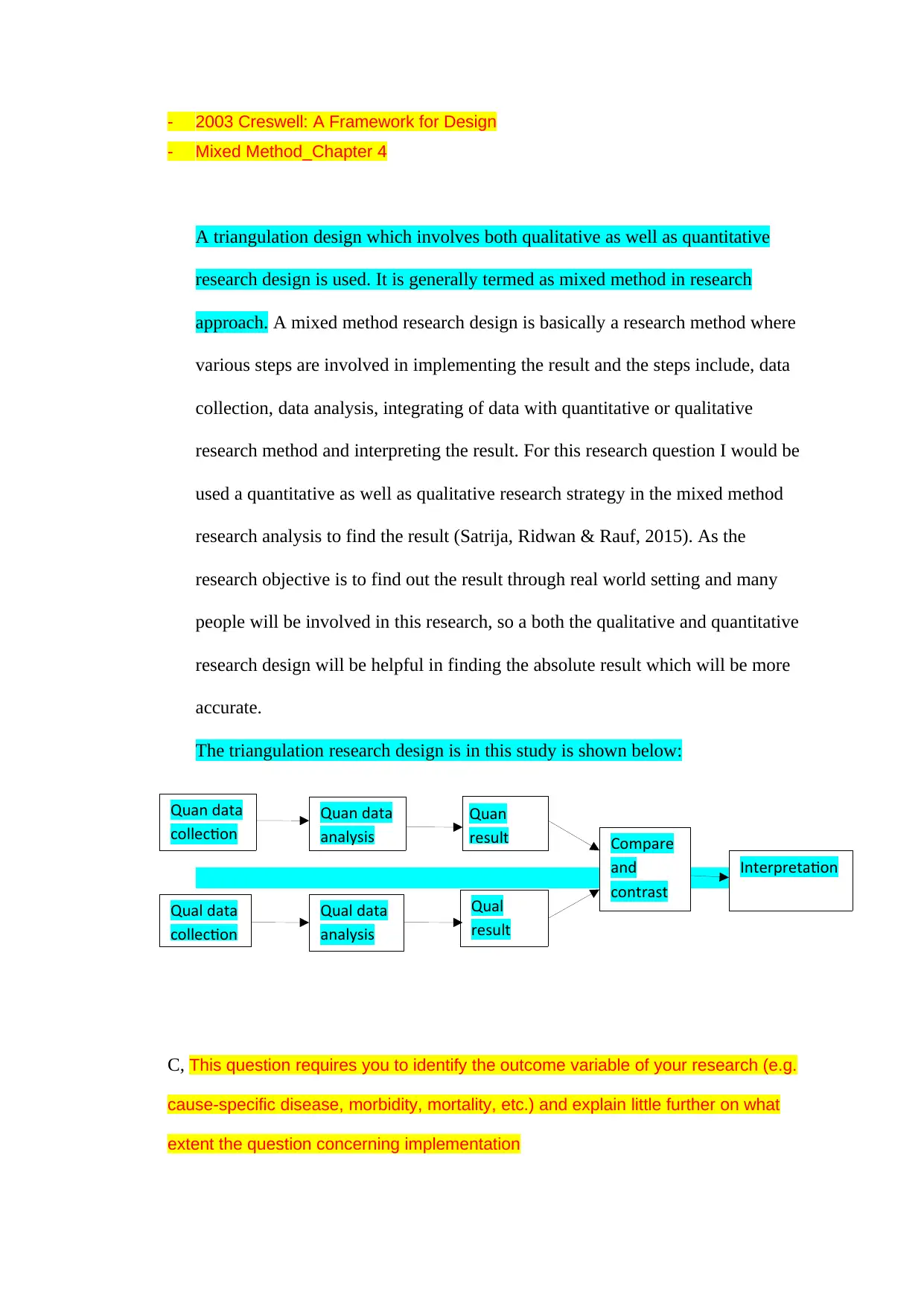
A triangulation design which involves both qualitative as well as quantitative
research design is used. It is generally termed as mixed method in research
approach. A mixed method research design is basically a research method where
various steps are involved in implementing the result and the steps include, data
collection, data analysis, integrating of data with quantitative or qualitative
research method and interpreting the result. For this research question I would be
used a quantitative as well as qualitative research strategy in the mixed method
research analysis to find the result (Satrija, Ridwan & Rauf, 2015). As the
research objective is to find out the result through real world setting and many
people will be involved in this research, so a both the qualitative and quantitative
research design will be helpful in finding the absolute result which will be more
accurate.
The triangulation research design is in this study is shown below:
C, This question requires you to identify the outcome variable of your research (e.g.
cause-specific disease, morbidity, mortality, etc.) and explain little further on what
extent the question concerning implementation
Quan data
collection
Quan data
analysis
Quan
result
Qual data
collection
Qual data
analysis
Qual
result
Compare
and
contrast
Interpretation
- Mixed Method_Chapter 4
A triangulation design which involves both qualitative as well as quantitative
research design is used. It is generally termed as mixed method in research
approach. A mixed method research design is basically a research method where
various steps are involved in implementing the result and the steps include, data
collection, data analysis, integrating of data with quantitative or qualitative
research method and interpreting the result. For this research question I would be
used a quantitative as well as qualitative research strategy in the mixed method
research analysis to find the result (Satrija, Ridwan & Rauf, 2015). As the
research objective is to find out the result through real world setting and many
people will be involved in this research, so a both the qualitative and quantitative
research design will be helpful in finding the absolute result which will be more
accurate.
The triangulation research design is in this study is shown below:
C, This question requires you to identify the outcome variable of your research (e.g.
cause-specific disease, morbidity, mortality, etc.) and explain little further on what
extent the question concerning implementation
Quan data
collection
Quan data
analysis
Quan
result
Qual data
collection
Qual data
analysis
Qual
result
Compare
and
contrast
Interpretation
⊘ This is a preview!⊘
Do you want full access?
Subscribe today to unlock all pages.
Trusted by 1+ million students worldwide
Implementation outcome variables generally depict the intentional actions to deliver
services (Sestini et al., 2015). Outcome variable is helpful to assess the research
method that how well the implementation has occurred in the research process.In an
implementing research strategy, primary outcome variable plays a major role. Primary
outcome variables are the most important variable in a research method (Sestini et al.,
2015). In this research method, the objective of the research question is to find out the
different ways of preventing schistosomiasis. It will also focus on the cause-specific
disease to find out the main reason. Apart from that, the outcome of the study will
help to reduce the mortality rate caused by the disease. The morbidity will be
considered as an outcome variable to find the condition of being diseased. So, the
various ways of prevention are the primary outcome variable in this case. In this case,
the appropriateness has been considered as the main outcome variable which shows
how the types of preventions of schistosomiasis are appropriate. At the same time
research will analyse how people are getting affected by the disease and what are the
root cause for the disease also.
D,
Target population is mainly the entire group of audience who are considered for
the research methods and who will be directly involved with the outcomes of the
study. The target population for this research will be the people living in Central
Sulawesi Highlands of Indonesia irrespective of their age and sex because the
disease not attacks people as per their age or sex. Mainly 28 villages of that region
of the valley were affected by the disease.All the people of those areas will be
considered in this study as main primary and pain target audience (Sozzi et al.,
2014). But the result is expected to be beneficial for a wider audience across the
world. The study sample will be the randomly selected subset within the study
services (Sestini et al., 2015). Outcome variable is helpful to assess the research
method that how well the implementation has occurred in the research process.In an
implementing research strategy, primary outcome variable plays a major role. Primary
outcome variables are the most important variable in a research method (Sestini et al.,
2015). In this research method, the objective of the research question is to find out the
different ways of preventing schistosomiasis. It will also focus on the cause-specific
disease to find out the main reason. Apart from that, the outcome of the study will
help to reduce the mortality rate caused by the disease. The morbidity will be
considered as an outcome variable to find the condition of being diseased. So, the
various ways of prevention are the primary outcome variable in this case. In this case,
the appropriateness has been considered as the main outcome variable which shows
how the types of preventions of schistosomiasis are appropriate. At the same time
research will analyse how people are getting affected by the disease and what are the
root cause for the disease also.
D,
Target population is mainly the entire group of audience who are considered for
the research methods and who will be directly involved with the outcomes of the
study. The target population for this research will be the people living in Central
Sulawesi Highlands of Indonesia irrespective of their age and sex because the
disease not attacks people as per their age or sex. Mainly 28 villages of that region
of the valley were affected by the disease.All the people of those areas will be
considered in this study as main primary and pain target audience (Sozzi et al.,
2014). But the result is expected to be beneficial for a wider audience across the
world. The study sample will be the randomly selected subset within the study
Paraphrase This Document
Need a fresh take? Get an instant paraphrase of this document with our AI Paraphraser

population where the research will be organized to find the answer of the research
question.
- E, Lecture 5: Slides 5-17
- Lwanga sample size 1993
- EPI INFO provided in the link (including tutorials)
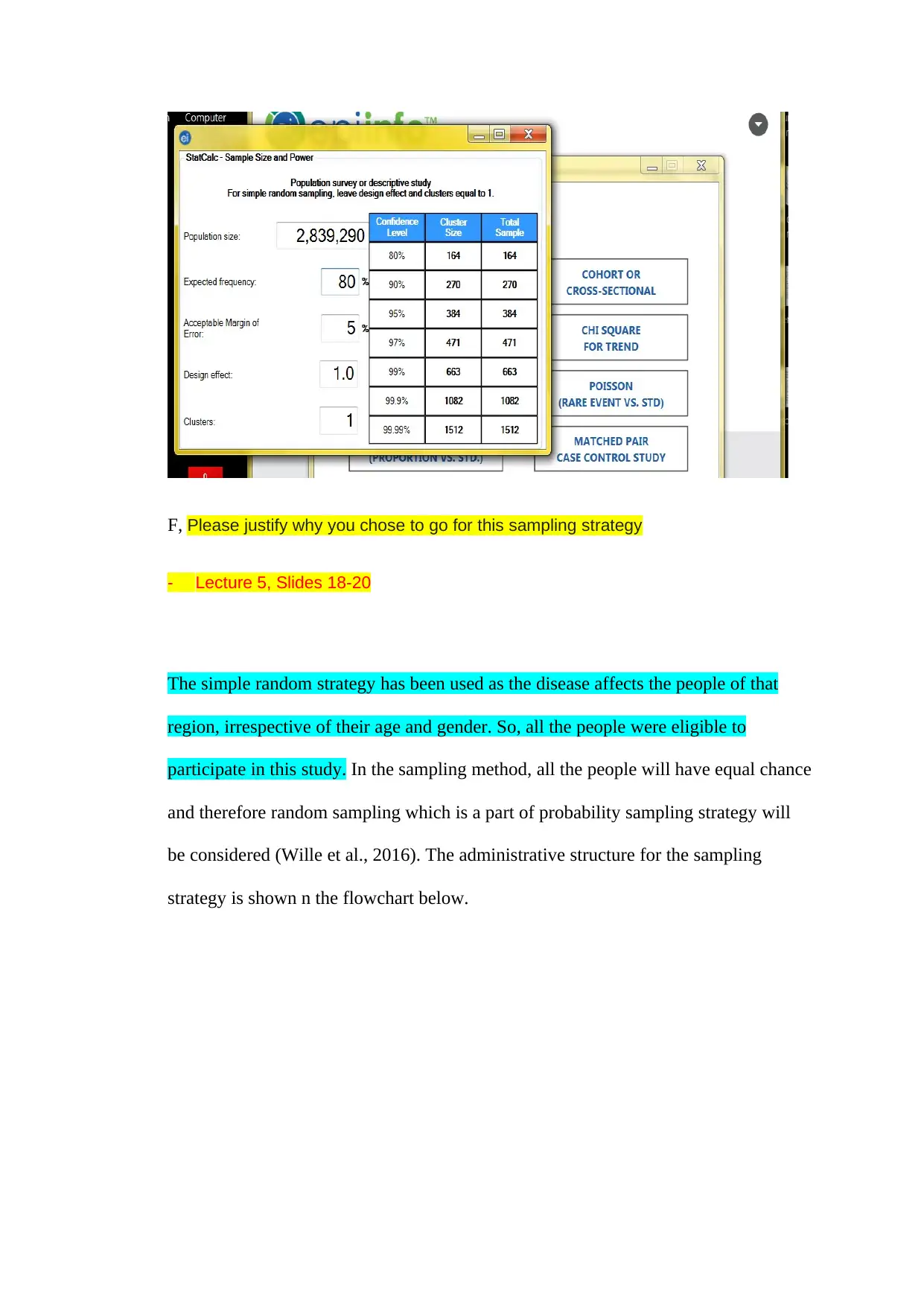
Based on the research question, in this research method, a one-sample situation will
be considered. It will help to measure the prevalence of the disease and its effect
among the sample size. The findings will describe the ways of prevention of the
disease and at the same time it will also depict how people are getting affected and
what are the main causes of the issue (Greer, Singh, Blake & Stockton, 2018). Among
the total population size, it is being expected that there will be 80% frequency and
95% error-free result will be achieved. To calculate the minimum required sample
size, EPI Info software will be used. While determining the sample size, some
assumptions will be taken which is, the design effect and the cluster will be kept equal
to 1. The expected frequency is shown 80% which means the percentage of people of
overall population of the discussed area or region.
question.
- E, Lecture 5: Slides 5-17
- Lwanga sample size 1993
- EPI INFO provided in the link (including tutorials)
Based on the research question, in this research method, a one-sample situation will
be considered. It will help to measure the prevalence of the disease and its effect
among the sample size. The findings will describe the ways of prevention of the
disease and at the same time it will also depict how people are getting affected and
what are the main causes of the issue (Greer, Singh, Blake & Stockton, 2018). Among
the total population size, it is being expected that there will be 80% frequency and
95% error-free result will be achieved. To calculate the minimum required sample
size, EPI Info software will be used. While determining the sample size, some
assumptions will be taken which is, the design effect and the cluster will be kept equal
to 1. The expected frequency is shown 80% which means the percentage of people of
overall population of the discussed area or region.
F, Please justify why you chose to go for this sampling strategy
- Lecture 5, Slides 18-20
The simple random strategy has been used as the disease affects the people of that
region, irrespective of their age and gender. So, all the people were eligible to
participate in this study. In the sampling method, all the people will have equal chance
and therefore random sampling which is a part of probability sampling strategy will
be considered (Wille et al., 2016). The administrative structure for the sampling
strategy is shown n the flowchart below.
- Lecture 5, Slides 18-20
The simple random strategy has been used as the disease affects the people of that
region, irrespective of their age and gender. So, all the people were eligible to
participate in this study. In the sampling method, all the people will have equal chance
and therefore random sampling which is a part of probability sampling strategy will
be considered (Wille et al., 2016). The administrative structure for the sampling
strategy is shown n the flowchart below.
⊘ This is a preview!⊘
Do you want full access?
Subscribe today to unlock all pages.
Trusted by 1+ million students worldwide

G,
A purposeful sampling strategy will be considered in the case of qualitative
sampling strategy as it is the most common sampling strategy where data is collected
irrespective of the age as well as gender of the participants to get a desired outcome
of an implementation research analysis. In this sampling strategy, the participants
were chosen from that region irrespective of their age and sex. So, purposeful
sampling in qualitative data analysis sampling strategy will be the best for this
method (Chen, Sun, Shi, & Hong, 2017).
H,
The study result will be assessed in descriptive analysis and for the statistical
analysis method, chi-square analysis technique will be appropriate for this. In
thisresearch this statistical analysis technique will be helpful in finding the answer of
the research question which will be statistically significant (Sefer, Kleyman & Bar-
A purposeful sampling strategy will be considered in the case of qualitative
sampling strategy as it is the most common sampling strategy where data is collected
irrespective of the age as well as gender of the participants to get a desired outcome
of an implementation research analysis. In this sampling strategy, the participants
were chosen from that region irrespective of their age and sex. So, purposeful
sampling in qualitative data analysis sampling strategy will be the best for this
method (Chen, Sun, Shi, & Hong, 2017).
H,
The study result will be assessed in descriptive analysis and for the statistical
analysis method, chi-square analysis technique will be appropriate for this. In
thisresearch this statistical analysis technique will be helpful in finding the answer of
the research question which will be statistically significant (Sefer, Kleyman & Bar-
Paraphrase This Document
Need a fresh take? Get an instant paraphrase of this document with our AI Paraphraser

Joseph, 2016). It will help to find out the difference between what we observe and
what the expectations were.
I,
Qualitative data will be presented in the form of observational data and records of responses
for the questionnaires of the interview. Statistical analysis will be helpful in analysing them.
Here grounded theory will be used for the analysis of qualitative data.
J, Mixed method_ Chapter 4
Before the integration of the findings of the result, it is necessary to address the consistence
of two types of data analysis method which is qualitative as well as quantitative. Integration
of the result improves the strength of it and at the same time it also enhances the value of
mixed method approach used in the research analysis (Hampton, & Doostan, 2015).
The qualitative data will be collected from the observations as well as the semi-structured
interviews. The data found from the qualitative research method will address the quantitative
research approach. Researchers attempt to merge the data from the two types of analysis
which qualitative and quantitative. For the integration of the research outcomes, the results
should be merged together. Various approaches are there for integrating data and in this case
contiguous approach will be better by using appropriate tables and graphs to show the result
outcome (Ronayne & Ezcurra, 2016).
what the expectations were.
I,
Qualitative data will be presented in the form of observational data and records of responses
for the questionnaires of the interview. Statistical analysis will be helpful in analysing them.
Here grounded theory will be used for the analysis of qualitative data.
J, Mixed method_ Chapter 4
Before the integration of the findings of the result, it is necessary to address the consistence
of two types of data analysis method which is qualitative as well as quantitative. Integration
of the result improves the strength of it and at the same time it also enhances the value of
mixed method approach used in the research analysis (Hampton, & Doostan, 2015).
The qualitative data will be collected from the observations as well as the semi-structured
interviews. The data found from the qualitative research method will address the quantitative
research approach. Researchers attempt to merge the data from the two types of analysis
which qualitative and quantitative. For the integration of the research outcomes, the results
should be merged together. Various approaches are there for integrating data and in this case
contiguous approach will be better by using appropriate tables and graphs to show the result
outcome (Ronayne & Ezcurra, 2016).

References
Cardarelli, R., Reese, D., Roper, K. L., Cardarelli, K., Feltner, F. J., Studts, J. L., ... & Shaffer,
D. (2017). Terminate lung cancer (TLC) study—A mixed-methods population
approach to increase lung cancer screening awareness and low-dose computed
tomography in Eastern Kentucky. Cancer epidemiology, 46, 1-8.
Chen, T., Sun, Y., Shi, Y., & Hong, L. (2017, August). On sampling strategies for neural
network-based collaborative filtering. In Proceedings of the 23rd ACM SIGKDD
International Conference on Knowledge Discovery and Data Mining (pp. 767-776).
ACM.
Craig, P., Dieppe, P., Macintyre, S., Michie, S., Nazareth, I., & Petticrew, M. (2013).
Developing and evaluating complex interventions: the new Medical Research Council
guidance. International journal of nursing studies, 50(5), 587-592.
Dotse-Gborgbortsi, W., Wardrop, N., Adewole, A., Thomas, M. L., & Wright, J. (2018). A
cross-sectional ecological analysis of international and sub-national health inequalities
in commercial geospatial resource availability. International journal of health
geographics, 17(1), 14.
Field, J. K., Duffy, S. W., Baldwin, D. R., Brain, K. E., Devaraj, A., Eisen, T., ... & Ledson,
M. (2016). The UK Lung Cancer Screening Trial: a pilot randomised controlled trial
of low-dose computed tomography screening for the early detection of lung
cancer. Health technology assessment (Winchester, England), 20(40), 1.
Greer, E., Singh, K. H., Blake, G., & Stockton, M. D. (2018). Schistosomiasis in a returning
international traveler with cyclic fevers and diarrhea. Canadian Family
Physician, 64(2), 123-126.
Cardarelli, R., Reese, D., Roper, K. L., Cardarelli, K., Feltner, F. J., Studts, J. L., ... & Shaffer,
D. (2017). Terminate lung cancer (TLC) study—A mixed-methods population
approach to increase lung cancer screening awareness and low-dose computed
tomography in Eastern Kentucky. Cancer epidemiology, 46, 1-8.
Chen, T., Sun, Y., Shi, Y., & Hong, L. (2017, August). On sampling strategies for neural
network-based collaborative filtering. In Proceedings of the 23rd ACM SIGKDD
International Conference on Knowledge Discovery and Data Mining (pp. 767-776).
ACM.
Craig, P., Dieppe, P., Macintyre, S., Michie, S., Nazareth, I., & Petticrew, M. (2013).
Developing and evaluating complex interventions: the new Medical Research Council
guidance. International journal of nursing studies, 50(5), 587-592.
Dotse-Gborgbortsi, W., Wardrop, N., Adewole, A., Thomas, M. L., & Wright, J. (2018). A
cross-sectional ecological analysis of international and sub-national health inequalities
in commercial geospatial resource availability. International journal of health
geographics, 17(1), 14.
Field, J. K., Duffy, S. W., Baldwin, D. R., Brain, K. E., Devaraj, A., Eisen, T., ... & Ledson,
M. (2016). The UK Lung Cancer Screening Trial: a pilot randomised controlled trial
of low-dose computed tomography screening for the early detection of lung
cancer. Health technology assessment (Winchester, England), 20(40), 1.
Greer, E., Singh, K. H., Blake, G., & Stockton, M. D. (2018). Schistosomiasis in a returning
international traveler with cyclic fevers and diarrhea. Canadian Family
Physician, 64(2), 123-126.
⊘ This is a preview!⊘
Do you want full access?
Subscribe today to unlock all pages.
Trusted by 1+ million students worldwide

1 out of 14


Related Documents


Your All-in-One AI-Powered Toolkit for Academic Success.
+13062052269
info@desklib.com
Available 24*7 on WhatsApp / Email
![[object Object]](/_next/static/media/star-bottom.7253800d.svg)
Unlock your academic potential
Copyright © 2020–2025 A2Z Services. All Rights Reserved. Developed and managed by ZUCOL.