Leadership and Management Report: Leadership, Management Analysis
VerifiedAdded on 2020/12/09
|13
|3655
|220
Report
AI Summary
This report delves into the core concepts of leadership and management, providing a comprehensive analysis of what constitutes a successful leader and how leadership skills can be developed. The report explores various leadership theories, including situational leadership and path-goal theory, and examines how these theories can be applied in different organizational contexts. It highlights key traits of effective leaders, such as communication, strategic thinking, and the ability to build lasting relationships. Furthermore, the report differentiates between leadership and management, outlining their distinct roles and approaches within an organization. The analysis includes examples of how leaders in different companies apply these principles and concludes with a discussion on the development of leadership skills and the importance of discipline and conflict resolution. The report also covers the importance of setting clear goals, creating lasting relationships, and continuous learning in order to become an effective leader.
LEADERSHIP
AND
MANAGEMENT
AND
MANAGEMENT

Paraphrase This Document
Need a fresh take? Get an instant paraphrase of this document with our AI Paraphraser
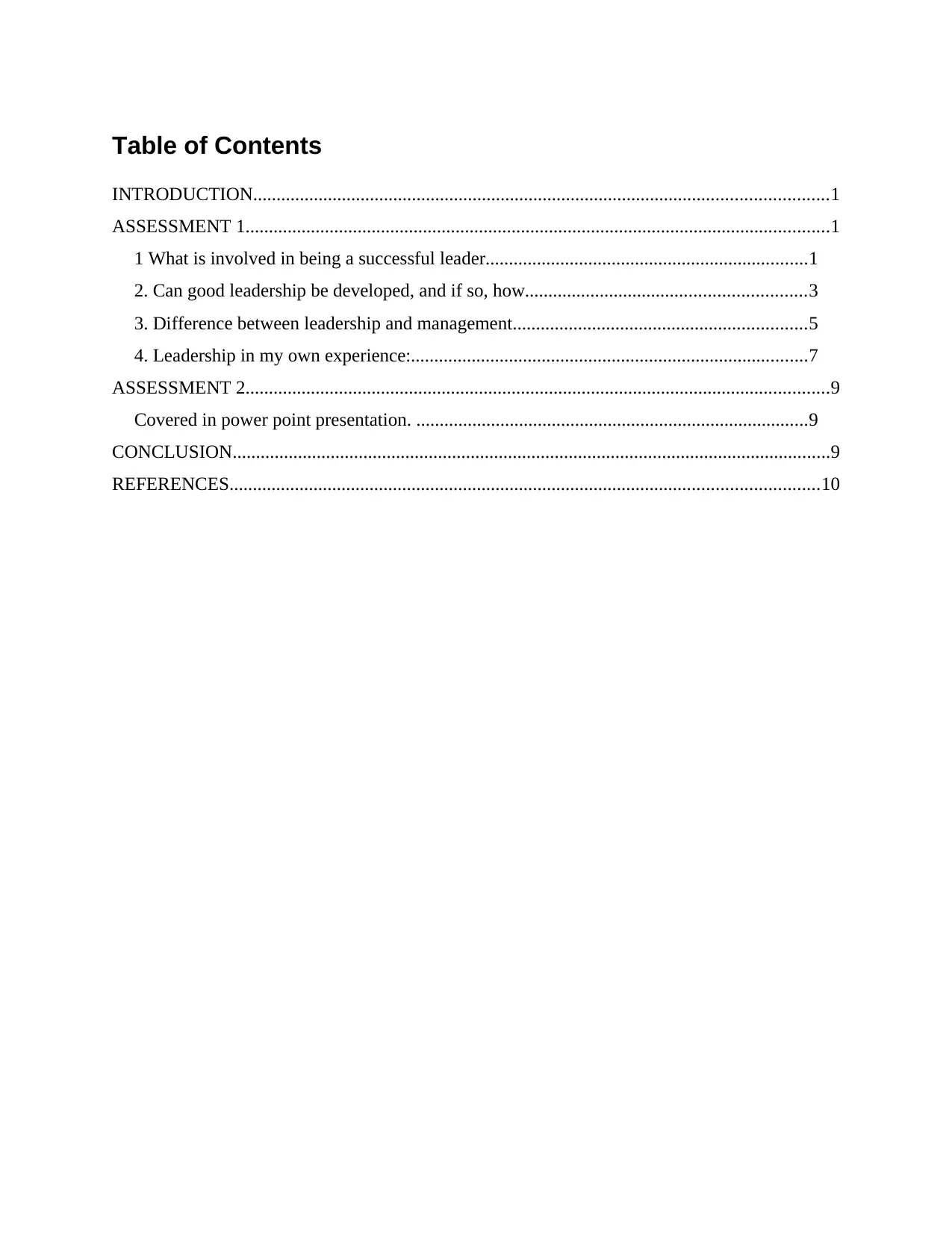
Table of Contents
INTRODUCTION...........................................................................................................................1
ASSESSMENT 1.............................................................................................................................1
1 What is involved in being a successful leader.....................................................................1
2. Can good leadership be developed, and if so, how............................................................3
3. Difference between leadership and management...............................................................5
4. Leadership in my own experience:.....................................................................................7
ASSESSMENT 2.............................................................................................................................9
Covered in power point presentation. ....................................................................................9
CONCLUSION................................................................................................................................9
REFERENCES..............................................................................................................................10
INTRODUCTION...........................................................................................................................1
ASSESSMENT 1.............................................................................................................................1
1 What is involved in being a successful leader.....................................................................1
2. Can good leadership be developed, and if so, how............................................................3
3. Difference between leadership and management...............................................................5
4. Leadership in my own experience:.....................................................................................7
ASSESSMENT 2.............................................................................................................................9
Covered in power point presentation. ....................................................................................9
CONCLUSION................................................................................................................................9
REFERENCES..............................................................................................................................10
INTRODUCTION
Leadership is a planning of new direction and view for the team of organisation. They
follow by setting of clear view and sharing views with others members of the team to let them
follow while providing the instruction, learning and approach to know that point of view
(Bolden, 2016). Management regulates and guide the resources of the organisation in order of the
values and ethics he has been adopted. Management helps to keep organisation to be organized.
Management works with human, financial and physical resources by performing its functions
(Amanchukwu, Stanley and Ololube, 2015). The study lays emphasis on how a successful leader
is and how a good leadership can be developed by applying some strategies.
This will also highlight the difference between leadership and management. This report
will show the experience as a leadership in organisation. In this report also discussion on
opportunity to look into many aspects like leadership, management, team-working and project
management.
ASSESSMENT 1
1 What is involved in being a successful leader
Leadership is an art of motivating a group of people to achieving a common goal. Anyone can
learn to become leaders by improving their particular skills. Every organisation needs a good
leader. They are able to inspire others and being prepared to do.
There are some traits of successful leaders:
Self-managing:
According to the situation theory of leadership, most effective leaders are those that are
able manage various situations. The analysis type of task, nature of the team and many other
factors that are help to getting work done. Leaders of Sodexo's Corporates services, can use this
theory to manage their roles and responsibilities according to the situation. They can improve
skills of employees, enhance knowledge of task and make them more effective performer. By
this theory leaders can improve their qualities of leadership with effective performance of group
member. They are more high skilled and willing to complete the task at time.
Effective communication:
1
Leadership is a planning of new direction and view for the team of organisation. They
follow by setting of clear view and sharing views with others members of the team to let them
follow while providing the instruction, learning and approach to know that point of view
(Bolden, 2016). Management regulates and guide the resources of the organisation in order of the
values and ethics he has been adopted. Management helps to keep organisation to be organized.
Management works with human, financial and physical resources by performing its functions
(Amanchukwu, Stanley and Ololube, 2015). The study lays emphasis on how a successful leader
is and how a good leadership can be developed by applying some strategies.
This will also highlight the difference between leadership and management. This report
will show the experience as a leadership in organisation. In this report also discussion on
opportunity to look into many aspects like leadership, management, team-working and project
management.
ASSESSMENT 1
1 What is involved in being a successful leader
Leadership is an art of motivating a group of people to achieving a common goal. Anyone can
learn to become leaders by improving their particular skills. Every organisation needs a good
leader. They are able to inspire others and being prepared to do.
There are some traits of successful leaders:
Self-managing:
According to the situation theory of leadership, most effective leaders are those that are
able manage various situations. The analysis type of task, nature of the team and many other
factors that are help to getting work done. Leaders of Sodexo's Corporates services, can use this
theory to manage their roles and responsibilities according to the situation. They can improve
skills of employees, enhance knowledge of task and make them more effective performer. By
this theory leaders can improve their qualities of leadership with effective performance of group
member. They are more high skilled and willing to complete the task at time.
Effective communication:
1
⊘ This is a preview!⊘
Do you want full access?
Subscribe today to unlock all pages.

Trusted by 1+ million students worldwide
The good leaders have an effective communication skill for clearly and succinctly explain
their employees everything about the organization (Pardey, 2016). IBM leaders, can use situation
theory for effectively communicate the peoples what to do and how to do. This theory help to
both leader and follower. Leaders share their idea and messages to team members and team
members are use idea into process of task. By applying this theory in the organization for
leadership, this will helpful for the effective result of work. Therefore, leaders communicate with
their follower according to the situation to situation. Leader is still decision maker, but they
communicate and works to persuade the employees rather than simply directing them.
Acting strategically:
It is necessary for leaders are forwarding thinking and open minded approach. Leaders
use path goal theory to give proper way to achieve their team goal. They always tries employees
are prepared for adjust strategies to capture emerging opportunities to tackle unexpected
challenges. Robert McDonald leads the P&G, they can use path goal theory to give proper
guidance to their employees. This is helpful for leader became a directive leadership. They
identify opportunities, take responsibility for solving problems and their positive confidence
inspire to other to do same. Therefore, this management style is more helpful for very
inexperienced employees who need guidances and to be checked on regularly.
Accountable and responsible:
Leaders are always encourage to follower towards the positive and effective work. They
take their responsibility for their mistakes and give proper attention to the needs and wellbeing to
employees. Leaders of General Electric use path goal theory for support to their employees by
motivation and trust. They can treat their employees with respect and support then when
necessary. It is effective way of becoming the supportive leadership. This style useful in the
situation in which the employees has a problem. By this theory leaders can improve output of
their organization and team by influencing employees and guiding them to their goals.
Set clear goals:
Set their goals and determined that according to the work. According to the skills
approach, leader can learn certain skill and turn self into a remarkable for goals. Barry –
Wehmiller's leader can use this theory for set their work goal and convey that to others for
2
their employees everything about the organization (Pardey, 2016). IBM leaders, can use situation
theory for effectively communicate the peoples what to do and how to do. This theory help to
both leader and follower. Leaders share their idea and messages to team members and team
members are use idea into process of task. By applying this theory in the organization for
leadership, this will helpful for the effective result of work. Therefore, leaders communicate with
their follower according to the situation to situation. Leader is still decision maker, but they
communicate and works to persuade the employees rather than simply directing them.
Acting strategically:
It is necessary for leaders are forwarding thinking and open minded approach. Leaders
use path goal theory to give proper way to achieve their team goal. They always tries employees
are prepared for adjust strategies to capture emerging opportunities to tackle unexpected
challenges. Robert McDonald leads the P&G, they can use path goal theory to give proper
guidance to their employees. This is helpful for leader became a directive leadership. They
identify opportunities, take responsibility for solving problems and their positive confidence
inspire to other to do same. Therefore, this management style is more helpful for very
inexperienced employees who need guidances and to be checked on regularly.
Accountable and responsible:
Leaders are always encourage to follower towards the positive and effective work. They
take their responsibility for their mistakes and give proper attention to the needs and wellbeing to
employees. Leaders of General Electric use path goal theory for support to their employees by
motivation and trust. They can treat their employees with respect and support then when
necessary. It is effective way of becoming the supportive leadership. This style useful in the
situation in which the employees has a problem. By this theory leaders can improve output of
their organization and team by influencing employees and guiding them to their goals.
Set clear goals:
Set their goals and determined that according to the work. According to the skills
approach, leader can learn certain skill and turn self into a remarkable for goals. Barry –
Wehmiller's leader can use this theory for set their work goal and convey that to others for
2
Paraphrase This Document
Need a fresh take? Get an instant paraphrase of this document with our AI Paraphraser
processing. Sets goal for the team and analysis what is actually needs of team. Leaders can
improve their leadership quality by providing such trainings to their followers. That is human
skill, technical skill and conceptual skill. That is very effective and helpful for the leaders to
analysis and manage time. By this, they improve the work efficiency of employees.
Create lasting relationship:
According to transformational theory, leaders are know how to motivate their employees
to achieve company goals. Employees who feel valued and appreciated, to push harder to gain
success for their company (Donate and de Pablo, 2015). Leaders of TDIndustries can use this
theory for ensure that, their values are lived out daily:
Build and maintain trusting relationship
Celebrate the power of individual differences
Lead with a servant' servant hearts
This theory is focus on how leaders can create valuable and positive change in their followers.
When employees are motivated and appreciated by the leader then they give hard contribution to
achieve goal of the company.
Learning ability:
It is most important for leadership. Skilled based theory is helpful for gaining various
knowledge of the organization and other. Learning ability helps leaders for know about the
suddenly changes in circumstances. Leaders of IBM, can us this theory to learn the changes
happened in the circumstance and policies. That is help to gain knowledge about the changes and
give effective solution according to requirement. By this leaders earn technical knowledge. For
an example: use certain computer software is an advanced technical knowledge. This effective
way of improving leadership.
2. Can good leadership be developed, and if so, how
Yes, leadership can be develop by their qualities, communication and their managing
skill. That are help to leaders to improve their leadership qualities.
Critical thinking:
3
improve their leadership quality by providing such trainings to their followers. That is human
skill, technical skill and conceptual skill. That is very effective and helpful for the leaders to
analysis and manage time. By this, they improve the work efficiency of employees.
Create lasting relationship:
According to transformational theory, leaders are know how to motivate their employees
to achieve company goals. Employees who feel valued and appreciated, to push harder to gain
success for their company (Donate and de Pablo, 2015). Leaders of TDIndustries can use this
theory for ensure that, their values are lived out daily:
Build and maintain trusting relationship
Celebrate the power of individual differences
Lead with a servant' servant hearts
This theory is focus on how leaders can create valuable and positive change in their followers.
When employees are motivated and appreciated by the leader then they give hard contribution to
achieve goal of the company.
Learning ability:
It is most important for leadership. Skilled based theory is helpful for gaining various
knowledge of the organization and other. Learning ability helps leaders for know about the
suddenly changes in circumstances. Leaders of IBM, can us this theory to learn the changes
happened in the circumstance and policies. That is help to gain knowledge about the changes and
give effective solution according to requirement. By this leaders earn technical knowledge. For
an example: use certain computer software is an advanced technical knowledge. This effective
way of improving leadership.
2. Can good leadership be developed, and if so, how
Yes, leadership can be develop by their qualities, communication and their managing
skill. That are help to leaders to improve their leadership qualities.
Critical thinking:
3
For develop their leadership skill, critical thinking is important. Good leaders are able to
foresee the potential problem before they happen (Chin, 2015). TDIndustries leaders use
situational theory to develop their critical thinking. By this theory critical thinking is most
important for the leaders because deals in various situation. They makes decisions and tell to
employees. For that they have to improve their critical thinking. That is effective way of
improving their leadership skill in positive way.
Listening effectively:
One of the most important skill of leader is effective listening. The effective listen to their
followers and others that is help improve their communication skills. Without the listening skill,
they are not able to get feedback from others and not to get correct scenes of team member what
actually want about the project. Leaders of IBM can use situation theory for improve their
listening skills by maintain the eye contact, avoid distractions and respond appropriately (Gorton,
Alston and Snowden, 2018). They can be aware with their body language and gestures to
determine peoples. This theory help to improve their leadership quality to effectively manage
their team members.
Motivating quality:
A leaders have positively influences the others. That is true quality of leaders. Sometimes
people lose their motivation because they are facing difficulties, when a good leader talk with the
people and try solve their problem and build motivation for working. According to path goal
theory, Leaders of P&G can improve leadership skill by the motivating to others. This is
effective leadership skill. By this theory leaders can motivate their employees by appreciating
them. This is effective way of creating positive work environment.
Discipline:
Discipline is require in order to execute the goal of firm. Even leaders have proper vision
of their work and effective idea for presentation, that is unless without the discipline. Barry –
Wehmiller's leader require to use path goal theory for maintain discipline in the organization.
When they disciplined with their work and workplace, then they are able to suggest others in
better way. Discipline is effective part of the leadership for became a good leader. By that they
able to give proper instructions to others.
4
foresee the potential problem before they happen (Chin, 2015). TDIndustries leaders use
situational theory to develop their critical thinking. By this theory critical thinking is most
important for the leaders because deals in various situation. They makes decisions and tell to
employees. For that they have to improve their critical thinking. That is effective way of
improving their leadership skill in positive way.
Listening effectively:
One of the most important skill of leader is effective listening. The effective listen to their
followers and others that is help improve their communication skills. Without the listening skill,
they are not able to get feedback from others and not to get correct scenes of team member what
actually want about the project. Leaders of IBM can use situation theory for improve their
listening skills by maintain the eye contact, avoid distractions and respond appropriately (Gorton,
Alston and Snowden, 2018). They can be aware with their body language and gestures to
determine peoples. This theory help to improve their leadership quality to effectively manage
their team members.
Motivating quality:
A leaders have positively influences the others. That is true quality of leaders. Sometimes
people lose their motivation because they are facing difficulties, when a good leader talk with the
people and try solve their problem and build motivation for working. According to path goal
theory, Leaders of P&G can improve leadership skill by the motivating to others. This is
effective leadership skill. By this theory leaders can motivate their employees by appreciating
them. This is effective way of creating positive work environment.
Discipline:
Discipline is require in order to execute the goal of firm. Even leaders have proper vision
of their work and effective idea for presentation, that is unless without the discipline. Barry –
Wehmiller's leader require to use path goal theory for maintain discipline in the organization.
When they disciplined with their work and workplace, then they are able to suggest others in
better way. Discipline is effective part of the leadership for became a good leader. By that they
able to give proper instructions to others.
4
⊘ This is a preview!⊘
Do you want full access?
Subscribe today to unlock all pages.
Trusted by 1+ million students worldwide
Handling conflicts:
Good leaders are always know how to handle difficult peoples and resolve problems.
They have to be honest and straightforward with their work. Leaders of Sodexo's Corporates
services can use transformational theory to handling the difficulties (Rothaermel, 2015). This
theory create high performance workforces and that is important for the leaders to achieve team
goal. By using this leaders are easily manage their problems and give effective and good solution
for problems. That is not easy to point out a problem, so always listen the employee’s side first
then reach on conclusion.
Manage responsibilities:
Develop their leadership it is necessary to manage their responsibilities according to
position within the organization. IBM manager can improve their leadership quality by:
Selecting leaders who are able to manage the things of work
They give proper direction of the job and task responsibility
Ensure about coaches are provide personal and professional development
To provide formal development for all aspects of leadership
According to skilled based theory leaders of IBM are able to improve leadership quality for
effective result of leadership. That give positive impact on the employees to motivate them
towards positive and effective work.
Leadership is combination of character, competence and performance (Hristov and
Ramkissoon, 2016). They select for character, develop competence and set their high standards
and reward performance. For became a successful leader put them together at workplace.
3. Difference between leadership and management
Leadership is tactic applied by leaders to influence the employees of the organisation and
inspire them to attain the objective cheerfully and with keen desire to achieve it. According to
situational theory of leadership, leader adapt the style to engage their team towards goals as
stated in situation. Strength of this theory, it help to build motivation in employees as this
leadership involves workers to select the best leadership style than following the same. While
5
Good leaders are always know how to handle difficult peoples and resolve problems.
They have to be honest and straightforward with their work. Leaders of Sodexo's Corporates
services can use transformational theory to handling the difficulties (Rothaermel, 2015). This
theory create high performance workforces and that is important for the leaders to achieve team
goal. By using this leaders are easily manage their problems and give effective and good solution
for problems. That is not easy to point out a problem, so always listen the employee’s side first
then reach on conclusion.
Manage responsibilities:
Develop their leadership it is necessary to manage their responsibilities according to
position within the organization. IBM manager can improve their leadership quality by:
Selecting leaders who are able to manage the things of work
They give proper direction of the job and task responsibility
Ensure about coaches are provide personal and professional development
To provide formal development for all aspects of leadership
According to skilled based theory leaders of IBM are able to improve leadership quality for
effective result of leadership. That give positive impact on the employees to motivate them
towards positive and effective work.
Leadership is combination of character, competence and performance (Hristov and
Ramkissoon, 2016). They select for character, develop competence and set their high standards
and reward performance. For became a successful leader put them together at workplace.
3. Difference between leadership and management
Leadership is tactic applied by leaders to influence the employees of the organisation and
inspire them to attain the objective cheerfully and with keen desire to achieve it. According to
situational theory of leadership, leader adapt the style to engage their team towards goals as
stated in situation. Strength of this theory, it help to build motivation in employees as this
leadership involves workers to select the best leadership style than following the same. While
5
Paraphrase This Document
Need a fresh take? Get an instant paraphrase of this document with our AI Paraphraser
there is lack to understand the demographic difference due to lack of high quality experience in
worker that is weakness of this theory.
Management is combination of four words together i.e. man+age+men+t(technique).
Management is a regulation to manage things in the best relevant way according to the value's
manager adopt (Bird and Mendenhall, 2016). Management has the art to get things done by
others or through. The big difference between leadership and management is that management is
for categorized people and formal groups only while leadership is for formal as well as informal
team of organisation.
Comparison:
Basis Leadership Management
Role Leadership builds trust
amongst team members.
Management controls the
activities of employees and
others in organisation to
regulate the services.
Strategy Leaders are proactive in work
nature (Storey, 2016).
Managers are reactive in work
nature.
Formulation Leaders imply with the
concept and instructions
Managers imply approaches
and process.
Power Leaders have power to
influence the team members.
Managers have power to imply
rule to regulate the team in
organisation.
Emphasis Leaders inspires the team
members in organisation.
Managers supervise the
activities of team in
organisation (Ghasabeh,
Soosay and Reaiche, 2015).
Perspective Leaders needs a good
anticipation regarding things
Managers has short term of
angle to look after things.
6
worker that is weakness of this theory.
Management is combination of four words together i.e. man+age+men+t(technique).
Management is a regulation to manage things in the best relevant way according to the value's
manager adopt (Bird and Mendenhall, 2016). Management has the art to get things done by
others or through. The big difference between leadership and management is that management is
for categorized people and formal groups only while leadership is for formal as well as informal
team of organisation.
Comparison:
Basis Leadership Management
Role Leadership builds trust
amongst team members.
Management controls the
activities of employees and
others in organisation to
regulate the services.
Strategy Leaders are proactive in work
nature (Storey, 2016).
Managers are reactive in work
nature.
Formulation Leaders imply with the
concept and instructions
Managers imply approaches
and process.
Power Leaders have power to
influence the team members.
Managers have power to imply
rule to regulate the team in
organisation.
Emphasis Leaders inspires the team
members in organisation.
Managers supervise the
activities of team in
organisation (Ghasabeh,
Soosay and Reaiche, 2015).
Perspective Leaders needs a good
anticipation regarding things
Managers has short term of
angle to look after things.
6
going in organisation.
Change Leadership delivers changes in
organisation.
Management delivers stability
in organisation.
Leader always looks for long-term goals and knows well how to achieve it. Managers
always predict the future of organisation and keeping that in mind it controls and execute the
organisation. The leader can get feedback from the team, as like what has been worked out and
what is required in achieving the target of the project.
Managers analysing the task that is to be achieved and organising the resources according
to that (Donate and de Pablo, 2015). The main difference between the leaders and managers is
the team members follow the leaders while the managers have people who work for them.
Hence, the organisation needs both leaders and managers to be stronger so that the team follow
them on board to attain vision of success.
4. Leadership in my own experience:
I was a leader in Mc Kinsey & company for 5 months but I was not up to mark as a team
leader for organisation because lack of some skills and characteristics mentioned. Through my
observation there are some characteristic each leaders must possess which are Strong
Communication, Passion and Commitment, Positivity, Innovation and Collaboration. The good
leader is one who effectively communicates with the other team members. In my past
organization I used path goal theory of leadership. This is effective for improve their leadership
qualities. By this I can give proper direction employees for the work task and also increase
motivation of followers. I have passion and commitment regarding the task allotted. I had lack of
some of these characteristics of a good leader in me otherwise I would be one amongst the best
leaders in organisation.
Strong communication:
A good leader should be an effective communicator is top most aspect of a strategic
leader in leadership. Although you are having fair perception of what is to be attained but if you
fail to make it other team members understand the objective decided by you won't be
7
Change Leadership delivers changes in
organisation.
Management delivers stability
in organisation.
Leader always looks for long-term goals and knows well how to achieve it. Managers
always predict the future of organisation and keeping that in mind it controls and execute the
organisation. The leader can get feedback from the team, as like what has been worked out and
what is required in achieving the target of the project.
Managers analysing the task that is to be achieved and organising the resources according
to that (Donate and de Pablo, 2015). The main difference between the leaders and managers is
the team members follow the leaders while the managers have people who work for them.
Hence, the organisation needs both leaders and managers to be stronger so that the team follow
them on board to attain vision of success.
4. Leadership in my own experience:
I was a leader in Mc Kinsey & company for 5 months but I was not up to mark as a team
leader for organisation because lack of some skills and characteristics mentioned. Through my
observation there are some characteristic each leaders must possess which are Strong
Communication, Passion and Commitment, Positivity, Innovation and Collaboration. The good
leader is one who effectively communicates with the other team members. In my past
organization I used path goal theory of leadership. This is effective for improve their leadership
qualities. By this I can give proper direction employees for the work task and also increase
motivation of followers. I have passion and commitment regarding the task allotted. I had lack of
some of these characteristics of a good leader in me otherwise I would be one amongst the best
leaders in organisation.
Strong communication:
A good leader should be an effective communicator is top most aspect of a strategic
leader in leadership. Although you are having fair perception of what is to be attained but if you
fail to make it other team members understand the objective decided by you won't be
7
⊘ This is a preview!⊘
Do you want full access?
Subscribe today to unlock all pages.
Trusted by 1+ million students worldwide
accomplished. I had lack of communication because of which I was unable to relate it to other
members of the team which was a weak point in me.
Passion and Commitment:
Passion regarding the project is necessary for a team leader to motivate other members as
they see as well feel the enthusiasm of yours. But passion does not work out for target to be
completed, so commitment as well is essential for the task completion. Commitment is the
quality process of being dedicative for the task completion. Commitment is the capacity to be
focus which will make you successful (Hallinger and et.al., 2015). I had successfully
accomplished the task by keeping both the terms in my mind. As I had a clear vision regarding
the task to be performed I was easily able to accomplish project with passion and commitment as
well.
Positivity:
A positive and healthy environment is very essential for every organisation. If a
successful team is surrounded with positive and happy people then the team members will be
able to work more efficiently and smartly. There should be a balance in free time and productive
time. A positive environment is necessary to eliminate the weak loyalty, huge turnover, and less
productivity. Being a positive leader in workplace I maintained the quality of positive work
environment and motivated other team members to perform best in possible way.
Innovation:
Innovation means idea to bring changes according to the need. A leader should not get
very comfortable with the same idea or tactic he is been using since instead he must innovate
some new ideas in beneficial way for completion the task. A leader must have sessions or
meetings with the team members to share the new vision in form of idea or changes. And leaders
should even encourage other team members to share their unique opinions and ideas related to
the task and adopt it if it is relevant. I was very active as a leader to apply the innovative and
unique idea to the task wherever required and even used to share it with other team members so
that they could follow it in right way to complete the project allotted.
Collaboration:
8
members of the team which was a weak point in me.
Passion and Commitment:
Passion regarding the project is necessary for a team leader to motivate other members as
they see as well feel the enthusiasm of yours. But passion does not work out for target to be
completed, so commitment as well is essential for the task completion. Commitment is the
quality process of being dedicative for the task completion. Commitment is the capacity to be
focus which will make you successful (Hallinger and et.al., 2015). I had successfully
accomplished the task by keeping both the terms in my mind. As I had a clear vision regarding
the task to be performed I was easily able to accomplish project with passion and commitment as
well.
Positivity:
A positive and healthy environment is very essential for every organisation. If a
successful team is surrounded with positive and happy people then the team members will be
able to work more efficiently and smartly. There should be a balance in free time and productive
time. A positive environment is necessary to eliminate the weak loyalty, huge turnover, and less
productivity. Being a positive leader in workplace I maintained the quality of positive work
environment and motivated other team members to perform best in possible way.
Innovation:
Innovation means idea to bring changes according to the need. A leader should not get
very comfortable with the same idea or tactic he is been using since instead he must innovate
some new ideas in beneficial way for completion the task. A leader must have sessions or
meetings with the team members to share the new vision in form of idea or changes. And leaders
should even encourage other team members to share their unique opinions and ideas related to
the task and adopt it if it is relevant. I was very active as a leader to apply the innovative and
unique idea to the task wherever required and even used to share it with other team members so
that they could follow it in right way to complete the project allotted.
Collaboration:
8
Paraphrase This Document
Need a fresh take? Get an instant paraphrase of this document with our AI Paraphraser
Collaboration is the process of working with the other team members together to
complete the task. Collaboration is gathering of team which work under same instructions
provided by leader on particular task. In collaborative team members can together solve the
sensitive and controversial issues by helping each other in a team. So that they can work with
dedication. I was not effectively able to collaborate the team as a leader because of which I had
to face lack of unity in the team members.
ASSESSMENT 2
Covered in power point presentation.
CONCLUSION
From the above study it had been concluded that leadership and management has
important part of the organization. Both were put and pull, respectively, in the whole operation.
Leadership serves it inspire people to greater accomplishment, and management exists to
motivate them to the objective. Report has covered by the characteristic, qualities and
communication skill were important for the successful leadership to motivate the employees. It
has also discussed on the developed the leaders’ qualities in such as positive manner. The same
discussed on management and leadership has different from each other. Leaders always build
trust among the team member and management controlled the activities of the employees. That
were important for the organization success and achieved goal. It has also highlighted by the past
organization experience at leadership.
9
complete the task. Collaboration is gathering of team which work under same instructions
provided by leader on particular task. In collaborative team members can together solve the
sensitive and controversial issues by helping each other in a team. So that they can work with
dedication. I was not effectively able to collaborate the team as a leader because of which I had
to face lack of unity in the team members.
ASSESSMENT 2
Covered in power point presentation.
CONCLUSION
From the above study it had been concluded that leadership and management has
important part of the organization. Both were put and pull, respectively, in the whole operation.
Leadership serves it inspire people to greater accomplishment, and management exists to
motivate them to the objective. Report has covered by the characteristic, qualities and
communication skill were important for the successful leadership to motivate the employees. It
has also discussed on the developed the leaders’ qualities in such as positive manner. The same
discussed on management and leadership has different from each other. Leaders always build
trust among the team member and management controlled the activities of the employees. That
were important for the organization success and achieved goal. It has also highlighted by the past
organization experience at leadership.
9
REFERENCES
Books and journals
Amanchukwu, Stanley and Ololube, 2015. A review of leadership theories, principles and styles
and their relevance to educational management. Management. 5(1). pp.6-14.
Bird, A. and Mendenhall, M.E., 2016. From cross-cultural management to global leadership:
Evolution and adaptation. Journal of World Business. 51(1). pp.115-126.
Bolden, R., 2016. Leadership, management and organisational development. In Gower handbook
of leadership and management development (pp. 143-158). Routledge.
Chin, R.J., 2015. Examining teamwork and leadership in the fields of public administration,
leadership, and management. Team Performance Management: An International
Journal. 21(3/4). pp.199-216.
Donate, M.J. and de Pablo, J.D.S., 2015. The role of knowledge-oriented leadership in
knowledge management practices and innovation. Journal of Business Research. 68(2).
pp.360-370.
Donate, M.J. and de Pablo, J.D.S., 2015. The role of knowledge-oriented leadership in
knowledge management practices and innovation. Journal of Business Research. 68(2).
pp.360-370.
Ghasabeh, M.S., Soosay, C. and Reaiche, C., 2015. The emerging role of transformational
leadership. The Journal of Developing Areas. 49(6). pp.459-467.
Gorton, Alston, and Snowden, P., 2018. School leadership & administration: Important
concepts, case studies, & simulations. McGraw-Hill Education.
Hallinger and et.al., 2015. Assessing instructional leadership with the principal instructional
management rating scale. Dordrecht, Netherlands: Springer.
Hristov, D. and Ramkissoon, H., 2016. Leadership in destination management organisations.
Annals of Tourism Research. 61. pp.230-234.
10
Books and journals
Amanchukwu, Stanley and Ololube, 2015. A review of leadership theories, principles and styles
and their relevance to educational management. Management. 5(1). pp.6-14.
Bird, A. and Mendenhall, M.E., 2016. From cross-cultural management to global leadership:
Evolution and adaptation. Journal of World Business. 51(1). pp.115-126.
Bolden, R., 2016. Leadership, management and organisational development. In Gower handbook
of leadership and management development (pp. 143-158). Routledge.
Chin, R.J., 2015. Examining teamwork and leadership in the fields of public administration,
leadership, and management. Team Performance Management: An International
Journal. 21(3/4). pp.199-216.
Donate, M.J. and de Pablo, J.D.S., 2015. The role of knowledge-oriented leadership in
knowledge management practices and innovation. Journal of Business Research. 68(2).
pp.360-370.
Donate, M.J. and de Pablo, J.D.S., 2015. The role of knowledge-oriented leadership in
knowledge management practices and innovation. Journal of Business Research. 68(2).
pp.360-370.
Ghasabeh, M.S., Soosay, C. and Reaiche, C., 2015. The emerging role of transformational
leadership. The Journal of Developing Areas. 49(6). pp.459-467.
Gorton, Alston, and Snowden, P., 2018. School leadership & administration: Important
concepts, case studies, & simulations. McGraw-Hill Education.
Hallinger and et.al., 2015. Assessing instructional leadership with the principal instructional
management rating scale. Dordrecht, Netherlands: Springer.
Hristov, D. and Ramkissoon, H., 2016. Leadership in destination management organisations.
Annals of Tourism Research. 61. pp.230-234.
10
⊘ This is a preview!⊘
Do you want full access?
Subscribe today to unlock all pages.
Trusted by 1+ million students worldwide

1 out of 13


Related Documents


Your All-in-One AI-Powered Toolkit for Academic Success.
+13062052269
info@desklib.com
Available 24*7 on WhatsApp / Email
![[object Object]](/_next/static/media/star-bottom.7253800d.svg)
Unlock your academic potential
Copyright © 2020–2025 A2Z Services. All Rights Reserved. Developed and managed by ZUCOL.