Leadership and Management in the Nursing Workplace: A Detailed Report
VerifiedAdded on 2022/08/15
|16
|3939
|10
Report
AI Summary
This report provides an in-depth analysis of leadership and management in the nursing workplace. It begins by introducing the importance of nursing in ensuring positive health outcomes and highlights the evolving roles of nurses in response to advancements in medical technology and globalization. The report then delves into key concepts, skills, and activities essential for effective nursing leadership and management, including transformational leadership, emotional intelligence, conflict resolution, team building, and advocacy. Each concept is explained in detail, with examples of how nurses can apply these skills in their professional practice. The report also emphasizes the need for nurses to multitask, integrating clinical activities with leadership and management responsibilities. The discussion covers the practical application of these concepts in real-life nursing scenarios, underscoring the importance of cultural competency and patient-centered care. Overall, the report offers a comprehensive overview of the multifaceted role of nurses as leaders and managers in the healthcare environment.
Running head: LEADERSHIP AND MANAGEMENT IN THE NURSING WORKPLACE
LEADERSHIP AND MANAGEMENT IN THE NURSING WORKPLACE
Name of the Student:
Name of the University:
Author note:
LEADERSHIP AND MANAGEMENT IN THE NURSING WORKPLACE
Name of the Student:
Name of the University:
Author note:

Paraphrase This Document
Need a fresh take? Get an instant paraphrase of this document with our AI Paraphraser
1LEADERSHIP AND MANAGEMENT IN THE NURSING WORKPLACE
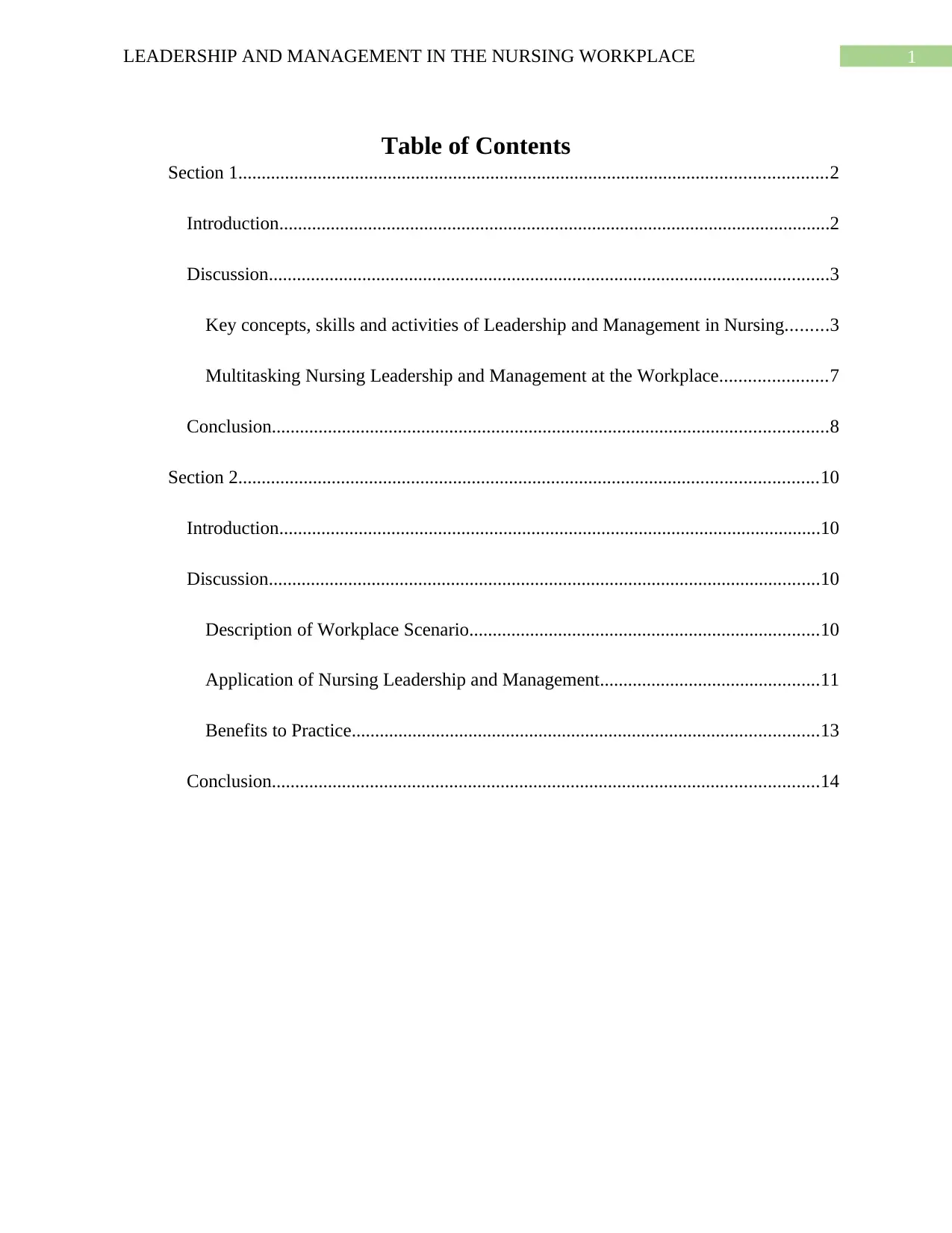
Table of Contents
Section 1..............................................................................................................................2
Introduction......................................................................................................................2
Discussion........................................................................................................................3
Key concepts, skills and activities of Leadership and Management in Nursing.........3
Multitasking Nursing Leadership and Management at the Workplace.......................7
Conclusion.......................................................................................................................8
Section 2............................................................................................................................10
Introduction....................................................................................................................10
Discussion......................................................................................................................10
Description of Workplace Scenario...........................................................................10
Application of Nursing Leadership and Management...............................................11
Benefits to Practice....................................................................................................13
Conclusion.....................................................................................................................14
Table of Contents
Section 1..............................................................................................................................2
Introduction......................................................................................................................2
Discussion........................................................................................................................3
Key concepts, skills and activities of Leadership and Management in Nursing.........3
Multitasking Nursing Leadership and Management at the Workplace.......................7
Conclusion.......................................................................................................................8
Section 2............................................................................................................................10
Introduction....................................................................................................................10
Discussion......................................................................................................................10
Description of Workplace Scenario...........................................................................10
Application of Nursing Leadership and Management...............................................11
Benefits to Practice....................................................................................................13
Conclusion.....................................................................................................................14
2LEADERSHIP AND MANAGEMENT IN THE NURSING WORKPLACE
Section 1
Introduction
For the purpose of ensuring the fulfilment and maintenance of positive health outcomes
across the community and the global population, the field of nursing is of utmost importance.
Indeed, since traditional times, nurses have played a key role in not merely ensuring the safety,
management and protection of individuals from serious illnesses and healthcare issues, but also
improving upon the ability of patients to maintain an optimum and sound health status in the
future. However, with advancements in medical technology as well as globalization and
communication channels, healthcare organizations are currently encountering diverse changes in
terms of organization as well as the need to meet diverse consumer expectations. With respect to
the same, nurses are no longer expected to merely limit their clinical activities to ensuring the
alleviation of the physiological symptoms of diseases. Additionally, with the increasing influx of
patients, healthcare organizations currently encounter a range of complex diseases conditions,
diverse patient perspectives and unpredictable emergencies. To mitigate all these, nurses are now
expected to integrate their clinical activities with multitasking functions of clinical leadership
and management at the healthcare organizational workplace.
The aim of this paper is to provide an extensive and elaborate discussion on the key
concepts, skills and activities pertaining to leadership and management in nursing. Additionally,
the succeeding sections of this paper will also expound upon the application of such leadership
and management concepts in real life, professional nursing practice by drawing upon relevant
clinical scenarios. The following paragraphs of this section will thus, shed light on evidence
Section 1
Introduction
For the purpose of ensuring the fulfilment and maintenance of positive health outcomes
across the community and the global population, the field of nursing is of utmost importance.
Indeed, since traditional times, nurses have played a key role in not merely ensuring the safety,
management and protection of individuals from serious illnesses and healthcare issues, but also
improving upon the ability of patients to maintain an optimum and sound health status in the
future. However, with advancements in medical technology as well as globalization and
communication channels, healthcare organizations are currently encountering diverse changes in
terms of organization as well as the need to meet diverse consumer expectations. With respect to
the same, nurses are no longer expected to merely limit their clinical activities to ensuring the
alleviation of the physiological symptoms of diseases. Additionally, with the increasing influx of
patients, healthcare organizations currently encounter a range of complex diseases conditions,
diverse patient perspectives and unpredictable emergencies. To mitigate all these, nurses are now
expected to integrate their clinical activities with multitasking functions of clinical leadership
and management at the healthcare organizational workplace.
The aim of this paper is to provide an extensive and elaborate discussion on the key
concepts, skills and activities pertaining to leadership and management in nursing. Additionally,
the succeeding sections of this paper will also expound upon the application of such leadership
and management concepts in real life, professional nursing practice by drawing upon relevant
clinical scenarios. The following paragraphs of this section will thus, shed light on evidence
⊘ This is a preview!⊘
Do you want full access?
Subscribe today to unlock all pages.

Trusted by 1+ million students worldwide
3LEADERSHIP AND MANAGEMENT IN THE NURSING WORKPLACE
based concepts as well as the strategies with which, nurses can implement multitasking activities
of leadership and management at the professional nursing workplace.
Discussion
Key concepts, skills and activities of Leadership and Management in Nursing
For the purpose of integrating leadership and management skills in professional nursing
practice, nurses are required to demonstrate their understanding across a range of management
and leadership concepts. These have been enlisted in the following sections:
Transformational Leadership: Transformational leadership is a style of leadership in
which leaders work collaboratively with the workforce for the identification of organization
change, creation of a collect vision and inspiring and motivating team towards personal as well
as professional development. While a number of leadership styles exist for nurses to effectively
apply across clinical practice, the transformational leadership style has been evidenced to be
effective with regards to ensuring long term organizational change and motivating team members
to practice continuous improvement. Healthcare organizations are required to encounter complex
healthcare situations and diverse patient needs, in addition to the need to meet patient
expectation upon a background of increasing patient influx. Thus, nurses who use
transformational leadership to supervise nursing teams, are likely to keep team members
motivated as well as ensure that each nurse engages in continuous improvement with respect to
clinical professional quality as well as personal growth and development. Nurses exercising
transformational leadership also have the ability to ensure that teams members work
harmoniously and collectively with each other to achieve collective organizational goals and
healthcare organizational change management. Some of the common activities of
transformational leadership which nurses may have to exercise, include: working or supervising
based concepts as well as the strategies with which, nurses can implement multitasking activities
of leadership and management at the professional nursing workplace.
Discussion
Key concepts, skills and activities of Leadership and Management in Nursing
For the purpose of integrating leadership and management skills in professional nursing
practice, nurses are required to demonstrate their understanding across a range of management
and leadership concepts. These have been enlisted in the following sections:
Transformational Leadership: Transformational leadership is a style of leadership in
which leaders work collaboratively with the workforce for the identification of organization
change, creation of a collect vision and inspiring and motivating team towards personal as well
as professional development. While a number of leadership styles exist for nurses to effectively
apply across clinical practice, the transformational leadership style has been evidenced to be
effective with regards to ensuring long term organizational change and motivating team members
to practice continuous improvement. Healthcare organizations are required to encounter complex
healthcare situations and diverse patient needs, in addition to the need to meet patient
expectation upon a background of increasing patient influx. Thus, nurses who use
transformational leadership to supervise nursing teams, are likely to keep team members
motivated as well as ensure that each nurse engages in continuous improvement with respect to
clinical professional quality as well as personal growth and development. Nurses exercising
transformational leadership also have the ability to ensure that teams members work
harmoniously and collectively with each other to achieve collective organizational goals and
healthcare organizational change management. Some of the common activities of
transformational leadership which nurses may have to exercise, include: working or supervising
Paraphrase This Document
Need a fresh take? Get an instant paraphrase of this document with our AI Paraphraser
4LEADERSHIP AND MANAGEMENT IN THE NURSING WORKPLACE
a team of enrolled nurses to not just address the healthcare needs of a patient but to also ensure
that each nurse feels inspired to work collectively in achieving organizational goals as well as
personally in improving intrapersonal commitment. Using skills of intellectual stimulation,
individualized consideration, idealized influence and inspired motivation, a transformational
nurse leader will recognize the competency of each team member and delegate tasks to them
accordingly so as to ensure that they fulfil expected clinical targets as well as feel encouraged to
improve beyond their current skillsets at the workplace.
Emotional Intelligence: The skill of emotional intelligence is often evidenced to be
followed by leaders as well as managers. Emotional intelligence implies the ability to
demonstrate awareness regarding one’s own as well as other’s emotions and ensure application
of the same with regards to identification of one’s limitations, strengths and scope of
improvement in areas of both personal and professional practice. Healthcare organizations and
clinical environments are required to encounter a range of critical situations and patient
emergencies which often contribute to conflicts and disagreements. Nurses are often at the
receiving end of negative feedback and comments from both healthcare personnel as well as
patients, which in turn, can contribute to feelings of anxiety, discouragement and distress.
Practicing skills of emotional intelligence will not only allow nurses to empathize with others’
emotions but will also allow nurses to recognize factors impacting their negative and positive
emotions and thus, assist them in practicing appropriate interpersonal communication and
emotional expression at the workplace. A common activity in which nurses can demonstrate
emotional intelligence is during understanding and empathizing difficult situations with client or
peers. It is not uncommon for nursing students or even registered nurses to hear discouraging
feedback from patients or supervisors. However, an emotionally intelligent nurse, by exercising
a team of enrolled nurses to not just address the healthcare needs of a patient but to also ensure
that each nurse feels inspired to work collectively in achieving organizational goals as well as
personally in improving intrapersonal commitment. Using skills of intellectual stimulation,
individualized consideration, idealized influence and inspired motivation, a transformational
nurse leader will recognize the competency of each team member and delegate tasks to them
accordingly so as to ensure that they fulfil expected clinical targets as well as feel encouraged to
improve beyond their current skillsets at the workplace.
Emotional Intelligence: The skill of emotional intelligence is often evidenced to be
followed by leaders as well as managers. Emotional intelligence implies the ability to
demonstrate awareness regarding one’s own as well as other’s emotions and ensure application
of the same with regards to identification of one’s limitations, strengths and scope of
improvement in areas of both personal and professional practice. Healthcare organizations and
clinical environments are required to encounter a range of critical situations and patient
emergencies which often contribute to conflicts and disagreements. Nurses are often at the
receiving end of negative feedback and comments from both healthcare personnel as well as
patients, which in turn, can contribute to feelings of anxiety, discouragement and distress.
Practicing skills of emotional intelligence will not only allow nurses to empathize with others’
emotions but will also allow nurses to recognize factors impacting their negative and positive
emotions and thus, assist them in practicing appropriate interpersonal communication and
emotional expression at the workplace. A common activity in which nurses can demonstrate
emotional intelligence is during understanding and empathizing difficult situations with client or
peers. It is not uncommon for nursing students or even registered nurses to hear discouraging
feedback from patients or supervisors. However, an emotionally intelligent nurse, by exercising
5LEADERSHIP AND MANAGEMENT IN THE NURSING WORKPLACE
skills of: self-awareness and motivation, will be able empathize with the patient or supervisor
with regards to what conditions could have contributed to the conflict. Emotional intelligent
nurses will also reflect upon what factors or situations could have prompted them to react in a
certain way, which they can then work upon for future personal improvement and professional
functioning.
Conflict Resolution: As mentioned previously, healthcare organizations, especially
nurses, have to experience and address a large number of patient concerns which are diverse and
highly complex in nature. Coupled with this is the nursing obligation to collaborate with
healthcare professionals and other medical staff belonging to various healthcare disciplines and
organizational levels. Thus, it is not surprising to find nurses experiencing frequent conflicts with
patients, peers or even supervisors, which if not addressed in a timely and effective manner, can
contribute to feelings of distress, insecurity, agitation, loss of self-esteem, increased medical
errors and high rates of nursing attrition. Conflict Resolution is the management practice of
mediating arguments and disputes by arriving harmoniously at a consensus and agreement. The
practice of optimum conflict resolution practice by nurses comprising of ensuring that opposing
parties arriving at a win-win situation where both groups are benefitted. Engagement in sufficient
conflict resolution practices allows for improved practice of team work, interpersonal
collaboration and communication which in turn, contributes to improved clinical practice and
nursing retention rates. Common activities where nurse leaders and managers are required to
exercise skills of conflict resolution is during a situation of negative patient feedback where often
patients and their families raise complaints or communicate using harsh, impolite language. To
ensure a win-win situation, not only will the nurse gently and calmly apologize for any
inconveniences with patients but will also ensure that patient and nurses engage in open,
skills of: self-awareness and motivation, will be able empathize with the patient or supervisor
with regards to what conditions could have contributed to the conflict. Emotional intelligent
nurses will also reflect upon what factors or situations could have prompted them to react in a
certain way, which they can then work upon for future personal improvement and professional
functioning.
Conflict Resolution: As mentioned previously, healthcare organizations, especially
nurses, have to experience and address a large number of patient concerns which are diverse and
highly complex in nature. Coupled with this is the nursing obligation to collaborate with
healthcare professionals and other medical staff belonging to various healthcare disciplines and
organizational levels. Thus, it is not surprising to find nurses experiencing frequent conflicts with
patients, peers or even supervisors, which if not addressed in a timely and effective manner, can
contribute to feelings of distress, insecurity, agitation, loss of self-esteem, increased medical
errors and high rates of nursing attrition. Conflict Resolution is the management practice of
mediating arguments and disputes by arriving harmoniously at a consensus and agreement. The
practice of optimum conflict resolution practice by nurses comprising of ensuring that opposing
parties arriving at a win-win situation where both groups are benefitted. Engagement in sufficient
conflict resolution practices allows for improved practice of team work, interpersonal
collaboration and communication which in turn, contributes to improved clinical practice and
nursing retention rates. Common activities where nurse leaders and managers are required to
exercise skills of conflict resolution is during a situation of negative patient feedback where often
patients and their families raise complaints or communicate using harsh, impolite language. To
ensure a win-win situation, not only will the nurse gently and calmly apologize for any
inconveniences with patients but will also ensure that patient and nurses engage in open,
⊘ This is a preview!⊘
Do you want full access?
Subscribe today to unlock all pages.
Trusted by 1+ million students worldwide
6LEADERSHIP AND MANAGEMENT IN THE NURSING WORKPLACE
interpersonal communication in a peaceful manner so as to ensure that both parties are benefitted
and arrive at a harmonious agreement.
Team Building: Nurse are not merely required to work with patients but are also often
expected to work with other nurses from various designations and levels as well as with other
healthcare professionals belonging to diverse medical fields. Additionally, no two nurses have
the same set of skills and competencies, but nevertheless have to work together towards ensuring
that patients achieve positive health outcomes and that organizational targets and profits are
maintained. Additionally patients present to the healthcare organization with a range of complex
and multifaceted healthcare needs, whose interventions and management are often beyond the
scope of nursing practice. It is thus common for nurses to continuously collaborate, practice and
communicate with healthcare professionals from various medical disciplines across a
multidisciplinary team. Thus, to ensure that diverse patient healthcare needs are maintained
irrespective of how complex or critical the clinical situation is, it is imperative that nurse leaders
practice the managerial skills of team building and collaborative practice. Team building
comprises of working collaboratively with diverse team members as well as ensuring
harmonious cooperation amongst members of the workforce for the purpose of ensuring
collective achievement of organizational objectives. Team building activities are commonly
practiced during emergency situations or in situations when a limited nursing workforce are
required to address a high rate of patient influx. By exercise skills of motivation and
interpersonal communication, not only will the nurse leader inspire members to take challenges
but will also demonstrate openness and accountability to listen to the concerns and doubts of
each staff member. Additional skills which nurse leaders will be required to exercise for the
purpose of ensuring optimum team building practices include: resilience and debriefing. By
interpersonal communication in a peaceful manner so as to ensure that both parties are benefitted
and arrive at a harmonious agreement.
Team Building: Nurse are not merely required to work with patients but are also often
expected to work with other nurses from various designations and levels as well as with other
healthcare professionals belonging to diverse medical fields. Additionally, no two nurses have
the same set of skills and competencies, but nevertheless have to work together towards ensuring
that patients achieve positive health outcomes and that organizational targets and profits are
maintained. Additionally patients present to the healthcare organization with a range of complex
and multifaceted healthcare needs, whose interventions and management are often beyond the
scope of nursing practice. It is thus common for nurses to continuously collaborate, practice and
communicate with healthcare professionals from various medical disciplines across a
multidisciplinary team. Thus, to ensure that diverse patient healthcare needs are maintained
irrespective of how complex or critical the clinical situation is, it is imperative that nurse leaders
practice the managerial skills of team building and collaborative practice. Team building
comprises of working collaboratively with diverse team members as well as ensuring
harmonious cooperation amongst members of the workforce for the purpose of ensuring
collective achievement of organizational objectives. Team building activities are commonly
practiced during emergency situations or in situations when a limited nursing workforce are
required to address a high rate of patient influx. By exercise skills of motivation and
interpersonal communication, not only will the nurse leader inspire members to take challenges
but will also demonstrate openness and accountability to listen to the concerns and doubts of
each staff member. Additional skills which nurse leaders will be required to exercise for the
purpose of ensuring optimum team building practices include: resilience and debriefing. By
Paraphrase This Document
Need a fresh take? Get an instant paraphrase of this document with our AI Paraphraser
7LEADERSHIP AND MANAGEMENT IN THE NURSING WORKPLACE
conducting timely and regular debriefing based group discussions nurse leaders will be able to
motivate and teach staff on strategies of mindfulness and reflection, with which, they can be
resilient enough to overcome or recover from challenges.
Advocacy: Nursing activities are no longer only limited to addressing merely the
physiological symptoms of patients. Patients are often subjected to a range of social, educational
and cultural concerns which in turn, impact their ability to feel empowered enough to take
control of maintaining their health outcomes in the future. For example, patients from diverse
cultural groups or economic conditions are commonly discriminated across the workplace or
healthcare organization which in turn, can impact their achievement of optimum health status.
Management skills of advocacy involves representing or assisting individuals to represent their
concerns across multiple social platforms in order to ensure that their healthcare needs and
demands are heard. Nurses commonly advocate for culturally diverse or disabled clients when
they are met with discrimination at the workplace or educational institutions.
Cultural Competency: As mentioned previously, globalization has contributed to the
influx of patients from a wide range of cultural communities and ethnicities, who present to the
healthcare organization with a diverse set of religious, spiritual and linguistic needs. Cultural
competency is the management skill with which nurses demonstrate cultural sensitivity towards
the practices and expectations of linguistically and cultural diverse patients. Skills of cultural
competency, cultural sensitivity and empathy are commonly required to be practice when
addressing the healthcare needs of patients belonging to Indigenous, non-English and
linguistically diverse minority backgrounds.
conducting timely and regular debriefing based group discussions nurse leaders will be able to
motivate and teach staff on strategies of mindfulness and reflection, with which, they can be
resilient enough to overcome or recover from challenges.
Advocacy: Nursing activities are no longer only limited to addressing merely the
physiological symptoms of patients. Patients are often subjected to a range of social, educational
and cultural concerns which in turn, impact their ability to feel empowered enough to take
control of maintaining their health outcomes in the future. For example, patients from diverse
cultural groups or economic conditions are commonly discriminated across the workplace or
healthcare organization which in turn, can impact their achievement of optimum health status.
Management skills of advocacy involves representing or assisting individuals to represent their
concerns across multiple social platforms in order to ensure that their healthcare needs and
demands are heard. Nurses commonly advocate for culturally diverse or disabled clients when
they are met with discrimination at the workplace or educational institutions.
Cultural Competency: As mentioned previously, globalization has contributed to the
influx of patients from a wide range of cultural communities and ethnicities, who present to the
healthcare organization with a diverse set of religious, spiritual and linguistic needs. Cultural
competency is the management skill with which nurses demonstrate cultural sensitivity towards
the practices and expectations of linguistically and cultural diverse patients. Skills of cultural
competency, cultural sensitivity and empathy are commonly required to be practice when
addressing the healthcare needs of patients belonging to Indigenous, non-English and
linguistically diverse minority backgrounds.
8LEADERSHIP AND MANAGEMENT IN THE NURSING WORKPLACE
Multitasking Nursing Leadership and Management at the Workplace
The field of nursing has traditionally comprised of merely attending to the safety and
hygiene needs of a patient as well as ensuring that patients are relieved of their debilitating
disease conditions and physiological concerns. However, due to the contribution of notable
theoretical perspectives as well as the rising rates of globalization and emerging patient influx
across healthcare organizations, nurses are not required to exercise leadership and management
skills in congruence with their traditional clinical patient care activities. Prior to implementing
regular patient care activities of hygiene, pain reduction and comfort, nurses are now expected to
engage in in-depth patient centered and family-centered conversations with patients and families
concerning their expectation along with simultaneously ensuring understanding of cultural needs
as well as communicating to the multidisciplinary team concerning implementation of
customized interventions as per comprehensive assessment needs. Additionally, during peak
business hours, nurses are expected to juggle between medication administration, fulfillment of
clinical handovers as well as mitigating any clinical emergencies simultaneously on a daily,
priority basis. For this reason, it is thus imperative that nurses multitask their daily clinical
activities and organizational responsibilities in a sound and effective manner, by simultaneous
implementation of both management and leadership skills.
Conclusion
This section thus successfully provides an extensive and elaborate discussion on the key
concepts, skills and activities underlying the fields of leadership and management in nursing
professional practice. With respect to the nature of clinical activities and patient care
complexities prevalent across healthcare organizations, some of the key concepts of leadership
and management which nurses are required to understand and implement at the workplace,
Multitasking Nursing Leadership and Management at the Workplace
The field of nursing has traditionally comprised of merely attending to the safety and
hygiene needs of a patient as well as ensuring that patients are relieved of their debilitating
disease conditions and physiological concerns. However, due to the contribution of notable
theoretical perspectives as well as the rising rates of globalization and emerging patient influx
across healthcare organizations, nurses are not required to exercise leadership and management
skills in congruence with their traditional clinical patient care activities. Prior to implementing
regular patient care activities of hygiene, pain reduction and comfort, nurses are now expected to
engage in in-depth patient centered and family-centered conversations with patients and families
concerning their expectation along with simultaneously ensuring understanding of cultural needs
as well as communicating to the multidisciplinary team concerning implementation of
customized interventions as per comprehensive assessment needs. Additionally, during peak
business hours, nurses are expected to juggle between medication administration, fulfillment of
clinical handovers as well as mitigating any clinical emergencies simultaneously on a daily,
priority basis. For this reason, it is thus imperative that nurses multitask their daily clinical
activities and organizational responsibilities in a sound and effective manner, by simultaneous
implementation of both management and leadership skills.
Conclusion
This section thus successfully provides an extensive and elaborate discussion on the key
concepts, skills and activities underlying the fields of leadership and management in nursing
professional practice. With respect to the nature of clinical activities and patient care
complexities prevalent across healthcare organizations, some of the key concepts of leadership
and management which nurses are required to understand and implement at the workplace,
⊘ This is a preview!⊘
Do you want full access?
Subscribe today to unlock all pages.
Trusted by 1+ million students worldwide
9LEADERSHIP AND MANAGEMENT IN THE NURSING WORKPLACE
include: transformational leadership, emotional intelligence, cultural competency, delegation,
team building, task delegation, patient or workforce advocacy and most importantly, conflict
resolution. In addition to the application and integration of the above nursing and leadership
concepts and skills, nurses are also expect to simultaneously implement and engage in
multitasking activities of both leadership and management, due to the diverse organizational
situations and conflicts encountered at the workplace every day. To conclude, it is evident that
leadership and management practices go simultaneously in nursing practice. To address multiple,
critical healthcare situations and diverse patient requests effectively, nurses are expected to
implement multitasking activities comprising of both leadership and management.
include: transformational leadership, emotional intelligence, cultural competency, delegation,
team building, task delegation, patient or workforce advocacy and most importantly, conflict
resolution. In addition to the application and integration of the above nursing and leadership
concepts and skills, nurses are also expect to simultaneously implement and engage in
multitasking activities of both leadership and management, due to the diverse organizational
situations and conflicts encountered at the workplace every day. To conclude, it is evident that
leadership and management practices go simultaneously in nursing practice. To address multiple,
critical healthcare situations and diverse patient requests effectively, nurses are expected to
implement multitasking activities comprising of both leadership and management.
Paraphrase This Document
Need a fresh take? Get an instant paraphrase of this document with our AI Paraphraser
10LEADERSHIP AND MANAGEMENT IN THE NURSING WORKPLACE
Section 2
Introduction
For the purpose of ensuring simultaneous fulfilment of long term positive health
outcomes, high levels of satisfaction and positive feedback across patients as well the prevention
of medical errors and organizational conflicts at the workplace, nurses are expected to adhere to
a range of management and leadership skills. Additionally, as discussed previously,
implementation of nursing skills of leadership and management also ensures improve rates of
interpersonal communication, team work, collaborative practice and teamwork, which in turn,
encourages feelings of optimum confidence, self-esteem and motivation across the nursing
workforce. The following sections of this paper will provide a succinct yet detailed discussion on
the strategies with which skills of leadership and management be applied across clinical patient
or organizational scenarios across healthcare environments. This paper will also draw the key
benefits both nurses and healthcare organizations can derive via the applicable of multitasking
skills with respect to simultaneous implementation of both management and leadership skills at
the workplace.
Discussion
Description of Workplace Scenario
The clinical scenario in this case is from my friend, who was once working in a mental
healthcare ward as a nursing student in a local healthcare organization, as a part of a clinical
placement. This patient care setting attended to the diverse mental healthcare needs of patients
belonging to diverse cultural, linguistic and ethnic backgrounds. Thus, it was not uncommon for
my friend to not only demonstrate cultural competency but also to demonstrate skills of
Section 2
Introduction
For the purpose of ensuring simultaneous fulfilment of long term positive health
outcomes, high levels of satisfaction and positive feedback across patients as well the prevention
of medical errors and organizational conflicts at the workplace, nurses are expected to adhere to
a range of management and leadership skills. Additionally, as discussed previously,
implementation of nursing skills of leadership and management also ensures improve rates of
interpersonal communication, team work, collaborative practice and teamwork, which in turn,
encourages feelings of optimum confidence, self-esteem and motivation across the nursing
workforce. The following sections of this paper will provide a succinct yet detailed discussion on
the strategies with which skills of leadership and management be applied across clinical patient
or organizational scenarios across healthcare environments. This paper will also draw the key
benefits both nurses and healthcare organizations can derive via the applicable of multitasking
skills with respect to simultaneous implementation of both management and leadership skills at
the workplace.
Discussion
Description of Workplace Scenario
The clinical scenario in this case is from my friend, who was once working in a mental
healthcare ward as a nursing student in a local healthcare organization, as a part of a clinical
placement. This patient care setting attended to the diverse mental healthcare needs of patients
belonging to diverse cultural, linguistic and ethnic backgrounds. Thus, it was not uncommon for
my friend to not only demonstrate cultural competency but also to demonstrate skills of
11LEADERSHIP AND MANAGEMENT IN THE NURSING WORKPLACE
emotional intelligence, delegation, team building and transformational leadership when dealing
harmoniously with patients presenting with critical mental health conditions – as observed in the
scenario below.
In one instance, my friend and her peer reported to the nursing station only to find that
their supervisor had to attend to a patient’s emergency. They were then instructed by the nurse
practitioner at the station to start with their morning handover and that their supervisor will join
them soon. While my friend begun to attend to one patient, her peer was instructed to
immediately attend to another patient who was currently complaining of wishing to call her
family. The patient my peer attended to was a 60 year old Aboriginal women with dementia. The
moment my friend began to attend to her bathing, the patient suddenly began to scream, leaving
my friend, who was alone, in a conflicting situation. However, my friend managed to stay calm,
switch off the shower and first empathized with the patient by gently talking to her and
simultaneously wrap her in a warm towel. While directing the patient to her bed, my friend
continued to speak to her in simple English and had simultaneously alerted the workstation for
assistance. After the arrival of her peer, who was by now alarmed at the situation, my friend
instructed her to inform the patient’s family. She then proceeded to prepare the handover and
immediately discuss the issue in collaboration with the supervisor and the neurologist.
Application of Nursing Leadership and Management
To address the above scenario, the key nursing and management skills which were
addressed here included: management skills of emotional intelligence, team building and cultural
competency for conflict resolution as well as leadership skills of transformational leadership.
To first resolve the conflict with the patient, the nurse can be observed to apply the
management skills of cultural competency, emotional intelligence and team building. Cultural
emotional intelligence, delegation, team building and transformational leadership when dealing
harmoniously with patients presenting with critical mental health conditions – as observed in the
scenario below.
In one instance, my friend and her peer reported to the nursing station only to find that
their supervisor had to attend to a patient’s emergency. They were then instructed by the nurse
practitioner at the station to start with their morning handover and that their supervisor will join
them soon. While my friend begun to attend to one patient, her peer was instructed to
immediately attend to another patient who was currently complaining of wishing to call her
family. The patient my peer attended to was a 60 year old Aboriginal women with dementia. The
moment my friend began to attend to her bathing, the patient suddenly began to scream, leaving
my friend, who was alone, in a conflicting situation. However, my friend managed to stay calm,
switch off the shower and first empathized with the patient by gently talking to her and
simultaneously wrap her in a warm towel. While directing the patient to her bed, my friend
continued to speak to her in simple English and had simultaneously alerted the workstation for
assistance. After the arrival of her peer, who was by now alarmed at the situation, my friend
instructed her to inform the patient’s family. She then proceeded to prepare the handover and
immediately discuss the issue in collaboration with the supervisor and the neurologist.
Application of Nursing Leadership and Management
To address the above scenario, the key nursing and management skills which were
addressed here included: management skills of emotional intelligence, team building and cultural
competency for conflict resolution as well as leadership skills of transformational leadership.
To first resolve the conflict with the patient, the nurse can be observed to apply the
management skills of cultural competency, emotional intelligence and team building. Cultural
⊘ This is a preview!⊘
Do you want full access?
Subscribe today to unlock all pages.
Trusted by 1+ million students worldwide

1 out of 16


Related Documents


Your All-in-One AI-Powered Toolkit for Academic Success.
+13062052269
info@desklib.com
Available 24*7 on WhatsApp / Email
![[object Object]](/_next/static/media/star-bottom.7253800d.svg)
Unlock your academic potential
Copyright © 2020–2026 A2Z Services. All Rights Reserved. Developed and managed by ZUCOL.