Leadership Development Plan: Analyzing Skills and Strategies
VerifiedAdded on 2023/06/04
|13
|3856
|412
Report
AI Summary
This report presents a personal leadership development plan, aiming to diagnose current leadership skills and identify strategies for improvement. The report begins with an introduction outlining the plan's importance, followed by a literature review exploring leadership development theories and key approaches. The analysis includes self-assessment of leadership skills, identifying strengths like effective strategy and weaknesses such as poor communication. The report incorporates experiences that have shaped the individual's leadership mindset and discusses strategies for developing leadership potential, drawing on concepts like communication, problem-solving, and trustworthiness. The plan utilizes the Immunity to Change mapping to identify reasons for skill development barriers. The conclusion summarizes the key findings and proposed strategies for enhanced leadership capacity.
LEADERSHIP

Paraphrase This Document
Need a fresh take? Get an instant paraphrase of this document with our AI Paraphraser
1
Contents
Introduction...........................................................................................................................................1
Literature Review..................................................................................................................................1
Leadership development in an individual..........................................................................................1
Key development approaches or methods..........................................................................................2
Developing leaders for future............................................................................................................2
Diagnosing my current leadership skills................................................................................................3
Essential to effective leadership........................................................................................................3
Experiences that set my mind-set......................................................................................................4
Current strength and weaknesses...........................................................................................................5
Strategies to develop leadership potential..............................................................................................8
Conclusion.............................................................................................................................................9
REFERENCES....................................................................................................................................10
Introduction
Contents
Introduction...........................................................................................................................................1
Literature Review..................................................................................................................................1
Leadership development in an individual..........................................................................................1
Key development approaches or methods..........................................................................................2
Developing leaders for future............................................................................................................2
Diagnosing my current leadership skills................................................................................................3
Essential to effective leadership........................................................................................................3
Experiences that set my mind-set......................................................................................................4
Current strength and weaknesses...........................................................................................................5
Strategies to develop leadership potential..............................................................................................8
Conclusion.............................................................................................................................................9
REFERENCES....................................................................................................................................10
Introduction
2
The purpose of this report is to evaluate a personal development plan that would analyse my
personal leadership skills. The personal development plan analyse the current leadership
skills along with potential leadership strategies that can enhance my capacity to lead.
Literature review on the leadership development theories is also explained that evaluates key
development approaches to leadership. A leadership development plan is an invaluable tool
that is strategically used to guide a person with their career choices and personal growth as
well. This plan is a detailed plan that helps an individual in choosing the right career on the
basis of strategic leadership track. This plan includes various aspects like, vision for career,
specific leadership goal with a timeline, commitment towards action steps and lastly,
revaluation of action plan. This plan helps the person in evaluating the vision that they want
to become. It further assists an individual in moving on that path as well. Personal leadership
development plan is very important for an individual as it helps in building strengths of a
person by helping them to acknowledge their inner capabilities. Further, it also helps in
improving the image of a person and increases their self-respect as well. This plan also helps
in overcoming past situations in the environment.
Literature Review
Leadership development in an individual
Packard & Jones, (2015) suggests that leadership development is a very essential aspect of
the modern day business. It can be developed in the organisation with the help of activities
and programs elated to leadership development. Company should provide opportunities to the
employees so that they can ensure their professional growth. This acts as a motivator due to
which people does self-development. One of the greatest facilitators in the leadership
development is the employee retention as it takes a long time for the employee to learn the
culture and value of the organisation. Such motivators like promotions helps the people to
understand their
On the other hand Sholl, (2011) states that leadership can be developed in the organisation by
the help of the coaching and mentoring programs. These programs help as an external
facilitator that helps the individual in managing their development plan. The mentor must be
an experienced personality in their field. It is to be noted that there are people from the
different sections of the society hence a specialised development program shall be needed.
The purpose of this report is to evaluate a personal development plan that would analyse my
personal leadership skills. The personal development plan analyse the current leadership
skills along with potential leadership strategies that can enhance my capacity to lead.
Literature review on the leadership development theories is also explained that evaluates key
development approaches to leadership. A leadership development plan is an invaluable tool
that is strategically used to guide a person with their career choices and personal growth as
well. This plan is a detailed plan that helps an individual in choosing the right career on the
basis of strategic leadership track. This plan includes various aspects like, vision for career,
specific leadership goal with a timeline, commitment towards action steps and lastly,
revaluation of action plan. This plan helps the person in evaluating the vision that they want
to become. It further assists an individual in moving on that path as well. Personal leadership
development plan is very important for an individual as it helps in building strengths of a
person by helping them to acknowledge their inner capabilities. Further, it also helps in
improving the image of a person and increases their self-respect as well. This plan also helps
in overcoming past situations in the environment.
Literature Review
Leadership development in an individual
Packard & Jones, (2015) suggests that leadership development is a very essential aspect of
the modern day business. It can be developed in the organisation with the help of activities
and programs elated to leadership development. Company should provide opportunities to the
employees so that they can ensure their professional growth. This acts as a motivator due to
which people does self-development. One of the greatest facilitators in the leadership
development is the employee retention as it takes a long time for the employee to learn the
culture and value of the organisation. Such motivators like promotions helps the people to
understand their
On the other hand Sholl, (2011) states that leadership can be developed in the organisation by
the help of the coaching and mentoring programs. These programs help as an external
facilitator that helps the individual in managing their development plan. The mentor must be
an experienced personality in their field. It is to be noted that there are people from the
different sections of the society hence a specialised development program shall be needed.
⊘ This is a preview!⊘
Do you want full access?
Subscribe today to unlock all pages.

Trusted by 1+ million students worldwide
3
On the contrary Avolio, (2011) believes that in the leadership development, it is very
essential to take use of theories such as component theory which concentrates on the
environment and behaviour of the individual for their development. Humanistic theory
suggests focusing on the inner capabilities for the self-fulfilment and growth. Energy
psychology focuses on the human experience and communication as well as Neuro-linguistic
programming interconnectedness of mind and body for developing skills in the individual.
Key development approaches or methods
Different development approaches used for the personal and professional development.
Different researchers give different approaches for development.
Petrie, (2011) suggests that Self-development approach is an approach that is utilised by the
organisation and individual in which self-learning should is promoted. With the help of
books, learning mediums from the internet sources like journals and videos etc. leadership
skills can be learnt. In this approach people learn from their internal motivation. They can go
to seminars and workshop where leadership development skills are taught. In the
improvement of skills like motivational and risk taking skills this approach is very much
effective.
Komives, Dugan, Owen, Wagner & Slack, (2011) believes that mentoring approach is an
approach where the individual can take use of their seniors or the experienced personality so
as to develop skills in them. The skills must be developed under the guidance of the person
that is experienced in that field. Regular feedbacks is taken from the mentors and their
analysis reports acts as a tool using which the development plan is prepared.
Developing leaders for future
Jarvis, Gulati, McCririck & Simpson, (2013) states that Sports need highly disciplined
leaders. For developing the best leaders in sport one needs to first find the appropriate
candidate for it then only their training should be started related to leadership development.
Consistency in the performance should be one of the major factors for this identification. One
should be in the team for the longer period of time so as to understand the behaviour of each
and every individual in its team. In sports for leadership development one should be given
responsibilities from time to time so as to check their ability to lead before actually giving
them the responsibility of the team.
On the contrary Avolio, (2011) believes that in the leadership development, it is very
essential to take use of theories such as component theory which concentrates on the
environment and behaviour of the individual for their development. Humanistic theory
suggests focusing on the inner capabilities for the self-fulfilment and growth. Energy
psychology focuses on the human experience and communication as well as Neuro-linguistic
programming interconnectedness of mind and body for developing skills in the individual.
Key development approaches or methods
Different development approaches used for the personal and professional development.
Different researchers give different approaches for development.
Petrie, (2011) suggests that Self-development approach is an approach that is utilised by the
organisation and individual in which self-learning should is promoted. With the help of
books, learning mediums from the internet sources like journals and videos etc. leadership
skills can be learnt. In this approach people learn from their internal motivation. They can go
to seminars and workshop where leadership development skills are taught. In the
improvement of skills like motivational and risk taking skills this approach is very much
effective.
Komives, Dugan, Owen, Wagner & Slack, (2011) believes that mentoring approach is an
approach where the individual can take use of their seniors or the experienced personality so
as to develop skills in them. The skills must be developed under the guidance of the person
that is experienced in that field. Regular feedbacks is taken from the mentors and their
analysis reports acts as a tool using which the development plan is prepared.
Developing leaders for future
Jarvis, Gulati, McCririck & Simpson, (2013) states that Sports need highly disciplined
leaders. For developing the best leaders in sport one needs to first find the appropriate
candidate for it then only their training should be started related to leadership development.
Consistency in the performance should be one of the major factors for this identification. One
should be in the team for the longer period of time so as to understand the behaviour of each
and every individual in its team. In sports for leadership development one should be given
responsibilities from time to time so as to check their ability to lead before actually giving
them the responsibility of the team.
Paraphrase This Document
Need a fresh take? Get an instant paraphrase of this document with our AI Paraphraser
4
Diagnosing my current leadership skills
For every individual it is necessary to diagnose their own leadership skills (Abrell, Rowold,
Weibler & Moenninghoff, 2011). This must be done on regular basis so as to ensure that
skills are developed as per the requirements of the industry in which I am working. This will
help me in creating personal and professional development plan which will have direct
impact on my career and future plans. There are various aspects that need to be seen while
doing the diagnosis.
Essential to effective leadership
From the experience and observation that I had in my life and career, there are various things
that I found essential for effective leadership. Some of them are illustrated below:
Communication skills: One of the most essential skills that need to be present in any leader
is communication skill (Ely, Ibarra & Kolb, 2011). In the companies where the employees are
from different cultural backgrounds, communication skills play a very crucial role. Effective
leaders always have to communicate their ideas to the stakeholders so that they can get
assured about the direction in which company will move in future. Apart from this,
communication skills are also essential for communicating goals and objectives to the
employees which is again essential aspect in the leadership. Communicating goal and
objectives is also essential for managing the work as per the schedule as well as it also
removes confusions from the minds of the employees. I have seen that communication skills
were also necessary for conveying the company’s plan to the public and their customer base.
I have seen that many big companies like Google and Apple use the communication skills of
their leaders as a prime marketing tool. I have also seen that excellent communication skills
act as a tool of motivation. I have had this experience in life. Once in my professional career
my performances as a manager was going down. I was not able to control the operations and
the conflicts that were going on at the workplace. In such a situation my senior manager
motivated me with his words taking help of his experience. By interacting with him for a
week, I was able to understand the problems that I was facing.
Problem solving: I have seen that one of the most important things that were necessary for
effective leadership is that leader needs to be an excellent problem solver. This is necessary
for the managing the problems and issues that arise at the workplace (Wagner, 2016). In my
company or in any company, there are numbers of problems that get arise on the regular basis
Diagnosing my current leadership skills
For every individual it is necessary to diagnose their own leadership skills (Abrell, Rowold,
Weibler & Moenninghoff, 2011). This must be done on regular basis so as to ensure that
skills are developed as per the requirements of the industry in which I am working. This will
help me in creating personal and professional development plan which will have direct
impact on my career and future plans. There are various aspects that need to be seen while
doing the diagnosis.
Essential to effective leadership
From the experience and observation that I had in my life and career, there are various things
that I found essential for effective leadership. Some of them are illustrated below:
Communication skills: One of the most essential skills that need to be present in any leader
is communication skill (Ely, Ibarra & Kolb, 2011). In the companies where the employees are
from different cultural backgrounds, communication skills play a very crucial role. Effective
leaders always have to communicate their ideas to the stakeholders so that they can get
assured about the direction in which company will move in future. Apart from this,
communication skills are also essential for communicating goals and objectives to the
employees which is again essential aspect in the leadership. Communicating goal and
objectives is also essential for managing the work as per the schedule as well as it also
removes confusions from the minds of the employees. I have seen that communication skills
were also necessary for conveying the company’s plan to the public and their customer base.
I have seen that many big companies like Google and Apple use the communication skills of
their leaders as a prime marketing tool. I have also seen that excellent communication skills
act as a tool of motivation. I have had this experience in life. Once in my professional career
my performances as a manager was going down. I was not able to control the operations and
the conflicts that were going on at the workplace. In such a situation my senior manager
motivated me with his words taking help of his experience. By interacting with him for a
week, I was able to understand the problems that I was facing.
Problem solving: I have seen that one of the most important things that were necessary for
effective leadership is that leader needs to be an excellent problem solver. This is necessary
for the managing the problems and issues that arise at the workplace (Wagner, 2016). In my
company or in any company, there are numbers of problems that get arise on the regular basis
5
and for becoming the effective leaders he or she needs to have excellent thinker. Creativity
plays a very important role in this.
Trustworthiness: From my experience I could tell that a leader is effective when he or she is
trustworthy. Due to lack of trustworthiness, it is often seen that stakeholders lose faith on
their leaders (Vitello-Cicciu, Weatherford, Gemme, Glass & Seymour-Route, 2014). In the
long term it is harmful for managing the operations at the workplace and may create an
environment of negativity at the workplace. Due to this it is crucial that every decision that
leaders make must be on the basis of values and ethics that any company has made for itself.
All these skills are also essential for taking everyone together and work as a team. A leader
having all these three skills acts as a facilitator in different situation and hence becoming
capable of solving the problems that a firm has to face.
Experiences that set my mind-set
There were few experiences I had in my professional career which has influenced my
thoughts about leadership. Some of the experiences are as follows:
Once I was not able to manage the work at my workplace as a manager. There were conflicts
going on at the workplace due to the negativity that was created due to confusion. The major
reason for this was there was change going on in the organisation. These changes were in
terms of technological advancements and change in the organisational structure. Due to
introduction of Information system at my firm people needed training and motivation as there
was strong resistance from the side of the workers. This resistance from the side of the
workers was because they do not want things to be changed and there was fear that they
might lose their job. In this situation when my senior leaders communicated their goals and
objectives of the firm to all the stakeholders about the changes that were taking place at the
firm. They needed an assurance that their jobs will not go.
Apart from this once there was problems related to the management of staffs as there were
large numbers of staffs leaving the organisation. The major reason for this was that
employees were not satisfied with the way in which awards were distributed. There was
consistent lagging in way the compensations and benefits were given to the employees. In
order to resolve this problem he used his idea to bring performance management system. This
technology helped them in evaluating the performance effectively and hence such problems
never came again. Employees started to lose trust on the firm but the idea of implementing
and for becoming the effective leaders he or she needs to have excellent thinker. Creativity
plays a very important role in this.
Trustworthiness: From my experience I could tell that a leader is effective when he or she is
trustworthy. Due to lack of trustworthiness, it is often seen that stakeholders lose faith on
their leaders (Vitello-Cicciu, Weatherford, Gemme, Glass & Seymour-Route, 2014). In the
long term it is harmful for managing the operations at the workplace and may create an
environment of negativity at the workplace. Due to this it is crucial that every decision that
leaders make must be on the basis of values and ethics that any company has made for itself.
All these skills are also essential for taking everyone together and work as a team. A leader
having all these three skills acts as a facilitator in different situation and hence becoming
capable of solving the problems that a firm has to face.
Experiences that set my mind-set
There were few experiences I had in my professional career which has influenced my
thoughts about leadership. Some of the experiences are as follows:
Once I was not able to manage the work at my workplace as a manager. There were conflicts
going on at the workplace due to the negativity that was created due to confusion. The major
reason for this was there was change going on in the organisation. These changes were in
terms of technological advancements and change in the organisational structure. Due to
introduction of Information system at my firm people needed training and motivation as there
was strong resistance from the side of the workers. This resistance from the side of the
workers was because they do not want things to be changed and there was fear that they
might lose their job. In this situation when my senior leaders communicated their goals and
objectives of the firm to all the stakeholders about the changes that were taking place at the
firm. They needed an assurance that their jobs will not go.
Apart from this once there was problems related to the management of staffs as there were
large numbers of staffs leaving the organisation. The major reason for this was that
employees were not satisfied with the way in which awards were distributed. There was
consistent lagging in way the compensations and benefits were given to the employees. In
order to resolve this problem he used his idea to bring performance management system. This
technology helped them in evaluating the performance effectively and hence such problems
never came again. Employees started to lose trust on the firm but the idea of implementing
⊘ This is a preview!⊘
Do you want full access?
Subscribe today to unlock all pages.
Trusted by 1+ million students worldwide
6
technology in performance management regained their trust and employee turnover decreased
considerably. At the same time there was also frustration in the minds of suppliers and
distributors as they were facing many challenges. In order to resolve this problem they started
to use supply chain management system. This brought flexibility in the process and hence
balances between demand and supply was maintained.
Both these experiences have impact on my thoughts about the leadership. From all these
experiences I feel that I will be moulding myself as a team leader where everything will be
communicated to all the stakeholders. For this I would have to enhance my communication
skills in which I would take the help of my senior managers. Apart from this I would also
involve more members in my decision making process. This would help me in gaining new
ideas which I could implement in the future if any such challenges come again. I would also
focus on relationship building skills as it would help me maintaining healthy relations with
my sub-ordinates. Healthy relations will help me in building trust among the employees even
in difficult times.
Current strength and weaknesses
After evaluation I have found that at present there are several strengths and weaknesses in me
in terms of leadership skills. Some of the strengths are:
Patient listener
Effective strategist
Able resource planner
Effective team leader
Weaknesses include:
Low quality communication skills
Poor motivator
Poor risk taker
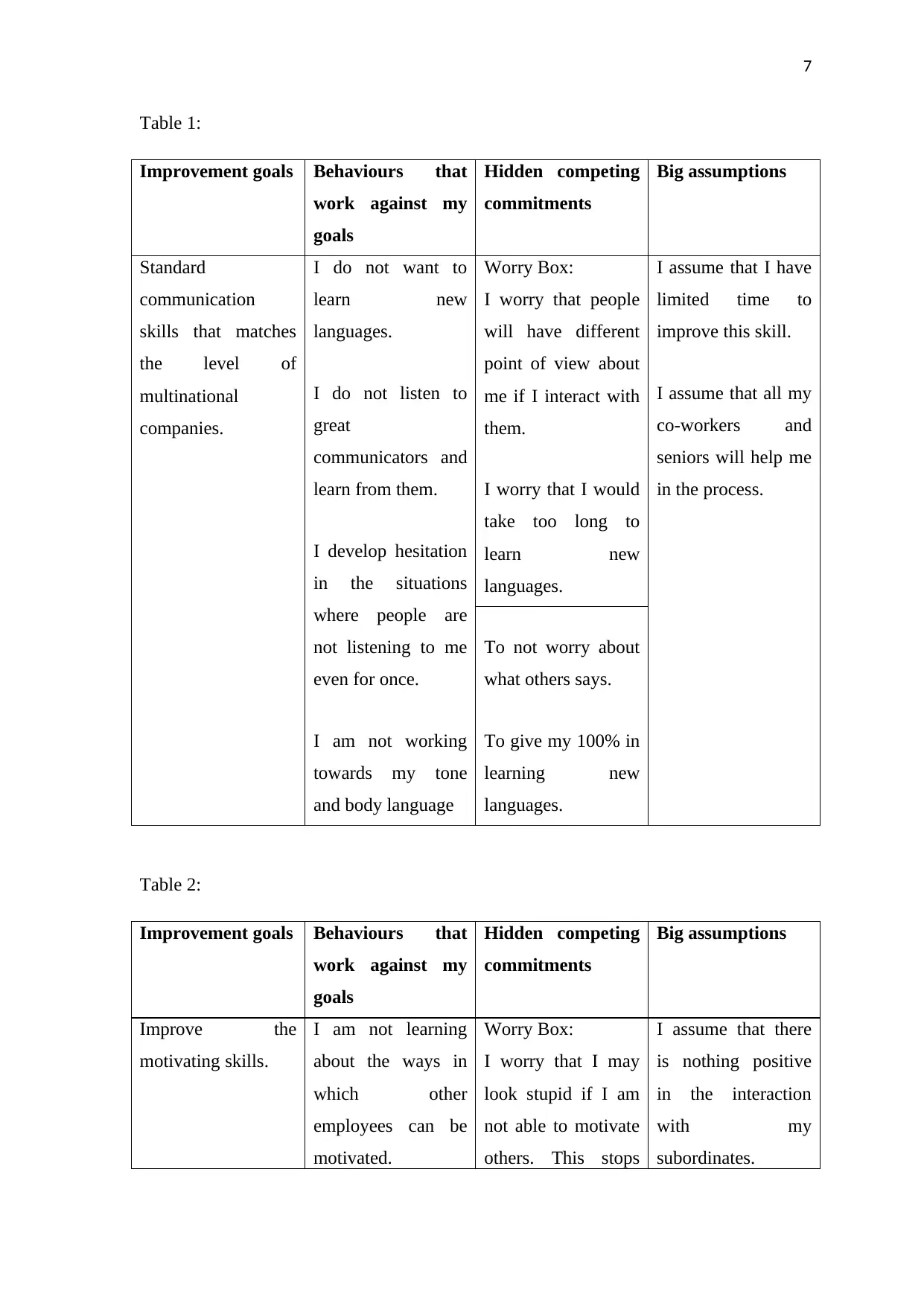
In order to improve my skills I have to work on my weaknesses. For understanding the
process that is required is illustrated by the help of immunity to change mapping (Harvard
University, 2018). This mapping suggests about the reasons why any person is unable to
improve on their skills. It helps in finding the gap in between intention to change and the
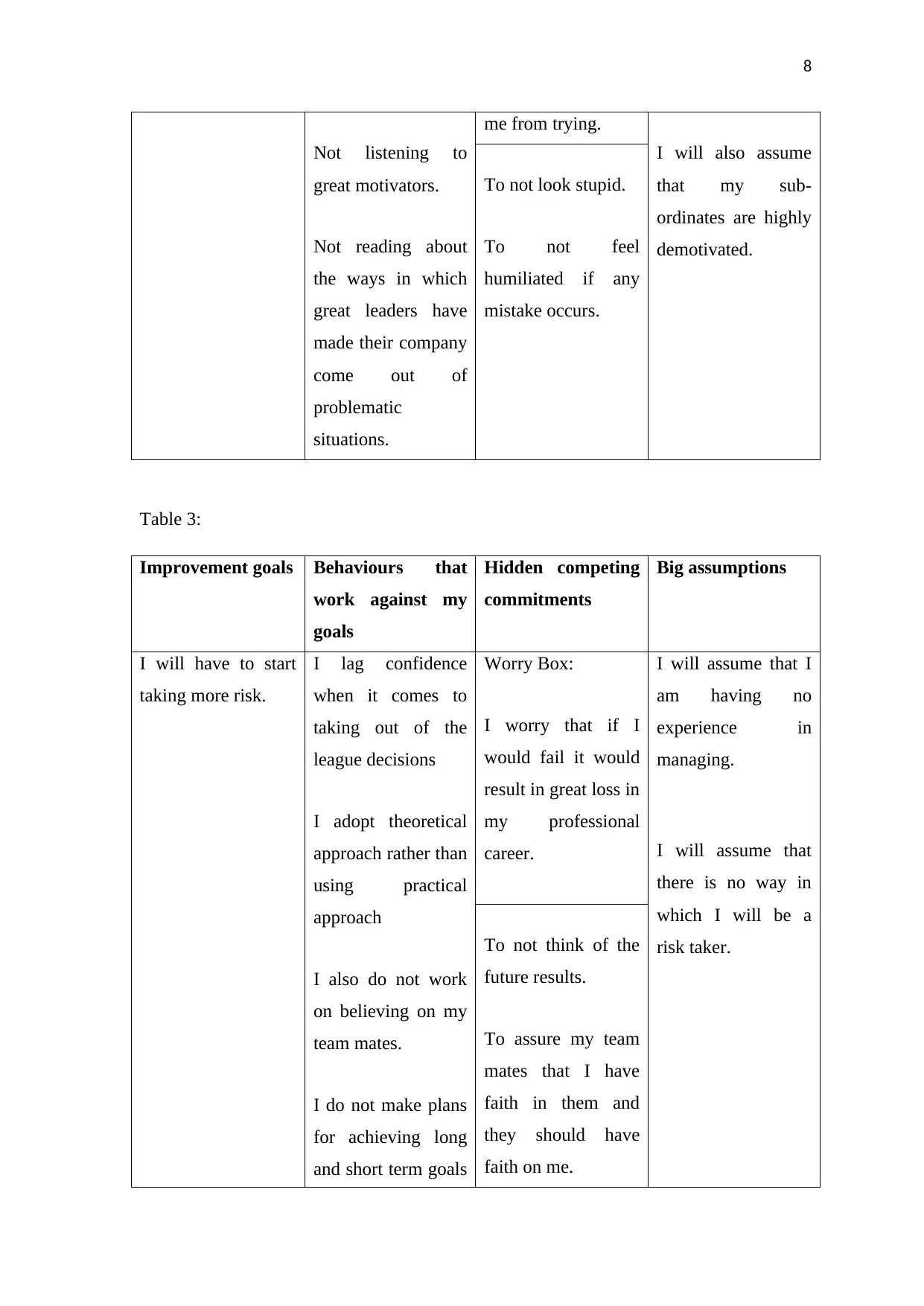
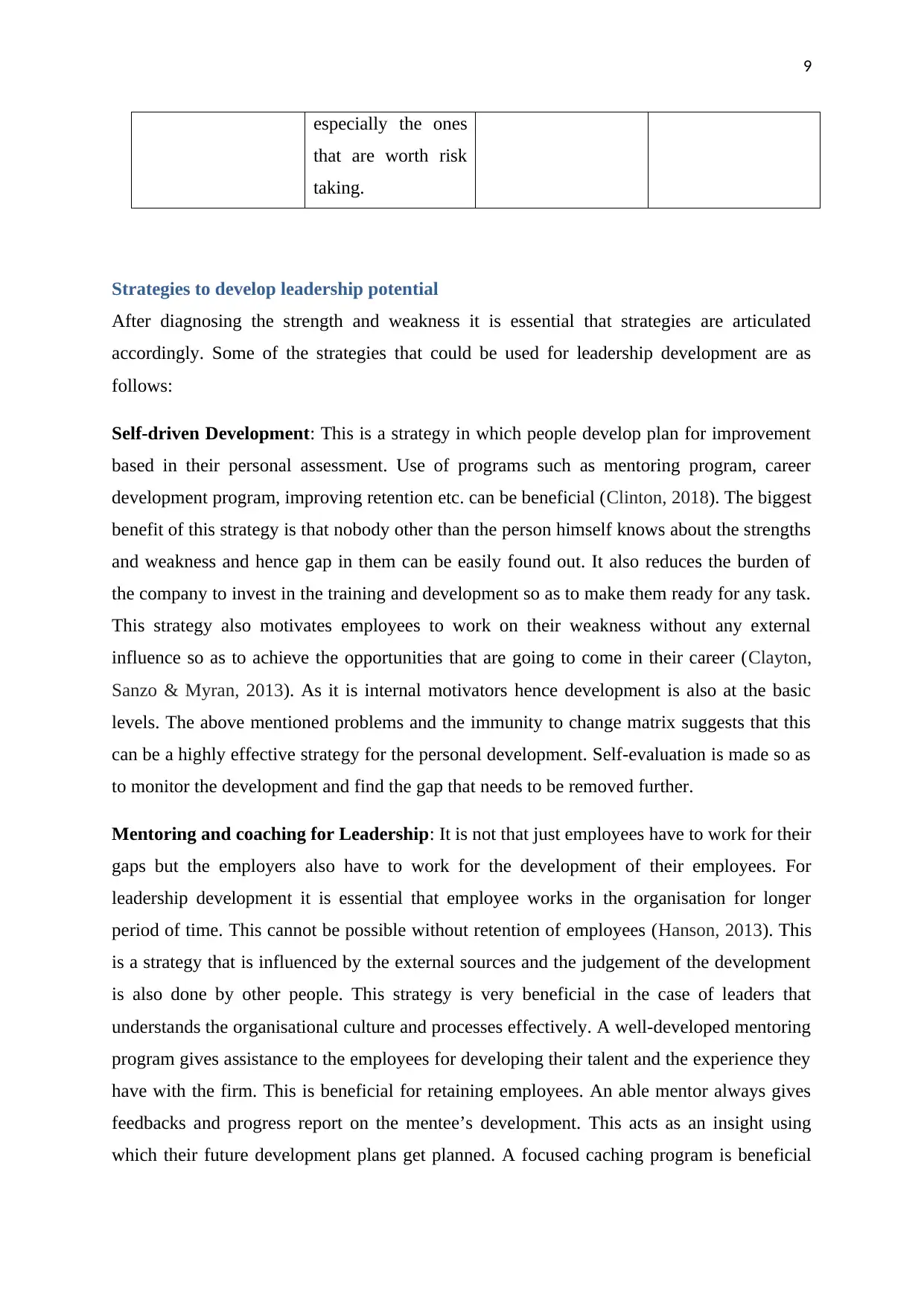
actual desire to change (Youngman, 2016). My immunity to change is illustrated below:
technology in performance management regained their trust and employee turnover decreased
considerably. At the same time there was also frustration in the minds of suppliers and
distributors as they were facing many challenges. In order to resolve this problem they started
to use supply chain management system. This brought flexibility in the process and hence
balances between demand and supply was maintained.
Both these experiences have impact on my thoughts about the leadership. From all these
experiences I feel that I will be moulding myself as a team leader where everything will be
communicated to all the stakeholders. For this I would have to enhance my communication
skills in which I would take the help of my senior managers. Apart from this I would also
involve more members in my decision making process. This would help me in gaining new
ideas which I could implement in the future if any such challenges come again. I would also
focus on relationship building skills as it would help me maintaining healthy relations with
my sub-ordinates. Healthy relations will help me in building trust among the employees even
in difficult times.
Current strength and weaknesses
After evaluation I have found that at present there are several strengths and weaknesses in me
in terms of leadership skills. Some of the strengths are:
Patient listener
Effective strategist
Able resource planner
Effective team leader
Weaknesses include:
Low quality communication skills
Poor motivator
Poor risk taker
In order to improve my skills I have to work on my weaknesses. For understanding the
process that is required is illustrated by the help of immunity to change mapping (Harvard
University, 2018). This mapping suggests about the reasons why any person is unable to
improve on their skills. It helps in finding the gap in between intention to change and the
actual desire to change (Youngman, 2016). My immunity to change is illustrated below:
Paraphrase This Document
Need a fresh take? Get an instant paraphrase of this document with our AI Paraphraser
7
Table 1:
Improvement goals Behaviours that
work against my
goals
Hidden competing
commitments
Big assumptions
Standard
communication
skills that matches
the level of
multinational
companies.
I do not want to
learn new
languages.
I do not listen to
great
communicators and
learn from them.
I develop hesitation
in the situations
where people are
not listening to me
even for once.
I am not working
towards my tone
and body language
Worry Box:
I worry that people
will have different
point of view about
me if I interact with
them.
I worry that I would
take too long to
learn new
languages.
I assume that I have
limited time to
improve this skill.
I assume that all my
co-workers and
seniors will help me
in the process.
To not worry about
what others says.
To give my 100% in
learning new
languages.
Table 2:
Improvement goals Behaviours that
work against my
goals
Hidden competing
commitments
Big assumptions
Improve the
motivating skills.
I am not learning
about the ways in
which other
employees can be
motivated.
Worry Box:
I worry that I may
look stupid if I am
not able to motivate
others. This stops
I assume that there
is nothing positive
in the interaction
with my
subordinates.
Table 1:
Improvement goals Behaviours that
work against my
goals
Hidden competing
commitments
Big assumptions
Standard
communication
skills that matches
the level of
multinational
companies.
I do not want to
learn new
languages.
I do not listen to
great
communicators and
learn from them.
I develop hesitation
in the situations
where people are
not listening to me
even for once.
I am not working
towards my tone
and body language
Worry Box:
I worry that people
will have different
point of view about
me if I interact with
them.
I worry that I would
take too long to
learn new
languages.
I assume that I have
limited time to
improve this skill.
I assume that all my
co-workers and
seniors will help me
in the process.
To not worry about
what others says.
To give my 100% in
learning new
languages.
Table 2:
Improvement goals Behaviours that
work against my
goals
Hidden competing
commitments
Big assumptions
Improve the
motivating skills.
I am not learning
about the ways in
which other
employees can be
motivated.
Worry Box:
I worry that I may
look stupid if I am
not able to motivate
others. This stops
I assume that there
is nothing positive
in the interaction
with my
subordinates.
8
Not listening to
great motivators.
Not reading about
the ways in which
great leaders have
made their company
come out of
problematic
situations.
me from trying.
I will also assume
that my sub-
ordinates are highly
demotivated.
To not look stupid.
To not feel
humiliated if any
mistake occurs.
Table 3:
Improvement goals Behaviours that
work against my
goals
Hidden competing
commitments
Big assumptions
I will have to start
taking more risk.
I lag confidence
when it comes to
taking out of the
league decisions
I adopt theoretical
approach rather than
using practical
approach
I also do not work
on believing on my
team mates.
I do not make plans
for achieving long
and short term goals
Worry Box:
I worry that if I
would fail it would
result in great loss in
my professional
career.
I will assume that I
am having no
experience in
managing.
I will assume that
there is no way in
which I will be a
risk taker.To not think of the
future results.
To assure my team
mates that I have
faith in them and
they should have
faith on me.
Not listening to
great motivators.
Not reading about
the ways in which
great leaders have
made their company
come out of
problematic
situations.
me from trying.
I will also assume
that my sub-
ordinates are highly
demotivated.
To not look stupid.
To not feel
humiliated if any
mistake occurs.
Table 3:
Improvement goals Behaviours that
work against my
goals
Hidden competing
commitments
Big assumptions
I will have to start
taking more risk.
I lag confidence
when it comes to
taking out of the
league decisions
I adopt theoretical
approach rather than
using practical
approach
I also do not work
on believing on my
team mates.
I do not make plans
for achieving long
and short term goals
Worry Box:
I worry that if I
would fail it would
result in great loss in
my professional
career.
I will assume that I
am having no
experience in
managing.
I will assume that
there is no way in
which I will be a
risk taker.To not think of the
future results.
To assure my team
mates that I have
faith in them and
they should have
faith on me.
⊘ This is a preview!⊘
Do you want full access?
Subscribe today to unlock all pages.
Trusted by 1+ million students worldwide
9
especially the ones
that are worth risk
taking.
Strategies to develop leadership potential
After diagnosing the strength and weakness it is essential that strategies are articulated
accordingly. Some of the strategies that could be used for leadership development are as
follows:
Self-driven Development: This is a strategy in which people develop plan for improvement
based in their personal assessment. Use of programs such as mentoring program, career
development program, improving retention etc. can be beneficial (Clinton, 2018). The biggest
benefit of this strategy is that nobody other than the person himself knows about the strengths
and weakness and hence gap in them can be easily found out. It also reduces the burden of
the company to invest in the training and development so as to make them ready for any task.
This strategy also motivates employees to work on their weakness without any external
influence so as to achieve the opportunities that are going to come in their career (Clayton,
Sanzo & Myran, 2013). As it is internal motivators hence development is also at the basic
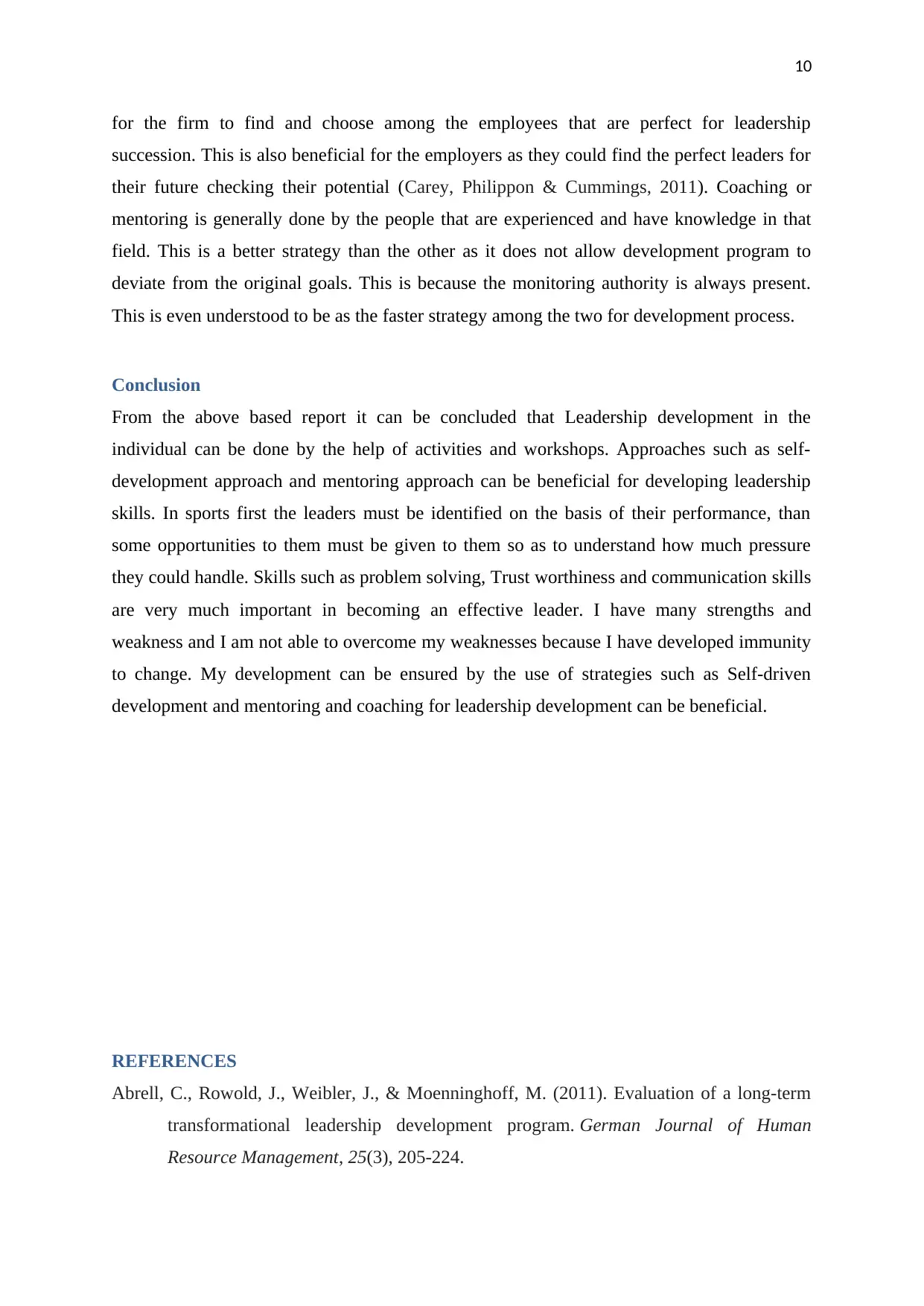
levels. The above mentioned problems and the immunity to change matrix suggests that this
can be a highly effective strategy for the personal development. Self-evaluation is made so as
to monitor the development and find the gap that needs to be removed further.
Mentoring and coaching for Leadership: It is not that just employees have to work for their
gaps but the employers also have to work for the development of their employees. For
leadership development it is essential that employee works in the organisation for longer
period of time. This cannot be possible without retention of employees (Hanson, 2013). This
is a strategy that is influenced by the external sources and the judgement of the development
is also done by other people. This strategy is very beneficial in the case of leaders that
understands the organisational culture and processes effectively. A well-developed mentoring
program gives assistance to the employees for developing their talent and the experience they
have with the firm. This is beneficial for retaining employees. An able mentor always gives
feedbacks and progress report on the mentee’s development. This acts as an insight using
which their future development plans get planned. A focused caching program is beneficial
especially the ones
that are worth risk
taking.
Strategies to develop leadership potential
After diagnosing the strength and weakness it is essential that strategies are articulated
accordingly. Some of the strategies that could be used for leadership development are as
follows:
Self-driven Development: This is a strategy in which people develop plan for improvement
based in their personal assessment. Use of programs such as mentoring program, career
development program, improving retention etc. can be beneficial (Clinton, 2018). The biggest
benefit of this strategy is that nobody other than the person himself knows about the strengths
and weakness and hence gap in them can be easily found out. It also reduces the burden of
the company to invest in the training and development so as to make them ready for any task.
This strategy also motivates employees to work on their weakness without any external
influence so as to achieve the opportunities that are going to come in their career (Clayton,
Sanzo & Myran, 2013). As it is internal motivators hence development is also at the basic
levels. The above mentioned problems and the immunity to change matrix suggests that this
can be a highly effective strategy for the personal development. Self-evaluation is made so as
to monitor the development and find the gap that needs to be removed further.
Mentoring and coaching for Leadership: It is not that just employees have to work for their
gaps but the employers also have to work for the development of their employees. For
leadership development it is essential that employee works in the organisation for longer
period of time. This cannot be possible without retention of employees (Hanson, 2013). This
is a strategy that is influenced by the external sources and the judgement of the development
is also done by other people. This strategy is very beneficial in the case of leaders that
understands the organisational culture and processes effectively. A well-developed mentoring
program gives assistance to the employees for developing their talent and the experience they
have with the firm. This is beneficial for retaining employees. An able mentor always gives
feedbacks and progress report on the mentee’s development. This acts as an insight using
which their future development plans get planned. A focused caching program is beneficial
Paraphrase This Document
Need a fresh take? Get an instant paraphrase of this document with our AI Paraphraser
10
for the firm to find and choose among the employees that are perfect for leadership
succession. This is also beneficial for the employers as they could find the perfect leaders for
their future checking their potential (Carey, Philippon & Cummings, 2011). Coaching or
mentoring is generally done by the people that are experienced and have knowledge in that
field. This is a better strategy than the other as it does not allow development program to
deviate from the original goals. This is because the monitoring authority is always present.
This is even understood to be as the faster strategy among the two for development process.
Conclusion
From the above based report it can be concluded that Leadership development in the
individual can be done by the help of activities and workshops. Approaches such as self-
development approach and mentoring approach can be beneficial for developing leadership
skills. In sports first the leaders must be identified on the basis of their performance, than
some opportunities to them must be given to them so as to understand how much pressure
they could handle. Skills such as problem solving, Trust worthiness and communication skills
are very much important in becoming an effective leader. I have many strengths and
weakness and I am not able to overcome my weaknesses because I have developed immunity
to change. My development can be ensured by the use of strategies such as Self-driven
development and mentoring and coaching for leadership development can be beneficial.
REFERENCES
Abrell, C., Rowold, J., Weibler, J., & Moenninghoff, M. (2011). Evaluation of a long-term
transformational leadership development program. German Journal of Human
Resource Management, 25(3), 205-224.
for the firm to find and choose among the employees that are perfect for leadership
succession. This is also beneficial for the employers as they could find the perfect leaders for
their future checking their potential (Carey, Philippon & Cummings, 2011). Coaching or
mentoring is generally done by the people that are experienced and have knowledge in that
field. This is a better strategy than the other as it does not allow development program to
deviate from the original goals. This is because the monitoring authority is always present.
This is even understood to be as the faster strategy among the two for development process.
Conclusion
From the above based report it can be concluded that Leadership development in the
individual can be done by the help of activities and workshops. Approaches such as self-
development approach and mentoring approach can be beneficial for developing leadership
skills. In sports first the leaders must be identified on the basis of their performance, than
some opportunities to them must be given to them so as to understand how much pressure
they could handle. Skills such as problem solving, Trust worthiness and communication skills
are very much important in becoming an effective leader. I have many strengths and
weakness and I am not able to overcome my weaknesses because I have developed immunity
to change. My development can be ensured by the use of strategies such as Self-driven
development and mentoring and coaching for leadership development can be beneficial.
REFERENCES
Abrell, C., Rowold, J., Weibler, J., & Moenninghoff, M. (2011). Evaluation of a long-term
transformational leadership development program. German Journal of Human
Resource Management, 25(3), 205-224.
11
Avolio, B. J. (2011). Full range leadership development. Sage.
Carey, W., Philippon, D. J., & Cummings, G. G. (2011). Coaching models for leadership
development: An integrative review. Journal of Leadership Studies, 5(1), 51-69.
Clayton, J. K., Sanzo, K. L., & Myran, S. (2013). Understanding mentoring in leadership
development: Perspectives of district administrators and aspiring leaders. Journal of
Research on Leadership Education, 8(1), 77-96.
Clinton, R. (2018). The making of a leader: Recognizing the lessons and stages of leadership
development. Tyndale House Publishers, Inc..
Ely, R. J., Ibarra, H., & Kolb, D. M. (2011). Taking gender into account: Theory and design
for women's leadership development programs. Academy of Management Learning &
Education, 10(3), 474-493.
Hanson, B. (2013). The leadership development interface: Aligning leaders and organizations
toward more effective leadership learning. Advances in Developing Human
Resources, 15(1), 106-120.
Harvard University, (2018) The Surprising Reason We Don’t Keep Our Resolutions (and
How to Overcome It). Retrieved from: https://www.extension.harvard.edu/inside-
extension/surprising-reason-we-dont-keep-our-resolutions-how-overcome-it
Jarvis, C., Gulati, A., McCririck, V., & Simpson, P. (2013). Leadership matters: Tensions in
evaluating leadership development. Advances in Developing Human
Resources, 15(1), 27-45.
Komives, S. R., Dugan, J. P., Owen, J. E., Wagner, W., & Slack, C. (2011). The handbook
for student leadership development. John Wiley & Sons.
Packard, T., & Jones, L. (2015). An outcomes evaluation of a leadership development
initiative. Journal of Management Development, 34(2), 153-168.
Petrie, N. (2011). Future trends in leadership development. Center for Creative Leadership
white paper, 5(5).
Sholl, J. (2011) How to Overcome Immunity to Change. Retrieved from:
https://experiencelife.com/article/how-to-overcome-immunity-to-change/
Avolio, B. J. (2011). Full range leadership development. Sage.
Carey, W., Philippon, D. J., & Cummings, G. G. (2011). Coaching models for leadership
development: An integrative review. Journal of Leadership Studies, 5(1), 51-69.
Clayton, J. K., Sanzo, K. L., & Myran, S. (2013). Understanding mentoring in leadership
development: Perspectives of district administrators and aspiring leaders. Journal of
Research on Leadership Education, 8(1), 77-96.
Clinton, R. (2018). The making of a leader: Recognizing the lessons and stages of leadership
development. Tyndale House Publishers, Inc..
Ely, R. J., Ibarra, H., & Kolb, D. M. (2011). Taking gender into account: Theory and design
for women's leadership development programs. Academy of Management Learning &
Education, 10(3), 474-493.
Hanson, B. (2013). The leadership development interface: Aligning leaders and organizations
toward more effective leadership learning. Advances in Developing Human
Resources, 15(1), 106-120.
Harvard University, (2018) The Surprising Reason We Don’t Keep Our Resolutions (and
How to Overcome It). Retrieved from: https://www.extension.harvard.edu/inside-
extension/surprising-reason-we-dont-keep-our-resolutions-how-overcome-it
Jarvis, C., Gulati, A., McCririck, V., & Simpson, P. (2013). Leadership matters: Tensions in
evaluating leadership development. Advances in Developing Human
Resources, 15(1), 27-45.
Komives, S. R., Dugan, J. P., Owen, J. E., Wagner, W., & Slack, C. (2011). The handbook
for student leadership development. John Wiley & Sons.
Packard, T., & Jones, L. (2015). An outcomes evaluation of a leadership development
initiative. Journal of Management Development, 34(2), 153-168.
Petrie, N. (2011). Future trends in leadership development. Center for Creative Leadership
white paper, 5(5).
Sholl, J. (2011) How to Overcome Immunity to Change. Retrieved from:
https://experiencelife.com/article/how-to-overcome-immunity-to-change/
⊘ This is a preview!⊘
Do you want full access?
Subscribe today to unlock all pages.
Trusted by 1+ million students worldwide

1 out of 13


Related Documents


Your All-in-One AI-Powered Toolkit for Academic Success.
+13062052269
info@desklib.com
Available 24*7 on WhatsApp / Email
![[object Object]](/_next/static/media/star-bottom.7253800d.svg)
Unlock your academic potential
Copyright © 2020–2026 A2Z Services. All Rights Reserved. Developed and managed by ZUCOL.