The Role of Ethics in Business Leadership: Analysis and Strategies
VerifiedAdded on 2023/01/23
|9
|2285
|46
Essay
AI Summary
This essay explores the critical role of ethics in business leadership, highlighting the increasing importance of ethical considerations in light of recent leadership failures. It emphasizes the need to supplement traditional social science-based leadership studies with an ethical dimension. The essay delves into the levels of ethics in leadership, stressing the importance of moral behavior and integrity, and analyzes the consequences of neglecting ethical standards. It advocates for leaders to exhibit high moral standards, integrate personal and business ethics, and align leadership strategies with the overall mission of the company. The essay concludes with an action plan for businesses to adopt ethical leadership, including seminars, workshops, and training programs to sensitize and educate on the importance of ethics in leadership. The document is available on Desklib, a platform offering a variety of study resources for students.
Leadership in Business
Name:
Institution:
Date:
Name:
Institution:
Date:
Paraphrase This Document
Need a fresh take? Get an instant paraphrase of this document with our AI Paraphraser

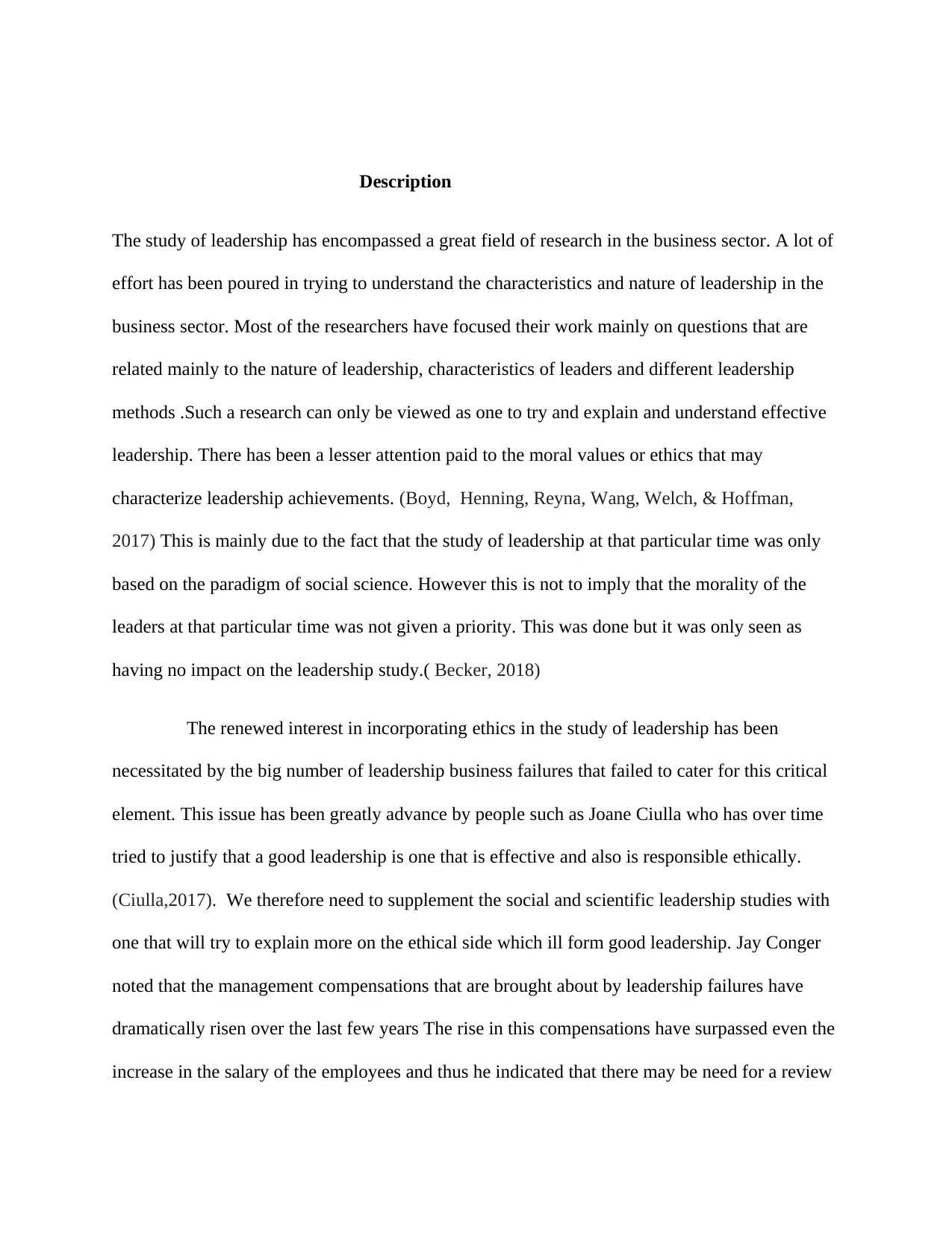
Description
The study of leadership has encompassed a great field of research in the business sector. A lot of
effort has been poured in trying to understand the characteristics and nature of leadership in the
business sector. Most of the researchers have focused their work mainly on questions that are
related mainly to the nature of leadership, characteristics of leaders and different leadership
methods .Such a research can only be viewed as one to try and explain and understand effective
leadership. There has been a lesser attention paid to the moral values or ethics that may
characterize leadership achievements. (Boyd, Henning, Reyna, Wang, Welch, & Hoffman,
2017) This is mainly due to the fact that the study of leadership at that particular time was only
based on the paradigm of social science. However this is not to imply that the morality of the
leaders at that particular time was not given a priority. This was done but it was only seen as
having no impact on the leadership study.( Becker, 2018)
The renewed interest in incorporating ethics in the study of leadership has been
necessitated by the big number of leadership business failures that failed to cater for this critical
element. This issue has been greatly advance by people such as Joane Ciulla who has over time
tried to justify that a good leadership is one that is effective and also is responsible ethically.
(Ciulla,2017). We therefore need to supplement the social and scientific leadership studies with
one that will try to explain more on the ethical side which ill form good leadership. Jay Conger
noted that the management compensations that are brought about by leadership failures have
dramatically risen over the last few years The rise in this compensations have surpassed even the
increase in the salary of the employees and thus he indicated that there may be need for a review
The study of leadership has encompassed a great field of research in the business sector. A lot of
effort has been poured in trying to understand the characteristics and nature of leadership in the
business sector. Most of the researchers have focused their work mainly on questions that are
related mainly to the nature of leadership, characteristics of leaders and different leadership
methods .Such a research can only be viewed as one to try and explain and understand effective
leadership. There has been a lesser attention paid to the moral values or ethics that may
characterize leadership achievements. (Boyd, Henning, Reyna, Wang, Welch, & Hoffman,
2017) This is mainly due to the fact that the study of leadership at that particular time was only
based on the paradigm of social science. However this is not to imply that the morality of the
leaders at that particular time was not given a priority. This was done but it was only seen as
having no impact on the leadership study.( Becker, 2018)
The renewed interest in incorporating ethics in the study of leadership has been
necessitated by the big number of leadership business failures that failed to cater for this critical
element. This issue has been greatly advance by people such as Joane Ciulla who has over time
tried to justify that a good leadership is one that is effective and also is responsible ethically.
(Ciulla,2017). We therefore need to supplement the social and scientific leadership studies with
one that will try to explain more on the ethical side which ill form good leadership. Jay Conger
noted that the management compensations that are brought about by leadership failures have
dramatically risen over the last few years The rise in this compensations have surpassed even the
increase in the salary of the employees and thus he indicated that there may be need for a review

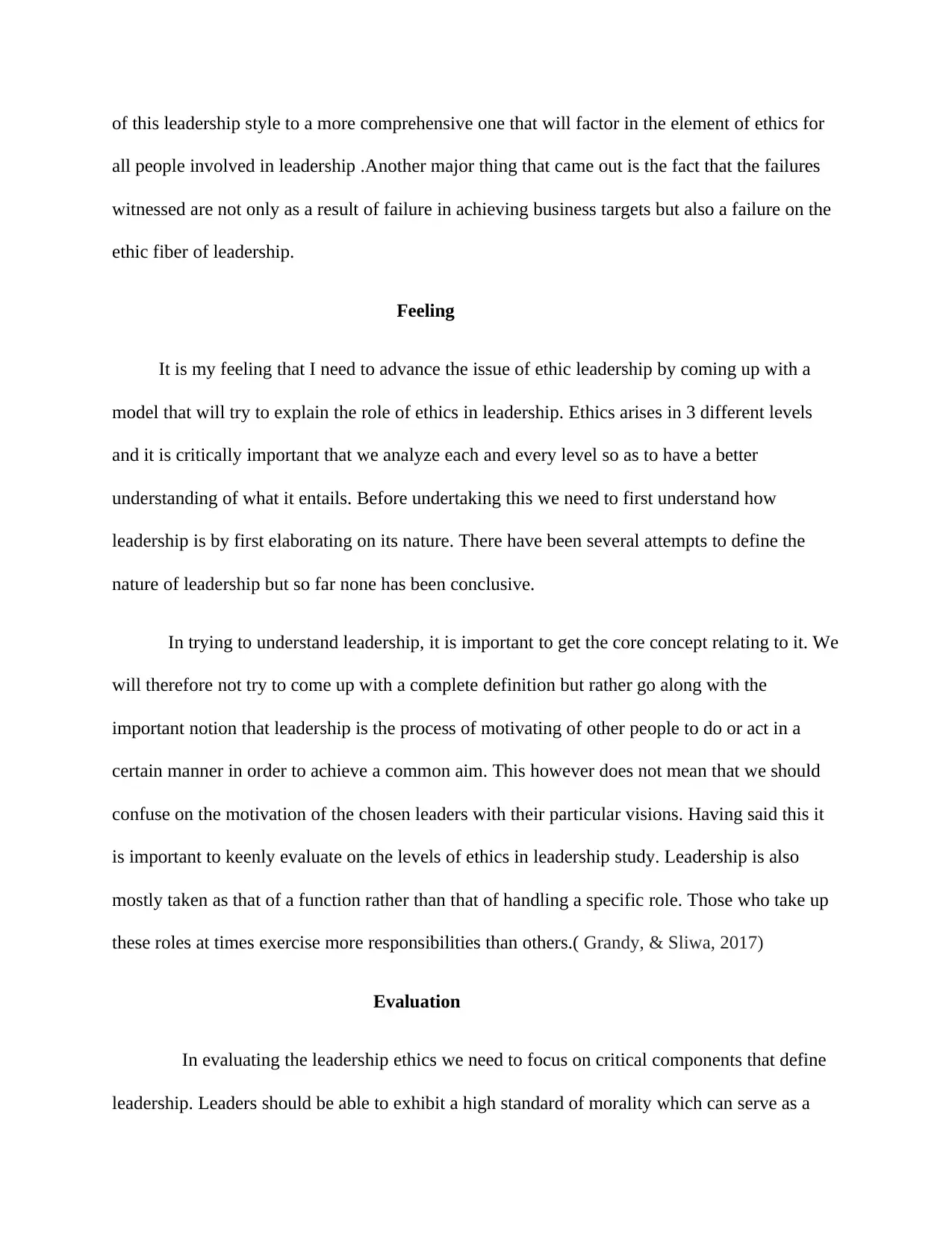
of this leadership style to a more comprehensive one that will factor in the element of ethics for
all people involved in leadership .Another major thing that came out is the fact that the failures
witnessed are not only as a result of failure in achieving business targets but also a failure on the
ethic fiber of leadership.
Feeling
It is my feeling that I need to advance the issue of ethic leadership by coming up with a
model that will try to explain the role of ethics in leadership. Ethics arises in 3 different levels
and it is critically important that we analyze each and every level so as to have a better
understanding of what it entails. Before undertaking this we need to first understand how
leadership is by first elaborating on its nature. There have been several attempts to define the
nature of leadership but so far none has been conclusive.
In trying to understand leadership, it is important to get the core concept relating to it. We
will therefore not try to come up with a complete definition but rather go along with the
important notion that leadership is the process of motivating of other people to do or act in a
certain manner in order to achieve a common aim. This however does not mean that we should
confuse on the motivation of the chosen leaders with their particular visions. Having said this it
is important to keenly evaluate on the levels of ethics in leadership study. Leadership is also
mostly taken as that of a function rather than that of handling a specific role. Those who take up
these roles at times exercise more responsibilities than others.( Grandy, & Sliwa, 2017)
Evaluation
In evaluating the leadership ethics we need to focus on critical components that define
leadership. Leaders should be able to exhibit a high standard of morality which can serve as a
all people involved in leadership .Another major thing that came out is the fact that the failures
witnessed are not only as a result of failure in achieving business targets but also a failure on the
ethic fiber of leadership.
Feeling
It is my feeling that I need to advance the issue of ethic leadership by coming up with a
model that will try to explain the role of ethics in leadership. Ethics arises in 3 different levels
and it is critically important that we analyze each and every level so as to have a better
understanding of what it entails. Before undertaking this we need to first understand how
leadership is by first elaborating on its nature. There have been several attempts to define the
nature of leadership but so far none has been conclusive.
In trying to understand leadership, it is important to get the core concept relating to it. We
will therefore not try to come up with a complete definition but rather go along with the
important notion that leadership is the process of motivating of other people to do or act in a
certain manner in order to achieve a common aim. This however does not mean that we should
confuse on the motivation of the chosen leaders with their particular visions. Having said this it
is important to keenly evaluate on the levels of ethics in leadership study. Leadership is also
mostly taken as that of a function rather than that of handling a specific role. Those who take up
these roles at times exercise more responsibilities than others.( Grandy, & Sliwa, 2017)
Evaluation
In evaluating the leadership ethics we need to focus on critical components that define
leadership. Leaders should be able to exhibit a high standard of morality which can serve as a
⊘ This is a preview!⊘
Do you want full access?
Subscribe today to unlock all pages.

Trusted by 1+ million students worldwide

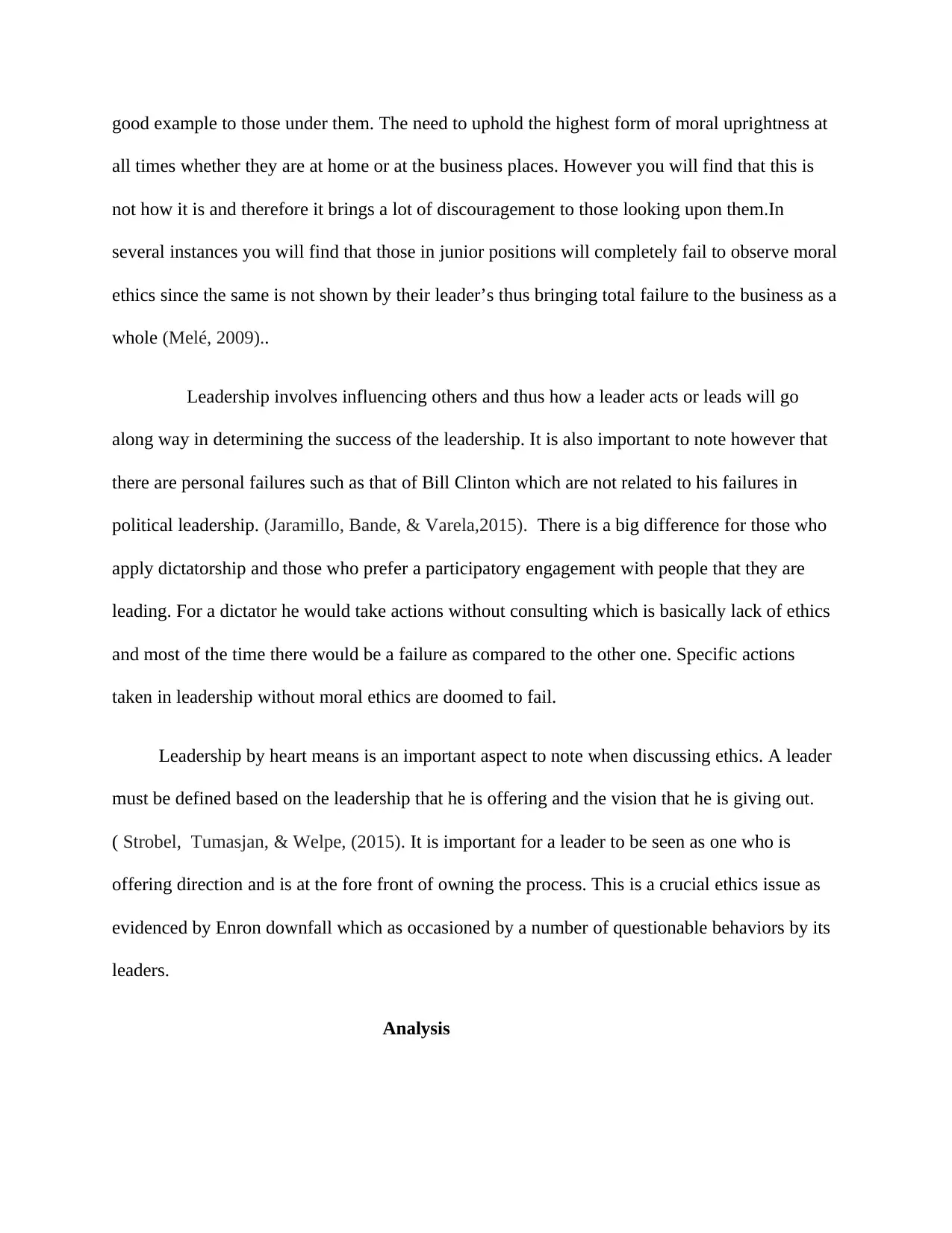
good example to those under them. The need to uphold the highest form of moral uprightness at
all times whether they are at home or at the business places. However you will find that this is
not how it is and therefore it brings a lot of discouragement to those looking upon them.In
several instances you will find that those in junior positions will completely fail to observe moral
ethics since the same is not shown by their leader’s thus bringing total failure to the business as a
whole (Melé, 2009)..
Leadership involves influencing others and thus how a leader acts or leads will go
along way in determining the success of the leadership. It is also important to note however that
there are personal failures such as that of Bill Clinton which are not related to his failures in
political leadership. (Jaramillo, Bande, & Varela,2015). There is a big difference for those who
apply dictatorship and those who prefer a participatory engagement with people that they are
leading. For a dictator he would take actions without consulting which is basically lack of ethics
and most of the time there would be a failure as compared to the other one. Specific actions
taken in leadership without moral ethics are doomed to fail.
Leadership by heart means is an important aspect to note when discussing ethics. A leader
must be defined based on the leadership that he is offering and the vision that he is giving out.
( Strobel, Tumasjan, & Welpe, (2015). It is important for a leader to be seen as one who is
offering direction and is at the fore front of owning the process. This is a crucial ethics issue as
evidenced by Enron downfall which as occasioned by a number of questionable behaviors by its
leaders.
Analysis
all times whether they are at home or at the business places. However you will find that this is
not how it is and therefore it brings a lot of discouragement to those looking upon them.In
several instances you will find that those in junior positions will completely fail to observe moral
ethics since the same is not shown by their leader’s thus bringing total failure to the business as a
whole (Melé, 2009)..
Leadership involves influencing others and thus how a leader acts or leads will go
along way in determining the success of the leadership. It is also important to note however that
there are personal failures such as that of Bill Clinton which are not related to his failures in
political leadership. (Jaramillo, Bande, & Varela,2015). There is a big difference for those who
apply dictatorship and those who prefer a participatory engagement with people that they are
leading. For a dictator he would take actions without consulting which is basically lack of ethics
and most of the time there would be a failure as compared to the other one. Specific actions
taken in leadership without moral ethics are doomed to fail.
Leadership by heart means is an important aspect to note when discussing ethics. A leader
must be defined based on the leadership that he is offering and the vision that he is giving out.
( Strobel, Tumasjan, & Welpe, (2015). It is important for a leader to be seen as one who is
offering direction and is at the fore front of owning the process. This is a crucial ethics issue as
evidenced by Enron downfall which as occasioned by a number of questionable behaviors by its
leaders.
Analysis
Paraphrase This Document
Need a fresh take? Get an instant paraphrase of this document with our AI Paraphraser

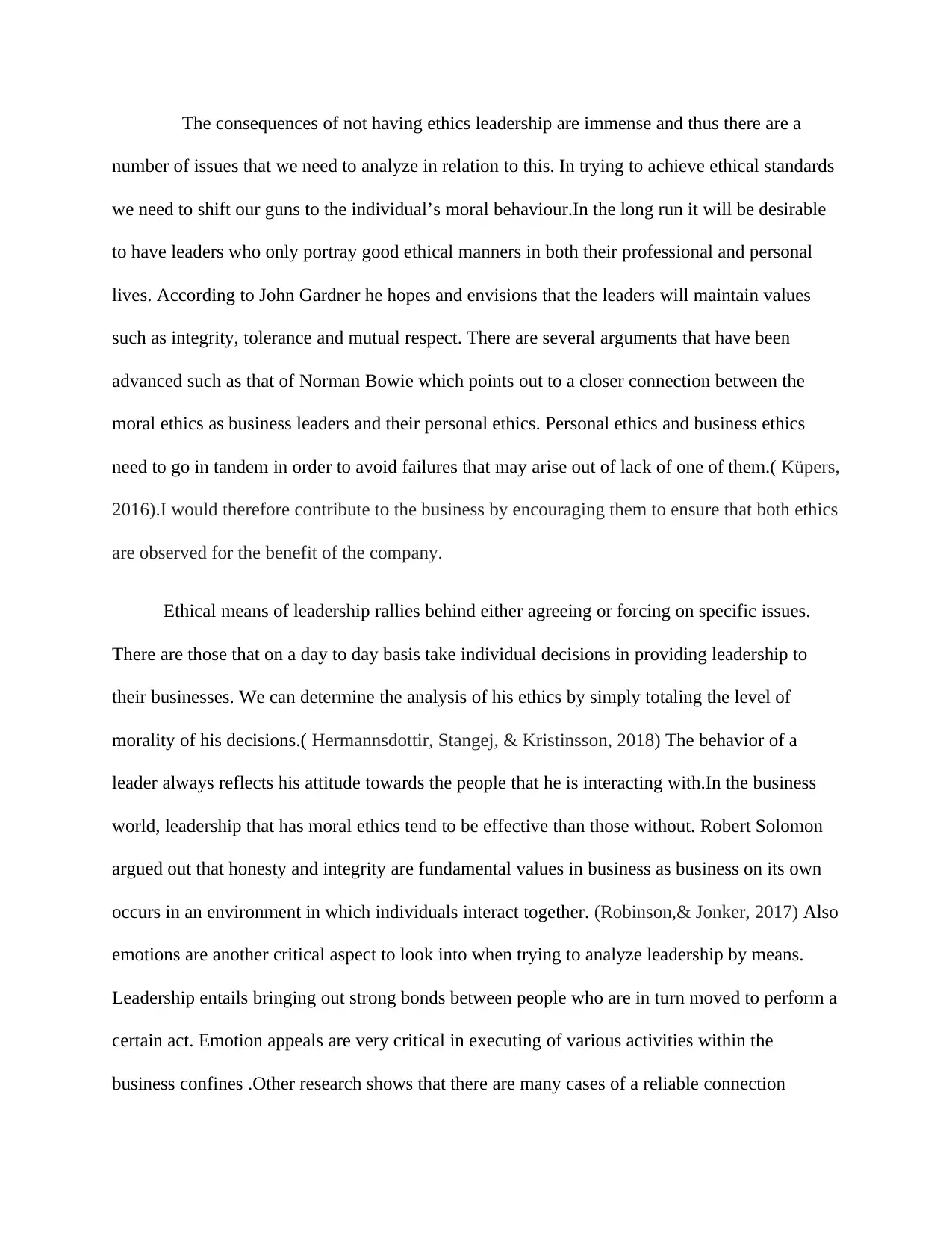
The consequences of not having ethics leadership are immense and thus there are a
number of issues that we need to analyze in relation to this. In trying to achieve ethical standards
we need to shift our guns to the individual’s moral behaviour.In the long run it will be desirable
to have leaders who only portray good ethical manners in both their professional and personal
lives. According to John Gardner he hopes and envisions that the leaders will maintain values
such as integrity, tolerance and mutual respect. There are several arguments that have been
advanced such as that of Norman Bowie which points out to a closer connection between the
moral ethics as business leaders and their personal ethics. Personal ethics and business ethics
need to go in tandem in order to avoid failures that may arise out of lack of one of them.( Küpers,
2016).I would therefore contribute to the business by encouraging them to ensure that both ethics
are observed for the benefit of the company.
Ethical means of leadership rallies behind either agreeing or forcing on specific issues.
There are those that on a day to day basis take individual decisions in providing leadership to
their businesses. We can determine the analysis of his ethics by simply totaling the level of
morality of his decisions.( Hermannsdottir, Stangej, & Kristinsson, 2018) The behavior of a
leader always reflects his attitude towards the people that he is interacting with.In the business
world, leadership that has moral ethics tend to be effective than those without. Robert Solomon
argued out that honesty and integrity are fundamental values in business as business on its own
occurs in an environment in which individuals interact together. (Robinson,& Jonker, 2017) Also
emotions are another critical aspect to look into when trying to analyze leadership by means.
Leadership entails bringing out strong bonds between people who are in turn moved to perform a
certain act. Emotion appeals are very critical in executing of various activities within the
business confines .Other research shows that there are many cases of a reliable connection
number of issues that we need to analyze in relation to this. In trying to achieve ethical standards
we need to shift our guns to the individual’s moral behaviour.In the long run it will be desirable
to have leaders who only portray good ethical manners in both their professional and personal
lives. According to John Gardner he hopes and envisions that the leaders will maintain values
such as integrity, tolerance and mutual respect. There are several arguments that have been
advanced such as that of Norman Bowie which points out to a closer connection between the
moral ethics as business leaders and their personal ethics. Personal ethics and business ethics
need to go in tandem in order to avoid failures that may arise out of lack of one of them.( Küpers,
2016).I would therefore contribute to the business by encouraging them to ensure that both ethics
are observed for the benefit of the company.
Ethical means of leadership rallies behind either agreeing or forcing on specific issues.
There are those that on a day to day basis take individual decisions in providing leadership to
their businesses. We can determine the analysis of his ethics by simply totaling the level of
morality of his decisions.( Hermannsdottir, Stangej, & Kristinsson, 2018) The behavior of a
leader always reflects his attitude towards the people that he is interacting with.In the business
world, leadership that has moral ethics tend to be effective than those without. Robert Solomon
argued out that honesty and integrity are fundamental values in business as business on its own
occurs in an environment in which individuals interact together. (Robinson,& Jonker, 2017) Also
emotions are another critical aspect to look into when trying to analyze leadership by means.
Leadership entails bringing out strong bonds between people who are in turn moved to perform a
certain act. Emotion appeals are very critical in executing of various activities within the
business confines .Other research shows that there are many cases of a reliable connection

between leadership that is effective in the sense of strategy and one of ethics. I will ensure that
steps are taken to fulfill all the conditions of ethics, honesty and integrity and thus ensure no
failure in of the business (Palmer, 2009)..
Leadership can show signs of ethics failure if it is only anchored on a mission that
cannot be supported. This kind of failure is as a result of the nature of the business itself.
Likewise if the projections set up by the leader are in conflict with the business missions, then
there is a high chance of the business failing. A failure of strategy is also a failure of ethics. This
is due to the fact that every business involves several risks and thus failure in miscalculation for
example may represent a failure in strategy which is in the long run an ethics failure.( Lawton, &
Páez, 2015).My contribution to this will be that of ensuring that the leadership in the business is
strictly in line with the overall mission of the company and that the business sets up projections
that cannot interfere with leadership implementation. By doing this I will have greatly reduced
the chances of failure
Conclusion
In concluding I have demonstrated the various ways in which issues of ethics arise in
relation to leadership. I have also illustrated the 3 models of leadership ethics and how they are
fundamentally important to the organization or the business at large. Leadership is a critical
aspect as it is the key element that drives expansion of businesses, innovations and ma more
other factors associated with it and in terms of ethics. It is equally important in an environment
such as one we are in now in which there is constant and rapid change in technology and
innovations .in view of this I decide to come up with an action plan for those business et to
adopt ethics in their leadership.
steps are taken to fulfill all the conditions of ethics, honesty and integrity and thus ensure no
failure in of the business (Palmer, 2009)..
Leadership can show signs of ethics failure if it is only anchored on a mission that
cannot be supported. This kind of failure is as a result of the nature of the business itself.
Likewise if the projections set up by the leader are in conflict with the business missions, then
there is a high chance of the business failing. A failure of strategy is also a failure of ethics. This
is due to the fact that every business involves several risks and thus failure in miscalculation for
example may represent a failure in strategy which is in the long run an ethics failure.( Lawton, &
Páez, 2015).My contribution to this will be that of ensuring that the leadership in the business is
strictly in line with the overall mission of the company and that the business sets up projections
that cannot interfere with leadership implementation. By doing this I will have greatly reduced
the chances of failure
Conclusion
In concluding I have demonstrated the various ways in which issues of ethics arise in
relation to leadership. I have also illustrated the 3 models of leadership ethics and how they are
fundamentally important to the organization or the business at large. Leadership is a critical
aspect as it is the key element that drives expansion of businesses, innovations and ma more
other factors associated with it and in terms of ethics. It is equally important in an environment
such as one we are in now in which there is constant and rapid change in technology and
innovations .in view of this I decide to come up with an action plan for those business et to
adopt ethics in their leadership.
⊘ This is a preview!⊘
Do you want full access?
Subscribe today to unlock all pages.

Trusted by 1+ million students worldwide

Action plan
Having critically analyzed and evaluated the importance of ethics in leadership for
businesses, it is imperative that I formulate an action plan. I will develop a leadership ethics
policy for organizations with the priority areas being on seminars and workshops to sensitize on
the need for implementing this in business.. I could also take steps such as conducting trainings
at the business premises in order for them to fully have first-hand information on the need to
incorporate leadership ethics (Zsolnai, 2015). .
Having critically analyzed and evaluated the importance of ethics in leadership for
businesses, it is imperative that I formulate an action plan. I will develop a leadership ethics
policy for organizations with the priority areas being on seminars and workshops to sensitize on
the need for implementing this in business.. I could also take steps such as conducting trainings
at the business premises in order for them to fully have first-hand information on the need to
incorporate leadership ethics (Zsolnai, 2015). .
Paraphrase This Document
Need a fresh take? Get an instant paraphrase of this document with our AI Paraphraser

References
Becker, G. K. (2018). Moral leadership in business. Contemporary Issues in Leadership, 237-257.
Boyd, B., Henning, N., Reyna, E., Wang, D., Welch, M., & Hoffman, A. J. (2017). Hybrid
organizations: New business models for environmental leadership. Routledge.
Ciulla, J. B. (2017). Trust and the future of leadership. The Blackwell guide to business ethics, 334-351
Grandy, G., & Sliwa, M. (2017). Contemplative leadership: The possibilities for the ethics of leadership
theory and practice. Journal of Business Ethics, 143(3), 423-440.
Hermannsdottir, A., Stangej, O., & Kristinsson, K. (2018). When being good is not enough: Towards
contextual education of business leadership ethics. Management: journal of contemporary
management issues, 23(2), 1-14.
Jaramillo, F., Bande, B., & Varela, J. (2015). Servant leadership and ethics: A dyadic examination of
supervisor behaviors and salesperson perceptions. Journal of Personal Selling & Sales
Management, 35(2), 108-124.
Küpers, W. (2016). A handbook of practical wisdom: Leadership, organization and integral business
practice. Routledge..
Lawton, A., & Páez, I. (2015). Developing a framework for ethical leadership. Journal of Business
Ethics, 130(3), 639-649.
Becker, G. K. (2018). Moral leadership in business. Contemporary Issues in Leadership, 237-257.
Boyd, B., Henning, N., Reyna, E., Wang, D., Welch, M., & Hoffman, A. J. (2017). Hybrid
organizations: New business models for environmental leadership. Routledge.
Ciulla, J. B. (2017). Trust and the future of leadership. The Blackwell guide to business ethics, 334-351
Grandy, G., & Sliwa, M. (2017). Contemplative leadership: The possibilities for the ethics of leadership
theory and practice. Journal of Business Ethics, 143(3), 423-440.
Hermannsdottir, A., Stangej, O., & Kristinsson, K. (2018). When being good is not enough: Towards
contextual education of business leadership ethics. Management: journal of contemporary
management issues, 23(2), 1-14.
Jaramillo, F., Bande, B., & Varela, J. (2015). Servant leadership and ethics: A dyadic examination of
supervisor behaviors and salesperson perceptions. Journal of Personal Selling & Sales
Management, 35(2), 108-124.
Küpers, W. (2016). A handbook of practical wisdom: Leadership, organization and integral business
practice. Routledge..
Lawton, A., & Páez, I. (2015). Developing a framework for ethical leadership. Journal of Business
Ethics, 130(3), 639-649.

Melé, D. (2009). Editorial introduction: Towards a more humanistic management. Journal of Business
Ethics, 88(3), 413-416.
Palmer, D. E. (2009). Business leadership: Three levels of ethical analysis. Journal of Business
Ethics, 88(3), 525-536.
Robinson, B. M., & Jonker, J. A. (2017). Inculcating ethics in small and mediumsized business
enterprises: A South African leadership perspective. African Journal of Business Ethics, 11(1).
Strobel, M., Tumasjan, A., & Welpe, I. (2015). Do business ethics pay off?. Zeitschrift für
Psychologie/Journal of Psychology.
Swanson, D. L., & Frederick, W. C. (2016). Denial and leadership in business ethics
education. Business ethics: New challenges for business schools and corporate leaders, 222-240.
Zsolnai, L. (2015). The spiritual dimension of business ethics and sustainability management. Springer,.
Ethics, 88(3), 413-416.
Palmer, D. E. (2009). Business leadership: Three levels of ethical analysis. Journal of Business
Ethics, 88(3), 525-536.
Robinson, B. M., & Jonker, J. A. (2017). Inculcating ethics in small and mediumsized business
enterprises: A South African leadership perspective. African Journal of Business Ethics, 11(1).
Strobel, M., Tumasjan, A., & Welpe, I. (2015). Do business ethics pay off?. Zeitschrift für
Psychologie/Journal of Psychology.
Swanson, D. L., & Frederick, W. C. (2016). Denial and leadership in business ethics
education. Business ethics: New challenges for business schools and corporate leaders, 222-240.
Zsolnai, L. (2015). The spiritual dimension of business ethics and sustainability management. Springer,.
⊘ This is a preview!⊘
Do you want full access?
Subscribe today to unlock all pages.

Trusted by 1+ million students worldwide
1 out of 9
Related Documents
Your All-in-One AI-Powered Toolkit for Academic Success.
+13062052269
info@desklib.com
Available 24*7 on WhatsApp / Email
Unlock your academic potential
Copyright © 2020–2026 A2Z Services. All Rights Reserved. Developed and managed by ZUCOL.