BMA6115 Leadership & Management: Success, Development, and Experiences
VerifiedAdded on 2023/06/08
|11
|3521
|456
Essay
AI Summary
This essay explores the key elements of successful leadership, including sharing a clear vision, leading by example, effective communication, integrity, and decisive decision-making. It discusses the Katz's three-skill model (technical, human, and conceptual skills) and Lewin's leadership styles (authoritarian, participative, and delegation). The essay further examines how leadership skills can be developed through initiative, feedback, effective listening, motivation, discipline, and continuous learning. It also differentiates between leadership and management, emphasizing that leadership focuses on inspiring and motivating, while management centers on planning and organizing. The essay concludes with personal reflections on leadership experiences, highlighting the importance of adaptability and continuous self-improvement. Desklib provides a platform for students to access this and other solved assignments.
BMA6115 Leadership and
Management
Management

Paraphrase This Document
Need a fresh take? Get an instant paraphrase of this document with our AI Paraphraser
TABLE OF CONTENT
INTRODUCTION...........................................................................................................................3
MAIN BODY...................................................................................................................................3
What it involves to being the successful leader...........................................................................3
Can good leadership be developed, and if so, how......................................................................5
What distinguishes leadership from management.......................................................................8
Analysation of the things learnt about leadership from your own experiences, on this course
and elsewhere:..............................................................................................................................9
CONCLUSION..............................................................................................................................10
REFERENCES................................................................................................................................1
INTRODUCTION...........................................................................................................................3
MAIN BODY...................................................................................................................................3
What it involves to being the successful leader...........................................................................3
Can good leadership be developed, and if so, how......................................................................5
What distinguishes leadership from management.......................................................................8
Analysation of the things learnt about leadership from your own experiences, on this course
and elsewhere:..............................................................................................................................9
CONCLUSION..............................................................................................................................10
REFERENCES................................................................................................................................1
INTRODUCTION
MAIN BODY
What it involves to being the successful leader
The leader is the one who is leads other employee in the organization towards the goal of
the organization. Successful business need solid leadership that help them to achieve
organization goal on time (Gardner and et.al.,.2020). Great leader not only help the company to
grow but instead it helps subordinates to take initiatives. The integrity, honesty and the character
must be reflected in everything they do for the organization. The traits such as the charm,
persuasiveness, judgement, courage are the most basic thing that an individual need to become
the successful leaders. The quality of successful leaders are as follows defined in the great man
theory are as follows (Shahzad, Raja and Hashmi, 2020)-
Share their vision-
The successful leaders are successful because they share their thoughts with other people. The
clear idea of what they want to do and the process to achieve the same is needed in the
organization. Contribution of leaders towards the success of the organization matter a lot. Clear
vision of leaders with persistence and enthusiasm inspire other employees of the organization as
well.
Lead by the Example-
The right examples by the leaders help the organization in achieving the goal of the organization.
There are times when leaders demand more from the employees and don't give their 100%which
is totally wrong on the side of the employee. Aligning all the actions of the leader helps to build
trust between the leaders and the employees that in turn helps the organization in achieving the
goal (Kalish and Luria, 2021).
Communication-
The successful leaders are always good communicators. The ability to communicate clearly with
all the employees is not an easy task. This skill involves sharing valuable information with the
employees, it also involves the asking frequent questions, clearing misunderstandings and the
conflicts that keep on happening between the organization. The best leader is the one that
communicates with other to inspire them.
MAIN BODY
What it involves to being the successful leader
The leader is the one who is leads other employee in the organization towards the goal of
the organization. Successful business need solid leadership that help them to achieve
organization goal on time (Gardner and et.al.,.2020). Great leader not only help the company to
grow but instead it helps subordinates to take initiatives. The integrity, honesty and the character
must be reflected in everything they do for the organization. The traits such as the charm,
persuasiveness, judgement, courage are the most basic thing that an individual need to become
the successful leaders. The quality of successful leaders are as follows defined in the great man
theory are as follows (Shahzad, Raja and Hashmi, 2020)-
Share their vision-
The successful leaders are successful because they share their thoughts with other people. The
clear idea of what they want to do and the process to achieve the same is needed in the
organization. Contribution of leaders towards the success of the organization matter a lot. Clear
vision of leaders with persistence and enthusiasm inspire other employees of the organization as
well.
Lead by the Example-
The right examples by the leaders help the organization in achieving the goal of the organization.
There are times when leaders demand more from the employees and don't give their 100%which
is totally wrong on the side of the employee. Aligning all the actions of the leader helps to build
trust between the leaders and the employees that in turn helps the organization in achieving the
goal (Kalish and Luria, 2021).
Communication-
The successful leaders are always good communicators. The ability to communicate clearly with
all the employees is not an easy task. This skill involves sharing valuable information with the
employees, it also involves the asking frequent questions, clearing misunderstandings and the
conflicts that keep on happening between the organization. The best leader is the one that
communicates with other to inspire them.
⊘ This is a preview!⊘
Do you want full access?
Subscribe today to unlock all pages.

Trusted by 1+ million students worldwide
Integrity-
The successful leaders are the ones who value the decisions and the behaviour of other. Clear
decision about what is right and wrong is needed to have a good leadership skill. Genuine,
principle and consistent leaders are the key to the successful organization. Displaying integrity
through the daily actions of the leaders will give them loyalty and respect from the employees
that will bring mutual understanding between them.
Hard decisions-
The successful leader is the one who don't hesitate to take hard decisions. The difficult decisions
determine the ability of the leader to survive in the difficult situations that frequently occurs in
the organization. Being the confident leaders helps the organization to capitalize all the
opportunities that come in the organization's way.
The Skills needed to be become good leaders are as follows-
Katz's three skills models has defined basic three skills that are needed in the leader to become
the successful leader and that in turn will help the organization to achieve the organization goal
and that are as follows-
Technical skills- The technical skills are all those skills that are required to be performed the
specific task that is given in the organization. The technological skill are also needed by the
leaders in order to perform all the management work like the programming, site maintenance,
writing and to perform on different software. The successful leaders must learn all the technical
skills to collect all the critical information and to communicate all this information while the
strategic planning in the organization.
Human skills- Team leaders who admire other subordinates in the organization are the successful
leaders. The human skills also counts concerns for other team member, helping in building their
career as well. Creating a healthy environment that gives other the options to speak, to
participate, to take the feedback and criticism carefully is the need of the organization. The clear
communication is also part of the human skills that are also defined as the interpersonal skill that
which focuses on the relationship between the leaders and the employees.
Conceptual Skills- Conceptual skills are concerned around generating new ideas and with
utilizing those ideas. When this skill is combined with other informations it results in degree of
creativity and the conceptual thinking to generate new ideas and the different strategies. These
The successful leaders are the ones who value the decisions and the behaviour of other. Clear
decision about what is right and wrong is needed to have a good leadership skill. Genuine,
principle and consistent leaders are the key to the successful organization. Displaying integrity
through the daily actions of the leaders will give them loyalty and respect from the employees
that will bring mutual understanding between them.
Hard decisions-
The successful leader is the one who don't hesitate to take hard decisions. The difficult decisions
determine the ability of the leader to survive in the difficult situations that frequently occurs in
the organization. Being the confident leaders helps the organization to capitalize all the
opportunities that come in the organization's way.
The Skills needed to be become good leaders are as follows-
Katz's three skills models has defined basic three skills that are needed in the leader to become
the successful leader and that in turn will help the organization to achieve the organization goal
and that are as follows-
Technical skills- The technical skills are all those skills that are required to be performed the
specific task that is given in the organization. The technological skill are also needed by the
leaders in order to perform all the management work like the programming, site maintenance,
writing and to perform on different software. The successful leaders must learn all the technical
skills to collect all the critical information and to communicate all this information while the
strategic planning in the organization.
Human skills- Team leaders who admire other subordinates in the organization are the successful
leaders. The human skills also counts concerns for other team member, helping in building their
career as well. Creating a healthy environment that gives other the options to speak, to
participate, to take the feedback and criticism carefully is the need of the organization. The clear
communication is also part of the human skills that are also defined as the interpersonal skill that
which focuses on the relationship between the leaders and the employees.
Conceptual Skills- Conceptual skills are concerned around generating new ideas and with
utilizing those ideas. When this skill is combined with other informations it results in degree of
creativity and the conceptual thinking to generate new ideas and the different strategies. These
Paraphrase This Document
Need a fresh take? Get an instant paraphrase of this document with our AI Paraphraser
skills are mostly used by the leaders of the upper department but with the growing competitions
today all the leaders of all the departments are taking initiatives to create new ideas and the
vision.
The leadership style given by Lewin are as follows-
The leadership styles are majorly of three types that are as follows (Al Khajeh, 2018)-
Authoritarian theory- This theory provides the clear expectations to the employees regarding
what to be done a how it is to be done (Gardner and et.al., 2021). The style of leadership is
mainly focused on giving command to the employees working in the organization. Authoritarian
leaders defines the clean division between the leader and the subordinates. The little make the
independent decisions.
Participative theory- This is also known as the democratic leadership as it involves all the team
members when it is time to take decisions for the organizations. The participations of all the
employees is equally important in the organization as their contribution will lead to the high
quality of the work and their performance. This style encourages employees to take initiatives
and form new ideas and the opinions.
Delegation theory- This leadership style of theory is also known as the Laissez- Fair -leadership
as it is concerned with delegating authority to the others. This theory totally depend on the
situation as it is totally related with the decision-making process that lies with the employees.
Delegating responsibility to the employees delegates decision process as well. This is already
useful only when the company has high qualified personnel in the organization and there are
defined roles for everyone that brings motivation in them.
Can good leadership be developed, and if so, how
Can you develop the leadership:
Yes, the leadership skill can be developed in an individual. Leadership skill plays a vital role in
the development of person's career (Rudolph, and et.al., 2020). The leadership skills are
considered one of critical traits that are necessary to get the on the top of career fields. The
degrees and technical skills are not taken as per the point but having the ability to be an effective
leader one need different skills and ability which are as described below by following the path
goal theory:
today all the leaders of all the departments are taking initiatives to create new ideas and the
vision.
The leadership style given by Lewin are as follows-
The leadership styles are majorly of three types that are as follows (Al Khajeh, 2018)-
Authoritarian theory- This theory provides the clear expectations to the employees regarding
what to be done a how it is to be done (Gardner and et.al., 2021). The style of leadership is
mainly focused on giving command to the employees working in the organization. Authoritarian
leaders defines the clean division between the leader and the subordinates. The little make the
independent decisions.
Participative theory- This is also known as the democratic leadership as it involves all the team
members when it is time to take decisions for the organizations. The participations of all the
employees is equally important in the organization as their contribution will lead to the high
quality of the work and their performance. This style encourages employees to take initiatives
and form new ideas and the opinions.
Delegation theory- This leadership style of theory is also known as the Laissez- Fair -leadership
as it is concerned with delegating authority to the others. This theory totally depend on the
situation as it is totally related with the decision-making process that lies with the employees.
Delegating responsibility to the employees delegates decision process as well. This is already
useful only when the company has high qualified personnel in the organization and there are
defined roles for everyone that brings motivation in them.
Can good leadership be developed, and if so, how
Can you develop the leadership:
Yes, the leadership skill can be developed in an individual. Leadership skill plays a vital role in
the development of person's career (Rudolph, and et.al., 2020). The leadership skills are
considered one of critical traits that are necessary to get the on the top of career fields. The
degrees and technical skills are not taken as per the point but having the ability to be an effective
leader one need different skills and ability which are as described below by following the path
goal theory:
Taking initiative and giving feed backs following the failures if any: most of the bosses give
responsibilities to the employees whom they know can do but taking on the responsibilities and
volunteer more while working above the current position. Stepping out of the comfort zone and
taking up more of the responsibilities helps in becoming the more powerful leader. For the job
profile like being a leader one needs to become critical thinker. Good leader always focus on
opportunities and take benefit from the opportunities to give the advantage to company and
employees. Being a leader the main thing is to take the things on serious basis and provide with
the solution at fast pace.
Listening effectively and contributing for growth: communication skills make an effective
impression on the team, as it help in presenting the ideas perfectly. One of the important skill for
the leader is to listen their employees (Al Khajeh, 2018). With the help of the listening skills,
being leader there feedbacks can be received and sense of doing things as per the tasks comes
there.
Motivating others: being a leader the things comes in front is to influence the employees and
maintain the workforce at workplace. By creating the positive workforce helps in completing the
tasks on time by hitting the timelines. Rewarding them by appraisals and other accommodations
creates a good environment and keep the work force motivated.
Development of personal responsibilities with Discipline: discipline is the key factor required
to achieve the goals as being the leader. By having the good vision and idea but if there is no
discipline and consistency to execute the idea and achieve the success then it is not useful, the
thing required is discipline to make the things come true as a leader.
Leadership with Constant learning: leadership and learning works in hand to hand. When
things take different turns, the changes need to be understood and learning should be done as per
the perspective (Asrar-ul-Haq, and Anwar, 2018). Things should be learnt from the other leaders
like qualities, manners, and how they take initiative and communicate with other employees and
work accordingly by learning the things on regular basis.
The bottom line: good leadership skills are the key role player for the career development. As a
good leader and a with the potential to learn new things by taking the potential actions one can
be more influential to the colleagues. As a leader, thinking out for influencing the employees will
develop things and make a good leader as a role player for the colleagues.
responsibilities to the employees whom they know can do but taking on the responsibilities and
volunteer more while working above the current position. Stepping out of the comfort zone and
taking up more of the responsibilities helps in becoming the more powerful leader. For the job
profile like being a leader one needs to become critical thinker. Good leader always focus on
opportunities and take benefit from the opportunities to give the advantage to company and
employees. Being a leader the main thing is to take the things on serious basis and provide with
the solution at fast pace.
Listening effectively and contributing for growth: communication skills make an effective
impression on the team, as it help in presenting the ideas perfectly. One of the important skill for
the leader is to listen their employees (Al Khajeh, 2018). With the help of the listening skills,
being leader there feedbacks can be received and sense of doing things as per the tasks comes
there.
Motivating others: being a leader the things comes in front is to influence the employees and
maintain the workforce at workplace. By creating the positive workforce helps in completing the
tasks on time by hitting the timelines. Rewarding them by appraisals and other accommodations
creates a good environment and keep the work force motivated.
Development of personal responsibilities with Discipline: discipline is the key factor required
to achieve the goals as being the leader. By having the good vision and idea but if there is no
discipline and consistency to execute the idea and achieve the success then it is not useful, the
thing required is discipline to make the things come true as a leader.
Leadership with Constant learning: leadership and learning works in hand to hand. When
things take different turns, the changes need to be understood and learning should be done as per
the perspective (Asrar-ul-Haq, and Anwar, 2018). Things should be learnt from the other leaders
like qualities, manners, and how they take initiative and communicate with other employees and
work accordingly by learning the things on regular basis.
The bottom line: good leadership skills are the key role player for the career development. As a
good leader and a with the potential to learn new things by taking the potential actions one can
be more influential to the colleagues. As a leader, thinking out for influencing the employees will
develop things and make a good leader as a role player for the colleagues.
⊘ This is a preview!⊘
Do you want full access?
Subscribe today to unlock all pages.
Trusted by 1+ million students worldwide
For example: It has been found from various studies that the effective manager provides with the
training programmes and not only influence to work on the institutional basis but also focus on
the personal development.
How can you develop leadership:
Anyone can develop the leadership skills with some practice. The development of the leadership
can be done by adopting the following techniques to be developed following:
Practising discipline: to be a good leader the main thing required is discipline. Discipline helps
a lot in the maintenance of the leadership skills in the professional career. Demonstrating the
discipline by working and meeting the deadlines, keeping the appointments and concluding
meetings on time will help to raise the level of discipline in the organization (Dinkmeyer, 2019).
Taking on more of the projects: taking more of the responsibility in the firm helps In
developing more leadership skills. Stepping out of the comfort zones comes as the only way to
learn new things and this will leads towards getting noticed by the executive as the one who
takes the responsibilities.
Learn to follow: as the true leader, there are no problems to control the things of others and be
appropriate. There should not be threatens and someone must not disagree with decisions taken.
Keeping open mind helps a lot and gives out the merits where the merits are low. By learning to
respect and value the things, helps in setting up things more likely.
Developing situational awareness: being a good leader, is the one who can see the things and
anticipate the problems. Having this skill helps in the handling the complex and tough projects
and being on the timeline (Oc, 2018). Things in maintaining the remote teams under this would
be difficult but practising makes the things happen and it develops the good leadership
management skills.
Inspiring others: leader also becomes the part of the team and helps the team by motivating
them in the effective ways. Being the leader inspire the employees and when in need of help he
encourages and guide on the right path. Sometimes, the things become personal and there is need
of someone to listen.
Keep learning: the thing that helps in becoming the leader is to continuously learn new things
and being open-minded. It keeps the mind sharp and enhances the skills. It keeps the things up to
the mark by keeping motivate to take the challenges and that's the ability of the good leader.
training programmes and not only influence to work on the institutional basis but also focus on
the personal development.
How can you develop leadership:
Anyone can develop the leadership skills with some practice. The development of the leadership
can be done by adopting the following techniques to be developed following:
Practising discipline: to be a good leader the main thing required is discipline. Discipline helps
a lot in the maintenance of the leadership skills in the professional career. Demonstrating the
discipline by working and meeting the deadlines, keeping the appointments and concluding
meetings on time will help to raise the level of discipline in the organization (Dinkmeyer, 2019).
Taking on more of the projects: taking more of the responsibility in the firm helps In
developing more leadership skills. Stepping out of the comfort zones comes as the only way to
learn new things and this will leads towards getting noticed by the executive as the one who
takes the responsibilities.
Learn to follow: as the true leader, there are no problems to control the things of others and be
appropriate. There should not be threatens and someone must not disagree with decisions taken.
Keeping open mind helps a lot and gives out the merits where the merits are low. By learning to
respect and value the things, helps in setting up things more likely.
Developing situational awareness: being a good leader, is the one who can see the things and
anticipate the problems. Having this skill helps in the handling the complex and tough projects
and being on the timeline (Oc, 2018). Things in maintaining the remote teams under this would
be difficult but practising makes the things happen and it develops the good leadership
management skills.
Inspiring others: leader also becomes the part of the team and helps the team by motivating
them in the effective ways. Being the leader inspire the employees and when in need of help he
encourages and guide on the right path. Sometimes, the things become personal and there is need
of someone to listen.
Keep learning: the thing that helps in becoming the leader is to continuously learn new things
and being open-minded. It keeps the mind sharp and enhances the skills. It keeps the things up to
the mark by keeping motivate to take the challenges and that's the ability of the good leader.
Paraphrase This Document
Need a fresh take? Get an instant paraphrase of this document with our AI Paraphraser
Empowering the teammates: once the thing is in mind that no one is good at the things and you
need to continuously learn the new things, it helps in becoming the good leader (Harris, and
Jones, 2018). Arranging the things with other members don't just frees up but also helps the team
members by empowering them.
What distinguishes leadership from management
Definition of Management
It is defined as the act, mannerism or conduct of supervising control different spheres of
activity. In the specific case of business organizations and industrial sector, the term
management means those processes of effective coordination through which various types of
business functions or corporate activities take place in an organized way (Griffin, 2021). The
characteristics of management comprise multi-dimensional, dynamic, and intangible features that
help determine its differing objectives such as profit growth, social or personnel related goals.
Different types of business organizations have distintive forms of management that aim at
achieving specific goals of companies as per their orientation. For instance, in order to embellish
their corporate social responsibilities (CSR) activities in an efficient way, the management team
of the UK based Tesco retail organization has launched a cautious environmental campaign that
more than fulfils the environmental concern policies of the retail sector company. This was a
basic example of management task.
Definition of Leadership
In the context of a business firm or organizational capacity, leadership is a qualitative
value-based model that sees to the fact that all the functional departmental teams of an
organization such as the human resource, operational management, sales, finance, etc. are
decisively working towards the company's aims in a collective and cohesive manner (Gandolfi
and Stone, 2018). The leadership aspect also tends to the matter of keeping the interpersonal
relationships of employees smoothly running which exhibits a sense of shared value growth and
a developmental workplace culture. Besides maintaining records of quantitative metrics, most of
the business structures also fine tune their leadership models which are numerous in numbers.
These leadership forms consist of transformational, participative, authoritative, laissez-faire, etc.
For example the Sainsbury firm follows the democratic style of leadership that holds high the
need to continuously learn the new things, it helps in becoming the good leader (Harris, and
Jones, 2018). Arranging the things with other members don't just frees up but also helps the team
members by empowering them.
What distinguishes leadership from management
Definition of Management
It is defined as the act, mannerism or conduct of supervising control different spheres of
activity. In the specific case of business organizations and industrial sector, the term
management means those processes of effective coordination through which various types of
business functions or corporate activities take place in an organized way (Griffin, 2021). The
characteristics of management comprise multi-dimensional, dynamic, and intangible features that
help determine its differing objectives such as profit growth, social or personnel related goals.
Different types of business organizations have distintive forms of management that aim at
achieving specific goals of companies as per their orientation. For instance, in order to embellish
their corporate social responsibilities (CSR) activities in an efficient way, the management team
of the UK based Tesco retail organization has launched a cautious environmental campaign that
more than fulfils the environmental concern policies of the retail sector company. This was a
basic example of management task.
Definition of Leadership
In the context of a business firm or organizational capacity, leadership is a qualitative
value-based model that sees to the fact that all the functional departmental teams of an
organization such as the human resource, operational management, sales, finance, etc. are
decisively working towards the company's aims in a collective and cohesive manner (Gandolfi
and Stone, 2018). The leadership aspect also tends to the matter of keeping the interpersonal
relationships of employees smoothly running which exhibits a sense of shared value growth and
a developmental workplace culture. Besides maintaining records of quantitative metrics, most of
the business structures also fine tune their leadership models which are numerous in numbers.
These leadership forms consist of transformational, participative, authoritative, laissez-faire, etc.
For example the Sainsbury firm follows the democratic style of leadership that holds high the
factor of employee liberty as a necessary phenomena for their motivation so that their work
commitment is properly regulated.
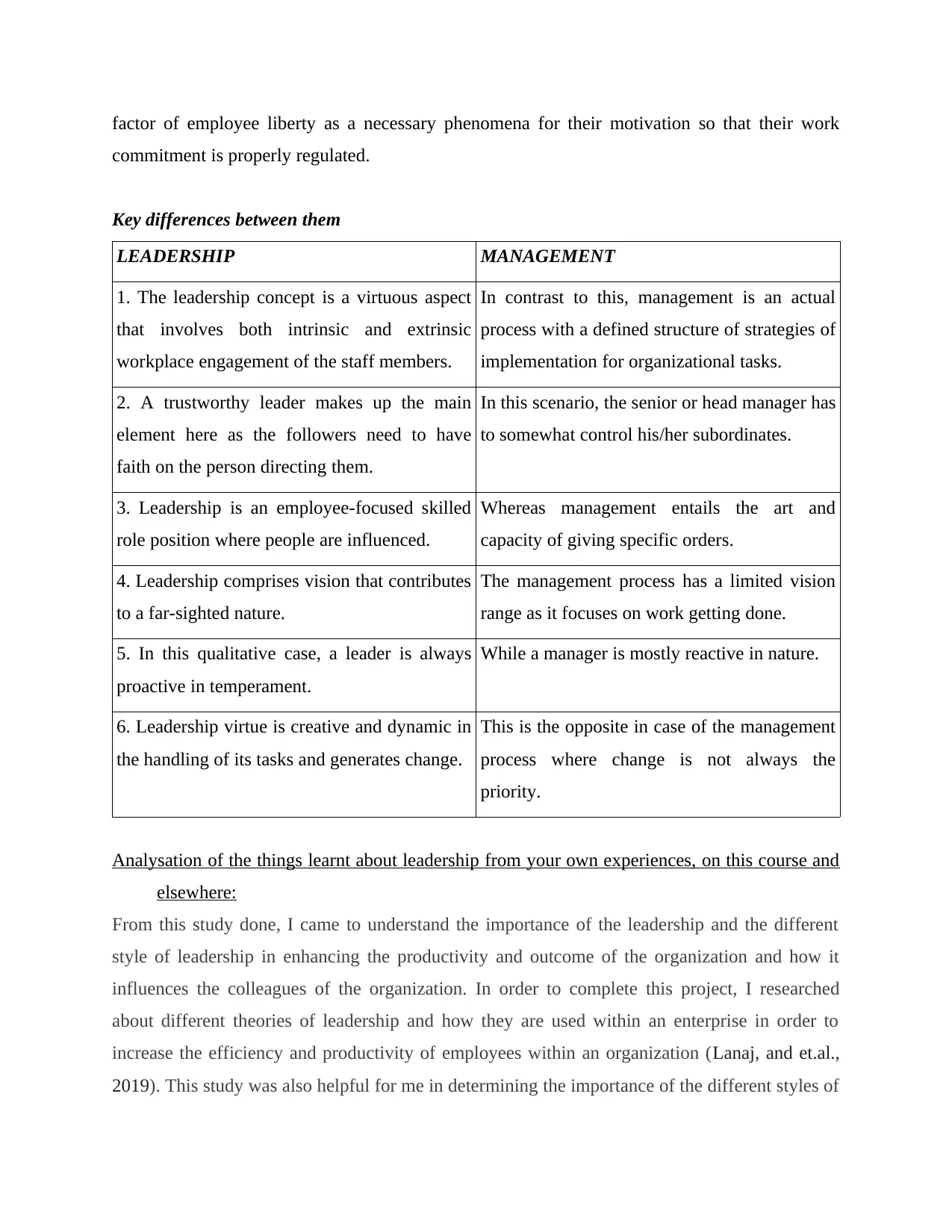
Key differences between them
LEADERSHIP MANAGEMENT
1. The leadership concept is a virtuous aspect
that involves both intrinsic and extrinsic
workplace engagement of the staff members.
In contrast to this, management is an actual
process with a defined structure of strategies of
implementation for organizational tasks.
2. A trustworthy leader makes up the main
element here as the followers need to have
faith on the person directing them.
In this scenario, the senior or head manager has
to somewhat control his/her subordinates.
3. Leadership is an employee-focused skilled
role position where people are influenced.
Whereas management entails the art and
capacity of giving specific orders.
4. Leadership comprises vision that contributes
to a far-sighted nature.
The management process has a limited vision
range as it focuses on work getting done.
5. In this qualitative case, a leader is always
proactive in temperament.
While a manager is mostly reactive in nature.
6. Leadership virtue is creative and dynamic in
the handling of its tasks and generates change.
This is the opposite in case of the management
process where change is not always the
priority.
Analysation of the things learnt about leadership from your own experiences, on this course and
elsewhere:
From this study done, I came to understand the importance of the leadership and the different
style of leadership in enhancing the productivity and outcome of the organization and how it
influences the colleagues of the organization. In order to complete this project, I researched
about different theories of leadership and how they are used within an enterprise in order to
increase the efficiency and productivity of employees within an organization (Lanaj, and et.al.,
2019). This study was also helpful for me in determining the importance of the different styles of
commitment is properly regulated.
Key differences between them
LEADERSHIP MANAGEMENT
1. The leadership concept is a virtuous aspect
that involves both intrinsic and extrinsic
workplace engagement of the staff members.
In contrast to this, management is an actual
process with a defined structure of strategies of
implementation for organizational tasks.
2. A trustworthy leader makes up the main
element here as the followers need to have
faith on the person directing them.
In this scenario, the senior or head manager has
to somewhat control his/her subordinates.
3. Leadership is an employee-focused skilled
role position where people are influenced.
Whereas management entails the art and
capacity of giving specific orders.
4. Leadership comprises vision that contributes
to a far-sighted nature.
The management process has a limited vision
range as it focuses on work getting done.
5. In this qualitative case, a leader is always
proactive in temperament.
While a manager is mostly reactive in nature.
6. Leadership virtue is creative and dynamic in
the handling of its tasks and generates change.
This is the opposite in case of the management
process where change is not always the
priority.
Analysation of the things learnt about leadership from your own experiences, on this course and
elsewhere:
From this study done, I came to understand the importance of the leadership and the different
style of leadership in enhancing the productivity and outcome of the organization and how it
influences the colleagues of the organization. In order to complete this project, I researched
about different theories of leadership and how they are used within an enterprise in order to
increase the efficiency and productivity of employees within an organization (Lanaj, and et.al.,
2019). This study was also helpful for me in determining the importance of the different styles of
⊘ This is a preview!⊘
Do you want full access?
Subscribe today to unlock all pages.
Trusted by 1+ million students worldwide
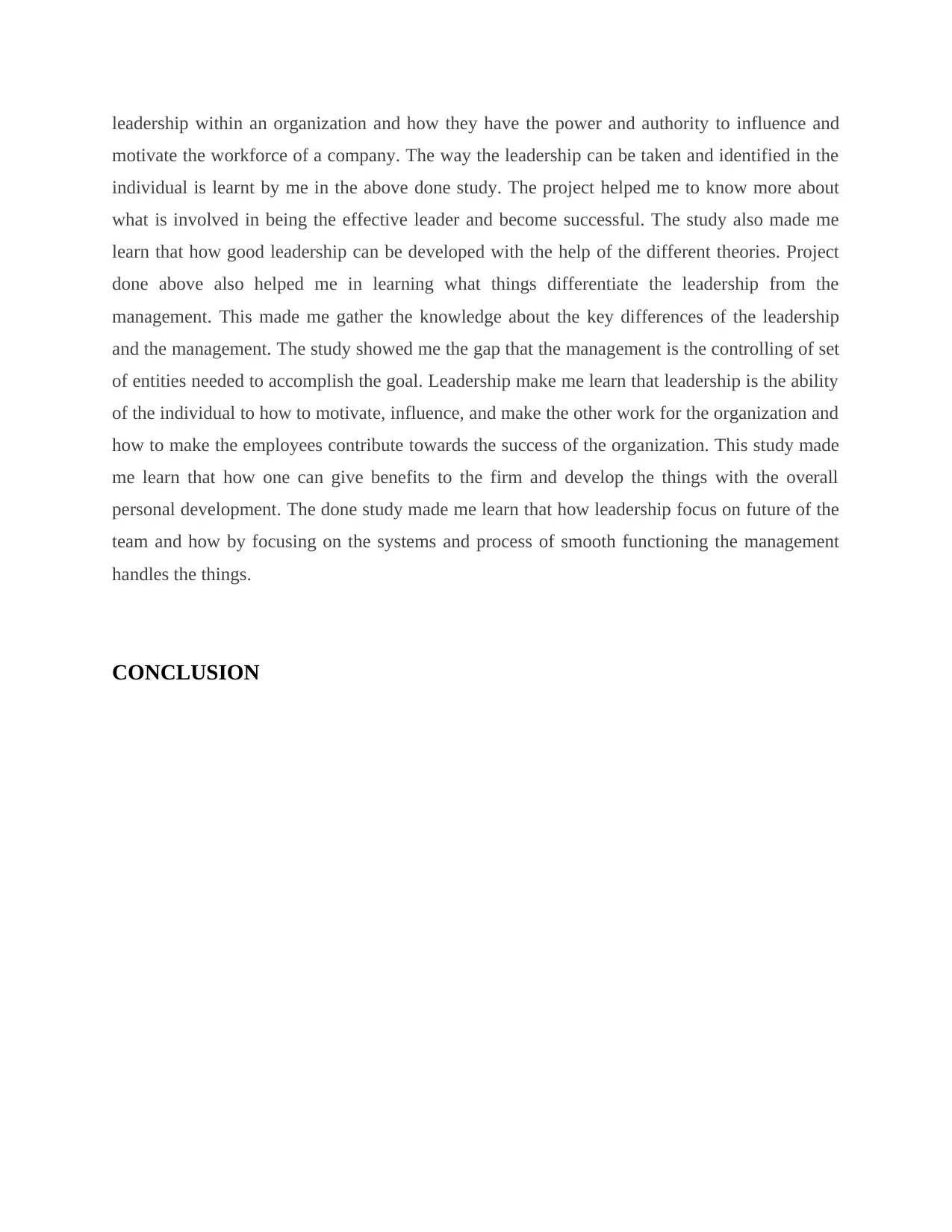
leadership within an organization and how they have the power and authority to influence and
motivate the workforce of a company. The way the leadership can be taken and identified in the
individual is learnt by me in the above done study. The project helped me to know more about
what is involved in being the effective leader and become successful. The study also made me
learn that how good leadership can be developed with the help of the different theories. Project
done above also helped me in learning what things differentiate the leadership from the
management. This made me gather the knowledge about the key differences of the leadership
and the management. The study showed me the gap that the management is the controlling of set
of entities needed to accomplish the goal. Leadership make me learn that leadership is the ability
of the individual to how to motivate, influence, and make the other work for the organization and
how to make the employees contribute towards the success of the organization. This study made
me learn that how one can give benefits to the firm and develop the things with the overall
personal development. The done study made me learn that how leadership focus on future of the
team and how by focusing on the systems and process of smooth functioning the management
handles the things.
CONCLUSION
motivate the workforce of a company. The way the leadership can be taken and identified in the
individual is learnt by me in the above done study. The project helped me to know more about
what is involved in being the effective leader and become successful. The study also made me
learn that how good leadership can be developed with the help of the different theories. Project
done above also helped me in learning what things differentiate the leadership from the
management. This made me gather the knowledge about the key differences of the leadership
and the management. The study showed me the gap that the management is the controlling of set
of entities needed to accomplish the goal. Leadership make me learn that leadership is the ability
of the individual to how to motivate, influence, and make the other work for the organization and
how to make the employees contribute towards the success of the organization. This study made
me learn that how one can give benefits to the firm and develop the things with the overall
personal development. The done study made me learn that how leadership focus on future of the
team and how by focusing on the systems and process of smooth functioning the management
handles the things.
CONCLUSION
Paraphrase This Document
Need a fresh take? Get an instant paraphrase of this document with our AI Paraphraser
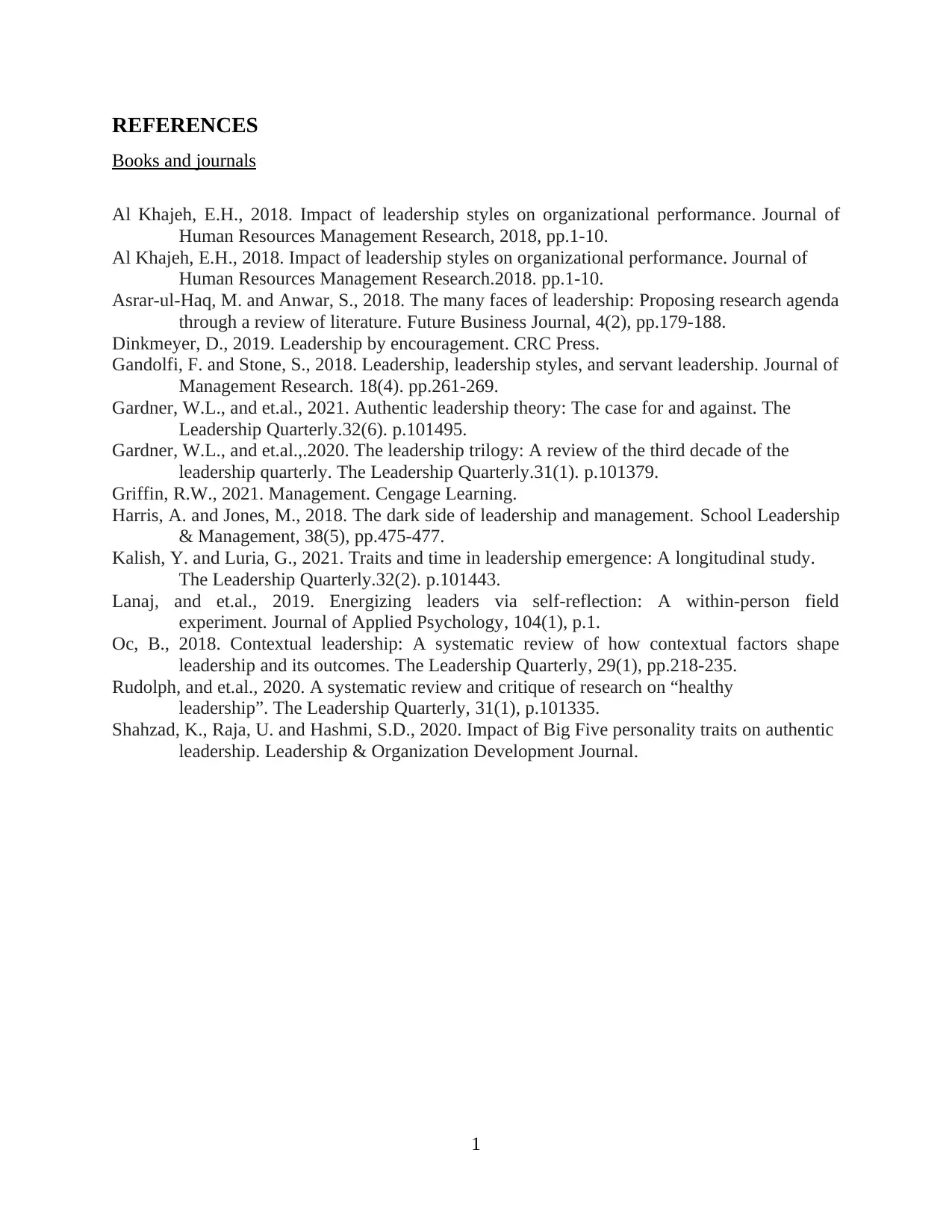
REFERENCES
Books and journals
Al Khajeh, E.H., 2018. Impact of leadership styles on organizational performance. Journal of
Human Resources Management Research, 2018, pp.1-10.
Al Khajeh, E.H., 2018. Impact of leadership styles on organizational performance. Journal of
Human Resources Management Research.2018. pp.1-10.
Asrar-ul-Haq, M. and Anwar, S., 2018. The many faces of leadership: Proposing research agenda
through a review of literature. Future Business Journal, 4(2), pp.179-188.
Dinkmeyer, D., 2019. Leadership by encouragement. CRC Press.
Gandolfi, F. and Stone, S., 2018. Leadership, leadership styles, and servant leadership. Journal of
Management Research. 18(4). pp.261-269.
Gardner, W.L., and et.al., 2021. Authentic leadership theory: The case for and against. The
Leadership Quarterly.32(6). p.101495.
Gardner, W.L., and et.al.,.2020. The leadership trilogy: A review of the third decade of the
leadership quarterly. The Leadership Quarterly.31(1). p.101379.
Griffin, R.W., 2021. Management. Cengage Learning.
Harris, A. and Jones, M., 2018. The dark side of leadership and management. School Leadership
& Management, 38(5), pp.475-477.
Kalish, Y. and Luria, G., 2021. Traits and time in leadership emergence: A longitudinal study.
The Leadership Quarterly.32(2). p.101443.
Lanaj, and et.al., 2019. Energizing leaders via self-reflection: A within-person field
experiment. Journal of Applied Psychology, 104(1), p.1.
Oc, B., 2018. Contextual leadership: A systematic review of how contextual factors shape
leadership and its outcomes. The Leadership Quarterly, 29(1), pp.218-235.
Rudolph, and et.al., 2020. A systematic review and critique of research on “healthy
leadership”. The Leadership Quarterly, 31(1), p.101335.
Shahzad, K., Raja, U. and Hashmi, S.D., 2020. Impact of Big Five personality traits on authentic
leadership. Leadership & Organization Development Journal.
1
Books and journals
Al Khajeh, E.H., 2018. Impact of leadership styles on organizational performance. Journal of
Human Resources Management Research, 2018, pp.1-10.
Al Khajeh, E.H., 2018. Impact of leadership styles on organizational performance. Journal of
Human Resources Management Research.2018. pp.1-10.
Asrar-ul-Haq, M. and Anwar, S., 2018. The many faces of leadership: Proposing research agenda
through a review of literature. Future Business Journal, 4(2), pp.179-188.
Dinkmeyer, D., 2019. Leadership by encouragement. CRC Press.
Gandolfi, F. and Stone, S., 2018. Leadership, leadership styles, and servant leadership. Journal of
Management Research. 18(4). pp.261-269.
Gardner, W.L., and et.al., 2021. Authentic leadership theory: The case for and against. The
Leadership Quarterly.32(6). p.101495.
Gardner, W.L., and et.al.,.2020. The leadership trilogy: A review of the third decade of the
leadership quarterly. The Leadership Quarterly.31(1). p.101379.
Griffin, R.W., 2021. Management. Cengage Learning.
Harris, A. and Jones, M., 2018. The dark side of leadership and management. School Leadership
& Management, 38(5), pp.475-477.
Kalish, Y. and Luria, G., 2021. Traits and time in leadership emergence: A longitudinal study.
The Leadership Quarterly.32(2). p.101443.
Lanaj, and et.al., 2019. Energizing leaders via self-reflection: A within-person field
experiment. Journal of Applied Psychology, 104(1), p.1.
Oc, B., 2018. Contextual leadership: A systematic review of how contextual factors shape
leadership and its outcomes. The Leadership Quarterly, 29(1), pp.218-235.
Rudolph, and et.al., 2020. A systematic review and critique of research on “healthy
leadership”. The Leadership Quarterly, 31(1), p.101335.
Shahzad, K., Raja, U. and Hashmi, S.D., 2020. Impact of Big Five personality traits on authentic
leadership. Leadership & Organization Development Journal.
1

1 out of 11


Related Documents


Your All-in-One AI-Powered Toolkit for Academic Success.
+13062052269
info@desklib.com
Available 24*7 on WhatsApp / Email
![[object Object]](/_next/static/media/star-bottom.7253800d.svg)
Unlock your academic potential
Copyright © 2020–2025 A2Z Services. All Rights Reserved. Developed and managed by ZUCOL.