Leadership Theories and Their Influence in Disability Care Settings
VerifiedAdded on 2021/11/06
|9
|2178
|305
Report
AI Summary
This report provides a comprehensive analysis of leadership within residential disability care settings. It begins with an introduction defining leadership and its importance in the sector. The report then explores the trait theory of leadership, examining the core traits necessary for effective leadership, such as honesty, integrity, empathy, and cognitive abilities, and analyzes how these traits apply within the context of disability care. Following this, the report delves into the skill theory of leadership, identifying essential skills like human, technical, and conceptual skills that leaders should possess. The report also provides a critical analysis of these theories, discussing their strengths and weaknesses and considering their practical implications. The discussion includes leadership qualities, such as charisma and motivational power, and their impact on implementing action plans. The report concludes by summarizing the key findings and emphasizing the importance of leadership in fostering holistic development within residential disability care. The report uses various sources and figures to support the analysis.
Leadership
0 | P a g e
0 | P a g e

Paraphrase This Document
Need a fresh take? Get an instant paraphrase of this document with our AI Paraphraser
Table of Contents
Introduction................................................................................................................................2
Analysis of leadership using the Trait theory approach.............................................................2
Critical Analysis of leadership theories related to residential disability care............................3
Leadership theories and its influence in a residential disability care setting.............................6
Conclusion..................................................................................................................................7
Reference list..............................................................................................................................8
1 | P a g e
Introduction................................................................................................................................2
Analysis of leadership using the Trait theory approach.............................................................2
Critical Analysis of leadership theories related to residential disability care............................3
Leadership theories and its influence in a residential disability care setting.............................6
Conclusion..................................................................................................................................7
Reference list..............................................................................................................................8
1 | P a g e
Introduction
Leadership is one of the most essential skills required to implement efficient service in the
residential disability care sector. It is one of the most important attributes that should be
possessed by the team leaders. Effective leadership enables in formulating a proper vision for
the organizations in the residential disability care sectors. The work environment in
residential disability care is dynamic. This study will deal with the definition of the
leadership. Comparison of Different kinds of leadership theories essential for the residential
disability care setting will be identified and they will be analyzed in a prominent manner. The
different components of leadership theories those influences the work of social practitioners
in the residential disability care setting will be analyzed. At last a summary of all the points
will be included in the conclusion section. The concluding section will comprise of
recommendation to improve the leadership in the residential disability care settings.
Analysis of leadership using the Trait theory approach
According to the researchers, leadership is the quality to incorporate proper vision in a team
and to implement that vision in reality by efficient action. Mainly the leadership in the
residential disability care comprises many traits based on four components (Burnes 2009).
. These are Person, position, process, and purpose. These traits are analyzed to see the
different aspects of leadership in residential disability care settings. The four traits or skills of
leadership in residential disability care are mentioned below.
Different aspects of leadership Analysis of the different traits of residential
disability care setting
Person: This mainly consists of the characteristic
traits of the person
The core traits required to deal with the
dynamic work of residential disability care
are honesty integrity motivation and excellent
cognitive ability charismatic nature, supportive
and empathetic attitudes. These traits are required
to manage the nursing team in residential
disability care setting(Cummings & Worley
2009)
. Empathetic attitude is very much essential to
2 | P a g e
Leadership is one of the most essential skills required to implement efficient service in the
residential disability care sector. It is one of the most important attributes that should be
possessed by the team leaders. Effective leadership enables in formulating a proper vision for
the organizations in the residential disability care sectors. The work environment in
residential disability care is dynamic. This study will deal with the definition of the
leadership. Comparison of Different kinds of leadership theories essential for the residential
disability care setting will be identified and they will be analyzed in a prominent manner. The
different components of leadership theories those influences the work of social practitioners
in the residential disability care setting will be analyzed. At last a summary of all the points
will be included in the conclusion section. The concluding section will comprise of
recommendation to improve the leadership in the residential disability care settings.
Analysis of leadership using the Trait theory approach
According to the researchers, leadership is the quality to incorporate proper vision in a team
and to implement that vision in reality by efficient action. Mainly the leadership in the
residential disability care comprises many traits based on four components (Burnes 2009).
. These are Person, position, process, and purpose. These traits are analyzed to see the
different aspects of leadership in residential disability care settings. The four traits or skills of
leadership in residential disability care are mentioned below.
Different aspects of leadership Analysis of the different traits of residential
disability care setting
Person: This mainly consists of the characteristic
traits of the person
The core traits required to deal with the
dynamic work of residential disability care
are honesty integrity motivation and excellent
cognitive ability charismatic nature, supportive
and empathetic attitudes. These traits are required
to manage the nursing team in residential
disability care setting(Cummings & Worley
2009)
. Empathetic attitude is very much essential to
2 | P a g e
⊘ This is a preview!⊘
Do you want full access?
Subscribe today to unlock all pages.

Trusted by 1+ million students worldwide
treat the patients of the disability care units.
Position: It depicts the actual role played by the
leader to manage the nursing team in residential
disability care settings
According to the Trait approach, the leaders in
residential disability care should possess effective
cognitive abilities. Analytical and conceptual
skills are needed to perform efficient situation
analysis during emergency cases in disability care
Process: This comprises the systematic
mechanism through which the leaders implement
the action plan into reality
Different kinds of traits are used by the leaders to
implement the action plan into reality. Through
effective motivation and creativity, complex
workplace problem in disability care may be
solved by the leaders(Kotter&, John 1996)
. According to trait theory, the Charismatic nature
and flexibility of the leader help in the
implementation of an action plan in residential
disability care setting(Kotter&, John 1996)
.
Purpose: This part mainly comprises of the vision
held by the leaders in the residential disability
care setting.
The purpose includes the objectives and the
organizational goals and vision set by the leaders
in the residential disability care settings.
These traits of leadership play a pivotal role in individual level or organizational level in the
residential disability care setting.
Critical Analysis of leadership theories related to residential
disability care
There are several kinds of leadership theories that exist in organizational settings. The critical
analysis of the trait theory of leadership with respect to residential disability care is as below:
According to the researchers in disability care, setting trait theory is one of the most
important aspects. This theory mainly deals with the different skills possessed by the leaders
in residential disability care settings. This theory elaborates that leaders should possess traits
like motivation integrity and honesty to work in a complex set of disability care(Gold,
Thorpe& Mumford 2010).. However, physical traits like height, weight and body structure
are also considered as essential skills for good leadership
3 | P a g e
Position: It depicts the actual role played by the
leader to manage the nursing team in residential
disability care settings
According to the Trait approach, the leaders in
residential disability care should possess effective
cognitive abilities. Analytical and conceptual
skills are needed to perform efficient situation
analysis during emergency cases in disability care
Process: This comprises the systematic
mechanism through which the leaders implement
the action plan into reality
Different kinds of traits are used by the leaders to
implement the action plan into reality. Through
effective motivation and creativity, complex
workplace problem in disability care may be
solved by the leaders(Kotter&, John 1996)
. According to trait theory, the Charismatic nature
and flexibility of the leader help in the
implementation of an action plan in residential
disability care setting(Kotter&, John 1996)
.
Purpose: This part mainly comprises of the vision
held by the leaders in the residential disability
care setting.
The purpose includes the objectives and the
organizational goals and vision set by the leaders
in the residential disability care settings.
These traits of leadership play a pivotal role in individual level or organizational level in the
residential disability care setting.
Critical Analysis of leadership theories related to residential
disability care
There are several kinds of leadership theories that exist in organizational settings. The critical
analysis of the trait theory of leadership with respect to residential disability care is as below:
According to the researchers in disability care, setting trait theory is one of the most
important aspects. This theory mainly deals with the different skills possessed by the leaders
in residential disability care settings. This theory elaborates that leaders should possess traits
like motivation integrity and honesty to work in a complex set of disability care(Gold,
Thorpe& Mumford 2010).. However, physical traits like height, weight and body structure
are also considered as essential skills for good leadership
3 | P a g e
Paraphrase This Document
Need a fresh take? Get an instant paraphrase of this document with our AI Paraphraser
This is one of the limitations of the trait theory Hughes2010). As in residential disability care,
mental traits like analysis and judgement skills are more important than physical traits. The
trait theory implies that self-confidence, creativity and flexibility are important skills of the
leader. Self-confidence flexibility and creativity are three important traits essential to
managing the nursing team in disability care setting.
On the contrary, researchers criticise the trait theory for being too generalist. According to the
theory, there are 100 of successful traits listed for being a good leader. It is complex to
calculate from this long list of traits.
The service design in the residential disability care needs inputs from all the members of the
team. Achievement drive and a collaborative approach are the two traits responsible for this
kind of leadership. According to the Trait, approach leaders should possess got cognitive
abilities to analyze all the opinion and reach the best decision. On the contrary, it is opined by
researchers that the trait theory is very complex to implement in a practical situation(Senior&
Swailes2010)
. The trait theory says that leaders always try to improve by taking feedback from the patient
in disability care. The leaders should take the feedback from the patients and incorporate
them in the action plan to make the holistic development of the patients in disability care
settings. According to Trait approach, this shows maturity and analyzing the ability of the
leaders(Henderson & Atkinson2003).
The leaders by using cognitive abilities may analyze the situation from the perspectives of
different patients in residential disability care settings. However, researchers criticize that the
traits are not ranked in an efficient manner in the trait theory. Thus trait theory of leadership
has its positive and negative aspects. The theory may be implemented on the mangers of the
residential disability care to assess their strength and weakness. The drawbacks of the theory
should be considered while estimating the traits of leaders with respect to residential
disability care settings.
Analysis of the Skill theory of leadership
The skill theory of leadership identifies the specific set of skills that should be possessed by a
good leader. The residential disability care centre comprises a dynamic workplace situation.
According to the skills theory, an excellent leader must develop a specific set of skills those
are mentioned below:
4 | P a g e
mental traits like analysis and judgement skills are more important than physical traits. The
trait theory implies that self-confidence, creativity and flexibility are important skills of the
leader. Self-confidence flexibility and creativity are three important traits essential to
managing the nursing team in disability care setting.
On the contrary, researchers criticise the trait theory for being too generalist. According to the
theory, there are 100 of successful traits listed for being a good leader. It is complex to
calculate from this long list of traits.
The service design in the residential disability care needs inputs from all the members of the
team. Achievement drive and a collaborative approach are the two traits responsible for this
kind of leadership. According to the Trait, approach leaders should possess got cognitive
abilities to analyze all the opinion and reach the best decision. On the contrary, it is opined by
researchers that the trait theory is very complex to implement in a practical situation(Senior&
Swailes2010)
. The trait theory says that leaders always try to improve by taking feedback from the patient
in disability care. The leaders should take the feedback from the patients and incorporate
them in the action plan to make the holistic development of the patients in disability care
settings. According to Trait approach, this shows maturity and analyzing the ability of the
leaders(Henderson & Atkinson2003).
The leaders by using cognitive abilities may analyze the situation from the perspectives of
different patients in residential disability care settings. However, researchers criticize that the
traits are not ranked in an efficient manner in the trait theory. Thus trait theory of leadership
has its positive and negative aspects. The theory may be implemented on the mangers of the
residential disability care to assess their strength and weakness. The drawbacks of the theory
should be considered while estimating the traits of leaders with respect to residential
disability care settings.
Analysis of the Skill theory of leadership
The skill theory of leadership identifies the specific set of skills that should be possessed by a
good leader. The residential disability care centre comprises a dynamic workplace situation.
According to the skills theory, an excellent leader must develop a specific set of skills those
are mentioned below:
4 | P a g e
Human skills- The human skills consist of communication and cognitive ability
mainly. Comprehension of human behaviour, group dynamics, and motives in an
effective manner is the major component of human skills. Disability care consists of
complex and dynamic workplace scenario. The human skills by the leaders to
implement the action plan in a proper manner. This will enhance the holistic service
quality in the residential disability(Kotter & John2002)
Care setting. Interpersonal is one of the significant terms used in human skills. The
interpersonal leaders tend to be more emphatic in their approach(Kotter & John2002)
. This skill enhances the motivation of team members that result in the holistic
development of service in the disability care setting.
Technical skill- The technical skills are the skills those helps in accomplishing the
task by different techniques. The standard operating procedure for a residential
disability care should be effectively managed by the leader. Moreover, by using
effective management techniques like situational analysis, effective delegation of
work, formulating an efficient timeline for the work holistic service efficiency in the
residential disability care setting might be increased(Morley et al. 2004) The
technical skills may be divided into supervisory management, middle management
and senor management
Conceptual skills- It is said that the conceptual skills help in formulating a different
kind of strategies for effective implementation of the action plan. The conceptual
skills of leaders help to formulate innovative strategies to enhance the efficiency of
service in the disability care setting(Morley et al. 2004)
According to some of the researchers, the skilled approach of leadership is more generalise
and less precise (Williams et al. 2017). Moreover, the predictive value is low it fails to find
the correlation between the set of skills and its effect on the performance of the leaders.
5 | P a g e
mainly. Comprehension of human behaviour, group dynamics, and motives in an
effective manner is the major component of human skills. Disability care consists of
complex and dynamic workplace scenario. The human skills by the leaders to
implement the action plan in a proper manner. This will enhance the holistic service
quality in the residential disability(Kotter & John2002)
Care setting. Interpersonal is one of the significant terms used in human skills. The
interpersonal leaders tend to be more emphatic in their approach(Kotter & John2002)
. This skill enhances the motivation of team members that result in the holistic
development of service in the disability care setting.
Technical skill- The technical skills are the skills those helps in accomplishing the
task by different techniques. The standard operating procedure for a residential
disability care should be effectively managed by the leader. Moreover, by using
effective management techniques like situational analysis, effective delegation of
work, formulating an efficient timeline for the work holistic service efficiency in the
residential disability care setting might be increased(Morley et al. 2004) The
technical skills may be divided into supervisory management, middle management
and senor management
Conceptual skills- It is said that the conceptual skills help in formulating a different
kind of strategies for effective implementation of the action plan. The conceptual
skills of leaders help to formulate innovative strategies to enhance the efficiency of
service in the disability care setting(Morley et al. 2004)
According to some of the researchers, the skilled approach of leadership is more generalise
and less precise (Williams et al. 2017). Moreover, the predictive value is low it fails to find
the correlation between the set of skills and its effect on the performance of the leaders.
5 | P a g e
⊘ This is a preview!⊘
Do you want full access?
Subscribe today to unlock all pages.
Trusted by 1+ million students worldwide
Leadership theories and its influence in a residential disability care
setting
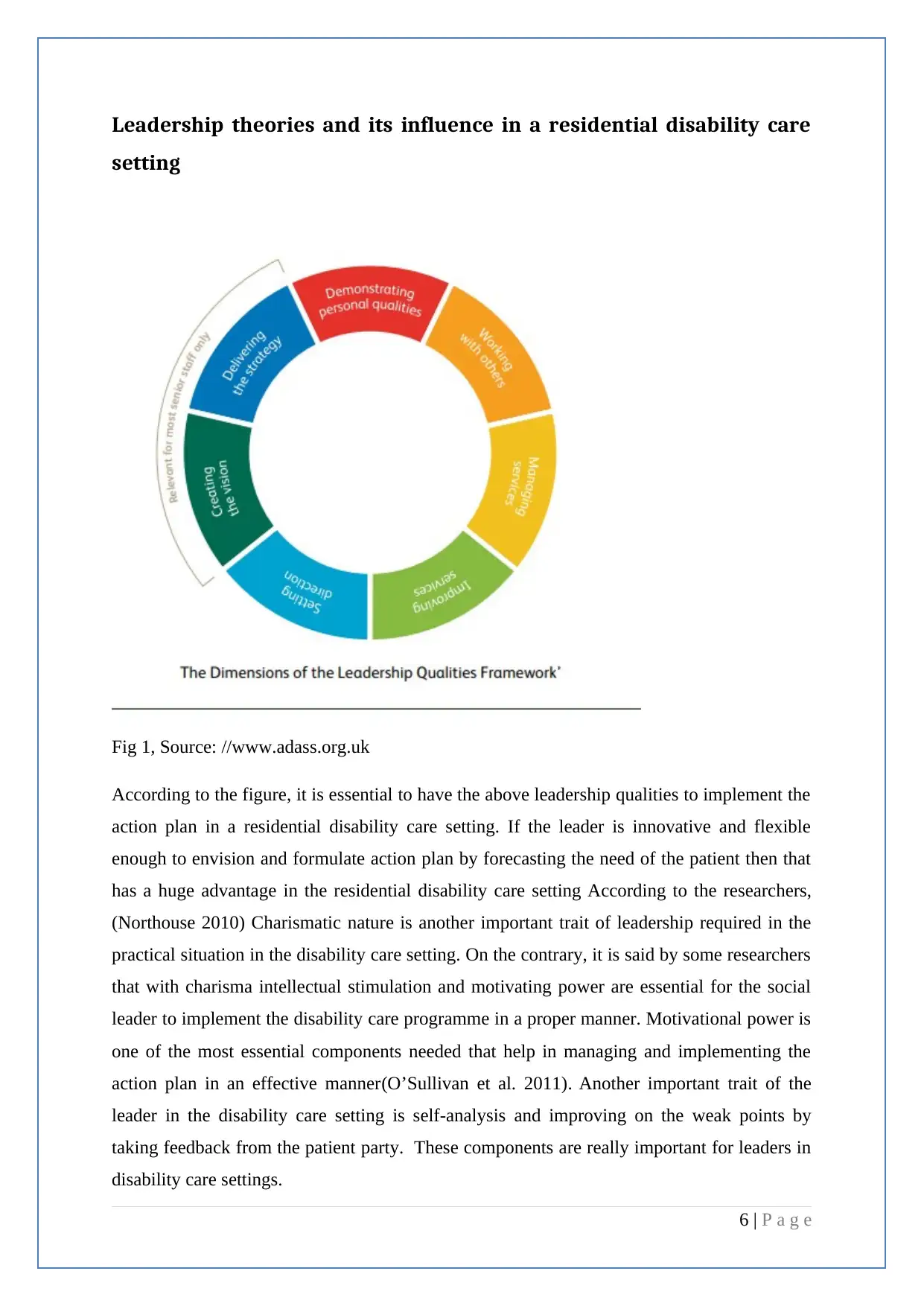
Fig 1, Source: //www.adass.org.uk
According to the figure, it is essential to have the above leadership qualities to implement the
action plan in a residential disability care setting. If the leader is innovative and flexible
enough to envision and formulate action plan by forecasting the need of the patient then that
has a huge advantage in the residential disability care setting According to the researchers,
(Northouse 2010) Charismatic nature is another important trait of leadership required in the
practical situation in the disability care setting. On the contrary, it is said by some researchers
that with charisma intellectual stimulation and motivating power are essential for the social
leader to implement the disability care programme in a proper manner. Motivational power is
one of the most essential components needed that help in managing and implementing the
action plan in an effective manner(O’Sullivan et al. 2011). Another important trait of the
leader in the disability care setting is self-analysis and improving on the weak points by
taking feedback from the patient party. These components are really important for leaders in
disability care settings.
6 | P a g e
setting
Fig 1, Source: //www.adass.org.uk
According to the figure, it is essential to have the above leadership qualities to implement the
action plan in a residential disability care setting. If the leader is innovative and flexible
enough to envision and formulate action plan by forecasting the need of the patient then that
has a huge advantage in the residential disability care setting According to the researchers,
(Northouse 2010) Charismatic nature is another important trait of leadership required in the
practical situation in the disability care setting. On the contrary, it is said by some researchers
that with charisma intellectual stimulation and motivating power are essential for the social
leader to implement the disability care programme in a proper manner. Motivational power is
one of the most essential components needed that help in managing and implementing the
action plan in an effective manner(O’Sullivan et al. 2011). Another important trait of the
leader in the disability care setting is self-analysis and improving on the weak points by
taking feedback from the patient party. These components are really important for leaders in
disability care settings.
6 | P a g e
Paraphrase This Document
Need a fresh take? Get an instant paraphrase of this document with our AI Paraphraser
Conclusion
The study mainly comprised of the two leading theories that are the trait leadership theory
and the skill leadership theory in respect to the disability care setting. These two leadership
theories are essential in the residential disability care settings and are slightly different from
the other organizational settings. The trait leadership theory deals with leadership skills those
help in the implementation of the action plan in a proper manner. On the other hand, the skill
theory explains that leaders should possess a fixed set of skills to become effective and
efficient. The main components that should be improved by the leaders in the disability care
settings are the charisma, motivational strength, and intellectual thinking. This may help in
the holistic development of leadership in a residential disability care setting.
7 | P a g e
The study mainly comprised of the two leading theories that are the trait leadership theory
and the skill leadership theory in respect to the disability care setting. These two leadership
theories are essential in the residential disability care settings and are slightly different from
the other organizational settings. The trait leadership theory deals with leadership skills those
help in the implementation of the action plan in a proper manner. On the other hand, the skill
theory explains that leaders should possess a fixed set of skills to become effective and
efficient. The main components that should be improved by the leaders in the disability care
settings are the charisma, motivational strength, and intellectual thinking. This may help in
the holistic development of leadership in a residential disability care setting.
7 | P a g e
Reference list
.Kotter, John P., (1996), Leading Change, Harvard Business School Press
Burnes, B. (2009). Managing Change. 5 th Edition, Harlow: Financial Times, Prentice Hall
Cummings, T. G. and Worley, C. G. (2009). Organization Development & Change. New
York: Cengage.
Gold, J., Thorpe, R. and Mumford, A. (2010). Leadership and Management Development.
5th Edition, London: CIPD.
Henderson, J. & Atkinson, D. (2003) Managing Care in Context. London; Open University
Hughes, M. (2010). Managing Change: A Critical Perspective, London: CIPD.
Kotter, John P., (2002), The Heart of Change, Harvard Business School
Morley, M., Moore, S., Heraty, N., Linehan, M., MacCurtain, S.,(2004), Principles of
Organisational Behaviour - An Irish Text, Dublin: Gill & Macmillan
Northouse, P. G. (2010). Leadership: Theory and Practice. 5 th Edition, London: Sage.
O’Sullivan, T. (2011) Decision Making in Social Work. UK; Palgrave Macmillan 12.
Tiernan, S. D., Morley, M. & Foley, E. (2001) Modern Management; Theory and Practice for
Irish Students. Dublin; Gill Mac Millan
Senior, B. and Swailes, S. (2010). Organizational Change. 4th Edition, Harlow: Financial
Times, Prentice Hall.
Williams Jr, W.A., Brandon, R.S., Hayek, M., Haden, S.P. and Atinc, G., 2017. Servant
leadership and followership creativity: The influence of workplace spirituality and political
skill. Leadership & Organization Development Journal, 38(2), pp.178-193.
8 | P a g e
.Kotter, John P., (1996), Leading Change, Harvard Business School Press
Burnes, B. (2009). Managing Change. 5 th Edition, Harlow: Financial Times, Prentice Hall
Cummings, T. G. and Worley, C. G. (2009). Organization Development & Change. New
York: Cengage.
Gold, J., Thorpe, R. and Mumford, A. (2010). Leadership and Management Development.
5th Edition, London: CIPD.
Henderson, J. & Atkinson, D. (2003) Managing Care in Context. London; Open University
Hughes, M. (2010). Managing Change: A Critical Perspective, London: CIPD.
Kotter, John P., (2002), The Heart of Change, Harvard Business School
Morley, M., Moore, S., Heraty, N., Linehan, M., MacCurtain, S.,(2004), Principles of
Organisational Behaviour - An Irish Text, Dublin: Gill & Macmillan
Northouse, P. G. (2010). Leadership: Theory and Practice. 5 th Edition, London: Sage.
O’Sullivan, T. (2011) Decision Making in Social Work. UK; Palgrave Macmillan 12.
Tiernan, S. D., Morley, M. & Foley, E. (2001) Modern Management; Theory and Practice for
Irish Students. Dublin; Gill Mac Millan
Senior, B. and Swailes, S. (2010). Organizational Change. 4th Edition, Harlow: Financial
Times, Prentice Hall.
Williams Jr, W.A., Brandon, R.S., Hayek, M., Haden, S.P. and Atinc, G., 2017. Servant
leadership and followership creativity: The influence of workplace spirituality and political
skill. Leadership & Organization Development Journal, 38(2), pp.178-193.
8 | P a g e
⊘ This is a preview!⊘
Do you want full access?
Subscribe today to unlock all pages.
Trusted by 1+ million students worldwide

1 out of 9


Related Documents


Your All-in-One AI-Powered Toolkit for Academic Success.
+13062052269
info@desklib.com
Available 24*7 on WhatsApp / Email
![[object Object]](/_next/static/media/star-bottom.7253800d.svg)
Unlock your academic potential
Copyright © 2020–2026 A2Z Services. All Rights Reserved. Developed and managed by ZUCOL.