Challenging Lefebvre's Assessment of Objects in 'A Christmas Memory'
VerifiedAdded on 2020/02/24
|6
|1698
|183
Essay
AI Summary
This essay critically examines Truman Capote's 'A Christmas Memory' to challenge Henri Lefebvre's assessment of the evolving relationship between humans and objects in the modern era. The essay argues that Lefebvre's view, which suggests a shift towards instrumental and materialistic relationships with objects, doesn't fully capture the nuances of human connection. The analysis focuses on Buddy and his cousin's interactions, particularly their Christmas traditions, gift-giving, and the value they place on non-material items like the Christmas tree and their dog, Queenie. The essay highlights how these characters demonstrate love, friendship, and religious values, which contradict Lefebvre's assertion that modernity has eroded these aspects of human life. By exploring themes of poverty, simplicity, and the enduring importance of relationships, the essay concludes that while materialism exists, it doesn't entirely define the human connection to objects, and that values like friendship and religion continue to shape our interactions with the world around us. The essay also references the works of Olson to support the arguments.
SURNAME1
Name
Course
Institution
Lecturer
Date
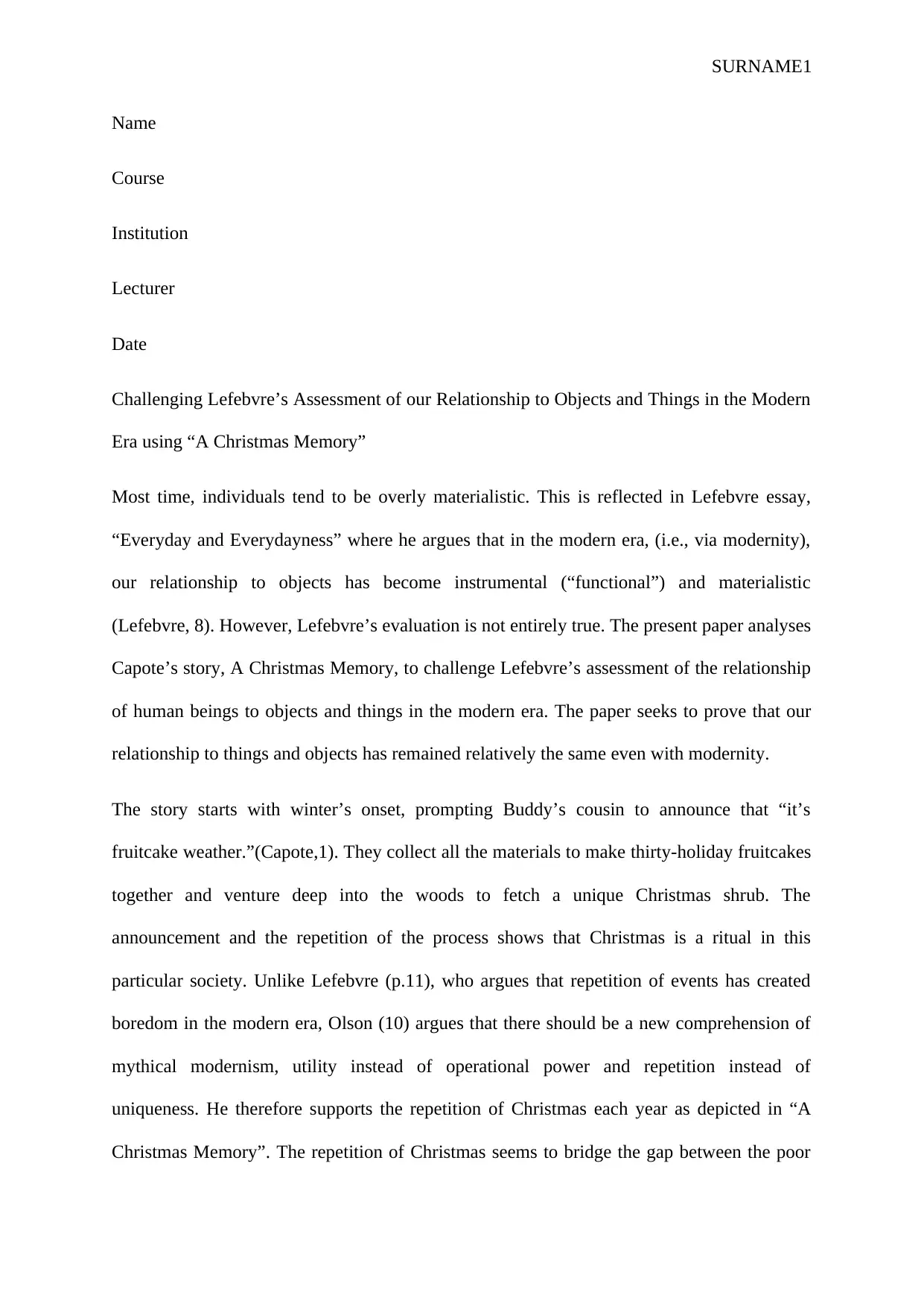
Challenging Lefebvre’s Assessment of our Relationship to Objects and Things in the Modern
Era using “A Christmas Memory”
Most time, individuals tend to be overly materialistic. This is reflected in Lefebvre essay,
“Everyday and Everydayness” where he argues that in the modern era, (i.e., via modernity),
our relationship to objects has become instrumental (“functional”) and materialistic
(Lefebvre, 8). However, Lefebvre’s evaluation is not entirely true. The present paper analyses
Capote’s story, A Christmas Memory, to challenge Lefebvre’s assessment of the relationship
of human beings to objects and things in the modern era. The paper seeks to prove that our
relationship to things and objects has remained relatively the same even with modernity.
The story starts with winter’s onset, prompting Buddy’s cousin to announce that “it’s
fruitcake weather.”(Capote,1). They collect all the materials to make thirty-holiday fruitcakes
together and venture deep into the woods to fetch a unique Christmas shrub. The
announcement and the repetition of the process shows that Christmas is a ritual in this
particular society. Unlike Lefebvre (p.11), who argues that repetition of events has created
boredom in the modern era, Olson (10) argues that there should be a new comprehension of
mythical modernism, utility instead of operational power and repetition instead of
uniqueness. He therefore supports the repetition of Christmas each year as depicted in “A
Christmas Memory”. The repetition of Christmas seems to bridge the gap between the poor
Name
Course
Institution
Lecturer
Date
Challenging Lefebvre’s Assessment of our Relationship to Objects and Things in the Modern
Era using “A Christmas Memory”
Most time, individuals tend to be overly materialistic. This is reflected in Lefebvre essay,
“Everyday and Everydayness” where he argues that in the modern era, (i.e., via modernity),
our relationship to objects has become instrumental (“functional”) and materialistic
(Lefebvre, 8). However, Lefebvre’s evaluation is not entirely true. The present paper analyses
Capote’s story, A Christmas Memory, to challenge Lefebvre’s assessment of the relationship
of human beings to objects and things in the modern era. The paper seeks to prove that our
relationship to things and objects has remained relatively the same even with modernity.
The story starts with winter’s onset, prompting Buddy’s cousin to announce that “it’s
fruitcake weather.”(Capote,1). They collect all the materials to make thirty-holiday fruitcakes
together and venture deep into the woods to fetch a unique Christmas shrub. The
announcement and the repetition of the process shows that Christmas is a ritual in this
particular society. Unlike Lefebvre (p.11), who argues that repetition of events has created
boredom in the modern era, Olson (10) argues that there should be a new comprehension of
mythical modernism, utility instead of operational power and repetition instead of
uniqueness. He therefore supports the repetition of Christmas each year as depicted in “A
Christmas Memory”. The repetition of Christmas seems to bridge the gap between the poor
Paraphrase This Document
Need a fresh take? Get an instant paraphrase of this document with our AI Paraphraser

SURNAME2
and the rich and serves as a constant reminder of our immaterial relationship to things and
objects. On Christmas Eve, they beautify the tree with homemade adornments and create gifts
for their relatives. Though they would wish to buy each other expensive gifts, they are
poverty stricken and end up making each other kites instead. The simplicity of fruitcakes and
the fact that Buddy and his cousin were willing to save money throughout the year in order to
afford the ingredients symbolizes the value attached to Christmas. The fruitcakes are also
symbolic of the priceless friendship that Buddy’s cousin shared with the strangers. This act in
itself challenges the notion that our relationship to things and objects has become
materialistic and functional as suggested by Lefebvre.
From the story, Buddy’s revulsion for materialistic things is evident. On Christmas Day, he
receives a Sunday school shirt, handkerchiefs, a second-hand sweater and a subscription to a
religious children’s magazine. He is however not excited about the gifts which are evident in
the statement; “Well, I’m disappointed. Who wouldn’t be?” (Capote, 9). Buddy’s cousin is a
bit more enthusiastic with the gift she receives from her married sister, a woollen sweater.
However, it is their cheap gifts towards each other, the fruitcakes and the handmade kites that
make them happy. The kites and fruitcakes are a symbol of the friendship bond and love that
these two characters shared. Though their economic condition does not allow them to buy
each other expensive gifts, they are content and appreciate what they can afford. In modern
life, though material possessions such as wealth are important, individuals cannot draw full
utility from these possessions. Love and friendship are still important even in the modern
world and define our existence as human beings.
Further, Buddy’s cousin’s distaste for materialism is apparent when she refuses to exchange
the Christmas tree for money. The mill owner’s wife offers Buddy’s cousin money for the
tree, suggesting that they could get another one. However, she responds by saying that “there
is never two of anything.” (Capote,7).From her response, it is clear that she has extraordinary
and the rich and serves as a constant reminder of our immaterial relationship to things and
objects. On Christmas Eve, they beautify the tree with homemade adornments and create gifts
for their relatives. Though they would wish to buy each other expensive gifts, they are
poverty stricken and end up making each other kites instead. The simplicity of fruitcakes and
the fact that Buddy and his cousin were willing to save money throughout the year in order to
afford the ingredients symbolizes the value attached to Christmas. The fruitcakes are also
symbolic of the priceless friendship that Buddy’s cousin shared with the strangers. This act in
itself challenges the notion that our relationship to things and objects has become
materialistic and functional as suggested by Lefebvre.
From the story, Buddy’s revulsion for materialistic things is evident. On Christmas Day, he
receives a Sunday school shirt, handkerchiefs, a second-hand sweater and a subscription to a
religious children’s magazine. He is however not excited about the gifts which are evident in
the statement; “Well, I’m disappointed. Who wouldn’t be?” (Capote, 9). Buddy’s cousin is a
bit more enthusiastic with the gift she receives from her married sister, a woollen sweater.
However, it is their cheap gifts towards each other, the fruitcakes and the handmade kites that
make them happy. The kites and fruitcakes are a symbol of the friendship bond and love that
these two characters shared. Though their economic condition does not allow them to buy
each other expensive gifts, they are content and appreciate what they can afford. In modern
life, though material possessions such as wealth are important, individuals cannot draw full
utility from these possessions. Love and friendship are still important even in the modern
world and define our existence as human beings.
Further, Buddy’s cousin’s distaste for materialism is apparent when she refuses to exchange
the Christmas tree for money. The mill owner’s wife offers Buddy’s cousin money for the
tree, suggesting that they could get another one. However, she responds by saying that “there
is never two of anything.” (Capote,7).From her response, it is clear that she has extraordinary

SURNAME3
respect for the exceptionality of “things” and that she has a spiritual indebtedness for both the
tree and other “things” in life. Her reaction also contradicts the evident affluence of the mill
owner’s wife, proposing that she would rather gain the reward of their efforts in finding the
impeccable Christmas tree than being compensated with money. This contradicts Lefebvre’s
statement; “our relationship to things has become materialistic and instrumental due to
modernity” (p.8) since it is clear that materialism does not affect individual decisions in all
situations. The notion by Lefebvre, that modernism has brought in materialism is drawn from
the Marxist Framework, i.e. individuals are alienated from themselves and from each other
under conditions of capitalist production (Olson, 14). However, if this were the case, Buddy’s
cousin would have accepted the mill owner’s wife money offer, especially owing to their
financial situation at the moment.
In his essay, Lefebvre suggests that due to the materialistic and instrumental value that has
been attached to things and objects, the relationship between human beings and God
(divinity) has eroded. He states that; “The every day is, therefore, a concept. For it to have
ever been engaged as a concept, the reality is designated had to become dominated, and old
obsessions about shortages- “give us our daily bread…” had to disappear” (Lefebvre, 9). He
further argues that in the pre modern era, buildings and furniture were constructed one by
one, and each existed in relation to symbols, to social and moral reference, a concept that has
since disappeared (p.9). However, the concept of religion is still evident in the modern era,
and certain things symbolize religion as seen in “A Christmas Memory.” When flying the
kites, Buddy’s cousin suddenly declares, “My, how foolish I am” (Capote, 10). The
experience gives her a new understanding of the presence of God in ordinary things. She
remembers how she always assumed that “a body would have to be sick and dying before
they saw the Lord” (Capote, 10). Buddy’s cousin compared her experience to the “Baptist
Window” (10) and confesses that she had believed that the shine clears the scary feeling. She
respect for the exceptionality of “things” and that she has a spiritual indebtedness for both the
tree and other “things” in life. Her reaction also contradicts the evident affluence of the mill
owner’s wife, proposing that she would rather gain the reward of their efforts in finding the
impeccable Christmas tree than being compensated with money. This contradicts Lefebvre’s
statement; “our relationship to things has become materialistic and instrumental due to
modernity” (p.8) since it is clear that materialism does not affect individual decisions in all
situations. The notion by Lefebvre, that modernism has brought in materialism is drawn from
the Marxist Framework, i.e. individuals are alienated from themselves and from each other
under conditions of capitalist production (Olson, 14). However, if this were the case, Buddy’s
cousin would have accepted the mill owner’s wife money offer, especially owing to their
financial situation at the moment.
In his essay, Lefebvre suggests that due to the materialistic and instrumental value that has
been attached to things and objects, the relationship between human beings and God
(divinity) has eroded. He states that; “The every day is, therefore, a concept. For it to have
ever been engaged as a concept, the reality is designated had to become dominated, and old
obsessions about shortages- “give us our daily bread…” had to disappear” (Lefebvre, 9). He
further argues that in the pre modern era, buildings and furniture were constructed one by
one, and each existed in relation to symbols, to social and moral reference, a concept that has
since disappeared (p.9). However, the concept of religion is still evident in the modern era,
and certain things symbolize religion as seen in “A Christmas Memory.” When flying the
kites, Buddy’s cousin suddenly declares, “My, how foolish I am” (Capote, 10). The
experience gives her a new understanding of the presence of God in ordinary things. She
remembers how she always assumed that “a body would have to be sick and dying before
they saw the Lord” (Capote, 10). Buddy’s cousin compared her experience to the “Baptist
Window” (10) and confesses that she had believed that the shine clears the scary feeling. She
⊘ This is a preview!⊘
Do you want full access?
Subscribe today to unlock all pages.

Trusted by 1+ million students worldwide

SURNAME4
realizes that the Lord has always been present in her life through ordinary things such as her
dog Queenie, clouds, kites and grass. It is therefore evident that the value attached to religion
has not entirely disappeared as suggested by Lefebvre. Rather, the choice to be religious
depends on personal choice as suggested by Olson (15).
Our relationship to things to objects and things has remained relatively the same as seen
through the relationship between Buddy’s cousin and her dog, Queenie. The dog is a mere
pet, and the owner has no prospects of benefitting from it in the future. The description of the
dog itself, “our tough little orange and a white terrier who has survived distemper and two
rattlesnake bites” (Capote, 1) shows the tough times the dog has had to endure. The name,
Queenie, is ironical since unlike royalty, it lives in a poor homestead. Buddy and his cousin
continue to take care of their little dog even as they anticipate burying its body the following
winter. The sorrow of Queenie’s death is apparent in a letter she writes to Buddy to inform
him that Jim Macy’s horse had kicked the dog to death. It is evident that it love defines the
relationship between Buddy’s cousin and her dog, and not the materialistic and functional
value she attached to it. Olson (15), a person’s ordinary routines resound with individual in a
system that controls choice. This is evident in Buddy’s cousin’s act of keeping a dog which
has no material value, and feeding it even though she is impoverished.
In conclusion, even with modernity our relationship to objects and things has remained
relatively the same and is not dictated by the instrumental and materialistic value. Although it
may seem like materialism has taken root in the society, especially due to the tough economic
times, people still use certain objects as symbols of love, religion, and friendship. For
instance, just like Buddy’s cousin valued her dog, individuals still rare priceless pets. People
still present priceless gifts to their friends and families, particularly during festive seasons.
Christmas and Christmas trees are still a vital part of our existence as human beings. As such,
it would be wrong to assume that our relationship to things and object has become
realizes that the Lord has always been present in her life through ordinary things such as her
dog Queenie, clouds, kites and grass. It is therefore evident that the value attached to religion
has not entirely disappeared as suggested by Lefebvre. Rather, the choice to be religious
depends on personal choice as suggested by Olson (15).
Our relationship to things to objects and things has remained relatively the same as seen
through the relationship between Buddy’s cousin and her dog, Queenie. The dog is a mere
pet, and the owner has no prospects of benefitting from it in the future. The description of the
dog itself, “our tough little orange and a white terrier who has survived distemper and two
rattlesnake bites” (Capote, 1) shows the tough times the dog has had to endure. The name,
Queenie, is ironical since unlike royalty, it lives in a poor homestead. Buddy and his cousin
continue to take care of their little dog even as they anticipate burying its body the following
winter. The sorrow of Queenie’s death is apparent in a letter she writes to Buddy to inform
him that Jim Macy’s horse had kicked the dog to death. It is evident that it love defines the
relationship between Buddy’s cousin and her dog, and not the materialistic and functional
value she attached to it. Olson (15), a person’s ordinary routines resound with individual in a
system that controls choice. This is evident in Buddy’s cousin’s act of keeping a dog which
has no material value, and feeding it even though she is impoverished.
In conclusion, even with modernity our relationship to objects and things has remained
relatively the same and is not dictated by the instrumental and materialistic value. Although it
may seem like materialism has taken root in the society, especially due to the tough economic
times, people still use certain objects as symbols of love, religion, and friendship. For
instance, just like Buddy’s cousin valued her dog, individuals still rare priceless pets. People
still present priceless gifts to their friends and families, particularly during festive seasons.
Christmas and Christmas trees are still a vital part of our existence as human beings. As such,
it would be wrong to assume that our relationship to things and object has become
Paraphrase This Document
Need a fresh take? Get an instant paraphrase of this document with our AI Paraphraser

SURNAME5
instrumental and materialistic in the modern era. In my opinion, the repetition of “Everyday”,
for instance festivities, creates value and satisfaction to modernism as suggested by Olson
(p.9) and should not be replaced by uniqueness.
instrumental and materialistic in the modern era. In my opinion, the repetition of “Everyday”,
for instance festivities, creates value and satisfaction to modernism as suggested by Olson
(p.9) and should not be replaced by uniqueness.

SURNAME6
References
Capote. "A Christmas Memory." (n.d.): 1-11.
Lefebvre, H. "The Everydat and Everydayness." (n.d.): 7-11.
Olson, Liesl, M. Modernity and the Ordinary. Oxford: Oxford University Press, 2009.
References
Capote. "A Christmas Memory." (n.d.): 1-11.
Lefebvre, H. "The Everydat and Everydayness." (n.d.): 7-11.
Olson, Liesl, M. Modernity and the Ordinary. Oxford: Oxford University Press, 2009.
⊘ This is a preview!⊘
Do you want full access?
Subscribe today to unlock all pages.

Trusted by 1+ million students worldwide
1 out of 6
Your All-in-One AI-Powered Toolkit for Academic Success.
+13062052269
info@desklib.com
Available 24*7 on WhatsApp / Email
Unlock your academic potential
Copyright © 2020–2025 A2Z Services. All Rights Reserved. Developed and managed by ZUCOL.