Legal Aspects of Business Organizations for Business Success
VerifiedAdded on 2021/06/16
|11
|2650
|14
Report
AI Summary
This report provides an overview of the legal aspects of business organizations, focusing on two primary forms: unlimited partnerships and private limited companies. It details the characteristics of each, including formation, membership, liability, and capital contributions. The report also examines the duties of a company director, as outlined in the Companies Act 2006, including the duty to act within powers, promote the success of the company, and exercise independent judgment. It discusses relevant case law and practical difficulties directors may face, along with ways to mitigate risks. The report emphasizes the importance of legal considerations in ensuring the successful operation of a business and the responsibilities of directors in upholding these standards. The report also provides information on the legal framework and director's responsibilities to the firm and stockholders.

Legal Aspects Of Business Organization 1
LEGAL ASPECTS OF BUSINESS ORGANIZATIONS
By (Student’s Name)
Professor’s Name
College
Course
Date
LEGAL ASPECTS OF BUSINESS ORGANIZATIONS
By (Student’s Name)
Professor’s Name
College
Course
Date

Paraphrase This Document
Need a fresh take? Get an instant paraphrase of this document with our AI Paraphraser
Legal Aspects Of Business Organization 2
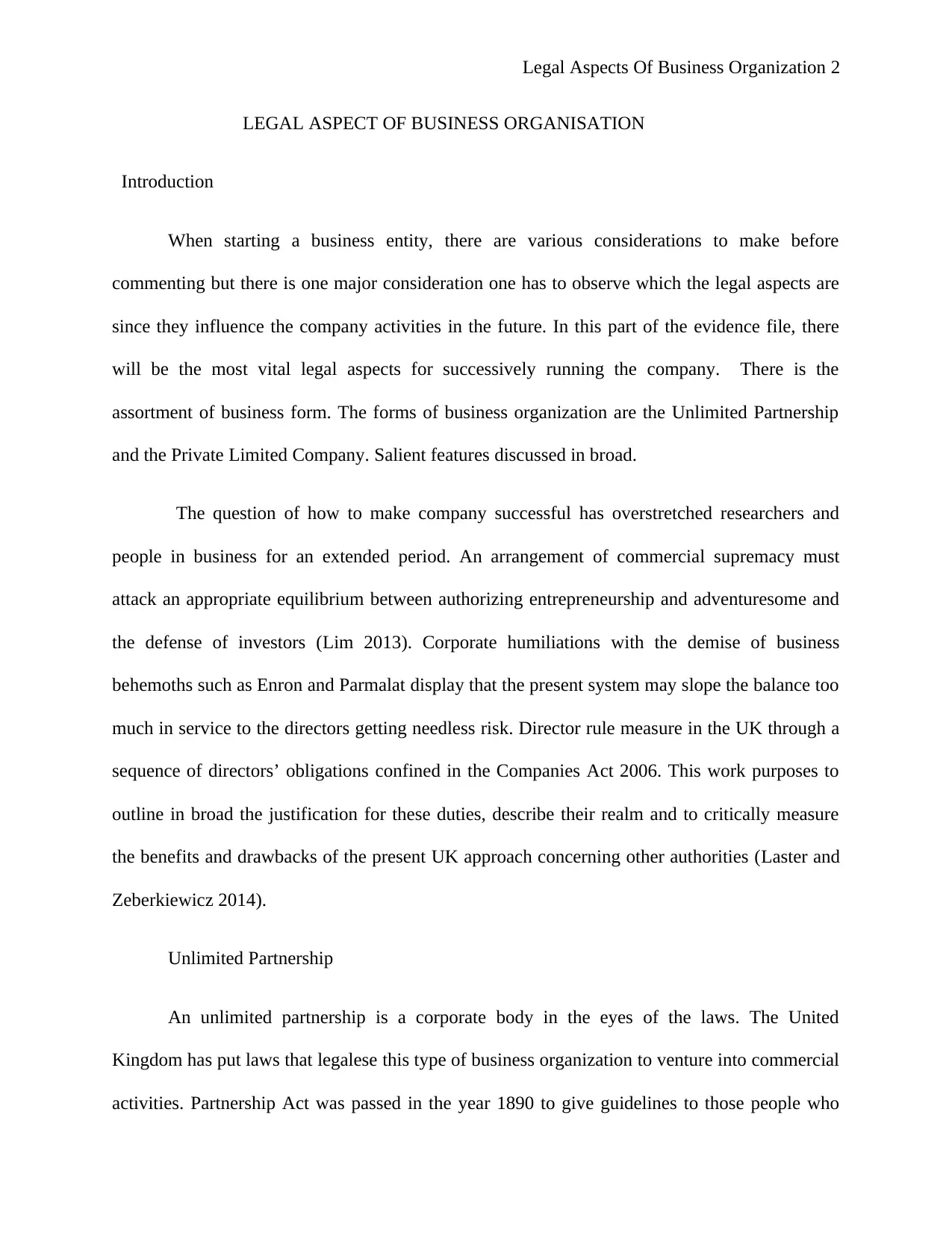
LEGAL ASPECT OF BUSINESS ORGANISATION
Introduction
When starting a business entity, there are various considerations to make before
commenting but there is one major consideration one has to observe which the legal aspects are
since they influence the company activities in the future. In this part of the evidence file, there
will be the most vital legal aspects for successively running the company. There is the
assortment of business form. The forms of business organization are the Unlimited Partnership
and the Private Limited Company. Salient features discussed in broad.
The question of how to make company successful has overstretched researchers and
people in business for an extended period. An arrangement of commercial supremacy must
attack an appropriate equilibrium between authorizing entrepreneurship and adventuresome and
the defense of investors (Lim 2013). Corporate humiliations with the demise of business
behemoths such as Enron and Parmalat display that the present system may slope the balance too
much in service to the directors getting needless risk. Director rule measure in the UK through a
sequence of directors’ obligations confined in the Companies Act 2006. This work purposes to
outline in broad the justification for these duties, describe their realm and to critically measure
the benefits and drawbacks of the present UK approach concerning other authorities (Laster and
Zeberkiewicz 2014).
Unlimited Partnership
An unlimited partnership is a corporate body in the eyes of the laws. The United
Kingdom has put laws that legalese this type of business organization to venture into commercial
activities. Partnership Act was passed in the year 1890 to give guidelines to those people who
LEGAL ASPECT OF BUSINESS ORGANISATION
Introduction
When starting a business entity, there are various considerations to make before
commenting but there is one major consideration one has to observe which the legal aspects are
since they influence the company activities in the future. In this part of the evidence file, there
will be the most vital legal aspects for successively running the company. There is the
assortment of business form. The forms of business organization are the Unlimited Partnership
and the Private Limited Company. Salient features discussed in broad.
The question of how to make company successful has overstretched researchers and
people in business for an extended period. An arrangement of commercial supremacy must
attack an appropriate equilibrium between authorizing entrepreneurship and adventuresome and
the defense of investors (Lim 2013). Corporate humiliations with the demise of business
behemoths such as Enron and Parmalat display that the present system may slope the balance too
much in service to the directors getting needless risk. Director rule measure in the UK through a
sequence of directors’ obligations confined in the Companies Act 2006. This work purposes to
outline in broad the justification for these duties, describe their realm and to critically measure
the benefits and drawbacks of the present UK approach concerning other authorities (Laster and
Zeberkiewicz 2014).
Unlimited Partnership
An unlimited partnership is a corporate body in the eyes of the laws. The United
Kingdom has put laws that legalese this type of business organization to venture into commercial
activities. Partnership Act was passed in the year 1890 to give guidelines to those people who
Legal Aspects Of Business Organization 3
would want to engage in partnership with the aim of doing business activities. (Act 2000 Section
1)
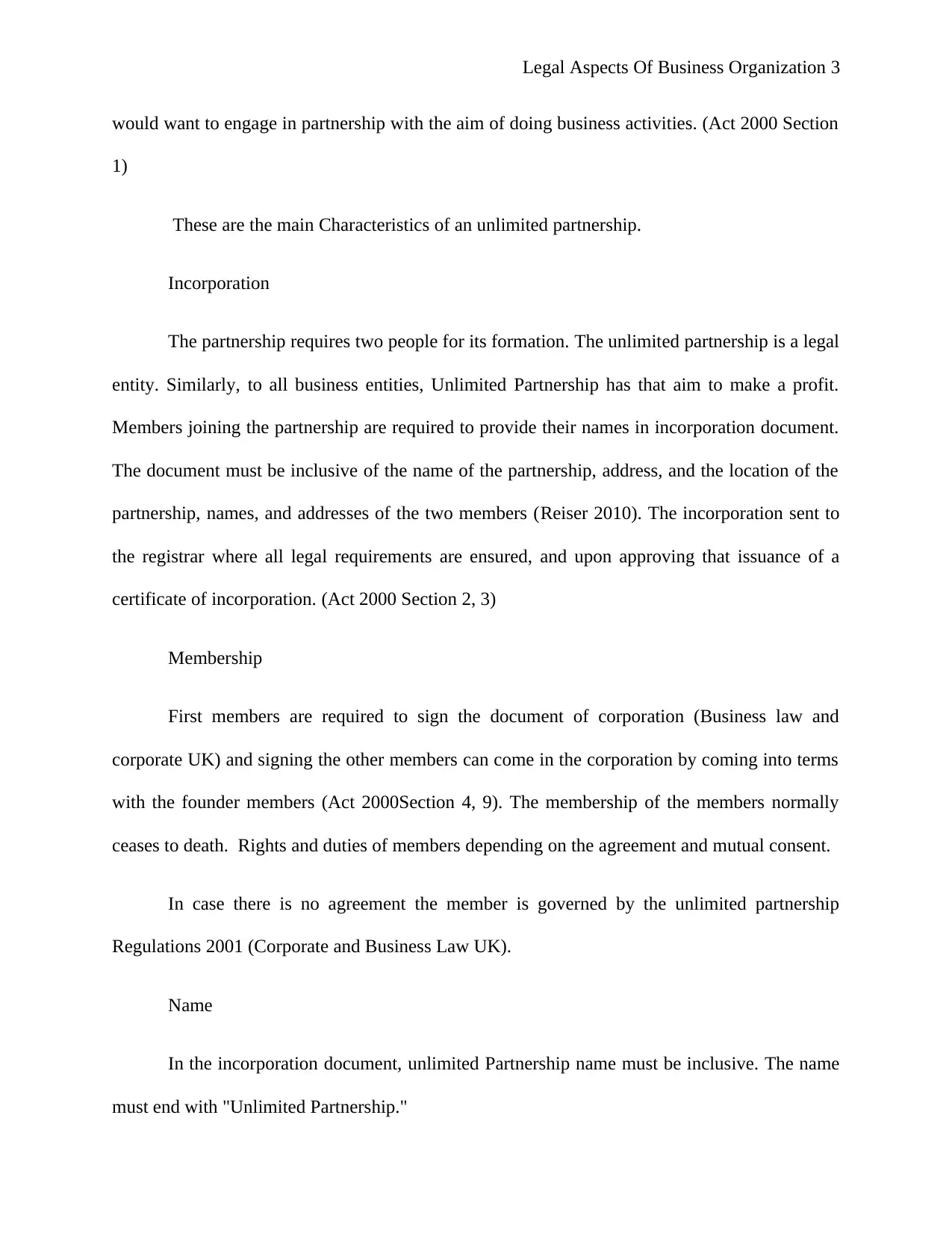
These are the main Characteristics of an unlimited partnership.
Incorporation
The partnership requires two people for its formation. The unlimited partnership is a legal
entity. Similarly, to all business entities, Unlimited Partnership has that aim to make a profit.
Members joining the partnership are required to provide their names in incorporation document.
The document must be inclusive of the name of the partnership, address, and the location of the
partnership, names, and addresses of the two members (Reiser 2010). The incorporation sent to
the registrar where all legal requirements are ensured, and upon approving that issuance of a
certificate of incorporation. (Act 2000 Section 2, 3)
Membership
First members are required to sign the document of corporation (Business law and
corporate UK) and signing the other members can come in the corporation by coming into terms
with the founder members (Act 2000Section 4, 9). The membership of the members normally
ceases to death. Rights and duties of members depending on the agreement and mutual consent.
In case there is no agreement the member is governed by the unlimited partnership
Regulations 2001 (Corporate and Business Law UK).
Name
In the incorporation document, unlimited Partnership name must be inclusive. The name
must end with "Unlimited Partnership."
would want to engage in partnership with the aim of doing business activities. (Act 2000 Section
1)
These are the main Characteristics of an unlimited partnership.
Incorporation
The partnership requires two people for its formation. The unlimited partnership is a legal
entity. Similarly, to all business entities, Unlimited Partnership has that aim to make a profit.
Members joining the partnership are required to provide their names in incorporation document.
The document must be inclusive of the name of the partnership, address, and the location of the
partnership, names, and addresses of the two members (Reiser 2010). The incorporation sent to
the registrar where all legal requirements are ensured, and upon approving that issuance of a
certificate of incorporation. (Act 2000 Section 2, 3)
Membership
First members are required to sign the document of corporation (Business law and
corporate UK) and signing the other members can come in the corporation by coming into terms
with the founder members (Act 2000Section 4, 9). The membership of the members normally
ceases to death. Rights and duties of members depending on the agreement and mutual consent.
In case there is no agreement the member is governed by the unlimited partnership
Regulations 2001 (Corporate and Business Law UK).
Name
In the incorporation document, unlimited Partnership name must be inclusive. The name
must end with "Unlimited Partnership."
⊘ This is a preview!⊘
Do you want full access?
Subscribe today to unlock all pages.

Trusted by 1+ million students worldwide
Legal Aspects Of Business Organization 4
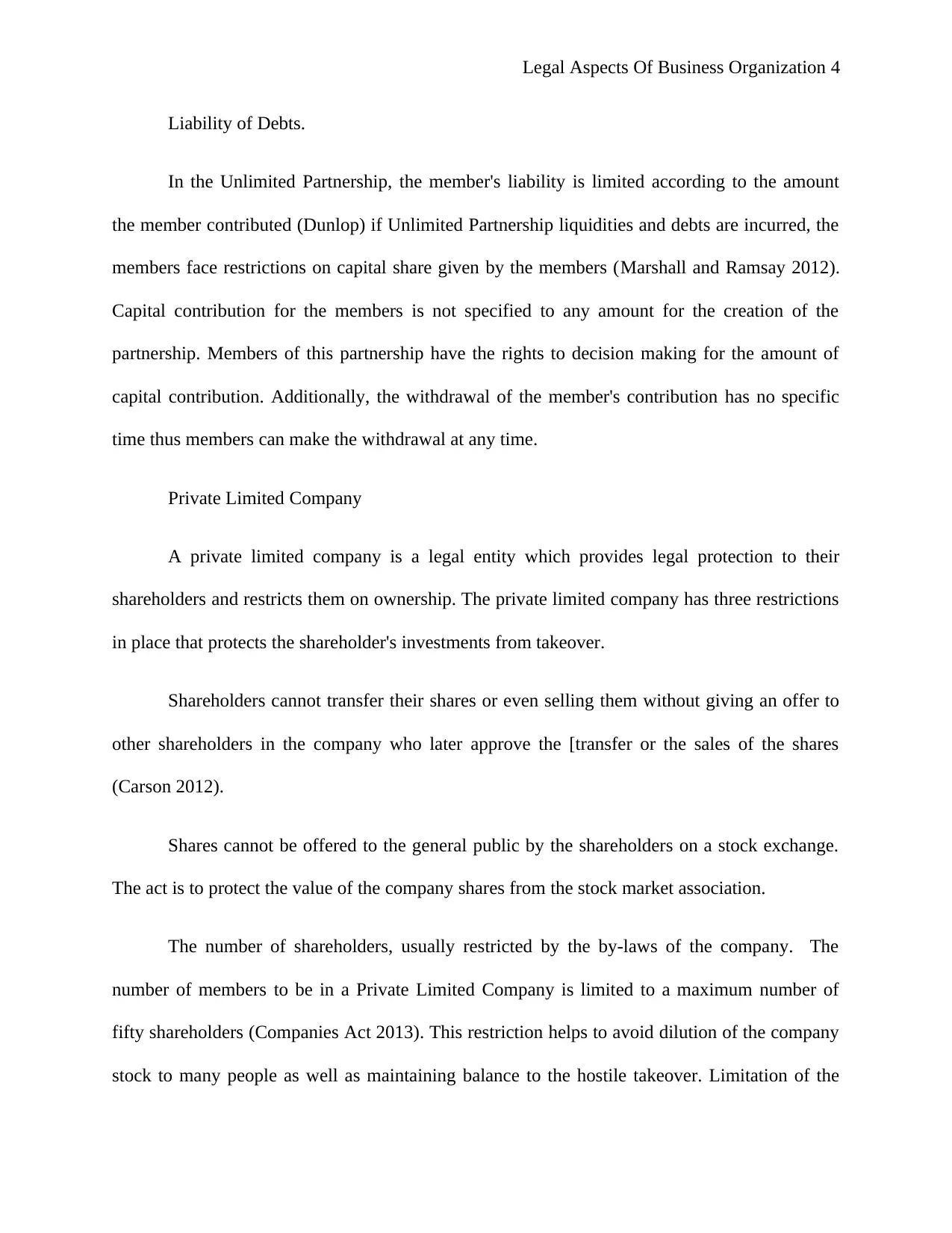
Liability of Debts.
In the Unlimited Partnership, the member's liability is limited according to the amount
the member contributed (Dunlop) if Unlimited Partnership liquidities and debts are incurred, the
members face restrictions on capital share given by the members (Marshall and Ramsay 2012).
Capital contribution for the members is not specified to any amount for the creation of the
partnership. Members of this partnership have the rights to decision making for the amount of
capital contribution. Additionally, the withdrawal of the member's contribution has no specific
time thus members can make the withdrawal at any time.
Private Limited Company
A private limited company is a legal entity which provides legal protection to their
shareholders and restricts them on ownership. The private limited company has three restrictions
in place that protects the shareholder's investments from takeover.
Shareholders cannot transfer their shares or even selling them without giving an offer to
other shareholders in the company who later approve the [transfer or the sales of the shares
(Carson 2012).
Shares cannot be offered to the general public by the shareholders on a stock exchange.
The act is to protect the value of the company shares from the stock market association.
The number of shareholders, usually restricted by the by-laws of the company. The
number of members to be in a Private Limited Company is limited to a maximum number of
fifty shareholders (Companies Act 2013). This restriction helps to avoid dilution of the company
stock to many people as well as maintaining balance to the hostile takeover. Limitation of the
Liability of Debts.
In the Unlimited Partnership, the member's liability is limited according to the amount
the member contributed (Dunlop) if Unlimited Partnership liquidities and debts are incurred, the
members face restrictions on capital share given by the members (Marshall and Ramsay 2012).
Capital contribution for the members is not specified to any amount for the creation of the
partnership. Members of this partnership have the rights to decision making for the amount of
capital contribution. Additionally, the withdrawal of the member's contribution has no specific
time thus members can make the withdrawal at any time.
Private Limited Company
A private limited company is a legal entity which provides legal protection to their
shareholders and restricts them on ownership. The private limited company has three restrictions
in place that protects the shareholder's investments from takeover.
Shareholders cannot transfer their shares or even selling them without giving an offer to
other shareholders in the company who later approve the [transfer or the sales of the shares
(Carson 2012).
Shares cannot be offered to the general public by the shareholders on a stock exchange.
The act is to protect the value of the company shares from the stock market association.
The number of shareholders, usually restricted by the by-laws of the company. The
number of members to be in a Private Limited Company is limited to a maximum number of
fifty shareholders (Companies Act 2013). This restriction helps to avoid dilution of the company
stock to many people as well as maintaining balance to the hostile takeover. Limitation of the
Paraphrase This Document
Need a fresh take? Get an instant paraphrase of this document with our AI Paraphraser
Legal Aspects Of Business Organization 5
number of the members ensures the company is manageable thus making it easier to meet the
required needs of each shareholder with less straining financially.
The liability of all members is limited thus their private assets are not subjected to risk in
the recovering of company assets due to bankruptcy, lawsuits or even losses. The insolvency of
an individual member, death or bankruptcy does not alter the existence of that particular
company since the company's presence is perpetual. A Private Limited Company is not required
to issue a business's affairs statement compared to the Public Limited Company.
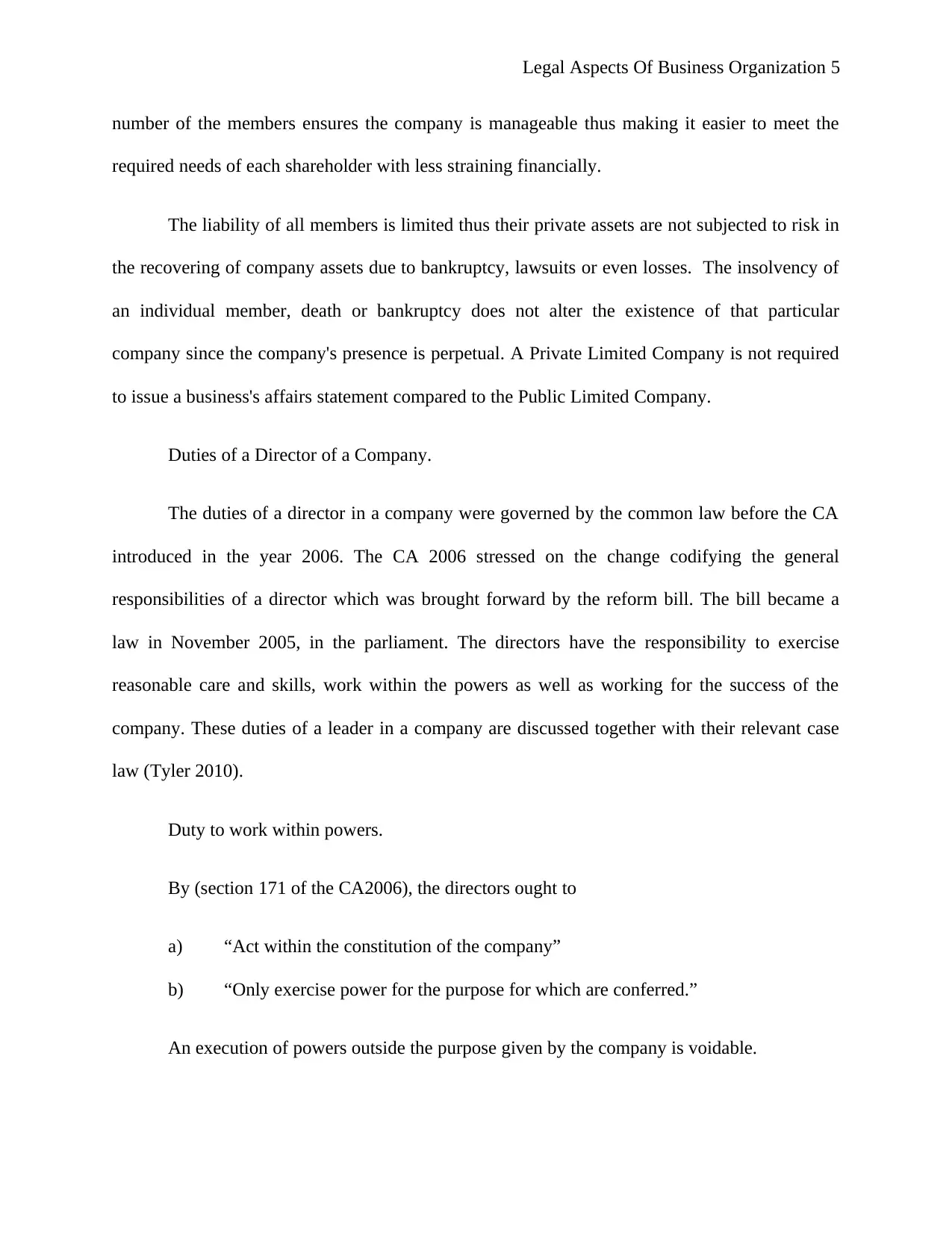
Duties of a Director of a Company.
The duties of a director in a company were governed by the common law before the CA
introduced in the year 2006. The CA 2006 stressed on the change codifying the general
responsibilities of a director which was brought forward by the reform bill. The bill became a
law in November 2005, in the parliament. The directors have the responsibility to exercise
reasonable care and skills, work within the powers as well as working for the success of the
company. These duties of a leader in a company are discussed together with their relevant case
law (Tyler 2010).
Duty to work within powers.
By (section 171 of the CA2006), the directors ought to
a) “Act within the constitution of the company”
b) “Only exercise power for the purpose for which are conferred.”
An execution of powers outside the purpose given by the company is voidable.
number of the members ensures the company is manageable thus making it easier to meet the
required needs of each shareholder with less straining financially.
The liability of all members is limited thus their private assets are not subjected to risk in
the recovering of company assets due to bankruptcy, lawsuits or even losses. The insolvency of
an individual member, death or bankruptcy does not alter the existence of that particular
company since the company's presence is perpetual. A Private Limited Company is not required
to issue a business's affairs statement compared to the Public Limited Company.
Duties of a Director of a Company.
The duties of a director in a company were governed by the common law before the CA
introduced in the year 2006. The CA 2006 stressed on the change codifying the general
responsibilities of a director which was brought forward by the reform bill. The bill became a
law in November 2005, in the parliament. The directors have the responsibility to exercise
reasonable care and skills, work within the powers as well as working for the success of the
company. These duties of a leader in a company are discussed together with their relevant case
law (Tyler 2010).
Duty to work within powers.
By (section 171 of the CA2006), the directors ought to
a) “Act within the constitution of the company”
b) “Only exercise power for the purpose for which are conferred.”
An execution of powers outside the purpose given by the company is voidable.
Legal Aspects Of Business Organization 6
Such a workout of power without following the stated manner in the business’s
constitution uses the authority for an unsuitable purpose. Those supremacies trained by the
managers' lead to the consequence. Therefore, attainment of the one or more of the outcome is a
proper drive and the outstanding regarded to an improper purpose. That is the aim that the court
is mandated to find out whether such inappropriate drive attained is the substantial aim or the
primary goal. Rendering to C.G Kilian, the correct purpose policy, frequently jumbled with
honesty (Johnson 2011). He confirms that morality is a significant condition for a correct wok.
Sincerity is not evident in the legal scheme and the motive the court attempts to emphasize on
the most exceptional interest relatively to integrity. Main aim is that executives are permitted by
regulation to a large degree to take business perils of the company for its measurement referred
to as flexible code.
Practical difficulties
In the case law, the responsibility initially established that the obligation spread over to
an extensive variety of authorities, including the authority to subject shares, the power to endorse
a dividend and the influence to deny opportunity in registering shares. It only works in the sense
that, to any authorities discussed on the managers by the stakeholders over the articles and
powers discussed on them by law (Kleinheisterkamp 2014). Inappropriately, neither the case law
nor the Act covers a general assessment to assist executives in defining the drive for which a
specific power has been approved to him. In practice, directors will not always consider it calm
to decide whether a planned workout of a rule may establish a breach of the obligation.
Such a workout of power without following the stated manner in the business’s
constitution uses the authority for an unsuitable purpose. Those supremacies trained by the
managers' lead to the consequence. Therefore, attainment of the one or more of the outcome is a
proper drive and the outstanding regarded to an improper purpose. That is the aim that the court
is mandated to find out whether such inappropriate drive attained is the substantial aim or the
primary goal. Rendering to C.G Kilian, the correct purpose policy, frequently jumbled with
honesty (Johnson 2011). He confirms that morality is a significant condition for a correct wok.
Sincerity is not evident in the legal scheme and the motive the court attempts to emphasize on
the most exceptional interest relatively to integrity. Main aim is that executives are permitted by
regulation to a large degree to take business perils of the company for its measurement referred
to as flexible code.
Practical difficulties
In the case law, the responsibility initially established that the obligation spread over to
an extensive variety of authorities, including the authority to subject shares, the power to endorse
a dividend and the influence to deny opportunity in registering shares. It only works in the sense
that, to any authorities discussed on the managers by the stakeholders over the articles and
powers discussed on them by law (Kleinheisterkamp 2014). Inappropriately, neither the case law
nor the Act covers a general assessment to assist executives in defining the drive for which a
specific power has been approved to him. In practice, directors will not always consider it calm
to decide whether a planned workout of a rule may establish a breach of the obligation.
⊘ This is a preview!⊘
Do you want full access?
Subscribe today to unlock all pages.
Trusted by 1+ million students worldwide
Legal Aspects Of Business Organization 7
Ways of lessening the risk
There is no clear trial for determining whether a planned workout is for a proper purpose.
Therefore, the manager is supposed to come up with some tips to minimize the perils that
might breach the act of section 171.
The first stage is to recall the existence of the duty. Linked to other constitutional
responsibilities, the function to work out powers for the resolutions for whose discussion
obtains slight coverage hence some managements may merely forget to reflect on it.
Directors ought to consider the phrasing of the provision which grants them the authority
in question and obeys any direct limitations on the purposes of exercising it.
It is advisable to obtain the stakeholder approval before the exercise of power planning
The managers ought to document their efforts to adhere to the responsibility. All the
decisions made and reasons behind all decision making explained in the minutes of all the
meetings held.
Duty to promote the success of the company.
The act 172 in practice sets out a framework by the law and gives direction that managers
should follow for the attainment of the goals and objectives set. The manager ought to act in
good faith in a way he/she thinks it is best to ensure the success of the company (Muchlinski
2012).
Secondly, the manager should be able to make decisions that bring benefits to the
members of the company for the success of the business. Decisions made should benefit
members as a whole in that the director cannot reflect on just some interest of particular
individuals or group (Sealy and Worthington 2013). Promotion of interest in a specific group
Ways of lessening the risk
There is no clear trial for determining whether a planned workout is for a proper purpose.
Therefore, the manager is supposed to come up with some tips to minimize the perils that
might breach the act of section 171.
The first stage is to recall the existence of the duty. Linked to other constitutional
responsibilities, the function to work out powers for the resolutions for whose discussion
obtains slight coverage hence some managements may merely forget to reflect on it.
Directors ought to consider the phrasing of the provision which grants them the authority
in question and obeys any direct limitations on the purposes of exercising it.
It is advisable to obtain the stakeholder approval before the exercise of power planning
The managers ought to document their efforts to adhere to the responsibility. All the
decisions made and reasons behind all decision making explained in the minutes of all the
meetings held.
Duty to promote the success of the company.
The act 172 in practice sets out a framework by the law and gives direction that managers
should follow for the attainment of the goals and objectives set. The manager ought to act in
good faith in a way he/she thinks it is best to ensure the success of the company (Muchlinski
2012).
Secondly, the manager should be able to make decisions that bring benefits to the
members of the company for the success of the business. Decisions made should benefit
members as a whole in that the director cannot reflect on just some interest of particular
individuals or group (Sealy and Worthington 2013). Promotion of interest in a specific group
Paraphrase This Document
Need a fresh take? Get an instant paraphrase of this document with our AI Paraphraser
Legal Aspects Of Business Organization 8
will not yield the success of a company because for a company to be termed as successful, all
members should be included (Hazen and Hazen 2011).
The formulation of the collective law responsibility to act bona fide for the benefits of the
company. This was recognized by the judiciary in RWM Langport Ltd vs. Cobden Investments
Ltd affirming that he possibly old phrase acting "bona fide in the benefits of the corporation" is
replicated in the legal words interim "in good faith in a way to promote the achievement of the
business"'. Section 172 specifies that manager ought to have respect to the interests of
shareholders such as staffs, dealers, the location, and customers when determining how best to
encourage the achievement of the company for the advantage of associates as the whole. The
intention of this change to avoid short-termism and investor wealth enlargement to stress on the
longstanding effects of results and the social accountability of the firm (Udovitch 2011).
Act in obeying the contract arrived by the firm which confines the impending workout of
will by directors or allowed in company’s structure. This has remained specified in the
descriptive note
Duty to Exercise Independent Judgement.
Section 173 of the CA 2006 delivers the responsibility that executives ought to
implement self-governing judgment. Managers should use sovereign decision to avoid breaching
of their responsibility if they take instruction or if executive of CA 2006 concerning the unit as
follows:
“The obligation organizes current code of regulation which employers must work out
their powers self-reliant, deprived of subordinating their controls to the willpower of others,
whether by designation or else (unless sanctioned by or under the law to do so)."
will not yield the success of a company because for a company to be termed as successful, all
members should be included (Hazen and Hazen 2011).
The formulation of the collective law responsibility to act bona fide for the benefits of the
company. This was recognized by the judiciary in RWM Langport Ltd vs. Cobden Investments
Ltd affirming that he possibly old phrase acting "bona fide in the benefits of the corporation" is
replicated in the legal words interim "in good faith in a way to promote the achievement of the
business"'. Section 172 specifies that manager ought to have respect to the interests of
shareholders such as staffs, dealers, the location, and customers when determining how best to
encourage the achievement of the company for the advantage of associates as the whole. The
intention of this change to avoid short-termism and investor wealth enlargement to stress on the
longstanding effects of results and the social accountability of the firm (Udovitch 2011).
Act in obeying the contract arrived by the firm which confines the impending workout of
will by directors or allowed in company’s structure. This has remained specified in the
descriptive note
Duty to Exercise Independent Judgement.
Section 173 of the CA 2006 delivers the responsibility that executives ought to
implement self-governing judgment. Managers should use sovereign decision to avoid breaching
of their responsibility if they take instruction or if executive of CA 2006 concerning the unit as
follows:
“The obligation organizes current code of regulation which employers must work out
their powers self-reliant, deprived of subordinating their controls to the willpower of others,
whether by designation or else (unless sanctioned by or under the law to do so)."
Legal Aspects Of Business Organization 9
This duty is evident in that case of Re Englefield Colliery; a manager held answerable
and had make a payment the company their cash back. In exercise of independent judgment
lately, case of the international Pl vs. Crowther Group Plc, the law court demanded the directors
to make a decision on the inclusive of attention of business and must act accordingly to what
they believe is decent for that particular company.
Binding to the executives’ pleasure to ensure that he is convincingly doing his
managerial job by his occupation agreement that he cannot alter those conclusions which are
conflicting to the interest of the company (Friedman 2011).
In Conclusion
The Act 2006 of the company has presented a planned-on tasks for the organizations of
the company. The panels have persuaded responsibilities to the firm and stockholders as they
plan. A firm has additional powers to make the director responsible for being undutiful and for
the waste of control discussed by CA 2006. Managers have the responsibility to work hard and
excel in their managerial power and work out reasonable skill as it is predictable from them. The
managers are answerable to creditors in the firm in the case of the liquidation of the organization.
Lately, it is anticipated more than before by directors of a particular firm to perform in good faith
in bettering the interest of the company.
This duty is evident in that case of Re Englefield Colliery; a manager held answerable
and had make a payment the company their cash back. In exercise of independent judgment
lately, case of the international Pl vs. Crowther Group Plc, the law court demanded the directors
to make a decision on the inclusive of attention of business and must act accordingly to what
they believe is decent for that particular company.
Binding to the executives’ pleasure to ensure that he is convincingly doing his
managerial job by his occupation agreement that he cannot alter those conclusions which are
conflicting to the interest of the company (Friedman 2011).
In Conclusion
The Act 2006 of the company has presented a planned-on tasks for the organizations of
the company. The panels have persuaded responsibilities to the firm and stockholders as they
plan. A firm has additional powers to make the director responsible for being undutiful and for
the waste of control discussed by CA 2006. Managers have the responsibility to work hard and
excel in their managerial power and work out reasonable skill as it is predictable from them. The
managers are answerable to creditors in the firm in the case of the liquidation of the organization.
Lately, it is anticipated more than before by directors of a particular firm to perform in good faith
in bettering the interest of the company.
⊘ This is a preview!⊘
Do you want full access?
Subscribe today to unlock all pages.
Trusted by 1+ million students worldwide
Legal Aspects Of Business Organization 10
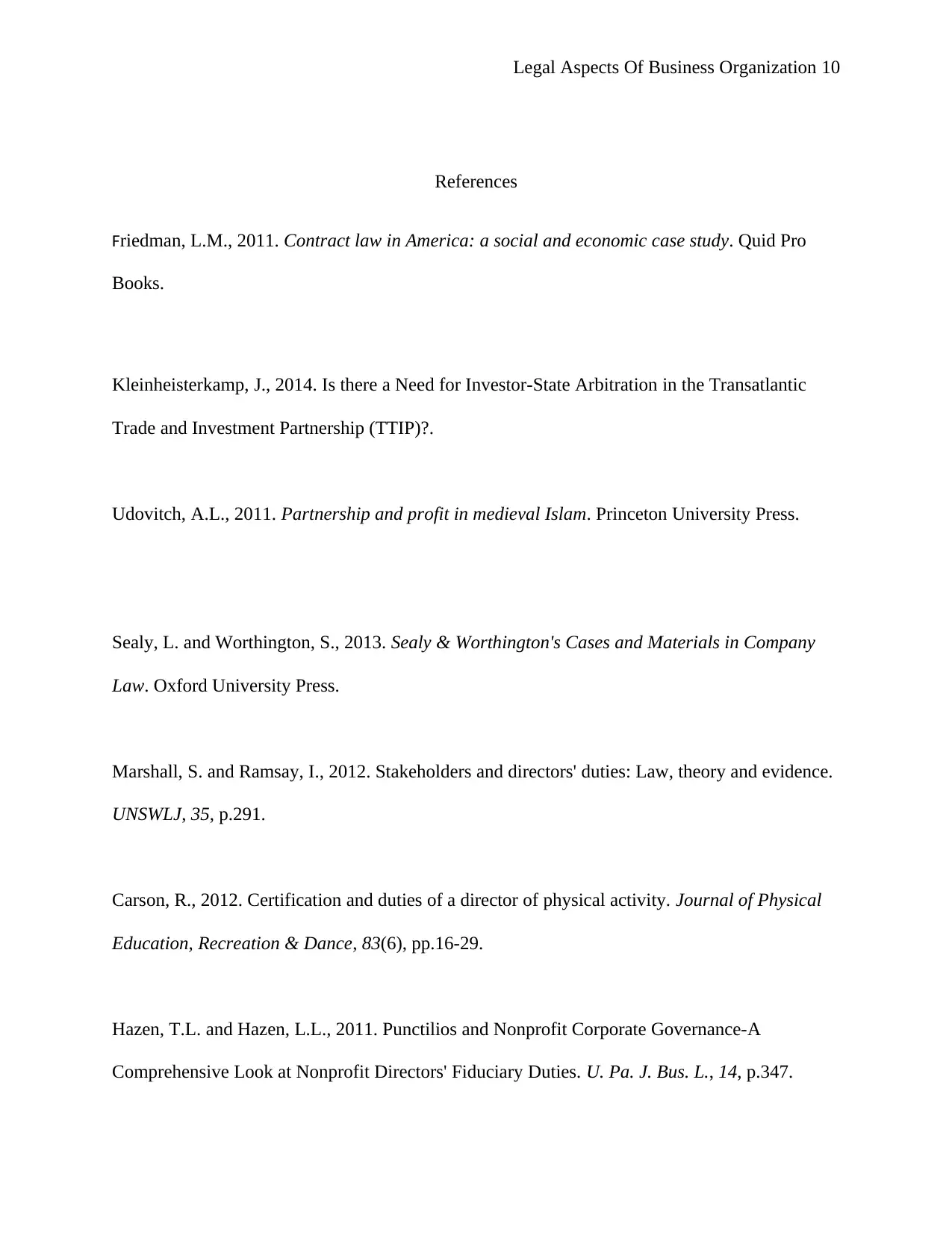
References
Friedman, L.M., 2011. Contract law in America: a social and economic case study. Quid Pro
Books.
Kleinheisterkamp, J., 2014. Is there a Need for Investor-State Arbitration in the Transatlantic
Trade and Investment Partnership (TTIP)?.
Udovitch, A.L., 2011. Partnership and profit in medieval Islam. Princeton University Press.
Sealy, L. and Worthington, S., 2013. Sealy & Worthington's Cases and Materials in Company
Law. Oxford University Press.
Marshall, S. and Ramsay, I., 2012. Stakeholders and directors' duties: Law, theory and evidence.
UNSWLJ, 35, p.291.
Carson, R., 2012. Certification and duties of a director of physical activity. Journal of Physical
Education, Recreation & Dance, 83(6), pp.16-29.
Hazen, T.L. and Hazen, L.L., 2011. Punctilios and Nonprofit Corporate Governance-A
Comprehensive Look at Nonprofit Directors' Fiduciary Duties. U. Pa. J. Bus. L., 14, p.347.
References
Friedman, L.M., 2011. Contract law in America: a social and economic case study. Quid Pro
Books.
Kleinheisterkamp, J., 2014. Is there a Need for Investor-State Arbitration in the Transatlantic
Trade and Investment Partnership (TTIP)?.
Udovitch, A.L., 2011. Partnership and profit in medieval Islam. Princeton University Press.
Sealy, L. and Worthington, S., 2013. Sealy & Worthington's Cases and Materials in Company
Law. Oxford University Press.
Marshall, S. and Ramsay, I., 2012. Stakeholders and directors' duties: Law, theory and evidence.
UNSWLJ, 35, p.291.
Carson, R., 2012. Certification and duties of a director of physical activity. Journal of Physical
Education, Recreation & Dance, 83(6), pp.16-29.
Hazen, T.L. and Hazen, L.L., 2011. Punctilios and Nonprofit Corporate Governance-A
Comprehensive Look at Nonprofit Directors' Fiduciary Duties. U. Pa. J. Bus. L., 14, p.347.
Paraphrase This Document
Need a fresh take? Get an instant paraphrase of this document with our AI Paraphraser
Legal Aspects Of Business Organization 11
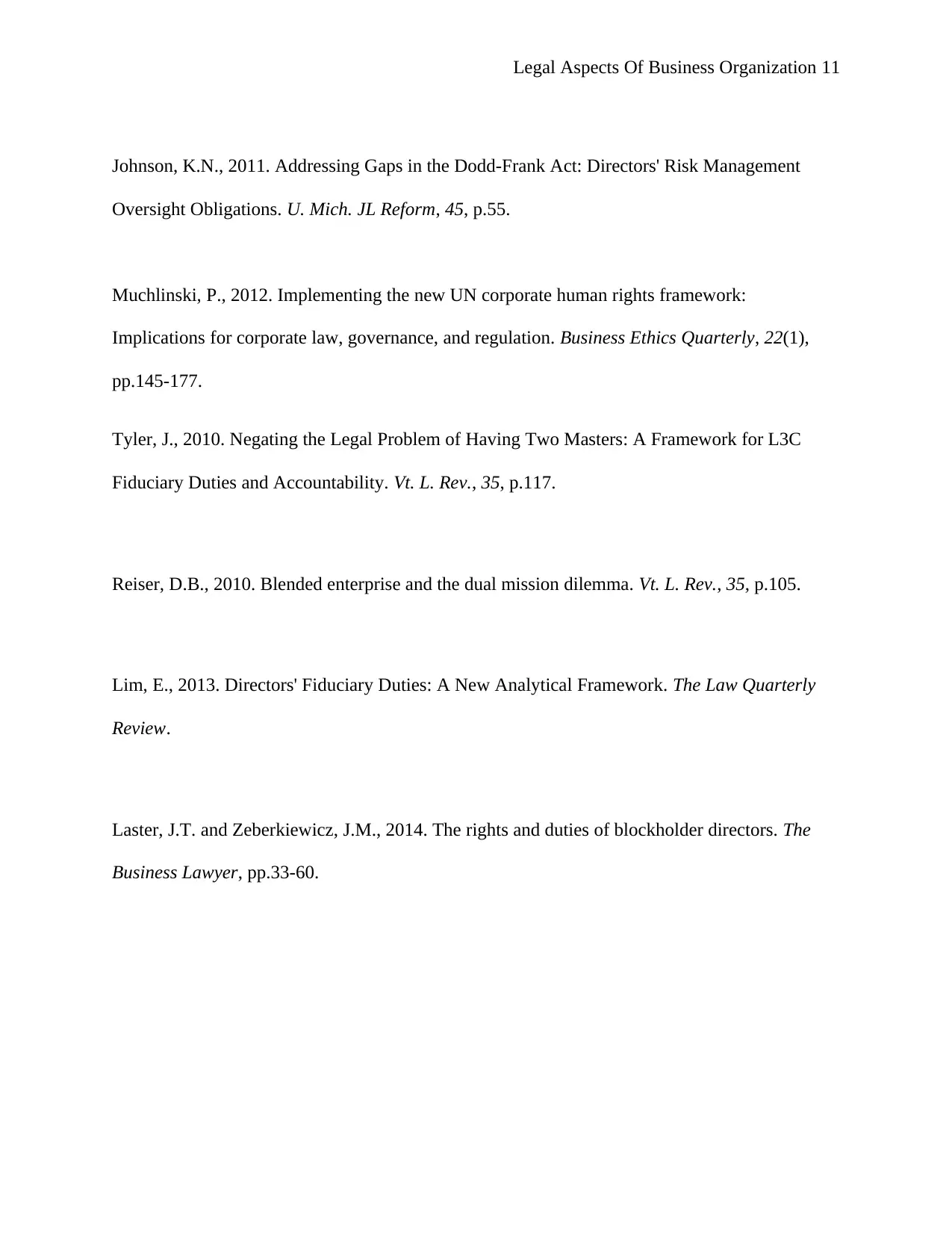
Johnson, K.N., 2011. Addressing Gaps in the Dodd-Frank Act: Directors' Risk Management
Oversight Obligations. U. Mich. JL Reform, 45, p.55.
Muchlinski, P., 2012. Implementing the new UN corporate human rights framework:
Implications for corporate law, governance, and regulation. Business Ethics Quarterly, 22(1),
pp.145-177.
Tyler, J., 2010. Negating the Legal Problem of Having Two Masters: A Framework for L3C
Fiduciary Duties and Accountability. Vt. L. Rev., 35, p.117.
Reiser, D.B., 2010. Blended enterprise and the dual mission dilemma. Vt. L. Rev., 35, p.105.
Lim, E., 2013. Directors' Fiduciary Duties: A New Analytical Framework. The Law Quarterly
Review.
Laster, J.T. and Zeberkiewicz, J.M., 2014. The rights and duties of blockholder directors. The
Business Lawyer, pp.33-60.
Johnson, K.N., 2011. Addressing Gaps in the Dodd-Frank Act: Directors' Risk Management
Oversight Obligations. U. Mich. JL Reform, 45, p.55.
Muchlinski, P., 2012. Implementing the new UN corporate human rights framework:
Implications for corporate law, governance, and regulation. Business Ethics Quarterly, 22(1),
pp.145-177.
Tyler, J., 2010. Negating the Legal Problem of Having Two Masters: A Framework for L3C
Fiduciary Duties and Accountability. Vt. L. Rev., 35, p.117.
Reiser, D.B., 2010. Blended enterprise and the dual mission dilemma. Vt. L. Rev., 35, p.105.
Lim, E., 2013. Directors' Fiduciary Duties: A New Analytical Framework. The Law Quarterly
Review.
Laster, J.T. and Zeberkiewicz, J.M., 2014. The rights and duties of blockholder directors. The
Business Lawyer, pp.33-60.

1 out of 11


Related Documents


Your All-in-One AI-Powered Toolkit for Academic Success.
+13062052269
info@desklib.com
Available 24*7 on WhatsApp / Email
![[object Object]](/_next/static/media/star-bottom.7253800d.svg)
Unlock your academic potential
Copyright © 2020–2026 A2Z Services. All Rights Reserved. Developed and managed by ZUCOL.