Legal Case Study Solutions
VerifiedAdded on 2019/10/01
|4
|1668
|282
Homework Assignment
AI Summary
This document provides solutions to a series of legal case studies covering various aspects of law, including inheritance law (per capita vs. per stripes distribution), contract law (minors' contracts, offer and acceptance), surety and guarantee, tax law (FICA tax calculation), corporate law (prospectus misstatements), and bankruptcy law (asset distribution in Chapter 7 bankruptcy). Each question presents a scenario and requires the application of relevant legal principles and case precedents to arrive at a solution. The solutions demonstrate a thorough understanding of the legal concepts involved and cite relevant statutes and case laws from the Indian legal system. The document also includes a list of references to the legal sources used in formulating the answers.
QUESTION 1.
Per Capita and Per Stripes Distribution
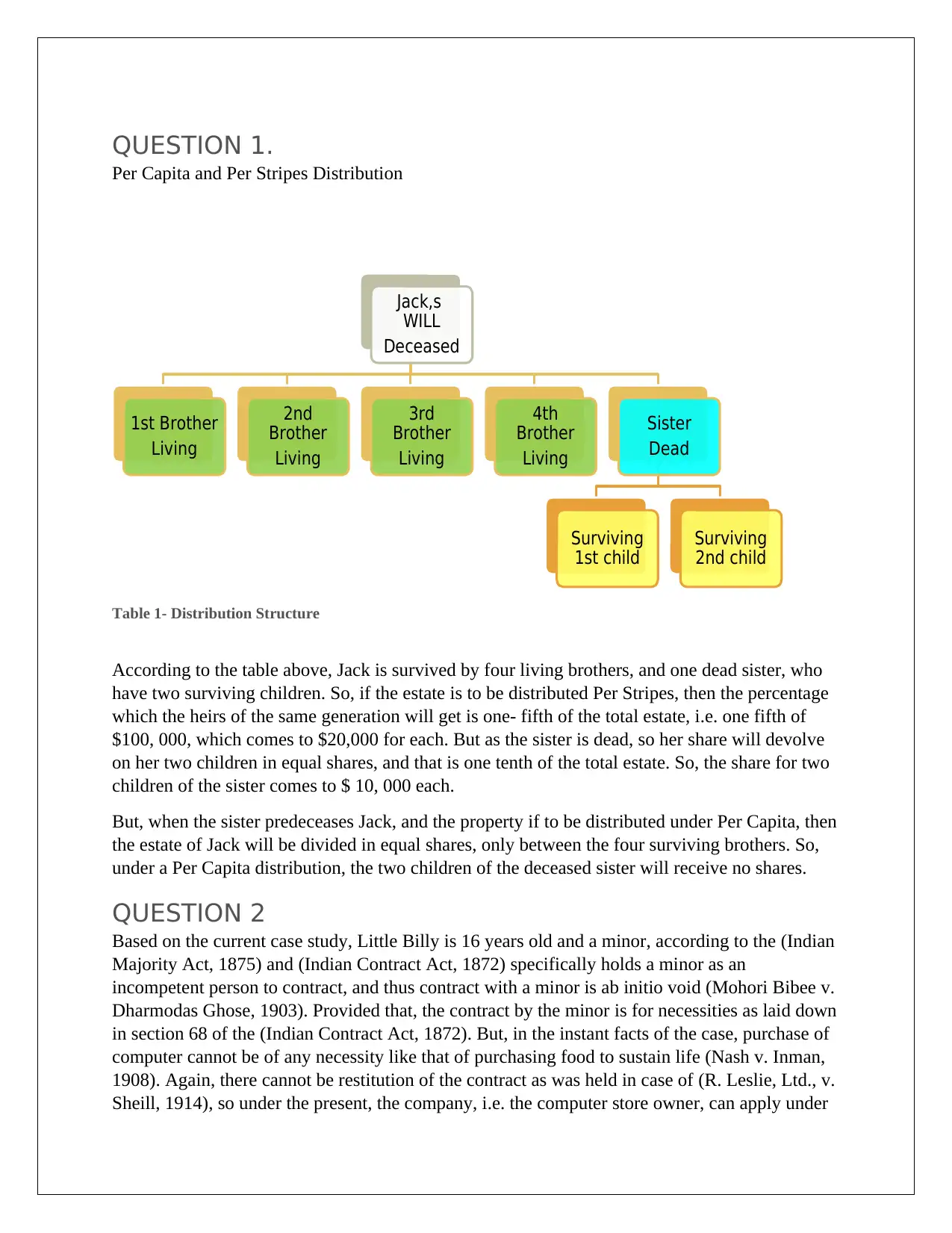
Table 1- Distribution Structure
According to the table above, Jack is survived by four living brothers, and one dead sister, who
have two surviving children. So, if the estate is to be distributed Per Stripes, then the percentage
which the heirs of the same generation will get is one- fifth of the total estate, i.e. one fifth of
$100, 000, which comes to $20,000 for each. But as the sister is dead, so her share will devolve
on her two children in equal shares, and that is one tenth of the total estate. So, the share for two
children of the sister comes to $ 10, 000 each.
But, when the sister predeceases Jack, and the property if to be distributed under Per Capita, then
the estate of Jack will be divided in equal shares, only between the four surviving brothers. So,
under a Per Capita distribution, the two children of the deceased sister will receive no shares.
QUESTION 2
Based on the current case study, Little Billy is 16 years old and a minor, according to the (Indian
Majority Act, 1875) and (Indian Contract Act, 1872) specifically holds a minor as an
incompetent person to contract, and thus contract with a minor is ab initio void (Mohori Bibee v.
Dharmodas Ghose, 1903). Provided that, the contract by the minor is for necessities as laid down
in section 68 of the (Indian Contract Act, 1872). But, in the instant facts of the case, purchase of
computer cannot be of any necessity like that of purchasing food to sustain life (Nash v. Inman,
1908). Again, there cannot be restitution of the contract as was held in case of (R. Leslie, Ltd., v.
Sheill, 1914), so under the present, the company, i.e. the computer store owner, can apply under
Jack,s
WILL
Deceased
1st Brother
Living
2nd
Brother
Living
3rd
Brother
Living
4th
Brother
Living
Sister
Dead
Surviving
1st child
Surviving
2nd child
Per Capita and Per Stripes Distribution
Table 1- Distribution Structure
According to the table above, Jack is survived by four living brothers, and one dead sister, who
have two surviving children. So, if the estate is to be distributed Per Stripes, then the percentage
which the heirs of the same generation will get is one- fifth of the total estate, i.e. one fifth of
$100, 000, which comes to $20,000 for each. But as the sister is dead, so her share will devolve
on her two children in equal shares, and that is one tenth of the total estate. So, the share for two
children of the sister comes to $ 10, 000 each.
But, when the sister predeceases Jack, and the property if to be distributed under Per Capita, then
the estate of Jack will be divided in equal shares, only between the four surviving brothers. So,
under a Per Capita distribution, the two children of the deceased sister will receive no shares.
QUESTION 2
Based on the current case study, Little Billy is 16 years old and a minor, according to the (Indian
Majority Act, 1875) and (Indian Contract Act, 1872) specifically holds a minor as an
incompetent person to contract, and thus contract with a minor is ab initio void (Mohori Bibee v.
Dharmodas Ghose, 1903). Provided that, the contract by the minor is for necessities as laid down
in section 68 of the (Indian Contract Act, 1872). But, in the instant facts of the case, purchase of
computer cannot be of any necessity like that of purchasing food to sustain life (Nash v. Inman,
1908). Again, there cannot be restitution of the contract as was held in case of (R. Leslie, Ltd., v.
Sheill, 1914), so under the present, the company, i.e. the computer store owner, can apply under
Jack,s
WILL
Deceased
1st Brother
Living
2nd
Brother
Living
3rd
Brother
Living
4th
Brother
Living
Sister
Dead
Surviving
1st child
Surviving
2nd child

Paraphrase This Document
Need a fresh take? Get an instant paraphrase of this document with our AI Paraphraser
section 33 of the (The Specific Relief Act, 1963), after registering the contract with the minor as
void, provided that, the computer owner store must have no prior knowledge about the minority
age of the Little Billy.
QUESTION 3
A. Offer
B. Counter offer
C. Counter offer
D. Acceptance
E. Statement D is an acceptance to the offer made in Statement C, so only these two
statements have the force to turn the statements in to a valid contract. Since the offer
becomes accepted and thus can be turned in to contract. In order to be a valid contract,
there are certain ingredients which need to be fulfilled. There must be an offer by the
promisor, followed by acceptance in totality by the promisee, which must be
unambiguous and also communicated to the offeror was held in case of (Bank of India
Ltd. Vs. Rustom Cowasjee, 1955) and also in (Lalman Shukla v. Gauri Datt , 1913),
along with a lawful consideration which moves from the promisee to the promisor
(Chinnaya vs Ramaya. , 1882) was held in case of (Newar Marble Industries Pvt. Ltd. Vs.
Rajasthan State Electricity Board, Jaipur, 1993). But, most importantly, the consent to
contract must be free and without any fraud or undue influence or misrepresentation, and
there must be an intention to create legal relation (Rose & Frank Co v JR Crompton &
Bros Ltd , 1924).
QUESTION 4
A. Arthur Apple, is secondarily liable since he is a guarantor.
B. Patty Pear, is primarily liable since he is the surety.
C. Surety is the one who under the original contract along with the principal signs the
agreement, and hence is bound by the contract just like the principal debtor. So, basically
surety is equally liable just like the principal debtor. On the other hand, a guarantor signs
only a separate undertaking where the principal does not join. So, liability of the surety is
much more stringent than that of the guarantor and so, the security of the guarantor is
collateral whereas the security of the surety is direct. So, if this definition is made
applicable to the present facts of the case, then Big Bank for collecting the loan amount,
must first approach Patty Pear, and only failure on their part, Arthur Apple can be
approached by the Big Bank, in the same line as was held in case of (Amulya Lal
Chowdhury vs Tripura Industrial Development , 2007).
QUESTION 5
The FICA (for Federal Insurance Contributions Act) tax is the contribution, which is made to
Social Security and also to the Medicare based on certain percentage of the salary of Lucy.
So, the calculations are as follows:
Social Security: 12.4% on the first $127,200 of wages= $ 15, 772. 80
void, provided that, the computer owner store must have no prior knowledge about the minority
age of the Little Billy.
QUESTION 3
A. Offer
B. Counter offer
C. Counter offer
D. Acceptance
E. Statement D is an acceptance to the offer made in Statement C, so only these two
statements have the force to turn the statements in to a valid contract. Since the offer
becomes accepted and thus can be turned in to contract. In order to be a valid contract,
there are certain ingredients which need to be fulfilled. There must be an offer by the
promisor, followed by acceptance in totality by the promisee, which must be
unambiguous and also communicated to the offeror was held in case of (Bank of India
Ltd. Vs. Rustom Cowasjee, 1955) and also in (Lalman Shukla v. Gauri Datt , 1913),
along with a lawful consideration which moves from the promisee to the promisor
(Chinnaya vs Ramaya. , 1882) was held in case of (Newar Marble Industries Pvt. Ltd. Vs.
Rajasthan State Electricity Board, Jaipur, 1993). But, most importantly, the consent to
contract must be free and without any fraud or undue influence or misrepresentation, and
there must be an intention to create legal relation (Rose & Frank Co v JR Crompton &
Bros Ltd , 1924).
QUESTION 4
A. Arthur Apple, is secondarily liable since he is a guarantor.
B. Patty Pear, is primarily liable since he is the surety.
C. Surety is the one who under the original contract along with the principal signs the
agreement, and hence is bound by the contract just like the principal debtor. So, basically
surety is equally liable just like the principal debtor. On the other hand, a guarantor signs
only a separate undertaking where the principal does not join. So, liability of the surety is
much more stringent than that of the guarantor and so, the security of the guarantor is
collateral whereas the security of the surety is direct. So, if this definition is made
applicable to the present facts of the case, then Big Bank for collecting the loan amount,
must first approach Patty Pear, and only failure on their part, Arthur Apple can be
approached by the Big Bank, in the same line as was held in case of (Amulya Lal
Chowdhury vs Tripura Industrial Development , 2007).
QUESTION 5
The FICA (for Federal Insurance Contributions Act) tax is the contribution, which is made to
Social Security and also to the Medicare based on certain percentage of the salary of Lucy.
So, the calculations are as follows:
Social Security: 12.4% on the first $127,200 of wages= $ 15, 772. 80
Medicare: 2.9% on the full wages= 8700
Total FICA: 15.3% maximum= 24, 472.80.
QUESTION 6
A. A prospectus is that document which includes the notice, or any circular, or also
advertisement and any other document with a view of inviting deposits from the general
public or rather inviting offers from them for the subscription or can also be for the
purchase of any shares in or debentures from a body corporate was held in (Pramatha
Nath Sanyal Vs. Kali Kumar Dutt , 1925). So, the prospectus must not be the one which
depicts scrupulous accuracy, (New Brunswick & Canada Railboard Co. v. New
Brunswick Ry. Co , 1924). So, in the present case study, when there is material
misstatement, then Frank can seek compensation from the company, Cannot Miss
Corporation, under Section 62 of the (Companies Act , 1956), provided that he suffers
loss due to that misstatement.
B. Indian legal system provides the investor with the recourse, if there is he loss so suffered
due to the subsequent purchase. The remedies so available are both criminal and also
civil. The civil remedy is under section 62 of the (Companies Act , 1956), whereas the
criminal liability can be imposed under section 63 of the (Companies Act , 1956). Tort
liability can also be imposed for the misstatements under (SECURITIES AND
EXCHANGE BOARD OF INDIA (PROHIBITION OF FRAUDULENT AND UNFAIR
TRADE PRACTICES RELATING TO SECURITIES MARKET) REGULATIONS,
2003), provided that the subsequent purchase was made, without being actually aware of
the misstatements so made.
QUESTION 7
A. Distribution of assets are divided in to following categories:
Secured Claims of $ 150,000 as against bank loans
Priority unsecured claims, amounting to bank personal credit for $50,000 and federal
income taxes for $ 5000.
General unsecured claims amounting to loan owed to mother for $10,000 and for VISA
credit card for the amount of $ 5000.
Domestic support obligations: Alimony Claims from former spouse, and child benefit of
$2000, respectively
B. The remaining liabilities will be discharged or not will based on the very intention of the
debtors. But, the Chapter 7 discharge is only available for those debts which accrued or
arose before the date on which the order for relief will be discharged was opined.
References
Total FICA: 15.3% maximum= 24, 472.80.
QUESTION 6
A. A prospectus is that document which includes the notice, or any circular, or also
advertisement and any other document with a view of inviting deposits from the general
public or rather inviting offers from them for the subscription or can also be for the
purchase of any shares in or debentures from a body corporate was held in (Pramatha
Nath Sanyal Vs. Kali Kumar Dutt , 1925). So, the prospectus must not be the one which
depicts scrupulous accuracy, (New Brunswick & Canada Railboard Co. v. New
Brunswick Ry. Co , 1924). So, in the present case study, when there is material
misstatement, then Frank can seek compensation from the company, Cannot Miss
Corporation, under Section 62 of the (Companies Act , 1956), provided that he suffers
loss due to that misstatement.
B. Indian legal system provides the investor with the recourse, if there is he loss so suffered
due to the subsequent purchase. The remedies so available are both criminal and also
civil. The civil remedy is under section 62 of the (Companies Act , 1956), whereas the
criminal liability can be imposed under section 63 of the (Companies Act , 1956). Tort
liability can also be imposed for the misstatements under (SECURITIES AND
EXCHANGE BOARD OF INDIA (PROHIBITION OF FRAUDULENT AND UNFAIR
TRADE PRACTICES RELATING TO SECURITIES MARKET) REGULATIONS,
2003), provided that the subsequent purchase was made, without being actually aware of
the misstatements so made.
QUESTION 7
A. Distribution of assets are divided in to following categories:
Secured Claims of $ 150,000 as against bank loans
Priority unsecured claims, amounting to bank personal credit for $50,000 and federal
income taxes for $ 5000.
General unsecured claims amounting to loan owed to mother for $10,000 and for VISA
credit card for the amount of $ 5000.
Domestic support obligations: Alimony Claims from former spouse, and child benefit of
$2000, respectively
B. The remaining liabilities will be discharged or not will based on the very intention of the
debtors. But, the Chapter 7 discharge is only available for those debts which accrued or
arose before the date on which the order for relief will be discharged was opined.
References
⊘ This is a preview!⊘
Do you want full access?
Subscribe today to unlock all pages.

Trusted by 1+ million students worldwide
Amulya Lal Chowdhury vs Tripura Industrial Development , AIR 2007 Gau 113, I (2008) BC
396, 2007 139 CompCas 594 Gauhati, (2007) 3 GLR 776, 2008 (1) GLT 137 (Gauhati
High Court 2007).
Bank of India Ltd. Vs. Rustom Cowasjee, AIR 1955 Bom. 419 at P. 430; 57 Bom. L.R. 850
(Bombay High Court 1955).
Chinnaya vs Ramaya. , (1882)4 Mad 137 (Madras High Court 1882).
Companies Act . (1956). Retrieved from
http://www.mca.gov.in/Ministry/pdf/Companies_Act_1956_13jun2011.pdf
Indian Contract Act. (1872). Retrieved from https://indiankanoon.org/doc/171398/
Indian Majority Act. (1875). Retrieved from https://indiankanoon.org/doc/80664820/
Lalman Shukla v. Gauri Datt , (1913) 11 ALJ 489 (Allahabad High Court 1913).
Mohori Bibee v. Dharmodas Ghose, (1903) 30 Cal. 539 (1903).
Nash v. Inman, [1908] 2 KB 1 (King's Bench 1908).
New Brunswick & Canada Railboard Co. v. New Brunswick Ry. Co , [1924] SCR 450 (Supreme
Court of Canada 1924).
Newar Marble Industries Pvt. Ltd. Vs. Rajasthan State Electricity Board, Jaipur, 1993 Cr. L.J.
1191 (1993).
Pramatha Nath Sanyal Vs. Kali Kumar Dutt , (1925)Cal High Court (Calcutta High Court 1925).
R. Leslie, Ltd., v. Sheill, [1914] 3 K. B. 607 (C. A.) (1914).
Rose & Frank Co v JR Crompton & Bros Ltd , [1924] UKHL 2 (UKHL 1924).
SECURITIES AND EXCHANGE BOARD OF INDIA (PROHIBITION OF FRAUDULENT AND
UNFAIR TRADE PRACTICES RELATING TO SECURITIES MARKET)
REGULATIONS. (2003). Retrieved from https://www.sebi.gov.in/acts/futpfinal.html
The Specific Relief Act. (1963). Retrieved from https://indiankanoon.org/doc/1671917/
396, 2007 139 CompCas 594 Gauhati, (2007) 3 GLR 776, 2008 (1) GLT 137 (Gauhati
High Court 2007).
Bank of India Ltd. Vs. Rustom Cowasjee, AIR 1955 Bom. 419 at P. 430; 57 Bom. L.R. 850
(Bombay High Court 1955).
Chinnaya vs Ramaya. , (1882)4 Mad 137 (Madras High Court 1882).
Companies Act . (1956). Retrieved from
http://www.mca.gov.in/Ministry/pdf/Companies_Act_1956_13jun2011.pdf
Indian Contract Act. (1872). Retrieved from https://indiankanoon.org/doc/171398/
Indian Majority Act. (1875). Retrieved from https://indiankanoon.org/doc/80664820/
Lalman Shukla v. Gauri Datt , (1913) 11 ALJ 489 (Allahabad High Court 1913).
Mohori Bibee v. Dharmodas Ghose, (1903) 30 Cal. 539 (1903).
Nash v. Inman, [1908] 2 KB 1 (King's Bench 1908).
New Brunswick & Canada Railboard Co. v. New Brunswick Ry. Co , [1924] SCR 450 (Supreme
Court of Canada 1924).
Newar Marble Industries Pvt. Ltd. Vs. Rajasthan State Electricity Board, Jaipur, 1993 Cr. L.J.
1191 (1993).
Pramatha Nath Sanyal Vs. Kali Kumar Dutt , (1925)Cal High Court (Calcutta High Court 1925).
R. Leslie, Ltd., v. Sheill, [1914] 3 K. B. 607 (C. A.) (1914).
Rose & Frank Co v JR Crompton & Bros Ltd , [1924] UKHL 2 (UKHL 1924).
SECURITIES AND EXCHANGE BOARD OF INDIA (PROHIBITION OF FRAUDULENT AND
UNFAIR TRADE PRACTICES RELATING TO SECURITIES MARKET)
REGULATIONS. (2003). Retrieved from https://www.sebi.gov.in/acts/futpfinal.html
The Specific Relief Act. (1963). Retrieved from https://indiankanoon.org/doc/1671917/

1 out of 4


Your All-in-One AI-Powered Toolkit for Academic Success.
+13062052269
info@desklib.com
Available 24*7 on WhatsApp / Email
![[object Object]](/_next/static/media/star-bottom.7253800d.svg)
Unlock your academic potential
Copyright © 2020–2026 A2Z Services. All Rights Reserved. Developed and managed by ZUCOL.