Examining Legal and Professional Issues in Contemporary Nursing
VerifiedAdded on 2023/06/12
|10
|2989
|216
Essay
AI Summary
This essay delves into the legal and professional responsibilities of nurses in addressing child abuse, domestic violence, and elder abuse. It discusses the importance of accountability, privacy, and proper reporting procedures. For child abuse, the essay emphasizes respecting the child's privacy, documenting observations, and adhering to legal reporting requirements like Chapter 261 of the Texas Family Code. Regarding domestic violence, it highlights the need for screening, providing medical care and counseling, and making appropriate referrals while respecting patient privacy. In cases of elder abuse, the essay discusses screening tools and observation techniques to identify abuse, offering legal interventions, and understanding the role of civil and criminal legislation. The essay concludes by stressing the importance of training healthcare workers to handle these sensitive situations and improve patient care, while also acknowledging potential conflicts between mandatory reporting and patient privacy.
Legal and Professional Issues in Nursing 1
LEGAL AND PROFESSIONAL ISSUES IN NURSING
by [NAME]
Course
Professor’s Name
Institution
Location of Institution
Date
LEGAL AND PROFESSIONAL ISSUES IN NURSING
by [NAME]
Course
Professor’s Name
Institution
Location of Institution
Date

Paraphrase This Document
Need a fresh take? Get an instant paraphrase of this document with our AI Paraphraser
Legal and Professional Issues in Nursing 2
Legal and Professional Issues in Nursing
Introduction
It is our responsibility as healthcare professionals to protect our patients from
dangers that they could be facing from other people within the community. Very many
individuals from children to the elderly experience harmful situations in the society and the
healthcare professionals are tasked with the duty of addressing such abuses. There are
several legal and professional issues that are addressed when these cases of abuse are
brought to the table of healthcare professionals.
Accountability has become more important in nursing than ever before for the sake
of the public, their employers, the patients, and their profession. It is therefore crucial that
the healthcare practitioners develop a more insightful understanding of the legal and
professional dilemmas that they may come across in their course of work (Schmeidel et al.
2012, p. 33). In this essay, we will talk about child abuse, domestic violence, and abuse of
the elderly. Additionally, we will discuss the professional and legal issues that are
addressed by the healthcare practitioners when people report to them that they have been
harmed. Furthermore, we will address the relevant documentation, codes, and legislation
that govern the procedures of reporting these cases of mistreatment. Finally, the essay talks
about the implications for the nurses and the delivery of care for the patient.
Child Abuse
Child abuse can be defined as actions and behaviors by an adult towards a child
that are aimed at endangering or harming the child. Legally, a child is anyone below 18
years of age. Child abuse affects children from all walks of life irrespective of race, social
class, or economic background (Cross et al. 2012, p. 211). How one responds to cases of
child abuse affects the overall experience of the child and their eventual healing. Everyone
in the society has the responsibility of reporting cases of child abuse in the first instance
when they notice anything of the sought.
Legal and Professional Issues in Nursing
Introduction
It is our responsibility as healthcare professionals to protect our patients from
dangers that they could be facing from other people within the community. Very many
individuals from children to the elderly experience harmful situations in the society and the
healthcare professionals are tasked with the duty of addressing such abuses. There are
several legal and professional issues that are addressed when these cases of abuse are
brought to the table of healthcare professionals.
Accountability has become more important in nursing than ever before for the sake
of the public, their employers, the patients, and their profession. It is therefore crucial that
the healthcare practitioners develop a more insightful understanding of the legal and
professional dilemmas that they may come across in their course of work (Schmeidel et al.
2012, p. 33). In this essay, we will talk about child abuse, domestic violence, and abuse of
the elderly. Additionally, we will discuss the professional and legal issues that are
addressed by the healthcare practitioners when people report to them that they have been
harmed. Furthermore, we will address the relevant documentation, codes, and legislation
that govern the procedures of reporting these cases of mistreatment. Finally, the essay talks
about the implications for the nurses and the delivery of care for the patient.
Child Abuse
Child abuse can be defined as actions and behaviors by an adult towards a child
that are aimed at endangering or harming the child. Legally, a child is anyone below 18
years of age. Child abuse affects children from all walks of life irrespective of race, social
class, or economic background (Cross et al. 2012, p. 211). How one responds to cases of
child abuse affects the overall experience of the child and their eventual healing. Everyone
in the society has the responsibility of reporting cases of child abuse in the first instance
when they notice anything of the sought.
Legal and Professional Issues in Nursing 3
As a healthcare professional, it is important to respect the privacy of an abused
child if such a case is brought to your attention. Respecting the privacy of an abused child
means that you will have to ask for their permission before attempting to look at any
bruises particularly if the child in question is attempting to hide the bruises (Finkelhor
2010, p. 101). Additionally, it is the presence of another responsible adult is important
when you are trying to look at the injuries. Professionally, it is essential that one reserves
their comments after assessing the bruises because it could be possible that the child’s
body bears some marks that might not have resulted from the abuse (Miller-Perrin and
Perrin 2012, p. 214). Any reasonable suspicion must be forwarded to the appropriate
authorities for further investigations.
Healthcare professionals are also required to ask the child questions with the aim of
getting simple explanations regarding any marks that may seem suspicious. The role
should not be investigating the child; instead, the healthcare practitioner should be aiming
at getting the necessary information and report your findings to the necessary authorities
(Furniss 2013, p.172). Practice professionalism as much as possible by avoiding leading
questions and instead, asking open-minded questions. It is inappropriate to pressure the
child by prompting for answers, instead let the child answer the questions on their own
convolution.
After finding all the relevant information regarding the abuse, it is important to
document your observations concerning the abuse and neglect. Note down the conversation
you had with the child in your own words (Lazenbatt, 2010). Additionally, document any
information that the child or a member of their family said to you. It is important to note
that anything you note down as having been said by the child is admissible as a piece of
evidence in investigations regarding the abuse.
It is then legally advisable to report the case of abuse to the relevant law
enforcement agency. Chapter 261 of the Texas family code demands that anyone who
believes beyond any doubt that a child has been mentally or physically has to report the
matter to the Texas Department of Protective and Regulatory Services. In fact, failing to
As a healthcare professional, it is important to respect the privacy of an abused
child if such a case is brought to your attention. Respecting the privacy of an abused child
means that you will have to ask for their permission before attempting to look at any
bruises particularly if the child in question is attempting to hide the bruises (Finkelhor
2010, p. 101). Additionally, it is the presence of another responsible adult is important
when you are trying to look at the injuries. Professionally, it is essential that one reserves
their comments after assessing the bruises because it could be possible that the child’s
body bears some marks that might not have resulted from the abuse (Miller-Perrin and
Perrin 2012, p. 214). Any reasonable suspicion must be forwarded to the appropriate
authorities for further investigations.
Healthcare professionals are also required to ask the child questions with the aim of
getting simple explanations regarding any marks that may seem suspicious. The role
should not be investigating the child; instead, the healthcare practitioner should be aiming
at getting the necessary information and report your findings to the necessary authorities
(Furniss 2013, p.172). Practice professionalism as much as possible by avoiding leading
questions and instead, asking open-minded questions. It is inappropriate to pressure the
child by prompting for answers, instead let the child answer the questions on their own
convolution.
After finding all the relevant information regarding the abuse, it is important to
document your observations concerning the abuse and neglect. Note down the conversation
you had with the child in your own words (Lazenbatt, 2010). Additionally, document any
information that the child or a member of their family said to you. It is important to note
that anything you note down as having been said by the child is admissible as a piece of
evidence in investigations regarding the abuse.
It is then legally advisable to report the case of abuse to the relevant law
enforcement agency. Chapter 261 of the Texas family code demands that anyone who
believes beyond any doubt that a child has been mentally or physically has to report the
matter to the Texas Department of Protective and Regulatory Services. In fact, failing to
⊘ This is a preview!⊘
Do you want full access?
Subscribe today to unlock all pages.

Trusted by 1+ million students worldwide
Legal and Professional Issues in Nursing 4
report an abuse is classified as class B misdemeanor that can be given a sentence of around
180 days behind bars and/or a fine in the region of $2000.
The law requires that professionals such as health practitioners who handle cases of
child abuse must report abuse within 48 hours. It is essential to provide the name of the
child and their address if possible when making a report (Cross et al. 2012, p. 213). Your
identity is protected if you report any case regarding child abuse and may only be revealed
by a court order. As highlighted in chapter 261 of the Texas Family Code, the Child
Protective Service carries out the civil investigation to determine whether the child has
been truly abused.
The major implication of this study is that the healthcare worker should be
educated to have a better understanding of how to handle victims of child abuse. The
curriculum of nursing should be modified to incorporate communication and policy skills.
This will effectively improve the delivery of patient care to all affected persons.
Domestic Violence
This is an act of a threatening behavior or abuse that occurs between adults who are
family members or intimate partners irrespective of sexuality or gender. It includes sexual,
physical, psychological, financial, and emotional abuse among others (Goodman and
Smyth 2011, p.79). Reports suggest that domestic violence is the largest contributor of
injuries to women in the United States of America (García-Moreno et al. 2015, p. 1570). It
is, however, worth noting that domestic violence is not only limited to women; men
equally experience domestic violence in addition to any other family member. The
healthcare practitioners have an ideal opportunity to address this menace of domestic
violence that has become prevalent in recent years.
The healthcare worker needs to address this issue of domestic violence with care to
ensure that the victim is comfortable to disclose what they have gone through. The primary
role of the practitioner when they come into contact with a victim of domestic violence is
to identify the presence of the abuse and manage patient care effectively (Husso et al.
report an abuse is classified as class B misdemeanor that can be given a sentence of around
180 days behind bars and/or a fine in the region of $2000.
The law requires that professionals such as health practitioners who handle cases of
child abuse must report abuse within 48 hours. It is essential to provide the name of the
child and their address if possible when making a report (Cross et al. 2012, p. 213). Your
identity is protected if you report any case regarding child abuse and may only be revealed
by a court order. As highlighted in chapter 261 of the Texas Family Code, the Child
Protective Service carries out the civil investigation to determine whether the child has
been truly abused.
The major implication of this study is that the healthcare worker should be
educated to have a better understanding of how to handle victims of child abuse. The
curriculum of nursing should be modified to incorporate communication and policy skills.
This will effectively improve the delivery of patient care to all affected persons.
Domestic Violence
This is an act of a threatening behavior or abuse that occurs between adults who are
family members or intimate partners irrespective of sexuality or gender. It includes sexual,
physical, psychological, financial, and emotional abuse among others (Goodman and
Smyth 2011, p.79). Reports suggest that domestic violence is the largest contributor of
injuries to women in the United States of America (García-Moreno et al. 2015, p. 1570). It
is, however, worth noting that domestic violence is not only limited to women; men
equally experience domestic violence in addition to any other family member. The
healthcare practitioners have an ideal opportunity to address this menace of domestic
violence that has become prevalent in recent years.
The healthcare worker needs to address this issue of domestic violence with care to
ensure that the victim is comfortable to disclose what they have gone through. The primary
role of the practitioner when they come into contact with a victim of domestic violence is
to identify the presence of the abuse and manage patient care effectively (Husso et al.
Paraphrase This Document
Need a fresh take? Get an instant paraphrase of this document with our AI Paraphraser
Legal and Professional Issues in Nursing 5
2012, p. 349). The first thing that a healthcare worker must do is to screen the patient for
abuse. Nurses and doctors are encouraged to perform routine screening on patients to
determine the presence of domestic violence.
It is also important to evaluate the medical context of the abuse. This evaluation
includes assessing the frequency and severity of the abuse and whether the medication is
being withheld from the patient among other assessments. After these evaluations, the
practitioner is required to provide the victim with medical care regarding the presented
injuries (Husso et al. 2012, p. 350). Additionally, it is essential to evaluate the victim’s
safety by asking them open-minded questions rather than leading questions. The victim
must never be coerced into answering questions that they do not feel comfortable asking.
This is to ensure comfort and trust between the patient and the healthcare worker.
The next step is to provide a counseling session to the victim concerning any
available management options and resources. The victim is advised on how he/she can
handle future abuse and any resources that can be used to manage domestic violence.
Additionally, it is important to document all the findings from your conversation and
assessment of the victim (Roberson and Wallace 2016, p. 105). As a healthcare
professional, it is advisable that you refer the victim to the most appropriate legal agency
that will help the victim.
It is important to exercise privacy during the screening process. It may even be
necessary to exclude all friends and members of the family from the screening process as
they may bias the response of the victim. Additionally, it is essential for the healthcare
professional to make the most appropriate referrals regarding the needs of the victim
(Roberson and Wallace 2016, p. 110). The victim’s needs may include legal services,
advocacy services, and medical services among others.
Healthcare practitioners required by law to report cases of domestic violence to the
appropriate law enforcement agencies. This law helps to improve the data collection on
abuse related to domestic violence and thus enhance patient care (Modi, Palmer and
2012, p. 349). The first thing that a healthcare worker must do is to screen the patient for
abuse. Nurses and doctors are encouraged to perform routine screening on patients to
determine the presence of domestic violence.
It is also important to evaluate the medical context of the abuse. This evaluation
includes assessing the frequency and severity of the abuse and whether the medication is
being withheld from the patient among other assessments. After these evaluations, the
practitioner is required to provide the victim with medical care regarding the presented
injuries (Husso et al. 2012, p. 350). Additionally, it is essential to evaluate the victim’s
safety by asking them open-minded questions rather than leading questions. The victim
must never be coerced into answering questions that they do not feel comfortable asking.
This is to ensure comfort and trust between the patient and the healthcare worker.
The next step is to provide a counseling session to the victim concerning any
available management options and resources. The victim is advised on how he/she can
handle future abuse and any resources that can be used to manage domestic violence.
Additionally, it is important to document all the findings from your conversation and
assessment of the victim (Roberson and Wallace 2016, p. 105). As a healthcare
professional, it is advisable that you refer the victim to the most appropriate legal agency
that will help the victim.
It is important to exercise privacy during the screening process. It may even be
necessary to exclude all friends and members of the family from the screening process as
they may bias the response of the victim. Additionally, it is essential for the healthcare
professional to make the most appropriate referrals regarding the needs of the victim
(Roberson and Wallace 2016, p. 110). The victim’s needs may include legal services,
advocacy services, and medical services among others.
Healthcare practitioners required by law to report cases of domestic violence to the
appropriate law enforcement agencies. This law helps to improve the data collection on
abuse related to domestic violence and thus enhance patient care (Modi, Palmer and
Legal and Professional Issues in Nursing 6
Armstrong 2014, p. 254). As a result, the perpetrators of domestic violence can be held to
account due to their actions.
The implication of this research, however, is that the healthcare workers need to be
trained adequately to give them the necessary skills required to help the patients with the
support needed to manage domestic violence. There is also an argument that the mandatory
reporting law violates the patient’s right to privacy. Other doctors have even argued that
the healthcare practitioner has no right to proceed with an investigation in situations where
the patient conceals details of domestic violence.
Abuse of the Elderly
Abuse of the elderly is mostly defined as an act of omission or commission
(Imbody, B. and Vandsburger 2011, p. 636). The abuse may be physical, emotional,
psychological and financial among others. It is important for the healthcare professional to
focus on individuals who are at a greater risk of experiencing abuse (Donovan, K. and
Regehr 2010, p. 177). Some of the groups of elders who are at greater risks of abuse
include the most dependent elders, those who are mentally incompetent, elders whose
family members engage in substance abuse and elders who have mentally ill family
members among others.
Healthcare workers can make use of screening tools, for example, the Elder Adult
Screening Test. The tool is made up of short questions that are designed to be used for the
use of mentally competent elders. These questions help to assess if the said individual
could be experiencing abuse of any kind. The design of this tool however only makes it
effective in addressing cases of abuse among the mentally competent elders and they do
not guarantee effectiveness if the elder in question is mentally challenged (Schmeidel et al.
2012, p. 27). It is, however, important to note that even the mentally incompetent
individuals possess some degree of competency in observing and reporting what they
experience. As a result, it is necessary to treat any report they may make about abuse with
the seriousness it deserves.
Armstrong 2014, p. 254). As a result, the perpetrators of domestic violence can be held to
account due to their actions.
The implication of this research, however, is that the healthcare workers need to be
trained adequately to give them the necessary skills required to help the patients with the
support needed to manage domestic violence. There is also an argument that the mandatory
reporting law violates the patient’s right to privacy. Other doctors have even argued that
the healthcare practitioner has no right to proceed with an investigation in situations where
the patient conceals details of domestic violence.
Abuse of the Elderly
Abuse of the elderly is mostly defined as an act of omission or commission
(Imbody, B. and Vandsburger 2011, p. 636). The abuse may be physical, emotional,
psychological and financial among others. It is important for the healthcare professional to
focus on individuals who are at a greater risk of experiencing abuse (Donovan, K. and
Regehr 2010, p. 177). Some of the groups of elders who are at greater risks of abuse
include the most dependent elders, those who are mentally incompetent, elders whose
family members engage in substance abuse and elders who have mentally ill family
members among others.
Healthcare workers can make use of screening tools, for example, the Elder Adult
Screening Test. The tool is made up of short questions that are designed to be used for the
use of mentally competent elders. These questions help to assess if the said individual
could be experiencing abuse of any kind. The design of this tool however only makes it
effective in addressing cases of abuse among the mentally competent elders and they do
not guarantee effectiveness if the elder in question is mentally challenged (Schmeidel et al.
2012, p. 27). It is, however, important to note that even the mentally incompetent
individuals possess some degree of competency in observing and reporting what they
experience. As a result, it is necessary to treat any report they may make about abuse with
the seriousness it deserves.
⊘ This is a preview!⊘
Do you want full access?
Subscribe today to unlock all pages.
Trusted by 1+ million students worldwide
Legal and Professional Issues in Nursing 7
Another thing that healthcare professionals can do to address issues of elder abuse
is by observing and substantiating the symptoms of abuse among elders that are suspected
to be experiencing elder abuse. Observation of the physical characteristics of the victim in
question can help to assess physical abuse (Anetzberger 2012, p. 109). Additionally,
evaluating the financial situation of the patient can help to assess the possibility of
financial abuse.
After the above assessments, the healthcare practitioner can help the victim to
access the necessary legal interventions. There are not many specific laws against adult
abuse but the present civil and criminal legislation can be used to address this issue
(Bennett and Kingston 2013, p. 111). The healthcare professional should be able to offer
the victim legal options that have referrals to appropriate legal services. The two types of
legal interventions include civil and criminal interventions. In most cases, the civil
intervention can lead to criminal intervention as is the situation with protection orders.
The protection order gives the victim a civil court order that is intended to set
conditions around the accused. In any case, the abuser breaches this order; it becomes a
criminal issue that is then addressed using a criminal court order (Schneider et al. 2010, p.
260). The victim can either apply for the related abuser or unrelated abuser which are the
two types of protection orders. These two orders fall under the Domestic and Family
Violence Protection Act of 1989.
Conclusion
It is the duty of the healthcare professional to protect the patients from risks of
harmful behavior from others and the community. There are different groups of individuals
in the community who experience different forms of abuse that range from child abuse,
domestic violence, and elder abuse. There are several procedures that the healthcare
workers follow when addressing these issues of abuse. These procedures are aimed at
providing quality care to the patients and ensuring patient safety from the abusers.
Additionally, several legislations are in place to help the victims of abuse. Several codes
and documentations protect the victims and the witnesses who choose to report cases of
Another thing that healthcare professionals can do to address issues of elder abuse
is by observing and substantiating the symptoms of abuse among elders that are suspected
to be experiencing elder abuse. Observation of the physical characteristics of the victim in
question can help to assess physical abuse (Anetzberger 2012, p. 109). Additionally,
evaluating the financial situation of the patient can help to assess the possibility of
financial abuse.
After the above assessments, the healthcare practitioner can help the victim to
access the necessary legal interventions. There are not many specific laws against adult
abuse but the present civil and criminal legislation can be used to address this issue
(Bennett and Kingston 2013, p. 111). The healthcare professional should be able to offer
the victim legal options that have referrals to appropriate legal services. The two types of
legal interventions include civil and criminal interventions. In most cases, the civil
intervention can lead to criminal intervention as is the situation with protection orders.
The protection order gives the victim a civil court order that is intended to set
conditions around the accused. In any case, the abuser breaches this order; it becomes a
criminal issue that is then addressed using a criminal court order (Schneider et al. 2010, p.
260). The victim can either apply for the related abuser or unrelated abuser which are the
two types of protection orders. These two orders fall under the Domestic and Family
Violence Protection Act of 1989.
Conclusion
It is the duty of the healthcare professional to protect the patients from risks of
harmful behavior from others and the community. There are different groups of individuals
in the community who experience different forms of abuse that range from child abuse,
domestic violence, and elder abuse. There are several procedures that the healthcare
workers follow when addressing these issues of abuse. These procedures are aimed at
providing quality care to the patients and ensuring patient safety from the abusers.
Additionally, several legislations are in place to help the victims of abuse. Several codes
and documentations protect the victims and the witnesses who choose to report cases of
Paraphrase This Document
Need a fresh take? Get an instant paraphrase of this document with our AI Paraphraser
Legal and Professional Issues in Nursing 8
abuse to the relevant authorities on behalf of the abused. The result of all these
interventions is that the patients receive quality care from the healthcare professionals.
abuse to the relevant authorities on behalf of the abused. The result of all these
interventions is that the patients receive quality care from the healthcare professionals.
Legal and Professional Issues in Nursing 9
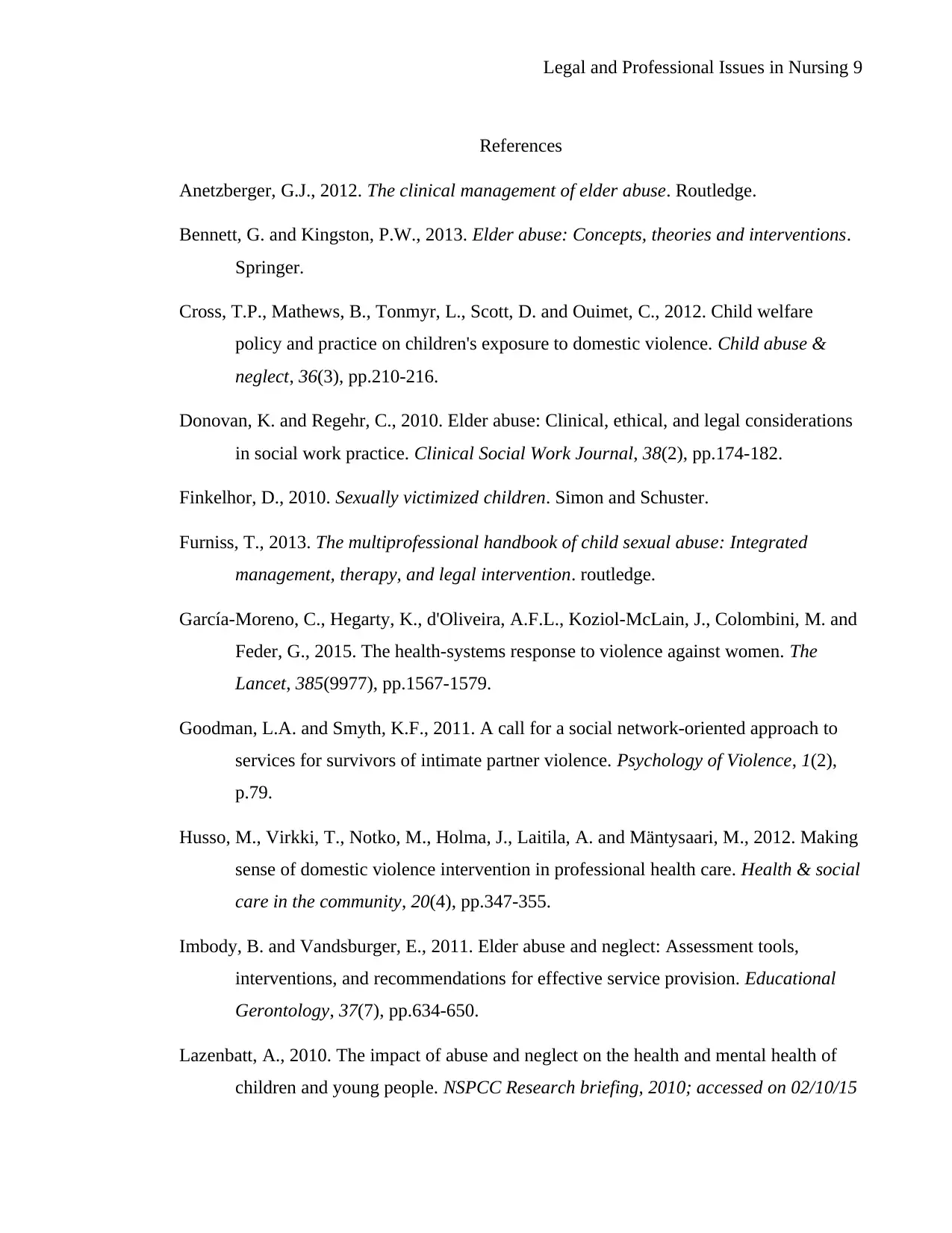
References
Anetzberger, G.J., 2012. The clinical management of elder abuse. Routledge.
Bennett, G. and Kingston, P.W., 2013. Elder abuse: Concepts, theories and interventions.
Springer.
Cross, T.P., Mathews, B., Tonmyr, L., Scott, D. and Ouimet, C., 2012. Child welfare
policy and practice on children's exposure to domestic violence. Child abuse &
neglect, 36(3), pp.210-216.
Donovan, K. and Regehr, C., 2010. Elder abuse: Clinical, ethical, and legal considerations
in social work practice. Clinical Social Work Journal, 38(2), pp.174-182.
Finkelhor, D., 2010. Sexually victimized children. Simon and Schuster.
Furniss, T., 2013. The multiprofessional handbook of child sexual abuse: Integrated
management, therapy, and legal intervention. routledge.
García-Moreno, C., Hegarty, K., d'Oliveira, A.F.L., Koziol-McLain, J., Colombini, M. and
Feder, G., 2015. The health-systems response to violence against women. The
Lancet, 385(9977), pp.1567-1579.
Goodman, L.A. and Smyth, K.F., 2011. A call for a social network-oriented approach to
services for survivors of intimate partner violence. Psychology of Violence, 1(2),
p.79.
Husso, M., Virkki, T., Notko, M., Holma, J., Laitila, A. and Mäntysaari, M., 2012. Making
sense of domestic violence intervention in professional health care. Health & social
care in the community, 20(4), pp.347-355.
Imbody, B. and Vandsburger, E., 2011. Elder abuse and neglect: Assessment tools,
interventions, and recommendations for effective service provision. Educational
Gerontology, 37(7), pp.634-650.
Lazenbatt, A., 2010. The impact of abuse and neglect on the health and mental health of
children and young people. NSPCC Research briefing, 2010; accessed on 02/10/15
References
Anetzberger, G.J., 2012. The clinical management of elder abuse. Routledge.
Bennett, G. and Kingston, P.W., 2013. Elder abuse: Concepts, theories and interventions.
Springer.
Cross, T.P., Mathews, B., Tonmyr, L., Scott, D. and Ouimet, C., 2012. Child welfare
policy and practice on children's exposure to domestic violence. Child abuse &
neglect, 36(3), pp.210-216.
Donovan, K. and Regehr, C., 2010. Elder abuse: Clinical, ethical, and legal considerations
in social work practice. Clinical Social Work Journal, 38(2), pp.174-182.
Finkelhor, D., 2010. Sexually victimized children. Simon and Schuster.
Furniss, T., 2013. The multiprofessional handbook of child sexual abuse: Integrated
management, therapy, and legal intervention. routledge.
García-Moreno, C., Hegarty, K., d'Oliveira, A.F.L., Koziol-McLain, J., Colombini, M. and
Feder, G., 2015. The health-systems response to violence against women. The
Lancet, 385(9977), pp.1567-1579.
Goodman, L.A. and Smyth, K.F., 2011. A call for a social network-oriented approach to
services for survivors of intimate partner violence. Psychology of Violence, 1(2),
p.79.
Husso, M., Virkki, T., Notko, M., Holma, J., Laitila, A. and Mäntysaari, M., 2012. Making
sense of domestic violence intervention in professional health care. Health & social
care in the community, 20(4), pp.347-355.
Imbody, B. and Vandsburger, E., 2011. Elder abuse and neglect: Assessment tools,
interventions, and recommendations for effective service provision. Educational
Gerontology, 37(7), pp.634-650.
Lazenbatt, A., 2010. The impact of abuse and neglect on the health and mental health of
children and young people. NSPCC Research briefing, 2010; accessed on 02/10/15
⊘ This is a preview!⊘
Do you want full access?
Subscribe today to unlock all pages.
Trusted by 1+ million students worldwide
Legal and Professional Issues in Nursing 10
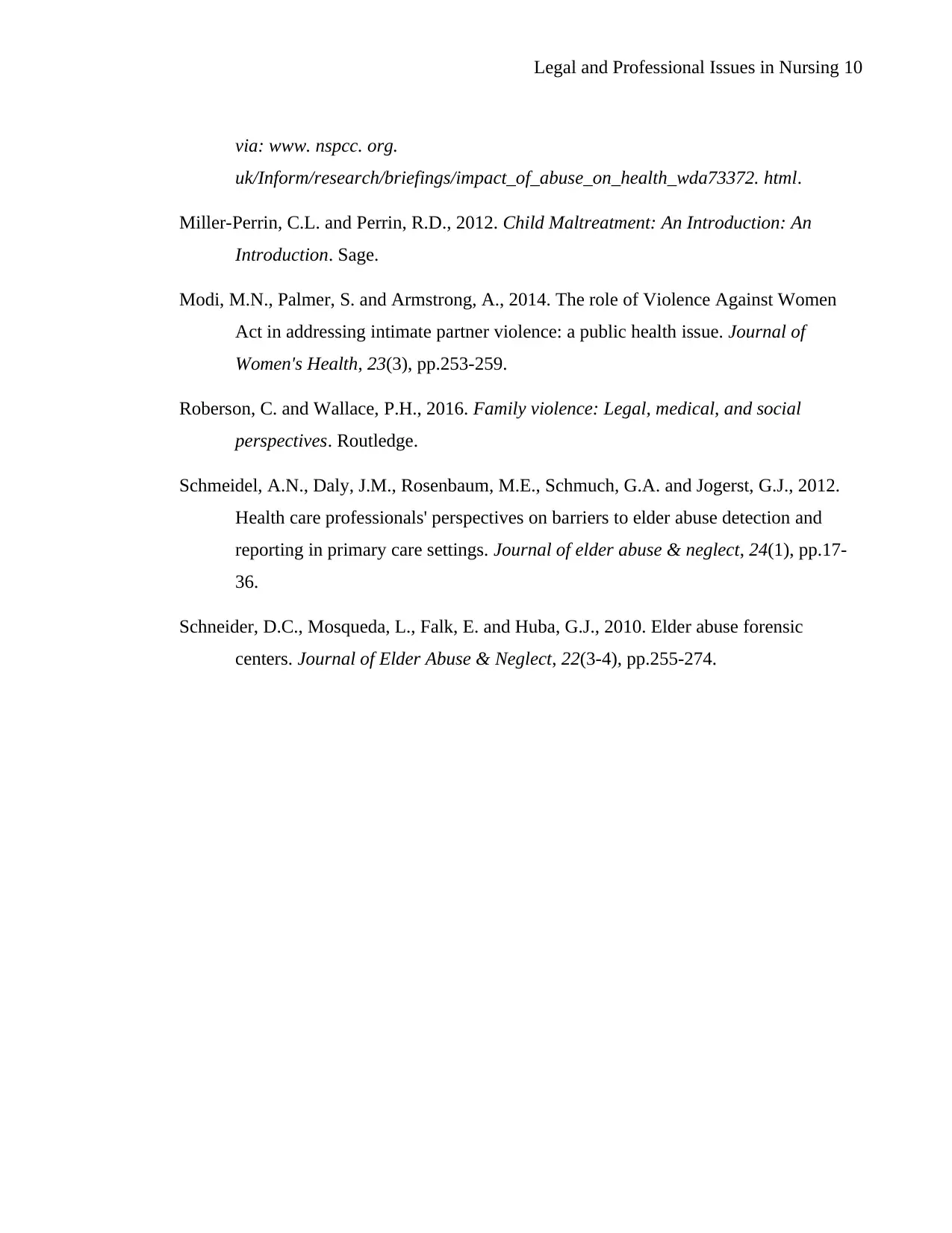
via: www. nspcc. org.
uk/Inform/research/briefings/impact_of_abuse_on_health_wda73372. html.
Miller-Perrin, C.L. and Perrin, R.D., 2012. Child Maltreatment: An Introduction: An
Introduction. Sage.
Modi, M.N., Palmer, S. and Armstrong, A., 2014. The role of Violence Against Women
Act in addressing intimate partner violence: a public health issue. Journal of
Women's Health, 23(3), pp.253-259.
Roberson, C. and Wallace, P.H., 2016. Family violence: Legal, medical, and social
perspectives. Routledge.
Schmeidel, A.N., Daly, J.M., Rosenbaum, M.E., Schmuch, G.A. and Jogerst, G.J., 2012.
Health care professionals' perspectives on barriers to elder abuse detection and
reporting in primary care settings. Journal of elder abuse & neglect, 24(1), pp.17-
36.
Schneider, D.C., Mosqueda, L., Falk, E. and Huba, G.J., 2010. Elder abuse forensic
centers. Journal of Elder Abuse & Neglect, 22(3-4), pp.255-274.
via: www. nspcc. org.
uk/Inform/research/briefings/impact_of_abuse_on_health_wda73372. html.
Miller-Perrin, C.L. and Perrin, R.D., 2012. Child Maltreatment: An Introduction: An
Introduction. Sage.
Modi, M.N., Palmer, S. and Armstrong, A., 2014. The role of Violence Against Women
Act in addressing intimate partner violence: a public health issue. Journal of
Women's Health, 23(3), pp.253-259.
Roberson, C. and Wallace, P.H., 2016. Family violence: Legal, medical, and social
perspectives. Routledge.
Schmeidel, A.N., Daly, J.M., Rosenbaum, M.E., Schmuch, G.A. and Jogerst, G.J., 2012.
Health care professionals' perspectives on barriers to elder abuse detection and
reporting in primary care settings. Journal of elder abuse & neglect, 24(1), pp.17-
36.
Schneider, D.C., Mosqueda, L., Falk, E. and Huba, G.J., 2010. Elder abuse forensic
centers. Journal of Elder Abuse & Neglect, 22(3-4), pp.255-274.

1 out of 10


Related Documents


Your All-in-One AI-Powered Toolkit for Academic Success.
+13062052269
info@desklib.com
Available 24*7 on WhatsApp / Email
![[object Object]](/_next/static/media/star-bottom.7253800d.svg)
Unlock your academic potential
Copyright © 2020–2026 A2Z Services. All Rights Reserved. Developed and managed by ZUCOL.