Business Health Check: Legislation, Ethics in Travel and Tourism
VerifiedAdded on 2020/06/03
|22
|7270
|1329
Report
AI Summary
This report provides a comprehensive analysis of the legal and regulatory framework governing the travel and tourism sector, encompassing surface, sea, and air transport laws. It explores legislation related to health, safety, and security, including the impact of these principles and legislation concerning equality. The report delves into consumer protection legislation, focusing on contract law and consumer rights within the industry. It examines the role of business ethics, ethical dilemmas, and corporate social responsibility, using the Hilton Hotel as a case study. Furthermore, the report assesses the Hilton Hotel's objectives, impacting factors, and potential improvements, culminating in a plan for skill development among management and staff. The report offers recommendations to facilitate further development and improvement within the travel and tourism sector, supported by cited references.
LEGISLATION, ETHICS,
BUSINESS HEALTH
CHECK IN TRAVEL AND
TOURISM SECTOR
BUSINESS HEALTH
CHECK IN TRAVEL AND
TOURISM SECTOR

Paraphrase This Document
Need a fresh take? Get an instant paraphrase of this document with our AI Paraphraser
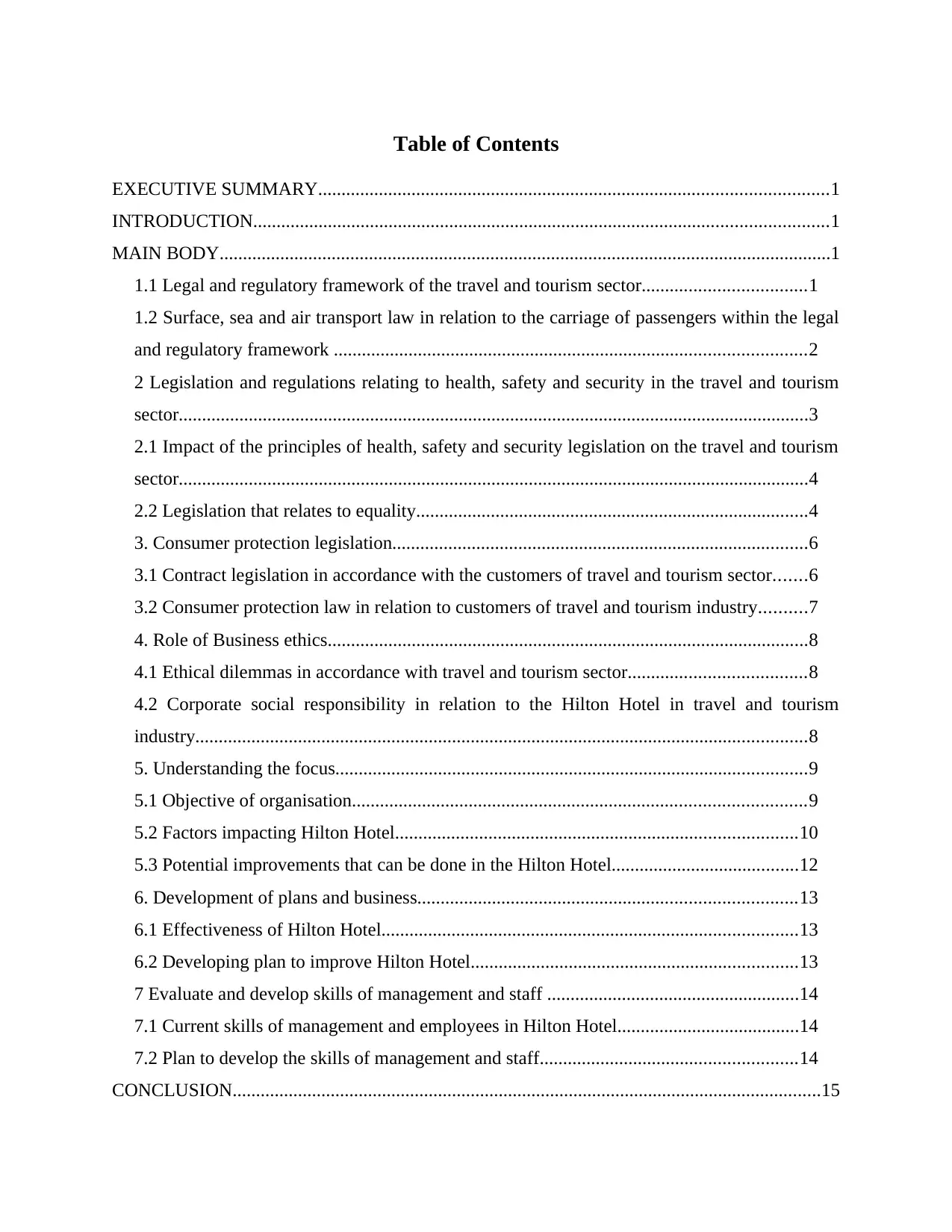
Table of Contents
EXECUTIVE SUMMARY.............................................................................................................1
INTRODUCTION...........................................................................................................................1
MAIN BODY...................................................................................................................................1
1.1 Legal and regulatory framework of the travel and tourism sector...................................1
1.2 Surface, sea and air transport law in relation to the carriage of passengers within the legal
and regulatory framework .....................................................................................................2
2 Legislation and regulations relating to health, safety and security in the travel and tourism
sector.......................................................................................................................................3
2.1 Impact of the principles of health, safety and security legislation on the travel and tourism
sector.......................................................................................................................................4
2.2 Legislation that relates to equality....................................................................................4
3. Consumer protection legislation.........................................................................................6
3.1 Contract legislation in accordance with the customers of travel and tourism sector.......6
3.2 Consumer protection law in relation to customers of travel and tourism industry..........7
4. Role of Business ethics.......................................................................................................8
4.1 Ethical dilemmas in accordance with travel and tourism sector......................................8
4.2 Corporate social responsibility in relation to the Hilton Hotel in travel and tourism
industry...................................................................................................................................8
5. Understanding the focus.....................................................................................................9
5.1 Objective of organisation.................................................................................................9
5.2 Factors impacting Hilton Hotel......................................................................................10
5.3 Potential improvements that can be done in the Hilton Hotel........................................12
6. Development of plans and business.................................................................................13
6.1 Effectiveness of Hilton Hotel.........................................................................................13
6.2 Developing plan to improve Hilton Hotel......................................................................13
7 Evaluate and develop skills of management and staff ......................................................14
7.1 Current skills of management and employees in Hilton Hotel.......................................14
7.2 Plan to develop the skills of management and staff.......................................................14
CONCLUSION..............................................................................................................................15
EXECUTIVE SUMMARY.............................................................................................................1
INTRODUCTION...........................................................................................................................1
MAIN BODY...................................................................................................................................1
1.1 Legal and regulatory framework of the travel and tourism sector...................................1
1.2 Surface, sea and air transport law in relation to the carriage of passengers within the legal
and regulatory framework .....................................................................................................2
2 Legislation and regulations relating to health, safety and security in the travel and tourism
sector.......................................................................................................................................3
2.1 Impact of the principles of health, safety and security legislation on the travel and tourism
sector.......................................................................................................................................4
2.2 Legislation that relates to equality....................................................................................4
3. Consumer protection legislation.........................................................................................6
3.1 Contract legislation in accordance with the customers of travel and tourism sector.......6
3.2 Consumer protection law in relation to customers of travel and tourism industry..........7
4. Role of Business ethics.......................................................................................................8
4.1 Ethical dilemmas in accordance with travel and tourism sector......................................8
4.2 Corporate social responsibility in relation to the Hilton Hotel in travel and tourism
industry...................................................................................................................................8
5. Understanding the focus.....................................................................................................9
5.1 Objective of organisation.................................................................................................9
5.2 Factors impacting Hilton Hotel......................................................................................10
5.3 Potential improvements that can be done in the Hilton Hotel........................................12
6. Development of plans and business.................................................................................13
6.1 Effectiveness of Hilton Hotel.........................................................................................13
6.2 Developing plan to improve Hilton Hotel......................................................................13
7 Evaluate and develop skills of management and staff ......................................................14
7.1 Current skills of management and employees in Hilton Hotel.......................................14
7.2 Plan to develop the skills of management and staff.......................................................14
CONCLUSION..............................................................................................................................15

RECOMMENDATION.................................................................................................................16
REFERENCES..............................................................................................................................17
REFERENCES..............................................................................................................................17
⊘ This is a preview!⊘
Do you want full access?
Subscribe today to unlock all pages.

Trusted by 1+ million students worldwide
EXECUTIVE SUMMARY
This report includes about various laws and legislations which are to be followed by the
organisations of travel and tourism sector. There are some ethics which are to be fulfilled by the
companies. It states about various objectives of organisation and impact of external and internal
factors. Skills of management and staffs are evaluated. This report concludes that there are
various ways which can be used by the organisation for further development. Plan is made to
develop those skills. Some more recommendations are given to justify the improvement.
INTRODUCTION
The travel and tourism laws implies on the travel agencies and organizations and airports. It
comprises the health and safety, protection of environment, customers protection etc. it has been
implied to make smooth and easy functioning of the tourism services (Turner, 2011). Is also
increases the quality of work of the people who are working in this industry.
MAIN BODY
1.1 Legal and regulatory framework of the travel and tourism sector
It is the main system that consists government rules and regulations for the decision making and
laws. The travel and tourism industries include customers, the big business organization,
hospitality, suppliers etc. It is essential for the tourist companies to imply follow these rules and
regulations. The tourism industries comprises the following acts:
Development of tourism act, 1969-
The British Tourist Authority introduced this act in 1969 which co-ordinates with those
organizations which are involved in the industry of tourism (Crooks, Turner and Kingsbury,
2011). The British Tourist Authority combined itself for visit Britain with the English Tourism
Council.
Transports acts 1980 and 1985 -
This act had terminated the laws of licensing because they were affecting the routes of
express coaches. By this the competition between the private and national buses had been
increased. According to act 1985 the route systems were removed to allow the private buses for
operate the routes (WHAT IS TOURISM LAW? 2017). This means the private buses can operate
on any route and would provide cheap travel rates, this will be the advantage to the travellers as
they can visit the places at cheaper rates.
1
This report includes about various laws and legislations which are to be followed by the
organisations of travel and tourism sector. There are some ethics which are to be fulfilled by the
companies. It states about various objectives of organisation and impact of external and internal
factors. Skills of management and staffs are evaluated. This report concludes that there are
various ways which can be used by the organisation for further development. Plan is made to
develop those skills. Some more recommendations are given to justify the improvement.
INTRODUCTION
The travel and tourism laws implies on the travel agencies and organizations and airports. It
comprises the health and safety, protection of environment, customers protection etc. it has been
implied to make smooth and easy functioning of the tourism services (Turner, 2011). Is also
increases the quality of work of the people who are working in this industry.
MAIN BODY
1.1 Legal and regulatory framework of the travel and tourism sector
It is the main system that consists government rules and regulations for the decision making and
laws. The travel and tourism industries include customers, the big business organization,
hospitality, suppliers etc. It is essential for the tourist companies to imply follow these rules and
regulations. The tourism industries comprises the following acts:
Development of tourism act, 1969-
The British Tourist Authority introduced this act in 1969 which co-ordinates with those
organizations which are involved in the industry of tourism (Crooks, Turner and Kingsbury,
2011). The British Tourist Authority combined itself for visit Britain with the English Tourism
Council.
Transports acts 1980 and 1985 -
This act had terminated the laws of licensing because they were affecting the routes of
express coaches. By this the competition between the private and national buses had been
increased. According to act 1985 the route systems were removed to allow the private buses for
operate the routes (WHAT IS TOURISM LAW? 2017). This means the private buses can operate
on any route and would provide cheap travel rates, this will be the advantage to the travellers as
they can visit the places at cheaper rates.
1
Paraphrase This Document
Need a fresh take? Get an instant paraphrase of this document with our AI Paraphraser
Package holidays, regulations of package tours and package travel 1992 -
The aim of this act was to establish the tour operators and also to develop the tourism .
Every tour operator has to follow these regulations. There are many regulations that has affected
the laws of tourism in countries to great extent. Some of which are health and safety commission,
this is the authority which prevents the injuries and deaths on the workplace (Cohen, 2014).
There is an International air transport association(IATA) which offers the topics of aviation such
as safety, security etc. Its main aim is to establish the policies in the travel and tourism sector
There is Strategic rail authority(SRA) which provides the direction strategies to the railway
industry.
These measures will help the cited firm to provide better products and services and cater
various types of customers or tourists.
1.2 Surface, sea and air transport law in relation to the carriage of passengers within the legal and
regulatory framework
Surface law-
According to the road act, 1979, the international carriage regulates the law of said
surface of the country. It gives the protection to the travellers on their permission. This contains
the physical, mental damages of passengers which are travelling. This law also provides the
luggage loss done by the carriages by act 1972. The surface law gives safety to the disabled
passengers.
Sea law-
The international maritime organization gives the security and safety regarding shipping.
“The international convention for the safety of life at sea” that is SOLAS gives the regulations
for the fire protection and skills of fire fighting and provides the equipments for life saving to sea
craft of minimum 12 passengers. According to“The Athens convention' act, 1974, the damages
which occurred on the ship or ferry will be compensated (Cohen, 2013). It was make mandatory
by the 2002 protocol.
Air law-
This law contains many legislations. The 1929 Warsaw convention defined the rules for
the international carriage and the carriage documents. It also included the compensation claim
for the damage or death of the passenger. The agreement of the Five Freedom,1944 contains the
rules in the context of flying without landing or put down the passengers, or non-traffic purpose
2
The aim of this act was to establish the tour operators and also to develop the tourism .
Every tour operator has to follow these regulations. There are many regulations that has affected
the laws of tourism in countries to great extent. Some of which are health and safety commission,
this is the authority which prevents the injuries and deaths on the workplace (Cohen, 2014).
There is an International air transport association(IATA) which offers the topics of aviation such
as safety, security etc. Its main aim is to establish the policies in the travel and tourism sector
There is Strategic rail authority(SRA) which provides the direction strategies to the railway
industry.
These measures will help the cited firm to provide better products and services and cater
various types of customers or tourists.
1.2 Surface, sea and air transport law in relation to the carriage of passengers within the legal and
regulatory framework
Surface law-
According to the road act, 1979, the international carriage regulates the law of said
surface of the country. It gives the protection to the travellers on their permission. This contains
the physical, mental damages of passengers which are travelling. This law also provides the
luggage loss done by the carriages by act 1972. The surface law gives safety to the disabled
passengers.
Sea law-
The international maritime organization gives the security and safety regarding shipping.
“The international convention for the safety of life at sea” that is SOLAS gives the regulations
for the fire protection and skills of fire fighting and provides the equipments for life saving to sea
craft of minimum 12 passengers. According to“The Athens convention' act, 1974, the damages
which occurred on the ship or ferry will be compensated (Cohen, 2013). It was make mandatory
by the 2002 protocol.
Air law-
This law contains many legislations. The 1929 Warsaw convention defined the rules for
the international carriage and the carriage documents. It also included the compensation claim
for the damage or death of the passenger. The agreement of the Five Freedom,1944 contains the
rules in the context of flying without landing or put down the passengers, or non-traffic purpose
2
landing. After that, the Warsaw convention system was replaced by the 1999 Montreal
Conference which included only one legal instrument instead of the earlier patchwork. On the
contrary The Denied Boarding Compensation Schemes(EU) targeted to raise the standards for
the passengers. All the above were made for the airline passengers.
2 Legislation and regulations relating to health, safety and security in the travel and tourism
sector
Initially, the legislators were intended to put rules for tourism development by
introducing collective practices of tourism by deciding rights of the people who are in this
industry. These rules and laws regarding to health, security and the safety of the passengers
regulate the possibilities of risks. It was the responsibilities of their employees and the employers
to ensure the minimisation of the danger. The country ensures to give safe accommodations and
the other securities to the travellers. Whenever, the situation comes where the laws and the rules
were not working well, The Health and Safety Commission has the following three options-
proper guidance- By this the HSC find the proper guidance to aware the passengers of the
regulations and also helps them to understand these laws as well. They give visitors the
information about accommodation, transport, and ensure that travellers are given the updates
about all the changes and modifications in the rules and regulations.
Approved codes of practice(ACOP)- These codes put the structure down to practical
implications of laws. The ACOP sets the codes for the materials which are risky and also can
lead to the liabilities of the employers whenever the health or the safety breaks. Some of the rules
can be obligated by the HSE by the parliament approval because they are made to be combined
with the guiding of EC. This can give the information to the passengers about how to comply
with the law of HSC so that they can get a better travel experience.
These are the following duties of the employers of ACOP-
The heating and the lighting
Provision to give the first-aid.
The duties of the employees of ACOP are as follows-
Prevention from accidents
Report the potential risks.
Should attend the sessions of training.
3
Conference which included only one legal instrument instead of the earlier patchwork. On the
contrary The Denied Boarding Compensation Schemes(EU) targeted to raise the standards for
the passengers. All the above were made for the airline passengers.
2 Legislation and regulations relating to health, safety and security in the travel and tourism
sector
Initially, the legislators were intended to put rules for tourism development by
introducing collective practices of tourism by deciding rights of the people who are in this
industry. These rules and laws regarding to health, security and the safety of the passengers
regulate the possibilities of risks. It was the responsibilities of their employees and the employers
to ensure the minimisation of the danger. The country ensures to give safe accommodations and
the other securities to the travellers. Whenever, the situation comes where the laws and the rules
were not working well, The Health and Safety Commission has the following three options-
proper guidance- By this the HSC find the proper guidance to aware the passengers of the
regulations and also helps them to understand these laws as well. They give visitors the
information about accommodation, transport, and ensure that travellers are given the updates
about all the changes and modifications in the rules and regulations.
Approved codes of practice(ACOP)- These codes put the structure down to practical
implications of laws. The ACOP sets the codes for the materials which are risky and also can
lead to the liabilities of the employers whenever the health or the safety breaks. Some of the rules
can be obligated by the HSE by the parliament approval because they are made to be combined
with the guiding of EC. This can give the information to the passengers about how to comply
with the law of HSC so that they can get a better travel experience.
These are the following duties of the employers of ACOP-
The heating and the lighting
Provision to give the first-aid.
The duties of the employees of ACOP are as follows-
Prevention from accidents
Report the potential risks.
Should attend the sessions of training.
3
⊘ This is a preview!⊘
Do you want full access?
Subscribe today to unlock all pages.
Trusted by 1+ million students worldwide
The Regulations-The employers are responsible for the safety and the health of the employees.
According to the Health and Safety Legislation, the organization needs to write a code if it
employs a 5 or more members in its staff. These are the kinds of training sessions provided by
the organization to follow-
Induction- the information is given to the new employees.
Ongoing- the existing staff are given the training to develop new skills on the
equipments.
Notices- issues the exercise of procedures.
Handbook- it is to be published for the staff.
Representative- by this, it means to develop a role to be the representative of health and
safety.
Demonstrations- to demonstrate the fire and evacuation tools.
Advice- regular sessions of advice are given by the officers of health and safety.
2.1 Impact of the principles of health, safety and security legislation on the travel and tourism
sector
By all the rules and regulations, the passengers tend to understand that they have given
full safety and security while travelling. They have given proper guidance regarding their
accommodation, their stay etc. these legislations ensures the fear free visit of travellers
throughout their journey. They also make sure to give updates to the visitors time to time so that
they can be aware of their rights and safety measures while boarding. The rules will also give
boost to travel industry and attract more travellers to visit freely without any fear regarding their
safety.
This will improve the product and the service quality of the company.
2.2 Legislation that relates to equality
Equality means to give the equal treatment to everybody. Various legislative measures
are been taken into the consideration. The regulations of the tourism gives the instructions to the
providers of the tourism to treat everyone equally disregarding the age, race or the gender of the
tourists. Providing the low quality of services and conducting inappropriate behaviour with
people or tourist is wrong.
When peoples are treated differently, then it will come under the behaviour of
discrimination. Discrimination is to be referred as providing the low grade service or
4
According to the Health and Safety Legislation, the organization needs to write a code if it
employs a 5 or more members in its staff. These are the kinds of training sessions provided by
the organization to follow-
Induction- the information is given to the new employees.
Ongoing- the existing staff are given the training to develop new skills on the
equipments.
Notices- issues the exercise of procedures.
Handbook- it is to be published for the staff.
Representative- by this, it means to develop a role to be the representative of health and
safety.
Demonstrations- to demonstrate the fire and evacuation tools.
Advice- regular sessions of advice are given by the officers of health and safety.
2.1 Impact of the principles of health, safety and security legislation on the travel and tourism
sector
By all the rules and regulations, the passengers tend to understand that they have given
full safety and security while travelling. They have given proper guidance regarding their
accommodation, their stay etc. these legislations ensures the fear free visit of travellers
throughout their journey. They also make sure to give updates to the visitors time to time so that
they can be aware of their rights and safety measures while boarding. The rules will also give
boost to travel industry and attract more travellers to visit freely without any fear regarding their
safety.
This will improve the product and the service quality of the company.
2.2 Legislation that relates to equality
Equality means to give the equal treatment to everybody. Various legislative measures
are been taken into the consideration. The regulations of the tourism gives the instructions to the
providers of the tourism to treat everyone equally disregarding the age, race or the gender of the
tourists. Providing the low quality of services and conducting inappropriate behaviour with
people or tourist is wrong.
When peoples are treated differently, then it will come under the behaviour of
discrimination. Discrimination is to be referred as providing the low grade service or
4
Paraphrase This Document
Need a fresh take? Get an instant paraphrase of this document with our AI Paraphraser
inappropriate behaviour (Turner, 2010). The Equality act, 2010 clearly instructs that every
citizen or the employee should be treated equally by law simplifications. There are many
legislations which are made in accordance with the equity. It ensures that every customer and
member will be treated with the equality. The legislations which are in relation with the equity in
travel and tourism sector are as follows:
Employment act 2002-
This is the legislation which shows about various guidelines which are to be followed by
the employer in accordance with their employees. This make the organisations to give
equal payments to workers without doing any kind of discrimination. This make the
employees feel safe and secure. In accordance with this legislation workers have the rights to take the leaves in maternity
period. Any statutory leaves can also be taken under this law (Smith and Puczkó, 2014).
No company of travel and tourism industry can snatch these rights from the employees.
Race discrimination act 2005
This act prohibits all the activities which are done in accordance with any kind of racial
discrimination.
It makes the firms to remove all the activities which are done at the work place and show
some kind discrimination on the basis of colour, status, cast and race. The companies have to see that their all the employees are handled with the equality in
relation with any kind of race.
Human rights act 1988 This is the legislation which protects every right of employees in travel and tourism
sector. Workers will feel satisfied with the protection which they are being provided with.
Sex discrimination act 1975
It is the legislation which is on the basis of any kind of discrimination between male and
female employees of travel and tourism industry (Spece, 2010). This protects individuals
from discrimination in accordance with the sex, marriage etc. This law is mainly based on any favouritism done at work place of various companies in
relation to harassment, employment etc.
Disability discrimination act 2005
5
citizen or the employee should be treated equally by law simplifications. There are many
legislations which are made in accordance with the equity. It ensures that every customer and
member will be treated with the equality. The legislations which are in relation with the equity in
travel and tourism sector are as follows:
Employment act 2002-
This is the legislation which shows about various guidelines which are to be followed by
the employer in accordance with their employees. This make the organisations to give
equal payments to workers without doing any kind of discrimination. This make the
employees feel safe and secure. In accordance with this legislation workers have the rights to take the leaves in maternity
period. Any statutory leaves can also be taken under this law (Smith and Puczkó, 2014).
No company of travel and tourism industry can snatch these rights from the employees.
Race discrimination act 2005
This act prohibits all the activities which are done in accordance with any kind of racial
discrimination.
It makes the firms to remove all the activities which are done at the work place and show
some kind discrimination on the basis of colour, status, cast and race. The companies have to see that their all the employees are handled with the equality in
relation with any kind of race.
Human rights act 1988 This is the legislation which protects every right of employees in travel and tourism
sector. Workers will feel satisfied with the protection which they are being provided with.
Sex discrimination act 1975
It is the legislation which is on the basis of any kind of discrimination between male and
female employees of travel and tourism industry (Spece, 2010). This protects individuals
from discrimination in accordance with the sex, marriage etc. This law is mainly based on any favouritism done at work place of various companies in
relation to harassment, employment etc.
Disability discrimination act 2005
5
This is the legislation which protect the individuals who are disabled, in relation with
travel and tourism sector.
Many types of facilities are given to persons who are disabled. They are provided with
the quarters which are made especially for them.
This law furthermore makes the organisations to give some raise to disabled persons,
which they can use in getting the treatment for their disability.
The effective following of this legislations will help the company to meet the
requirements of its clients in a better way and will affect the operations of the company in a very
positive manner.
3. Consumer protection legislation
3.1 Contract legislation in accordance with the customers of travel and tourism sector
The term contract states that it is the agreement which is made between two or more
individuals (Lee, Song and Han, 2012). This is termed to be the legal bound to perform some
activities or tasks when it is signed by all the concerned parties. Now they have the legal binding
in accordance with the court. Travel and tourism sector have to follow all the processes and
procedure for making legal contract.
Court has very much importance in making the rules and regulations which are to be
followed by the travel and tourism sector in relations with their customers. The organisation have
to do all the activities which are stated in the agreement. If not than consumer can claim against
the companies of this industry. The individuals will also have to interact with tourism agency and
make all the clarification before signing the contract. There should be no misunderstanding
between the concerned parties.
The first factor which is to be considered under contract act 1950 is termed to be offer. At
first the one party should provide offer to the other party. The contract can be made when the
second party accepts the offer of first party (Heung, Kucukusta and Song, 2011). This element
needs at least two individuals.
Contract in travel and tourism sector will only be valid when the concerned parties will
sign the document. The agreement should all the terms and conditions. The contract legislation
helps the organisation of travel and tourism sector to follow all the ethics in the proper and
efficient manner.
6
travel and tourism sector.
Many types of facilities are given to persons who are disabled. They are provided with
the quarters which are made especially for them.
This law furthermore makes the organisations to give some raise to disabled persons,
which they can use in getting the treatment for their disability.
The effective following of this legislations will help the company to meet the
requirements of its clients in a better way and will affect the operations of the company in a very
positive manner.
3. Consumer protection legislation
3.1 Contract legislation in accordance with the customers of travel and tourism sector
The term contract states that it is the agreement which is made between two or more
individuals (Lee, Song and Han, 2012). This is termed to be the legal bound to perform some
activities or tasks when it is signed by all the concerned parties. Now they have the legal binding
in accordance with the court. Travel and tourism sector have to follow all the processes and
procedure for making legal contract.
Court has very much importance in making the rules and regulations which are to be
followed by the travel and tourism sector in relations with their customers. The organisation have
to do all the activities which are stated in the agreement. If not than consumer can claim against
the companies of this industry. The individuals will also have to interact with tourism agency and
make all the clarification before signing the contract. There should be no misunderstanding
between the concerned parties.
The first factor which is to be considered under contract act 1950 is termed to be offer. At
first the one party should provide offer to the other party. The contract can be made when the
second party accepts the offer of first party (Heung, Kucukusta and Song, 2011). This element
needs at least two individuals.
Contract in travel and tourism sector will only be valid when the concerned parties will
sign the document. The agreement should all the terms and conditions. The contract legislation
helps the organisation of travel and tourism sector to follow all the ethics in the proper and
efficient manner.
6
⊘ This is a preview!⊘
Do you want full access?
Subscribe today to unlock all pages.
Trusted by 1+ million students worldwide
The effective following of the contract legislation will help the cited firm to ensure and
provide suitable services to its customers.
3.2 Consumer protection law in relation to customers of travel and tourism industry
The legislations which are made to protect the customers are termed to be consumer
protection laws.
Consumer protection act 1987
This is the act which prohibits all the activities which are doing any harm to consumers. It makes
the organisations to provide that products and services which are of quality. It also prohibits all
the activities in which consumers are being provided with any king of defective product by the
companies of travel and tourism sector. If the organisation do any kind of operations which are
not fair on the hand customers then some legal action can be taken against them. Organisations
which are working in the travel and tourism sector should see that all the information which are
related to the package are stated in the contract. Customers should know that all the information
related to the facilities should be provided to them.
Trade discrimination act 1968
This act states that organisations cannot do any activity which will mislead the
consumers. They should be provided with all the informations in relation to prices of goods and
services (Donchin, 2010). If not than company will have to pay high fines and damages. The
businesses of travel and tourism sectors must see that they quote right price to their consumer
about all the prices. They could not state any price which is wanted by them. It is completely
illegal. They are obligated to not to perform any activity which can creates misunderstanding
among the individuals.
These are some laws which are in relation with the protection of consumer in travel and
tourism industry. Consumer protection laws helps the businesses of travel and tourism sector to
satisfy all the customers by following all the ethics and keep in check with their health.
The efficient management of these laws will help the company to meet the requirements
of the clients or the tourists in a better way.
7
provide suitable services to its customers.
3.2 Consumer protection law in relation to customers of travel and tourism industry
The legislations which are made to protect the customers are termed to be consumer
protection laws.
Consumer protection act 1987
This is the act which prohibits all the activities which are doing any harm to consumers. It makes
the organisations to provide that products and services which are of quality. It also prohibits all
the activities in which consumers are being provided with any king of defective product by the
companies of travel and tourism sector. If the organisation do any kind of operations which are
not fair on the hand customers then some legal action can be taken against them. Organisations
which are working in the travel and tourism sector should see that all the information which are
related to the package are stated in the contract. Customers should know that all the information
related to the facilities should be provided to them.
Trade discrimination act 1968
This act states that organisations cannot do any activity which will mislead the
consumers. They should be provided with all the informations in relation to prices of goods and
services (Donchin, 2010). If not than company will have to pay high fines and damages. The
businesses of travel and tourism sectors must see that they quote right price to their consumer
about all the prices. They could not state any price which is wanted by them. It is completely
illegal. They are obligated to not to perform any activity which can creates misunderstanding
among the individuals.
These are some laws which are in relation with the protection of consumer in travel and
tourism industry. Consumer protection laws helps the businesses of travel and tourism sector to
satisfy all the customers by following all the ethics and keep in check with their health.
The efficient management of these laws will help the company to meet the requirements
of the clients or the tourists in a better way.
7
Paraphrase This Document
Need a fresh take? Get an instant paraphrase of this document with our AI Paraphraser
4. Role of Business ethics
4.1 Ethical dilemmas in accordance with travel and tourism sector
There are various ethical dilemmas which faced by cited industry. There is the term
ethical tourism which states that the environment and individuals of different places should get
some benefits. This can be effectively and efficiently done by following all the ethics. There are
some values which are to considered by the businesses who are working in travel and tourism
sector. Following all the ethics is not treated as the legal obligation of organisations. But it can
satisfy all the elements which are associated with them.
It is seen that ethical values has become very common in present situation of the world.
This is necessary to conduct fair practice and satisfy all the members associated with firm. There
are many approaches which are used by the companies to follow all the morals and values
(McGuinness and McHale, 2014). Those can be environmental policies, supply chain in relation
to consumers, regulations of integrity on the basis of both corporate and personal elements,
corporate social responsibility etc.
The main issues which are faced by the travel and tourism sectors are in relations with the
consumers, supply chain etc. There are many ethical challenges which are faced by the
companies on the basis of pollution, environmental degradation etc.
The organisations have to see that all the responsibilities are effectively fulfilled by using
the most suitable approach. Otherwise, there are many issues and problems which can be faced
by them in relation to the ethics. They have to see that workers who are working are not being
exploited in any way. It the duty of managers to see that all the issues are effectively and
efficiently resolved. The companies should think about the effect of not following ethics on the
world condition. Properly following all the ethics of travel and tourism will make the businesses
to give sustainable business performance.
The ethical dilemmas which are faced by the organisation of travel and tourism sectors
can create trouble for them in the activities or operations. These dilemmas are required to
beavoided by the company for the better management of the various operations.
4.2 Corporate social responsibility in relation to the Hilton Hotel in travel and tourism industry
CSR is the process which makes the firms to fulfil all their responsibilities towards the
society. It is the duty of the company to do something for the environment and society. It means
that organisations should follow all the values and ethics in the business operations and functions
8
4.1 Ethical dilemmas in accordance with travel and tourism sector
There are various ethical dilemmas which faced by cited industry. There is the term
ethical tourism which states that the environment and individuals of different places should get
some benefits. This can be effectively and efficiently done by following all the ethics. There are
some values which are to considered by the businesses who are working in travel and tourism
sector. Following all the ethics is not treated as the legal obligation of organisations. But it can
satisfy all the elements which are associated with them.
It is seen that ethical values has become very common in present situation of the world.
This is necessary to conduct fair practice and satisfy all the members associated with firm. There
are many approaches which are used by the companies to follow all the morals and values
(McGuinness and McHale, 2014). Those can be environmental policies, supply chain in relation
to consumers, regulations of integrity on the basis of both corporate and personal elements,
corporate social responsibility etc.
The main issues which are faced by the travel and tourism sectors are in relations with the
consumers, supply chain etc. There are many ethical challenges which are faced by the
companies on the basis of pollution, environmental degradation etc.
The organisations have to see that all the responsibilities are effectively fulfilled by using
the most suitable approach. Otherwise, there are many issues and problems which can be faced
by them in relation to the ethics. They have to see that workers who are working are not being
exploited in any way. It the duty of managers to see that all the issues are effectively and
efficiently resolved. The companies should think about the effect of not following ethics on the
world condition. Properly following all the ethics of travel and tourism will make the businesses
to give sustainable business performance.
The ethical dilemmas which are faced by the organisation of travel and tourism sectors
can create trouble for them in the activities or operations. These dilemmas are required to
beavoided by the company for the better management of the various operations.
4.2 Corporate social responsibility in relation to the Hilton Hotel in travel and tourism industry
CSR is the process which makes the firms to fulfil all their responsibilities towards the
society. It is the duty of the company to do something for the environment and society. It means
that organisations should follow all the values and ethics in the business operations and functions
8
(Turner, 2012). The approach of CSR is very much effective to be used by the organisations to
fulfil all their duties. It is upon the firms that they want to use it or not (Definition of corporate
social responsibility (CSR). 2017). The concept of corporate social responsibility includes
perceptions about environment and society. This concept is not treated differently from the
strategies and business activities. To efficiently adopt the CSR in working of businesses will
proper knowledge of external and internal elements which has high impact.
Hilton Hotel
Hilton Hotel is very wide organisation of travel and tourism sectors. They effectively use
the approach of corporate social responsibility in their working style. It makes them to satisfy all
their customers and local community. The approach of CSR makes cited firm to use and allocate
all the resources in effective manner. It makes them to reduce the waste of natural resources
which is very important for the survival. There are various activities which are done by Hilton
Hotel to protect the natural beauty of the place where they are established. The areas which are
concerned by them are customers, suppliers, safety and security, workers, environment etc. It is
seen that cited hotel adopts many measures to provide proper facilities to the customers. It made
them to increase their performance level. This states that the approach of corporate social
responsibility is effectively and efficiently used by the Hilton Hotel.
It makes the organisation to follow all the legislations and keep in check with all the
ethical values. It is also helpful in business health check. The CSR process will help the company
to take into the consideration the suitable measures that will affect its operations and will attract
larger number of customers.
5. Understanding the focus
5.1 Objective of organisation
There are many objectives which are set and targeted by Hilton Hotel. Those objectives
are described below: Experience of customers- They plan to give very good experience to their customers
while their stay. They think that consumers are the most important part to make any
organisation successful and lead in the market (Jackson and Barber, 2015). They adopt
many measures to conducts all the activities which are needed and required by the
customers to make their experience better.
9
fulfil all their duties. It is upon the firms that they want to use it or not (Definition of corporate
social responsibility (CSR). 2017). The concept of corporate social responsibility includes
perceptions about environment and society. This concept is not treated differently from the
strategies and business activities. To efficiently adopt the CSR in working of businesses will
proper knowledge of external and internal elements which has high impact.
Hilton Hotel
Hilton Hotel is very wide organisation of travel and tourism sectors. They effectively use
the approach of corporate social responsibility in their working style. It makes them to satisfy all
their customers and local community. The approach of CSR makes cited firm to use and allocate
all the resources in effective manner. It makes them to reduce the waste of natural resources
which is very important for the survival. There are various activities which are done by Hilton
Hotel to protect the natural beauty of the place where they are established. The areas which are
concerned by them are customers, suppliers, safety and security, workers, environment etc. It is
seen that cited hotel adopts many measures to provide proper facilities to the customers. It made
them to increase their performance level. This states that the approach of corporate social
responsibility is effectively and efficiently used by the Hilton Hotel.
It makes the organisation to follow all the legislations and keep in check with all the
ethical values. It is also helpful in business health check. The CSR process will help the company
to take into the consideration the suitable measures that will affect its operations and will attract
larger number of customers.
5. Understanding the focus
5.1 Objective of organisation
There are many objectives which are set and targeted by Hilton Hotel. Those objectives
are described below: Experience of customers- They plan to give very good experience to their customers
while their stay. They think that consumers are the most important part to make any
organisation successful and lead in the market (Jackson and Barber, 2015). They adopt
many measures to conducts all the activities which are needed and required by the
customers to make their experience better.
9
⊘ This is a preview!⊘
Do you want full access?
Subscribe today to unlock all pages.
Trusted by 1+ million students worldwide

1 out of 22


Related Documents


Your All-in-One AI-Powered Toolkit for Academic Success.
+13062052269
info@desklib.com
Available 24*7 on WhatsApp / Email
![[object Object]](/_next/static/media/star-bottom.7253800d.svg)
Unlock your academic potential
Copyright © 2020–2026 A2Z Services. All Rights Reserved. Developed and managed by ZUCOL.