Comprehensive Analysis: Legislations, Ethics, and CSR in T&T Industry
VerifiedAdded on 2023/01/18
|17
|3364
|78
Report
AI Summary
This report provides a detailed analysis of the legal and ethical considerations within the travel and tourism (T&T) industry, focusing on the TUI Group. It begins by defining the legal and regulatory frameworks, including the Strategic Rail Authority, Health and Safety Executive (HSE), IATA, and the various court structures and processes. The report then examines transport laws and regulations such as the Carriage of Passenger by Road Act, Athens, Geneva, and London Conventions, passenger charters, and air transport conventions, including denied boarding compensation schemes. The second task explores the principles of safety and health, covering relevant legislation like the Health and Safety at Work Act, Occupiers Liability Act, and Data Protection Act. It also evaluates regulations related to equality, including the Sex Discrimination Act, Race Discrimination Act, Employment Protection Act, and Disability Discrimination Act. The report further analyzes ethical dilemmas and CSR activities within the T&T industry. Overall, the report provides a comprehensive overview of the legal, ethical, and social responsibilities of the T&T sector.
Legislations and ethics
in T&T industry
in T&T industry

Paraphrase This Document
Need a fresh take? Get an instant paraphrase of this document with our AI Paraphraser
Table of Contents
INTRODUCTION ..........................................................................................................................3
TASK 1............................................................................................................................................4
1.1 Define the frameworks related to the legal and regulatory of travel and tourism sector. 5
1.2 Define the transport laws and regulations with the respective industry. .........................7
TASK 2............................................................................................................................................8
2.1 Define the effects of the various principles of safety and health in respective industry. 8
2.2 Evaluate the regulations related to equality. ....................................................................9
TASK 3..........................................................................................................................................11
Covered in Leaflet................................................................................................................11
TASK 4..........................................................................................................................................11
4.1 Evaluate dilemmas related to ethics in T&T industry. ..................................................12
4.2 Evaluate the CSR activities or polices in specified industry. ........................................14
CONCLUSION .............................................................................................................................15
REFRENCES.................................................................................................................................16
INTRODUCTION ..........................................................................................................................3
TASK 1............................................................................................................................................4
1.1 Define the frameworks related to the legal and regulatory of travel and tourism sector. 5
1.2 Define the transport laws and regulations with the respective industry. .........................7
TASK 2............................................................................................................................................8
2.1 Define the effects of the various principles of safety and health in respective industry. 8
2.2 Evaluate the regulations related to equality. ....................................................................9
TASK 3..........................................................................................................................................11
Covered in Leaflet................................................................................................................11
TASK 4..........................................................................................................................................11
4.1 Evaluate dilemmas related to ethics in T&T industry. ..................................................12
4.2 Evaluate the CSR activities or polices in specified industry. ........................................14
CONCLUSION .............................................................................................................................15
REFRENCES.................................................................................................................................16
INTRODUCTION
Hospitality business is one of broad category within the field of service sector includes
the housing, F&B, planning of events, theme park and conveyance to provide no. of services
under one roof. Respective industry totally rely on the free time and income of consumers of
public by concentrating on satisfaction of consumers by building services and products that can
meet their needs properly. Respective report is based on TUI Group which is an Anglo German
multinational travel and tourism company headquartered in the Germany. Respective
organisation is one of the largest supplier of leisure, T&T and many more. Respective report is
based on the Laws and legislations related to travel and tourism industry such as transport laws
to bring out the regulatory framework. Further it elaborate the principle of health, safety and
security, equality legislation of T&T sector. In addition to contract legislation and consumer
protection legislation in respective industry. At last it includes ethical dilemmas and CSR
policies of T&T business in order to work in proper style.
Hospitality business is one of broad category within the field of service sector includes
the housing, F&B, planning of events, theme park and conveyance to provide no. of services
under one roof. Respective industry totally rely on the free time and income of consumers of
public by concentrating on satisfaction of consumers by building services and products that can
meet their needs properly. Respective report is based on TUI Group which is an Anglo German
multinational travel and tourism company headquartered in the Germany. Respective
organisation is one of the largest supplier of leisure, T&T and many more. Respective report is
based on the Laws and legislations related to travel and tourism industry such as transport laws
to bring out the regulatory framework. Further it elaborate the principle of health, safety and
security, equality legislation of T&T sector. In addition to contract legislation and consumer
protection legislation in respective industry. At last it includes ethical dilemmas and CSR
policies of T&T business in order to work in proper style.
⊘ This is a preview!⊘
Do you want full access?
Subscribe today to unlock all pages.

Trusted by 1+ million students worldwide

TASK 1
Paraphrase This Document
Need a fresh take? Get an instant paraphrase of this document with our AI Paraphraser
1.1 Define the frameworks related to the legal and regulatory of travel and tourism sector.
Travel and tourism industry to serve in best way to their consumers provides kinds of
legal and regulatory frameworks that are as follows:
Strategic rail authority:
Respective body of travel and tourism which was a non departmental public body in the
UK marketplace set up under the transport act 2000 to provide one of best plan of action
directions to the railway industry (Van der, 2015) Respective bodies proved beneficial for TUI
as it mediators to complete the experiences of consumers so they indirectly contributes in
enhancement of their business.
Health and safety executive (HSE):
Respective regulatory authority is a UK system of rules agency accountable to bring
regulations and enforcement of people within the organisation in order to conduct occupational
risks in UK marketplace (Simat, Dragin and Dragićević, 2012).. In context of TUI by taking
help of respective department they can be able to build safe and healthy work environment for
their employees so that they can give one of their best services.
Processes:
The authority, the rail regulator and HSC are the three main pillars of railway regulation
in UK. In it the secretary of state looks to these regulators to work together to run safely in area
of public interest by using effective and accountable kind of regulations.
International air transport association (IATA):
The IATA is a trade association of world' airlines, it consist of the 290 airlines that
major carriers represent the 117 countries. Respective authority accountable to assist the airline
activity and formulate the industry policies and standards. By using respective legislation
organisation can be able to give one of best services under one roof as it enhances consumers
experience level. They provide safety and security in context of data sharing by using multitude
of sources so that important decisions should be taken to improve the level of performance.
Structures:
To regulate the various institutions there are no. of structures prevails that responsible to
proceed work in systematic direction such as Magistrates court, county court, crown court and
high court.
Travel and tourism industry to serve in best way to their consumers provides kinds of
legal and regulatory frameworks that are as follows:
Strategic rail authority:
Respective body of travel and tourism which was a non departmental public body in the
UK marketplace set up under the transport act 2000 to provide one of best plan of action
directions to the railway industry (Van der, 2015) Respective bodies proved beneficial for TUI
as it mediators to complete the experiences of consumers so they indirectly contributes in
enhancement of their business.
Health and safety executive (HSE):
Respective regulatory authority is a UK system of rules agency accountable to bring
regulations and enforcement of people within the organisation in order to conduct occupational
risks in UK marketplace (Simat, Dragin and Dragićević, 2012).. In context of TUI by taking
help of respective department they can be able to build safe and healthy work environment for
their employees so that they can give one of their best services.
Processes:
The authority, the rail regulator and HSC are the three main pillars of railway regulation
in UK. In it the secretary of state looks to these regulators to work together to run safely in area
of public interest by using effective and accountable kind of regulations.
International air transport association (IATA):
The IATA is a trade association of world' airlines, it consist of the 290 airlines that
major carriers represent the 117 countries. Respective authority accountable to assist the airline
activity and formulate the industry policies and standards. By using respective legislation
organisation can be able to give one of best services under one roof as it enhances consumers
experience level. They provide safety and security in context of data sharing by using multitude
of sources so that important decisions should be taken to improve the level of performance.
Structures:
To regulate the various institutions there are no. of structures prevails that responsible to
proceed work in systematic direction such as Magistrates court, county court, crown court and
high court.

Processes:
To reach at desirable goals and objectives it is crucial to follow a series such as legal
criminal, regulatory law promulgated by executive branch agency under delegation from a
legislature (Paraskou and George, 2017)
To reach at desirable goals and objectives it is crucial to follow a series such as legal
criminal, regulatory law promulgated by executive branch agency under delegation from a
legislature (Paraskou and George, 2017)
⊘ This is a preview!⊘
Do you want full access?
Subscribe today to unlock all pages.
Trusted by 1+ million students worldwide
1.2 Define the transport laws and regulations with the respective industry.
In travel and tourism industry there are various kinds of regulations prevails in context
of surface and sea transport that helps to protect the rights of consumers that are as follows:
Carriage of passenger by road act, 1974:
Respective kind of legislation in the T&T sector provide provisions to the convention
related to contract for international carriage for passengers and luggage by using road in order
to safeguard their self interest in positive manner. In context of TUI they by using respective
laws and regulations provides services to fulfil their level of experience in order to remain
competitive in marketplace.
Athens, Geneva and London conventions:
Athens convention related to the carriage of passengers and their luggage by the sea
respective regulation determine about the agreement certain kind of rules related to the carriage
of passengers (Van and Pennings, 2012). Respective convention governs or provide the timing
and limitation of claims for passengers and their luggage. Respective law and regulation helps
to remain competitive in marketplace to safeguard the interest of passengers in order to remain
competitive.
Passengers charters of UK rail/ coach companies:
Passengers charters helps to organisation as well as consumers to acknowledge what
exactly they expect from the service providers (McCabe and Diekmann, 2015). In it includes
customer promises and committed to providing safe, punctual and reliable journey with treating
consumers in a most fair and courteous manner for gaining potential outcomes.
Air transport conventions and protocols:
There are various kinds of group meeting and rule such as Warsaw, Hague, Tokyo and
Montreal and many more respective kinds of conventions applied to all global carries of
individual, luggage or goods occurred by aircraft for reward (Lashley, 2016). It is evenly
applied to the gratuitous carried by arid transport undertakings. The major purpose of
respective convention to express contract made by parties, place of departure and place of goal
kinds of information in order to take care rights of consumers in positive manner.
Denied Boarding compensation schemes:
Respective scheme helps to set out common rules related to compensation and assist to
passengers in circumstance of departure and of cancellation of flights. The major aim is to
In travel and tourism industry there are various kinds of regulations prevails in context
of surface and sea transport that helps to protect the rights of consumers that are as follows:
Carriage of passenger by road act, 1974:
Respective kind of legislation in the T&T sector provide provisions to the convention
related to contract for international carriage for passengers and luggage by using road in order
to safeguard their self interest in positive manner. In context of TUI they by using respective
laws and regulations provides services to fulfil their level of experience in order to remain
competitive in marketplace.
Athens, Geneva and London conventions:
Athens convention related to the carriage of passengers and their luggage by the sea
respective regulation determine about the agreement certain kind of rules related to the carriage
of passengers (Van and Pennings, 2012). Respective convention governs or provide the timing
and limitation of claims for passengers and their luggage. Respective law and regulation helps
to remain competitive in marketplace to safeguard the interest of passengers in order to remain
competitive.
Passengers charters of UK rail/ coach companies:
Passengers charters helps to organisation as well as consumers to acknowledge what
exactly they expect from the service providers (McCabe and Diekmann, 2015). In it includes
customer promises and committed to providing safe, punctual and reliable journey with treating
consumers in a most fair and courteous manner for gaining potential outcomes.
Air transport conventions and protocols:
There are various kinds of group meeting and rule such as Warsaw, Hague, Tokyo and
Montreal and many more respective kinds of conventions applied to all global carries of
individual, luggage or goods occurred by aircraft for reward (Lashley, 2016). It is evenly
applied to the gratuitous carried by arid transport undertakings. The major purpose of
respective convention to express contract made by parties, place of departure and place of goal
kinds of information in order to take care rights of consumers in positive manner.
Denied Boarding compensation schemes:
Respective scheme helps to set out common rules related to compensation and assist to
passengers in circumstance of departure and of cancellation of flights. The major aim is to
Paraphrase This Document
Need a fresh take? Get an instant paraphrase of this document with our AI Paraphraser
ensure high level of protection provided to passengers by set out common goals to give one of
best experiences to consumers. By using various kinds of services under one by TUI they need
to comply various kinds of rules and regulations to make arrangements in context of consumers.
TASK 2
2.1 Define the effects of the various principles of safety and health in respective industry.
Legislation and laws effect on the law of wellness, guard and safety legislation on the
T&T sector to improve the working conditions within the organisation that are as follows:
Health, safety and security:
There are various kinds of statute law prevails in the UK marketplace that helps to
provide best environment in which personnel can give one of their best efforts that are as
follows:
Health and safety at work act, 1974:
Respective legislation which is the main piece of the UK legislation which detailed about
the obligations of the employers in regards of health and duty at the work place. It covers the
people visiting at a particular premises such as temporary workers, casual kind of worker and
self employed workers and clients (Izadi and et. al., 2013). Respective regulation allows to
government in regards of issue regulations, guidance and approved by codes of conduct practice
for employers to motivate and encourage employees and consumers for their active participation.
In context of TUI they by using respective regulation in their organisation provide suitable work
environment and security to their clients so that they become loyal towards them.
Occupiers liability act, 1984:
Respective act related to the personal liabilities in respect of occupational structures
whether it is fixed or moveable. The occupiers main obligation is to care all their visitors so that
better kind of services can be offered to them. The major reasonable is to see that the visitor will
be reasonably safe in regards of the premises for the major cause he is invited or permitted to be
there. In that regards the occupier bound by contract to permit strangers to enter into their land,
his duty of care not be restricted.
best experiences to consumers. By using various kinds of services under one by TUI they need
to comply various kinds of rules and regulations to make arrangements in context of consumers.
TASK 2
2.1 Define the effects of the various principles of safety and health in respective industry.
Legislation and laws effect on the law of wellness, guard and safety legislation on the
T&T sector to improve the working conditions within the organisation that are as follows:
Health, safety and security:
There are various kinds of statute law prevails in the UK marketplace that helps to
provide best environment in which personnel can give one of their best efforts that are as
follows:
Health and safety at work act, 1974:
Respective legislation which is the main piece of the UK legislation which detailed about
the obligations of the employers in regards of health and duty at the work place. It covers the
people visiting at a particular premises such as temporary workers, casual kind of worker and
self employed workers and clients (Izadi and et. al., 2013). Respective regulation allows to
government in regards of issue regulations, guidance and approved by codes of conduct practice
for employers to motivate and encourage employees and consumers for their active participation.
In context of TUI they by using respective regulation in their organisation provide suitable work
environment and security to their clients so that they become loyal towards them.
Occupiers liability act, 1984:
Respective act related to the personal liabilities in respect of occupational structures
whether it is fixed or moveable. The occupiers main obligation is to care all their visitors so that
better kind of services can be offered to them. The major reasonable is to see that the visitor will
be reasonably safe in regards of the premises for the major cause he is invited or permitted to be
there. In that regards the occupier bound by contract to permit strangers to enter into their land,
his duty of care not be restricted.
Data protection:
Data protection act, 2018 controls or regulates the personal information of consumers that
are used by organisation, business or government (Hudson and Miller, 2012). In the whole world
each and every individual for using personal information have to follow strict rules in order to
work in best manner. In context of TUI they by using respective regulation protect the self
interest of their consumers so that they can easily avail their services in positive manner.
Impacts of legislation and regulation:
Legislation and regulations are very much important for the organisation as well as
individual in order to gain potential outcomes in positive manner.
Purpose of key legislation and regulations:
The main purpose of legislators is to coordinate the development of travel and tourism
sector by bringing new practices after determining the obligation of an individual as well as
organisation. Health, safety and security legislation provides the best work place to their
employees so that they can give one of their best efforts. Data protection act provides the
security to employees so that they can share it ease and it is the responsibility of organisation to
not use it illegally. Fair trading law related to the deal in fair manner by providing adequate
pricing of products and services offered to consumers in order to remain competitive in
marketplace (Greenwood and Dwyer, 2015). The usage of employment law is to regulate
relationship in between the employee and employer it helps to build positive relationship within
the organisation to gain higher level of productivity and sustainability into marketplace. So
respective laws and regulations proved very much important to maintain harmony in works and
activities positively.
2.2 Evaluate the regulations related to equality.
Equality is the state of affairs in which all people are treated in equal manner which helps
to maintain their motivation and sustainability at the work place. There are no. of legislation and
regulations that work to maintain equality within the work environment that are as follows:
Sex discrimination act, 1975:
Respective regulation work in a situation when people are treated differently because of
sex in certain situations covered into equality act. Respective regulation helps to organisation by
aware people its importance and the way it maintained within the organisation. In context of TUI
Data protection act, 2018 controls or regulates the personal information of consumers that
are used by organisation, business or government (Hudson and Miller, 2012). In the whole world
each and every individual for using personal information have to follow strict rules in order to
work in best manner. In context of TUI they by using respective regulation protect the self
interest of their consumers so that they can easily avail their services in positive manner.
Impacts of legislation and regulation:
Legislation and regulations are very much important for the organisation as well as
individual in order to gain potential outcomes in positive manner.
Purpose of key legislation and regulations:
The main purpose of legislators is to coordinate the development of travel and tourism
sector by bringing new practices after determining the obligation of an individual as well as
organisation. Health, safety and security legislation provides the best work place to their
employees so that they can give one of their best efforts. Data protection act provides the
security to employees so that they can share it ease and it is the responsibility of organisation to
not use it illegally. Fair trading law related to the deal in fair manner by providing adequate
pricing of products and services offered to consumers in order to remain competitive in
marketplace (Greenwood and Dwyer, 2015). The usage of employment law is to regulate
relationship in between the employee and employer it helps to build positive relationship within
the organisation to gain higher level of productivity and sustainability into marketplace. So
respective laws and regulations proved very much important to maintain harmony in works and
activities positively.
2.2 Evaluate the regulations related to equality.
Equality is the state of affairs in which all people are treated in equal manner which helps
to maintain their motivation and sustainability at the work place. There are no. of legislation and
regulations that work to maintain equality within the work environment that are as follows:
Sex discrimination act, 1975:
Respective regulation work in a situation when people are treated differently because of
sex in certain situations covered into equality act. Respective regulation helps to organisation by
aware people its importance and the way it maintained within the organisation. In context of TUI
⊘ This is a preview!⊘
Do you want full access?
Subscribe today to unlock all pages.
Trusted by 1+ million students worldwide
by using respective legislation organisation can be able to treat in equal manner without any
kind of discrimination.
Race discrimination act, 1976:
Respective act is very much important for an organisation as well as individual to made it
illegal to discriminate against an individual due to their colour of skin, race, religion and many
more (Greenwood and Dwyer, 2014). Discrimination when people treated unfairly that hinders
their morale and satisfaction level within the work place. In context of TUI by treating equally
with people they able to gain higher level of productivity from them.
Employment protection act, 1978:
Employment protection or consolidation act, 1978 was a act of UK parliament part of
labour laws. It includes the employment protection measures, collectively bargained conditions
of employment or customary practices. It helps to amend the working conditions prevailed in the
work place in positive manner.
Disability discrimination act, 1995
Respective act helps to protect the people with disabilities includes blind and partially
sighted people which has substantial impact for long term on individual's ability to carry out the
working as an normal person (Deonandan, Green and Van, 2012). So it is the responsibility of
management to treat with them properly and equally provide opportunities by using DDA which
covers the employment and training, education, goods and facilities many more. In context of
TUI by Adopting respective regulation in their organisation they provide employment
opportunities to people by making reasonable adjustments.
kind of discrimination.
Race discrimination act, 1976:
Respective act is very much important for an organisation as well as individual to made it
illegal to discriminate against an individual due to their colour of skin, race, religion and many
more (Greenwood and Dwyer, 2014). Discrimination when people treated unfairly that hinders
their morale and satisfaction level within the work place. In context of TUI by treating equally
with people they able to gain higher level of productivity from them.
Employment protection act, 1978:
Employment protection or consolidation act, 1978 was a act of UK parliament part of
labour laws. It includes the employment protection measures, collectively bargained conditions
of employment or customary practices. It helps to amend the working conditions prevailed in the
work place in positive manner.
Disability discrimination act, 1995
Respective act helps to protect the people with disabilities includes blind and partially
sighted people which has substantial impact for long term on individual's ability to carry out the
working as an normal person (Deonandan, Green and Van, 2012). So it is the responsibility of
management to treat with them properly and equally provide opportunities by using DDA which
covers the employment and training, education, goods and facilities many more. In context of
TUI by Adopting respective regulation in their organisation they provide employment
opportunities to people by making reasonable adjustments.
Paraphrase This Document
Need a fresh take? Get an instant paraphrase of this document with our AI Paraphraser

TASK 3
Covered in Leaflet.
TASK 4
Covered in Leaflet.
TASK 4
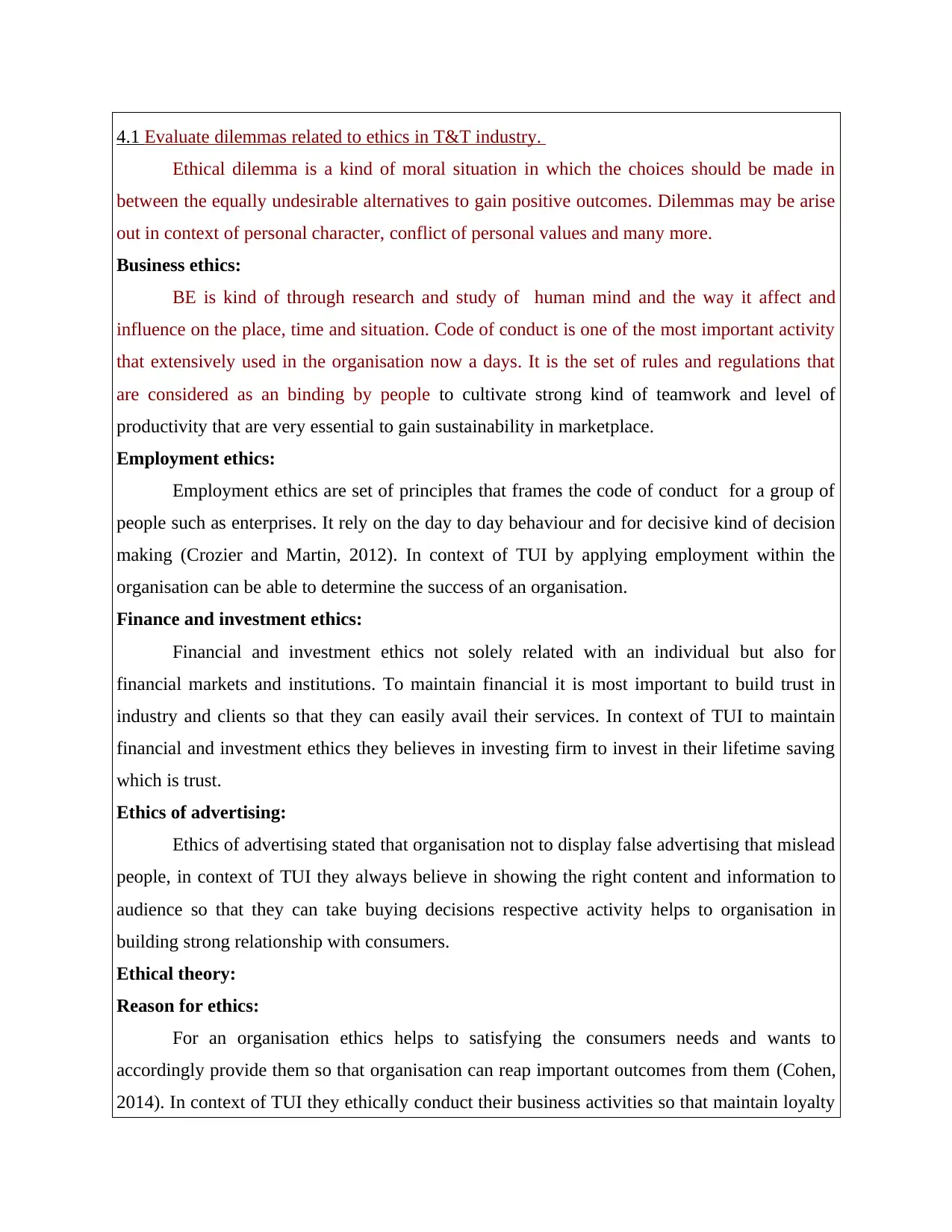
4.1 Evaluate dilemmas related to ethics in T&T industry.
Ethical dilemma is a kind of moral situation in which the choices should be made in
between the equally undesirable alternatives to gain positive outcomes. Dilemmas may be arise
out in context of personal character, conflict of personal values and many more.
Business ethics:
BE is kind of through research and study of human mind and the way it affect and
influence on the place, time and situation. Code of conduct is one of the most important activity
that extensively used in the organisation now a days. It is the set of rules and regulations that
are considered as an binding by people to cultivate strong kind of teamwork and level of
productivity that are very essential to gain sustainability in marketplace.
Employment ethics:
Employment ethics are set of principles that frames the code of conduct for a group of
people such as enterprises. It rely on the day to day behaviour and for decisive kind of decision
making (Crozier and Martin, 2012). In context of TUI by applying employment within the
organisation can be able to determine the success of an organisation.
Finance and investment ethics:
Financial and investment ethics not solely related with an individual but also for
financial markets and institutions. To maintain financial it is most important to build trust in
industry and clients so that they can easily avail their services. In context of TUI to maintain
financial and investment ethics they believes in investing firm to invest in their lifetime saving
which is trust.
Ethics of advertising:
Ethics of advertising stated that organisation not to display false advertising that mislead
people, in context of TUI they always believe in showing the right content and information to
audience so that they can take buying decisions respective activity helps to organisation in
building strong relationship with consumers.
Ethical theory:
Reason for ethics:
For an organisation ethics helps to satisfying the consumers needs and wants to
accordingly provide them so that organisation can reap important outcomes from them (Cohen,
2014). In context of TUI they ethically conduct their business activities so that maintain loyalty
Ethical dilemma is a kind of moral situation in which the choices should be made in
between the equally undesirable alternatives to gain positive outcomes. Dilemmas may be arise
out in context of personal character, conflict of personal values and many more.
Business ethics:
BE is kind of through research and study of human mind and the way it affect and
influence on the place, time and situation. Code of conduct is one of the most important activity
that extensively used in the organisation now a days. It is the set of rules and regulations that
are considered as an binding by people to cultivate strong kind of teamwork and level of
productivity that are very essential to gain sustainability in marketplace.
Employment ethics:
Employment ethics are set of principles that frames the code of conduct for a group of
people such as enterprises. It rely on the day to day behaviour and for decisive kind of decision
making (Crozier and Martin, 2012). In context of TUI by applying employment within the
organisation can be able to determine the success of an organisation.
Finance and investment ethics:
Financial and investment ethics not solely related with an individual but also for
financial markets and institutions. To maintain financial it is most important to build trust in
industry and clients so that they can easily avail their services. In context of TUI to maintain
financial and investment ethics they believes in investing firm to invest in their lifetime saving
which is trust.
Ethics of advertising:
Ethics of advertising stated that organisation not to display false advertising that mislead
people, in context of TUI they always believe in showing the right content and information to
audience so that they can take buying decisions respective activity helps to organisation in
building strong relationship with consumers.
Ethical theory:
Reason for ethics:
For an organisation ethics helps to satisfying the consumers needs and wants to
accordingly provide them so that organisation can reap important outcomes from them (Cohen,
2014). In context of TUI they ethically conduct their business activities so that maintain loyalty
⊘ This is a preview!⊘
Do you want full access?
Subscribe today to unlock all pages.
Trusted by 1+ million students worldwide

1 out of 17


Related Documents


Your All-in-One AI-Powered Toolkit for Academic Success.
+13062052269
info@desklib.com
Available 24*7 on WhatsApp / Email
![[object Object]](/_next/static/media/star-bottom.7253800d.svg)
Unlock your academic potential
Copyright © 2020–2026 A2Z Services. All Rights Reserved. Developed and managed by ZUCOL.