Ethics and Small Entrepreneurship in Social Development: A Review
VerifiedAdded on 2021/10/14
|18
|4906
|167
Literature Review
AI Summary
This literature review explores the significant relationship between ethics and small entrepreneurship in driving social development. It defines key concepts such as social development and business ethics, highlighting the importance of ethical practices for SMEs. The review examines the advantages of ethical policies, including increased employee commitment, reduced costs, and ethical guidance. It discusses the implementation of ethical codes, emphasizing core values, codes of conduct, and effective communication. The paper analyzes the contributions of business ethics to social development, including CSR and stakeholder theory, and discusses the role of ethics in various aspects of business, such as human resources, sales, marketing, production, and competition. The review emphasizes the importance of ethical behavior in satisfying stakeholders and contributing to a sustainable business environment.
Running Head: LITERATURE
Role of ethics and small entrepreneurship in social development
[Student ID]
[Module ID]
[Date]
Role of ethics and small entrepreneurship in social development
[Student ID]
[Module ID]
[Date]

Paraphrase This Document
Need a fresh take? Get an instant paraphrase of this document with our AI Paraphraser
Chapter 2 – Literature Review
About research
Nowadays, different small entrepreneurs are governing the major market activities all
over the globe that also have multiplier effects on the economies of their selected countries.
Entrepreneurship is the willingness of entrepreneurs to engage in development, organization and
management of the businesses by managing risk with the intention to attain the profitability by
incorporation of innovation, opportunity recognition, risk management, action, use of resources
and adding value (Filion, 2011, pp.1). In the past, small entrepreneurship has faced different
sorts of scandals and other issues that have been significantly impacting the business in the
overall market. Due to this reason, customers are becoming more aware of small firms or
entrepreneurs. SMEs are the independent and non-subsidiary firms which employ fewer
employees, and the number may vary from country to country, but the most daily limit of the
number of employees hired by SME is 250 employees. These SMEs are the entrepreneurship
ventures as enterprises create them under their capacity to develop, to organise and to manage
the businesses along their risks for attaining desired profitability (Observer, O. E. C. D., 2000,
pp. 2). More and more SMEs are now transforming into social enterprise, which can be defined
as the organizations applying commercial strategies for maximization of improvements in social,
financial and environmental well being (Yang, Lee, & Lee, 2013, pp.17). The current chapter
will be discussing the literature of previous studies performed for understanding the role of ethics
and small entrepreneurship in social development (Crane, Crane, & Matten, 200-220). Before
incorporating the relevant literature it is significantly important to define the social development
and business ethics to clarify the core concepts. The social development is an approach of putting
people at centre of the development or a process of planned social change which is designed to
About research
Nowadays, different small entrepreneurs are governing the major market activities all
over the globe that also have multiplier effects on the economies of their selected countries.
Entrepreneurship is the willingness of entrepreneurs to engage in development, organization and
management of the businesses by managing risk with the intention to attain the profitability by
incorporation of innovation, opportunity recognition, risk management, action, use of resources
and adding value (Filion, 2011, pp.1). In the past, small entrepreneurship has faced different
sorts of scandals and other issues that have been significantly impacting the business in the
overall market. Due to this reason, customers are becoming more aware of small firms or
entrepreneurs. SMEs are the independent and non-subsidiary firms which employ fewer
employees, and the number may vary from country to country, but the most daily limit of the
number of employees hired by SME is 250 employees. These SMEs are the entrepreneurship
ventures as enterprises create them under their capacity to develop, to organise and to manage
the businesses along their risks for attaining desired profitability (Observer, O. E. C. D., 2000,
pp. 2). More and more SMEs are now transforming into social enterprise, which can be defined
as the organizations applying commercial strategies for maximization of improvements in social,
financial and environmental well being (Yang, Lee, & Lee, 2013, pp.17). The current chapter
will be discussing the literature of previous studies performed for understanding the role of ethics
and small entrepreneurship in social development (Crane, Crane, & Matten, 200-220). Before
incorporating the relevant literature it is significantly important to define the social development
and business ethics to clarify the core concepts. The social development is an approach of putting
people at centre of the development or a process of planned social change which is designed to
promote well being of public within context of the dynamic multifaceted developmental process
(Teshale,, 2016, pp.13). On the other hand, the business ethics is the moral principles which
guide how businesses should behave, and these principles determine the individuals' actions
which are applied to companies. When taking business-related decisions, acting ethically
involves distinguishing between the right and wrong and then making the right choice to respond
to the concerns of a maximum number of stakeholders (Ezigbo, , 2012, pp. 232).
In the current literature, there are specific commitments to the research which are made
for moving forward in the study. First of all, the study plans touse an extensive survey for
understanding the functions of social responsibility in small businesses. In the first place, we
present literature about the workings of the SBSR. This will discuss some important factors that
can help small businesses in governing their social responsibility practices so that they can
compete in the market. Second, our survey challenges different nominal researches in SBSR
research and offers new theoretical points of view that can shape future SBSR inquire about.
Third, we set out a guide for an educated research plan proposing numerous improved bearings:
original hypothesis utilise and advancement that takes care of the arranged activities (or
organisation) of proprietor supervisors; a social perspective of SBSR. A more modern
comprehension of national setting; tending to content-related holes at various levels of
examination, and the utilisation of appropriate and fitting strategies to gauge SBSR. Given the
critical cross-preparation among SBSR and the more extensive CSR writing, our survey
additionally nourishes into administration grant all the more comprehensively (Filatotchev, and
Wright, 2010. pp.471–486).
(Teshale,, 2016, pp.13). On the other hand, the business ethics is the moral principles which
guide how businesses should behave, and these principles determine the individuals' actions
which are applied to companies. When taking business-related decisions, acting ethically
involves distinguishing between the right and wrong and then making the right choice to respond
to the concerns of a maximum number of stakeholders (Ezigbo, , 2012, pp. 232).
In the current literature, there are specific commitments to the research which are made
for moving forward in the study. First of all, the study plans touse an extensive survey for
understanding the functions of social responsibility in small businesses. In the first place, we
present literature about the workings of the SBSR. This will discuss some important factors that
can help small businesses in governing their social responsibility practices so that they can
compete in the market. Second, our survey challenges different nominal researches in SBSR
research and offers new theoretical points of view that can shape future SBSR inquire about.
Third, we set out a guide for an educated research plan proposing numerous improved bearings:
original hypothesis utilise and advancement that takes care of the arranged activities (or
organisation) of proprietor supervisors; a social perspective of SBSR. A more modern
comprehension of national setting; tending to content-related holes at various levels of
examination, and the utilisation of appropriate and fitting strategies to gauge SBSR. Given the
critical cross-preparation among SBSR and the more extensive CSR writing, our survey
additionally nourishes into administration grant all the more comprehensively (Filatotchev, and
Wright, 2010. pp.471–486).
⊘ This is a preview!⊘
Do you want full access?
Subscribe today to unlock all pages.

Trusted by 1+ million students worldwide
Literature review
The small entrepreneurship can be characterised as a type of entrepreneurship that has a
low level of understanding that is developed through the shared expectation of work. Therefore,
the working practices and the culture of the small entrepreneurship are generally performed by
the owners of the business. The small entrepreneurs’ culture and other working ethics are
developed through the attitudes and behaviours of the owners and other related persons who are
performing their duties of business (Spence, 2016. pp.23-55). However, there are many
advantages of developing an effective, ethical policy that can help the company in covering the
moral grounds for performing business activitiesso that the firm can stay economically, socially
and environmentally responsible (Evans, and Sawyer, 2010. pp.433-451).
By following a clear code of conduct andbusiness ethics, the small business entrepreneurs
can ethically perform theirbusiness activities. Those developed ethical policies can help small
entrepreneurs to contribute to social development as clear policies can help them in being
responsive to all stakeholders involved(Crane, Crane, & Matten, 235-245).The business ethics
adopted by the small corporations can make direct contribution in social development by staying
in compliance with clearly developed ethical conduct which can increase in the commitment and
loyalty level of employees, highly educated staff will join the organisation, the business costs
will be directly reduced, and the employees will be guided for performing ethical practices. The
development and implementation of the ethical policies in the small entrepreneurship can be
achieved through following three simple steps.These three steps include Outlining and describing
the core values for business, Developing a valid code of business ethics and Implanting the ethics
code (Carroll, 2016. p.3).
The small entrepreneurship can be characterised as a type of entrepreneurship that has a
low level of understanding that is developed through the shared expectation of work. Therefore,
the working practices and the culture of the small entrepreneurship are generally performed by
the owners of the business. The small entrepreneurs’ culture and other working ethics are
developed through the attitudes and behaviours of the owners and other related persons who are
performing their duties of business (Spence, 2016. pp.23-55). However, there are many
advantages of developing an effective, ethical policy that can help the company in covering the
moral grounds for performing business activitiesso that the firm can stay economically, socially
and environmentally responsible (Evans, and Sawyer, 2010. pp.433-451).
By following a clear code of conduct andbusiness ethics, the small business entrepreneurs
can ethically perform theirbusiness activities. Those developed ethical policies can help small
entrepreneurs to contribute to social development as clear policies can help them in being
responsive to all stakeholders involved(Crane, Crane, & Matten, 235-245).The business ethics
adopted by the small corporations can make direct contribution in social development by staying
in compliance with clearly developed ethical conduct which can increase in the commitment and
loyalty level of employees, highly educated staff will join the organisation, the business costs
will be directly reduced, and the employees will be guided for performing ethical practices. The
development and implementation of the ethical policies in the small entrepreneurship can be
achieved through following three simple steps.These three steps include Outlining and describing
the core values for business, Developing a valid code of business ethics and Implanting the ethics
code (Carroll, 2016. p.3).
Paraphrase This Document
Need a fresh take? Get an instant paraphrase of this document with our AI Paraphraser
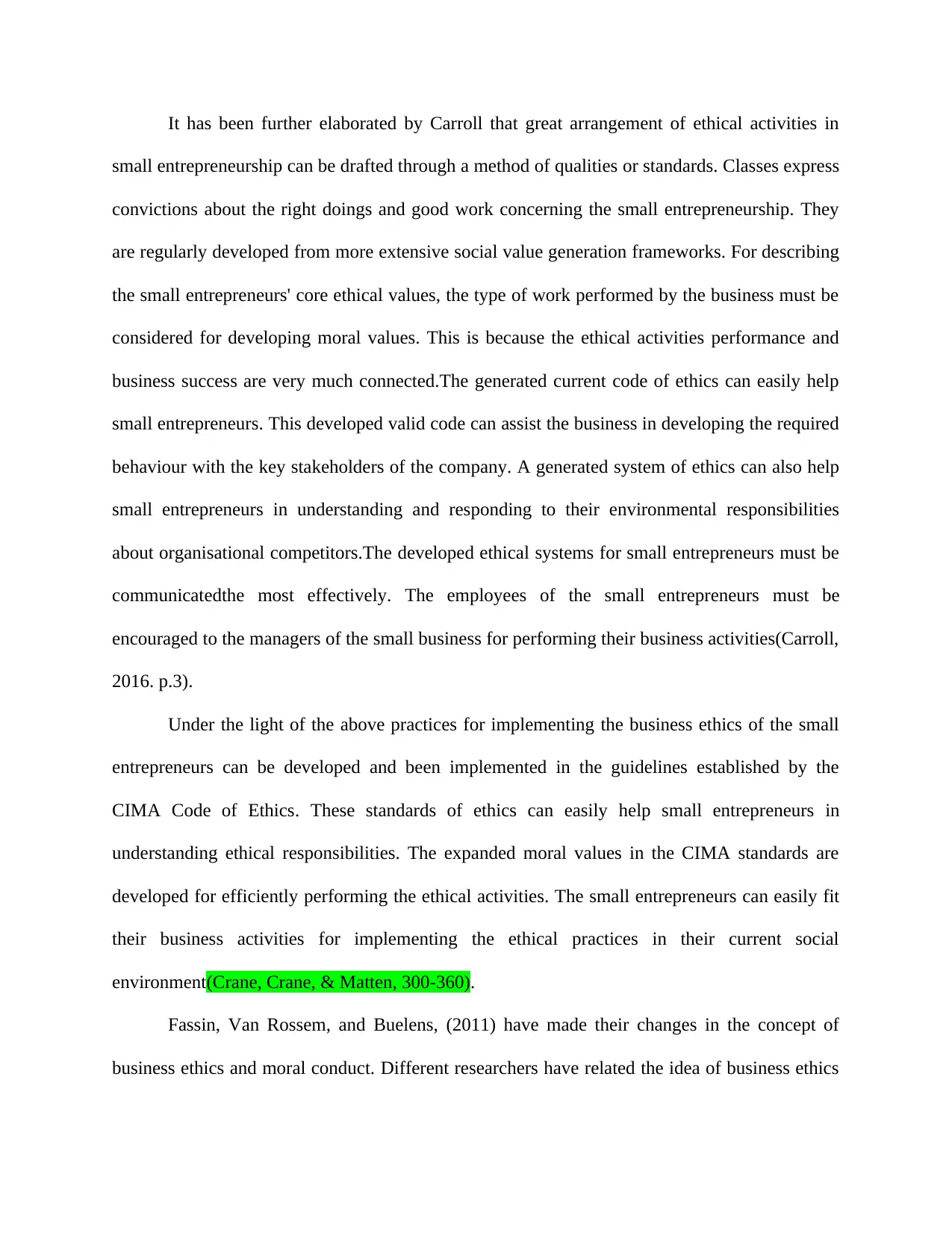
It has been further elaborated by Carroll that great arrangement of ethical activities in
small entrepreneurship can be drafted through a method of qualities or standards. Classes express
convictions about the right doings and good work concerning the small entrepreneurship. They
are regularly developed from more extensive social value generation frameworks. For describing
the small entrepreneurs' core ethical values, the type of work performed by the business must be
considered for developing moral values. This is because the ethical activities performance and
business success are very much connected.The generated current code of ethics can easily help
small entrepreneurs. This developed valid code can assist the business in developing the required
behaviour with the key stakeholders of the company. A generated system of ethics can also help
small entrepreneurs in understanding and responding to their environmental responsibilities
about organisational competitors.The developed ethical systems for small entrepreneurs must be
communicatedthe most effectively. The employees of the small entrepreneurs must be
encouraged to the managers of the small business for performing their business activities(Carroll,
2016. p.3).
Under the light of the above practices for implementing the business ethics of the small
entrepreneurs can be developed and been implemented in the guidelines established by the
CIMA Code of Ethics. These standards of ethics can easily help small entrepreneurs in
understanding ethical responsibilities. The expanded moral values in the CIMA standards are
developed for efficiently performing the ethical activities. The small entrepreneurs can easily fit
their business activities for implementing the ethical practices in their current social
environment(Crane, Crane, & Matten, 300-360).
Fassin, Van Rossem, and Buelens, (2011) have made their changes in the concept of
business ethics and moral conduct. Different researchers have related the idea of business ethics
small entrepreneurship can be drafted through a method of qualities or standards. Classes express
convictions about the right doings and good work concerning the small entrepreneurship. They
are regularly developed from more extensive social value generation frameworks. For describing
the small entrepreneurs' core ethical values, the type of work performed by the business must be
considered for developing moral values. This is because the ethical activities performance and
business success are very much connected.The generated current code of ethics can easily help
small entrepreneurs. This developed valid code can assist the business in developing the required
behaviour with the key stakeholders of the company. A generated system of ethics can also help
small entrepreneurs in understanding and responding to their environmental responsibilities
about organisational competitors.The developed ethical systems for small entrepreneurs must be
communicatedthe most effectively. The employees of the small entrepreneurs must be
encouraged to the managers of the small business for performing their business activities(Carroll,
2016. p.3).
Under the light of the above practices for implementing the business ethics of the small
entrepreneurs can be developed and been implemented in the guidelines established by the
CIMA Code of Ethics. These standards of ethics can easily help small entrepreneurs in
understanding ethical responsibilities. The expanded moral values in the CIMA standards are
developed for efficiently performing the ethical activities. The small entrepreneurs can easily fit
their business activities for implementing the ethical practices in their current social
environment(Crane, Crane, & Matten, 300-360).
Fassin, Van Rossem, and Buelens, (2011) have made their changes in the concept of
business ethics and moral conduct. Different researchers have related the idea of business ethics
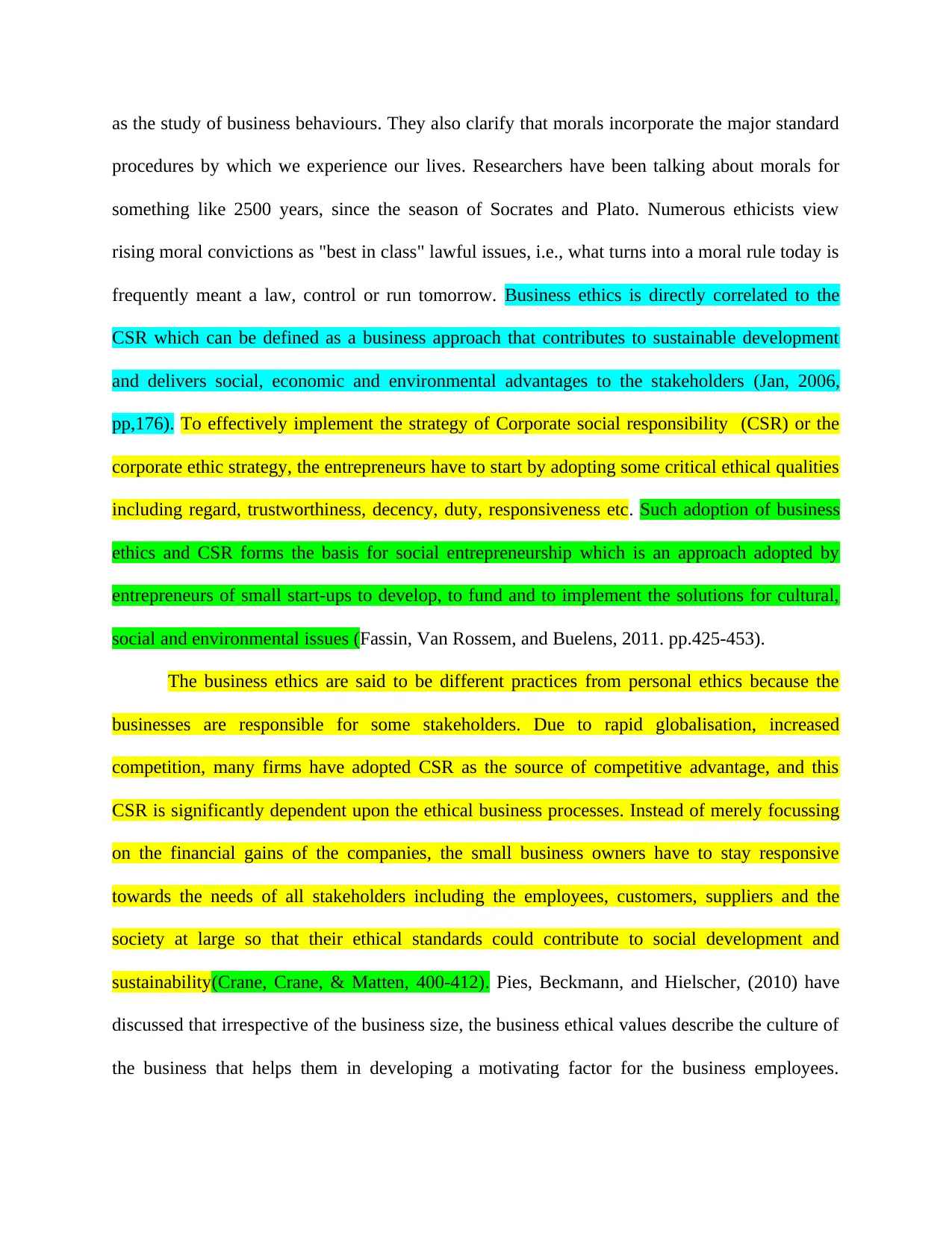
as the study of business behaviours. They also clarify that morals incorporate the major standard
procedures by which we experience our lives. Researchers have been talking about morals for
something like 2500 years, since the season of Socrates and Plato. Numerous ethicists view
rising moral convictions as "best in class" lawful issues, i.e., what turns into a moral rule today is
frequently meant a law, control or run tomorrow. Business ethics is directly correlated to the
CSR which can be defined as a business approach that contributes to sustainable development
and delivers social, economic and environmental advantages to the stakeholders (Jan, 2006,
pp,176). To effectively implement the strategy of Corporate social responsibility (CSR) or the
corporate ethic strategy, the entrepreneurs have to start by adopting some critical ethical qualities
including regard, trustworthiness, decency, duty, responsiveness etc. Such adoption of business
ethics and CSR forms the basis for social entrepreneurship which is an approach adopted by
entrepreneurs of small start-ups to develop, to fund and to implement the solutions for cultural,
social and environmental issues (Fassin, Van Rossem, and Buelens, 2011. pp.425-453).
The business ethics are said to be different practices from personal ethics because the
businesses are responsible for some stakeholders. Due to rapid globalisation, increased
competition, many firms have adopted CSR as the source of competitive advantage, and this
CSR is significantly dependent upon the ethical business processes. Instead of merely focussing
on the financial gains of the companies, the small business owners have to stay responsive
towards the needs of all stakeholders including the employees, customers, suppliers and the
society at large so that their ethical standards could contribute to social development and
sustainability(Crane, Crane, & Matten, 400-412). Pies, Beckmann, and Hielscher, (2010) have
discussed that irrespective of the business size, the business ethical values describe the culture of
the business that helps them in developing a motivating factor for the business employees.
procedures by which we experience our lives. Researchers have been talking about morals for
something like 2500 years, since the season of Socrates and Plato. Numerous ethicists view
rising moral convictions as "best in class" lawful issues, i.e., what turns into a moral rule today is
frequently meant a law, control or run tomorrow. Business ethics is directly correlated to the
CSR which can be defined as a business approach that contributes to sustainable development
and delivers social, economic and environmental advantages to the stakeholders (Jan, 2006,
pp,176). To effectively implement the strategy of Corporate social responsibility (CSR) or the
corporate ethic strategy, the entrepreneurs have to start by adopting some critical ethical qualities
including regard, trustworthiness, decency, duty, responsiveness etc. Such adoption of business
ethics and CSR forms the basis for social entrepreneurship which is an approach adopted by
entrepreneurs of small start-ups to develop, to fund and to implement the solutions for cultural,
social and environmental issues (Fassin, Van Rossem, and Buelens, 2011. pp.425-453).
The business ethics are said to be different practices from personal ethics because the
businesses are responsible for some stakeholders. Due to rapid globalisation, increased
competition, many firms have adopted CSR as the source of competitive advantage, and this
CSR is significantly dependent upon the ethical business processes. Instead of merely focussing
on the financial gains of the companies, the small business owners have to stay responsive
towards the needs of all stakeholders including the employees, customers, suppliers and the
society at large so that their ethical standards could contribute to social development and
sustainability(Crane, Crane, & Matten, 400-412). Pies, Beckmann, and Hielscher, (2010) have
discussed that irrespective of the business size, the business ethical values describe the culture of
the business that helps them in developing a motivating factor for the business employees.
⊘ This is a preview!⊘
Do you want full access?
Subscribe today to unlock all pages.
Trusted by 1+ million students worldwide
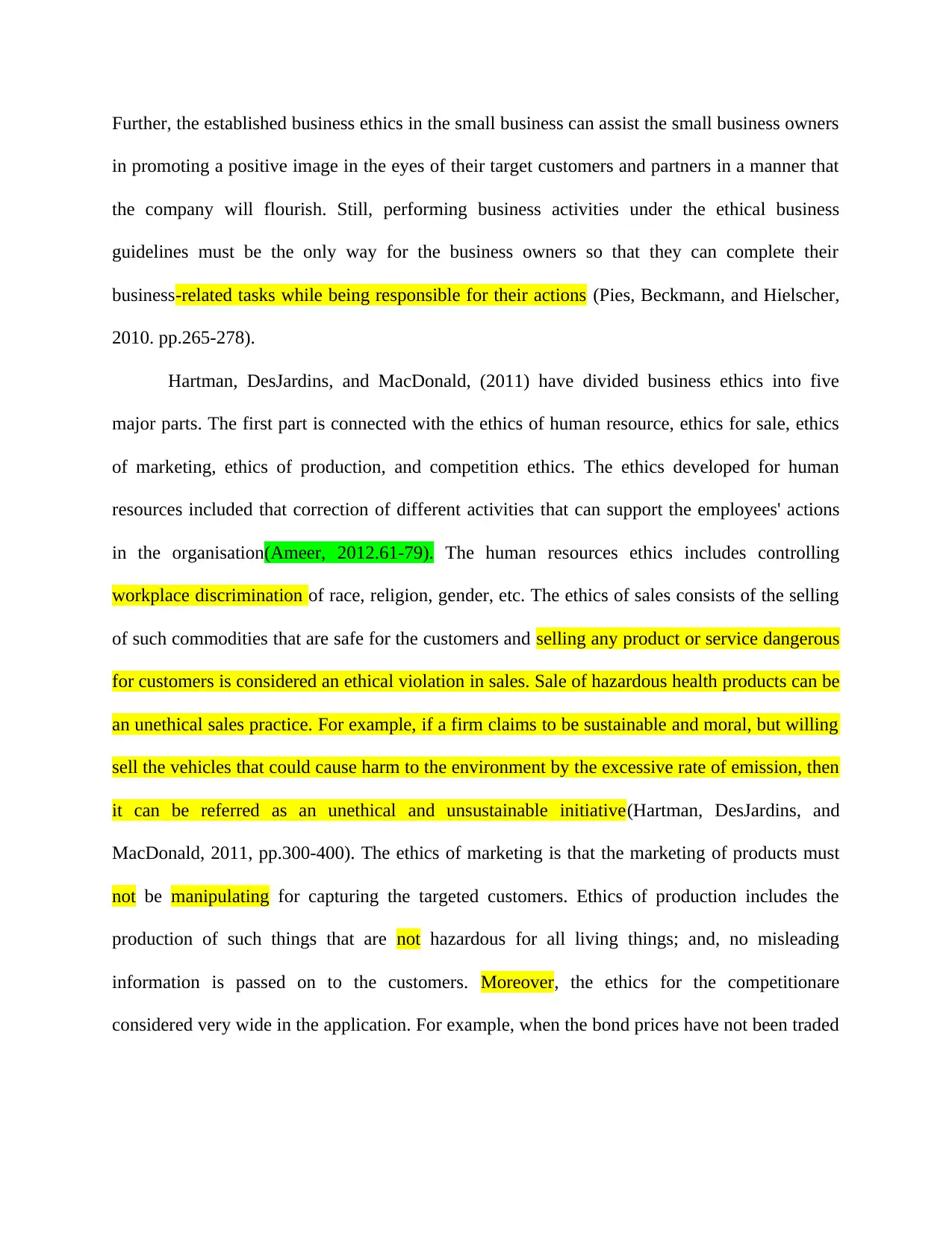
Further, the established business ethics in the small business can assist the small business owners
in promoting a positive image in the eyes of their target customers and partners in a manner that
the company will flourish. Still, performing business activities under the ethical business
guidelines must be the only way for the business owners so that they can complete their
business-related tasks while being responsible for their actions (Pies, Beckmann, and Hielscher,
2010. pp.265-278).
Hartman, DesJardins, and MacDonald, (2011) have divided business ethics into five
major parts. The first part is connected with the ethics of human resource, ethics for sale, ethics
of marketing, ethics of production, and competition ethics. The ethics developed for human
resources included that correction of different activities that can support the employees' actions
in the organisation(Ameer, 2012.61-79). The human resources ethics includes controlling
workplace discrimination of race, religion, gender, etc. The ethics of sales consists of the selling
of such commodities that are safe for the customers and selling any product or service dangerous
for customers is considered an ethical violation in sales. Sale of hazardous health products can be
an unethical sales practice. For example, if a firm claims to be sustainable and moral, but willing
sell the vehicles that could cause harm to the environment by the excessive rate of emission, then
it can be referred as an unethical and unsustainable initiative(Hartman, DesJardins, and
MacDonald, 2011, pp.300-400). The ethics of marketing is that the marketing of products must
not be manipulating for capturing the targeted customers. Ethics of production includes the
production of such things that are not hazardous for all living things; and, no misleading
information is passed on to the customers. Moreover, the ethics for the competitionare
considered very wide in the application. For example, when the bond prices have not been traded
in promoting a positive image in the eyes of their target customers and partners in a manner that
the company will flourish. Still, performing business activities under the ethical business
guidelines must be the only way for the business owners so that they can complete their
business-related tasks while being responsible for their actions (Pies, Beckmann, and Hielscher,
2010. pp.265-278).
Hartman, DesJardins, and MacDonald, (2011) have divided business ethics into five
major parts. The first part is connected with the ethics of human resource, ethics for sale, ethics
of marketing, ethics of production, and competition ethics. The ethics developed for human
resources included that correction of different activities that can support the employees' actions
in the organisation(Ameer, 2012.61-79). The human resources ethics includes controlling
workplace discrimination of race, religion, gender, etc. The ethics of sales consists of the selling
of such commodities that are safe for the customers and selling any product or service dangerous
for customers is considered an ethical violation in sales. Sale of hazardous health products can be
an unethical sales practice. For example, if a firm claims to be sustainable and moral, but willing
sell the vehicles that could cause harm to the environment by the excessive rate of emission, then
it can be referred as an unethical and unsustainable initiative(Hartman, DesJardins, and
MacDonald, 2011, pp.300-400). The ethics of marketing is that the marketing of products must
not be manipulating for capturing the targeted customers. Ethics of production includes the
production of such things that are not hazardous for all living things; and, no misleading
information is passed on to the customers. Moreover, the ethics for the competitionare
considered very wide in the application. For example, when the bond prices have not been traded
Paraphrase This Document
Need a fresh take? Get an instant paraphrase of this document with our AI Paraphraser
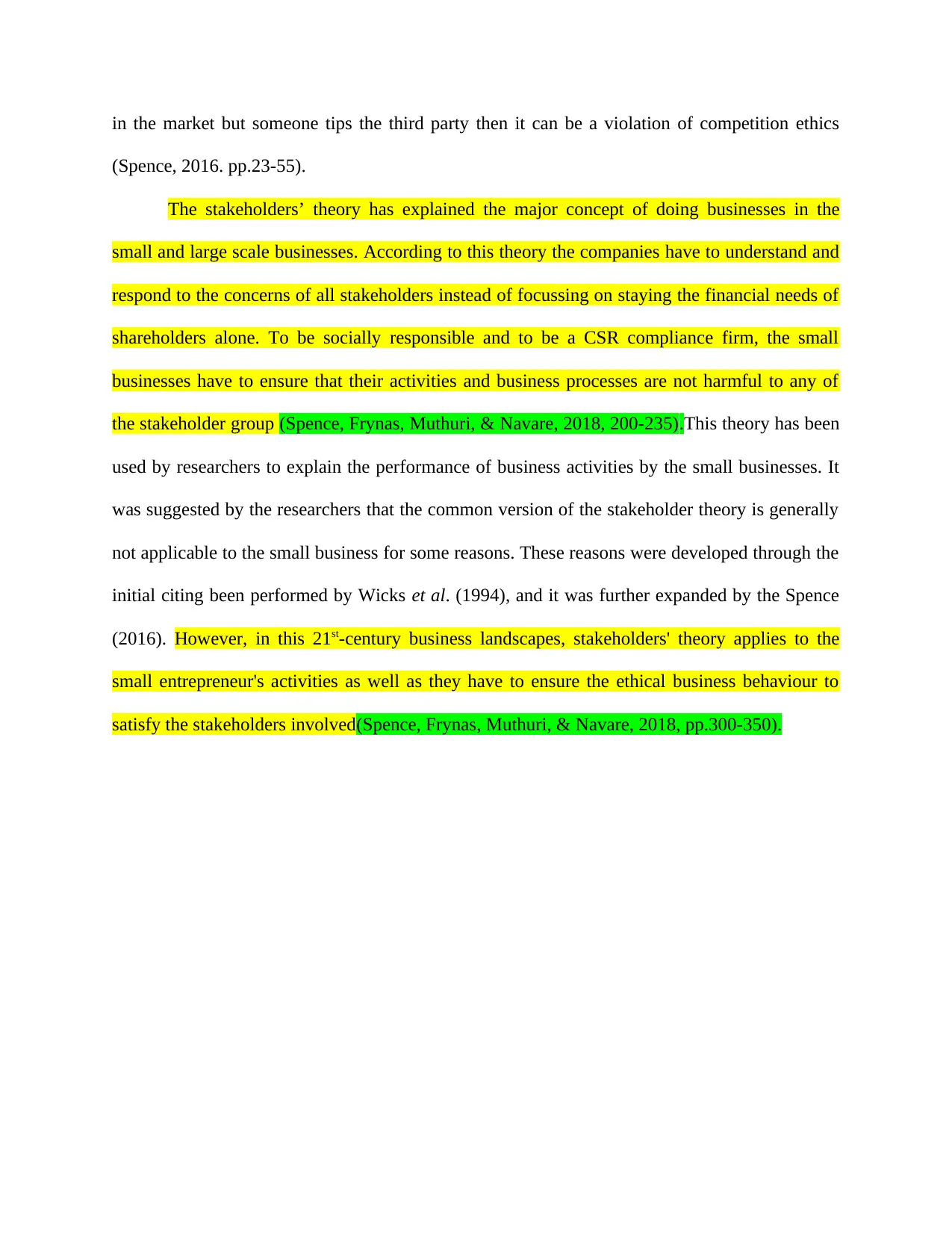
in the market but someone tips the third party then it can be a violation of competition ethics
(Spence, 2016. pp.23-55).
The stakeholders’ theory has explained the major concept of doing businesses in the
small and large scale businesses. According to this theory the companies have to understand and
respond to the concerns of all stakeholders instead of focussing on staying the financial needs of
shareholders alone. To be socially responsible and to be a CSR compliance firm, the small
businesses have to ensure that their activities and business processes are not harmful to any of
the stakeholder group (Spence, Frynas, Muthuri, & Navare, 2018, 200-235).This theory has been
used by researchers to explain the performance of business activities by the small businesses. It
was suggested by the researchers that the common version of the stakeholder theory is generally
not applicable to the small business for some reasons. These reasons were developed through the
initial citing been performed by Wicks et al. (1994), and it was further expanded by the Spence
(2016). However, in this 21st-century business landscapes, stakeholders' theory applies to the
small entrepreneur's activities as well as they have to ensure the ethical business behaviour to
satisfy the stakeholders involved(Spence, Frynas, Muthuri, & Navare, 2018, pp.300-350).
(Spence, 2016. pp.23-55).
The stakeholders’ theory has explained the major concept of doing businesses in the
small and large scale businesses. According to this theory the companies have to understand and
respond to the concerns of all stakeholders instead of focussing on staying the financial needs of
shareholders alone. To be socially responsible and to be a CSR compliance firm, the small
businesses have to ensure that their activities and business processes are not harmful to any of
the stakeholder group (Spence, Frynas, Muthuri, & Navare, 2018, 200-235).This theory has been
used by researchers to explain the performance of business activities by the small businesses. It
was suggested by the researchers that the common version of the stakeholder theory is generally
not applicable to the small business for some reasons. These reasons were developed through the
initial citing been performed by Wicks et al. (1994), and it was further expanded by the Spence
(2016). However, in this 21st-century business landscapes, stakeholders' theory applies to the
small entrepreneur's activities as well as they have to ensure the ethical business behaviour to
satisfy the stakeholders involved(Spence, Frynas, Muthuri, & Navare, 2018, pp.300-350).
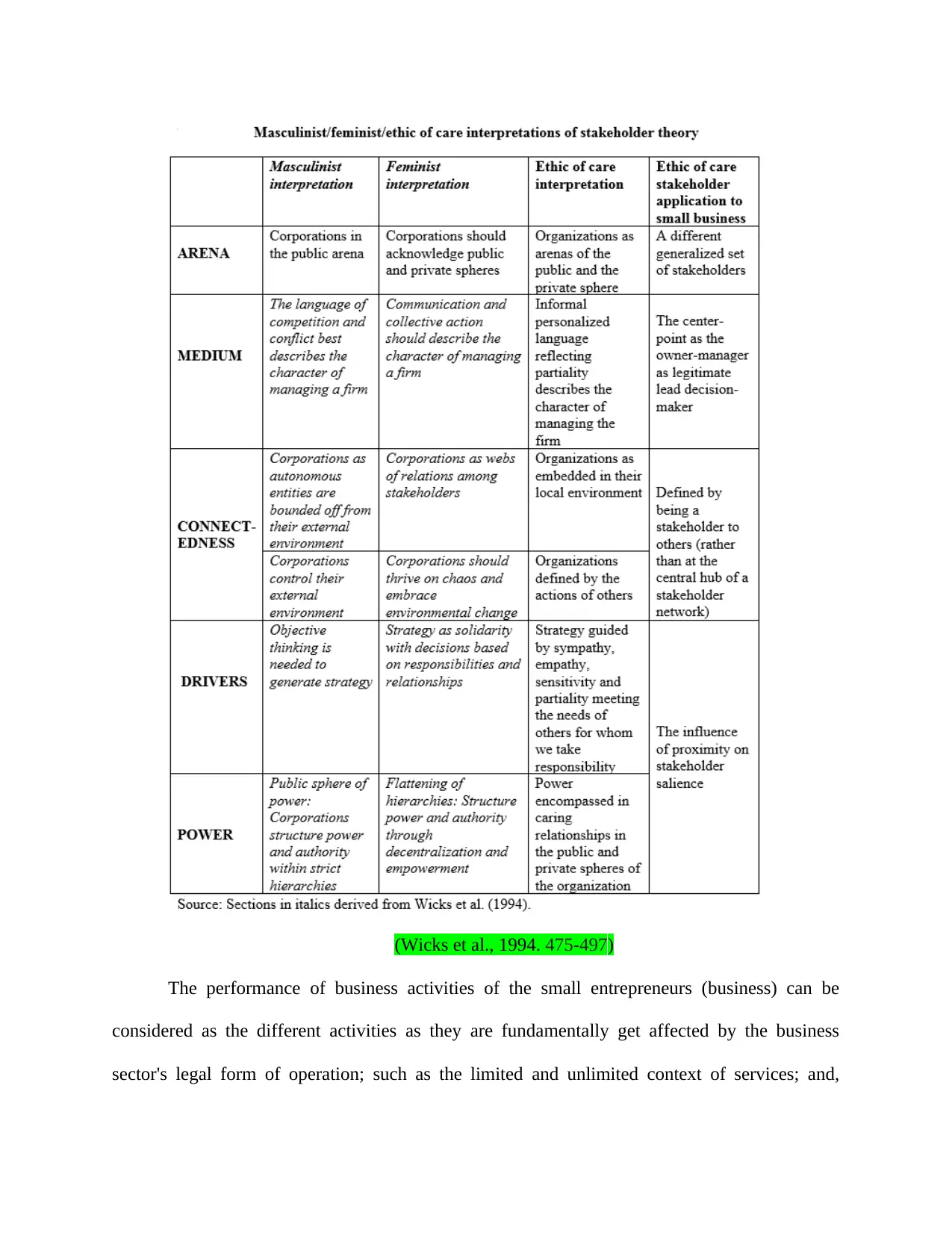
(Wicks et al., 1994. 475-497)
The performance of business activities of the small entrepreneurs (business) can be
considered as the different activities as they are fundamentally get affected by the business
sector's legal form of operation; such as the limited and unlimited context of services; and,
The performance of business activities of the small entrepreneurs (business) can be
considered as the different activities as they are fundamentally get affected by the business
sector's legal form of operation; such as the limited and unlimited context of services; and,
⊘ This is a preview!⊘
Do you want full access?
Subscribe today to unlock all pages.
Trusted by 1+ million students worldwide
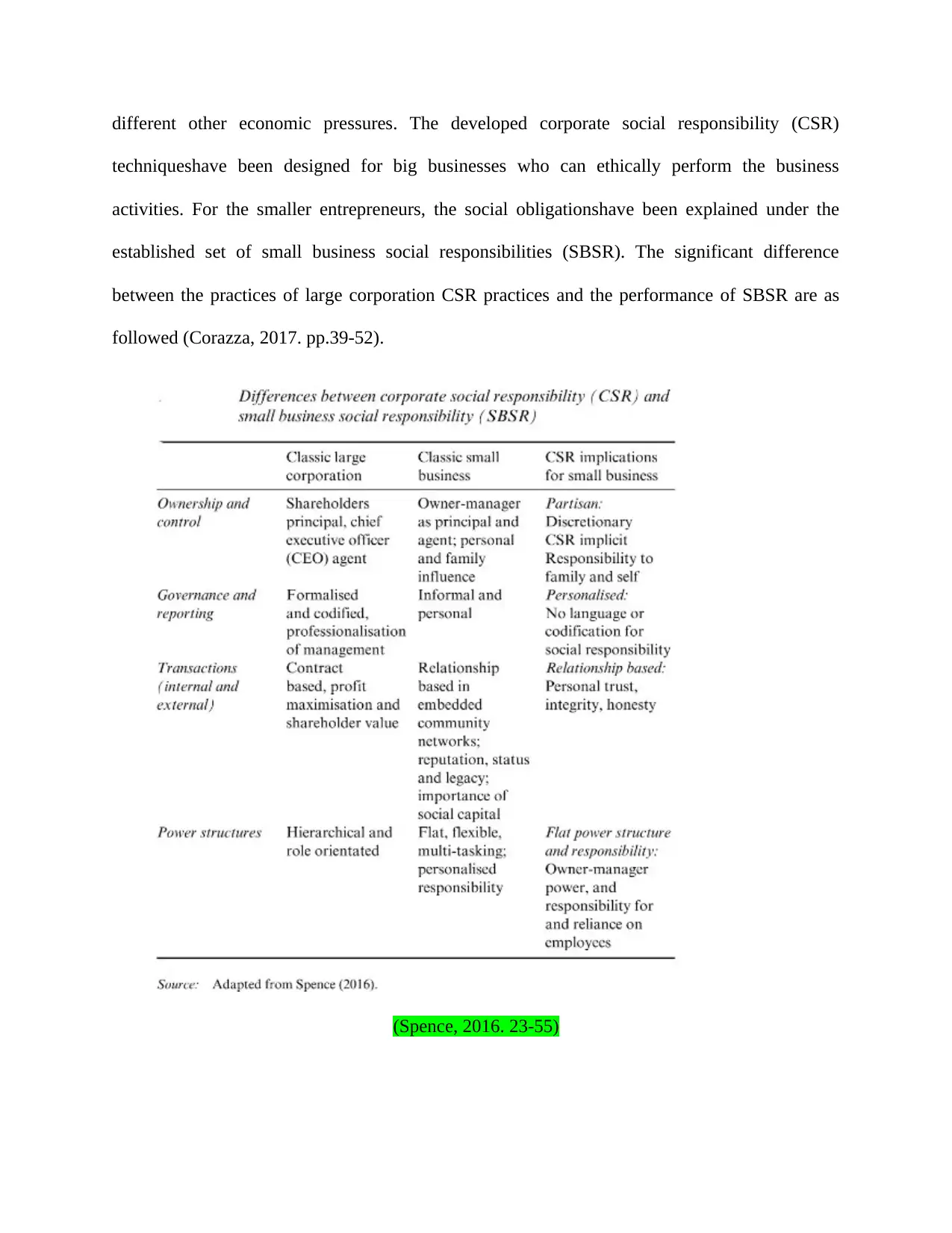
different other economic pressures. The developed corporate social responsibility (CSR)
techniqueshave been designed for big businesses who can ethically perform the business
activities. For the smaller entrepreneurs, the social obligationshave been explained under the
established set of small business social responsibilities (SBSR). The significant difference
between the practices of large corporation CSR practices and the performance of SBSR are as
followed (Corazza, 2017. pp.39-52).
(Spence, 2016. 23-55)
techniqueshave been designed for big businesses who can ethically perform the business
activities. For the smaller entrepreneurs, the social obligationshave been explained under the
established set of small business social responsibilities (SBSR). The significant difference
between the practices of large corporation CSR practices and the performance of SBSR are as
followed (Corazza, 2017. pp.39-52).
(Spence, 2016. 23-55)
Paraphrase This Document
Need a fresh take? Get an instant paraphrase of this document with our AI Paraphraser
The concept of the CSR has been adopted by the new organisations operating in the 21st-
century business environments. In the USA CSR is emphasised to control the reckless social
conduct of extensive associations, it isn't constrained to the satisfaction of monetary and lawful
obligations(Carroll, 2016). As a moderate contention for CSR, Chandler and Werther (2013)
have stated that in the present globalised world, where people and lobbyist associations feel
enabled to authorise the change, CSR speaks to methods for envisioning and reflecting societal
worries to limit operational and monetary imperatives on business.
From an ethical point of view, they trust accomplishment in business comes as much
from activities that are compatible with social qualities as from variables interior to the
organisation. The monetary contention set forward by these creators mirrors equal importance of
the network when they clarify CSR as the method for coordinating corporate tasks with societal
qualities and desires that are always advancing. Moreover, furthermore, trust that organisations
need to assemble a watertight picture as an association's engaging quality and achievement are
progressively connected to the conditions of its image and brand (Sen, and Cowley, 2013.
pp.413-427).
Moreover, it was also notified by Dincer, and Dincer, (2010) that in the modern era, the
evaluation process for the activities of CSR conducted by small businesses is complicated. The
human society, on the whole, has to develop the CSR practices for the minorities of the nations
with the expense of the majority population of the community. It has been discussed by different
researchers that the economic values of the small business could be contradictory in the response
of its CSR activities been performed (Dincer, and Dincer, 2010. pp.197-207). This fact was
explainedin the article written by Marana and Kostova in the year2016; still, they say that it is
essential for the effective prosperity of small business. This is because the locally developed
century business environments. In the USA CSR is emphasised to control the reckless social
conduct of extensive associations, it isn't constrained to the satisfaction of monetary and lawful
obligations(Carroll, 2016). As a moderate contention for CSR, Chandler and Werther (2013)
have stated that in the present globalised world, where people and lobbyist associations feel
enabled to authorise the change, CSR speaks to methods for envisioning and reflecting societal
worries to limit operational and monetary imperatives on business.
From an ethical point of view, they trust accomplishment in business comes as much
from activities that are compatible with social qualities as from variables interior to the
organisation. The monetary contention set forward by these creators mirrors equal importance of
the network when they clarify CSR as the method for coordinating corporate tasks with societal
qualities and desires that are always advancing. Moreover, furthermore, trust that organisations
need to assemble a watertight picture as an association's engaging quality and achievement are
progressively connected to the conditions of its image and brand (Sen, and Cowley, 2013.
pp.413-427).
Moreover, it was also notified by Dincer, and Dincer, (2010) that in the modern era, the
evaluation process for the activities of CSR conducted by small businesses is complicated. The
human society, on the whole, has to develop the CSR practices for the minorities of the nations
with the expense of the majority population of the community. It has been discussed by different
researchers that the economic values of the small business could be contradictory in the response
of its CSR activities been performed (Dincer, and Dincer, 2010. pp.197-207). This fact was
explainedin the article written by Marana and Kostova in the year2016; still, they say that it is
essential for the effective prosperity of small business. This is because the locally developed
ethics of small business and fair distribution with effective utilisation of the resources can help
the company in successfully performing its activities. Borden et al., (2017) have exemplified the
fact that the small businesses of car parts manufactures must not perform such business activities
that do support the increment in global warming. It has been discussed by researchers that SMEs
participate in a capable business hones even though they don't distribute formal social
announcing. It was also opposed that SMEs that are established in community networks and their
physical proximity to clients and system may mean a good district which can focus on the minds
of the businessmen for the effective performance of CSR activities (Jamali, and Karam,
2018.pp.32–61).
Out of these 28 million small businesses running in the US, the 70% of those businesses
are owned and operated by the single person. This only person operation of the company is
becoming the critical reason that the small companies are neglecting the performance of CSR
activities. Moreover, the role played by the small businesses in the growth of their sector and the
overall economic activities is very fundamental as they generate 57% of the total income for the
US Government (Shepard, 2013. pp.213-233). Parnell, Lester, Long, and Köseoglu, (2012) have
described the fact that the small businesses or enterprises in the developing and non-developing
countries have more share in comparison of the small businesses share in the developed country
like the USA and European Union (EU). The data available from the developing countries about
the performance of the small business in the region are becoming outdated, and the small
business sector is growing in a significant manner in those developing and underdeveloped
countries (Parnell, Lester, Long, and Köseoglu, 2012. pp.546-568).
Nakara, Benmoussa, and Jaouen, (2012) have also established the fact that the small
businesses have created excellent opportunities for employment which is an initiative which
the company in successfully performing its activities. Borden et al., (2017) have exemplified the
fact that the small businesses of car parts manufactures must not perform such business activities
that do support the increment in global warming. It has been discussed by researchers that SMEs
participate in a capable business hones even though they don't distribute formal social
announcing. It was also opposed that SMEs that are established in community networks and their
physical proximity to clients and system may mean a good district which can focus on the minds
of the businessmen for the effective performance of CSR activities (Jamali, and Karam,
2018.pp.32–61).
Out of these 28 million small businesses running in the US, the 70% of those businesses
are owned and operated by the single person. This only person operation of the company is
becoming the critical reason that the small companies are neglecting the performance of CSR
activities. Moreover, the role played by the small businesses in the growth of their sector and the
overall economic activities is very fundamental as they generate 57% of the total income for the
US Government (Shepard, 2013. pp.213-233). Parnell, Lester, Long, and Köseoglu, (2012) have
described the fact that the small businesses or enterprises in the developing and non-developing
countries have more share in comparison of the small businesses share in the developed country
like the USA and European Union (EU). The data available from the developing countries about
the performance of the small business in the region are becoming outdated, and the small
business sector is growing in a significant manner in those developing and underdeveloped
countries (Parnell, Lester, Long, and Köseoglu, 2012. pp.546-568).
Nakara, Benmoussa, and Jaouen, (2012) have also established the fact that the small
businesses have created excellent opportunities for employment which is an initiative which
⊘ This is a preview!⊘
Do you want full access?
Subscribe today to unlock all pages.
Trusted by 1+ million students worldwide

1 out of 18


Related Documents


Your All-in-One AI-Powered Toolkit for Academic Success.
+13062052269
info@desklib.com
Available 24*7 on WhatsApp / Email
![[object Object]](/_next/static/media/star-bottom.7253800d.svg)
Unlock your academic potential
Copyright © 2020–2026 A2Z Services. All Rights Reserved. Developed and managed by ZUCOL.