AAF0436: Management Accounting and Financial Planning Report
VerifiedAdded on 2023/06/17
|13
|3166
|255
Report
AI Summary
This report provides a comprehensive analysis of management accounting and financial planning, focusing on key concepts such as standard costing, target costing, contribution techniques, and transfer pricing. It critically discusses the use of standard costing, its various types, and limitations, alongside a comparison with target costing. The role of contribution techniques in decision-making is explored, with illustrations relevant to BETA company, and an analysis of how transfer pricing approaches can improve profitability. The report concludes by synthesizing these elements, offering insights into their practical applications and strategic importance in enhancing organizational financial performance. Desklib offers a wide array of solved assignments and past papers for students.
Management Accounting
and Financial Planning
AAF0436
and Financial Planning
AAF0436

Paraphrase This Document
Need a fresh take? Get an instant paraphrase of this document with our AI Paraphraser

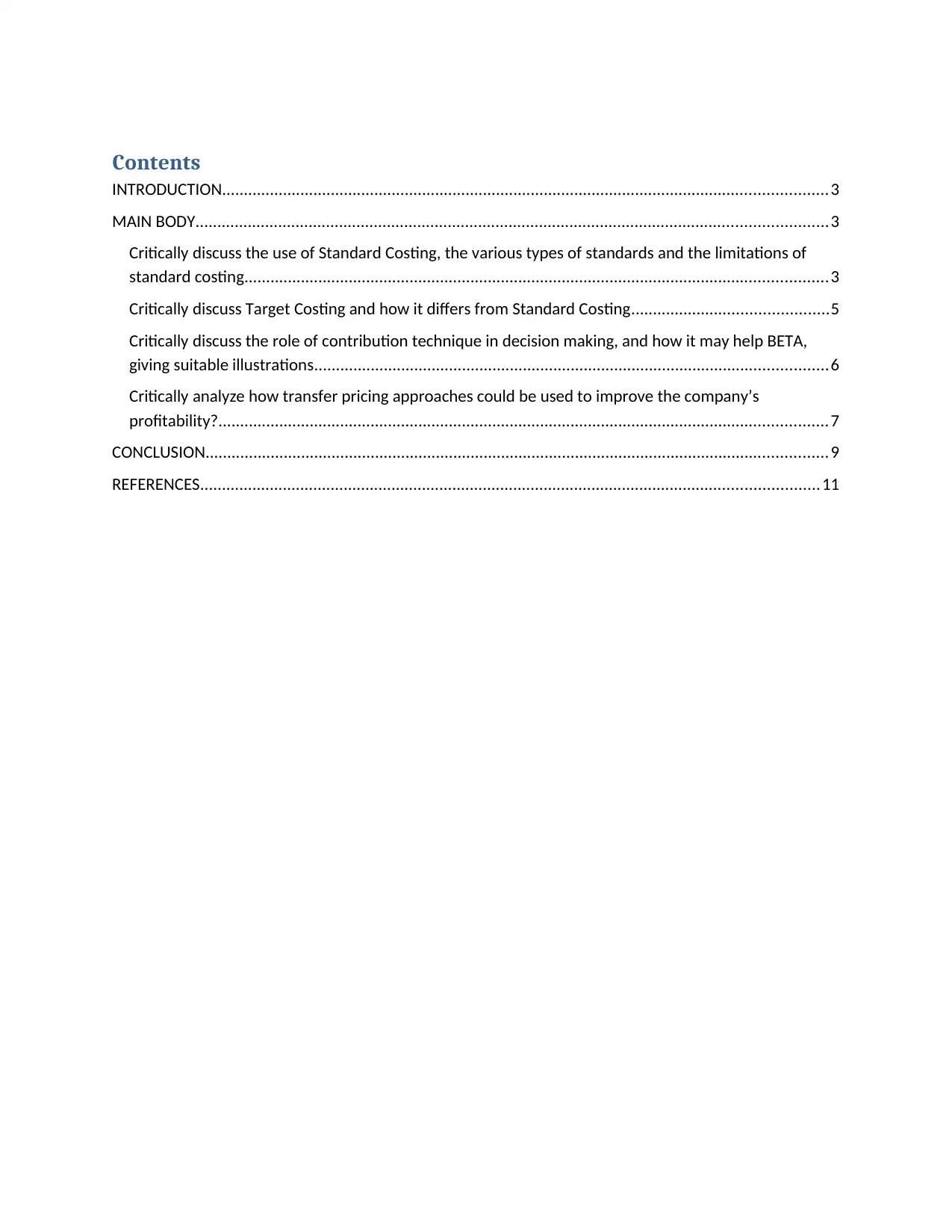
Contents
INTRODUCTION...........................................................................................................................................3
MAIN BODY.................................................................................................................................................3
Critically discuss the use of Standard Costing, the various types of standards and the limitations of
standard costing......................................................................................................................................3
Critically discuss Target Costing and how it differs from Standard Costing.............................................5
Critically discuss the role of contribution technique in decision making, and how it may help BETA,
giving suitable illustrations......................................................................................................................6
Critically analyze how transfer pricing approaches could be used to improve the company’s
profitability?............................................................................................................................................7
CONCLUSION...............................................................................................................................................9
REFERENCES..............................................................................................................................................11
INTRODUCTION...........................................................................................................................................3
MAIN BODY.................................................................................................................................................3
Critically discuss the use of Standard Costing, the various types of standards and the limitations of
standard costing......................................................................................................................................3
Critically discuss Target Costing and how it differs from Standard Costing.............................................5
Critically discuss the role of contribution technique in decision making, and how it may help BETA,
giving suitable illustrations......................................................................................................................6
Critically analyze how transfer pricing approaches could be used to improve the company’s
profitability?............................................................................................................................................7
CONCLUSION...............................................................................................................................................9
REFERENCES..............................................................................................................................................11
⊘ This is a preview!⊘
Do you want full access?
Subscribe today to unlock all pages.

Trusted by 1+ million students worldwide
INTRODUCTION
Management accounting is the collection and display of economic and accounting
information to aid in analyzing strategy implementation, developing plans, making parallels,
planning, and projecting, among other things. Management accounting is a discipline of
accounting that provides data to authorized parties and helps companies make decisions
(Alsulmani, Alkindi and Ahmed, 2021). On the other side, financial plan is a complete plan that
covers an user's present financial status, lengthy goals and tactics for achieving them. Financial
planning is a process for calculating the amount of money necessary and selecting how to obtain
it. Simple terms, it assists them in keeping track of their income, spending, and assets in relation
to managing their money.
MAIN BODY
Critically discuss the use of Standard Costing, the various types of standards and the limitations
of standard costing
Standard costing is an excellent tool for managing expenses and assessing growth and
performance. It's a cost-cutting and expense strategy. It assists in a variety of management
activities such as policy formulation, pricing level determination, and so on. The idea of standard
costing is to define goals and targets for achieving them, and then evaluate real costs to such
goals (Butyugina and Gorbunova, 2021). Standard costing is a method of determining the
standard cost for each cost factor, such as material, labor and overhead. There are using standard
costing in Beta Company to analysis the efficiency of different products in company such as:
Increased the quality and economy of management: It's hot enough for a manager to do
his job. They must also be productive. A manager's effectiveness should be both
productive and useful, meaning that the intended goal should be achieved with the least
amount of input materials. The adoption of standard pricing allows media to establish
those efficiency and productivity targets. It also focuses on assessing the degree to which
performance and efficiency have been achieved (Atienza and Tabuena, 2021).
Goods Costing is Made Easier: Isn't it true that valuing merchandise at standard cost
makes equipment pricing easier? It allows the firm to stick to a set of procedures. All
Management accounting is the collection and display of economic and accounting
information to aid in analyzing strategy implementation, developing plans, making parallels,
planning, and projecting, among other things. Management accounting is a discipline of
accounting that provides data to authorized parties and helps companies make decisions
(Alsulmani, Alkindi and Ahmed, 2021). On the other side, financial plan is a complete plan that
covers an user's present financial status, lengthy goals and tactics for achieving them. Financial
planning is a process for calculating the amount of money necessary and selecting how to obtain
it. Simple terms, it assists them in keeping track of their income, spending, and assets in relation
to managing their money.
MAIN BODY
Critically discuss the use of Standard Costing, the various types of standards and the limitations
of standard costing
Standard costing is an excellent tool for managing expenses and assessing growth and
performance. It's a cost-cutting and expense strategy. It assists in a variety of management
activities such as policy formulation, pricing level determination, and so on. The idea of standard
costing is to define goals and targets for achieving them, and then evaluate real costs to such
goals (Butyugina and Gorbunova, 2021). Standard costing is a method of determining the
standard cost for each cost factor, such as material, labor and overhead. There are using standard
costing in Beta Company to analysis the efficiency of different products in company such as:
Increased the quality and economy of management: It's hot enough for a manager to do
his job. They must also be productive. A manager's effectiveness should be both
productive and useful, meaning that the intended goal should be achieved with the least
amount of input materials. The adoption of standard pricing allows media to establish
those efficiency and productivity targets. It also focuses on assessing the degree to which
performance and efficiency have been achieved (Atienza and Tabuena, 2021).
Goods Costing is Made Easier: Isn't it true that valuing merchandise at standard cost
makes equipment pricing easier? It allows the firm to stick to a set of procedures. All
Paraphrase This Document
Need a fresh take? Get an instant paraphrase of this document with our AI Paraphraser
operating profits and losses are attributed to the period in which they occur. It allows
executives to break down differences by kind, reason, and location. A unit standard cost
is provided for inventory assessment and selling of store concerns whenever cost
estimation is applied. It eliminates the need to calculate a mean minimum unit cost for
each data item, as is the case with continuous inventory records stored at real cost.
Reduce Administrative Records Management and Assists in Reducing Costs: Costing
system may lead in administrative duty being reduced. While using the LIFO or FIFO
technique, every component of every valuable raw materials, for instance, must be
cruised individually underneath the real cost approach. This is a massive process in a
large firm, because hundreds of purchase requisition may be submitted. A standard
costing method requires that all problems of a certain category be compounded by the
normal price only (Mayr and et.al, 2021).
Types of standard costing
Ideal standard: Those would be the levels of productivity that can be attained whenever labor
and equipment expenses are at their lowest, whenever the highest output can be produced with
the necessary technology and architecture, then when capacity utilization is at its most efficient,
resulting in greater productivity for the lowest cost.
Normal standard: Those would be the kinds of criteria that can be met in everyday situations.
"The amount of normal hours will create product at regular performance to fulfill the typical
customer's request over a period of years," according to the definition of everyday activities.
Current standards: Such guidelines represent management's expectations regarding real
expenses for the current term. These are all the expenses that the company will pay if the
predicted prices for goods & services are received, and the consumption matches what is thought
to be required to generate the projected production.
Basic or bogey standards: Especially whenever these criteria are expected to stay consistent or
unmodified throughout time are they employed. A baseline year is selected for fair comparison
as per these criteria, just how statistics use pricing in- rolls (Zhang and et.al, 2021).
Limitation of standard costing
executives to break down differences by kind, reason, and location. A unit standard cost
is provided for inventory assessment and selling of store concerns whenever cost
estimation is applied. It eliminates the need to calculate a mean minimum unit cost for
each data item, as is the case with continuous inventory records stored at real cost.
Reduce Administrative Records Management and Assists in Reducing Costs: Costing
system may lead in administrative duty being reduced. While using the LIFO or FIFO
technique, every component of every valuable raw materials, for instance, must be
cruised individually underneath the real cost approach. This is a massive process in a
large firm, because hundreds of purchase requisition may be submitted. A standard
costing method requires that all problems of a certain category be compounded by the
normal price only (Mayr and et.al, 2021).
Types of standard costing
Ideal standard: Those would be the levels of productivity that can be attained whenever labor
and equipment expenses are at their lowest, whenever the highest output can be produced with
the necessary technology and architecture, then when capacity utilization is at its most efficient,
resulting in greater productivity for the lowest cost.
Normal standard: Those would be the kinds of criteria that can be met in everyday situations.
"The amount of normal hours will create product at regular performance to fulfill the typical
customer's request over a period of years," according to the definition of everyday activities.
Current standards: Such guidelines represent management's expectations regarding real
expenses for the current term. These are all the expenses that the company will pay if the
predicted prices for goods & services are received, and the consumption matches what is thought
to be required to generate the projected production.
Basic or bogey standards: Especially whenever these criteria are expected to stay consistent or
unmodified throughout time are they employed. A baseline year is selected for fair comparison
as per these criteria, just how statistics use pricing in- rolls (Zhang and et.al, 2021).
Limitation of standard costing
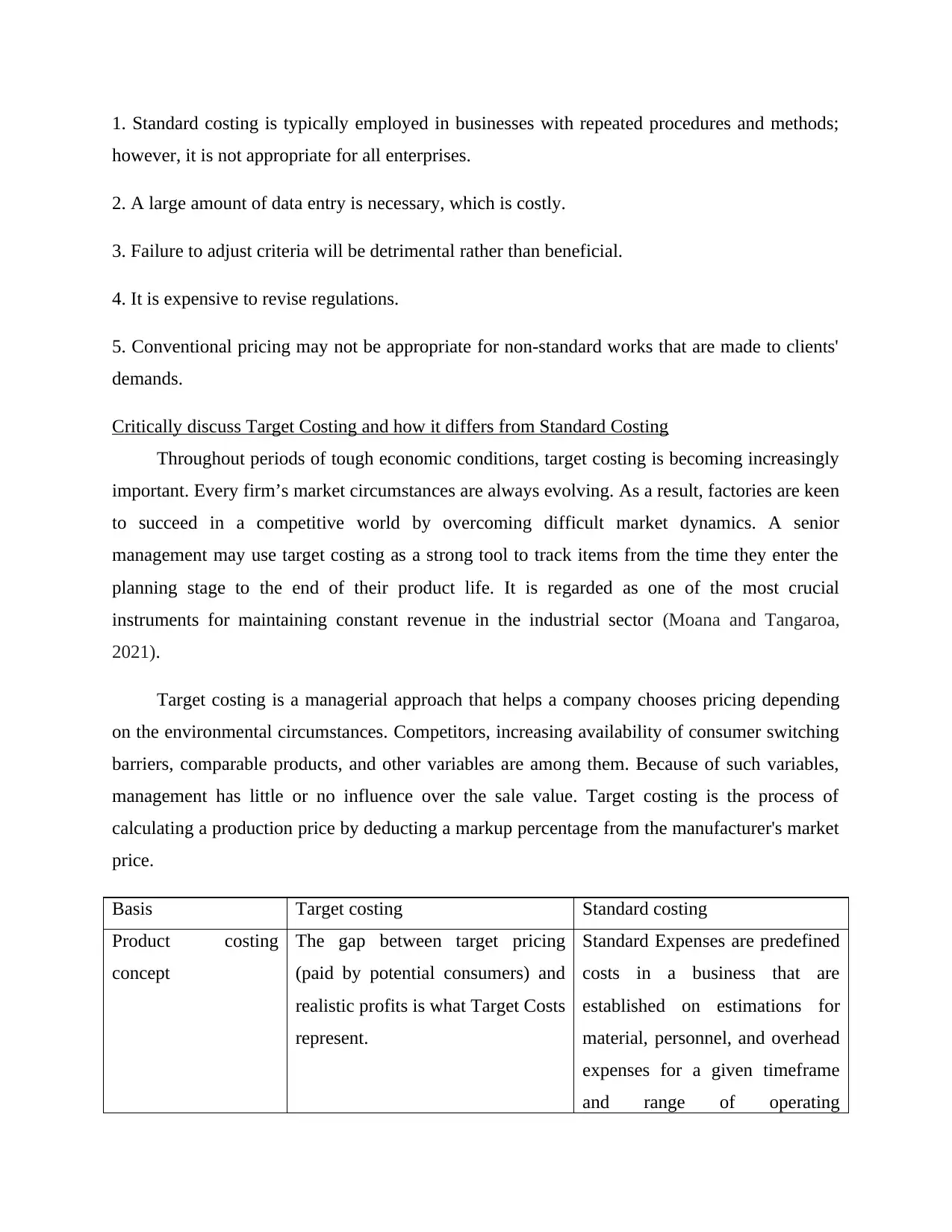
1. Standard costing is typically employed in businesses with repeated procedures and methods;
however, it is not appropriate for all enterprises.
2. A large amount of data entry is necessary, which is costly.
3. Failure to adjust criteria will be detrimental rather than beneficial.
4. It is expensive to revise regulations.
5. Conventional pricing may not be appropriate for non-standard works that are made to clients'
demands.
Critically discuss Target Costing and how it differs from Standard Costing
Throughout periods of tough economic conditions, target costing is becoming increasingly
important. Every firm’s market circumstances are always evolving. As a result, factories are keen
to succeed in a competitive world by overcoming difficult market dynamics. A senior
management may use target costing as a strong tool to track items from the time they enter the
planning stage to the end of their product life. It is regarded as one of the most crucial
instruments for maintaining constant revenue in the industrial sector (Moana and Tangaroa,
2021).
Target costing is a managerial approach that helps a company chooses pricing depending
on the environmental circumstances. Competitors, increasing availability of consumer switching
barriers, comparable products, and other variables are among them. Because of such variables,
management has little or no influence over the sale value. Target costing is the process of
calculating a production price by deducting a markup percentage from the manufacturer's market
price.
Basis Target costing Standard costing
Product costing
concept
The gap between target pricing
(paid by potential consumers) and
realistic profits is what Target Costs
represent.
Standard Expenses are predefined
costs in a business that are
established on estimations for
material, personnel, and overhead
expenses for a given timeframe
and range of operating
however, it is not appropriate for all enterprises.
2. A large amount of data entry is necessary, which is costly.
3. Failure to adjust criteria will be detrimental rather than beneficial.
4. It is expensive to revise regulations.
5. Conventional pricing may not be appropriate for non-standard works that are made to clients'
demands.
Critically discuss Target Costing and how it differs from Standard Costing
Throughout periods of tough economic conditions, target costing is becoming increasingly
important. Every firm’s market circumstances are always evolving. As a result, factories are keen
to succeed in a competitive world by overcoming difficult market dynamics. A senior
management may use target costing as a strong tool to track items from the time they enter the
planning stage to the end of their product life. It is regarded as one of the most crucial
instruments for maintaining constant revenue in the industrial sector (Moana and Tangaroa,
2021).
Target costing is a managerial approach that helps a company chooses pricing depending
on the environmental circumstances. Competitors, increasing availability of consumer switching
barriers, comparable products, and other variables are among them. Because of such variables,
management has little or no influence over the sale value. Target costing is the process of
calculating a production price by deducting a markup percentage from the manufacturer's market
price.
Basis Target costing Standard costing
Product costing
concept
The gap between target pricing
(paid by potential consumers) and
realistic profits is what Target Costs
represent.
Standard Expenses are predefined
costs in a business that are
established on estimations for
material, personnel, and overhead
expenses for a given timeframe
and range of operating
⊘ This is a preview!⊘
Do you want full access?
Subscribe today to unlock all pages.
Trusted by 1+ million students worldwide
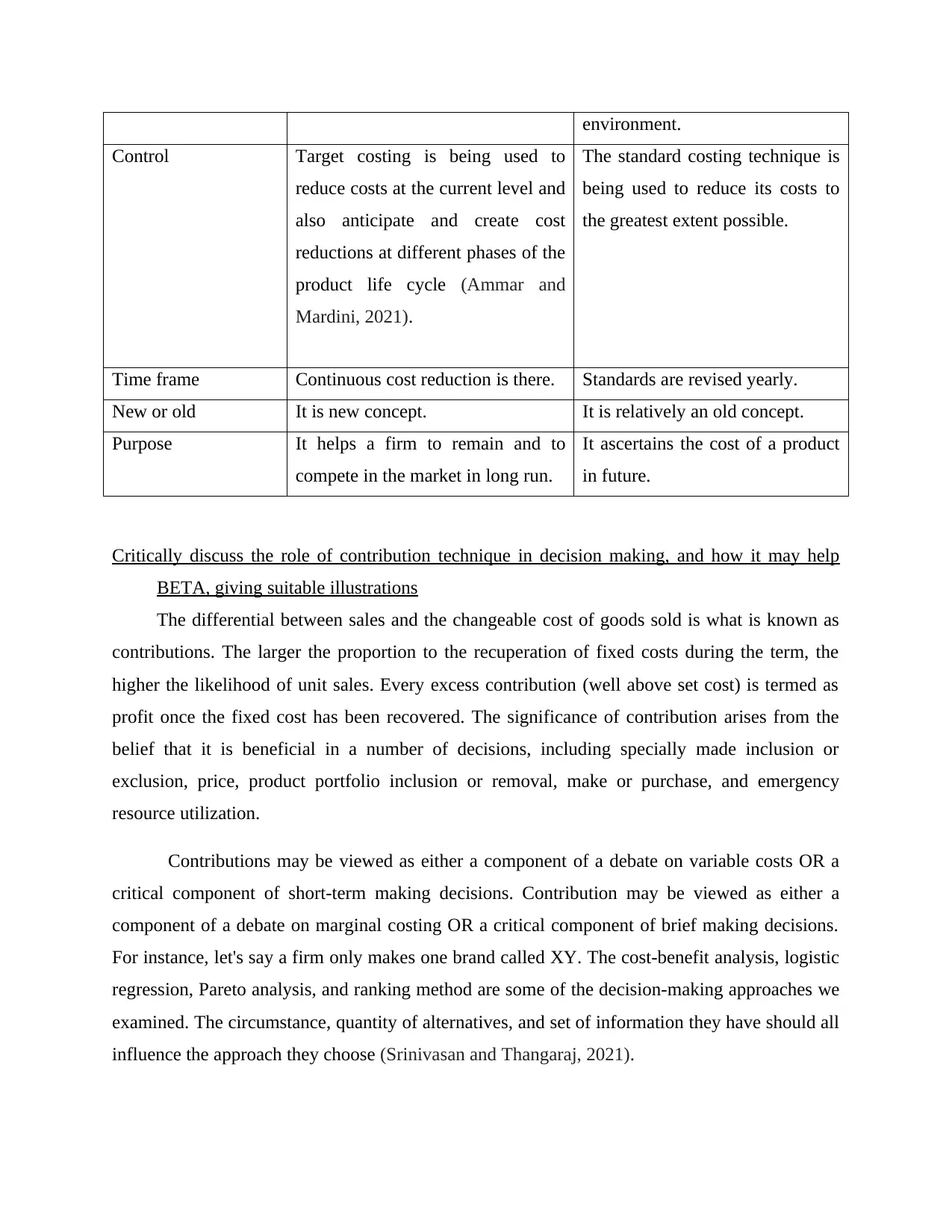
environment.
Control Target costing is being used to
reduce costs at the current level and
also anticipate and create cost
reductions at different phases of the
product life cycle (Ammar and
Mardini, 2021).
The standard costing technique is
being used to reduce its costs to
the greatest extent possible.
Time frame Continuous cost reduction is there. Standards are revised yearly.
New or old It is new concept. It is relatively an old concept.
Purpose It helps a firm to remain and to
compete in the market in long run.
It ascertains the cost of a product
in future.
Critically discuss the role of contribution technique in decision making, and how it may help
BETA, giving suitable illustrations
The differential between sales and the changeable cost of goods sold is what is known as
contributions. The larger the proportion to the recuperation of fixed costs during the term, the
higher the likelihood of unit sales. Every excess contribution (well above set cost) is termed as
profit once the fixed cost has been recovered. The significance of contribution arises from the
belief that it is beneficial in a number of decisions, including specially made inclusion or
exclusion, price, product portfolio inclusion or removal, make or purchase, and emergency
resource utilization.
Contributions may be viewed as either a component of a debate on variable costs OR a
critical component of short-term making decisions. Contribution may be viewed as either a
component of a debate on marginal costing OR a critical component of brief making decisions.
For instance, let's say a firm only makes one brand called XY. The cost-benefit analysis, logistic
regression, Pareto analysis, and ranking method are some of the decision-making approaches we
examined. The circumstance, quantity of alternatives, and set of information they have should all
influence the approach they choose (Srinivasan and Thangaraj, 2021).
Control Target costing is being used to
reduce costs at the current level and
also anticipate and create cost
reductions at different phases of the
product life cycle (Ammar and
Mardini, 2021).
The standard costing technique is
being used to reduce its costs to
the greatest extent possible.
Time frame Continuous cost reduction is there. Standards are revised yearly.
New or old It is new concept. It is relatively an old concept.
Purpose It helps a firm to remain and to
compete in the market in long run.
It ascertains the cost of a product
in future.
Critically discuss the role of contribution technique in decision making, and how it may help
BETA, giving suitable illustrations
The differential between sales and the changeable cost of goods sold is what is known as
contributions. The larger the proportion to the recuperation of fixed costs during the term, the
higher the likelihood of unit sales. Every excess contribution (well above set cost) is termed as
profit once the fixed cost has been recovered. The significance of contribution arises from the
belief that it is beneficial in a number of decisions, including specially made inclusion or
exclusion, price, product portfolio inclusion or removal, make or purchase, and emergency
resource utilization.
Contributions may be viewed as either a component of a debate on variable costs OR a
critical component of short-term making decisions. Contribution may be viewed as either a
component of a debate on marginal costing OR a critical component of brief making decisions.
For instance, let's say a firm only makes one brand called XY. The cost-benefit analysis, logistic
regression, Pareto analysis, and ranking method are some of the decision-making approaches we
examined. The circumstance, quantity of alternatives, and set of information they have should all
influence the approach they choose (Srinivasan and Thangaraj, 2021).
Paraphrase This Document
Need a fresh take? Get an instant paraphrase of this document with our AI Paraphraser
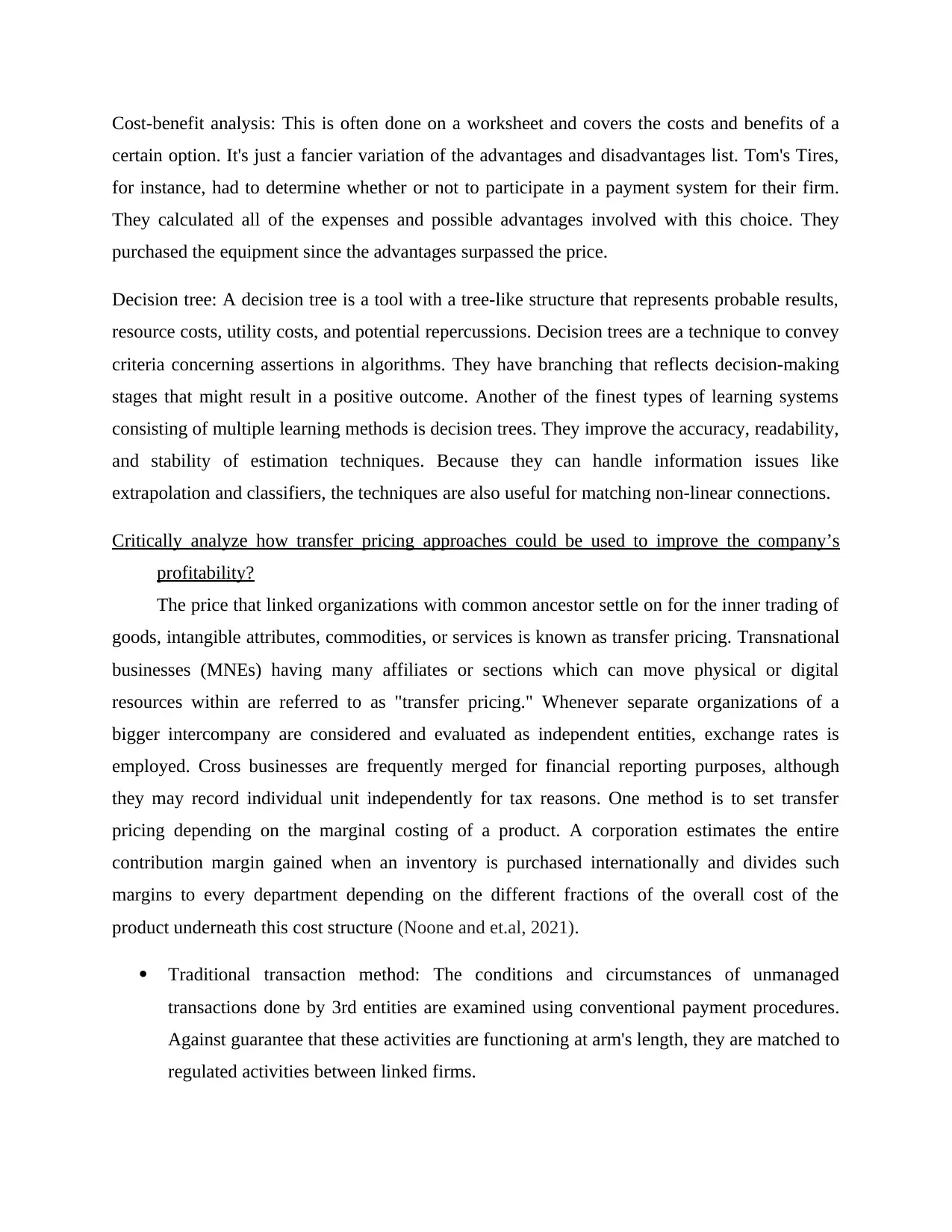
Cost-benefit analysis: This is often done on a worksheet and covers the costs and benefits of a
certain option. It's just a fancier variation of the advantages and disadvantages list. Tom's Tires,
for instance, had to determine whether or not to participate in a payment system for their firm.
They calculated all of the expenses and possible advantages involved with this choice. They
purchased the equipment since the advantages surpassed the price.
Decision tree: A decision tree is a tool with a tree-like structure that represents probable results,
resource costs, utility costs, and potential repercussions. Decision trees are a technique to convey
criteria concerning assertions in algorithms. They have branching that reflects decision-making
stages that might result in a positive outcome. Another of the finest types of learning systems
consisting of multiple learning methods is decision trees. They improve the accuracy, readability,
and stability of estimation techniques. Because they can handle information issues like
extrapolation and classifiers, the techniques are also useful for matching non-linear connections.
Critically analyze how transfer pricing approaches could be used to improve the company’s
profitability?
The price that linked organizations with common ancestor settle on for the inner trading of
goods, intangible attributes, commodities, or services is known as transfer pricing. Transnational
businesses (MNEs) having many affiliates or sections which can move physical or digital
resources within are referred to as "transfer pricing." Whenever separate organizations of a
bigger intercompany are considered and evaluated as independent entities, exchange rates is
employed. Cross businesses are frequently merged for financial reporting purposes, although
they may record individual unit independently for tax reasons. One method is to set transfer
pricing depending on the marginal costing of a product. A corporation estimates the entire
contribution margin gained when an inventory is purchased internationally and divides such
margins to every department depending on the different fractions of the overall cost of the
product underneath this cost structure (Noone and et.al, 2021).
Traditional transaction method: The conditions and circumstances of unmanaged
transactions done by 3rd entities are examined using conventional payment procedures.
Against guarantee that these activities are functioning at arm's length, they are matched to
regulated activities between linked firms.
certain option. It's just a fancier variation of the advantages and disadvantages list. Tom's Tires,
for instance, had to determine whether or not to participate in a payment system for their firm.
They calculated all of the expenses and possible advantages involved with this choice. They
purchased the equipment since the advantages surpassed the price.
Decision tree: A decision tree is a tool with a tree-like structure that represents probable results,
resource costs, utility costs, and potential repercussions. Decision trees are a technique to convey
criteria concerning assertions in algorithms. They have branching that reflects decision-making
stages that might result in a positive outcome. Another of the finest types of learning systems
consisting of multiple learning methods is decision trees. They improve the accuracy, readability,
and stability of estimation techniques. Because they can handle information issues like
extrapolation and classifiers, the techniques are also useful for matching non-linear connections.
Critically analyze how transfer pricing approaches could be used to improve the company’s
profitability?
The price that linked organizations with common ancestor settle on for the inner trading of
goods, intangible attributes, commodities, or services is known as transfer pricing. Transnational
businesses (MNEs) having many affiliates or sections which can move physical or digital
resources within are referred to as "transfer pricing." Whenever separate organizations of a
bigger intercompany are considered and evaluated as independent entities, exchange rates is
employed. Cross businesses are frequently merged for financial reporting purposes, although
they may record individual unit independently for tax reasons. One method is to set transfer
pricing depending on the marginal costing of a product. A corporation estimates the entire
contribution margin gained when an inventory is purchased internationally and divides such
margins to every department depending on the different fractions of the overall cost of the
product underneath this cost structure (Noone and et.al, 2021).
Traditional transaction method: The conditions and circumstances of unmanaged
transactions done by 3rd entities are examined using conventional payment procedures.
Against guarantee that these activities are functioning at arm's length, they are matched to
regulated activities between linked firms.
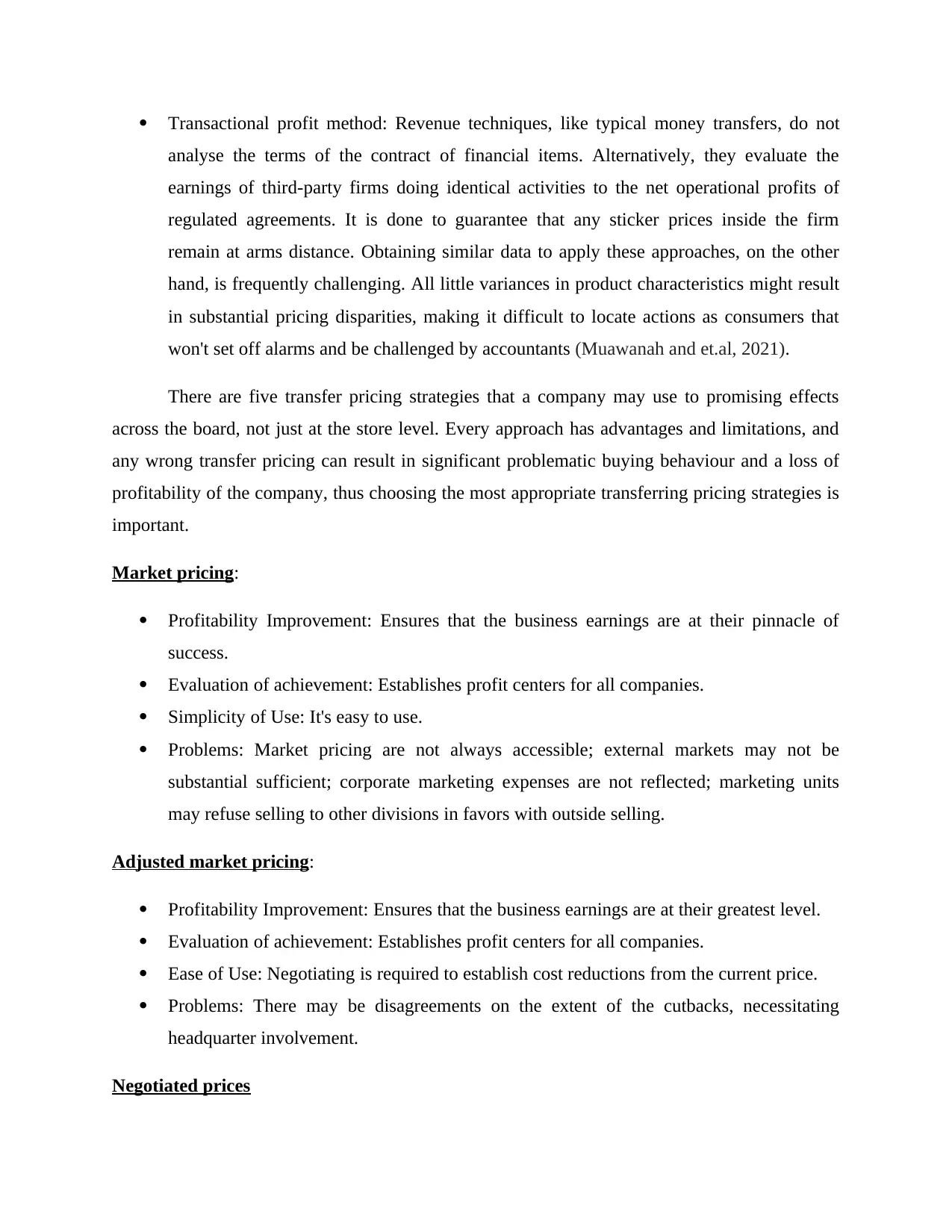
Transactional profit method: Revenue techniques, like typical money transfers, do not
analyse the terms of the contract of financial items. Alternatively, they evaluate the
earnings of third-party firms doing identical activities to the net operational profits of
regulated agreements. It is done to guarantee that any sticker prices inside the firm
remain at arms distance. Obtaining similar data to apply these approaches, on the other
hand, is frequently challenging. All little variances in product characteristics might result
in substantial pricing disparities, making it difficult to locate actions as consumers that
won't set off alarms and be challenged by accountants (Muawanah and et.al, 2021).
There are five transfer pricing strategies that a company may use to promising effects
across the board, not just at the store level. Every approach has advantages and limitations, and
any wrong transfer pricing can result in significant problematic buying behaviour and a loss of
profitability of the company, thus choosing the most appropriate transferring pricing strategies is
important.
Market pricing:
Profitability Improvement: Ensures that the business earnings are at their pinnacle of
success.
Evaluation of achievement: Establishes profit centers for all companies.
Simplicity of Use: It's easy to use.
Problems: Market pricing are not always accessible; external markets may not be
substantial sufficient; corporate marketing expenses are not reflected; marketing units
may refuse selling to other divisions in favors with outside selling.
Adjusted market pricing:
Profitability Improvement: Ensures that the business earnings are at their greatest level.
Evaluation of achievement: Establishes profit centers for all companies.
Ease of Use: Negotiating is required to establish cost reductions from the current price.
Problems: There may be disagreements on the extent of the cutbacks, necessitating
headquarter involvement.
Negotiated prices
analyse the terms of the contract of financial items. Alternatively, they evaluate the
earnings of third-party firms doing identical activities to the net operational profits of
regulated agreements. It is done to guarantee that any sticker prices inside the firm
remain at arms distance. Obtaining similar data to apply these approaches, on the other
hand, is frequently challenging. All little variances in product characteristics might result
in substantial pricing disparities, making it difficult to locate actions as consumers that
won't set off alarms and be challenged by accountants (Muawanah and et.al, 2021).
There are five transfer pricing strategies that a company may use to promising effects
across the board, not just at the store level. Every approach has advantages and limitations, and
any wrong transfer pricing can result in significant problematic buying behaviour and a loss of
profitability of the company, thus choosing the most appropriate transferring pricing strategies is
important.
Market pricing:
Profitability Improvement: Ensures that the business earnings are at their pinnacle of
success.
Evaluation of achievement: Establishes profit centers for all companies.
Simplicity of Use: It's easy to use.
Problems: Market pricing are not always accessible; external markets may not be
substantial sufficient; corporate marketing expenses are not reflected; marketing units
may refuse selling to other divisions in favors with outside selling.
Adjusted market pricing:
Profitability Improvement: Ensures that the business earnings are at their greatest level.
Evaluation of achievement: Establishes profit centers for all companies.
Ease of Use: Negotiating is required to establish cost reductions from the current price.
Problems: There may be disagreements on the extent of the cutbacks, necessitating
headquarter involvement.
Negotiated prices
⊘ This is a preview!⊘
Do you want full access?
Subscribe today to unlock all pages.
Trusted by 1+ million students worldwide
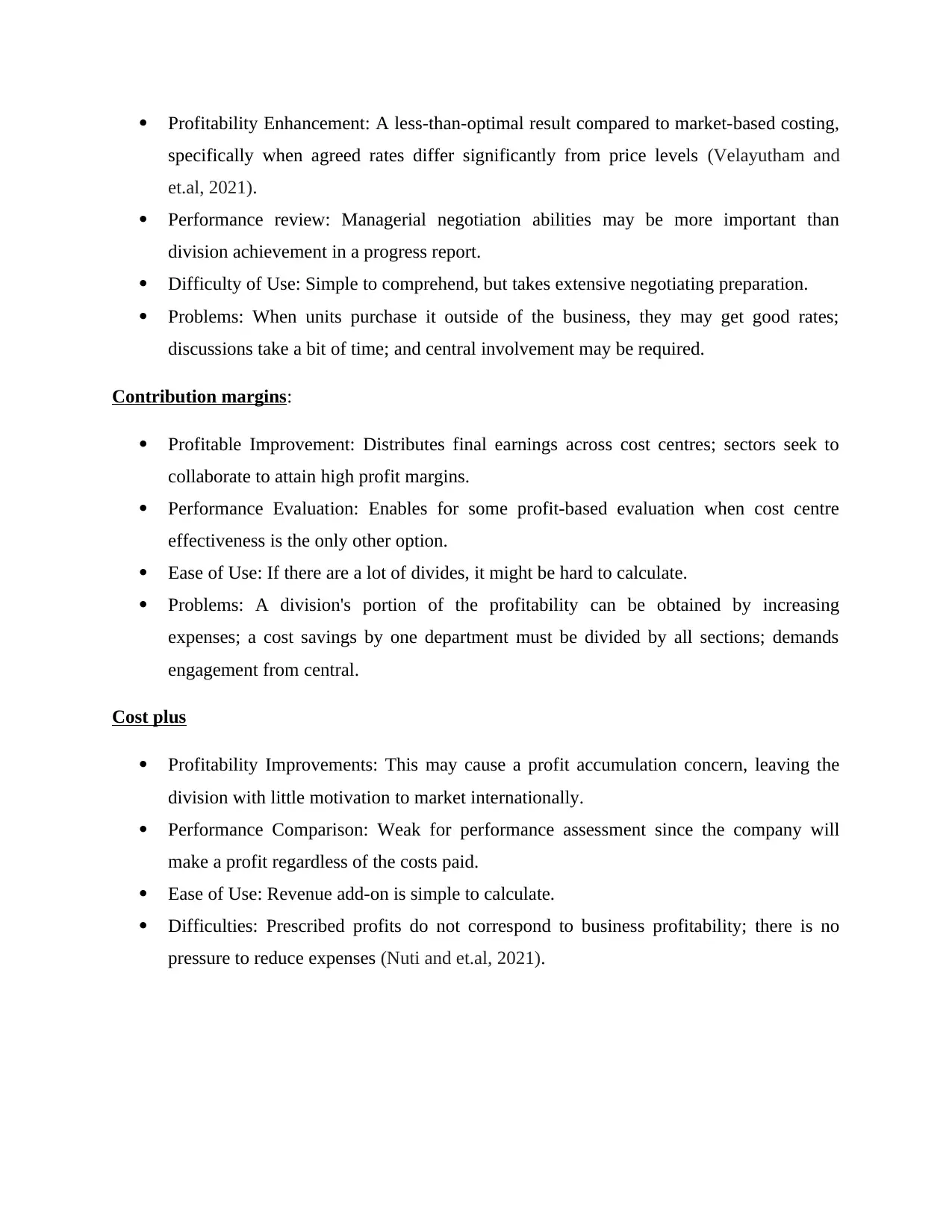
Profitability Enhancement: A less-than-optimal result compared to market-based costing,
specifically when agreed rates differ significantly from price levels (Velayutham and
et.al, 2021).
Performance review: Managerial negotiation abilities may be more important than
division achievement in a progress report.
Difficulty of Use: Simple to comprehend, but takes extensive negotiating preparation.
Problems: When units purchase it outside of the business, they may get good rates;
discussions take a bit of time; and central involvement may be required.
Contribution margins:
Profitable Improvement: Distributes final earnings across cost centres; sectors seek to
collaborate to attain high profit margins.
Performance Evaluation: Enables for some profit-based evaluation when cost centre
effectiveness is the only other option.
Ease of Use: If there are a lot of divides, it might be hard to calculate.
Problems: A division's portion of the profitability can be obtained by increasing
expenses; a cost savings by one department must be divided by all sections; demands
engagement from central.
Cost plus
Profitability Improvements: This may cause a profit accumulation concern, leaving the
division with little motivation to market internationally.
Performance Comparison: Weak for performance assessment since the company will
make a profit regardless of the costs paid.
Ease of Use: Revenue add-on is simple to calculate.
Difficulties: Prescribed profits do not correspond to business profitability; there is no
pressure to reduce expenses (Nuti and et.al, 2021).
specifically when agreed rates differ significantly from price levels (Velayutham and
et.al, 2021).
Performance review: Managerial negotiation abilities may be more important than
division achievement in a progress report.
Difficulty of Use: Simple to comprehend, but takes extensive negotiating preparation.
Problems: When units purchase it outside of the business, they may get good rates;
discussions take a bit of time; and central involvement may be required.
Contribution margins:
Profitable Improvement: Distributes final earnings across cost centres; sectors seek to
collaborate to attain high profit margins.
Performance Evaluation: Enables for some profit-based evaluation when cost centre
effectiveness is the only other option.
Ease of Use: If there are a lot of divides, it might be hard to calculate.
Problems: A division's portion of the profitability can be obtained by increasing
expenses; a cost savings by one department must be divided by all sections; demands
engagement from central.
Cost plus
Profitability Improvements: This may cause a profit accumulation concern, leaving the
division with little motivation to market internationally.
Performance Comparison: Weak for performance assessment since the company will
make a profit regardless of the costs paid.
Ease of Use: Revenue add-on is simple to calculate.
Difficulties: Prescribed profits do not correspond to business profitability; there is no
pressure to reduce expenses (Nuti and et.al, 2021).
Paraphrase This Document
Need a fresh take? Get an instant paraphrase of this document with our AI Paraphraser
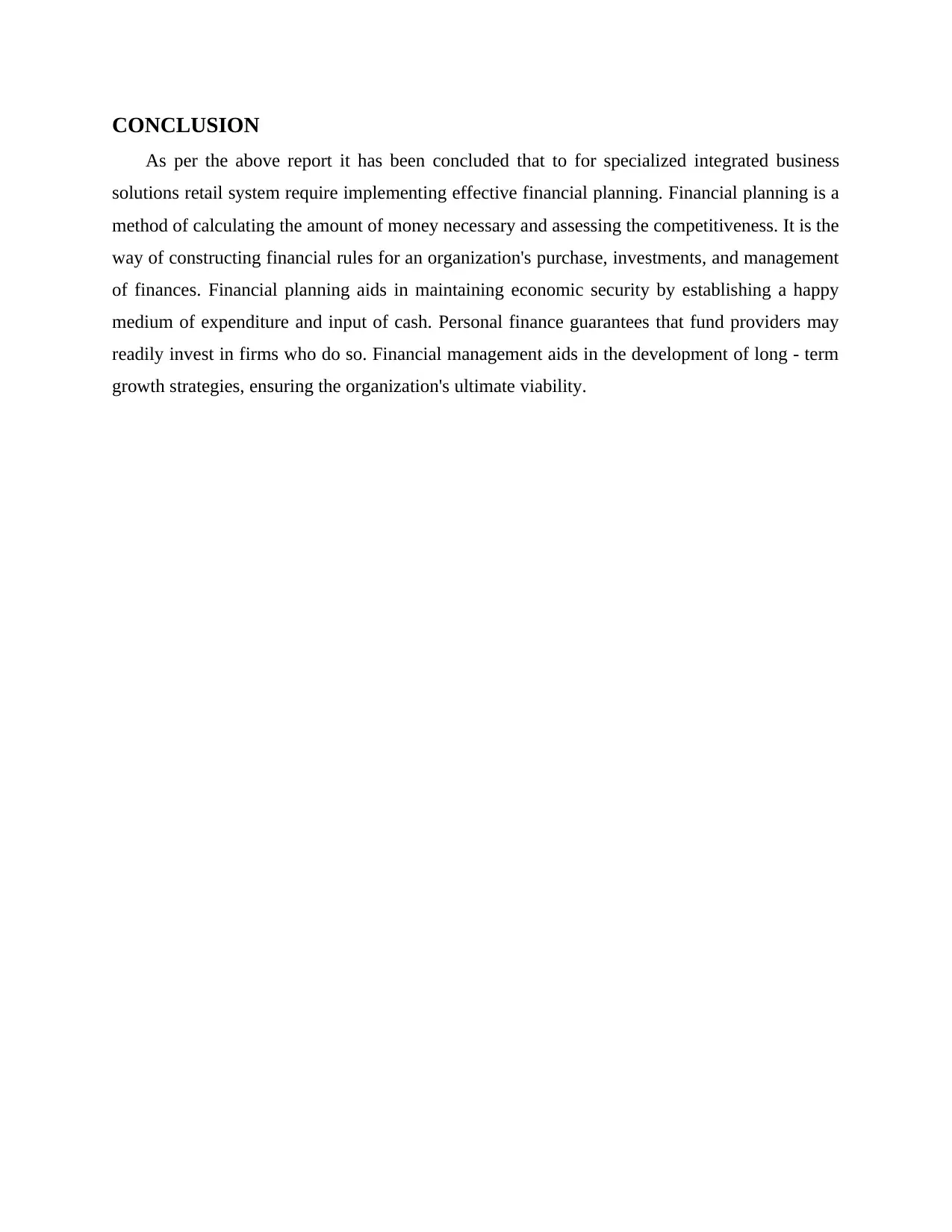
CONCLUSION
As per the above report it has been concluded that to for specialized integrated business
solutions retail system require implementing effective financial planning. Financial planning is a
method of calculating the amount of money necessary and assessing the competitiveness. It is the
way of constructing financial rules for an organization's purchase, investments, and management
of finances. Financial planning aids in maintaining economic security by establishing a happy
medium of expenditure and input of cash. Personal finance guarantees that fund providers may
readily invest in firms who do so. Financial management aids in the development of long - term
growth strategies, ensuring the organization's ultimate viability.
As per the above report it has been concluded that to for specialized integrated business
solutions retail system require implementing effective financial planning. Financial planning is a
method of calculating the amount of money necessary and assessing the competitiveness. It is the
way of constructing financial rules for an organization's purchase, investments, and management
of finances. Financial planning aids in maintaining economic security by establishing a happy
medium of expenditure and input of cash. Personal finance guarantees that fund providers may
readily invest in firms who do so. Financial management aids in the development of long - term
growth strategies, ensuring the organization's ultimate viability.
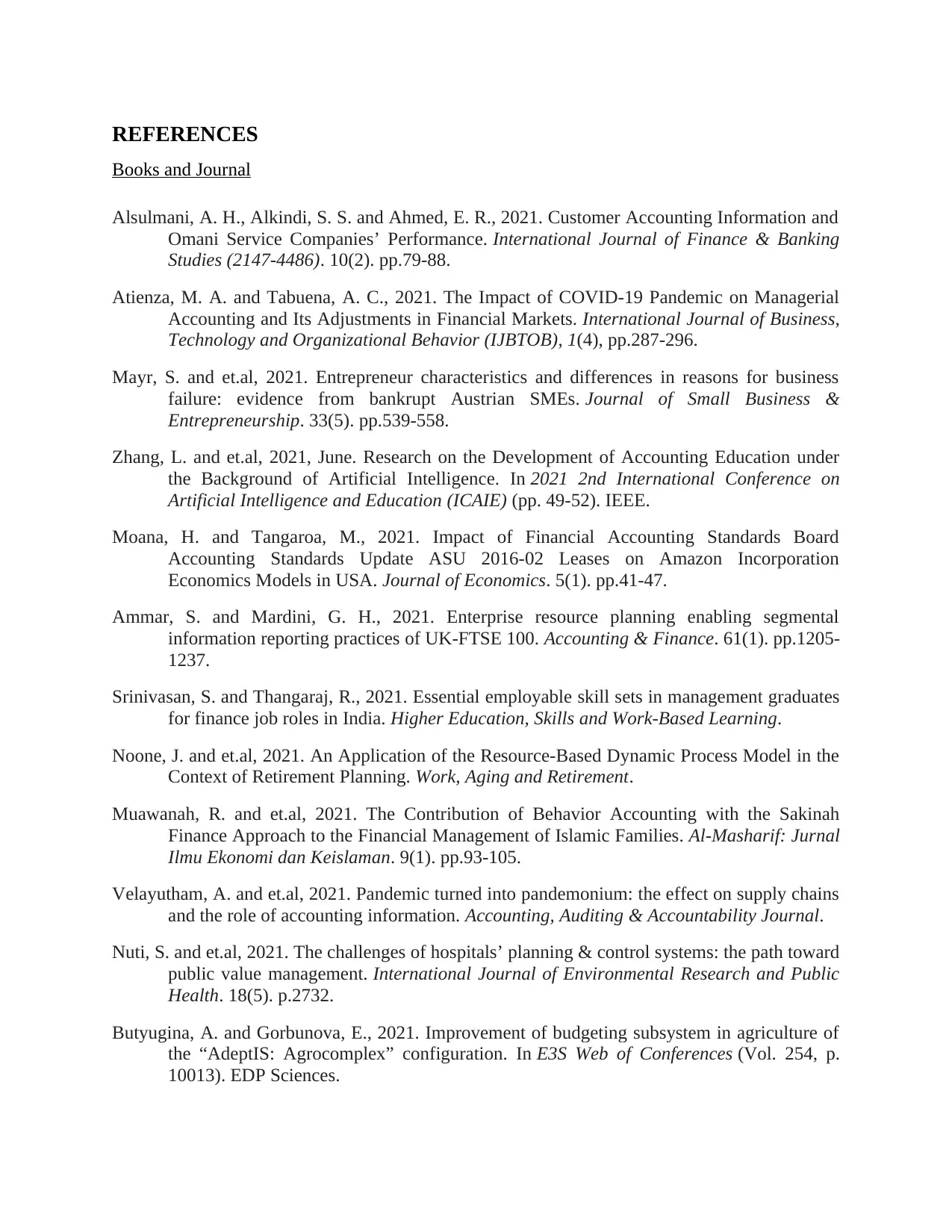
REFERENCES
Books and Journal
Alsulmani, A. H., Alkindi, S. S. and Ahmed, E. R., 2021. Customer Accounting Information and
Omani Service Companies’ Performance. International Journal of Finance & Banking
Studies (2147-4486). 10(2). pp.79-88.
Atienza, M. A. and Tabuena, A. C., 2021. The Impact of COVID-19 Pandemic on Managerial
Accounting and Its Adjustments in Financial Markets. International Journal of Business,
Technology and Organizational Behavior (IJBTOB), 1(4), pp.287-296.
Mayr, S. and et.al, 2021. Entrepreneur characteristics and differences in reasons for business
failure: evidence from bankrupt Austrian SMEs. Journal of Small Business &
Entrepreneurship. 33(5). pp.539-558.
Zhang, L. and et.al, 2021, June. Research on the Development of Accounting Education under
the Background of Artificial Intelligence. In 2021 2nd International Conference on
Artificial Intelligence and Education (ICAIE) (pp. 49-52). IEEE.
Moana, H. and Tangaroa, M., 2021. Impact of Financial Accounting Standards Board
Accounting Standards Update ASU 2016-02 Leases on Amazon Incorporation
Economics Models in USA. Journal of Economics. 5(1). pp.41-47.
Ammar, S. and Mardini, G. H., 2021. Enterprise resource planning enabling segmental
information reporting practices of UK‐FTSE 100. Accounting & Finance. 61(1). pp.1205-
1237.
Srinivasan, S. and Thangaraj, R., 2021. Essential employable skill sets in management graduates
for finance job roles in India. Higher Education, Skills and Work-Based Learning.
Noone, J. and et.al, 2021. An Application of the Resource-Based Dynamic Process Model in the
Context of Retirement Planning. Work, Aging and Retirement.
Muawanah, R. and et.al, 2021. The Contribution of Behavior Accounting with the Sakinah
Finance Approach to the Financial Management of Islamic Families. Al-Masharif: Jurnal
Ilmu Ekonomi dan Keislaman. 9(1). pp.93-105.
Velayutham, A. and et.al, 2021. Pandemic turned into pandemonium: the effect on supply chains
and the role of accounting information. Accounting, Auditing & Accountability Journal.
Nuti, S. and et.al, 2021. The challenges of hospitals’ planning & control systems: the path toward
public value management. International Journal of Environmental Research and Public
Health. 18(5). p.2732.
Butyugina, A. and Gorbunova, E., 2021. Improvement of budgeting subsystem in agriculture of
the “AdeptIS: Agrocomplex” configuration. In E3S Web of Conferences (Vol. 254, p.
10013). EDP Sciences.
Books and Journal
Alsulmani, A. H., Alkindi, S. S. and Ahmed, E. R., 2021. Customer Accounting Information and
Omani Service Companies’ Performance. International Journal of Finance & Banking
Studies (2147-4486). 10(2). pp.79-88.
Atienza, M. A. and Tabuena, A. C., 2021. The Impact of COVID-19 Pandemic on Managerial
Accounting and Its Adjustments in Financial Markets. International Journal of Business,
Technology and Organizational Behavior (IJBTOB), 1(4), pp.287-296.
Mayr, S. and et.al, 2021. Entrepreneur characteristics and differences in reasons for business
failure: evidence from bankrupt Austrian SMEs. Journal of Small Business &
Entrepreneurship. 33(5). pp.539-558.
Zhang, L. and et.al, 2021, June. Research on the Development of Accounting Education under
the Background of Artificial Intelligence. In 2021 2nd International Conference on
Artificial Intelligence and Education (ICAIE) (pp. 49-52). IEEE.
Moana, H. and Tangaroa, M., 2021. Impact of Financial Accounting Standards Board
Accounting Standards Update ASU 2016-02 Leases on Amazon Incorporation
Economics Models in USA. Journal of Economics. 5(1). pp.41-47.
Ammar, S. and Mardini, G. H., 2021. Enterprise resource planning enabling segmental
information reporting practices of UK‐FTSE 100. Accounting & Finance. 61(1). pp.1205-
1237.
Srinivasan, S. and Thangaraj, R., 2021. Essential employable skill sets in management graduates
for finance job roles in India. Higher Education, Skills and Work-Based Learning.
Noone, J. and et.al, 2021. An Application of the Resource-Based Dynamic Process Model in the
Context of Retirement Planning. Work, Aging and Retirement.
Muawanah, R. and et.al, 2021. The Contribution of Behavior Accounting with the Sakinah
Finance Approach to the Financial Management of Islamic Families. Al-Masharif: Jurnal
Ilmu Ekonomi dan Keislaman. 9(1). pp.93-105.
Velayutham, A. and et.al, 2021. Pandemic turned into pandemonium: the effect on supply chains
and the role of accounting information. Accounting, Auditing & Accountability Journal.
Nuti, S. and et.al, 2021. The challenges of hospitals’ planning & control systems: the path toward
public value management. International Journal of Environmental Research and Public
Health. 18(5). p.2732.
Butyugina, A. and Gorbunova, E., 2021. Improvement of budgeting subsystem in agriculture of
the “AdeptIS: Agrocomplex” configuration. In E3S Web of Conferences (Vol. 254, p.
10013). EDP Sciences.
⊘ This is a preview!⊘
Do you want full access?
Subscribe today to unlock all pages.
Trusted by 1+ million students worldwide

1 out of 13


Related Documents


Your All-in-One AI-Powered Toolkit for Academic Success.
+13062052269
info@desklib.com
Available 24*7 on WhatsApp / Email
![[object Object]](/_next/static/media/star-bottom.7253800d.svg)
Unlock your academic potential
Copyright © 2020–2026 A2Z Services. All Rights Reserved. Developed and managed by ZUCOL.