Management Accounting for Dairy: Cost Analysis and Profit Improvement
VerifiedAdded on 2024/05/27
|5
|933
|447
Homework Assignment
AI Summary
This assignment delves into the application of management accounting principles to analyze the cost structure of Australian dairy production. It examines whether dairy producers utilize job costing, process costing, or a combination of both, concluding that a hybrid approach is typically employed. A detailed product cost outline is presented, breaking down the costs associated with producing a dozen bottles of milk, highlighting raw milk as the most significant expense. Furthermore, the assignment identifies key factors beyond production costs, such as scale, competition, transport issues, workforce, regulatory standards, and research & development, that can improve net profit for dairy producers. The analysis emphasizes the importance of operational efficiency, adherence to regulatory standards, and innovation in achieving higher profitability in the dairy industry.
Management Accounting
1
1
Paraphrase This Document
Need a fresh take? Get an instant paraphrase of this document with our AI Paraphraser

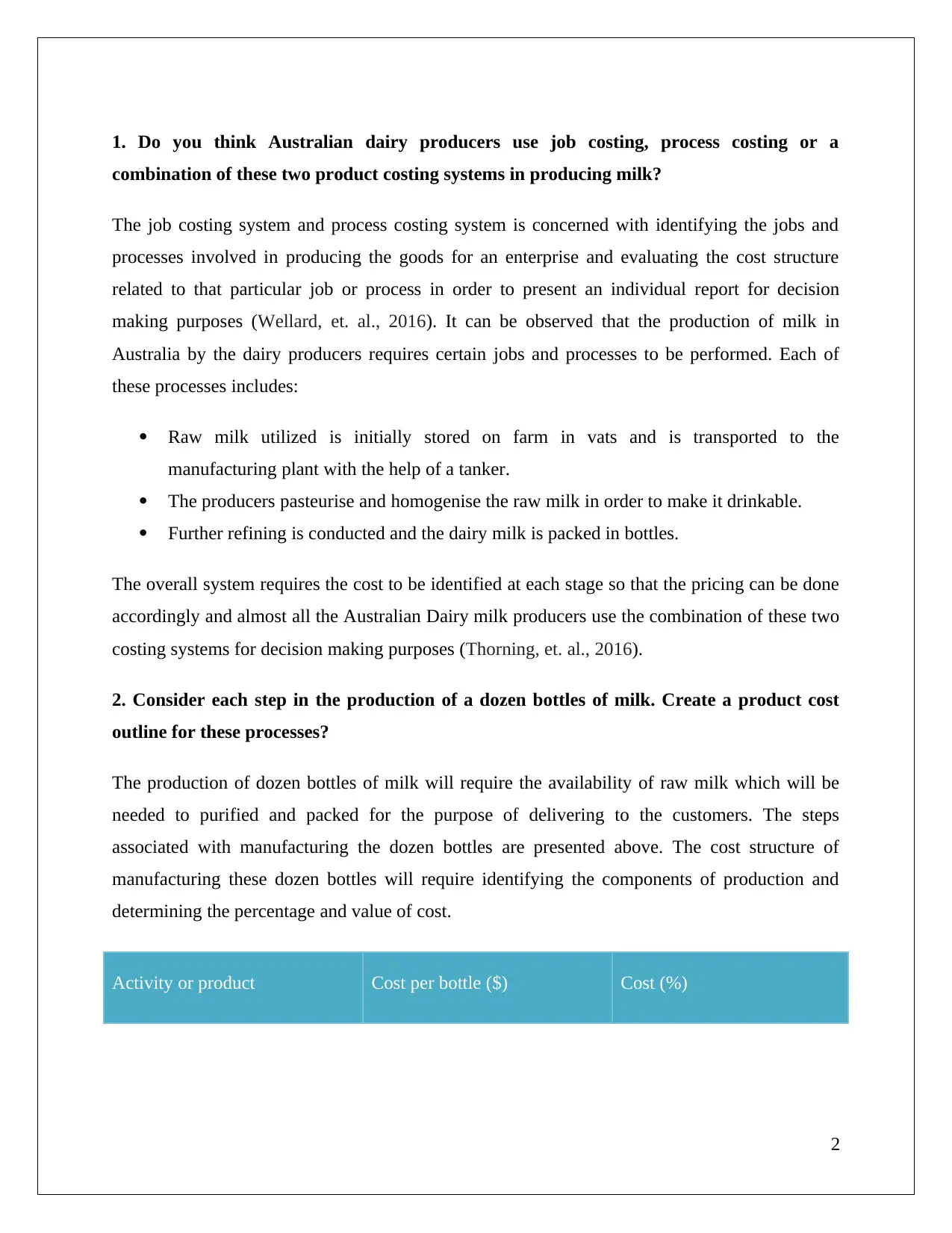
1. Do you think Australian dairy producers use job costing, process costing or a
combination of these two product costing systems in producing milk?
The job costing system and process costing system is concerned with identifying the jobs and
processes involved in producing the goods for an enterprise and evaluating the cost structure
related to that particular job or process in order to present an individual report for decision
making purposes (Wellard, et. al., 2016). It can be observed that the production of milk in
Australia by the dairy producers requires certain jobs and processes to be performed. Each of
these processes includes:
Raw milk utilized is initially stored on farm in vats and is transported to the
manufacturing plant with the help of a tanker.
The producers pasteurise and homogenise the raw milk in order to make it drinkable.
Further refining is conducted and the dairy milk is packed in bottles.
The overall system requires the cost to be identified at each stage so that the pricing can be done
accordingly and almost all the Australian Dairy milk producers use the combination of these two
costing systems for decision making purposes (Thorning, et. al., 2016).
2. Consider each step in the production of a dozen bottles of milk. Create a product cost
outline for these processes?
The production of dozen bottles of milk will require the availability of raw milk which will be
needed to purified and packed for the purpose of delivering to the customers. The steps
associated with manufacturing the dozen bottles are presented above. The cost structure of
manufacturing these dozen bottles will require identifying the components of production and
determining the percentage and value of cost.
Activity or product Cost per bottle ($) Cost (%)
2
combination of these two product costing systems in producing milk?
The job costing system and process costing system is concerned with identifying the jobs and
processes involved in producing the goods for an enterprise and evaluating the cost structure
related to that particular job or process in order to present an individual report for decision
making purposes (Wellard, et. al., 2016). It can be observed that the production of milk in
Australia by the dairy producers requires certain jobs and processes to be performed. Each of
these processes includes:
Raw milk utilized is initially stored on farm in vats and is transported to the
manufacturing plant with the help of a tanker.
The producers pasteurise and homogenise the raw milk in order to make it drinkable.
Further refining is conducted and the dairy milk is packed in bottles.
The overall system requires the cost to be identified at each stage so that the pricing can be done
accordingly and almost all the Australian Dairy milk producers use the combination of these two
costing systems for decision making purposes (Thorning, et. al., 2016).
2. Consider each step in the production of a dozen bottles of milk. Create a product cost
outline for these processes?
The production of dozen bottles of milk will require the availability of raw milk which will be
needed to purified and packed for the purpose of delivering to the customers. The steps
associated with manufacturing the dozen bottles are presented above. The cost structure of
manufacturing these dozen bottles will require identifying the components of production and
determining the percentage and value of cost.
Activity or product Cost per bottle ($) Cost (%)
2

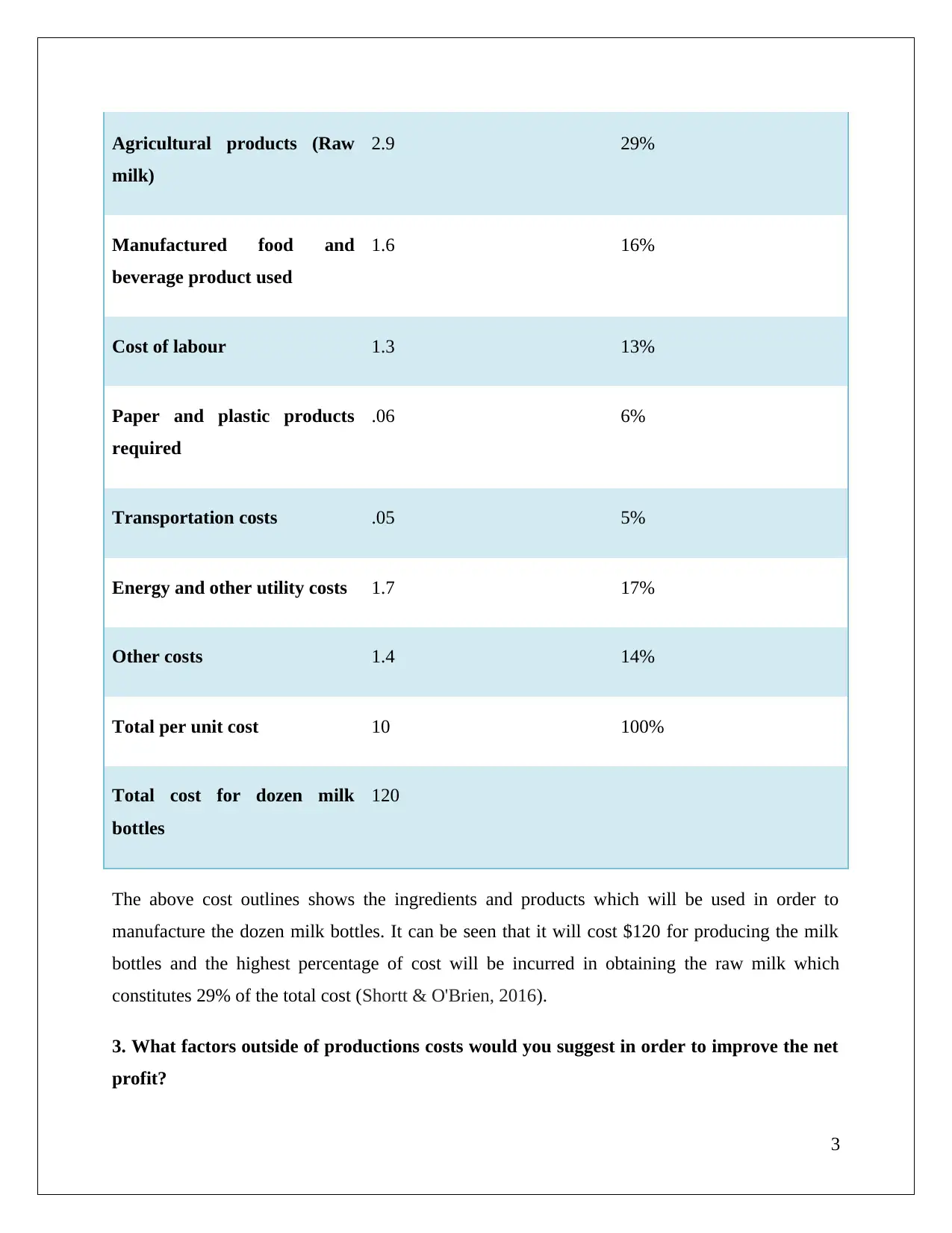
Agricultural products (Raw
milk)
2.9 29%
Manufactured food and
beverage product used
1.6 16%
Cost of labour 1.3 13%
Paper and plastic products
required
.06 6%
Transportation costs .05 5%
Energy and other utility costs 1.7 17%
Other costs 1.4 14%
Total per unit cost 10 100%
Total cost for dozen milk
bottles
120
The above cost outlines shows the ingredients and products which will be used in order to
manufacture the dozen milk bottles. It can be seen that it will cost $120 for producing the milk
bottles and the highest percentage of cost will be incurred in obtaining the raw milk which
constitutes 29% of the total cost (Shortt & O'Brien, 2016).
3. What factors outside of productions costs would you suggest in order to improve the net
profit?
3
milk)
2.9 29%
Manufactured food and
beverage product used
1.6 16%
Cost of labour 1.3 13%
Paper and plastic products
required
.06 6%
Transportation costs .05 5%
Energy and other utility costs 1.7 17%
Other costs 1.4 14%
Total per unit cost 10 100%
Total cost for dozen milk
bottles
120
The above cost outlines shows the ingredients and products which will be used in order to
manufacture the dozen milk bottles. It can be seen that it will cost $120 for producing the milk
bottles and the highest percentage of cost will be incurred in obtaining the raw milk which
constitutes 29% of the total cost (Shortt & O'Brien, 2016).
3. What factors outside of productions costs would you suggest in order to improve the net
profit?
3
⊘ This is a preview!⊘
Do you want full access?
Subscribe today to unlock all pages.

Trusted by 1+ million students worldwide

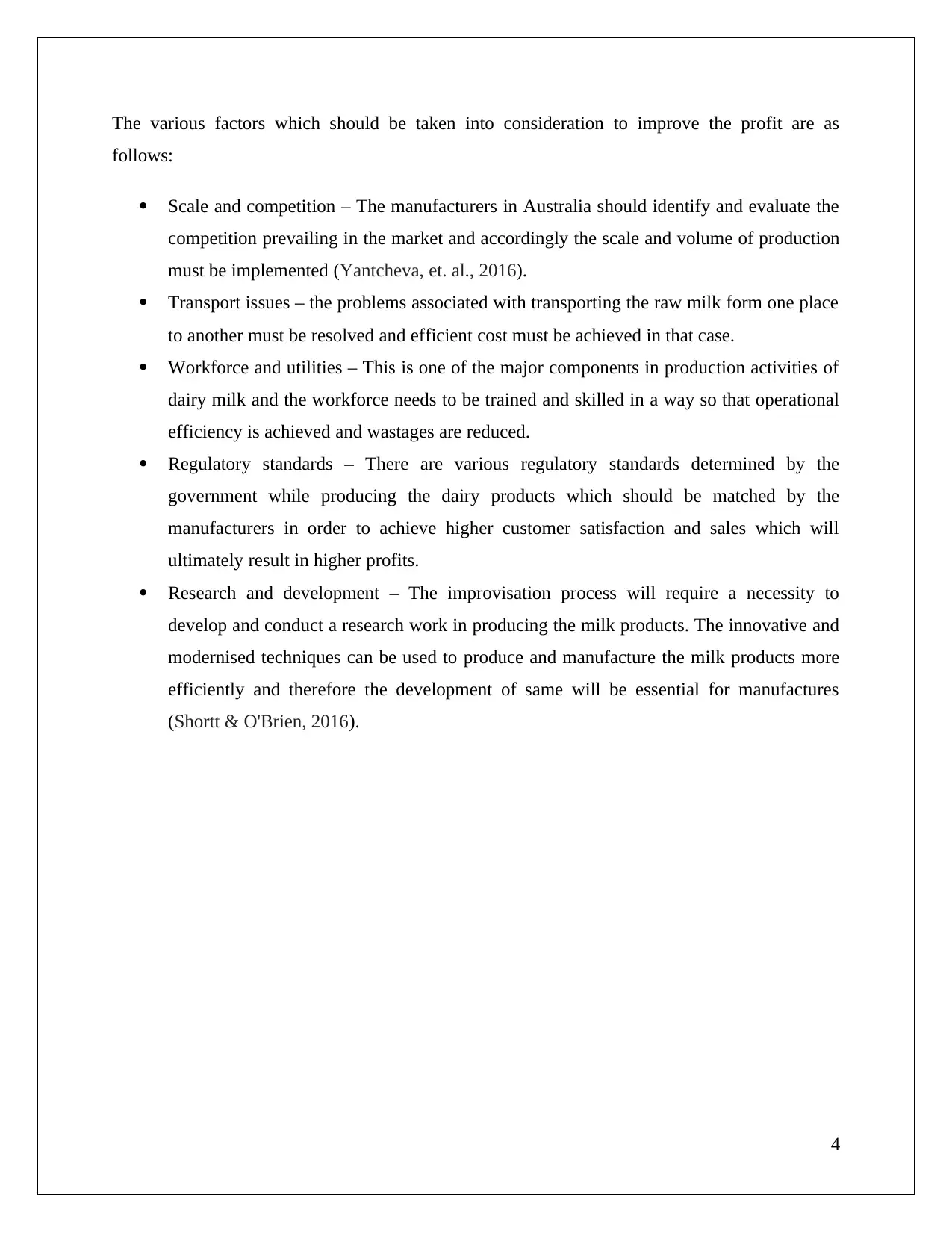
The various factors which should be taken into consideration to improve the profit are as
follows:
Scale and competition – The manufacturers in Australia should identify and evaluate the
competition prevailing in the market and accordingly the scale and volume of production
must be implemented (Yantcheva, et. al., 2016).
Transport issues – the problems associated with transporting the raw milk form one place
to another must be resolved and efficient cost must be achieved in that case.
Workforce and utilities – This is one of the major components in production activities of
dairy milk and the workforce needs to be trained and skilled in a way so that operational
efficiency is achieved and wastages are reduced.
Regulatory standards – There are various regulatory standards determined by the
government while producing the dairy products which should be matched by the
manufacturers in order to achieve higher customer satisfaction and sales which will
ultimately result in higher profits.
Research and development – The improvisation process will require a necessity to
develop and conduct a research work in producing the milk products. The innovative and
modernised techniques can be used to produce and manufacture the milk products more
efficiently and therefore the development of same will be essential for manufactures
(Shortt & O'Brien, 2016).
4
follows:
Scale and competition – The manufacturers in Australia should identify and evaluate the
competition prevailing in the market and accordingly the scale and volume of production
must be implemented (Yantcheva, et. al., 2016).
Transport issues – the problems associated with transporting the raw milk form one place
to another must be resolved and efficient cost must be achieved in that case.
Workforce and utilities – This is one of the major components in production activities of
dairy milk and the workforce needs to be trained and skilled in a way so that operational
efficiency is achieved and wastages are reduced.
Regulatory standards – There are various regulatory standards determined by the
government while producing the dairy products which should be matched by the
manufacturers in order to achieve higher customer satisfaction and sales which will
ultimately result in higher profits.
Research and development – The improvisation process will require a necessity to
develop and conduct a research work in producing the milk products. The innovative and
modernised techniques can be used to produce and manufacture the milk products more
efficiently and therefore the development of same will be essential for manufactures
(Shortt & O'Brien, 2016).
4
Paraphrase This Document
Need a fresh take? Get an instant paraphrase of this document with our AI Paraphraser

References:
Shortt, C., & O'Brien, J. (2016). Overview of opportunities for health-enhancing
functional dairy products. In Handbook of functional dairy products (pp. 19-30). CRC
press.
Shortt, C., & O'Brien, J. (Eds.). (2016). Handbook of functional dairy products. CRC
Press.
Thorning, T. K., Raben, A., Tholstrup, T., Soedamah-Muthu, S. S., Givens, I., & Astrup,
A. (2016). Milk and dairy products: good or bad for human health? An assessment of the
totality of scientific evidence. Food & nutrition research, 60(1), 32527.
Wellard, L., Hughes, C., & Watson, W. L. (2016). Investigating nutrient profiling and
Health Star Ratings on core dairy products in Australia. Public health nutrition, 19(15),
2860-2865.
Yantcheva, B., Golley, S., Topping, D., & Mohr, P. (2016). Food avoidance in an
Australian adult population sample: the case of dairy products. Public health
nutrition, 19(9), 1616-1623.
5
Shortt, C., & O'Brien, J. (2016). Overview of opportunities for health-enhancing
functional dairy products. In Handbook of functional dairy products (pp. 19-30). CRC
press.
Shortt, C., & O'Brien, J. (Eds.). (2016). Handbook of functional dairy products. CRC
Press.
Thorning, T. K., Raben, A., Tholstrup, T., Soedamah-Muthu, S. S., Givens, I., & Astrup,
A. (2016). Milk and dairy products: good or bad for human health? An assessment of the
totality of scientific evidence. Food & nutrition research, 60(1), 32527.
Wellard, L., Hughes, C., & Watson, W. L. (2016). Investigating nutrient profiling and
Health Star Ratings on core dairy products in Australia. Public health nutrition, 19(15),
2860-2865.
Yantcheva, B., Golley, S., Topping, D., & Mohr, P. (2016). Food avoidance in an
Australian adult population sample: the case of dairy products. Public health
nutrition, 19(9), 1616-1623.
5
1 out of 5
Related Documents
Your All-in-One AI-Powered Toolkit for Academic Success.
+13062052269
info@desklib.com
Available 24*7 on WhatsApp / Email
Unlock your academic potential
Copyright © 2020–2026 A2Z Services. All Rights Reserved. Developed and managed by ZUCOL.