Management Accounting Report: Analysis of Big Bear Food Company
VerifiedAdded on 2020/02/17
|19
|6267
|251
Report
AI Summary
This report delves into the core principles of management accounting, providing a comprehensive analysis of its role in financial planning and decision-making within organizations. It explores the fundamental aspects of management accounting, including explaining the different types of management systems, emphasizing their significance in collecting, arranging, and communicating financial data. The report then transitions to the practical application of management accounting techniques, such as activity-based costing and transfer pricing, illustrated with a case study of Big Bear Food Company. It also examines various planning tools used in management accounting, detailing their advantages and limitations. Furthermore, the report analyzes different methods for preparing management accounting reports, including budget reports, accounts receivable aging reports, job cost reports, and inventory and manufacturing reports. Finally, the report compares the ways organizations react to financial problems using management accounting, providing a conclusion and recommendations for effective financial management.
STUDENT NAME:
STUDENT ID:
SUBJECT CODE:
ASSIGNMENT TITLE: MANAGEMENT ACCOUNTING
STUDENT ID:
SUBJECT CODE:
ASSIGNMENT TITLE: MANAGEMENT ACCOUNTING

Paraphrase This Document
Need a fresh take? Get an instant paraphrase of this document with our AI Paraphraser
TABLE OF CONTENTS
INTRODUCTION...........................................................................................................................1
Task 1...............................................................................................................................................1
P1: Explaining management accounting and demonstrating the requirements of various types of
management system.........................................................................................................................1
P2: Different methods for preparing management accounting report.............................................5
Task 2...............................................................................................................................................7
LO 2: Application of a range of management accounting techniques.............................................7
P3: Calculation of costs...................................................................................................................7
Task 3.............................................................................................................................................10
LO 3: Explanation on the ‘planning tools’ used in the field of Management Accounting ...........10
P4: Advantages and limitations of the ‘planning tools’ with respect to the scenario under
consideration..................................................................................................................................10
Task 4.............................................................................................................................................13
LO 4: Comparison of the different ways by which Organizations react to the financial problems
using management accounting.......................................................................................................13
P5: Comparison of the accounting system implemented in companies to tackle the financial
problems ........................................................................................................................................13
Conclusion and Recommendation.................................................................................................15
Reference list.................................................................................................................................16
INTRODUCTION...........................................................................................................................1
Task 1...............................................................................................................................................1
P1: Explaining management accounting and demonstrating the requirements of various types of
management system.........................................................................................................................1
P2: Different methods for preparing management accounting report.............................................5
Task 2...............................................................................................................................................7
LO 2: Application of a range of management accounting techniques.............................................7
P3: Calculation of costs...................................................................................................................7
Task 3.............................................................................................................................................10
LO 3: Explanation on the ‘planning tools’ used in the field of Management Accounting ...........10
P4: Advantages and limitations of the ‘planning tools’ with respect to the scenario under
consideration..................................................................................................................................10
Task 4.............................................................................................................................................13
LO 4: Comparison of the different ways by which Organizations react to the financial problems
using management accounting.......................................................................................................13
P5: Comparison of the accounting system implemented in companies to tackle the financial
problems ........................................................................................................................................13
Conclusion and Recommendation.................................................................................................15
Reference list.................................................................................................................................16
INTRODUCTION
Management accounting refer to the method in which organisation store financial data for
systematic planning of business and it also helps management body of an organisation to take
financial and non-financial decision relating to the firm. The process measures, identify,
interpret and communicate information throughout the business environment to achieve goals of
organisation. Alternatively, the role accounting plays to supply information, which will assist
management in planning economical structure, controlling cost, decision making, and to increase
profitability of business is termed as Management accounting. The user of accounting
information who will be benefited from management accounting can be divided into two groups.
The groups are internal manager and external parties. Internal managers group are divided into
two part again one who makes short-run planning and another who make decisions to formulate
policies. External parties refer to shareholders, investors, associate partners and others. Here in
the study a manufacturing organisation Big Bear (Food Company) has been selected to interpret
management accounting system of the company which will give clear concept of fundamental of
Management accounting.
Overview of company
Big bear Limited supply foods, it is situated at Leicester, London and owned brands of different
company such as XXX mints, Sugar Puffs and others. The company was established in 2011 by
Raisio Group and specialised the brands which is unknown or have household names. The
company operate small-size business by producing different food products.
Task 1
P1: Explaining management accounting and demonstrating the requirements
of various types of management system
Management accounting focuses areas of accounting which help management in financial
planning and they prepared principles by interpreting financial data available in business sectors.
Management accounting gives information to management body which will assist them to take
decisions and fulfil objectives of business (Kaplan and Atkinson, 2015, p.47). The basic
objective of management accounting are discussed below-
formulate policy related to financial management
plan for future events to cooperate with internal and external changes of business
1
Management accounting refer to the method in which organisation store financial data for
systematic planning of business and it also helps management body of an organisation to take
financial and non-financial decision relating to the firm. The process measures, identify,
interpret and communicate information throughout the business environment to achieve goals of
organisation. Alternatively, the role accounting plays to supply information, which will assist
management in planning economical structure, controlling cost, decision making, and to increase
profitability of business is termed as Management accounting. The user of accounting
information who will be benefited from management accounting can be divided into two groups.
The groups are internal manager and external parties. Internal managers group are divided into
two part again one who makes short-run planning and another who make decisions to formulate
policies. External parties refer to shareholders, investors, associate partners and others. Here in
the study a manufacturing organisation Big Bear (Food Company) has been selected to interpret
management accounting system of the company which will give clear concept of fundamental of
Management accounting.
Overview of company
Big bear Limited supply foods, it is situated at Leicester, London and owned brands of different
company such as XXX mints, Sugar Puffs and others. The company was established in 2011 by
Raisio Group and specialised the brands which is unknown or have household names. The
company operate small-size business by producing different food products.
Task 1
P1: Explaining management accounting and demonstrating the requirements
of various types of management system
Management accounting focuses areas of accounting which help management in financial
planning and they prepared principles by interpreting financial data available in business sectors.
Management accounting gives information to management body which will assist them to take
decisions and fulfil objectives of business (Kaplan and Atkinson, 2015, p.47). The basic
objective of management accounting are discussed below-
formulate policy related to financial management
plan for future events to cooperate with internal and external changes of business
1
⊘ This is a preview!⊘
Do you want full access?
Subscribe today to unlock all pages.

Trusted by 1+ million students worldwide
monitoring performance to use resources efficiently and control daily activities of firm
comparing between alternative scenarios of business to assess growth and implement new
methods to improve quality of product
solving financial problems and achieving business targets
Considering behavioural factors that can affect business activities
An accounting system always provide various ways to collect, arrange and communicate
information related to financial activities of firm to organise different elements of firm
systematically (Zimmerman and Yahya-Zadeh, 2011, p.258). Management accounting is
different from actual accounting system, it basically focused on collecting information about
product or cost of specific operation at detail level which will help higher authority to take
decision especially financial decision. The work of management accounting involves around
identifying different types of resolution management will need to carry on business activities
(Ward, 2012, p.36). The decisions which are concerned with management accounting are of two
types, output decision and input decision. Output decision relates with quantity, quality and price
of goods or product supplied by company and Input decision deals with production elements
such as labour, raw materials, capital investments and equipments.
Both the decision discussed above are interconnected thus, for management accounting
managerial planning is necessary which involves seven stages. These stages are also appropriate
for small enterprises as selected above Big Bear (Food Company) for efficient management
accounting system in their manufacturing company. Management accounting has responsibility,
which includes:
Planning: By planning, the accounting manager gets ready for application of the structured
process as per the raised budget of the overall business.
Implementation: After planning the activities the factors essential for implementation are
performed on the workforce is done as an activity as per the raised situation.
Controlling: The workforce of the concerned firm is controlled in order to stabilize the
increasing budget of the firm.
2
comparing between alternative scenarios of business to assess growth and implement new
methods to improve quality of product
solving financial problems and achieving business targets
Considering behavioural factors that can affect business activities
An accounting system always provide various ways to collect, arrange and communicate
information related to financial activities of firm to organise different elements of firm
systematically (Zimmerman and Yahya-Zadeh, 2011, p.258). Management accounting is
different from actual accounting system, it basically focused on collecting information about
product or cost of specific operation at detail level which will help higher authority to take
decision especially financial decision. The work of management accounting involves around
identifying different types of resolution management will need to carry on business activities
(Ward, 2012, p.36). The decisions which are concerned with management accounting are of two
types, output decision and input decision. Output decision relates with quantity, quality and price
of goods or product supplied by company and Input decision deals with production elements
such as labour, raw materials, capital investments and equipments.
Both the decision discussed above are interconnected thus, for management accounting
managerial planning is necessary which involves seven stages. These stages are also appropriate
for small enterprises as selected above Big Bear (Food Company) for efficient management
accounting system in their manufacturing company. Management accounting has responsibility,
which includes:
Planning: By planning, the accounting manager gets ready for application of the structured
process as per the raised budget of the overall business.
Implementation: After planning the activities the factors essential for implementation are
performed on the workforce is done as an activity as per the raised situation.
Controlling: The workforce of the concerned firm is controlled in order to stabilize the
increasing budget of the firm.
2
Paraphrase This Document
Need a fresh take? Get an instant paraphrase of this document with our AI Paraphraser
Monitoring performance: The performance of the employees is then monitored in order to
avoid flaws that may be faced in the long run of the firm.
Motivating employee: The employees must be motivated in order to gain quality goods and
services for their customers. Therefore, the concerned organization makes effort to motivate their
employees in terms of satisfactory salary and rewarding them as per their capabilities and
performances.
Communicating information: The communication process is again well maintained in order to
keep both the organization and their employees connected to their target audiences.
Different types of management accounting
Management accountings are of different types such as Activity-Based costing, Resource
consumption accounting, Throughput accounting, Transfer pricing and Lean accounting. Here
two types of management accounting related with manufacturing industries are discussed below
briefly to understand the concept of management accounting.
Activity based costing (ABC)
The concept of Activity based costing was explained clearly by Robert S. Kalpan and W. Bruns
in 1987. This method identifies the activities to be followed by an organisation to produce goods
or service and then the cost of each activity are allocated according to cost of production
(Needles et al. 2013, p.27). Activity-Based costing focus on two common aspects of
manufacturing activities, firstly it set up production machine to run batches of product and
secondly it focuses on actual production levels.
Transfer pricing
Transfer pricing deals with the fundamental concept of assigning value to the produced product
by specifying functions and also attribute revenue to different business units, in another way it
can be said the price at which departments of an organisation transacts within organization is
termed as transfer pricing, the departments may be labour and supplier or others. It often
involves transfer of intangible and tangible assets. In addition to above, the cost accounting
system has been marked as a framework that is utilized by the companies in order to acquire an
estimated cost price for the product. Moreover, buy acquiring the estimate costs, the concerned
3
avoid flaws that may be faced in the long run of the firm.
Motivating employee: The employees must be motivated in order to gain quality goods and
services for their customers. Therefore, the concerned organization makes effort to motivate their
employees in terms of satisfactory salary and rewarding them as per their capabilities and
performances.
Communicating information: The communication process is again well maintained in order to
keep both the organization and their employees connected to their target audiences.
Different types of management accounting
Management accountings are of different types such as Activity-Based costing, Resource
consumption accounting, Throughput accounting, Transfer pricing and Lean accounting. Here
two types of management accounting related with manufacturing industries are discussed below
briefly to understand the concept of management accounting.
Activity based costing (ABC)
The concept of Activity based costing was explained clearly by Robert S. Kalpan and W. Bruns
in 1987. This method identifies the activities to be followed by an organisation to produce goods
or service and then the cost of each activity are allocated according to cost of production
(Needles et al. 2013, p.27). Activity-Based costing focus on two common aspects of
manufacturing activities, firstly it set up production machine to run batches of product and
secondly it focuses on actual production levels.
Transfer pricing
Transfer pricing deals with the fundamental concept of assigning value to the produced product
by specifying functions and also attribute revenue to different business units, in another way it
can be said the price at which departments of an organisation transacts within organization is
termed as transfer pricing, the departments may be labour and supplier or others. It often
involves transfer of intangible and tangible assets. In addition to above, the cost accounting
system has been marked as a framework that is utilized by the companies in order to acquire an
estimated cost price for the product. Moreover, buy acquiring the estimate costs, the concerned
3
origanisation would be able to analyse the profitability, inventory along with cost measurable for
the raised situations. Therefore, by application of the cost accounting system, the overall cist
price of the served products and services are estimated more evenly by the job order costing
along with the process costing.
Different kinds of management accounting systems which are used under the Big Bear
business entity of the food processing industry are such as follows:
Cost accounting system: The method in which several kinds of the costs and expenses
come into consideration at the workplace are to be included and analysed is called the
cost accounting system. By using this particular approach of management accounting the
selected food processing company can assess that, how much cost is incurred under the
different business processes like administration, operation, production etc. Hence, the
pricing decisions also can be taken in fruitful manner.
Job costing system: The system where expenses of each and every job of the firm under
the production process are analysed in proper direction is considered as the job costing
(Kaplan and Atkinson, 2015). In the Big Bear company there are different range of the
food items are cooked and served up to the customers. Further, in order to know total
production cost of every job, the mentioned system of management accounting is
undertaken by the manager.
Batch costing system: Moreover, in the cited firm of food industry, different types of
batches are included where several numbers of the products are cooked up to the greater
extent. In every batch, food items differ with each other and level of expenditures as well.
Due to the occurring difference in such all the things cost of the products and services
cannot determine by the company. Therefore, in order to resolve this particular problem
the batch costing system is one of the best and appropriate tool for the chosen company.
Inventory management system: Within working environment, if level of stock or
inventory is higher, then productivity and revenue generation capability affects in
negative direction up to the larger extent. In order to resolve this particular problem, the
mentioned management accounting system is supportive and helps to manage the stock.
Further, it includes basically three methods by which available inventory can be valued
4
the raised situations. Therefore, by application of the cost accounting system, the overall cist
price of the served products and services are estimated more evenly by the job order costing
along with the process costing.
Different kinds of management accounting systems which are used under the Big Bear
business entity of the food processing industry are such as follows:
Cost accounting system: The method in which several kinds of the costs and expenses
come into consideration at the workplace are to be included and analysed is called the
cost accounting system. By using this particular approach of management accounting the
selected food processing company can assess that, how much cost is incurred under the
different business processes like administration, operation, production etc. Hence, the
pricing decisions also can be taken in fruitful manner.
Job costing system: The system where expenses of each and every job of the firm under
the production process are analysed in proper direction is considered as the job costing
(Kaplan and Atkinson, 2015). In the Big Bear company there are different range of the
food items are cooked and served up to the customers. Further, in order to know total
production cost of every job, the mentioned system of management accounting is
undertaken by the manager.
Batch costing system: Moreover, in the cited firm of food industry, different types of
batches are included where several numbers of the products are cooked up to the greater
extent. In every batch, food items differ with each other and level of expenditures as well.
Due to the occurring difference in such all the things cost of the products and services
cannot determine by the company. Therefore, in order to resolve this particular problem
the batch costing system is one of the best and appropriate tool for the chosen company.
Inventory management system: Within working environment, if level of stock or
inventory is higher, then productivity and revenue generation capability affects in
negative direction up to the larger extent. In order to resolve this particular problem, the
mentioned management accounting system is supportive and helps to manage the stock.
Further, it includes basically three methods by which available inventory can be valued
4
⊘ This is a preview!⊘
Do you want full access?
Subscribe today to unlock all pages.
Trusted by 1+ million students worldwide
(Hall, 2012). Such stock valuation techniques are like FIFO (first in first out), Weighted
average method (WAM) as well as LIFO (last in first out).
Price optimisation system: Apart from the above all management accounting systems,
other is price optimisation by which the Big Bear enterprise able to take pricing decisions
of its food products and services in profitable way. When the firm charges different
selling prices then number of customers also differ. Moreover, a specific pricing level at
which more consumers attract that will be selected by the management of cited firm for
selling further goods and services.
P2: Different methods for preparing management accounting report
Management accounting reports assist management body and owners of small enterprises to
assess the performance of company. It is prepared frequently in the accounting period as required
depending on the activities of business (Weil, et al. 2013, p.38). There are specifically four types
of methods for preparing management accounting report such as Budget report, Accounts
Receivable Aging, Job Cost reports and Inventory & manufacturing report. These methods are
described below-
Budget report
Budget report is type of internal report which is utilized by management to compare growth of
business with actual performance and estimate cost of production. If organisations are big then
different department of organisation prepare budget report to evaluate their performance. Again
if organisation is small the budget of whole organisation is considered to measure performance
of business. Manager can use budget report to provide incentive and bonus to staff if they
analysed that their performance is enhancing the growth of business. The steps to prepare budget
report are as follows-
Update assumption
Evaluate the capacity of firm to generate sales
Allocate funds required for activities
Step costing points
Create and issue budget package
Obtain department budgets and their request for capital budget
Prepare budget model
Review and issue the budget
5
average method (WAM) as well as LIFO (last in first out).
Price optimisation system: Apart from the above all management accounting systems,
other is price optimisation by which the Big Bear enterprise able to take pricing decisions
of its food products and services in profitable way. When the firm charges different
selling prices then number of customers also differ. Moreover, a specific pricing level at
which more consumers attract that will be selected by the management of cited firm for
selling further goods and services.
P2: Different methods for preparing management accounting report
Management accounting reports assist management body and owners of small enterprises to
assess the performance of company. It is prepared frequently in the accounting period as required
depending on the activities of business (Weil, et al. 2013, p.38). There are specifically four types
of methods for preparing management accounting report such as Budget report, Accounts
Receivable Aging, Job Cost reports and Inventory & manufacturing report. These methods are
described below-
Budget report
Budget report is type of internal report which is utilized by management to compare growth of
business with actual performance and estimate cost of production. If organisations are big then
different department of organisation prepare budget report to evaluate their performance. Again
if organisation is small the budget of whole organisation is considered to measure performance
of business. Manager can use budget report to provide incentive and bonus to staff if they
analysed that their performance is enhancing the growth of business. The steps to prepare budget
report are as follows-
Update assumption
Evaluate the capacity of firm to generate sales
Allocate funds required for activities
Step costing points
Create and issue budget package
Obtain department budgets and their request for capital budget
Prepare budget model
Review and issue the budget
5
Paraphrase This Document
Need a fresh take? Get an instant paraphrase of this document with our AI Paraphraser
Accounts Receivable Aging Report
This method of management accounting is used to manage cash flow of an organisation which
will assist management to make decision that if they can extend their credit period to customers.
This report reveal that how long a consumer have been allowed credit period and it basically
include specific columns for invoices in which shows separate customers according to credit
periods such as 30 days late, 60 days late or 90 days late (Weygandt et al. 2015, p.23). This
report is used by managers to analyse if company is facing any problem in collecting fund and
how to overcome those problems by incorporating tighten credit policies.
Job Cost reports
This report shows the expenses incurred for particular project. Before preparing job cost report
estimate value are compared with job’s profitability. It also helps to estimate the expenses an
organisation incurred when the job is in progress level which help managers to evade from cost
wastage. In order to prepare job cost report few practices are to be considered such as refining
estimates, identifying needs of information, reporting during job and put forth the effort.
Inventory & manufacturing report
Organisations, which deal with inventory, can use inventory and manufacturing management
accounting reports to make efficient their manufacturing process. This report includes hourly
labour cost, inventory cost, inventory waste, overhead cost per unit and other items related to
inventories. This report also helps management to take decision if they can provide bonus to
employee or not after comparing different assembly line present in an organisation.
6
This method of management accounting is used to manage cash flow of an organisation which
will assist management to make decision that if they can extend their credit period to customers.
This report reveal that how long a consumer have been allowed credit period and it basically
include specific columns for invoices in which shows separate customers according to credit
periods such as 30 days late, 60 days late or 90 days late (Weygandt et al. 2015, p.23). This
report is used by managers to analyse if company is facing any problem in collecting fund and
how to overcome those problems by incorporating tighten credit policies.
Job Cost reports
This report shows the expenses incurred for particular project. Before preparing job cost report
estimate value are compared with job’s profitability. It also helps to estimate the expenses an
organisation incurred when the job is in progress level which help managers to evade from cost
wastage. In order to prepare job cost report few practices are to be considered such as refining
estimates, identifying needs of information, reporting during job and put forth the effort.
Inventory & manufacturing report
Organisations, which deal with inventory, can use inventory and manufacturing management
accounting reports to make efficient their manufacturing process. This report includes hourly
labour cost, inventory cost, inventory waste, overhead cost per unit and other items related to
inventories. This report also helps management to take decision if they can provide bonus to
employee or not after comparing different assembly line present in an organisation.
6
Task 2
LO 2: Application of a range of management accounting techniques
From the given scenario it has been identified that the organisation chosen for the report ‘Big
Bear’ produces and sells a single product for which the exercise of determining the appropriate
cost structure of the product has been undertaken. Further two important techniques of cost
analysis namely, ‘Absorption costing’ and ‘Marginal costing’ have been undertaken in order to
prepare an income statement. ‘Absorption costing’ has been identified as the method by which
various costs associated with a particular process of production is accumulated and apportioned
to individuals unit of the product. Through absorption costing the exercise of valuing the
inventory is undertaken (Kaplan and Atkinson, 2015, p.60). On the other hand, ‘marginal
costing’ has been identified as the method which is used in order to derive the impact or value of
variable cost on the overall output or the entire production volume. Through the marginal costing
method the variable costs incurred on producing a particular product is charged against
individual cost units whereas the costs incurred in the form of fixed costs for the particular
period is written off against the value of contribution.
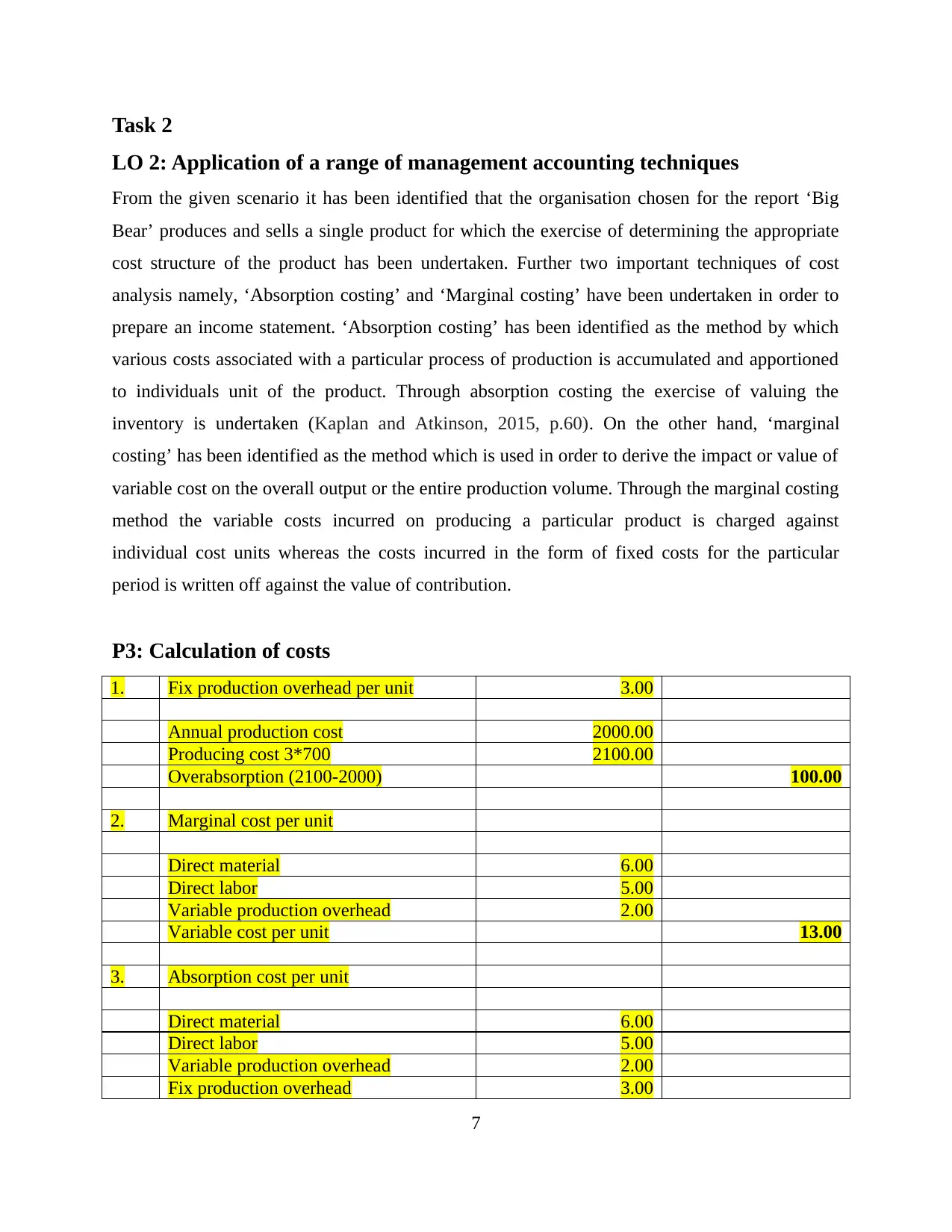
P3: Calculation of costs
1. Fix production overhead per unit 3.00
Annual production cost 2000.00
Producing cost 3*700 2100.00
Overabsorption (2100-2000) 100.00
2. Marginal cost per unit
Direct material 6.00
Direct labor 5.00
Variable production overhead 2.00
Variable cost per unit 13.00
3. Absorption cost per unit
Direct material 6.00
Direct labor 5.00
Variable production overhead 2.00
Fix production overhead 3.00
7
LO 2: Application of a range of management accounting techniques
From the given scenario it has been identified that the organisation chosen for the report ‘Big
Bear’ produces and sells a single product for which the exercise of determining the appropriate
cost structure of the product has been undertaken. Further two important techniques of cost
analysis namely, ‘Absorption costing’ and ‘Marginal costing’ have been undertaken in order to
prepare an income statement. ‘Absorption costing’ has been identified as the method by which
various costs associated with a particular process of production is accumulated and apportioned
to individuals unit of the product. Through absorption costing the exercise of valuing the
inventory is undertaken (Kaplan and Atkinson, 2015, p.60). On the other hand, ‘marginal
costing’ has been identified as the method which is used in order to derive the impact or value of
variable cost on the overall output or the entire production volume. Through the marginal costing
method the variable costs incurred on producing a particular product is charged against
individual cost units whereas the costs incurred in the form of fixed costs for the particular
period is written off against the value of contribution.
P3: Calculation of costs
1. Fix production overhead per unit 3.00
Annual production cost 2000.00
Producing cost 3*700 2100.00
Overabsorption (2100-2000) 100.00
2. Marginal cost per unit
Direct material 6.00
Direct labor 5.00
Variable production overhead 2.00
Variable cost per unit 13.00
3. Absorption cost per unit
Direct material 6.00
Direct labor 5.00
Variable production overhead 2.00
Fix production overhead 3.00
7
⊘ This is a preview!⊘
Do you want full access?
Subscribe today to unlock all pages.
Trusted by 1+ million students worldwide
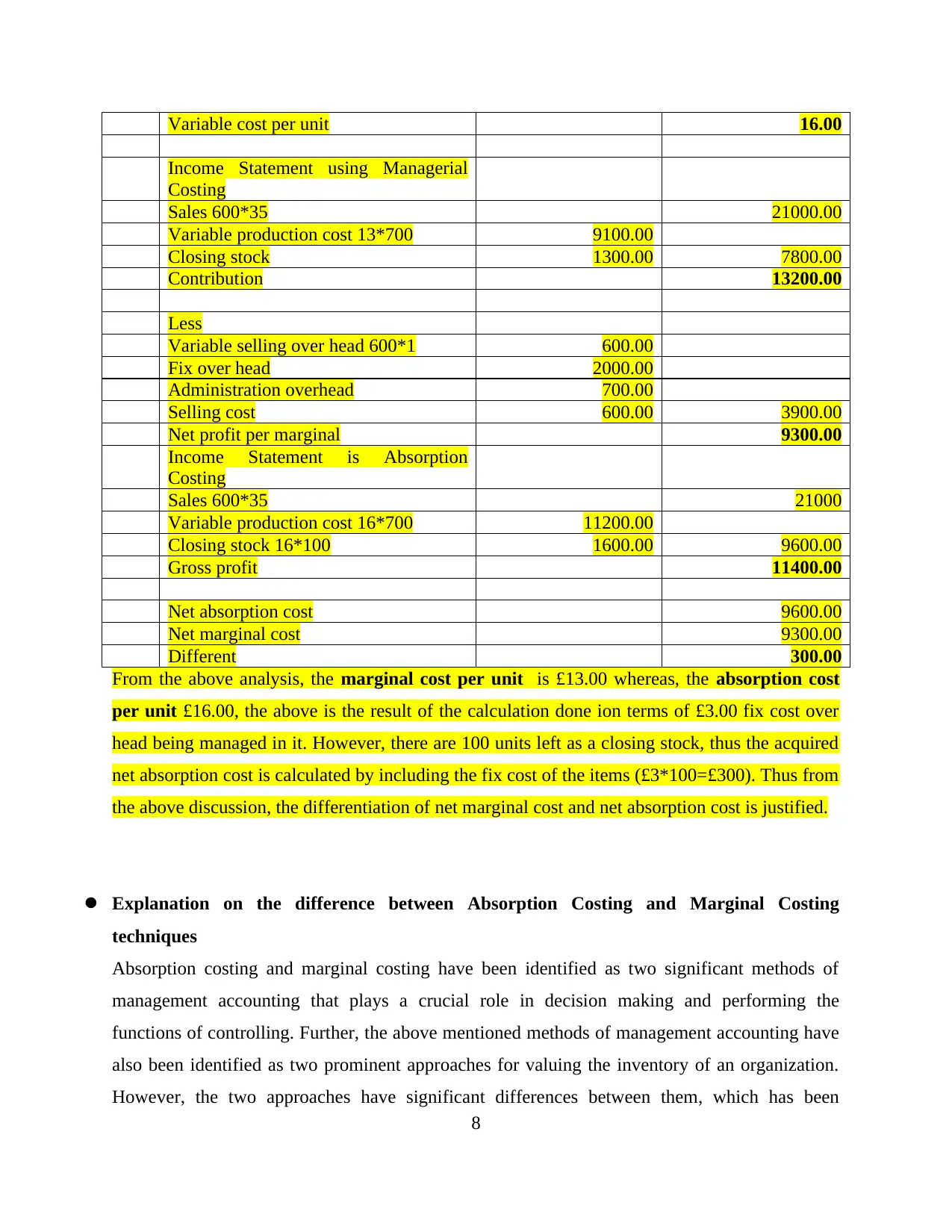
Variable cost per unit 16.00
Income Statement using Managerial
Costing
Sales 600*35 21000.00
Variable production cost 13*700 9100.00
Closing stock 1300.00 7800.00
Contribution 13200.00
Less
Variable selling over head 600*1 600.00
Fix over head 2000.00
Administration overhead 700.00
Selling cost 600.00 3900.00
Net profit per marginal 9300.00
Income Statement is Absorption
Costing
Sales 600*35 21000
Variable production cost 16*700 11200.00
Closing stock 16*100 1600.00 9600.00
Gross profit 11400.00
Net absorption cost 9600.00
Net marginal cost 9300.00
Different 300.00
From the above analysis, the marginal cost per unit is £13.00 whereas, the absorption cost
per unit £16.00, the above is the result of the calculation done ion terms of £3.00 fix cost over
head being managed in it. However, there are 100 units left as a closing stock, thus the acquired
net absorption cost is calculated by including the fix cost of the items (£3*100=£300). Thus from
the above discussion, the differentiation of net marginal cost and net absorption cost is justified.
Explanation on the difference between Absorption Costing and Marginal Costing
techniques
Absorption costing and marginal costing have been identified as two significant methods of
management accounting that plays a crucial role in decision making and performing the
functions of controlling. Further, the above mentioned methods of management accounting have
also been identified as two prominent approaches for valuing the inventory of an organization.
However, the two approaches have significant differences between them, which has been
8
Income Statement using Managerial
Costing
Sales 600*35 21000.00
Variable production cost 13*700 9100.00
Closing stock 1300.00 7800.00
Contribution 13200.00
Less
Variable selling over head 600*1 600.00
Fix over head 2000.00
Administration overhead 700.00
Selling cost 600.00 3900.00
Net profit per marginal 9300.00
Income Statement is Absorption
Costing
Sales 600*35 21000
Variable production cost 16*700 11200.00
Closing stock 16*100 1600.00 9600.00
Gross profit 11400.00
Net absorption cost 9600.00
Net marginal cost 9300.00
Different 300.00
From the above analysis, the marginal cost per unit is £13.00 whereas, the absorption cost
per unit £16.00, the above is the result of the calculation done ion terms of £3.00 fix cost over
head being managed in it. However, there are 100 units left as a closing stock, thus the acquired
net absorption cost is calculated by including the fix cost of the items (£3*100=£300). Thus from
the above discussion, the differentiation of net marginal cost and net absorption cost is justified.
Explanation on the difference between Absorption Costing and Marginal Costing
techniques
Absorption costing and marginal costing have been identified as two significant methods of
management accounting that plays a crucial role in decision making and performing the
functions of controlling. Further, the above mentioned methods of management accounting have
also been identified as two prominent approaches for valuing the inventory of an organization.
However, the two approaches have significant differences between them, which has been
8
Paraphrase This Document
Need a fresh take? Get an instant paraphrase of this document with our AI Paraphraser
discussed hereafter. Primarily, marginal costing method have been chosen as the best decision
making tool over absorption costing.
Marginal costing is a technique for undertaking significant decisions in order to ascertain the
total or overall cost involved in production process whereas absorption costing undertakes the
processes of apportioning the total cost incurred over the cost centres for the purpose of
determining the total or actual cost involved in production (Zimmerman and Yahya-Zadeh, 2011,
p.258). Under the technique of marginal costing the product cost is identified to be the ‘variable
cost’ while the fixed cost involved in producing a product is considered as the ‘period cost’. On
the other hand, under the absorption costing technique, the ‘product cost’ is calculated
considering both the costs namely, fixed cost and variable cost.
The overheads of marginal costing method has been identified as fixed overheads and variable
overheads while the overheads of absorption costing technique have been classified as,
production overhead, selling and distribution overhead and administration overhead.
Through marginal costing data is presented in a manner which helps in highlighting the
contribution made from each product along with the total contribution (Syverson, 2011, p.135).
On the other hand, in absorption costing the data of the cost structure is presented in such a
manner that follows a conventional mechanism or pattern.
As marginal costing technique do not consider the fixed costs therefore the cost attributed to per
unit of production does not appear to be affected due to any kind of difference arising in the
value of opening inventory and closing inventory (Zimmerman and Yahya-Zadeh, 2011, p.258).
In comparison, the per unit cost of production determined using the absorption costing method is
expected to be affected due to the impact created by the fixed overheads as a result of the
difference in its value of opening and closing inventory.
In the method of ‘absorption costing’ for the purpose of valuing the inventory both fixed and
variable costs incurred during the production process are undertaken. Whereas, for the purpose
of valuing the inventory under marginal costing only the costs incurred in the form of variable
costs are considered.
In order to derive the profitability structure under absorption costing two components are
considered namely, revenue generated from sales and the total cost incurred. The decisions made
by the management depending on the absorption data is based on the difference derived from the
figures with respect to sales and total cost (Weygandt et al. 2015, p.112). On the other hand, the
9
making tool over absorption costing.
Marginal costing is a technique for undertaking significant decisions in order to ascertain the
total or overall cost involved in production process whereas absorption costing undertakes the
processes of apportioning the total cost incurred over the cost centres for the purpose of
determining the total or actual cost involved in production (Zimmerman and Yahya-Zadeh, 2011,
p.258). Under the technique of marginal costing the product cost is identified to be the ‘variable
cost’ while the fixed cost involved in producing a product is considered as the ‘period cost’. On
the other hand, under the absorption costing technique, the ‘product cost’ is calculated
considering both the costs namely, fixed cost and variable cost.
The overheads of marginal costing method has been identified as fixed overheads and variable
overheads while the overheads of absorption costing technique have been classified as,
production overhead, selling and distribution overhead and administration overhead.
Through marginal costing data is presented in a manner which helps in highlighting the
contribution made from each product along with the total contribution (Syverson, 2011, p.135).
On the other hand, in absorption costing the data of the cost structure is presented in such a
manner that follows a conventional mechanism or pattern.
As marginal costing technique do not consider the fixed costs therefore the cost attributed to per
unit of production does not appear to be affected due to any kind of difference arising in the
value of opening inventory and closing inventory (Zimmerman and Yahya-Zadeh, 2011, p.258).
In comparison, the per unit cost of production determined using the absorption costing method is
expected to be affected due to the impact created by the fixed overheads as a result of the
difference in its value of opening and closing inventory.
In the method of ‘absorption costing’ for the purpose of valuing the inventory both fixed and
variable costs incurred during the production process are undertaken. Whereas, for the purpose
of valuing the inventory under marginal costing only the costs incurred in the form of variable
costs are considered.
In order to derive the profitability structure under absorption costing two components are
considered namely, revenue generated from sales and the total cost incurred. The decisions made
by the management depending on the absorption data is based on the difference derived from the
figures with respect to sales and total cost (Weygandt et al. 2015, p.112). On the other hand, the
9
decisions of the management depending on the data of marginal costing are based on the figures
derived with respect to ‘contribution’. ‘Contribution’ is a term that is used to denote the excess
value of revenue generated in the form of sales over the marginal cost.
Task 3
LO 3: Explanation on the ‘planning tools’ used in the field of Management
Accounting
P4: Advantages and limitations of the ‘planning tools’ with respect to the
scenario under consideration
Advantages of the ‘planning tools’ implemented in the chosen scenario
Management accounting encompasses various accounting techniques and planning tools that
help the organizations in performing efficient decision-making exercises. The process of
budgeting and the functions performed by the techniques of budgetary control helps in
increasing the efficiency of an organization. Various other tools of management accounting
namely, variance analysis and performance indicators helps in undertaking effective decision
making strategies within an organization. Through the techniques of budgetary control, the
estimations are made on the financial needs of an organization to be incorporated in the
future. The planning tool incorporated in the method of budgetary control helps in controlling
the financial performance of an organization and helps the entity in achieving the desired
results (Hiebl et al. 2013, p.122). Since the budget of an organization is perceived to be an
instrument of control therefore it helps in controlling and measuring the deviations attained
while performing various activities in the organization with respect to planning production
and sales. Various advantages of budgetary control as a planning technique have been
perceived which is enumerated hereafter. Preparation and presentation of the of budgets
which is one of the important planning tools as a part of the budgetary control mechanism
helps the financial manager or the budget coordinator of the organization in coordinating the
resources appropriately ensuring optimum utilization of the resources. Further, the budget
helps in defining the benchmarks or the standards required across different controlling
systems implemented within the organization.
10
derived with respect to ‘contribution’. ‘Contribution’ is a term that is used to denote the excess
value of revenue generated in the form of sales over the marginal cost.
Task 3
LO 3: Explanation on the ‘planning tools’ used in the field of Management
Accounting
P4: Advantages and limitations of the ‘planning tools’ with respect to the
scenario under consideration
Advantages of the ‘planning tools’ implemented in the chosen scenario
Management accounting encompasses various accounting techniques and planning tools that
help the organizations in performing efficient decision-making exercises. The process of
budgeting and the functions performed by the techniques of budgetary control helps in
increasing the efficiency of an organization. Various other tools of management accounting
namely, variance analysis and performance indicators helps in undertaking effective decision
making strategies within an organization. Through the techniques of budgetary control, the
estimations are made on the financial needs of an organization to be incorporated in the
future. The planning tool incorporated in the method of budgetary control helps in controlling
the financial performance of an organization and helps the entity in achieving the desired
results (Hiebl et al. 2013, p.122). Since the budget of an organization is perceived to be an
instrument of control therefore it helps in controlling and measuring the deviations attained
while performing various activities in the organization with respect to planning production
and sales. Various advantages of budgetary control as a planning technique have been
perceived which is enumerated hereafter. Preparation and presentation of the of budgets
which is one of the important planning tools as a part of the budgetary control mechanism
helps the financial manager or the budget coordinator of the organization in coordinating the
resources appropriately ensuring optimum utilization of the resources. Further, the budget
helps in defining the benchmarks or the standards required across different controlling
systems implemented within the organization.
10
⊘ This is a preview!⊘
Do you want full access?
Subscribe today to unlock all pages.
Trusted by 1+ million students worldwide

1 out of 19


Related Documents


Your All-in-One AI-Powered Toolkit for Academic Success.
+13062052269
info@desklib.com
Available 24*7 on WhatsApp / Email
![[object Object]](/_next/static/media/star-bottom.7253800d.svg)
Unlock your academic potential
Copyright © 2020–2026 A2Z Services. All Rights Reserved. Developed and managed by ZUCOL.