Management Accounting: Customer Performance Measurement System Design

Verified

Added on  2023/06/14

|6
|739
|444
Report
AI Summary
This report presents a comprehensive design for a performance measurement system, emphasizing customer performance within the framework of management accounting. The design incorporates four key perspectives: financial, customer, internal, and learning & growth. The financial perspective focuses on liquidity, profitability, and activity ratios. The customer perspective aims to enhance customer satisfaction and brand awareness. The internal perspective seeks to reduce waste and improve product quality. The learning & growth perspective emphasizes employee training and technological advancements. The report justifies the design's adoption by highlighting its potential to improve financial performance through enhanced customer satisfaction, operational efficiency, and strategic alignment. The design leverages management accounting theory to generate higher returns from operations and improve financial projections. Desklib offers this and many other solved assignments and past papers for students.

Document Page
Running head: MANAGEMENT ACCOUNTING
Management Accounting
Name of the Student:
Name of the University:
Authors Note:
tabler-icon-diamond-filled.svg

Paraphrase This Document

Need a fresh take? Get an instant paraphrase of this document with our AI Paraphraser
Document Page
MANAGEMENT ACCOUNTING
1
Table of Contents
Question 2:.................................................................................................................................2
Infographics of the performance measurement system:.............................................................2
Reference and Bibliography:......................................................................................................5
Document Page
MANAGEMENT ACCOUNTING
2
Question 2:
Infographics of the performance measurement system: Part 1
Infographics of the performance measurement system: Part 4
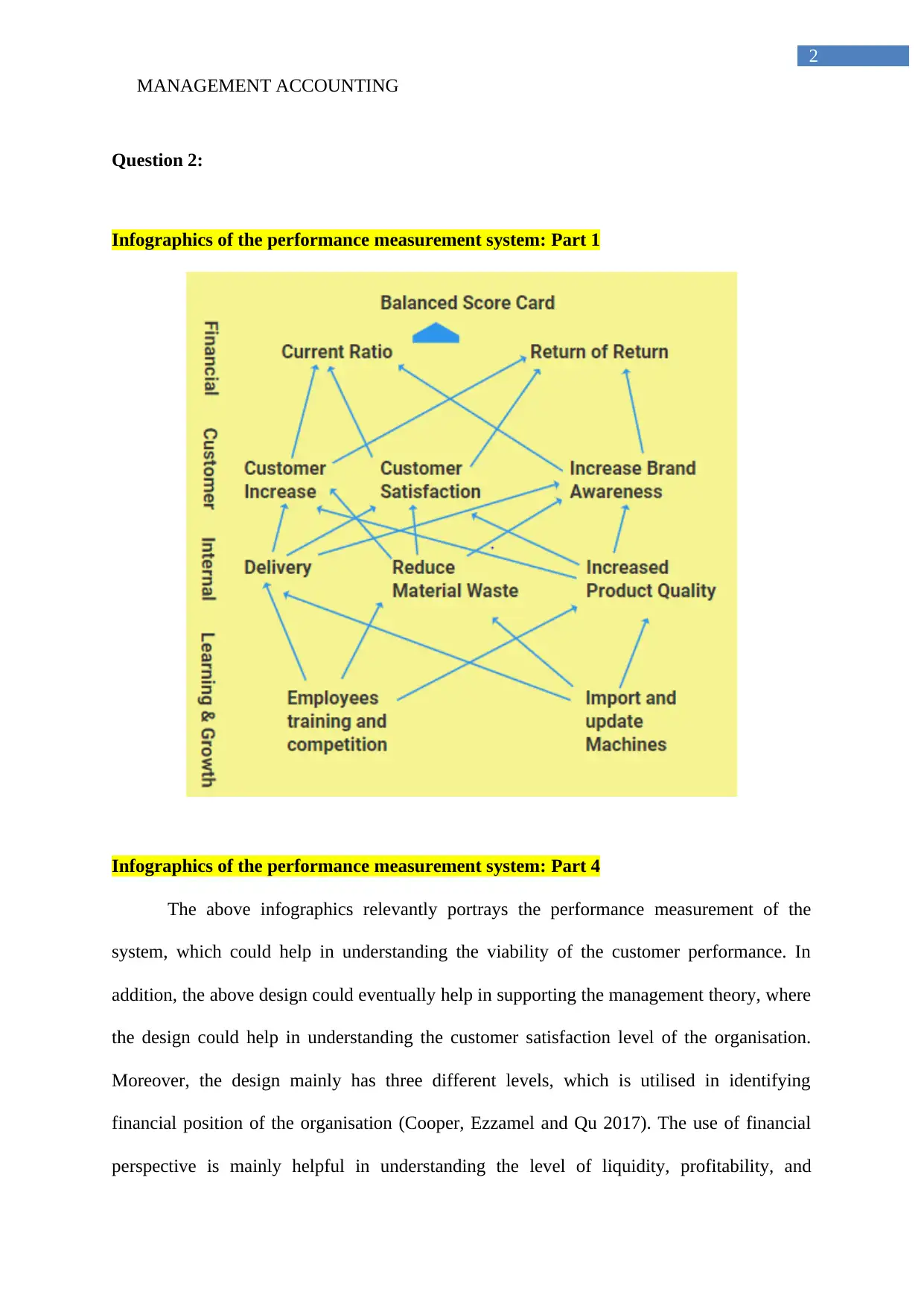
The above infographics relevantly portrays the performance measurement of the
system, which could help in understanding the viability of the customer performance. In
addition, the above design could eventually help in supporting the management theory, where
the design could help in understanding the customer satisfaction level of the organisation.
Moreover, the design mainly has three different levels, which is utilised in identifying
financial position of the organisation (Cooper, Ezzamel and Qu 2017). The use of financial
perspective is mainly helpful in understanding the level of liquidity, profitability, and
Document Page
MANAGEMENT ACCOUNTING
3
activities ratio of the organisation. This inclusion of the overall financial perspective would
eventually help in understanding the level of profitability, which is generated by the
organisation over period.
In addition, the financial perspective is directly affected by customer perspective,
where the increment in customer satisfaction is improving the level of profits generated from
operations. Moreover, the customer perspective level relevant comprises of customer
increase, customer satisfaction and increase brand awareness, which will directly raise the
level of returns from operations. This relevant design would eventually help in detecting the
level of customer support, which is obtained by the company from its operations.
Furthermore, the use of internal perspective would eventually help in understanding the level
of returns, which could be generated from investment. Moreover, the perspective would
eventually help in understanding the level of reduction in waste, while increasing the product
quality. This would eventually help in improving the internal factors of the company and
raise the level of profits from operations (Otley 2016).
The starting stage of the design is from learnings & growth, which relevantly allows
the organisation to train their employee and import new machines, which could improve the
level of operations of the organisation. The drafted design relevantly provides different
strategies, which needs to be followed by the organisation for improving the level of profits
and productivity. In addition, the design relevantly helps in improving the operational
capability of the company by improving its machines and training the employees. In this
context, Renz and Herman (2016) stated that with the implementation of the adequate design
companies can minimise their expenses and improve profitability, liquidity, and activities
ratios.
tabler-icon-diamond-filled.svg

Paraphrase This Document

Need a fresh take? Get an instant paraphrase of this document with our AI Paraphraser
Document Page
MANAGEMENT ACCOUNTING
4
According to the management accounting measures the companies are able generate
high level of returns from investment, while reducing the expenses form operations. In
addition, the level of management accounting measures might directly affect financial
performance of the company. Furthermore, the design would eventually allow the
organisation to improve their financial projection by raising the level of profits, which could
be generated from operations. The management accounting theory directly helps in
generating the level of returns, which could be generated tom operations (Soltani,
Nayebzadeh and Moeinaddin 2014).
Document Page
MANAGEMENT ACCOUNTING
5
References:
Cooper, D.J., Ezzamel, M. and Qu, S.Q., 2017. Popularizing a management accounting idea:
The case of the balanced scorecard. Contemporary Accounting Research, 34(2), pp.991-1025.
Otley, D., 2016. The contingency theory of management accounting and control: 1980–
2014. Management accounting research, 31, pp.45-62.
Renz, D.O. and Herman, R.D. eds., 2016. The Jossey-Bass handbook of nonprofit leadership
and management. John Wiley & Sons.
Soltani, S., Nayebzadeh, S. and Moeinaddin, M., 2014. The Impact Examination of the
Techniques of Management Accounting on the Performance of Tile Companies of
Yazd. International Journal of Academic Research in Accounting, Finance and Management
Sciences, 4(1), pp.382-389.
chevron_up_icon
1 out of 6
circle_padding
hide_on_mobile
zoom_out_icon
[object Object]