Management Accounting for Planning and Control Case Studies Analysis
VerifiedAdded on 2023/06/18
|13
|2906
|480
Case Study
AI Summary
This document presents solutions to several management accounting case studies, covering topics such as ethical considerations in sales management, investment decisions using ROI, cost-volume-profit (CVP) analysis, and the importance of budgeting and strategic planning. The case studies address issues like laying off expensive salespeople, ethical dilemmas in investment decisions, calculating breakeven points and margin of safety, and creating sales budgets. The solutions provide detailed calculations, explanations, and recommendations, emphasizing the importance of ethical behavior and strategic financial management in achieving organizational goals. This resource is designed to assist students in understanding and applying management accounting principles to real-world scenarios.
Management Accounting for
Planning and Control
Planning and Control

Paraphrase This Document
Need a fresh take? Get an instant paraphrase of this document with our AI Paraphraser
Table of Contents
CASE STUDY 1..............................................................................................................................3
PART A...........................................................................................................................................3
1...................................................................................................................................................3
2...................................................................................................................................................3
PART B...........................................................................................................................................3
1...................................................................................................................................................3
2...................................................................................................................................................3
3...................................................................................................................................................4
4...................................................................................................................................................4
CASE STUDY 2..............................................................................................................................4
1)..................................................................................................................................................4
2)..................................................................................................................................................4
3)..................................................................................................................................................5
CASE STUDY 3..............................................................................................................................6
1...................................................................................................................................................6
2. Calculating breakeven point....................................................................................................6
3. Calculating margin of safety in both units and sales dollar.....................................................7
4...................................................................................................................................................7
5...................................................................................................................................................8
6. Explaining the limitation of CVP analysis and reason for its usage........................................8
CASE STUDY 4..............................................................................................................................9
1. Importance of budgeting..........................................................................................................9
2. Importance of strategic plan for DW99...................................................................................9
3. Sales Budget..........................................................................................................................10
4. Budgeting, Planning and control, setting up of strategic goal in improvement in business
performance...............................................................................................................................11
REFERENCES................................................................................................................................1
CASE STUDY 1..............................................................................................................................3
PART A...........................................................................................................................................3
1...................................................................................................................................................3
2...................................................................................................................................................3
PART B...........................................................................................................................................3
1...................................................................................................................................................3
2...................................................................................................................................................3
3...................................................................................................................................................4
4...................................................................................................................................................4
CASE STUDY 2..............................................................................................................................4
1)..................................................................................................................................................4
2)..................................................................................................................................................4
3)..................................................................................................................................................5
CASE STUDY 3..............................................................................................................................6
1...................................................................................................................................................6
2. Calculating breakeven point....................................................................................................6
3. Calculating margin of safety in both units and sales dollar.....................................................7
4...................................................................................................................................................7
5...................................................................................................................................................8
6. Explaining the limitation of CVP analysis and reason for its usage........................................8
CASE STUDY 4..............................................................................................................................9
1. Importance of budgeting..........................................................................................................9
2. Importance of strategic plan for DW99...................................................................................9
3. Sales Budget..........................................................................................................................10
4. Budgeting, Planning and control, setting up of strategic goal in improvement in business
performance...............................................................................................................................11
REFERENCES................................................................................................................................1
CASE STUDY 1
PART A
1.
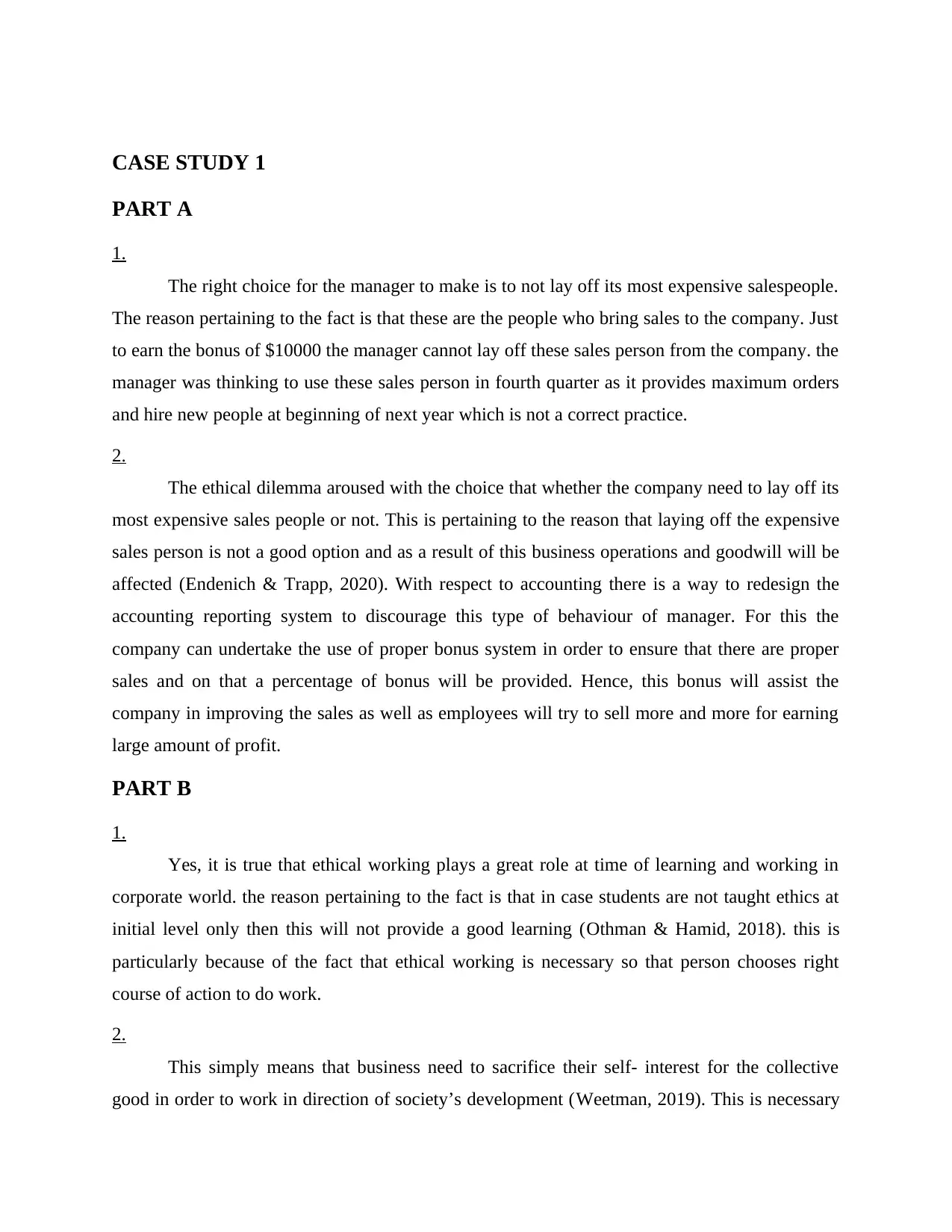
The right choice for the manager to make is to not lay off its most expensive salespeople.
The reason pertaining to the fact is that these are the people who bring sales to the company. Just
to earn the bonus of $10000 the manager cannot lay off these sales person from the company. the
manager was thinking to use these sales person in fourth quarter as it provides maximum orders
and hire new people at beginning of next year which is not a correct practice.
2.
The ethical dilemma aroused with the choice that whether the company need to lay off its
most expensive sales people or not. This is pertaining to the reason that laying off the expensive
sales person is not a good option and as a result of this business operations and goodwill will be
affected (Endenich & Trapp, 2020). With respect to accounting there is a way to redesign the
accounting reporting system to discourage this type of behaviour of manager. For this the
company can undertake the use of proper bonus system in order to ensure that there are proper
sales and on that a percentage of bonus will be provided. Hence, this bonus will assist the
company in improving the sales as well as employees will try to sell more and more for earning
large amount of profit.
PART B
1.
Yes, it is true that ethical working plays a great role at time of learning and working in
corporate world. the reason pertaining to the fact is that in case students are not taught ethics at
initial level only then this will not provide a good learning (Othman & Hamid, 2018). this is
particularly because of the fact that ethical working is necessary so that person chooses right
course of action to do work.
2.
This simply means that business need to sacrifice their self- interest for the collective
good in order to work in direction of society’s development (Weetman, 2019). This is necessary
PART A
1.
The right choice for the manager to make is to not lay off its most expensive salespeople.
The reason pertaining to the fact is that these are the people who bring sales to the company. Just
to earn the bonus of $10000 the manager cannot lay off these sales person from the company. the
manager was thinking to use these sales person in fourth quarter as it provides maximum orders
and hire new people at beginning of next year which is not a correct practice.
2.
The ethical dilemma aroused with the choice that whether the company need to lay off its
most expensive sales people or not. This is pertaining to the reason that laying off the expensive
sales person is not a good option and as a result of this business operations and goodwill will be
affected (Endenich & Trapp, 2020). With respect to accounting there is a way to redesign the
accounting reporting system to discourage this type of behaviour of manager. For this the
company can undertake the use of proper bonus system in order to ensure that there are proper
sales and on that a percentage of bonus will be provided. Hence, this bonus will assist the
company in improving the sales as well as employees will try to sell more and more for earning
large amount of profit.
PART B
1.
Yes, it is true that ethical working plays a great role at time of learning and working in
corporate world. the reason pertaining to the fact is that in case students are not taught ethics at
initial level only then this will not provide a good learning (Othman & Hamid, 2018). this is
particularly because of the fact that ethical working is necessary so that person chooses right
course of action to do work.
2.
This simply means that business need to sacrifice their self- interest for the collective
good in order to work in direction of society’s development (Weetman, 2019). This is necessary
⊘ This is a preview!⊘
Do you want full access?
Subscribe today to unlock all pages.

Trusted by 1+ million students worldwide
because when the companies will sacrifice their self-interest for the development of Australia
and its people then it will improve country’s development.
3.
This is true that the monetary benefits and titles are the by- products for doing a good job.
The reason underlying this fact is that when the employees and resources will be provided with
some monetary benefits then it will motivate the employees to work in ethical and correct
manner and in direction of good of society (Bafghi, 2021). This is necessary because when the
people will be managed in proper and good manner then they will work in required manner then
overall performance of company will increase.
4.
This is also true that when the companies prefer to have unethical behaviour and practices
then at first they get more benefits like high rollers in casino. But eventually after some time they
are wiped off financially (Charifzadeh & Taschner, 2017). This simply means that when the
person is working in wrong manner then at first they will earn profit but after some time this will
result in loss for the company.
CASE STUDY 2
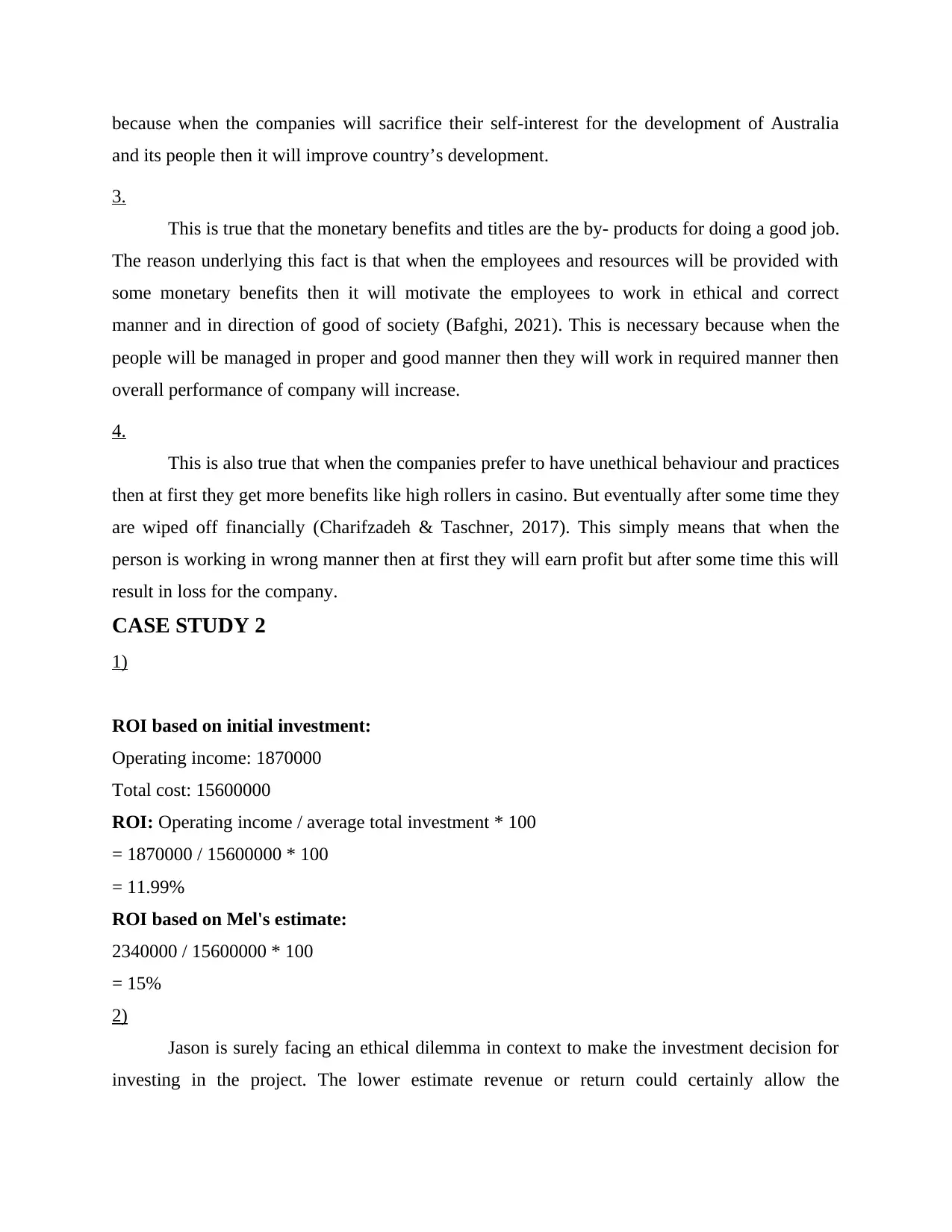
1)
ROI based on initial investment:
Operating income: 1870000
Total cost: 15600000
ROI: Operating income / average total investment * 100
= 1870000 / 15600000 * 100
= 11.99%
ROI based on Mel's estimate:
2340000 / 15600000 * 100
= 15%
2)
Jason is surely facing an ethical dilemma in context to make the investment decision for
investing in the project. The lower estimate revenue or return could certainly allow the
and its people then it will improve country’s development.
3.
This is true that the monetary benefits and titles are the by- products for doing a good job.
The reason underlying this fact is that when the employees and resources will be provided with
some monetary benefits then it will motivate the employees to work in ethical and correct
manner and in direction of good of society (Bafghi, 2021). This is necessary because when the
people will be managed in proper and good manner then they will work in required manner then
overall performance of company will increase.
4.
This is also true that when the companies prefer to have unethical behaviour and practices
then at first they get more benefits like high rollers in casino. But eventually after some time they
are wiped off financially (Charifzadeh & Taschner, 2017). This simply means that when the
person is working in wrong manner then at first they will earn profit but after some time this will
result in loss for the company.
CASE STUDY 2
1)
ROI based on initial investment:
Operating income: 1870000
Total cost: 15600000
ROI: Operating income / average total investment * 100
= 1870000 / 15600000 * 100
= 11.99%
ROI based on Mel's estimate:
2340000 / 15600000 * 100
= 15%
2)
Jason is surely facing an ethical dilemma in context to make the investment decision for
investing in the project. The lower estimate revenue or return could certainly allow the
Paraphrase This Document
Need a fresh take? Get an instant paraphrase of this document with our AI Paraphraser
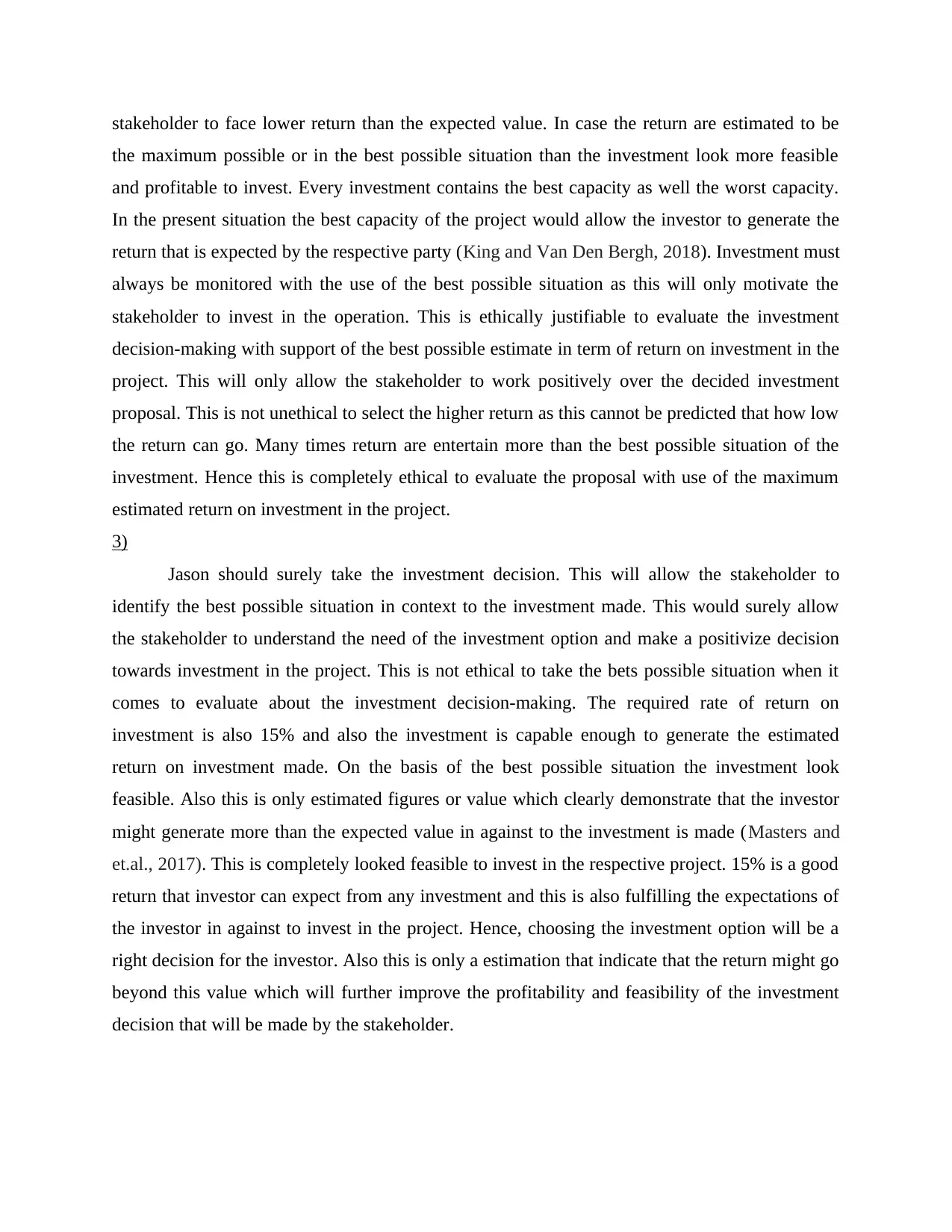
stakeholder to face lower return than the expected value. In case the return are estimated to be
the maximum possible or in the best possible situation than the investment look more feasible
and profitable to invest. Every investment contains the best capacity as well the worst capacity.
In the present situation the best capacity of the project would allow the investor to generate the
return that is expected by the respective party (King and Van Den Bergh, 2018). Investment must
always be monitored with the use of the best possible situation as this will only motivate the
stakeholder to invest in the operation. This is ethically justifiable to evaluate the investment
decision-making with support of the best possible estimate in term of return on investment in the
project. This will only allow the stakeholder to work positively over the decided investment
proposal. This is not unethical to select the higher return as this cannot be predicted that how low
the return can go. Many times return are entertain more than the best possible situation of the
investment. Hence this is completely ethical to evaluate the proposal with use of the maximum
estimated return on investment in the project.
3)
Jason should surely take the investment decision. This will allow the stakeholder to
identify the best possible situation in context to the investment made. This would surely allow
the stakeholder to understand the need of the investment option and make a positivize decision
towards investment in the project. This is not ethical to take the bets possible situation when it
comes to evaluate about the investment decision-making. The required rate of return on
investment is also 15% and also the investment is capable enough to generate the estimated
return on investment made. On the basis of the best possible situation the investment look
feasible. Also this is only estimated figures or value which clearly demonstrate that the investor
might generate more than the expected value in against to the investment is made (Masters and
et.al., 2017). This is completely looked feasible to invest in the respective project. 15% is a good
return that investor can expect from any investment and this is also fulfilling the expectations of
the investor in against to invest in the project. Hence, choosing the investment option will be a
right decision for the investor. Also this is only a estimation that indicate that the return might go
beyond this value which will further improve the profitability and feasibility of the investment
decision that will be made by the stakeholder.
the maximum possible or in the best possible situation than the investment look more feasible
and profitable to invest. Every investment contains the best capacity as well the worst capacity.
In the present situation the best capacity of the project would allow the investor to generate the
return that is expected by the respective party (King and Van Den Bergh, 2018). Investment must
always be monitored with the use of the best possible situation as this will only motivate the
stakeholder to invest in the operation. This is ethically justifiable to evaluate the investment
decision-making with support of the best possible estimate in term of return on investment in the
project. This will only allow the stakeholder to work positively over the decided investment
proposal. This is not unethical to select the higher return as this cannot be predicted that how low
the return can go. Many times return are entertain more than the best possible situation of the
investment. Hence this is completely ethical to evaluate the proposal with use of the maximum
estimated return on investment in the project.
3)
Jason should surely take the investment decision. This will allow the stakeholder to
identify the best possible situation in context to the investment made. This would surely allow
the stakeholder to understand the need of the investment option and make a positivize decision
towards investment in the project. This is not ethical to take the bets possible situation when it
comes to evaluate about the investment decision-making. The required rate of return on
investment is also 15% and also the investment is capable enough to generate the estimated
return on investment made. On the basis of the best possible situation the investment look
feasible. Also this is only estimated figures or value which clearly demonstrate that the investor
might generate more than the expected value in against to the investment is made (Masters and
et.al., 2017). This is completely looked feasible to invest in the respective project. 15% is a good
return that investor can expect from any investment and this is also fulfilling the expectations of
the investor in against to invest in the project. Hence, choosing the investment option will be a
right decision for the investor. Also this is only a estimation that indicate that the return might go
beyond this value which will further improve the profitability and feasibility of the investment
decision that will be made by the stakeholder.
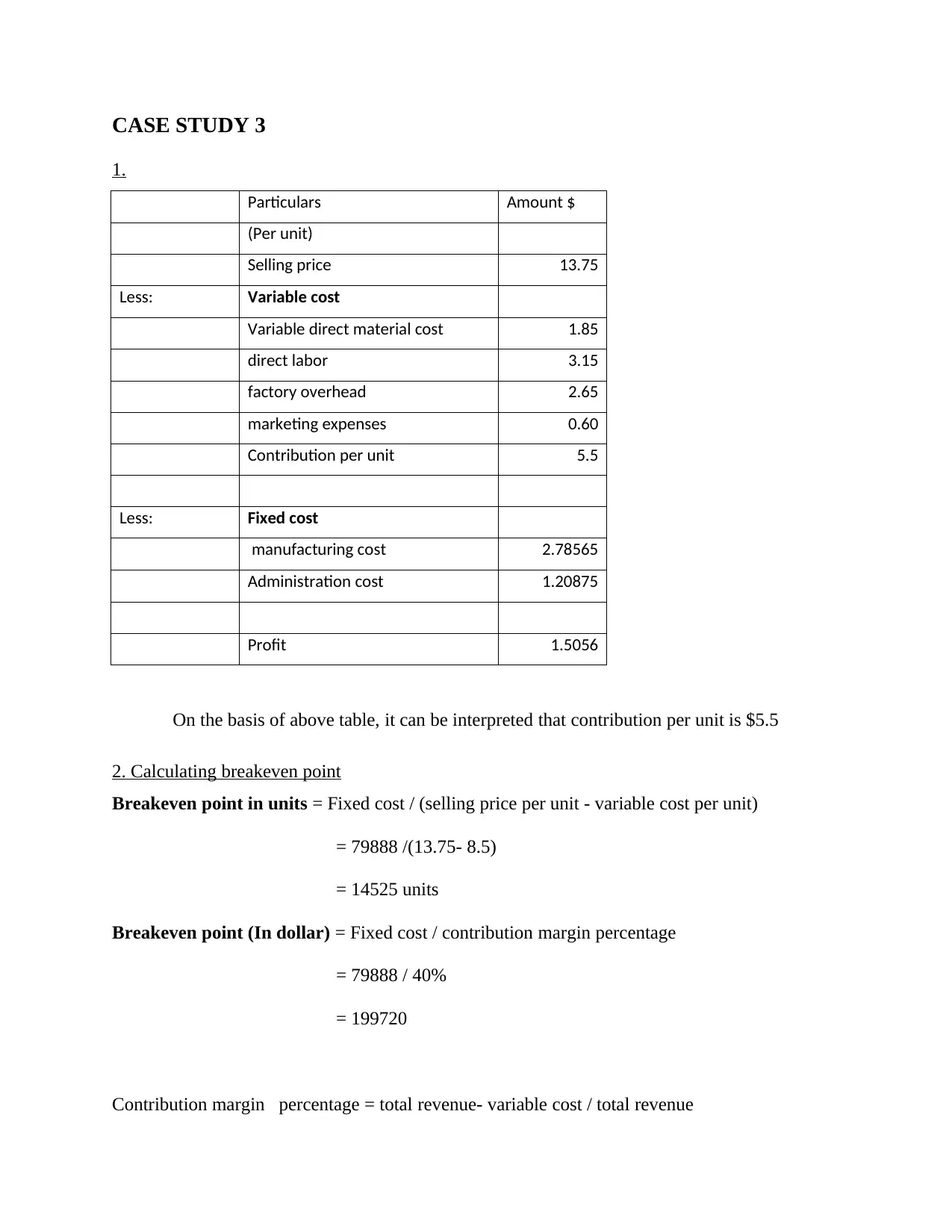
CASE STUDY 3
1.
Particulars Amount $
(Per unit)
Selling price 13.75
Less: Variable cost
Variable direct material cost 1.85
direct labor 3.15
factory overhead 2.65
marketing expenses 0.60
Contribution per unit 5.5
Less: Fixed cost
manufacturing cost 2.78565
Administration cost 1.20875
Profit 1.5056
On the basis of above table, it can be interpreted that contribution per unit is $5.5
2. Calculating breakeven point
Breakeven point in units = Fixed cost / (selling price per unit - variable cost per unit)
= 79888 /(13.75- 8.5)
= 14525 units
Breakeven point (In dollar) = Fixed cost / contribution margin percentage
= 79888 / 40%
= 199720
Contribution margin percentage = total revenue- variable cost / total revenue
1.
Particulars Amount $
(Per unit)
Selling price 13.75
Less: Variable cost
Variable direct material cost 1.85
direct labor 3.15
factory overhead 2.65
marketing expenses 0.60
Contribution per unit 5.5
Less: Fixed cost
manufacturing cost 2.78565
Administration cost 1.20875
Profit 1.5056
On the basis of above table, it can be interpreted that contribution per unit is $5.5
2. Calculating breakeven point
Breakeven point in units = Fixed cost / (selling price per unit - variable cost per unit)
= 79888 /(13.75- 8.5)
= 14525 units
Breakeven point (In dollar) = Fixed cost / contribution margin percentage
= 79888 / 40%
= 199720
Contribution margin percentage = total revenue- variable cost / total revenue
⊘ This is a preview!⊘
Do you want full access?
Subscribe today to unlock all pages.
Trusted by 1+ million students worldwide
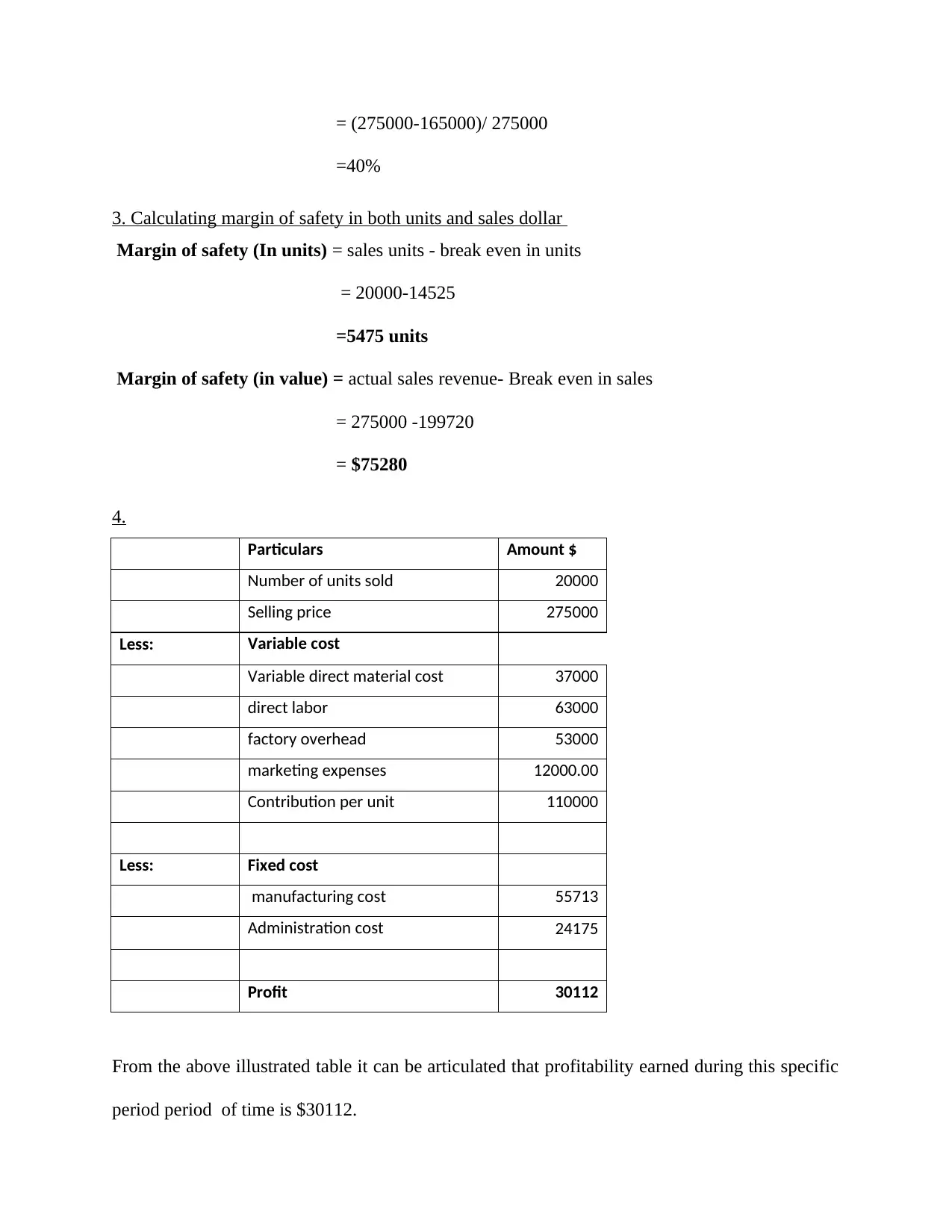
= (275000-165000)/ 275000
=40%
3. Calculating margin of safety in both units and sales dollar
Margin of safety (In units) = sales units - break even in units
= 20000-14525
=5475 units
Margin of safety (in value) = actual sales revenue- Break even in sales
= 275000 -199720
= $75280
4.
Particulars Amount $
Number of units sold 20000
Selling price 275000
Less: Variable cost
Variable direct material cost 37000
direct labor 63000
factory overhead 53000
marketing expenses 12000.00
Contribution per unit 110000
Less: Fixed cost
manufacturing cost 55713
Administration cost 24175
Profit 30112
From the above illustrated table it can be articulated that profitability earned during this specific
period period of time is $30112.
=40%
3. Calculating margin of safety in both units and sales dollar
Margin of safety (In units) = sales units - break even in units
= 20000-14525
=5475 units
Margin of safety (in value) = actual sales revenue- Break even in sales
= 275000 -199720
= $75280
4.
Particulars Amount $
Number of units sold 20000
Selling price 275000
Less: Variable cost
Variable direct material cost 37000
direct labor 63000
factory overhead 53000
marketing expenses 12000.00
Contribution per unit 110000
Less: Fixed cost
manufacturing cost 55713
Administration cost 24175
Profit 30112
From the above illustrated table it can be articulated that profitability earned during this specific
period period of time is $30112.
Paraphrase This Document
Need a fresh take? Get an instant paraphrase of this document with our AI Paraphraser
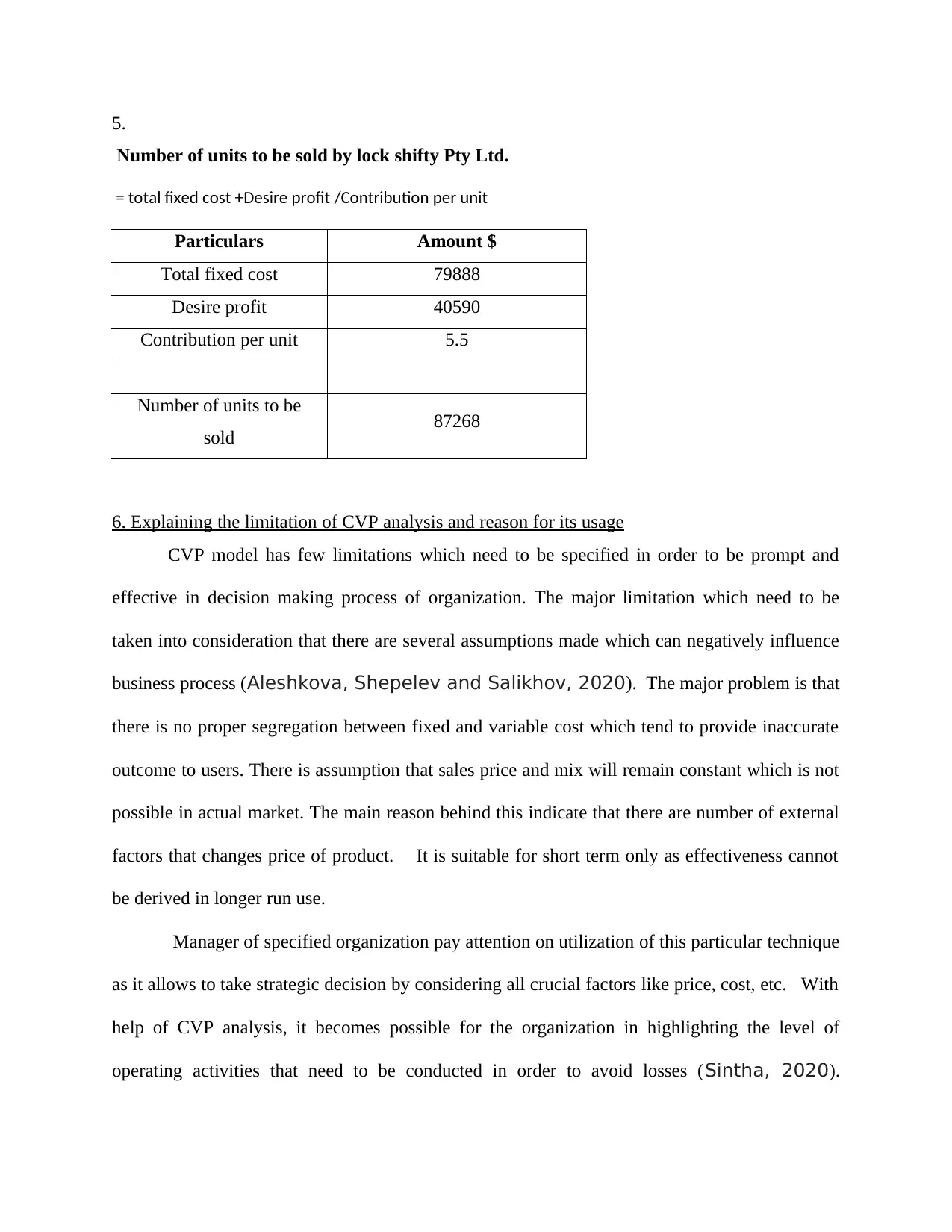
5.
Number of units to be sold by lock shifty Pty Ltd.
= total fixed cost +Desire profit /Contribution per unit
Particulars Amount $
Total fixed cost 79888
Desire profit 40590
Contribution per unit 5.5
Number of units to be
sold 87268
6. Explaining the limitation of CVP analysis and reason for its usage
CVP model has few limitations which need to be specified in order to be prompt and
effective in decision making process of organization. The major limitation which need to be
taken into consideration that there are several assumptions made which can negatively influence
business process (Aleshkova, Shepelev and Salikhov, 2020). The major problem is that
there is no proper segregation between fixed and variable cost which tend to provide inaccurate
outcome to users. There is assumption that sales price and mix will remain constant which is not
possible in actual market. The main reason behind this indicate that there are number of external
factors that changes price of product. It is suitable for short term only as effectiveness cannot
be derived in longer run use.
Manager of specified organization pay attention on utilization of this particular technique
as it allows to take strategic decision by considering all crucial factors like price, cost, etc. With
help of CVP analysis, it becomes possible for the organization in highlighting the level of
operating activities that need to be conducted in order to avoid losses (Sintha, 2020).
Number of units to be sold by lock shifty Pty Ltd.
= total fixed cost +Desire profit /Contribution per unit
Particulars Amount $
Total fixed cost 79888
Desire profit 40590
Contribution per unit 5.5
Number of units to be
sold 87268
6. Explaining the limitation of CVP analysis and reason for its usage
CVP model has few limitations which need to be specified in order to be prompt and
effective in decision making process of organization. The major limitation which need to be
taken into consideration that there are several assumptions made which can negatively influence
business process (Aleshkova, Shepelev and Salikhov, 2020). The major problem is that
there is no proper segregation between fixed and variable cost which tend to provide inaccurate
outcome to users. There is assumption that sales price and mix will remain constant which is not
possible in actual market. The main reason behind this indicate that there are number of external
factors that changes price of product. It is suitable for short term only as effectiveness cannot
be derived in longer run use.
Manager of specified organization pay attention on utilization of this particular technique
as it allows to take strategic decision by considering all crucial factors like price, cost, etc. With
help of CVP analysis, it becomes possible for the organization in highlighting the level of
operating activities that need to be conducted in order to avoid losses (Sintha, 2020).
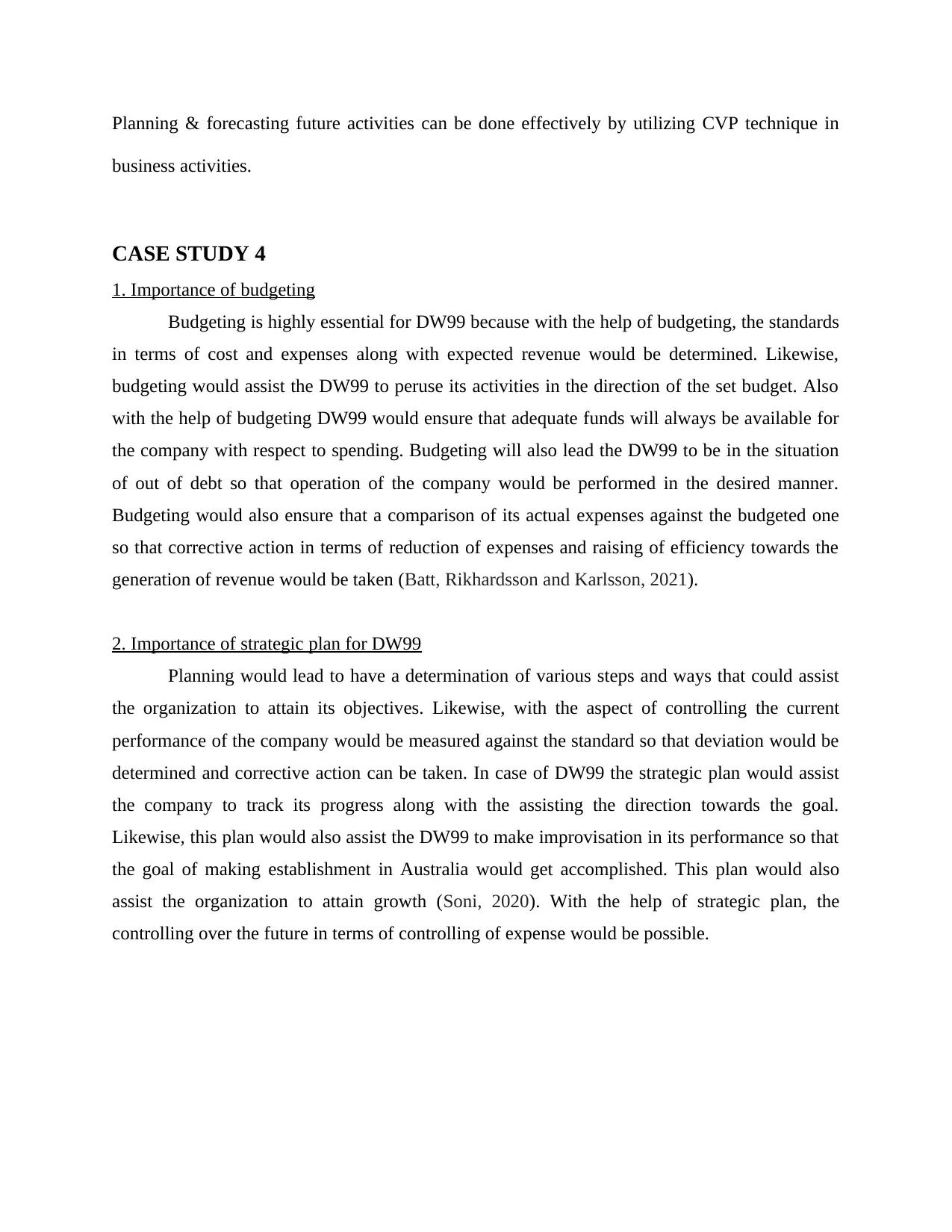
Planning & forecasting future activities can be done effectively by utilizing CVP technique in
business activities.
CASE STUDY 4
1. Importance of budgeting
Budgeting is highly essential for DW99 because with the help of budgeting, the standards
in terms of cost and expenses along with expected revenue would be determined. Likewise,
budgeting would assist the DW99 to peruse its activities in the direction of the set budget. Also
with the help of budgeting DW99 would ensure that adequate funds will always be available for
the company with respect to spending. Budgeting will also lead the DW99 to be in the situation
of out of debt so that operation of the company would be performed in the desired manner.
Budgeting would also ensure that a comparison of its actual expenses against the budgeted one
so that corrective action in terms of reduction of expenses and raising of efficiency towards the
generation of revenue would be taken (Batt, Rikhardsson and Karlsson, 2021).
2. Importance of strategic plan for DW99
Planning would lead to have a determination of various steps and ways that could assist
the organization to attain its objectives. Likewise, with the aspect of controlling the current
performance of the company would be measured against the standard so that deviation would be
determined and corrective action can be taken. In case of DW99 the strategic plan would assist
the company to track its progress along with the assisting the direction towards the goal.
Likewise, this plan would also assist the DW99 to make improvisation in its performance so that
the goal of making establishment in Australia would get accomplished. This plan would also
assist the organization to attain growth (Soni, 2020). With the help of strategic plan, the
controlling over the future in terms of controlling of expense would be possible.
business activities.
CASE STUDY 4
1. Importance of budgeting
Budgeting is highly essential for DW99 because with the help of budgeting, the standards
in terms of cost and expenses along with expected revenue would be determined. Likewise,
budgeting would assist the DW99 to peruse its activities in the direction of the set budget. Also
with the help of budgeting DW99 would ensure that adequate funds will always be available for
the company with respect to spending. Budgeting will also lead the DW99 to be in the situation
of out of debt so that operation of the company would be performed in the desired manner.
Budgeting would also ensure that a comparison of its actual expenses against the budgeted one
so that corrective action in terms of reduction of expenses and raising of efficiency towards the
generation of revenue would be taken (Batt, Rikhardsson and Karlsson, 2021).
2. Importance of strategic plan for DW99
Planning would lead to have a determination of various steps and ways that could assist
the organization to attain its objectives. Likewise, with the aspect of controlling the current
performance of the company would be measured against the standard so that deviation would be
determined and corrective action can be taken. In case of DW99 the strategic plan would assist
the company to track its progress along with the assisting the direction towards the goal.
Likewise, this plan would also assist the DW99 to make improvisation in its performance so that
the goal of making establishment in Australia would get accomplished. This plan would also
assist the organization to attain growth (Soni, 2020). With the help of strategic plan, the
controlling over the future in terms of controlling of expense would be possible.
⊘ This is a preview!⊘
Do you want full access?
Subscribe today to unlock all pages.
Trusted by 1+ million students worldwide
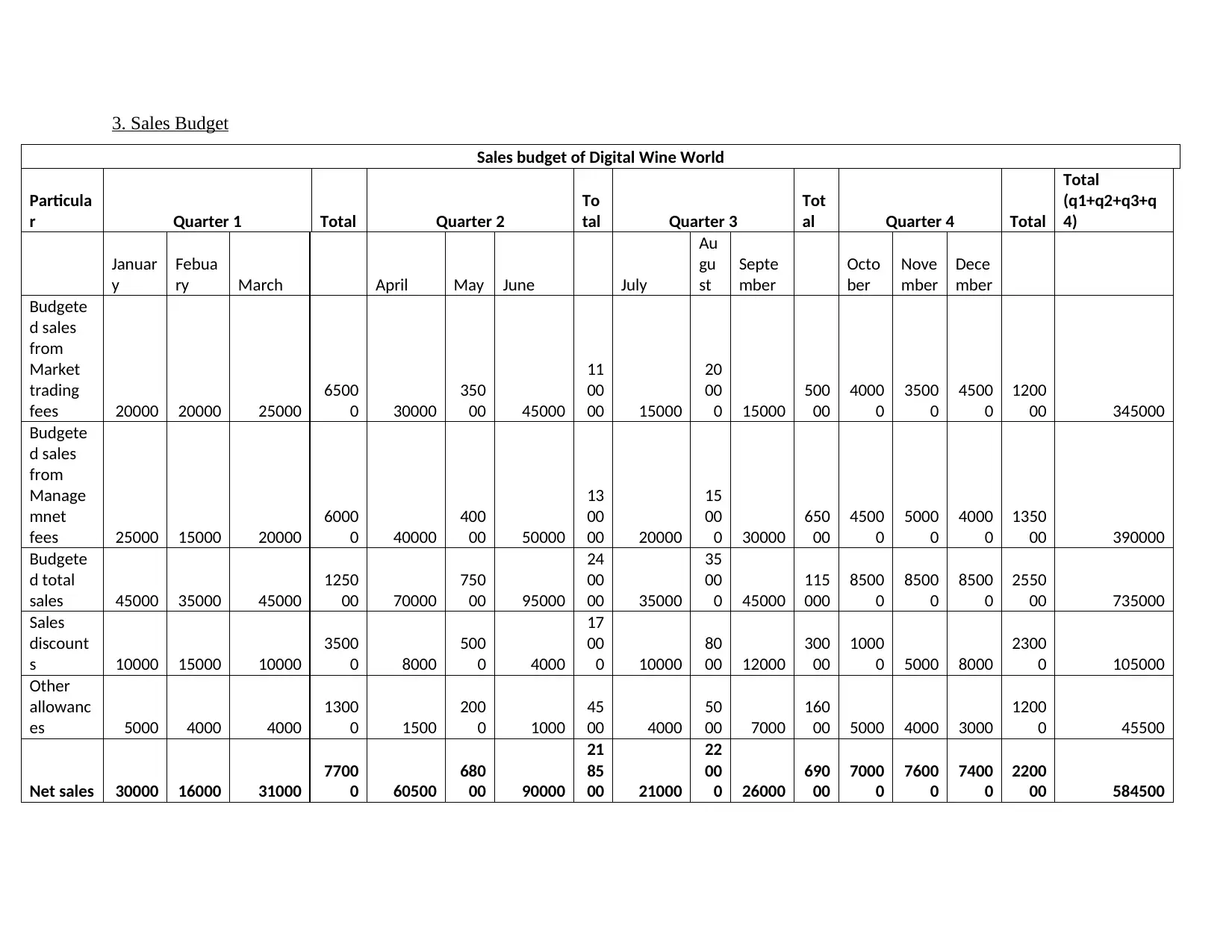
3. Sales Budget
Sales budget of Digital Wine World
Particula
r Quarter 1 Total Quarter 2
To
tal Quarter 3
Tot
al Quarter 4 Total
Total
(q1+q2+q3+q
4)
Januar
y
Febua
ry March April May June July
Au
gu
st
Septe
mber
Octo
ber
Nove
mber
Dece
mber
Budgete
d sales
from
Market
trading
fees 20000 20000 25000
6500
0 30000
350
00 45000
11
00
00 15000
20
00
0 15000
500
00
4000
0
3500
0
4500
0
1200
00 345000
Budgete
d sales
from
Manage
mnet
fees 25000 15000 20000
6000
0 40000
400
00 50000
13
00
00 20000
15
00
0 30000
650
00
4500
0
5000
0
4000
0
1350
00 390000
Budgete
d total
sales 45000 35000 45000
1250
00 70000
750
00 95000
24
00
00 35000
35
00
0 45000
115
000
8500
0
8500
0
8500
0
2550
00 735000
Sales
discount
s 10000 15000 10000
3500
0 8000
500
0 4000
17
00
0 10000
80
00 12000
300
00
1000
0 5000 8000
2300
0 105000
Other
allowanc
es 5000 4000 4000
1300
0 1500
200
0 1000
45
00 4000
50
00 7000
160
00 5000 4000 3000
1200
0 45500
Net sales 30000 16000 31000
7700
0 60500
680
00 90000
21
85
00 21000
22
00
0 26000
690
00
7000
0
7600
0
7400
0
2200
00 584500
Sales budget of Digital Wine World
Particula
r Quarter 1 Total Quarter 2
To
tal Quarter 3
Tot
al Quarter 4 Total
Total
(q1+q2+q3+q
4)
Januar
y
Febua
ry March April May June July
Au
gu
st
Septe
mber
Octo
ber
Nove
mber
Dece
mber
Budgete
d sales
from
Market
trading
fees 20000 20000 25000
6500
0 30000
350
00 45000
11
00
00 15000
20
00
0 15000
500
00
4000
0
3500
0
4500
0
1200
00 345000
Budgete
d sales
from
Manage
mnet
fees 25000 15000 20000
6000
0 40000
400
00 50000
13
00
00 20000
15
00
0 30000
650
00
4500
0
5000
0
4000
0
1350
00 390000
Budgete
d total
sales 45000 35000 45000
1250
00 70000
750
00 95000
24
00
00 35000
35
00
0 45000
115
000
8500
0
8500
0
8500
0
2550
00 735000
Sales
discount
s 10000 15000 10000
3500
0 8000
500
0 4000
17
00
0 10000
80
00 12000
300
00
1000
0 5000 8000
2300
0 105000
Other
allowanc
es 5000 4000 4000
1300
0 1500
200
0 1000
45
00 4000
50
00 7000
160
00 5000 4000 3000
1200
0 45500
Net sales 30000 16000 31000
7700
0 60500
680
00 90000
21
85
00 21000
22
00
0 26000
690
00
7000
0
7600
0
7400
0
2200
00 584500
Paraphrase This Document
Need a fresh take? Get an instant paraphrase of this document with our AI Paraphraser
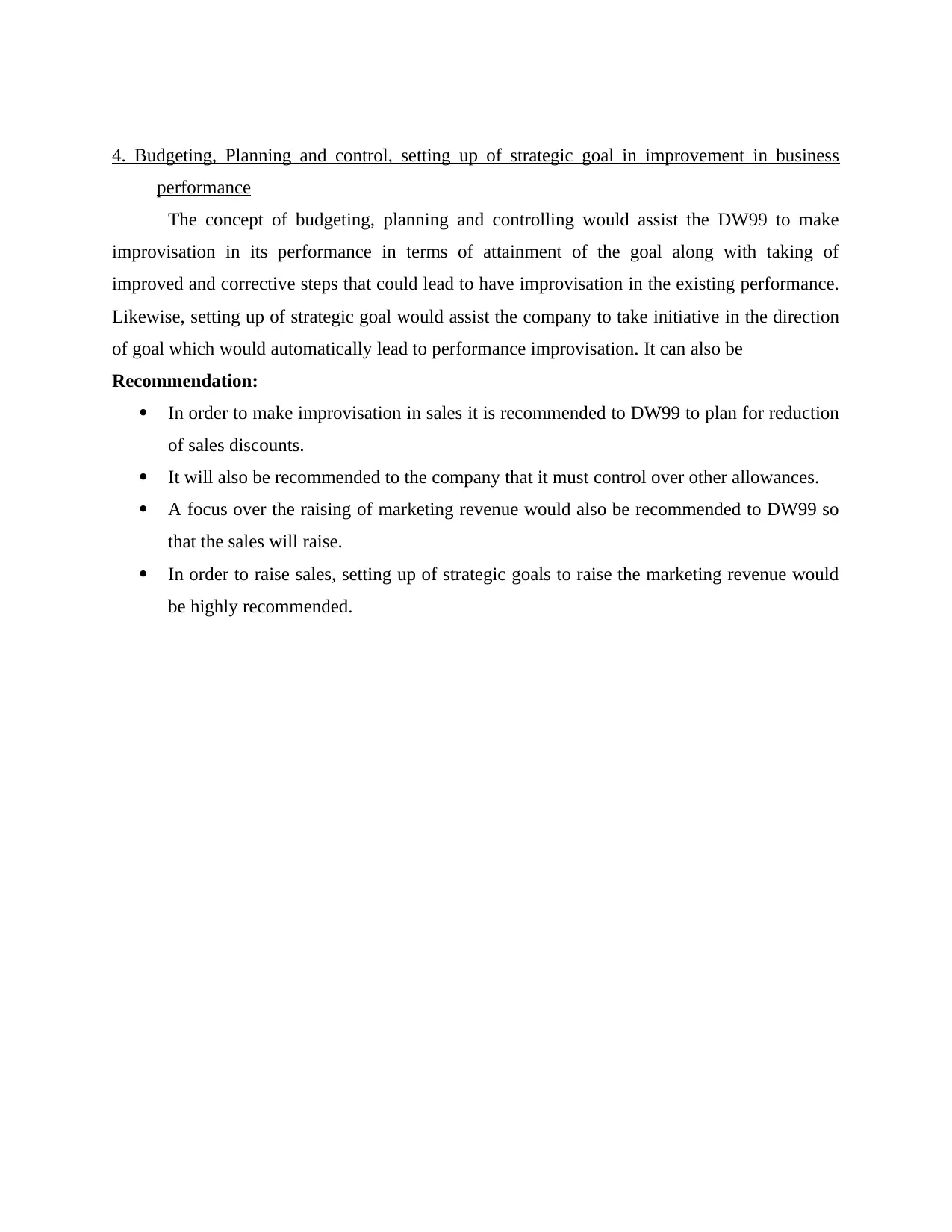
4. Budgeting, Planning and control, setting up of strategic goal in improvement in business
performance
The concept of budgeting, planning and controlling would assist the DW99 to make
improvisation in its performance in terms of attainment of the goal along with taking of
improved and corrective steps that could lead to have improvisation in the existing performance.
Likewise, setting up of strategic goal would assist the company to take initiative in the direction
of goal which would automatically lead to performance improvisation. It can also be
Recommendation:
In order to make improvisation in sales it is recommended to DW99 to plan for reduction
of sales discounts.
It will also be recommended to the company that it must control over other allowances.
A focus over the raising of marketing revenue would also be recommended to DW99 so
that the sales will raise.
In order to raise sales, setting up of strategic goals to raise the marketing revenue would
be highly recommended.
performance
The concept of budgeting, planning and controlling would assist the DW99 to make
improvisation in its performance in terms of attainment of the goal along with taking of
improved and corrective steps that could lead to have improvisation in the existing performance.
Likewise, setting up of strategic goal would assist the company to take initiative in the direction
of goal which would automatically lead to performance improvisation. It can also be
Recommendation:
In order to make improvisation in sales it is recommended to DW99 to plan for reduction
of sales discounts.
It will also be recommended to the company that it must control over other allowances.
A focus over the raising of marketing revenue would also be recommended to DW99 so
that the sales will raise.
In order to raise sales, setting up of strategic goals to raise the marketing revenue would
be highly recommended.
REFERENCES
Books and journals
Aleshkova, D. V., Shepelev, A. V., & Salikhov, K. M., 2020. Innovative
Methods of Managing the Company’s Financial Results. In International
Scientific and Practical Conference (pp. 649-658). Springer, Cham.
Bafghi, A. A. T. (2021). Professional Ethics and Behavior in Accounting. International Journal
of Multicultural and Multireligious Understanding. 8(1). 545-555.
Batt, C., Rikhardsson, P. and Karlsson, T., 2021. Exploring the Impact of Organizational Context
on Budgeting. Corporate Ownership and Control. 18(4). pp.134-151.
Charifzadeh, M., & Taschner, A. (2017). Management accounting and control: tools and
concepts in a Central European context. John Wiley & Sons.
Endenich, C., & Trapp, R. (2020). Ethical implications of management accounting and control:
A systematic review of the contributions from the Journal of Business Ethics. Journal of
business ethics. 163(2). 309-328.
King, L. C., & Van Den Bergh, J. C. (2018). Implications of net energy-return-on-investment for
a low-carbon energy transition. Nature Energy. 3(4). 334-340.
Masters, R. & et.al., (2017). Return on investment of public health interventions: a systematic
review. J Epidemiol Community Health. 71(8). 827-834.
Othman, Z., & Hamid, F. Z. A. (2018). Dealing with un (expected) ethical dilemma: Experience
from the field. The Qualitative Report. 23(4). pp.733-741.
Sintha, L., 2020. Importance of Break-Even Analysis for the Micro, Small and
Medium Enterprises. International Journal of Research-Granthaalayah.
8(6).
Soni, V.D., 2020. Importance and Strategic Planning of Team Management. International
Journal of Innovative Research in Technology. 7(2). pp.47-50.
Weetman, P., 2019. Financial and management accounting. Pearson UK.
1
Books and journals
Aleshkova, D. V., Shepelev, A. V., & Salikhov, K. M., 2020. Innovative
Methods of Managing the Company’s Financial Results. In International
Scientific and Practical Conference (pp. 649-658). Springer, Cham.
Bafghi, A. A. T. (2021). Professional Ethics and Behavior in Accounting. International Journal
of Multicultural and Multireligious Understanding. 8(1). 545-555.
Batt, C., Rikhardsson, P. and Karlsson, T., 2021. Exploring the Impact of Organizational Context
on Budgeting. Corporate Ownership and Control. 18(4). pp.134-151.
Charifzadeh, M., & Taschner, A. (2017). Management accounting and control: tools and
concepts in a Central European context. John Wiley & Sons.
Endenich, C., & Trapp, R. (2020). Ethical implications of management accounting and control:
A systematic review of the contributions from the Journal of Business Ethics. Journal of
business ethics. 163(2). 309-328.
King, L. C., & Van Den Bergh, J. C. (2018). Implications of net energy-return-on-investment for
a low-carbon energy transition. Nature Energy. 3(4). 334-340.
Masters, R. & et.al., (2017). Return on investment of public health interventions: a systematic
review. J Epidemiol Community Health. 71(8). 827-834.
Othman, Z., & Hamid, F. Z. A. (2018). Dealing with un (expected) ethical dilemma: Experience
from the field. The Qualitative Report. 23(4). pp.733-741.
Sintha, L., 2020. Importance of Break-Even Analysis for the Micro, Small and
Medium Enterprises. International Journal of Research-Granthaalayah.
8(6).
Soni, V.D., 2020. Importance and Strategic Planning of Team Management. International
Journal of Innovative Research in Technology. 7(2). pp.47-50.
Weetman, P., 2019. Financial and management accounting. Pearson UK.
1
⊘ This is a preview!⊘
Do you want full access?
Subscribe today to unlock all pages.
Trusted by 1+ million students worldwide

1 out of 13


Related Documents


Your All-in-One AI-Powered Toolkit for Academic Success.
+13062052269
info@desklib.com
Available 24*7 on WhatsApp / Email
![[object Object]](/_next/static/media/star-bottom.7253800d.svg)
Unlock your academic potential
Copyright © 2020–2025 A2Z Services. All Rights Reserved. Developed and managed by ZUCOL.