Management Accounting Report: Wilkerson Case Study Analysis

Verified

Added on  2022/08/22

|9
|2038
|19
Report
AI Summary
This report provides a detailed analysis of the Wilkerson case study, focusing on the application of Activity-Based Costing (ABC) in management accounting. The report begins by constructing an ABC model to determine the cost and profitability of Wilkerson's three product lines: Valves, Pumps, and Flow Controllers. It then compares the ABC method to traditional costing, highlighting how ABC provides a more accurate allocation of overhead costs and improves decision-making by providing insights into the costs associated with specific activities. The report further examines the assumptions underlying the ABC system, evaluates the reliability of cost estimates, and explores alternative cost allocation methods. It also discusses the factors that cause differences in costs and profitability between traditional and ABC costing, emphasizing the importance of cost control and maximizing profitability. Finally, the report concludes by assessing the impact of using actual activity level costing, and provides recommendations for improving the efficiency of the production process and overall profitability.
Document Page
Running Head: MANAGEMENT ACCOUNTING
MANAGEMENT ACCOUNTING
Name of the student
Name of the University
Author’s Note
tabler-icon-diamond-filled.svg

Paraphrase This Document

Need a fresh take? Get an instant paraphrase of this document with our AI Paraphraser
Document Page
1
MANAGEMENT ACCOUNTING
Table of Contents
Answer to Part 1:........................................................................................................................2
Answer to part 2:........................................................................................................................3
Answer to part 3:........................................................................................................................4
Answer to part 4.........................................................................................................................5
Answer to part 5:........................................................................................................................6
References:.................................................................................................................................8
Document Page
2
MANAGEMENT ACCOUNTING
Answer to Part 1:
Activity based costing is a method of evaluating all the possible courses of actions or
activities that are engaged with in the process of manufacturing a product and assigning costs
to each activity specifically. It also includes assigning overhead and indirect costs to each
activity (Drury, 2013). Wilkerson Company has been experiencing decline in their profits due
to decreasing price of their product. Hence, the company considers revising its product line
and flow controller line.
Activity based cost model of Wilkerson company will include costs of all such
activities that are the part of production process of the company. The company is specialised
in three product lines for which it purchases semi-finished materials from its suppliers and
convert these products into finished components with the help of machinery and labour
efforts. The machine equipment and labours used were same for all the three product line of
the company.
Three products of the company were as follows:
Valves – These were prepared by assembling four different semi-finished components and
the gross margin was kept at 35 per cent.
Pumps- Five semi-finished products were assembled with the help of machines and the
products were margined at 35 per cent.
Flow controllers- These were used to control the rate and flow of the chemicals and required
more components and labour than compare to the other two products. The company decided
to increase its price by 10% with no change in the demand.
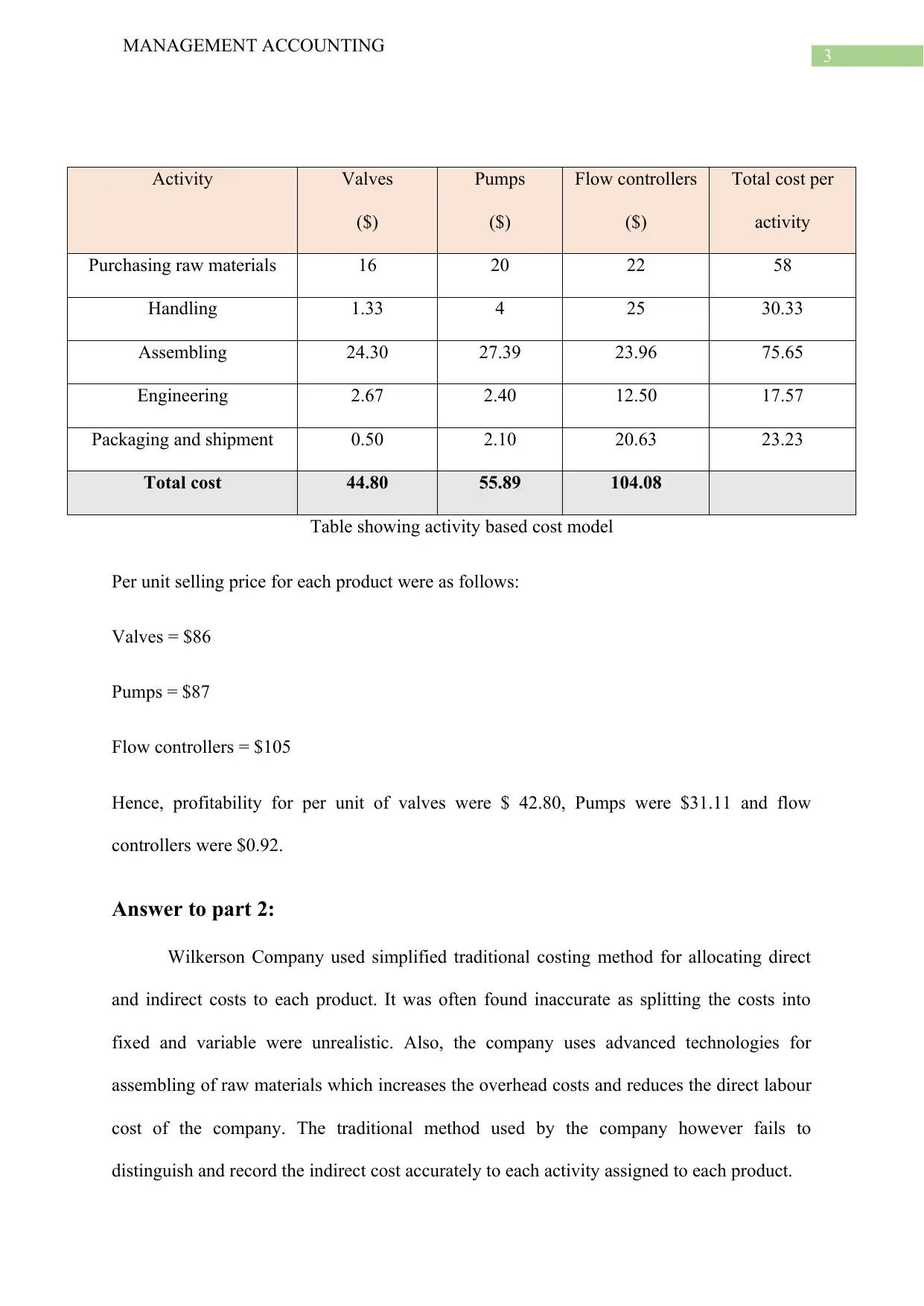
Costs allocated to each activity used to produce all the three product line of the company
were as follows:
Document Page
3
MANAGEMENT ACCOUNTING
Activity Valves
($)
Pumps
($)
Flow controllers
($)
Total cost per
activity
Purchasing raw materials 16 20 22 58
Handling 1.33 4 25 30.33
Assembling 24.30 27.39 23.96 75.65
Engineering 2.67 2.40 12.50 17.57
Packaging and shipment 0.50 2.10 20.63 23.23
Total cost 44.80 55.89 104.08
Table showing activity based cost model
Per unit selling price for each product were as follows:
Valves = $86
Pumps = $87
Flow controllers = $105
Hence, profitability for per unit of valves were $ 42.80, Pumps were $31.11 and flow
controllers were $0.92.
Answer to part 2:
Wilkerson Company used simplified traditional costing method for allocating direct
and indirect costs to each product. It was often found inaccurate as splitting the costs into
fixed and variable were unrealistic. Also, the company uses advanced technologies for
assembling of raw materials which increases the overhead costs and reduces the direct labour
cost of the company. The traditional method used by the company however fails to
distinguish and record the indirect cost accurately to each activity assigned to each product.
tabler-icon-diamond-filled.svg

Paraphrase This Document

Need a fresh take? Get an instant paraphrase of this document with our AI Paraphraser
Document Page
4
MANAGEMENT ACCOUNTING
Activity Based costing techniques helps the company in analysing all the activities
that the company will be performing in order to produce each products. Evaluating the cost to
each activities allows the company to determine where to allocate more cost and where the
costs need to be reduced (Mahal & Hossain, 2015). Also, traditional costing helps in
providing a precise breakdown of all indirect costs to each activity.
In case of activity based costing overhead or indirect costs are divided into various
activities such as packaging & shipment, engineering, handling, set up cost and machine
related costs. The amount allocated to each activity for all the different product line of the
company might not be the same. Hence, ABC method helps in evaluating the accurate costs
that must be assigned to each activity. For example in case of Valves the total overhead cost
under ABC method is $18.80 whereas in case of traditional method the overhead cost was
$30, which was overvalued. Similarly in case of pumps, the total ABC overhead costs were
reduced to $23.39 from $37.50. However, flow controllers required more labour and
machines at the time of assembling and therefore attracted $72.08 as the total ABC overhead
cost which the traditional method inaccurately estimated at $30.
Answer to part 3:
Activity based costing method assumes that the cost of manufacturing varies directly
with the production unit and each product requires a series of activities that consume
resources. ABC costing is one of the most reliable techniques used by mostly all the
manufacturing firms as it provides better classification of costs incurred in the production
process and gives an accurate estimation of costs to each activities (Mahal & Hossain, 2015).
It is a modern costing method used for accurate estimation of costs.
Other approaches or techniques of allocating costs are as follows:
Document Page
5
MANAGEMENT ACCOUNTING
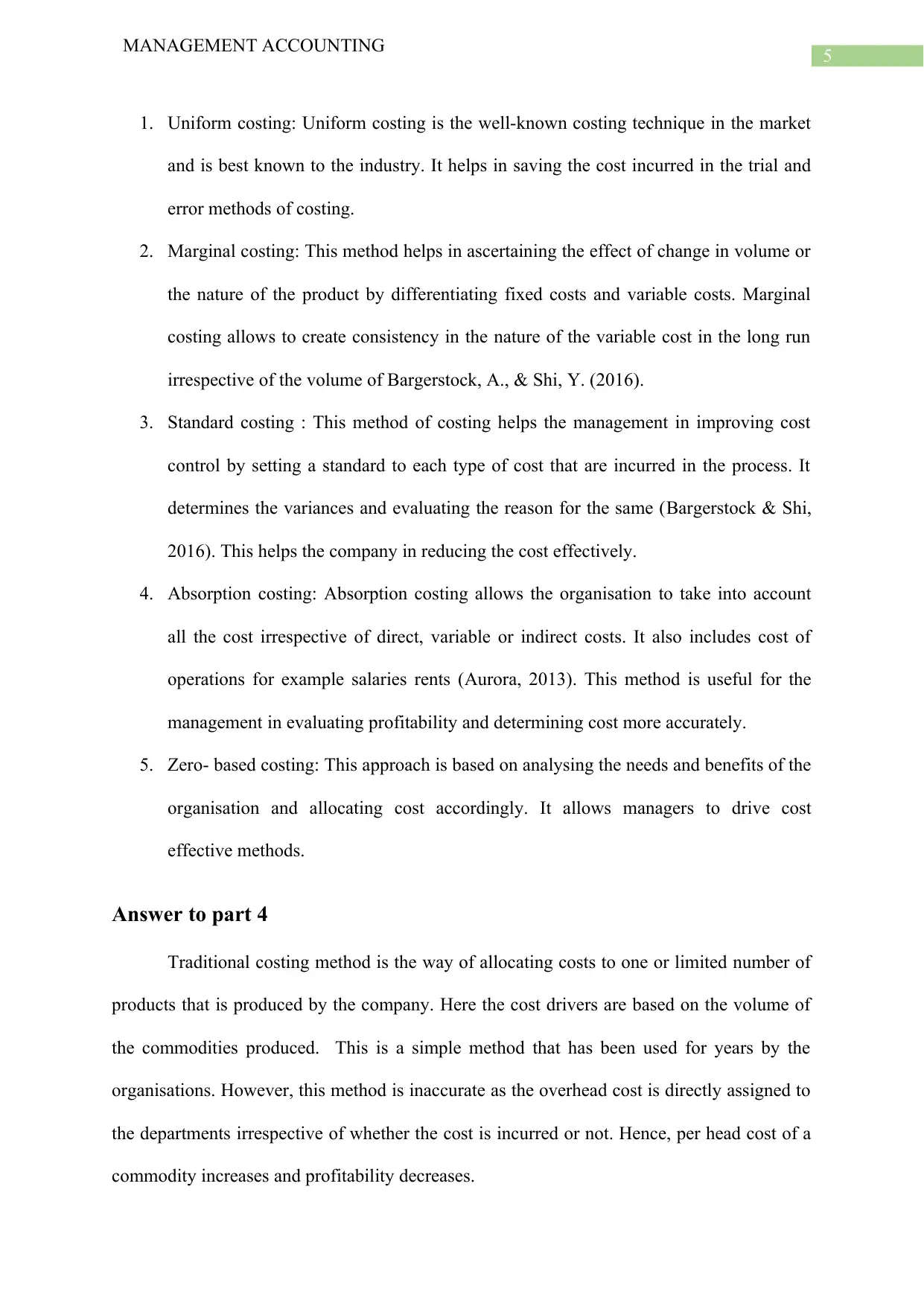
1. Uniform costing: Uniform costing is the well-known costing technique in the market
and is best known to the industry. It helps in saving the cost incurred in the trial and
error methods of costing.
2. Marginal costing: This method helps in ascertaining the effect of change in volume or
the nature of the product by differentiating fixed costs and variable costs. Marginal
costing allows to create consistency in the nature of the variable cost in the long run
irrespective of the volume of Bargerstock, A., & Shi, Y. (2016).
3. Standard costing : This method of costing helps the management in improving cost
control by setting a standard to each type of cost that are incurred in the process. It
determines the variances and evaluating the reason for the same (Bargerstock & Shi,
2016). This helps the company in reducing the cost effectively.
4. Absorption costing: Absorption costing allows the organisation to take into account
all the cost irrespective of direct, variable or indirect costs. It also includes cost of
operations for example salaries rents (Aurora, 2013). This method is useful for the
management in evaluating profitability and determining cost more accurately.
5. Zero- based costing: This approach is based on analysing the needs and benefits of the
organisation and allocating cost accordingly. It allows managers to drive cost
effective methods.
Answer to part 4
Traditional costing method is the way of allocating costs to one or limited number of
products that is produced by the company. Here the cost drivers are based on the volume of
the commodities produced. This is a simple method that has been used for years by the
organisations. However, this method is inaccurate as the overhead cost is directly assigned to
the departments irrespective of whether the cost is incurred or not. Hence, per head cost of a
commodity increases and profitability decreases.
Document Page
6
MANAGEMENT ACCOUNTING
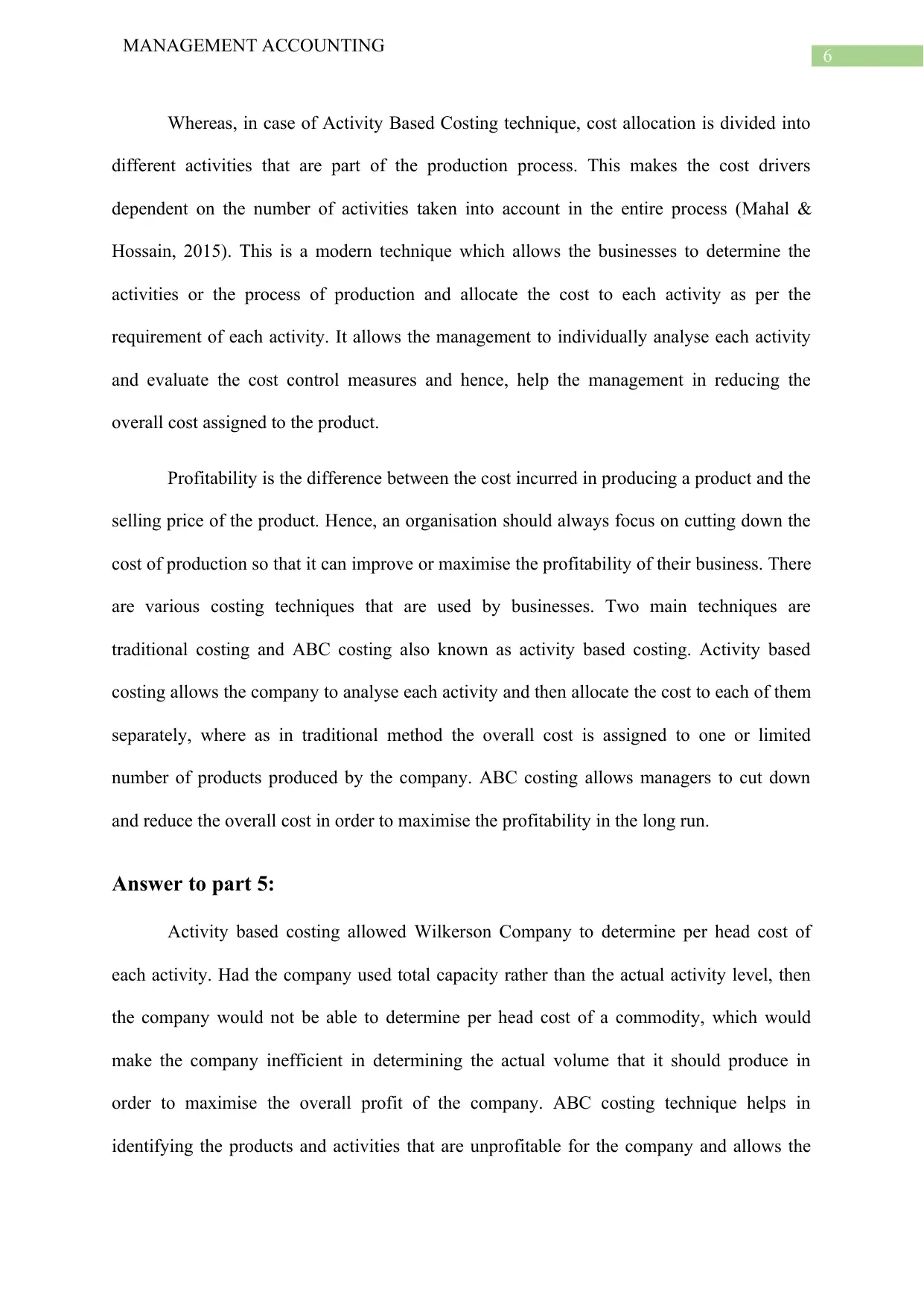
Whereas, in case of Activity Based Costing technique, cost allocation is divided into
different activities that are part of the production process. This makes the cost drivers
dependent on the number of activities taken into account in the entire process (Mahal &
Hossain, 2015). This is a modern technique which allows the businesses to determine the
activities or the process of production and allocate the cost to each activity as per the
requirement of each activity. It allows the management to individually analyse each activity
and evaluate the cost control measures and hence, help the management in reducing the
overall cost assigned to the product.
Profitability is the difference between the cost incurred in producing a product and the
selling price of the product. Hence, an organisation should always focus on cutting down the
cost of production so that it can improve or maximise the profitability of their business. There
are various costing techniques that are used by businesses. Two main techniques are
traditional costing and ABC costing also known as activity based costing. Activity based
costing allows the company to analyse each activity and then allocate the cost to each of them
separately, where as in traditional method the overall cost is assigned to one or limited
number of products produced by the company. ABC costing allows managers to cut down
and reduce the overall cost in order to maximise the profitability in the long run.
Answer to part 5:
Activity based costing allowed Wilkerson Company to determine per head cost of
each activity. Had the company used total capacity rather than the actual activity level, then
the company would not be able to determine per head cost of a commodity, which would
make the company inefficient in determining the actual volume that it should produce in
order to maximise the overall profit of the company. ABC costing technique helps in
identifying the products and activities that are unprofitable for the company and allows the
tabler-icon-diamond-filled.svg

Paraphrase This Document

Need a fresh take? Get an instant paraphrase of this document with our AI Paraphraser
Document Page
7
MANAGEMENT ACCOUNTING
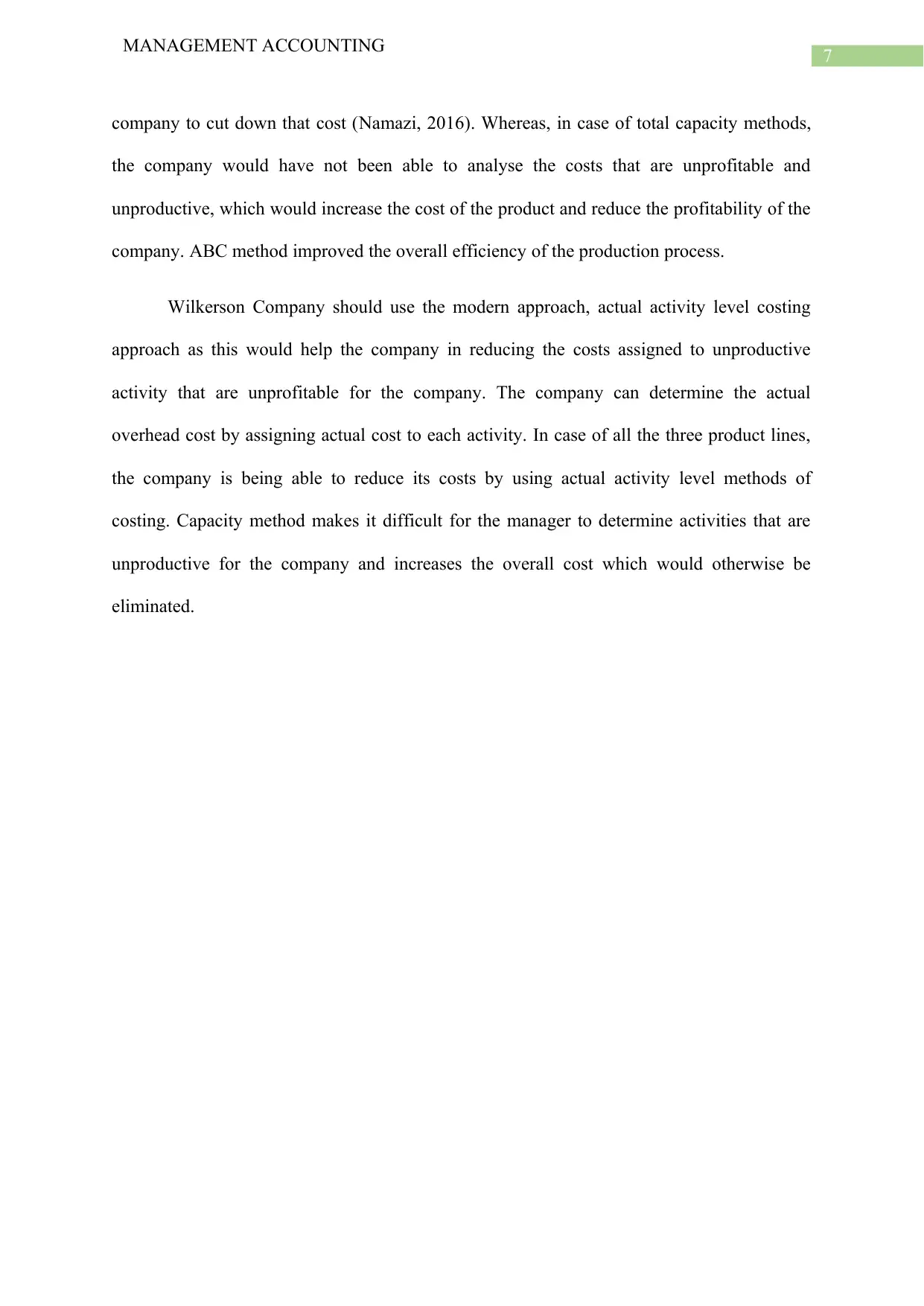
company to cut down that cost (Namazi, 2016). Whereas, in case of total capacity methods,
the company would have not been able to analyse the costs that are unprofitable and
unproductive, which would increase the cost of the product and reduce the profitability of the
company. ABC method improved the overall efficiency of the production process.
Wilkerson Company should use the modern approach, actual activity level costing
approach as this would help the company in reducing the costs assigned to unproductive
activity that are unprofitable for the company. The company can determine the actual
overhead cost by assigning actual cost to each activity. In case of all the three product lines,
the company is being able to reduce its costs by using actual activity level methods of
costing. Capacity method makes it difficult for the manager to determine activities that are
unproductive for the company and increases the overall cost which would otherwise be
eliminated.
Document Page
8
MANAGEMENT ACCOUNTING
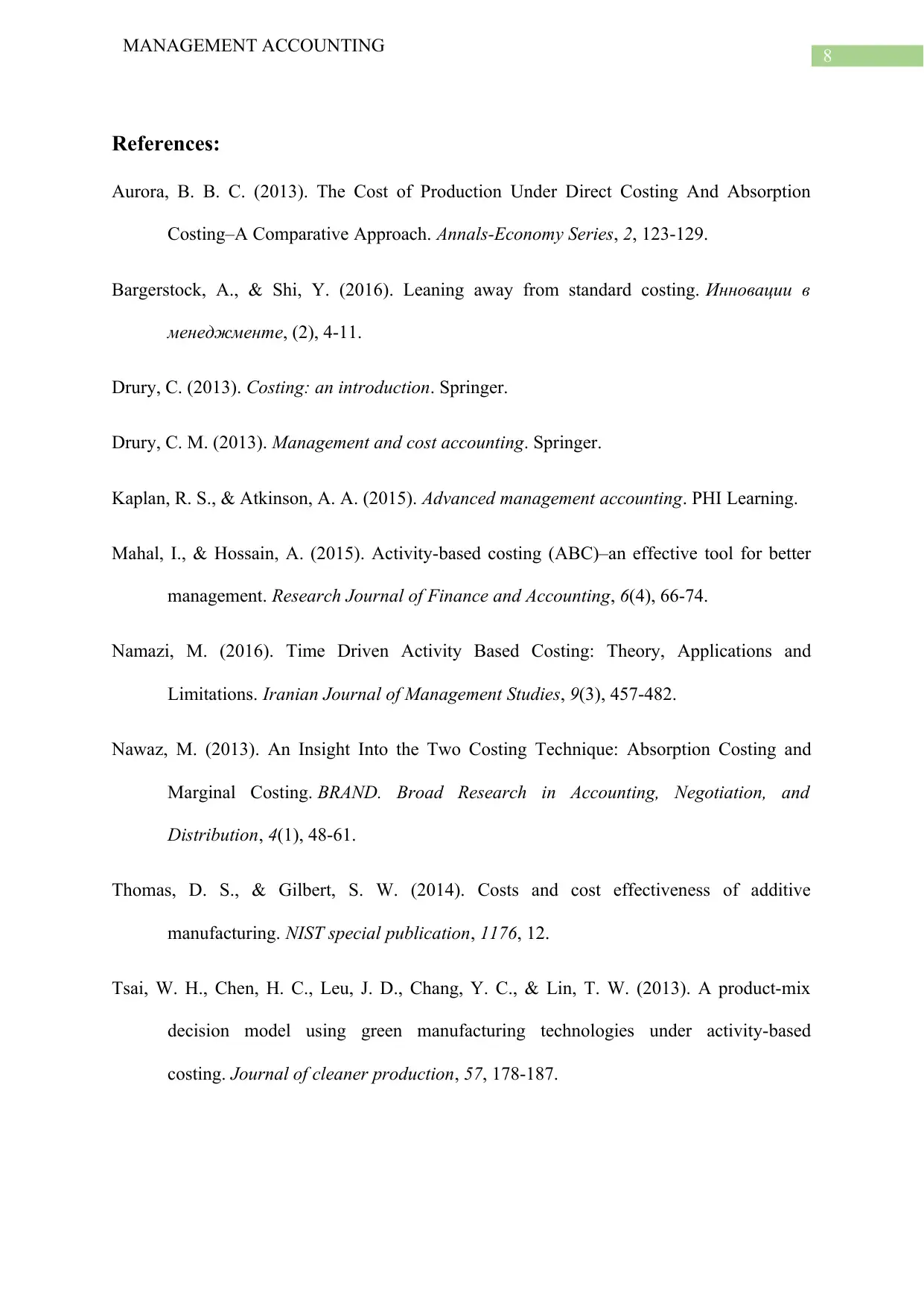
References:
Aurora, B. B. C. (2013). The Cost of Production Under Direct Costing And Absorption
Costing–A Comparative Approach. Annals-Economy Series, 2, 123-129.
Bargerstock, A., & Shi, Y. (2016). Leaning away from standard costing. Инновации в
менеджменте, (2), 4-11.
Drury, C. (2013). Costing: an introduction. Springer.
Drury, C. M. (2013). Management and cost accounting. Springer.
Kaplan, R. S., & Atkinson, A. A. (2015). Advanced management accounting. PHI Learning.
Mahal, I., & Hossain, A. (2015). Activity-based costing (ABC)–an effective tool for better
management. Research Journal of Finance and Accounting, 6(4), 66-74.
Namazi, M. (2016). Time Driven Activity Based Costing: Theory, Applications and
Limitations. Iranian Journal of Management Studies, 9(3), 457-482.
Nawaz, M. (2013). An Insight Into the Two Costing Technique: Absorption Costing and
Marginal Costing. BRAND. Broad Research in Accounting, Negotiation, and
Distribution, 4(1), 48-61.
Thomas, D. S., & Gilbert, S. W. (2014). Costs and cost effectiveness of additive
manufacturing. NIST special publication, 1176, 12.
Tsai, W. H., Chen, H. C., Leu, J. D., Chang, Y. C., & Lin, T. W. (2013). A product-mix
decision model using green manufacturing technologies under activity-based
costing. Journal of cleaner production, 57, 178-187.
chevron_up_icon
1 out of 9
circle_padding
hide_on_mobile
zoom_out_icon
[object Object]