Evaluating Management Accounting Systems for Organizational Success
VerifiedAdded on 2024/05/16
|22
|3674
|331
Report
AI Summary
This report provides a comprehensive analysis of management accounting systems and their application in organizational decision-making. It explains the importance of management accounting in improving company performance, details three different types of management accounting systems (managerial, inventory, and cost accounting), and critically evaluates their benefits within an organizational context. The report also includes the preparation of income statements under both absorption and marginal costing methods for two quarters, explains the differences in profits under these techniques, and presents a reconciliation statement. Furthermore, it compares and contrasts three different planning tools used in management accounting—standard costing, decision-making accounting, and budgetary control—and analyzes how these tools respond to financial problems to lead the organization to sustainable success. The document concludes by highlighting the significance of management accounting in achieving organizational goals and objectives. Desklib provides access to similar solved assignments and study resources for students.
Management Accounting System and its application
Paraphrase This Document
Need a fresh take? Get an instant paraphrase of this document with our AI Paraphraser

Table of Contents
Section I..........................................................................................................................................3
[P1] Explain why management accounting is important in the decision-making process for
improving the performance of the company...............................................................................3
[P2] Explain three different types of management accounting systems used for
management accounting reporting..............................................................................................5
[P3] Critically evaluate the benefits of types of management accounting systems and their
application within an organizational context..............................................................................6
[P4.(a)] Prepare and present two different income statements under absorption costing and
marginal costing for each of the two quarters............................................................................7
[P4.(b)] Explain with supportive calculations, why the profits under techniques are
different........................................................................................................................................11
[P4.(c)] Produce a reconciliation statement of profit or loss showing the reconciled profits
for the two techniques used previously......................................................................................12
Section II.......................................................................................................................................13
[Part A] Compare and contrast three different planning tools used in management
accounting. Analyse and evaluate how the use of planning tools for accounting respond to
solving financial problems to lead the organization.................................................................13
[Part B] Compare ways in which management accounting is applied. Analyse how, in
responding to financial problems, management accounting can lead organizations to
sustainable success.......................................................................................................................15
Conclusion....................................................................................................................................16
References.....................................................................................................................................17
Section I..........................................................................................................................................3
[P1] Explain why management accounting is important in the decision-making process for
improving the performance of the company...............................................................................3
[P2] Explain three different types of management accounting systems used for
management accounting reporting..............................................................................................5
[P3] Critically evaluate the benefits of types of management accounting systems and their
application within an organizational context..............................................................................6
[P4.(a)] Prepare and present two different income statements under absorption costing and
marginal costing for each of the two quarters............................................................................7
[P4.(b)] Explain with supportive calculations, why the profits under techniques are
different........................................................................................................................................11
[P4.(c)] Produce a reconciliation statement of profit or loss showing the reconciled profits
for the two techniques used previously......................................................................................12
Section II.......................................................................................................................................13
[Part A] Compare and contrast three different planning tools used in management
accounting. Analyse and evaluate how the use of planning tools for accounting respond to
solving financial problems to lead the organization.................................................................13
[Part B] Compare ways in which management accounting is applied. Analyse how, in
responding to financial problems, management accounting can lead organizations to
sustainable success.......................................................................................................................15
Conclusion....................................................................................................................................16
References.....................................................................................................................................17

Section I
[P1] Explain why management accounting is important in the decision-making process for
improving the performance of the company.
Management accounting is a broader concept as it involves various aspects. Each and every
branch of study of management accounting has different implications and aims to achieve
organizational goals and objectives. The formulation and implementation of management
accounting will help all the levels of management working within an organizational structure.
Role and significance of the management accounting in the decision making the process so that
the overall performance of the company can be improved are as follow:
1. The important and prominent feature of management accounting namely, financial accounting, is
used by the top-level management to take various crucial decisions (Ada & Ghaffarzadeh, 2015).
With the proper implementation of financial accounting, the true and actual profitability can be
determined. This will also help to satisfy the requirements of all the stakeholders as they are
always interested in the business affairs of the concerned business enterprise.
2. With the assistance of management accounting, the per unit cost can be determined and
identified. This information relating to per unit cost helps to take crucial decisions regarding cost
control and cost reduction to the extent possible (Guga & Musa, 2015). The management
accounting facilitates to take compare per unit cost with the rival firms operating in the business
environment.
3. The management accounting helps to identify the unprofitable segment or unprofitable
individual product or service as a result of which the overall profit can be achieved. As such,
through management accounting, the top level can focus on core activities so that overall
objectives can be achieved.
4. The implementation of management accounting will help to diversify the business so that it can
prosper and flourish and achieve competitive advantage over its rival firms. As such, the top
[P1] Explain why management accounting is important in the decision-making process for
improving the performance of the company.
Management accounting is a broader concept as it involves various aspects. Each and every
branch of study of management accounting has different implications and aims to achieve
organizational goals and objectives. The formulation and implementation of management
accounting will help all the levels of management working within an organizational structure.
Role and significance of the management accounting in the decision making the process so that
the overall performance of the company can be improved are as follow:
1. The important and prominent feature of management accounting namely, financial accounting, is
used by the top-level management to take various crucial decisions (Ada & Ghaffarzadeh, 2015).
With the proper implementation of financial accounting, the true and actual profitability can be
determined. This will also help to satisfy the requirements of all the stakeholders as they are
always interested in the business affairs of the concerned business enterprise.
2. With the assistance of management accounting, the per unit cost can be determined and
identified. This information relating to per unit cost helps to take crucial decisions regarding cost
control and cost reduction to the extent possible (Guga & Musa, 2015). The management
accounting facilitates to take compare per unit cost with the rival firms operating in the business
environment.
3. The management accounting helps to identify the unprofitable segment or unprofitable
individual product or service as a result of which the overall profit can be achieved. As such,
through management accounting, the top level can focus on core activities so that overall
objectives can be achieved.
4. The implementation of management accounting will help to diversify the business so that it can
prosper and flourish and achieve competitive advantage over its rival firms. As such, the top
⊘ This is a preview!⊘
Do you want full access?
Subscribe today to unlock all pages.

Trusted by 1+ million students worldwide

level management can take crucial decisions which will help to capture market share in the
market.
5. Under management accounting, different types of budgets are prepared by the all the segments
operating or functioning in the business enterprise (Breuer, et. al., 2013). Preparation of budget
helps to establish standards or benchmarks for every department which it aims to achieve within
a specified time span.
6. The information generated from the application of several costing principles can be analyzed on
the basis of which several decisions can be taken. The application of costing principles need to
be carefully applied by the management to get the accurate and correct result. For this purpose,
the cost accountant should be well skilled and have expert knowledge.
7. The management accounting helps to measure the performance by identifying key performance
indicators. Measuring the actual performance will help in the decision-making process. If the
management is unsatisfied with any particular segment or department, the management can take
suitable and appropriate decision against the responsible officer.
market.
5. Under management accounting, different types of budgets are prepared by the all the segments
operating or functioning in the business enterprise (Breuer, et. al., 2013). Preparation of budget
helps to establish standards or benchmarks for every department which it aims to achieve within
a specified time span.
6. The information generated from the application of several costing principles can be analyzed on
the basis of which several decisions can be taken. The application of costing principles need to
be carefully applied by the management to get the accurate and correct result. For this purpose,
the cost accountant should be well skilled and have expert knowledge.
7. The management accounting helps to measure the performance by identifying key performance
indicators. Measuring the actual performance will help in the decision-making process. If the
management is unsatisfied with any particular segment or department, the management can take
suitable and appropriate decision against the responsible officer.
Paraphrase This Document
Need a fresh take? Get an instant paraphrase of this document with our AI Paraphraser

[P2] Explain three different types of management accounting systems used for
management accounting reporting.
Under management accounting systems, different types of reports are prepared so as to take
several crucial and strategic decisions. All these reports play a major and dominant role in
management accounting reporting. These reports come under management accounting reporting.
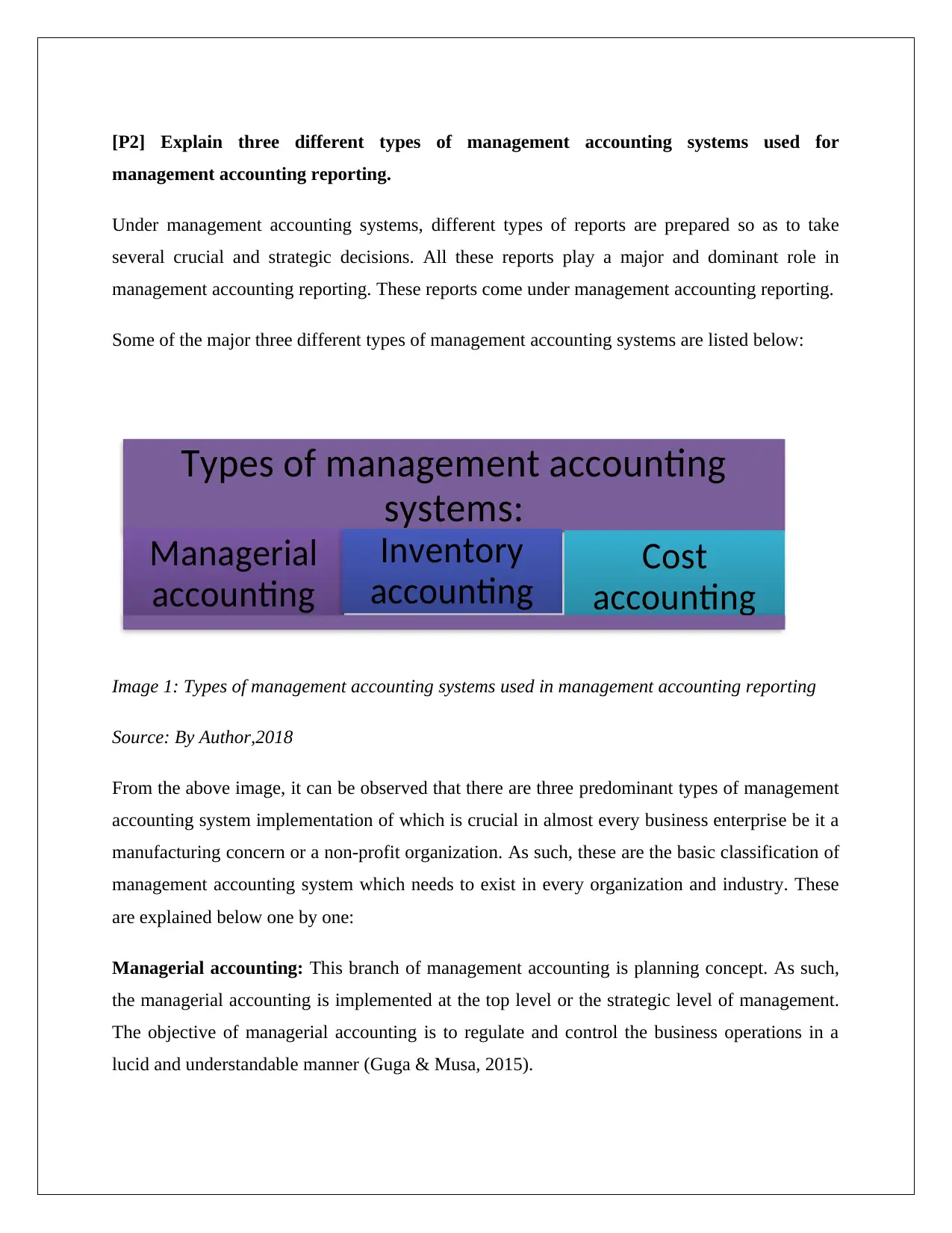
Some of the major three different types of management accounting systems are listed below:
Image 1: Types of management accounting systems used in management accounting reporting
Source: By Author,2018
From the above image, it can be observed that there are three predominant types of management
accounting system implementation of which is crucial in almost every business enterprise be it a
manufacturing concern or a non-profit organization. As such, these are the basic classification of
management accounting system which needs to exist in every organization and industry. These
are explained below one by one:
Managerial accounting: This branch of management accounting is planning concept. As such,
the managerial accounting is implemented at the top level or the strategic level of management.
The objective of managerial accounting is to regulate and control the business operations in a
lucid and understandable manner (Guga & Musa, 2015).
Types of management accounting
systems:
Managerial
accounting
Inventory
accounting Cost
accounting
management accounting reporting.
Under management accounting systems, different types of reports are prepared so as to take
several crucial and strategic decisions. All these reports play a major and dominant role in
management accounting reporting. These reports come under management accounting reporting.
Some of the major three different types of management accounting systems are listed below:
Image 1: Types of management accounting systems used in management accounting reporting
Source: By Author,2018
From the above image, it can be observed that there are three predominant types of management
accounting system implementation of which is crucial in almost every business enterprise be it a
manufacturing concern or a non-profit organization. As such, these are the basic classification of
management accounting system which needs to exist in every organization and industry. These
are explained below one by one:
Managerial accounting: This branch of management accounting is planning concept. As such,
the managerial accounting is implemented at the top level or the strategic level of management.
The objective of managerial accounting is to regulate and control the business operations in a
lucid and understandable manner (Guga & Musa, 2015).
Types of management accounting
systems:
Managerial
accounting
Inventory
accounting Cost
accounting

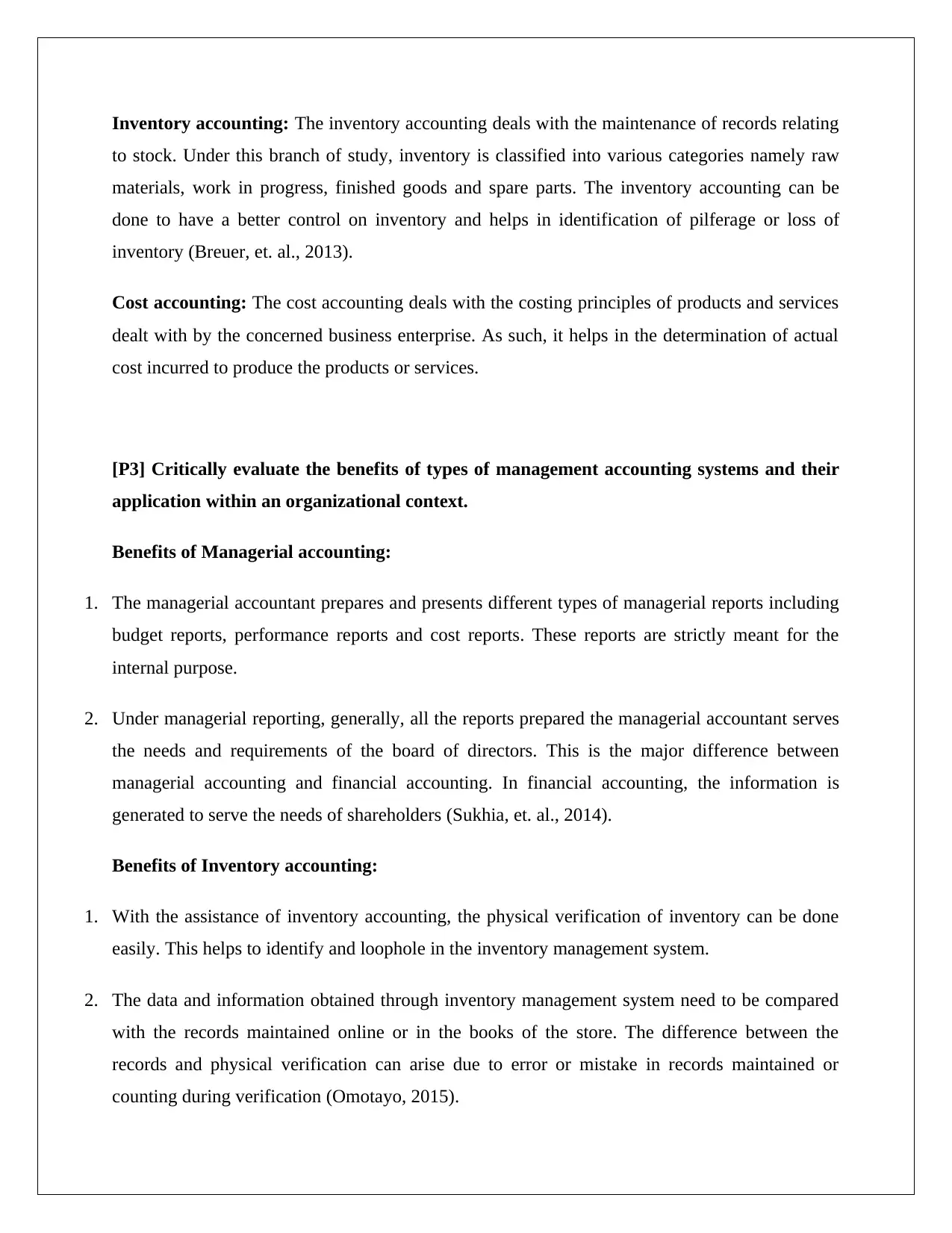
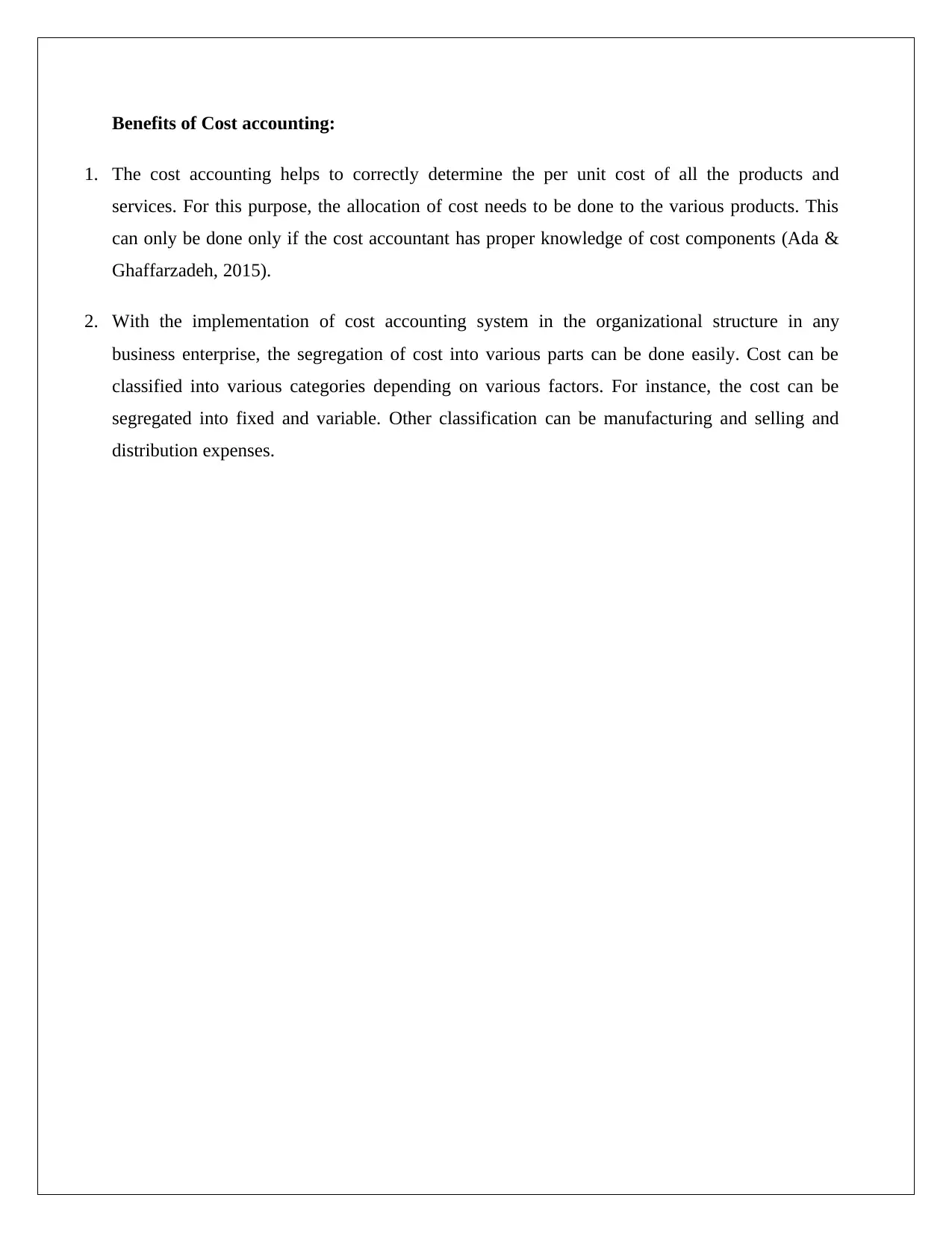
Inventory accounting: The inventory accounting deals with the maintenance of records relating
to stock. Under this branch of study, inventory is classified into various categories namely raw
materials, work in progress, finished goods and spare parts. The inventory accounting can be
done to have a better control on inventory and helps in identification of pilferage or loss of
inventory (Breuer, et. al., 2013).
Cost accounting: The cost accounting deals with the costing principles of products and services
dealt with by the concerned business enterprise. As such, it helps in the determination of actual
cost incurred to produce the products or services.
[P3] Critically evaluate the benefits of types of management accounting systems and their
application within an organizational context.
Benefits of Managerial accounting:
1. The managerial accountant prepares and presents different types of managerial reports including
budget reports, performance reports and cost reports. These reports are strictly meant for the
internal purpose.
2. Under managerial reporting, generally, all the reports prepared the managerial accountant serves
the needs and requirements of the board of directors. This is the major difference between
managerial accounting and financial accounting. In financial accounting, the information is
generated to serve the needs of shareholders (Sukhia, et. al., 2014).
Benefits of Inventory accounting:
1. With the assistance of inventory accounting, the physical verification of inventory can be done
easily. This helps to identify and loophole in the inventory management system.
2. The data and information obtained through inventory management system need to be compared
with the records maintained online or in the books of the store. The difference between the
records and physical verification can arise due to error or mistake in records maintained or
counting during verification (Omotayo, 2015).
to stock. Under this branch of study, inventory is classified into various categories namely raw
materials, work in progress, finished goods and spare parts. The inventory accounting can be
done to have a better control on inventory and helps in identification of pilferage or loss of
inventory (Breuer, et. al., 2013).
Cost accounting: The cost accounting deals with the costing principles of products and services
dealt with by the concerned business enterprise. As such, it helps in the determination of actual
cost incurred to produce the products or services.
[P3] Critically evaluate the benefits of types of management accounting systems and their
application within an organizational context.
Benefits of Managerial accounting:
1. The managerial accountant prepares and presents different types of managerial reports including
budget reports, performance reports and cost reports. These reports are strictly meant for the
internal purpose.
2. Under managerial reporting, generally, all the reports prepared the managerial accountant serves
the needs and requirements of the board of directors. This is the major difference between
managerial accounting and financial accounting. In financial accounting, the information is
generated to serve the needs of shareholders (Sukhia, et. al., 2014).
Benefits of Inventory accounting:
1. With the assistance of inventory accounting, the physical verification of inventory can be done
easily. This helps to identify and loophole in the inventory management system.
2. The data and information obtained through inventory management system need to be compared
with the records maintained online or in the books of the store. The difference between the
records and physical verification can arise due to error or mistake in records maintained or
counting during verification (Omotayo, 2015).
⊘ This is a preview!⊘
Do you want full access?
Subscribe today to unlock all pages.

Trusted by 1+ million students worldwide

Benefits of Cost accounting:
1. The cost accounting helps to correctly determine the per unit cost of all the products and
services. For this purpose, the allocation of cost needs to be done to the various products. This
can only be done only if the cost accountant has proper knowledge of cost components (Ada &
Ghaffarzadeh, 2015).
2. With the implementation of cost accounting system in the organizational structure in any
business enterprise, the segregation of cost into various parts can be done easily. Cost can be
classified into various categories depending on various factors. For instance, the cost can be
segregated into fixed and variable. Other classification can be manufacturing and selling and
distribution expenses.
1. The cost accounting helps to correctly determine the per unit cost of all the products and
services. For this purpose, the allocation of cost needs to be done to the various products. This
can only be done only if the cost accountant has proper knowledge of cost components (Ada &
Ghaffarzadeh, 2015).
2. With the implementation of cost accounting system in the organizational structure in any
business enterprise, the segregation of cost into various parts can be done easily. Cost can be
classified into various categories depending on various factors. For instance, the cost can be
segregated into fixed and variable. Other classification can be manufacturing and selling and
distribution expenses.
Paraphrase This Document
Need a fresh take? Get an instant paraphrase of this document with our AI Paraphraser

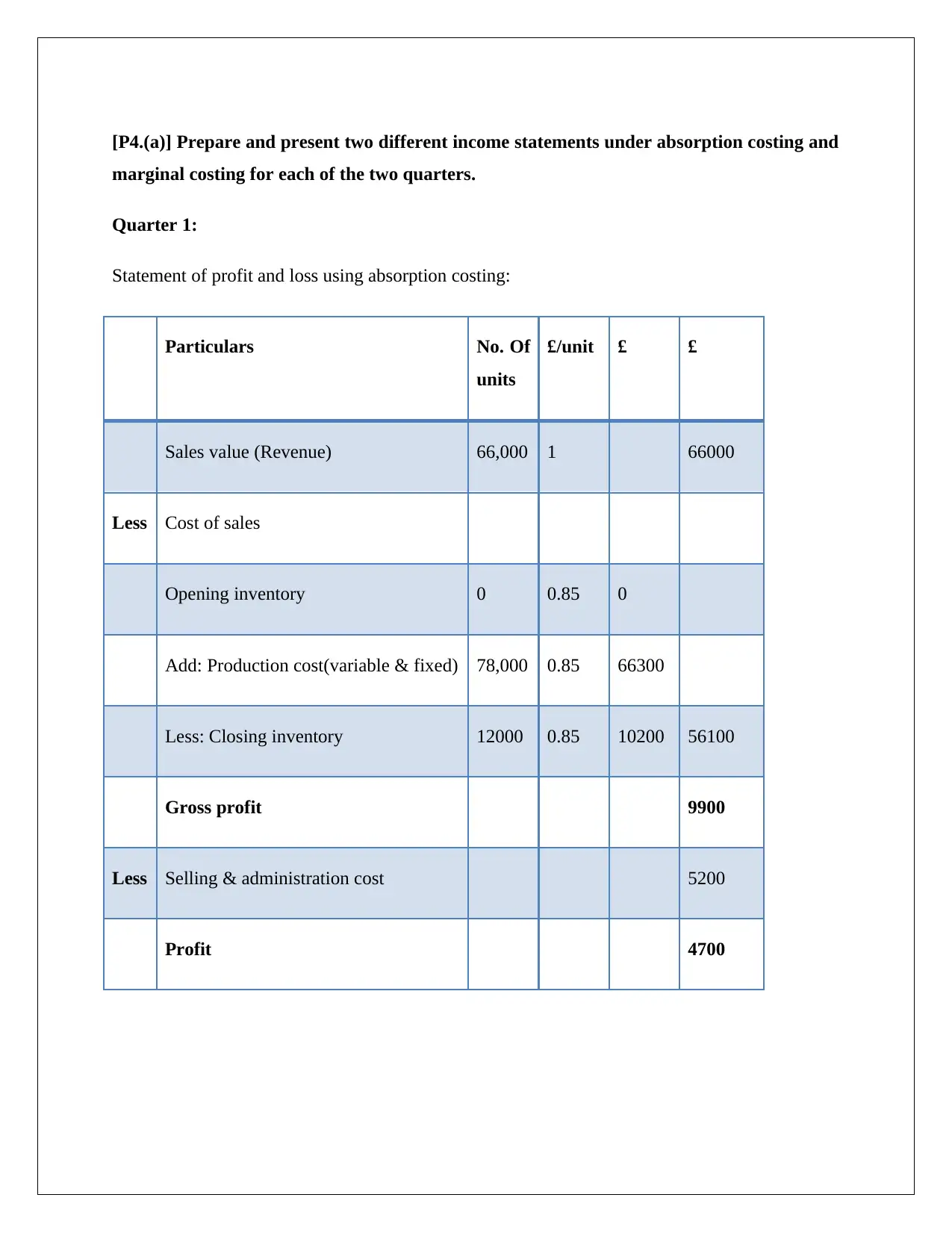
[P4.(a)] Prepare and present two different income statements under absorption costing and
marginal costing for each of the two quarters.
Quarter 1:
Statement of profit and loss using absorption costing:
Particulars No. Of
units
£/unit £ £
Sales value (Revenue) 66,000 1 66000
Less Cost of sales
Opening inventory 0 0.85 0
Add: Production cost(variable & fixed) 78,000 0.85 66300
Less: Closing inventory 12000 0.85 10200 56100
Gross profit 9900
Less Selling & administration cost 5200
Profit 4700
marginal costing for each of the two quarters.
Quarter 1:
Statement of profit and loss using absorption costing:
Particulars No. Of
units
£/unit £ £
Sales value (Revenue) 66,000 1 66000
Less Cost of sales
Opening inventory 0 0.85 0
Add: Production cost(variable & fixed) 78,000 0.85 66300
Less: Closing inventory 12000 0.85 10200 56100
Gross profit 9900
Less Selling & administration cost 5200
Profit 4700

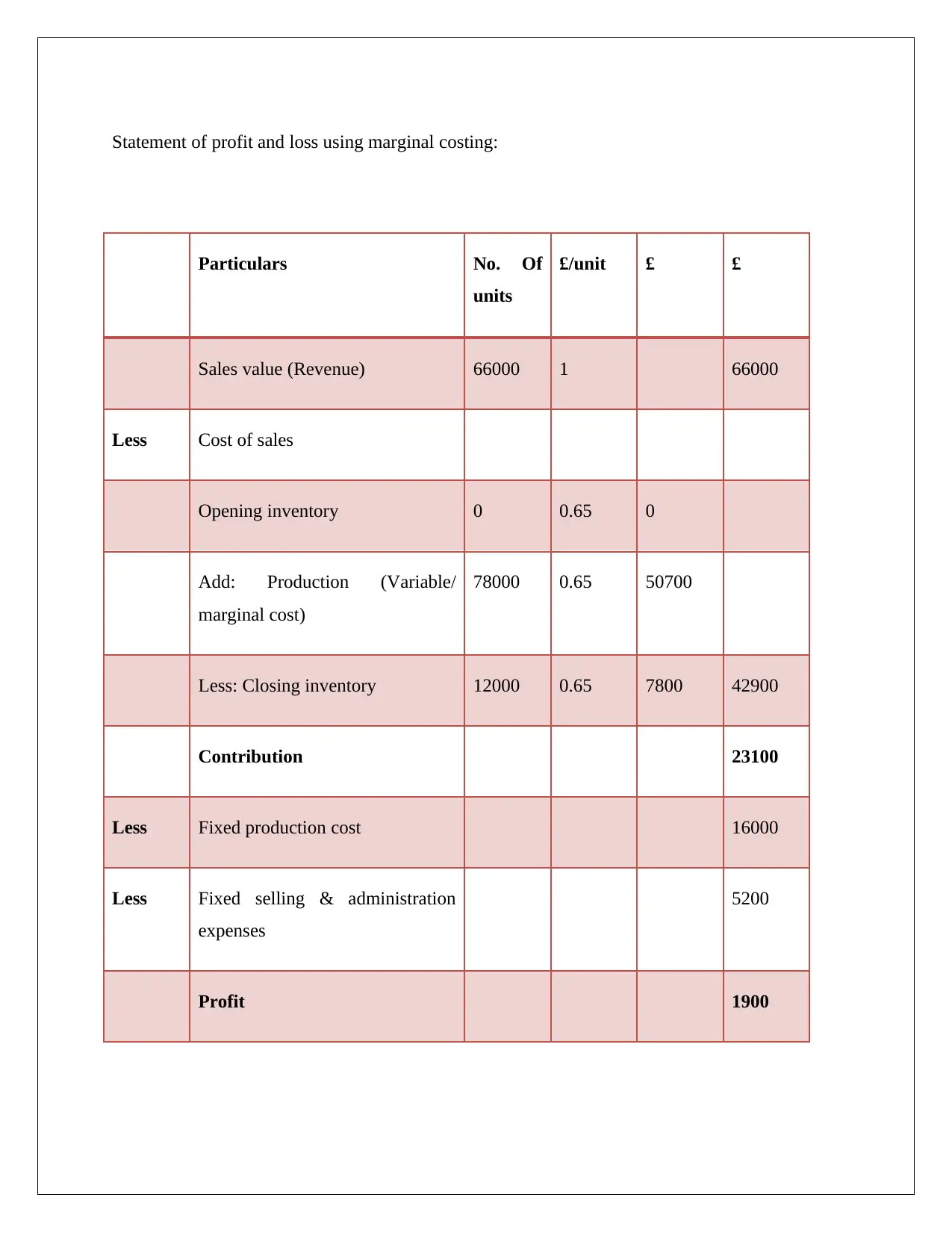
Statement of profit and loss using marginal costing:
Particulars No. Of
units
£/unit £ £
Sales value (Revenue) 66000 1 66000
Less Cost of sales
Opening inventory 0 0.65 0
Add: Production (Variable/
marginal cost)
78000 0.65 50700
Less: Closing inventory 12000 0.65 7800 42900
Contribution 23100
Less Fixed production cost 16000
Less Fixed selling & administration
expenses
5200
Profit 1900
Particulars No. Of
units
£/unit £ £
Sales value (Revenue) 66000 1 66000
Less Cost of sales
Opening inventory 0 0.65 0
Add: Production (Variable/
marginal cost)
78000 0.65 50700
Less: Closing inventory 12000 0.65 7800 42900
Contribution 23100
Less Fixed production cost 16000
Less Fixed selling & administration
expenses
5200
Profit 1900
⊘ This is a preview!⊘
Do you want full access?
Subscribe today to unlock all pages.

Trusted by 1+ million students worldwide

Paraphrase This Document
Need a fresh take? Get an instant paraphrase of this document with our AI Paraphraser

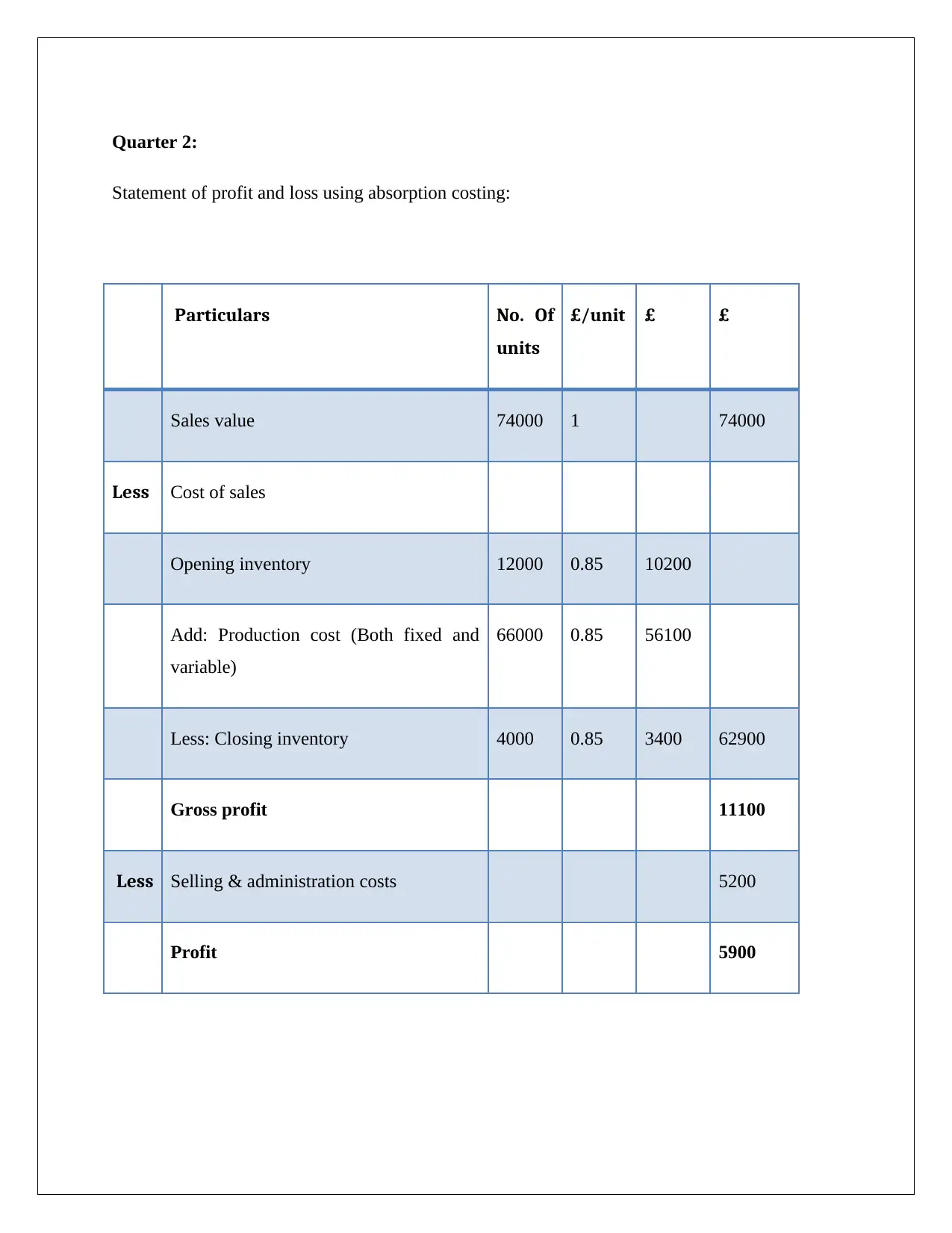
Quarter 2:
Statement of profit and loss using absorption costing:
Particulars No. Of
units
£/unit £ £
Sales value 74000 1 74000
Less Cost of sales
Opening inventory 12000 0.85 10200
Add: Production cost (Both fixed and
variable)
66000 0.85 56100
Less: Closing inventory 4000 0.85 3400 62900
Gross profit 11100
Less Selling & administration costs 5200
Profit 5900
Statement of profit and loss using absorption costing:
Particulars No. Of
units
£/unit £ £
Sales value 74000 1 74000
Less Cost of sales
Opening inventory 12000 0.85 10200
Add: Production cost (Both fixed and
variable)
66000 0.85 56100
Less: Closing inventory 4000 0.85 3400 62900
Gross profit 11100
Less Selling & administration costs 5200
Profit 5900

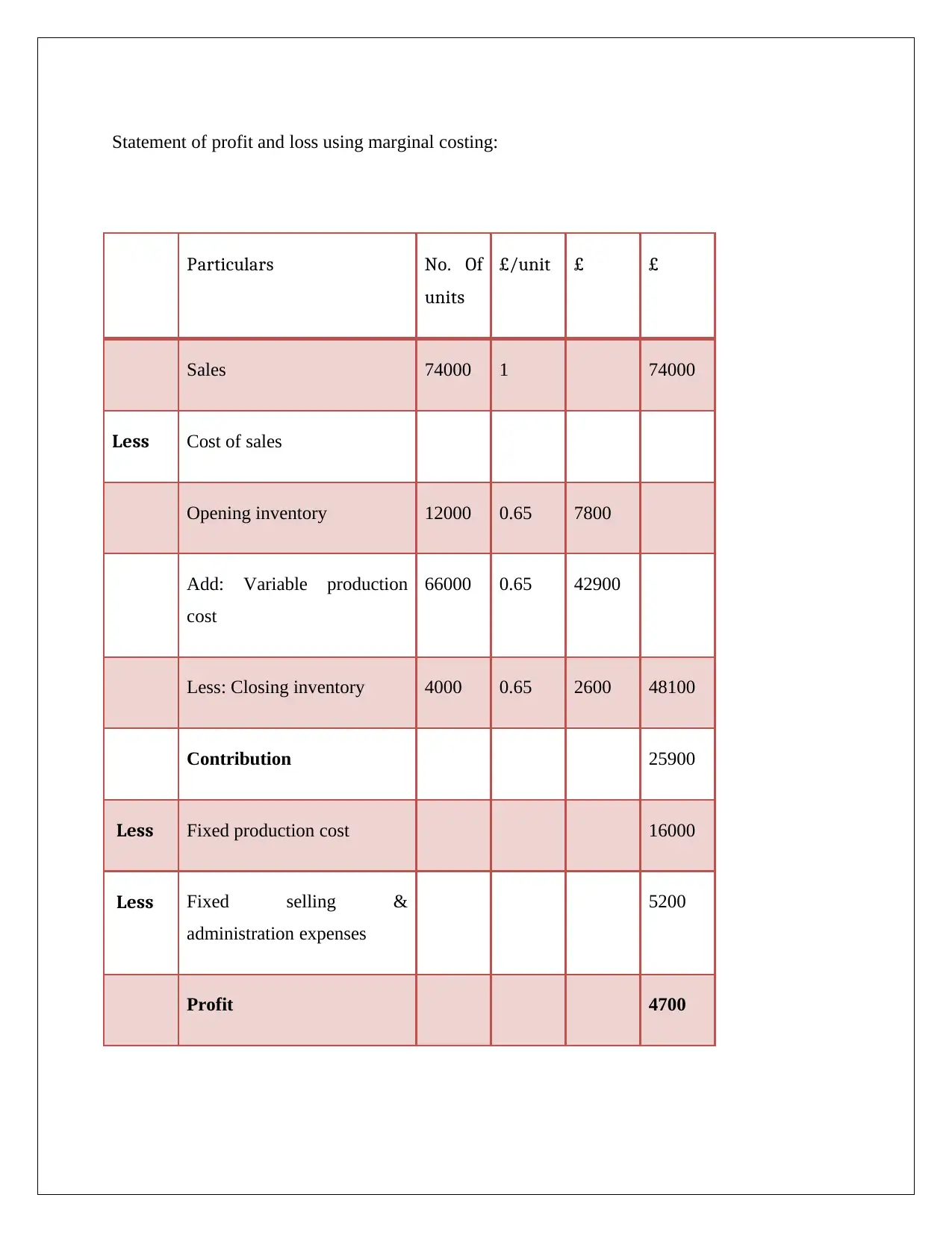
Statement of profit and loss using marginal costing:
Particulars No. Of
units
£/unit £ £
Sales 74000 1 74000
Less Cost of sales
Opening inventory 12000 0.65 7800
Add: Variable production
cost
66000 0.65 42900
Less: Closing inventory 4000 0.65 2600 48100
Contribution 25900
Less Fixed production cost 16000
Less Fixed selling &
administration expenses
5200
Profit 4700
Particulars No. Of
units
£/unit £ £
Sales 74000 1 74000
Less Cost of sales
Opening inventory 12000 0.65 7800
Add: Variable production
cost
66000 0.65 42900
Less: Closing inventory 4000 0.65 2600 48100
Contribution 25900
Less Fixed production cost 16000
Less Fixed selling &
administration expenses
5200
Profit 4700
⊘ This is a preview!⊘
Do you want full access?
Subscribe today to unlock all pages.

Trusted by 1+ million students worldwide
1 out of 22
Related Documents
Your All-in-One AI-Powered Toolkit for Academic Success.
+13062052269
info@desklib.com
Available 24*7 on WhatsApp / Email
Unlock your academic potential
Copyright © 2020–2025 A2Z Services. All Rights Reserved. Developed and managed by ZUCOL.