Analyzing Leadership and Management Operations in Toyota Motors
VerifiedAdded on 2024/05/29
|23
|5711
|97
Essay
AI Summary
This essay provides a comprehensive analysis of leadership and management within Toyota Motor Corporation, exploring the distinct roles and functions of leaders and managers, and their relationship in a contemporary business environment. It examines various leadership approaches employed by Toyota, including situational leadership, systems leadership, and contingency leadership, highlighting their significance in the company's operations. The essay details the functions of managers, such as interpersonal, informational, and decisional roles, and compares them with the roles of leaders in setting vision, motivating employees, and driving change. Toyota's people-centered approach, emphasizing teamwork, cooperation, and continuous improvement, is discussed, illustrating how effective leadership and management contribute to the organization's success. Desklib offers a platform for students to access this essay and a variety of other solved assignments and past papers.

Management and Operations in Toyota
1
1

Paraphrase This Document
Need a fresh take? Get an instant paraphrase of this document with our AI Paraphraser
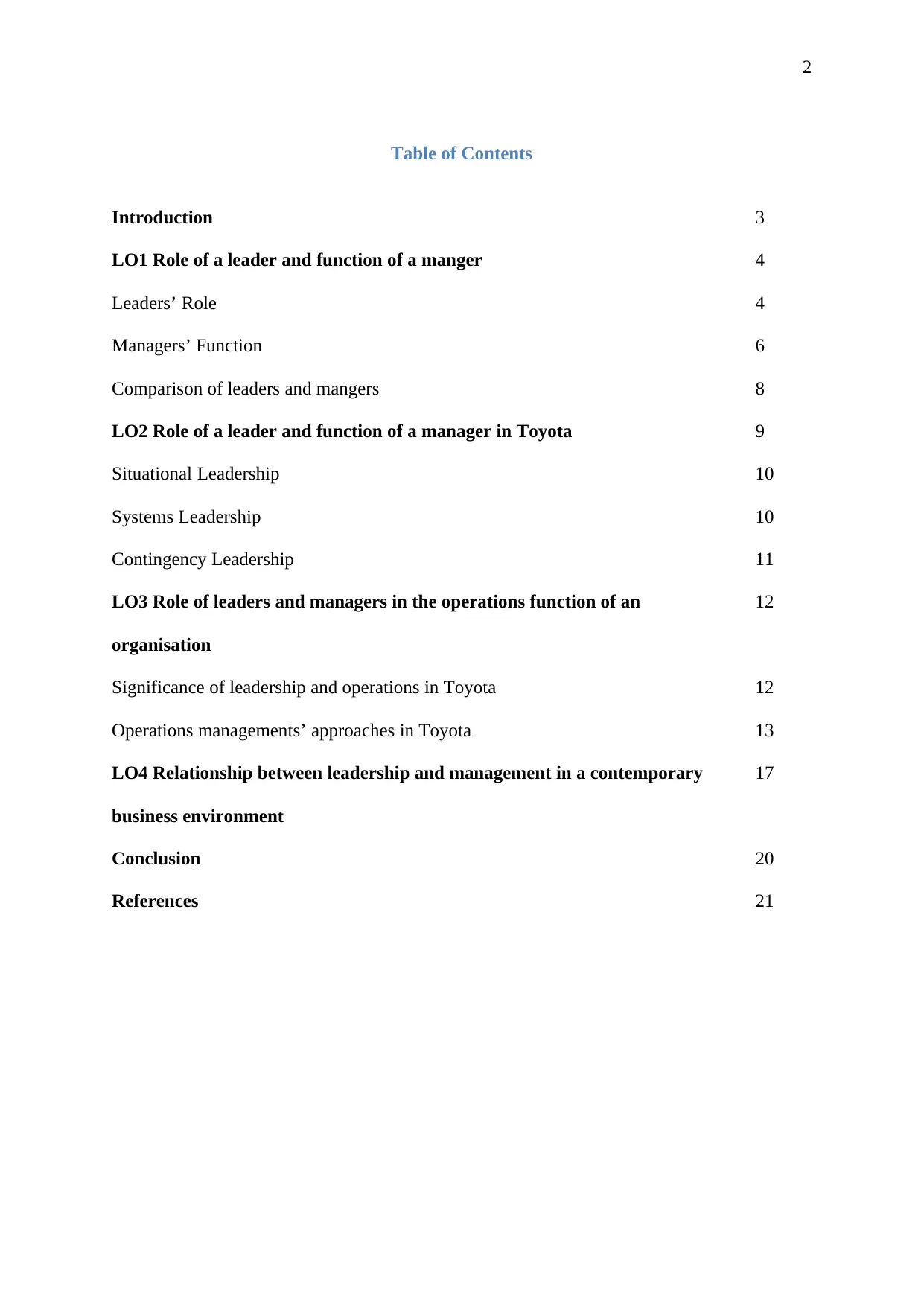
Table of Contents
Introduction 3
LO1 Role of a leader and function of a manger 4
Leaders’ Role 4
Managers’ Function 6
Comparison of leaders and mangers 8
LO2 Role of a leader and function of a manager in Toyota 9
Situational Leadership 10
Systems Leadership 10
Contingency Leadership 11
LO3 Role of leaders and managers in the operations function of an
organisation
12
Significance of leadership and operations in Toyota 12
Operations managements’ approaches in Toyota 13
LO4 Relationship between leadership and management in a contemporary
business environment
17
Conclusion 20
References 21
2
Introduction 3
LO1 Role of a leader and function of a manger 4
Leaders’ Role 4
Managers’ Function 6
Comparison of leaders and mangers 8
LO2 Role of a leader and function of a manager in Toyota 9
Situational Leadership 10
Systems Leadership 10
Contingency Leadership 11
LO3 Role of leaders and managers in the operations function of an
organisation
12
Significance of leadership and operations in Toyota 12
Operations managements’ approaches in Toyota 13
LO4 Relationship between leadership and management in a contemporary
business environment
17
Conclusion 20
References 21
2
Introduction
The current era being highly competitive in nature, experiences an accelerated change in
technological developments. This creates a need in the organisations to understand the
changing market and renew accordingly. They are not only required to introduce new range
of products, but also need to emphasise on the changing their management and leadership
styles to suit these changes. In this piece of writing an attempt has been has made to
understand what is leadership and management; what role leaders and mangers play in
Toyota; moreover, what is the relationship between the two. In this paper, the management
and leadership processes are studied in detail in context of Toyota. The leadership approaches
that Toyota has deployed are covered here to understand, this organisations’ secret to success.
3
The current era being highly competitive in nature, experiences an accelerated change in
technological developments. This creates a need in the organisations to understand the
changing market and renew accordingly. They are not only required to introduce new range
of products, but also need to emphasise on the changing their management and leadership
styles to suit these changes. In this piece of writing an attempt has been has made to
understand what is leadership and management; what role leaders and mangers play in
Toyota; moreover, what is the relationship between the two. In this paper, the management
and leadership processes are studied in detail in context of Toyota. The leadership approaches
that Toyota has deployed are covered here to understand, this organisations’ secret to success.
3
⊘ This is a preview!⊘
Do you want full access?
Subscribe today to unlock all pages.

Trusted by 1+ million students worldwide
LO1 Role of a leader and function of a manager
Success of organisations is driven by its executives; who form the base pillars for the
organisation. Effective leadership and skilful management are the key ingredients for any
institutions’ excellence. It’s the decision makers who determine the policies and principles
for various functions of an organisation; they become the torchbearers for the rest of the
employees. May it be the recruitment, meeting deliverables on time or operations of a
company, it is the leaders and the mangers, who take the responsibility of work completion.
While they help the organisation reach greater heights by the end of very fiscal year; they
also support the organisations to survive and thrive through difficult times. Now let’s briefly
understand leadership, the role of a leader, manager and the functions of management.
Leaders’ Role
Leadership is defined as the skill of shaping others’ beliefs and preferences. Psychologically,
it is about influencing and guiding people (Haslam, Reicher & Platow, 2011). In simple terms
leadership can be defined as the act of the leaders to accomplish certain goals. The fact that
leadership centres around the process of influence, sets the need to know people by
understanding their mental state, by actively listening to them. This is important for
performance and productivity of an organisation. The act of leadership is carried by a leader.
Therefore, a leader can be defined as an individual who motivates its fellow employees to
achieve goals. Leaders influence the behaviour of employees by setting clear goals,
motivating and guiding subordinates and also building their morale (Cook, 2001). Below are
the various roles that a leader needs to play in an organisation (Cook, 2001).
Setting a vision. It is the skills of forecasting the future state of work I the
organisation by clearly understanding the current work scenario. It is the
4
Success of organisations is driven by its executives; who form the base pillars for the
organisation. Effective leadership and skilful management are the key ingredients for any
institutions’ excellence. It’s the decision makers who determine the policies and principles
for various functions of an organisation; they become the torchbearers for the rest of the
employees. May it be the recruitment, meeting deliverables on time or operations of a
company, it is the leaders and the mangers, who take the responsibility of work completion.
While they help the organisation reach greater heights by the end of very fiscal year; they
also support the organisations to survive and thrive through difficult times. Now let’s briefly
understand leadership, the role of a leader, manager and the functions of management.
Leaders’ Role
Leadership is defined as the skill of shaping others’ beliefs and preferences. Psychologically,
it is about influencing and guiding people (Haslam, Reicher & Platow, 2011). In simple terms
leadership can be defined as the act of the leaders to accomplish certain goals. The fact that
leadership centres around the process of influence, sets the need to know people by
understanding their mental state, by actively listening to them. This is important for
performance and productivity of an organisation. The act of leadership is carried by a leader.
Therefore, a leader can be defined as an individual who motivates its fellow employees to
achieve goals. Leaders influence the behaviour of employees by setting clear goals,
motivating and guiding subordinates and also building their morale (Cook, 2001). Below are
the various roles that a leader needs to play in an organisation (Cook, 2001).
Setting a vision. It is the skills of forecasting the future state of work I the
organisation by clearly understanding the current work scenario. It is the
4
Paraphrase This Document
Need a fresh take? Get an instant paraphrase of this document with our AI Paraphraser
responsibility of the leader to explain the organisational goals to the employees, so as
to make it easier for the employees to understand their roles and company’s
expectations from them to achieve certain results.
Motivating employees. At times, the employees seek recognition for a job well done.
This helps them understand their position in respect to organisations’ expectations.
Ensuring the fact that employees are given a positive feedback of their performance,
recharges them to work more efficiently.
Providing guidance to employees. It is a vital function of a leader to set direction for
its subordinates, by clearly defining their job role at work, explain the process to
perform it and provide them with the necessary pre-requisites. A key tool in this
regard is good communication skills. Being able to clearly communicate the
organisational goals and defining each individuals’ role in it might make the work
smoother.
Building morale. In all successful institutions, team work is the vital element. It is a
leaders’ task to tie everyone in one thread in order to work for a common goal.
Setting standards. It is always the leader, who is held responsible for the outcome.
Hence, the leader needs to ensure that there is no compromise made on the quality of
performance. It essentially means addressing the underperformers in the team, by
helping them understand organisations’ expectations and the right means to meet
them effectively.
Change catalyst. For sustainable growth of an organisation, introducing latest
developments, is vital. It is a leaders’ responsibility to track these changes and
introduce it among the team members and help them sustain through the process of
change.
5
to make it easier for the employees to understand their roles and company’s
expectations from them to achieve certain results.
Motivating employees. At times, the employees seek recognition for a job well done.
This helps them understand their position in respect to organisations’ expectations.
Ensuring the fact that employees are given a positive feedback of their performance,
recharges them to work more efficiently.
Providing guidance to employees. It is a vital function of a leader to set direction for
its subordinates, by clearly defining their job role at work, explain the process to
perform it and provide them with the necessary pre-requisites. A key tool in this
regard is good communication skills. Being able to clearly communicate the
organisational goals and defining each individuals’ role in it might make the work
smoother.
Building morale. In all successful institutions, team work is the vital element. It is a
leaders’ task to tie everyone in one thread in order to work for a common goal.
Setting standards. It is always the leader, who is held responsible for the outcome.
Hence, the leader needs to ensure that there is no compromise made on the quality of
performance. It essentially means addressing the underperformers in the team, by
helping them understand organisations’ expectations and the right means to meet
them effectively.
Change catalyst. For sustainable growth of an organisation, introducing latest
developments, is vital. It is a leaders’ responsibility to track these changes and
introduce it among the team members and help them sustain through the process of
change.
5
Managers’ Function
With our understanding of a leadership and a leaders’ role, let’s try to understand
management and a managers’ function in an organisation. Being a higher-grade professional,
increases the chances of participating in the organisations’ management structure. It can vary
depending on the size and structure of the firm. Management is the act of optimal utilisation
of varied available resources. The key terms associated with management are coordination
and organisation. Management is an amalgamation of fabricating policies, organising
resources, planning tasks, controlling and directing resource movement in an organisation; in
order to accomplish tasks. All these tasks of management are carried out of mangers.
Therefore, a manager can be defined as an individual who is responsible for the supervising
all the work under his/ her unit. They are empowered with legal authority over a unit of the
institution; which enables them to make decisions and strategies. In large corporations, a
manger can be just responsible for all the tasks under his/ her small team; and in small
enterprises, a manger can even be the jack-of-all-trades (Mintzberg, 1997). Let’s briefly
examine the role of a manger.
The Interpersonal Roles. Being the legal head of a unit, manger is a figure-head.
Hence, manger is expected to present at the ceremonial events, do the legal works
under his/ her signature, interact internal and external stakeholders. Making use of his/
her status, a manger can establish network with others might help the manger bring
information from all sources that is beneficial for the organisations’ growth.
Leadership Roles. It is the most commonly understood managerial functions. A
manager is expected to encourage his/ her subordinates to perform tasks.
The Informational Roles. This is primarily the processing of information. Being the
nerve centre, all the information in an organisation passes through the manger.
Therefore, a manger is well informed about the issues that run in the organisation.
6
With our understanding of a leadership and a leaders’ role, let’s try to understand
management and a managers’ function in an organisation. Being a higher-grade professional,
increases the chances of participating in the organisations’ management structure. It can vary
depending on the size and structure of the firm. Management is the act of optimal utilisation
of varied available resources. The key terms associated with management are coordination
and organisation. Management is an amalgamation of fabricating policies, organising
resources, planning tasks, controlling and directing resource movement in an organisation; in
order to accomplish tasks. All these tasks of management are carried out of mangers.
Therefore, a manager can be defined as an individual who is responsible for the supervising
all the work under his/ her unit. They are empowered with legal authority over a unit of the
institution; which enables them to make decisions and strategies. In large corporations, a
manger can be just responsible for all the tasks under his/ her small team; and in small
enterprises, a manger can even be the jack-of-all-trades (Mintzberg, 1997). Let’s briefly
examine the role of a manger.
The Interpersonal Roles. Being the legal head of a unit, manger is a figure-head.
Hence, manger is expected to present at the ceremonial events, do the legal works
under his/ her signature, interact internal and external stakeholders. Making use of his/
her status, a manger can establish network with others might help the manger bring
information from all sources that is beneficial for the organisations’ growth.
Leadership Roles. It is the most commonly understood managerial functions. A
manager is expected to encourage his/ her subordinates to perform tasks.
The Informational Roles. This is primarily the processing of information. Being the
nerve centre, all the information in an organisation passes through the manger.
Therefore, a manger is well informed about the issues that run in the organisation.
6
⊘ This is a preview!⊘
Do you want full access?
Subscribe today to unlock all pages.
Trusted by 1+ million students worldwide
Hence, it is expected of the manger to address the same by elevating these matters to
the higher authorities, through further communication.
Disseminator. The information a manger holds, needs to be passed on to the
subordinates as well. There are many things a manger gets to know from varied
sources; some information might be relevant and some might not apply to his
subordinates. It is the role of the manager to scrutinize and understand the importance
of each information and transfer it to the fellow subordinates, if it is vital for them.
However, the information related to organisations’ vision/ changes in the broader
goals, must be shared with the subordinates.
The Decisional Roles. A manger is expected to take up all the decisions important for
the organisations’ growth. Therefore, he/ she is a key figure in making decisions and/
or strategies.
Entrepreneur. Manger is responsible for fabricating most of the changes in the
organisation. Utilising the opportunities and making use of potential problems, the
manger takes actions that are the need of the hour.
Conflict Management. Handling conflicts within his/ her team is an important task of
a manger. Conflict resolution is vital for smooth functioning of the organisation.
Resource Allocator. Claiming complete authority over a unit, the manger takes the job
of allocating resources. It is the manager who decides, who will get what.
Negotiator. Manger being the figure head of a unit, needs to be present during any
negotiation activity, so as to emphasise on the demand of his/ her team.
All the above roles indicate that a manger bears huge responsibility. He / she must be
thorough with the organisations’ work culture; must be a bridge of information between
7
the higher authorities, through further communication.
Disseminator. The information a manger holds, needs to be passed on to the
subordinates as well. There are many things a manger gets to know from varied
sources; some information might be relevant and some might not apply to his
subordinates. It is the role of the manager to scrutinize and understand the importance
of each information and transfer it to the fellow subordinates, if it is vital for them.
However, the information related to organisations’ vision/ changes in the broader
goals, must be shared with the subordinates.
The Decisional Roles. A manger is expected to take up all the decisions important for
the organisations’ growth. Therefore, he/ she is a key figure in making decisions and/
or strategies.
Entrepreneur. Manger is responsible for fabricating most of the changes in the
organisation. Utilising the opportunities and making use of potential problems, the
manger takes actions that are the need of the hour.
Conflict Management. Handling conflicts within his/ her team is an important task of
a manger. Conflict resolution is vital for smooth functioning of the organisation.
Resource Allocator. Claiming complete authority over a unit, the manger takes the job
of allocating resources. It is the manager who decides, who will get what.
Negotiator. Manger being the figure head of a unit, needs to be present during any
negotiation activity, so as to emphasise on the demand of his/ her team.
All the above roles indicate that a manger bears huge responsibility. He / she must be
thorough with the organisations’ work culture; must be a bridge of information between
7
Paraphrase This Document
Need a fresh take? Get an instant paraphrase of this document with our AI Paraphraser
seniors and subordinates; must attain a stable system of operation and ensure sustainable
growth.
Comparison of leaders and mangers
Often the terms – leader and manager are used interchangeably. However, these terms are
distinctly different in their meaning, role and characteristics. The difference between mangers
and leaders actually rests in the notions at their psyche (Zaleznik, 2004). Managers deal with
process implementation; conflict resolution; establishing stability in the work atmosphere at
the same time ensuring their authority. Leaders, at the same time allow a bit of chaos and
haywires; ultimately guiding the fellow employees towards right path. Leadership is actually
a part of candid management. Hence, organisations need effective leaders as mangers to
ensure greater scale-ups.
LO2 Role of a leader and function of a manager in Toyota
8
growth.
Comparison of leaders and mangers
Often the terms – leader and manager are used interchangeably. However, these terms are
distinctly different in their meaning, role and characteristics. The difference between mangers
and leaders actually rests in the notions at their psyche (Zaleznik, 2004). Managers deal with
process implementation; conflict resolution; establishing stability in the work atmosphere at
the same time ensuring their authority. Leaders, at the same time allow a bit of chaos and
haywires; ultimately guiding the fellow employees towards right path. Leadership is actually
a part of candid management. Hence, organisations need effective leaders as mangers to
ensure greater scale-ups.
LO2 Role of a leader and function of a manager in Toyota
8
Toyota Motor Corporation is worlds’ leading producer of automobiles. Establish in the year
1937, since then it has multiplied its success exponentially. The credit obviously goes to all
those leaders and managers of Toyota, who have struggled hard to help the organisation reach
where it is today.
A manger is an individual striving to make effective usage of people and resource, in order to
accomplish various organisational objectives. The key functions of manger are planning,
organising, guiding and controlling (Bateman & Snell, 2009). These functions are vital for
any organisation and Toyota also needs them.
Being a people-centred company Toyota empowers its employees to the extent that, it allows
its work-force to hold production in case they witness a problem. Giving its employees so
much of authority makes the job of the manger though, as the manger is accountable for the
flow at work. In order to accomplish task, keeping in view, employee’s need, the manger
should reflect as a good leader. People-oriented in its principles, Toyotas’ leadership model is
based on teamwork, cooperation and unanimity. For creating and maintaining a healthy
organisational culture, managers and leaders are very important. In this context, Toyota
strives for consistent growth and development, and the role of its leaders and mangers is to
inculcate this concept and express it in their performance. The approaches of leadership that
eases out management at Toyota are situational leadership, systems model and contingency,
to name a few. Let’s discuss them in brief in the following.
Situational leadership
9
1937, since then it has multiplied its success exponentially. The credit obviously goes to all
those leaders and managers of Toyota, who have struggled hard to help the organisation reach
where it is today.
A manger is an individual striving to make effective usage of people and resource, in order to
accomplish various organisational objectives. The key functions of manger are planning,
organising, guiding and controlling (Bateman & Snell, 2009). These functions are vital for
any organisation and Toyota also needs them.
Being a people-centred company Toyota empowers its employees to the extent that, it allows
its work-force to hold production in case they witness a problem. Giving its employees so
much of authority makes the job of the manger though, as the manger is accountable for the
flow at work. In order to accomplish task, keeping in view, employee’s need, the manger
should reflect as a good leader. People-oriented in its principles, Toyotas’ leadership model is
based on teamwork, cooperation and unanimity. For creating and maintaining a healthy
organisational culture, managers and leaders are very important. In this context, Toyota
strives for consistent growth and development, and the role of its leaders and mangers is to
inculcate this concept and express it in their performance. The approaches of leadership that
eases out management at Toyota are situational leadership, systems model and contingency,
to name a few. Let’s discuss them in brief in the following.
Situational leadership
9
⊘ This is a preview!⊘
Do you want full access?
Subscribe today to unlock all pages.
Trusted by 1+ million students worldwide
Developed by Hersey and Blanchard in 1969, situational leadership refers to the changing
leadership styles based on the changing situations and varied levels of employment. Its
effectiveness lies in its characteristic of adapting to the needs of employees, thereby creating
an employee friendly environment, ultimately encouraging performance and contributing to
holistic development (Graeff, 1983).
A leader or a manager uses directive as well as supportive behaviour while preferring
situational leadership. There are four levels according to Hersey and Blanchard among these
behaviour:
i. The leader advices. At this level, the manager/ the leader directs its team members
towards the expected behaviour.
ii. The leader sells. Scrutinising their work, and providing constant supervision, the
leader gives its employees with constant feedback and asks for suggestions and ideas
that can aid in organisational development.
iii. The leader participates. One of the ways to get every individual perform, is to work
along with them. This might also help get the best out of the employees.
iv. The leader delegates. The leader must know how to get the work done, keeping in
mind the time constraints.
Systems leadership
It is an outcome of the work of several behavioural scientists, who wanted to create an
intermediate field. This theory emphasises leader’s commitment to inculcate external
environment and interpersonal relations together. A leader would not be able to exercise
leadership in the absence of subordinates who admire his/ her principles. To ensure the same,
the leader has to provide them with a process and structure (Macdonald, 2017).
Contingency Leadership
10
leadership styles based on the changing situations and varied levels of employment. Its
effectiveness lies in its characteristic of adapting to the needs of employees, thereby creating
an employee friendly environment, ultimately encouraging performance and contributing to
holistic development (Graeff, 1983).
A leader or a manager uses directive as well as supportive behaviour while preferring
situational leadership. There are four levels according to Hersey and Blanchard among these
behaviour:
i. The leader advices. At this level, the manager/ the leader directs its team members
towards the expected behaviour.
ii. The leader sells. Scrutinising their work, and providing constant supervision, the
leader gives its employees with constant feedback and asks for suggestions and ideas
that can aid in organisational development.
iii. The leader participates. One of the ways to get every individual perform, is to work
along with them. This might also help get the best out of the employees.
iv. The leader delegates. The leader must know how to get the work done, keeping in
mind the time constraints.
Systems leadership
It is an outcome of the work of several behavioural scientists, who wanted to create an
intermediate field. This theory emphasises leader’s commitment to inculcate external
environment and interpersonal relations together. A leader would not be able to exercise
leadership in the absence of subordinates who admire his/ her principles. To ensure the same,
the leader has to provide them with a process and structure (Macdonald, 2017).
Contingency Leadership
10
Paraphrase This Document
Need a fresh take? Get an instant paraphrase of this document with our AI Paraphraser
This theory does not hold a single set of traits responsible for effective leadership. Rather, it
believes that the interplay of an individual’s mental state, traits and environmental influence
makes leadership efficient. In simple terms, effective leadership is a condition achieved by
amalgamation of many independent factors. One of the most famous works in the realm of
contingency leadership is Fiedler’s Contingency Model.
This model supports the notion that a leader needs to adapt to varied situational factors to
reach goals. The very first element of this model scrutinises leadership using the ‘Least
Preferred Co-worker Scale’ (LPC). This scale is used by leaders to rate fellow co-workers
with whom they might not have relished performing. Scoring more here indicates, relations-
oriented leadership; and scoring poorly indicates task-oriented leadership. In the first type,
emphasis is given towards well-being of the team. And in task-oriented style focus is on
completing goals to meet certain standards.
The second element of Fiedler’s Contingency Model is situational favourableness dimension.
This has three factors. The first is, the level of support from employees; second being,
whether work assigned is systematic or unsystematic; and the final one is, the level of
authority exuded by the leaders to their subordinates. Both the elements of Fiedler’s
Contingency Model create eight peculiar types of workplace situations that a leader might
come across (Houghton, 2005).
11
believes that the interplay of an individual’s mental state, traits and environmental influence
makes leadership efficient. In simple terms, effective leadership is a condition achieved by
amalgamation of many independent factors. One of the most famous works in the realm of
contingency leadership is Fiedler’s Contingency Model.
This model supports the notion that a leader needs to adapt to varied situational factors to
reach goals. The very first element of this model scrutinises leadership using the ‘Least
Preferred Co-worker Scale’ (LPC). This scale is used by leaders to rate fellow co-workers
with whom they might not have relished performing. Scoring more here indicates, relations-
oriented leadership; and scoring poorly indicates task-oriented leadership. In the first type,
emphasis is given towards well-being of the team. And in task-oriented style focus is on
completing goals to meet certain standards.
The second element of Fiedler’s Contingency Model is situational favourableness dimension.
This has three factors. The first is, the level of support from employees; second being,
whether work assigned is systematic or unsystematic; and the final one is, the level of
authority exuded by the leaders to their subordinates. Both the elements of Fiedler’s
Contingency Model create eight peculiar types of workplace situations that a leader might
come across (Houghton, 2005).
11
LO3 Role of leaders and managers in the operations function of an organisation
Toyota being world’s largest automotive manufacturer, is one of the biggest company in
global economy. In the past few decades, Toyota has under-went a mind-boggling growth
spurt all-round the globe. This car manufacturing giants’ unique leadership style and
operations management is its secret for success. A team of great planners, organisers and
supervisors ensure successful production, manufacturing and service thereby switching inputs
to outputs in an efficient manner. They ensure that the available resources are utilised to
design products and deliver them. This requires great planning and coordination.
Leaders in the organization also focus on achieving the targets with a goal oriented mind set.
At the same time, they also believe in knowledge sharing across all levels of employment.
This helps build strong networks in the organization that ultimately fosters growth and
productivity of the company. Extending their base outside the organization, Toyota also
involves the suppliers to participate in its knowledge-sharing network. The knowledge
sharing techniques employed by Toyota are as follows (Dyer & Nobeoka, 2000):
Enhancing employee participation to openly share knowledge
Preventing free riders
Cost reduction while expanding the knowledge base
Significance of leadership and operations management in Toyota
In the late 1980s, having acquired holistic knowledge about the automobile industry, Toyota
observed labour market shortages; and it conducted various experiments to cope with the
same. These included automating the manual work using super speciality machinery, making
the assembly work interesting, etc. This way, Toyota had been successful in a number of key
aspects of development; which included cost consciousness, no buffers, more transparent
12
Toyota being world’s largest automotive manufacturer, is one of the biggest company in
global economy. In the past few decades, Toyota has under-went a mind-boggling growth
spurt all-round the globe. This car manufacturing giants’ unique leadership style and
operations management is its secret for success. A team of great planners, organisers and
supervisors ensure successful production, manufacturing and service thereby switching inputs
to outputs in an efficient manner. They ensure that the available resources are utilised to
design products and deliver them. This requires great planning and coordination.
Leaders in the organization also focus on achieving the targets with a goal oriented mind set.
At the same time, they also believe in knowledge sharing across all levels of employment.
This helps build strong networks in the organization that ultimately fosters growth and
productivity of the company. Extending their base outside the organization, Toyota also
involves the suppliers to participate in its knowledge-sharing network. The knowledge
sharing techniques employed by Toyota are as follows (Dyer & Nobeoka, 2000):
Enhancing employee participation to openly share knowledge
Preventing free riders
Cost reduction while expanding the knowledge base
Significance of leadership and operations management in Toyota
In the late 1980s, having acquired holistic knowledge about the automobile industry, Toyota
observed labour market shortages; and it conducted various experiments to cope with the
same. These included automating the manual work using super speciality machinery, making
the assembly work interesting, etc. This way, Toyota had been successful in a number of key
aspects of development; which included cost consciousness, no buffers, more transparent
12
⊘ This is a preview!⊘
Do you want full access?
Subscribe today to unlock all pages.
Trusted by 1+ million students worldwide

1 out of 23


Related Documents


Your All-in-One AI-Powered Toolkit for Academic Success.
+13062052269
info@desklib.com
Available 24*7 on WhatsApp / Email
![[object Object]](/_next/static/media/star-bottom.7253800d.svg)
Unlock your academic potential
Copyright © 2020–2026 A2Z Services. All Rights Reserved. Developed and managed by ZUCOL.