Capstone Discussion: Andrews Company Financial Performance Analysis

Verified

Added on  2023/01/11

|4
|684
|87
Discussion Board Post
AI Summary
This discussion post presents a financial analysis of Andrews Company, focusing on Return on Equity (ROE), Return on Sales (ROS), and working capital. The analysis identifies that the company's ROE of 7.1% needs improvement, suggesting strategies such as cost rationalization, increased sales, and share buybacks to boost profitability. The current ratio of 3.45 indicates a healthy short-term liquidity position. However, the ROS of 3.4% is considered average compared to competitors, indicating a need to reduce costs and increase sales to improve profitability. Additionally, the high ending inventory is highlighted as a concern, potentially increasing working capital requirements. The post references key financial concepts and provides a clear assessment of the company's financial strengths and weaknesses, alongside actionable recommendations for improvement.
Document Page
MANAGEMENT CAPSTONE
DISCUSSION
STUDENT ID:
[Pick the date]
tabler-icon-diamond-filled.svg

Paraphrase This Document

Need a fresh take? Get an instant paraphrase of this document with our AI Paraphraser
Document Page
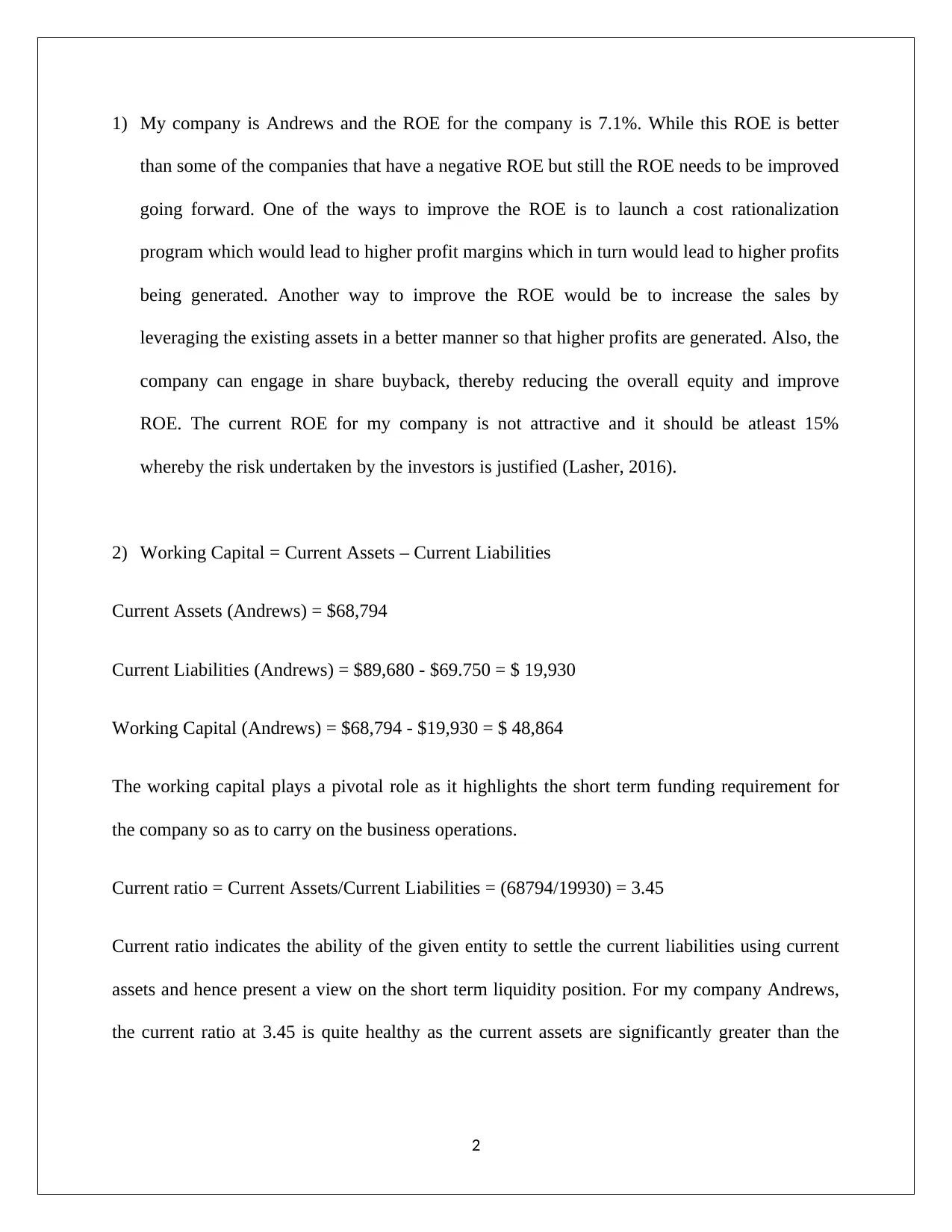
1) My company is Andrews and the ROE for the company is 7.1%. While this ROE is better
than some of the companies that have a negative ROE but still the ROE needs to be improved
going forward. One of the ways to improve the ROE is to launch a cost rationalization
program which would lead to higher profit margins which in turn would lead to higher profits
being generated. Another way to improve the ROE would be to increase the sales by
leveraging the existing assets in a better manner so that higher profits are generated. Also, the
company can engage in share buyback, thereby reducing the overall equity and improve
ROE. The current ROE for my company is not attractive and it should be atleast 15%
whereby the risk undertaken by the investors is justified (Lasher, 2016).
2) Working Capital = Current Assets – Current Liabilities
Current Assets (Andrews) = $68,794
Current Liabilities (Andrews) = $89,680 - $69.750 = $ 19,930
Working Capital (Andrews) = $68,794 - $19,930 = $ 48,864
The working capital plays a pivotal role as it highlights the short term funding requirement for
the company so as to carry on the business operations.
Current ratio = Current Assets/Current Liabilities = (68794/19930) = 3.45
Current ratio indicates the ability of the given entity to settle the current liabilities using current
assets and hence present a view on the short term liquidity position. For my company Andrews,
the current ratio at 3.45 is quite healthy as the current assets are significantly greater than the
2
Document Page
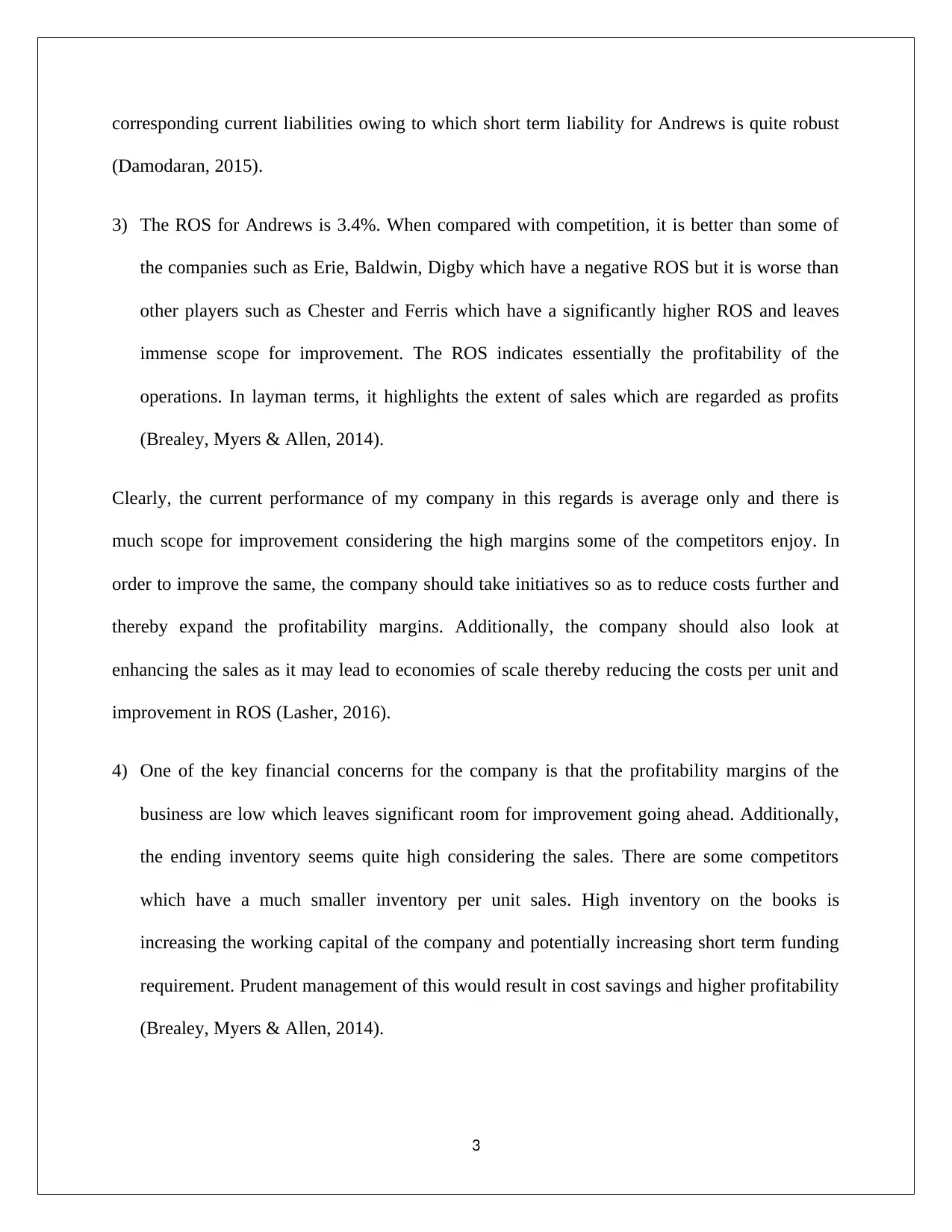
corresponding current liabilities owing to which short term liability for Andrews is quite robust
(Damodaran, 2015).
3) The ROS for Andrews is 3.4%. When compared with competition, it is better than some of
the companies such as Erie, Baldwin, Digby which have a negative ROS but it is worse than
other players such as Chester and Ferris which have a significantly higher ROS and leaves
immense scope for improvement. The ROS indicates essentially the profitability of the
operations. In layman terms, it highlights the extent of sales which are regarded as profits
(Brealey, Myers & Allen, 2014).
Clearly, the current performance of my company in this regards is average only and there is
much scope for improvement considering the high margins some of the competitors enjoy. In
order to improve the same, the company should take initiatives so as to reduce costs further and
thereby expand the profitability margins. Additionally, the company should also look at
enhancing the sales as it may lead to economies of scale thereby reducing the costs per unit and
improvement in ROS (Lasher, 2016).
4) One of the key financial concerns for the company is that the profitability margins of the
business are low which leaves significant room for improvement going ahead. Additionally,
the ending inventory seems quite high considering the sales. There are some competitors
which have a much smaller inventory per unit sales. High inventory on the books is
increasing the working capital of the company and potentially increasing short term funding
requirement. Prudent management of this would result in cost savings and higher profitability
(Brealey, Myers & Allen, 2014).
3
Document Page
References
Brealey, R. A., Myers, S. C., & Allen, F. (2014). Principles of corporate finance (2nd ed.). New
York: McGraw-Hill Inc
Damodaran, A. (2015). Applied corporate finance: A user’s manual (3rd ed.). New York: Wiley,
John & Sons.
Lasher, W. R., (2016) Practical Financial Management (5thed.). London: South- Western
College Publisher.
4
chevron_up_icon
1 out of 4
circle_padding
hide_on_mobile
zoom_out_icon
[object Object]