University Management Perspective Case Study Report: Samsung
VerifiedAdded on 2020/04/07
|14
|3177
|451
Case Study
AI Summary
This case study report examines Samsung's management perspective, organizational structure, and ethical acumen. The report utilizes a deductive research methodology and a positivism research philosophy, employing descriptive research design. It analyzes Samsung's management strategies, including innovation, communication, and organizational structure, drawing upon management theories. The ethical practices of Samsung, such as adherence to laws and ethical standards, are described, along with the company's five management principles. The report also addresses ethical controversies like labor practices, product failures, and bribery cases. Qualitative analysis of Samsung's management practices indicates compliance with laws and respect for stakeholders, but it also highlights the need to avoid ethical controversies. The report concludes that although Samsung generally follows ethical practices, it needs to improve in some areas to avoid tarnishing its reputation.
Running head: MANAGEMENT PERSPECTIVE
Management Perspective-Case Study Report Samsung
Name of the Student:
Name of the University:
Author’s Note:
Management Perspective-Case Study Report Samsung
Name of the Student:
Name of the University:
Author’s Note:

Paraphrase This Document
Need a fresh take? Get an instant paraphrase of this document with our AI Paraphraser
1MANAGEMENT PERSPECTIVE
Executive Summary
This report is a case study report of Samsung. The research methodology used for this case study
report is deductive research. A positivism research philosophy is chosen for this research and
descriptive research design is chosen. The management theories from the course module and
from additional reading are used to describe the management strategies. The ethical acumen of
case study of Samsung is described. From the qualitative analysis of the findings of the case of
Samsung, it can be concluded that ethical practices of Samsung ensure compliance with law,
respect for all stakeholders including customers and employees. However Samsung should avoid
ethical controversies like unethical labor practices in manufacturing firms in China, explosion of
devices like Galaxy Note 7 phone and the bribery case of Jay Y lee which can tarnish reputation
of the organization.
Executive Summary
This report is a case study report of Samsung. The research methodology used for this case study
report is deductive research. A positivism research philosophy is chosen for this research and
descriptive research design is chosen. The management theories from the course module and
from additional reading are used to describe the management strategies. The ethical acumen of
case study of Samsung is described. From the qualitative analysis of the findings of the case of
Samsung, it can be concluded that ethical practices of Samsung ensure compliance with law,
respect for all stakeholders including customers and employees. However Samsung should avoid
ethical controversies like unethical labor practices in manufacturing firms in China, explosion of
devices like Galaxy Note 7 phone and the bribery case of Jay Y lee which can tarnish reputation
of the organization.
2MANAGEMENT PERSPECTIVE
Contents
Introduction......................................................................................................................................3
Research Methodology....................................................................................................................3
Strategies..........................................................................................................................................4
Ethical acumen-Case of Samsung...................................................................................................6
Qualitative Analysis.........................................................................................................................9
Conclusion.......................................................................................................................................9
References......................................................................................................................................11
Contents
Introduction......................................................................................................................................3
Research Methodology....................................................................................................................3
Strategies..........................................................................................................................................4
Ethical acumen-Case of Samsung...................................................................................................6
Qualitative Analysis.........................................................................................................................9
Conclusion.......................................................................................................................................9
References......................................................................................................................................11
⊘ This is a preview!⊘
Do you want full access?
Subscribe today to unlock all pages.

Trusted by 1+ million students worldwide
3MANAGEMENT PERSPECTIVE
Introduction
Samsung is a multinational electronics company headquartered in South Korea. The CEO of
Samsung Jong-Yong Yun has played a vital role in incorporating management practices in the
organization that fosters continuous improvement and has enabled the organization to overcome
crisis related to finance. In Samsung, more than 1500 managers and employees underwent an in-
house training session in Samsung and the employees of the organization were trained in
Industrial Engineering concepts so that productivity of the employees in the organization
increases. Samsung comply with laws and ethics; fulfill their social responsibility as global
corporate citizen, they value environment, health and safety and respect customers. However,
Samsung was allegedly using illegal labor practices for Chinese manufacturers which is an
unethical practice (Samsung, 2017).
Research Methodology
The research will be based on secondary research. Resources from existing sources like
journals, books, government data, website of Samsung and other sources which can be found
offline and online will be utilized for this research. The findings from the secondary research will
be the basis of the outcomes of the research. The response gained from various experts on
different concepts of management like the role of managers in present competitive and dynamic
environment of business, organizational structures, politics and communication and
organizational diversity are studied and analyzed during the research. A positivism research
philosophy is applied because the topic can be investigated in a logical manner by this
philosophy. The approach for the research is deductive research because theories and concepts
that already exist help in developing the case study for Samsung. Inductive approach is not
Introduction
Samsung is a multinational electronics company headquartered in South Korea. The CEO of
Samsung Jong-Yong Yun has played a vital role in incorporating management practices in the
organization that fosters continuous improvement and has enabled the organization to overcome
crisis related to finance. In Samsung, more than 1500 managers and employees underwent an in-
house training session in Samsung and the employees of the organization were trained in
Industrial Engineering concepts so that productivity of the employees in the organization
increases. Samsung comply with laws and ethics; fulfill their social responsibility as global
corporate citizen, they value environment, health and safety and respect customers. However,
Samsung was allegedly using illegal labor practices for Chinese manufacturers which is an
unethical practice (Samsung, 2017).
Research Methodology
The research will be based on secondary research. Resources from existing sources like
journals, books, government data, website of Samsung and other sources which can be found
offline and online will be utilized for this research. The findings from the secondary research will
be the basis of the outcomes of the research. The response gained from various experts on
different concepts of management like the role of managers in present competitive and dynamic
environment of business, organizational structures, politics and communication and
organizational diversity are studied and analyzed during the research. A positivism research
philosophy is applied because the topic can be investigated in a logical manner by this
philosophy. The approach for the research is deductive research because theories and concepts
that already exist help in developing the case study for Samsung. Inductive approach is not
Paraphrase This Document
Need a fresh take? Get an instant paraphrase of this document with our AI Paraphraser
4MANAGEMENT PERSPECTIVE
chosen for developing the case study of Samsung as no new theories and models are developed.
For this particular topic analytical or descriptive research design is chosen as the case study of
Samsung is developed with the help of critical and detailed analysis of theories and concepts of
the various areas of management (Panneerselvam, 2014).
Strategies
Managers are constantly trying to develop innovative the structure of an organization to
increase organizational productivity. In recent days, virtual organizations has achieved
competitive environment with the help of internet that has contributed to establish network
structures of organization. In present business scenario, organizations are developing flatter
structures to increase efficiency and reduce labor cost. Communication also plays a great role in
organization and the major functions of communication are information, control, motivation and
emotional express. Managers need to be effective communicators in a business organizations and
they act as both sender and receiver of information. The channels of communication can be
classified into rich or poor or lean. The rich communication channels like interviews and
meetings are personal and two way communication medium from which fast feedback can be
obtained, while lean channels are good for record keeping. There are different barriers to
communication which include cultural barriers, language barriers, and psychological, relational
and environmental barriers .A great manager must be aware of the strengths of employees, must
contemplate on the triggers that activate the strengths of employees and must be aware about the
learning styles of employees( hbr Management, 2017) Domnica (2012), states that leaders must
focus on creating an innovative organization and develop strategies of continuous improvement
to create a sustainable organization in today’s volatile and competitive marketplace. Thus,
leaders play a much more critical role as they have to align the strategies of an organization to
chosen for developing the case study of Samsung as no new theories and models are developed.
For this particular topic analytical or descriptive research design is chosen as the case study of
Samsung is developed with the help of critical and detailed analysis of theories and concepts of
the various areas of management (Panneerselvam, 2014).
Strategies
Managers are constantly trying to develop innovative the structure of an organization to
increase organizational productivity. In recent days, virtual organizations has achieved
competitive environment with the help of internet that has contributed to establish network
structures of organization. In present business scenario, organizations are developing flatter
structures to increase efficiency and reduce labor cost. Communication also plays a great role in
organization and the major functions of communication are information, control, motivation and
emotional express. Managers need to be effective communicators in a business organizations and
they act as both sender and receiver of information. The channels of communication can be
classified into rich or poor or lean. The rich communication channels like interviews and
meetings are personal and two way communication medium from which fast feedback can be
obtained, while lean channels are good for record keeping. There are different barriers to
communication which include cultural barriers, language barriers, and psychological, relational
and environmental barriers .A great manager must be aware of the strengths of employees, must
contemplate on the triggers that activate the strengths of employees and must be aware about the
learning styles of employees( hbr Management, 2017) Domnica (2012), states that leaders must
focus on creating an innovative organization and develop strategies of continuous improvement
to create a sustainable organization in today’s volatile and competitive marketplace. Thus,
leaders play a much more critical role as they have to align the strategies of an organization to
5MANAGEMENT PERSPECTIVE
the broader vision and mission of the organization while management is responsible to establish
long-term goals, set budgets, plan and allocate resources. According to Longenecker, Neubert
and Fink (2007), organizations must understand the factors that lead to managerial failure to
avoid such fiasco and achieve desired results in today’s business environment which is ultra-
competitive. Ashford and Detert (2015), states that the middle level managers play a proactive
role in organizations and take actions on issues which are of strategic importance to an
organization like shift in technology and change in customer base. Thus, the top-down portray of
strategies where the top managers play strategic roles and the middle-level managers simply
follow these roles are not always true in present organizational setting. According to Gupta and
Kurian (2006), organizations need to re-invent their work process and structures to survive in the
dynamic marketplace of the present business scenario. According to Kassing (2009), employees
accounted for circumvention by supervisor performance, supervisor inaction and supervisor
indiscretion. According to Merindol & Versailles (2007), the distribution of responsibility in the
command and control (C2) chain, is impacted by the implementation of information and
communication technologies (ICTs). It is found that introduction of new technologies sometimes
favor centralization and sometimes it leads to decentralization. Morgan (2003), states that the
chain of command protocols are often misunderstood by employees. Alimo‐Metcalfe (2010),
investigated constructs of leadership qualities in male and female and found out that the men’s
descriptors linked to transactional leadership while that of female led to notions of
transformational leadership. Leonardo (2005), revealed that the critical race theory originated in
the civil rights movement in the United States of America and this theory is associated with
critical legal studies, discrimination in education, freedom of speech, racial discrimination and in
the 1990s scholars in education applied this theory to evaluate educational policies. According to
the broader vision and mission of the organization while management is responsible to establish
long-term goals, set budgets, plan and allocate resources. According to Longenecker, Neubert
and Fink (2007), organizations must understand the factors that lead to managerial failure to
avoid such fiasco and achieve desired results in today’s business environment which is ultra-
competitive. Ashford and Detert (2015), states that the middle level managers play a proactive
role in organizations and take actions on issues which are of strategic importance to an
organization like shift in technology and change in customer base. Thus, the top-down portray of
strategies where the top managers play strategic roles and the middle-level managers simply
follow these roles are not always true in present organizational setting. According to Gupta and
Kurian (2006), organizations need to re-invent their work process and structures to survive in the
dynamic marketplace of the present business scenario. According to Kassing (2009), employees
accounted for circumvention by supervisor performance, supervisor inaction and supervisor
indiscretion. According to Merindol & Versailles (2007), the distribution of responsibility in the
command and control (C2) chain, is impacted by the implementation of information and
communication technologies (ICTs). It is found that introduction of new technologies sometimes
favor centralization and sometimes it leads to decentralization. Morgan (2003), states that the
chain of command protocols are often misunderstood by employees. Alimo‐Metcalfe (2010),
investigated constructs of leadership qualities in male and female and found out that the men’s
descriptors linked to transactional leadership while that of female led to notions of
transformational leadership. Leonardo (2005), revealed that the critical race theory originated in
the civil rights movement in the United States of America and this theory is associated with
critical legal studies, discrimination in education, freedom of speech, racial discrimination and in
the 1990s scholars in education applied this theory to evaluate educational policies. According to
⊘ This is a preview!⊘
Do you want full access?
Subscribe today to unlock all pages.
Trusted by 1+ million students worldwide
6MANAGEMENT PERSPECTIVE
Moreton-Robinson (2004), whiteness was considered an invisible norm in the society against
which judgment about other races were developed. These theories are critical in studying the
organizational diversity of business organizations. Olsson and Walker (2003), interviewed 10
male and 10 female executives from New Zealand and found out that in corporate world
behavior of men and women are perceived through gendered lens. Tienari, Vaara and Meriläinen
(2010), has found out that top managers have masculine identity in global organizations. These
management concepts are used to analyze a case study report of Samsung.
Ethical acumen-Case of Samsung
The business activities of Samsung strictly follow ethical code of conduct and the
organization abides by laws and regulations and practices fair competition (Chen et al., 2015).
The organization follows ethics like the organization never makes use of the trade secrets of
competitors and do not access their confidential information. Samsung never uses power of
coercion to achieve any advantage that can be harmful to the interests of customers or partners of
the organization. Samsung also never engages into practices like price fixing or bid collusion.
The organization ensures not to abuse a market position that is dominant and never includes
unwanted items during sales transaction (Crane & Matten, 2016). The code of conduct of
Samsung is composed of 5 management principles. Values l like restriction to discriminate
against gender and nationality, protection of privacy of customers, opening of business
information which is transparent are some of the ethical practices that are adopted by Samsung
(Samsung, 2017).
The five principles of management practiced by Samsung are as follows
1) Laws and ethical standards are followed in Samsung
Moreton-Robinson (2004), whiteness was considered an invisible norm in the society against
which judgment about other races were developed. These theories are critical in studying the
organizational diversity of business organizations. Olsson and Walker (2003), interviewed 10
male and 10 female executives from New Zealand and found out that in corporate world
behavior of men and women are perceived through gendered lens. Tienari, Vaara and Meriläinen
(2010), has found out that top managers have masculine identity in global organizations. These
management concepts are used to analyze a case study report of Samsung.
Ethical acumen-Case of Samsung
The business activities of Samsung strictly follow ethical code of conduct and the
organization abides by laws and regulations and practices fair competition (Chen et al., 2015).
The organization follows ethics like the organization never makes use of the trade secrets of
competitors and do not access their confidential information. Samsung never uses power of
coercion to achieve any advantage that can be harmful to the interests of customers or partners of
the organization. Samsung also never engages into practices like price fixing or bid collusion.
The organization ensures not to abuse a market position that is dominant and never includes
unwanted items during sales transaction (Crane & Matten, 2016). The code of conduct of
Samsung is composed of 5 management principles. Values l like restriction to discriminate
against gender and nationality, protection of privacy of customers, opening of business
information which is transparent are some of the ethical practices that are adopted by Samsung
(Samsung, 2017).
The five principles of management practiced by Samsung are as follows
1) Laws and ethical standards are followed in Samsung
Paraphrase This Document
Need a fresh take? Get an instant paraphrase of this document with our AI Paraphraser
7MANAGEMENT PERSPECTIVE
2) The organizational structure of Samsung has clarity
3) Samsung cares for environment, safety and health
4) Samsung acts like a corporate citizen who is socially responsible
5) Shareholders, employees and customers are respected by Samsung.
Samsung electronics follows code of conduct like injustice behavior such as bribery is
prohibited in the organization. Samsung has to abide by the healthy organization structure of the
Company to prevent the illegalities the employees. The human resource management of
Samsung also focuses on International labor standards and local labor laws are and workplace
diversity is fostered in Samsung. The organizations like Samsung should avoid biases and
discrimination based on gender, race, religion or ethnicity (Parrott, 2014).
Role and legitimacy of the management function and impact of politics and the social
environment
The management of Samsung focuses on providing more autonomy to employees, and to
improve the process of works several initiatives are taken by Samsung. For instance, incentives
are provided to employees for filing patents. Thus more than 3000 patents were filed in the year
2008 in Samsung (Samsung, 2017).
The management of Samsung focuses on its core capabilities to develop products which
create greater value for customers. Samsung collaborates with retailers to provide them
information about the designs of products customers want and feedbacks from customers are
used to enhance the design of products and also to bring new product lines in the market. The
organization structure in Samsung is open with less layers of bureaucracy. This enables
2) The organizational structure of Samsung has clarity
3) Samsung cares for environment, safety and health
4) Samsung acts like a corporate citizen who is socially responsible
5) Shareholders, employees and customers are respected by Samsung.
Samsung electronics follows code of conduct like injustice behavior such as bribery is
prohibited in the organization. Samsung has to abide by the healthy organization structure of the
Company to prevent the illegalities the employees. The human resource management of
Samsung also focuses on International labor standards and local labor laws are and workplace
diversity is fostered in Samsung. The organizations like Samsung should avoid biases and
discrimination based on gender, race, religion or ethnicity (Parrott, 2014).
Role and legitimacy of the management function and impact of politics and the social
environment
The management of Samsung focuses on providing more autonomy to employees, and to
improve the process of works several initiatives are taken by Samsung. For instance, incentives
are provided to employees for filing patents. Thus more than 3000 patents were filed in the year
2008 in Samsung (Samsung, 2017).
The management of Samsung focuses on its core capabilities to develop products which
create greater value for customers. Samsung collaborates with retailers to provide them
information about the designs of products customers want and feedbacks from customers are
used to enhance the design of products and also to bring new product lines in the market. The
organization structure in Samsung is open with less layers of bureaucracy. This enables
8MANAGEMENT PERSPECTIVE
managers of Samsung to get a faster approval for new products and other plans like budgeting
and marketing plans in Samsung do not have to wait for long procedures of approval. The
management of Samsung removed bureaucratic obstacles and thus it was possible for the
organization to invest in key technologies to enhance innovative design of products. Samsung
has a talent pool of engineers, managers and designers who provide their innovative ideas to top
management. The organization has also opened centers for design and a two-way mirror was
provided to designers to observe the behavior of customers and their response to a particular
design was noted. Samsung is a learning organization and the Company makes investment to
educate and train its employees. The managers of the organization formulate learning objectives
along with the employees. The global competencies of the employees of Samsung are fostered
by the organization and Samsung has introduced various courses in foreign language train
employees for overseas assignment (Park-Barjot, 2014). The social norms have changed and
organizations have a larger number of female workforces. Thus to foster creativity among
employees and to retain them, the management of Samsung allows them to maintain a healthy
work-life balance. The organization also provides a vacation for the self-management of
employees. In order to increase the satisfaction level among employees, Samsung cares about the
health of the employees and organizes welfare programs to secure the post-retirement life of the
employees(Samsung, 2017).Corporate pension program, medical subsidies, employment
insurance and compensation insurance are some of the welfare measures that Samsung has
implemented for the employees. However, it has been found that recently employees of Samsung
have worked for more than 16 hours each day in the Chinese manufacturing firm with one day
off every month. Employees who were below 16 years of age were also hired. Also the explosion
of Samsung Galaxy Note 7 due to overheating of faulty batteries was an unethical practice of
managers of Samsung to get a faster approval for new products and other plans like budgeting
and marketing plans in Samsung do not have to wait for long procedures of approval. The
management of Samsung removed bureaucratic obstacles and thus it was possible for the
organization to invest in key technologies to enhance innovative design of products. Samsung
has a talent pool of engineers, managers and designers who provide their innovative ideas to top
management. The organization has also opened centers for design and a two-way mirror was
provided to designers to observe the behavior of customers and their response to a particular
design was noted. Samsung is a learning organization and the Company makes investment to
educate and train its employees. The managers of the organization formulate learning objectives
along with the employees. The global competencies of the employees of Samsung are fostered
by the organization and Samsung has introduced various courses in foreign language train
employees for overseas assignment (Park-Barjot, 2014). The social norms have changed and
organizations have a larger number of female workforces. Thus to foster creativity among
employees and to retain them, the management of Samsung allows them to maintain a healthy
work-life balance. The organization also provides a vacation for the self-management of
employees. In order to increase the satisfaction level among employees, Samsung cares about the
health of the employees and organizes welfare programs to secure the post-retirement life of the
employees(Samsung, 2017).Corporate pension program, medical subsidies, employment
insurance and compensation insurance are some of the welfare measures that Samsung has
implemented for the employees. However, it has been found that recently employees of Samsung
have worked for more than 16 hours each day in the Chinese manufacturing firm with one day
off every month. Employees who were below 16 years of age were also hired. Also the explosion
of Samsung Galaxy Note 7 due to overheating of faulty batteries was an unethical practice of
⊘ This is a preview!⊘
Do you want full access?
Subscribe today to unlock all pages.
Trusted by 1+ million students worldwide
9MANAGEMENT PERSPECTIVE
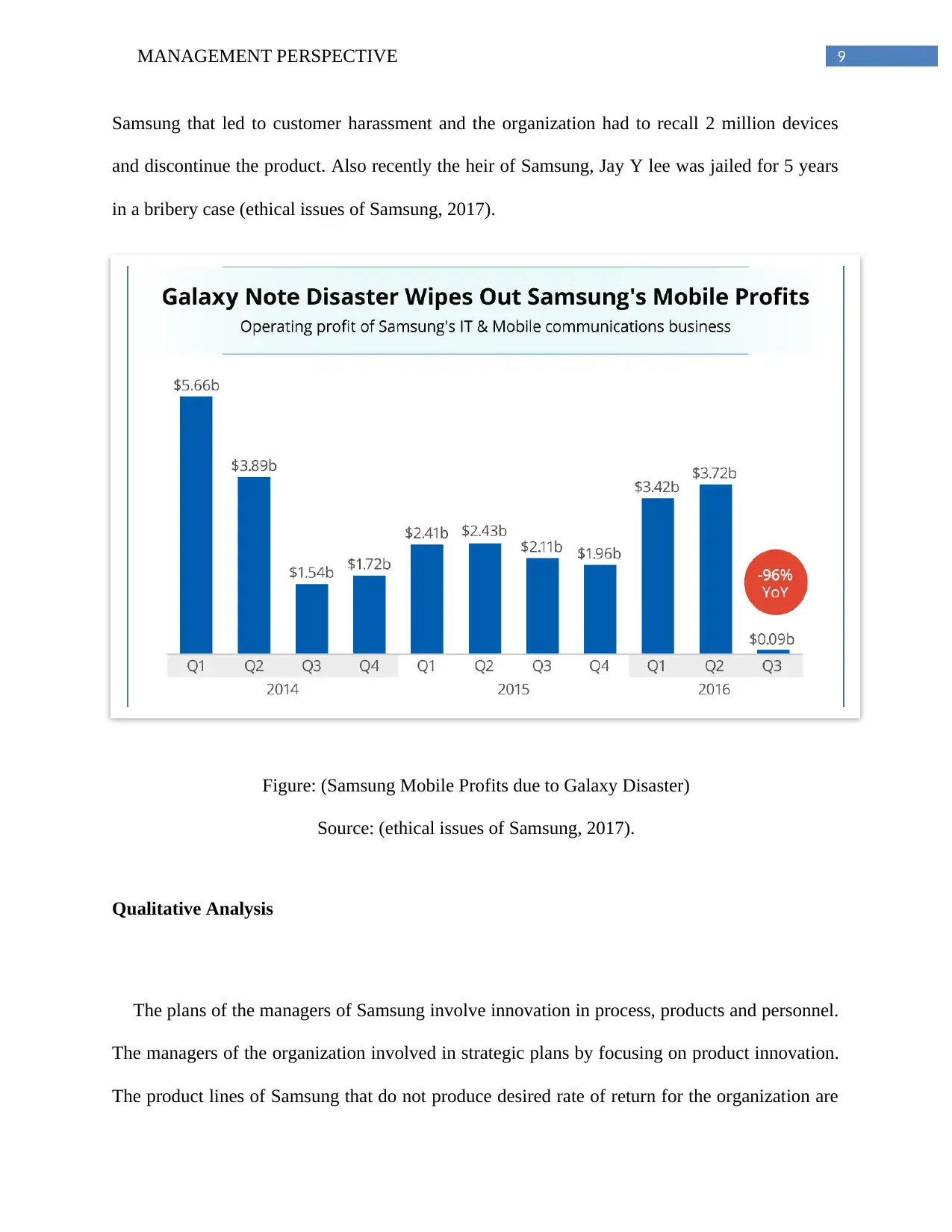
Samsung that led to customer harassment and the organization had to recall 2 million devices
and discontinue the product. Also recently the heir of Samsung, Jay Y lee was jailed for 5 years
in a bribery case (ethical issues of Samsung, 2017).
Figure: (Samsung Mobile Profits due to Galaxy Disaster)
Source: (ethical issues of Samsung, 2017).
Qualitative Analysis
The plans of the managers of Samsung involve innovation in process, products and personnel.
The managers of the organization involved in strategic plans by focusing on product innovation.
The product lines of Samsung that do not produce desired rate of return for the organization are
Samsung that led to customer harassment and the organization had to recall 2 million devices
and discontinue the product. Also recently the heir of Samsung, Jay Y lee was jailed for 5 years
in a bribery case (ethical issues of Samsung, 2017).
Figure: (Samsung Mobile Profits due to Galaxy Disaster)
Source: (ethical issues of Samsung, 2017).
Qualitative Analysis
The plans of the managers of Samsung involve innovation in process, products and personnel.
The managers of the organization involved in strategic plans by focusing on product innovation.
The product lines of Samsung that do not produce desired rate of return for the organization are
Paraphrase This Document
Need a fresh take? Get an instant paraphrase of this document with our AI Paraphraser
10MANAGEMENT PERSPECTIVE
pruned , for instance products like juicers and electronic pagers of the organization was replaced
with hi-tech goods of high-margin like mobile phones and music players. The focus of Samsung
on higher-end products also helped Samsung to increase the brand value of the Company.
Samsung also adopted the concept of Just-In-Time technology to reduce inventory level and the
concept of make-to-order production in Samsung also helped Samsung in process innovation
(SEYEDI & PAKNEZHAD, 2015). However the flaws in manufacturing and battery design
caused explosion of Samsung Galaxy Note 7 for which the organization had to recall 2 million
devices in 2016 which has cost the company 5.3 billion dollar. In manufacturing firms of
Samsung, young workers were hired for overtime work to cut cost and maximize profit. Also,
Lee Jae-yong was provided offered $ 38 million bribes to gain support of President Park Geun-
hye of South Korea. This briery was given to get help of government related to a merger that
would strengthen control of Lee over Samsung at a crucial time (ethical issues of Samsung,
2017).
Conclusion
The management system in Samsung is open and the managers of the organization
appreciate suggestions and ideas from employees. The knowledge management system of
Samsung helps employees to share knowledge and expertise. Ethical practices of Samsung
ensure compliance with law, respect for all stakeholders including customers and employees.
However Samsung should avoid ethical controversies like unethical labor practices in
manufacturing firms in China, explosion of devices like Galaxy Note 7 phone and the bribery
case of Jay Y lee which can tarnish reputation of the organization.
pruned , for instance products like juicers and electronic pagers of the organization was replaced
with hi-tech goods of high-margin like mobile phones and music players. The focus of Samsung
on higher-end products also helped Samsung to increase the brand value of the Company.
Samsung also adopted the concept of Just-In-Time technology to reduce inventory level and the
concept of make-to-order production in Samsung also helped Samsung in process innovation
(SEYEDI & PAKNEZHAD, 2015). However the flaws in manufacturing and battery design
caused explosion of Samsung Galaxy Note 7 for which the organization had to recall 2 million
devices in 2016 which has cost the company 5.3 billion dollar. In manufacturing firms of
Samsung, young workers were hired for overtime work to cut cost and maximize profit. Also,
Lee Jae-yong was provided offered $ 38 million bribes to gain support of President Park Geun-
hye of South Korea. This briery was given to get help of government related to a merger that
would strengthen control of Lee over Samsung at a crucial time (ethical issues of Samsung,
2017).
Conclusion
The management system in Samsung is open and the managers of the organization
appreciate suggestions and ideas from employees. The knowledge management system of
Samsung helps employees to share knowledge and expertise. Ethical practices of Samsung
ensure compliance with law, respect for all stakeholders including customers and employees.
However Samsung should avoid ethical controversies like unethical labor practices in
manufacturing firms in China, explosion of devices like Galaxy Note 7 phone and the bribery
case of Jay Y lee which can tarnish reputation of the organization.
11MANAGEMENT PERSPECTIVE
References
Ashford, S. J., & Detert, J. (2015). Get the Boss to Buy In Learn to sell your ideas up the chain
of command. Harvard Business Review, 93(1-2), 72-79.
Chen, J., Huang, Q., Peng, H., & Zhong, H. (2015). China Samsung: To Foster a Favorite Brand
for Chinese People and Contribute to Chinese Society. In Research Report on Corporate
Social Responsibility of China (pp. 263-282). Springer Berlin Heidelberg.
Crane, A., & Matten, D. (2016). Business ethics: Managing corporate citizenship and
sustainability in the age of globalization. Oxford University Press.
Domnica, D. (2012). The role of leadership in identifying the premises of the future
organization. Land Forces Academy Review, 17(2), 154.
ethical issues of Samsung. (2017). hbr.org. Retrieved 23 October 2017, from
https://hbr.org/2017/05/samsung-shame-and-corporate-atonement
Ford, J. (2005). Examining leadership through critical feminist readings. Journal of Health
Organization and Management, 19(3), 236-251.
Gupta, A. D., & Kurian, S. (2006). Empowerment at work: The dyadic approach. Vision, 10(1),
29-39.
Kassing, J. W. (2009). Breaking the chain of command: Making sense of employee
circumvention. The Journal of Business Communication (1973), 46(3), 311-334.
References
Ashford, S. J., & Detert, J. (2015). Get the Boss to Buy In Learn to sell your ideas up the chain
of command. Harvard Business Review, 93(1-2), 72-79.
Chen, J., Huang, Q., Peng, H., & Zhong, H. (2015). China Samsung: To Foster a Favorite Brand
for Chinese People and Contribute to Chinese Society. In Research Report on Corporate
Social Responsibility of China (pp. 263-282). Springer Berlin Heidelberg.
Crane, A., & Matten, D. (2016). Business ethics: Managing corporate citizenship and
sustainability in the age of globalization. Oxford University Press.
Domnica, D. (2012). The role of leadership in identifying the premises of the future
organization. Land Forces Academy Review, 17(2), 154.
ethical issues of Samsung. (2017). hbr.org. Retrieved 23 October 2017, from
https://hbr.org/2017/05/samsung-shame-and-corporate-atonement
Ford, J. (2005). Examining leadership through critical feminist readings. Journal of Health
Organization and Management, 19(3), 236-251.
Gupta, A. D., & Kurian, S. (2006). Empowerment at work: The dyadic approach. Vision, 10(1),
29-39.
Kassing, J. W. (2009). Breaking the chain of command: Making sense of employee
circumvention. The Journal of Business Communication (1973), 46(3), 311-334.
⊘ This is a preview!⊘
Do you want full access?
Subscribe today to unlock all pages.
Trusted by 1+ million students worldwide

1 out of 14


Related Documents


Your All-in-One AI-Powered Toolkit for Academic Success.
+13062052269
info@desklib.com
Available 24*7 on WhatsApp / Email
![[object Object]](/_next/static/media/star-bottom.7253800d.svg)
Unlock your academic potential
Copyright © 2020–2026 A2Z Services. All Rights Reserved. Developed and managed by ZUCOL.