HRM2018 Essay: Exploring Management's Role in Shaping Culture
VerifiedAdded on 2023/06/18
|12
|3254
|206
Essay
AI Summary
This HRM2018 essay examines the extent to which management can control organizational culture, drawing upon Charles Handy's Organizational Culture Theory and various perspectives such as managerial, productivity, inter-disciplinary, and systems approaches. It discusses how management can shape organizational culture through different strategies, including employee engagement, training and development, cultural transformation, and team collaboration. The essay also addresses issues such as discrimination and bias in the workplace, highlighting the importance of managerial approaches in fostering positive organizational behavior. The analysis emphasizes the need for managers to understand employee concerns, promote teamwork, and implement fair policies to improve productivity and create a robust, dynamic, and high-performing organizational environment. Desklib offers a platform for students to access similar solved assignments and study resources.
HRM2018 INDIVIDUAL
ACADEMIC ESSAY
ACADEMIC ESSAY

Paraphrase This Document
Need a fresh take? Get an instant paraphrase of this document with our AI Paraphraser
Table of Contents
INTRODUCTION...........................................................................................................................3
MAIN BODY..................................................................................................................................3
“To what extent can management control organizational culture”..................................................3
CONCLUSION................................................................................................................................8
REFERENCES................................................................................................................................1
INTRODUCTION...........................................................................................................................3
MAIN BODY..................................................................................................................................3
“To what extent can management control organizational culture”..................................................3
CONCLUSION................................................................................................................................8
REFERENCES................................................................................................................................1
INTRODUCTION
Organizational culture is basically the collection of beliefs, values, assumptions and ways
on the basis of which the company can contribute to the unique and different social and
psychological environment. The positive workplace environment will lead to the success and
also increase their share percentage in the local market. This helps in motivating the employees
and affects the way the employees and groups interact with each other’s. The report will discuss
the topic “To what extent can management control organizational culture”. This is important
because management are the part of the organization which look out the overall process and
activities of the employees on a daily basis. This topic helps in understanding and analysing how
the management with the help of their top skills can provide direction to the employees regarding
the culture of each other’s. The report will cover this topic by using the appropriate and reliable
literature and Charles Handy Organisation Culture Theory. The report will further state the
different perspectives and approaches on controlling organizational culture. In the present era,
discrimination between the employees on the basis of their caste, skin colour, gender, age etc. are
common in all organization. Discussing the management extent to control such a discrimination
and to make workplace better is one of the best ways to bring attention over these issues.
MAIN BODY
“To what extent can management control organizational culture”
As per the views of the King, and Lawley (2019), a good organizational culture does not
occur spontaneously as it requires adoption of various large and small ways throughout many
areas of the company. The management of the organization need to adopt suitable type of culture
and also maintain them. In case, if culture of the business creates negative impact on
performance and productivity than they also need to make changes in their strategies and
approaches.
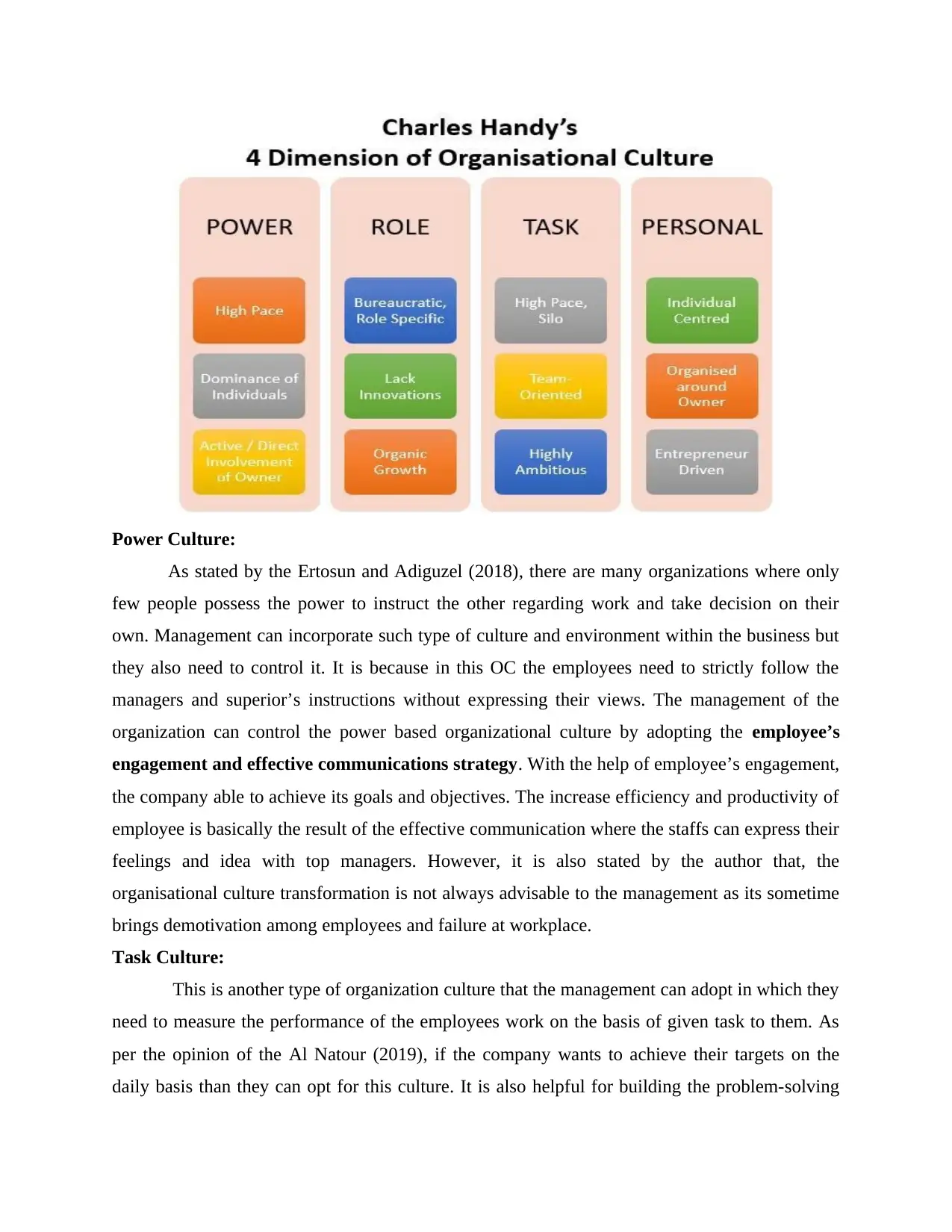
Charles Handy Organizational Culture Theory
This is a theory in which the philosopher has specialized and define the four types of
culture that the organization can follow in order to control, motivate and enhance employee’s
performance. This includes:
Organizational culture is basically the collection of beliefs, values, assumptions and ways
on the basis of which the company can contribute to the unique and different social and
psychological environment. The positive workplace environment will lead to the success and
also increase their share percentage in the local market. This helps in motivating the employees
and affects the way the employees and groups interact with each other’s. The report will discuss
the topic “To what extent can management control organizational culture”. This is important
because management are the part of the organization which look out the overall process and
activities of the employees on a daily basis. This topic helps in understanding and analysing how
the management with the help of their top skills can provide direction to the employees regarding
the culture of each other’s. The report will cover this topic by using the appropriate and reliable
literature and Charles Handy Organisation Culture Theory. The report will further state the
different perspectives and approaches on controlling organizational culture. In the present era,
discrimination between the employees on the basis of their caste, skin colour, gender, age etc. are
common in all organization. Discussing the management extent to control such a discrimination
and to make workplace better is one of the best ways to bring attention over these issues.
MAIN BODY
“To what extent can management control organizational culture”
As per the views of the King, and Lawley (2019), a good organizational culture does not
occur spontaneously as it requires adoption of various large and small ways throughout many
areas of the company. The management of the organization need to adopt suitable type of culture
and also maintain them. In case, if culture of the business creates negative impact on
performance and productivity than they also need to make changes in their strategies and
approaches.
Charles Handy Organizational Culture Theory
This is a theory in which the philosopher has specialized and define the four types of
culture that the organization can follow in order to control, motivate and enhance employee’s
performance. This includes:
⊘ This is a preview!⊘
Do you want full access?
Subscribe today to unlock all pages.

Trusted by 1+ million students worldwide
Power Culture:
As stated by the Ertosun and Adiguzel (2018), there are many organizations where only
few people possess the power to instruct the other regarding work and take decision on their
own. Management can incorporate such type of culture and environment within the business but
they also need to control it. It is because in this OC the employees need to strictly follow the
managers and superior’s instructions without expressing their views. The management of the
organization can control the power based organizational culture by adopting the employee’s
engagement and effective communications strategy. With the help of employee’s engagement,
the company able to achieve its goals and objectives. The increase efficiency and productivity of
employee is basically the result of the effective communication where the staffs can express their
feelings and idea with top managers. However, it is also stated by the author that, the
organisational culture transformation is not always advisable to the management as its sometime
brings demotivation among employees and failure at workplace.
Task Culture:
This is another type of organization culture that the management can adopt in which they
need to measure the performance of the employees work on the basis of given task to them. As
per the opinion of the Al Natour (2019), if the company wants to achieve their targets on the
daily basis than they can opt for this culture. It is also helpful for building the problem-solving
As stated by the Ertosun and Adiguzel (2018), there are many organizations where only
few people possess the power to instruct the other regarding work and take decision on their
own. Management can incorporate such type of culture and environment within the business but
they also need to control it. It is because in this OC the employees need to strictly follow the
managers and superior’s instructions without expressing their views. The management of the
organization can control the power based organizational culture by adopting the employee’s
engagement and effective communications strategy. With the help of employee’s engagement,
the company able to achieve its goals and objectives. The increase efficiency and productivity of
employee is basically the result of the effective communication where the staffs can express their
feelings and idea with top managers. However, it is also stated by the author that, the
organisational culture transformation is not always advisable to the management as its sometime
brings demotivation among employees and failure at workplace.
Task Culture:
This is another type of organization culture that the management can adopt in which they
need to measure the performance of the employees work on the basis of given task to them. As
per the opinion of the Al Natour (2019), if the company wants to achieve their targets on the
daily basis than they can opt for this culture. It is also helpful for building the problem-solving
Paraphrase This Document
Need a fresh take? Get an instant paraphrase of this document with our AI Paraphraser
skills among the employees and the impact of which they can easily solve critical problems. This
OC is best for forming the teams having common interest and specialization. But on the other
side, the author also stated that it demotivates and discourage the people that do not have other
field knowledge. So, the management can adopt the training and development strategy at the
workplace so that everyone can learn other field work and can also help each other. With the
help of this strategies, the management can able to increase interaction between the employees
which further help them in creating positive business environment. Low personal and
professional development is one of the issues of OC that affects the mind of the employees
which get solve by adopting training and development.
Person Culture:
This is a type of OC where the individual is concerned about their own self more than the
organization and this is known as person culture. The Hernes, and Schultz (2017), state that this
culture basically creates lots of difficulty for the management as the employees are not going to
listen anyone and do whatever they want to do. The organization in such a culture takes a back
seat and eventually suffers a lot. So, here the management of the organization can adopt cultural
transformation strategy in which they need to change the person-based OC to targets-based
organization culture. The management of the organization is liable for managing the work of the
employees and here they need to be strict towards it. In order to improve positive business
environment and employee’s productivity and performance changing the OC is best way that the
management can acquire.
Role Culture:
This is another type of organisational culture with the help of which management can
control the whole environment of the business and behaviour of the workforce. As per the views
of the Muzzio, and Paiva (2018), in this type of OC the management need to assign the work as
per specific role of the employees. The management have to applies this to the organization and
departments that operates within the same business. For example, if any employee is expert in
finance field than they will get only finance related work. But on other aspect, it is stated that this
type of culture creates difficult for management to build collaboration among the departments
and employees as all work as per their specific role and do not help each other. So, in order to
solve these issues, management can adopt team collaboration strategy in which they need to
arrange the fun activities and various group programs. This helps the management to build the
OC is best for forming the teams having common interest and specialization. But on the other
side, the author also stated that it demotivates and discourage the people that do not have other
field knowledge. So, the management can adopt the training and development strategy at the
workplace so that everyone can learn other field work and can also help each other. With the
help of this strategies, the management can able to increase interaction between the employees
which further help them in creating positive business environment. Low personal and
professional development is one of the issues of OC that affects the mind of the employees
which get solve by adopting training and development.
Person Culture:
This is a type of OC where the individual is concerned about their own self more than the
organization and this is known as person culture. The Hernes, and Schultz (2017), state that this
culture basically creates lots of difficulty for the management as the employees are not going to
listen anyone and do whatever they want to do. The organization in such a culture takes a back
seat and eventually suffers a lot. So, here the management of the organization can adopt cultural
transformation strategy in which they need to change the person-based OC to targets-based
organization culture. The management of the organization is liable for managing the work of the
employees and here they need to be strict towards it. In order to improve positive business
environment and employee’s productivity and performance changing the OC is best way that the
management can acquire.
Role Culture:
This is another type of organisational culture with the help of which management can
control the whole environment of the business and behaviour of the workforce. As per the views
of the Muzzio, and Paiva (2018), in this type of OC the management need to assign the work as
per specific role of the employees. The management have to applies this to the organization and
departments that operates within the same business. For example, if any employee is expert in
finance field than they will get only finance related work. But on other aspect, it is stated that this
type of culture creates difficult for management to build collaboration among the departments
and employees as all work as per their specific role and do not help each other. So, in order to
solve these issues, management can adopt team collaboration strategy in which they need to
arrange the fun activities and various group programs. This helps the management to build the
interaction between the employees and the impact of which management can control and manage
organizational culture and motivate workforce.
Different perspective and approach on controlling organizational culture
As stated by the Wang, and Lounsbury (2021), in their article that the extent organizational
culture generally depends upon the understanding, prediction and quality of the management
against the human behaviour. There are basically different perspective and approaches are
available which defines the organizational behaviour and culture as per their own point of view.
Managerial Approach
Understanding and identification of employee’s concern is one of the biggest issues that
companies are facing. In the present era, employees are facing partiality and discrimination at the
workplace which discourage them in attaining organisation objective and targets. This is an
approach of OC which state that every company have to consider its employees as main
resources and asset. As per the opinion of the Muhamad, Harrison and Yang (2019), appropriate
managerial approach plays a crucial role in controlling and managing the workforce of the
business. Managers are the one that work with the employees in the same business and look out
the negative and positive aspects and behaviour of employees. That’s why management know
better how the employees will react in a particular situation. The management in order to
improve teamwork and collaboration provides the freedom of personal expressions and diversity
to each and every employee. This approach state that the management of the company can
improve its workforce productivity by providing motivation, respect, fairness etc. By actively
put interest in the employees personal and professional development and advancement the
managers can provide employees job security and support for growth. For this the management
also need to provide work-life balance to the workforce which help them to realize their own
value.
Productivity Approach
This is an approach of OC which helps the management to measure the effectiveness of
the organization by using the input and output ratio. The Juliana, Gani and Jermias (2021), stated
about this approach and perspective in OB put their focus on employee’s productivity
improvement which further measured in term of economic, social and human input and output.
For example, in order to improve employee’s productivity, the management need to first improve
organizational culture and motivate workforce.
Different perspective and approach on controlling organizational culture
As stated by the Wang, and Lounsbury (2021), in their article that the extent organizational
culture generally depends upon the understanding, prediction and quality of the management
against the human behaviour. There are basically different perspective and approaches are
available which defines the organizational behaviour and culture as per their own point of view.
Managerial Approach
Understanding and identification of employee’s concern is one of the biggest issues that
companies are facing. In the present era, employees are facing partiality and discrimination at the
workplace which discourage them in attaining organisation objective and targets. This is an
approach of OC which state that every company have to consider its employees as main
resources and asset. As per the opinion of the Muhamad, Harrison and Yang (2019), appropriate
managerial approach plays a crucial role in controlling and managing the workforce of the
business. Managers are the one that work with the employees in the same business and look out
the negative and positive aspects and behaviour of employees. That’s why management know
better how the employees will react in a particular situation. The management in order to
improve teamwork and collaboration provides the freedom of personal expressions and diversity
to each and every employee. This approach state that the management of the company can
improve its workforce productivity by providing motivation, respect, fairness etc. By actively
put interest in the employees personal and professional development and advancement the
managers can provide employees job security and support for growth. For this the management
also need to provide work-life balance to the workforce which help them to realize their own
value.
Productivity Approach
This is an approach of OC which helps the management to measure the effectiveness of
the organization by using the input and output ratio. The Juliana, Gani and Jermias (2021), stated
about this approach and perspective in OB put their focus on employee’s productivity
improvement which further measured in term of economic, social and human input and output.
For example, in order to improve employee’s productivity, the management need to first improve
⊘ This is a preview!⊘
Do you want full access?
Subscribe today to unlock all pages.
Trusted by 1+ million students worldwide
their job satisfaction level. This means that improved job satisfaction level is an input which
create the output of better organizational behaviour. Another example of this approach is that to
create valuable social output, the management can provide development program to workforce
which further leads to better citizens in the community. In order to support the above fact, the
Pellettiere (2021), has defines that the organizational behaviour decision typically involves the
human, social and economic issues which are directly related to the productivity of the
organization. In such case, adopting the productivity approach to measure business performance
helps the management to do so and also create motivate the employees to do more work even at
the tight deadlines and workloads. The management can control the OC by developing and
adopting the best approaches and strategies which transform the business into robust, dynamic,
stable and high-performing entity.
Inter-Disciplinary Approach
In essence of Muhamad, Harrison and Yang, (2019), the organization performance is
dictated by the human beings and their mental process which depends upon their culture,
language and beliefs. That’s why this approach helps the management to understand the
psychology, sociological, axiology, anthropology and philosophy concept which further help
them in controlling the OC. The transformation and change in the organizational culture are
important to determine whether the organization is performing as per the desired goals and
objectives or not. In the course of conducting such a transformation, it is important to understand
that every business need sound and strong management. The manager must have the capability
and skills such as leadership, communication, active listening and critical thinking for
controlling the behaviour of the organization. The Pellettiere (2021), also state that this not only
help the management in building the strong and competitive workforce but also helps in
presenting the strong image of the company towards the society, local community and UK
government. So, for this the managers of the business have to apply the open communication
system and structure with the help of which each and every personnel can share their strength
and weakness with each other. They have to engage people in decision-making process and
also highlight the vision and mission with the employees. The ultimate result of doing this is
increased revenue and market share.
System Approach
create the output of better organizational behaviour. Another example of this approach is that to
create valuable social output, the management can provide development program to workforce
which further leads to better citizens in the community. In order to support the above fact, the
Pellettiere (2021), has defines that the organizational behaviour decision typically involves the
human, social and economic issues which are directly related to the productivity of the
organization. In such case, adopting the productivity approach to measure business performance
helps the management to do so and also create motivate the employees to do more work even at
the tight deadlines and workloads. The management can control the OC by developing and
adopting the best approaches and strategies which transform the business into robust, dynamic,
stable and high-performing entity.
Inter-Disciplinary Approach
In essence of Muhamad, Harrison and Yang, (2019), the organization performance is
dictated by the human beings and their mental process which depends upon their culture,
language and beliefs. That’s why this approach helps the management to understand the
psychology, sociological, axiology, anthropology and philosophy concept which further help
them in controlling the OC. The transformation and change in the organizational culture are
important to determine whether the organization is performing as per the desired goals and
objectives or not. In the course of conducting such a transformation, it is important to understand
that every business need sound and strong management. The manager must have the capability
and skills such as leadership, communication, active listening and critical thinking for
controlling the behaviour of the organization. The Pellettiere (2021), also state that this not only
help the management in building the strong and competitive workforce but also helps in
presenting the strong image of the company towards the society, local community and UK
government. So, for this the managers of the business have to apply the open communication
system and structure with the help of which each and every personnel can share their strength
and weakness with each other. They have to engage people in decision-making process and
also highlight the vision and mission with the employees. The ultimate result of doing this is
increased revenue and market share.
System Approach
Paraphrase This Document
Need a fresh take? Get an instant paraphrase of this document with our AI Paraphraser
In the current world, not having jack in the organization demotivates the talented
candidates as many of the companies are hiring people on the basis of internal references. As per
the Alhiddi, Osborne and Anyigor (2019), considering system approach is best for removing the
discrimination and biased issues which causes negative OB. The management in order to control
OC can establish policies, standards and systems and measured the performance of the
employees as per the standards. In case if such standards are not met the management can adopt
corrective actions and strategies. But for this first managers need to understand the behaviour of
the employees and which is possible only by adopting 360-feedback strategy. The managers
have to make sure that talented candidates get selected for the vacant position rather than any
referenced candidates. It is because the talent only going to help the business develop and expand
until and unless jack candidates also have strong skills and qualification. This approach is
basically giving the managers a way with the help of which they can view organization as a
whole person, group and social system. However, the Chtourou Ben Amar and Ben Romdhane
(2019), recommends that considering only business perception is not good and they also need to
consider and understand the employee’s perception to build productive team force. If the
managers treat clerk and executive’s differently than this brings gap between the employees.
That’s why it is management responsibility that they use OB to build and control the
organisational culture in which talents are utilized and further developed.
Critical Approach
The critical-thinking approach in organizational behaviour helps the management in
controlling the OC. In his article, the Sayyadi Ghasabeh (2021), has describe that thinking
critically about any situation can provide management a capability to understand and control
their employee’s concern. While controlling and managing large number of people, thinking only
own self perspective is not enough they need to think about the situation from both positive and
negative side. For example, if the management adopt recognition program strategy to improve
employee’s performance than they have to think that this also create jealousy feeling among the
employees which might decreases the employee’s performance. That’s why along with the
providence recognition program to overperformance employees the management keep their focus
on providing training and motivation to underperformance employees. This theory explains the
problem with the current social reality and provide the norms for social transformation. In
order to control the OC, the management need to understand that all the people have equal rights
candidates as many of the companies are hiring people on the basis of internal references. As per
the Alhiddi, Osborne and Anyigor (2019), considering system approach is best for removing the
discrimination and biased issues which causes negative OB. The management in order to control
OC can establish policies, standards and systems and measured the performance of the
employees as per the standards. In case if such standards are not met the management can adopt
corrective actions and strategies. But for this first managers need to understand the behaviour of
the employees and which is possible only by adopting 360-feedback strategy. The managers
have to make sure that talented candidates get selected for the vacant position rather than any
referenced candidates. It is because the talent only going to help the business develop and expand
until and unless jack candidates also have strong skills and qualification. This approach is
basically giving the managers a way with the help of which they can view organization as a
whole person, group and social system. However, the Chtourou Ben Amar and Ben Romdhane
(2019), recommends that considering only business perception is not good and they also need to
consider and understand the employee’s perception to build productive team force. If the
managers treat clerk and executive’s differently than this brings gap between the employees.
That’s why it is management responsibility that they use OB to build and control the
organisational culture in which talents are utilized and further developed.
Critical Approach
The critical-thinking approach in organizational behaviour helps the management in
controlling the OC. In his article, the Sayyadi Ghasabeh (2021), has describe that thinking
critically about any situation can provide management a capability to understand and control
their employee’s concern. While controlling and managing large number of people, thinking only
own self perspective is not enough they need to think about the situation from both positive and
negative side. For example, if the management adopt recognition program strategy to improve
employee’s performance than they have to think that this also create jealousy feeling among the
employees which might decreases the employee’s performance. That’s why along with the
providence recognition program to overperformance employees the management keep their focus
on providing training and motivation to underperformance employees. This theory explains the
problem with the current social reality and provide the norms for social transformation. In
order to control the OC, the management need to understand that all the people have equal rights
to make decision as per their own beliefs and cultures. Harassing the employees on the basis of
their gender and age are common in all organization which can be control and manage by
management by adopting the critical approach. In order to favour the above statement, it is also
stated by the author that retaining the employees and attracting the new talented employees
towards the organization is depends upon the extent the management uses to eliminate
discrimination. To win any discrimination claim against the business, the management need to
work as a friend of all the employees and maintain the equality and right to speak for workforce.
CONCLUSION
The report has concluded the extent to which can management control organizational
culture and for this the report has used the Charles Handy Organizational Culture and various
approaches and perspective of controlling OC. The report concludes the power, task, role and
person type of culture and critically analyse how the management can adopt this in order to
control the employees and other business activities. The report concludes that if the management
really wants to build the strong organizational culture than they first need to understand and
analyse the feelings, beliefs and emotions of the employees. The report has concluded the
different perspective and approaches with the help of which the management can not only
understand the people culture and behaviour but also use them to build strong OC. Further, the
report also concludes that the adoption of employee’s engagement and effective communication
strategy is also one of the best ways to power based culture and training and development
strategy is best for managing task-based organisation culture. In case of any company have
person-based organisational culture than the management of that company have to adopt the
cultural transformation strategy because in this type of culture people will not listen to anyone.
They do whatever they want to do and the impact of which management not able to meet its
targets and objectives and overall business performance get diminished. The report has also
concluded that team collaboration strategy and 360-degree feedback strategy is also one way
with the help of which management can control organizational culture.
their gender and age are common in all organization which can be control and manage by
management by adopting the critical approach. In order to favour the above statement, it is also
stated by the author that retaining the employees and attracting the new talented employees
towards the organization is depends upon the extent the management uses to eliminate
discrimination. To win any discrimination claim against the business, the management need to
work as a friend of all the employees and maintain the equality and right to speak for workforce.
CONCLUSION
The report has concluded the extent to which can management control organizational
culture and for this the report has used the Charles Handy Organizational Culture and various
approaches and perspective of controlling OC. The report concludes the power, task, role and
person type of culture and critically analyse how the management can adopt this in order to
control the employees and other business activities. The report concludes that if the management
really wants to build the strong organizational culture than they first need to understand and
analyse the feelings, beliefs and emotions of the employees. The report has concluded the
different perspective and approaches with the help of which the management can not only
understand the people culture and behaviour but also use them to build strong OC. Further, the
report also concludes that the adoption of employee’s engagement and effective communication
strategy is also one of the best ways to power based culture and training and development
strategy is best for managing task-based organisation culture. In case of any company have
person-based organisational culture than the management of that company have to adopt the
cultural transformation strategy because in this type of culture people will not listen to anyone.
They do whatever they want to do and the impact of which management not able to meet its
targets and objectives and overall business performance get diminished. The report has also
concluded that team collaboration strategy and 360-degree feedback strategy is also one way
with the help of which management can control organizational culture.
⊘ This is a preview!⊘
Do you want full access?
Subscribe today to unlock all pages.
Trusted by 1+ million students worldwide

Paraphrase This Document
Need a fresh take? Get an instant paraphrase of this document with our AI Paraphraser
REFERENCES
Books and journals
King, D. and Lawley, S. 2019. Chapter 7: Organizational culture. In King. D and Lawley.
Organizational Behaviour. Oxford: Oxford University Press.
Ertosun, O. G. and Adiguzel, Z., 2018. Leadership, personal values and organizational culture.
In Strategic Design and Innovative Thinking in Business Operations (pp. 51-74).
Springer, Cham.
Muzzio, H. and Paiva, F. G., 2018. Organizational creativity management: Discussion
elements. Revista de Administração Contemporânea. 22. pp.922-939.
Al Natour, W., 2019. Organizational Culture Management: Reality or Myth. Researchgate.
Luettavissa: https://www. researchgate.
net/publication/332569673_Organizational_Culture_manageme nt_Reality_or_Myth.
Luettu, 20, p.2020.
Wang, M. S. and Lounsbury, M., 2021. Cultural encounters: A practice-driven institutional
approach to the study of organizational culture. In On practice and institution: New
empirical directions. Emerald Publishing Limited.
Hernes, T. and Schultz, M., 2017. A temporal understanding of the connections between
organizational culture and identity. 2017). The Sage handbook of process organization
studies, pp.356-371.
Sayyadi Ghasabeh, M., 2021. Transformational Leadership: Implementing a Cultural Approach
in Organizations. The Journal of Values-Based Leadership. 14(1). p.9.
Alhiddi, A., Osborne, A. N. and Anyigor, K. T., 2019. Organizational culture and stakeholder
success criteria in construction projects. Periodica polytechnica architecture. 50(2).
pp.148-154.
Muhamad, J. W., Harrison, T. R. and Yang, F., 2019. Organizational communication: Theory
and practice. In An integrated approach to communication theory and research (pp. 359-
374). Routledge.
Juliana, C., Gani, L. and Jermias, J., 2021. Performance implications of misalignment among
business strategy, leadership style, organizational culture and management accounting
systems. International Journal of Ethics and Systems.
1
Books and journals
King, D. and Lawley, S. 2019. Chapter 7: Organizational culture. In King. D and Lawley.
Organizational Behaviour. Oxford: Oxford University Press.
Ertosun, O. G. and Adiguzel, Z., 2018. Leadership, personal values and organizational culture.
In Strategic Design and Innovative Thinking in Business Operations (pp. 51-74).
Springer, Cham.
Muzzio, H. and Paiva, F. G., 2018. Organizational creativity management: Discussion
elements. Revista de Administração Contemporânea. 22. pp.922-939.
Al Natour, W., 2019. Organizational Culture Management: Reality or Myth. Researchgate.
Luettavissa: https://www. researchgate.
net/publication/332569673_Organizational_Culture_manageme nt_Reality_or_Myth.
Luettu, 20, p.2020.
Wang, M. S. and Lounsbury, M., 2021. Cultural encounters: A practice-driven institutional
approach to the study of organizational culture. In On practice and institution: New
empirical directions. Emerald Publishing Limited.
Hernes, T. and Schultz, M., 2017. A temporal understanding of the connections between
organizational culture and identity. 2017). The Sage handbook of process organization
studies, pp.356-371.
Sayyadi Ghasabeh, M., 2021. Transformational Leadership: Implementing a Cultural Approach
in Organizations. The Journal of Values-Based Leadership. 14(1). p.9.
Alhiddi, A., Osborne, A. N. and Anyigor, K. T., 2019. Organizational culture and stakeholder
success criteria in construction projects. Periodica polytechnica architecture. 50(2).
pp.148-154.
Muhamad, J. W., Harrison, T. R. and Yang, F., 2019. Organizational communication: Theory
and practice. In An integrated approach to communication theory and research (pp. 359-
374). Routledge.
Juliana, C., Gani, L. and Jermias, J., 2021. Performance implications of misalignment among
business strategy, leadership style, organizational culture and management accounting
systems. International Journal of Ethics and Systems.
1

Chtourou Ben Amar, N. and Ben Romdhane, R., 2019. Organizational culture and information
systems strategic alignment: Exploring the influence through an empirical study from
Tunisia. Journal of Enterprise Information Management, 33(1), pp.95-119.
Pellettiere, V., 2021. Organizational Analysis: What, How, Why.
2
systems strategic alignment: Exploring the influence through an empirical study from
Tunisia. Journal of Enterprise Information Management, 33(1), pp.95-119.
Pellettiere, V., 2021. Organizational Analysis: What, How, Why.
2
⊘ This is a preview!⊘
Do you want full access?
Subscribe today to unlock all pages.
Trusted by 1+ million students worldwide

1 out of 12


Related Documents


Your All-in-One AI-Powered Toolkit for Academic Success.
+13062052269
info@desklib.com
Available 24*7 on WhatsApp / Email
![[object Object]](/_next/static/media/star-bottom.7253800d.svg)
Unlock your academic potential
Copyright © 2020–2025 A2Z Services. All Rights Reserved. Developed and managed by ZUCOL.