Information Systems Assignment: Secure Asset Management Analysis
VerifiedAdded on 2022/11/24
|16
|3924
|323
Homework Assignment
AI Summary
This Information Systems assignment analyzes the functional business units of Secure Asset Management, detailing data flow, types of data (operational, tactical, and strategic), and their relationships. The assignment explores technological solutions for implementing operational databases, CRM, data warehousing, data mining, data analytics, cloud-based platforms, and outsourced data management, along with their organizational applications. It also addresses professional, ethical, legal, and social considerations of implementing and using IT systems. The document provides a comprehensive overview of information systems within a business context, offering insights into data management, technological implementations, and the broader implications of IT systems.
Information Systems

Paraphrase This Document
Need a fresh take? Get an instant paraphrase of this document with our AI Paraphraser


Table of Contents
⊘ This is a preview!⊘
Do you want full access?
Subscribe today to unlock all pages.

Trusted by 1+ million students worldwide
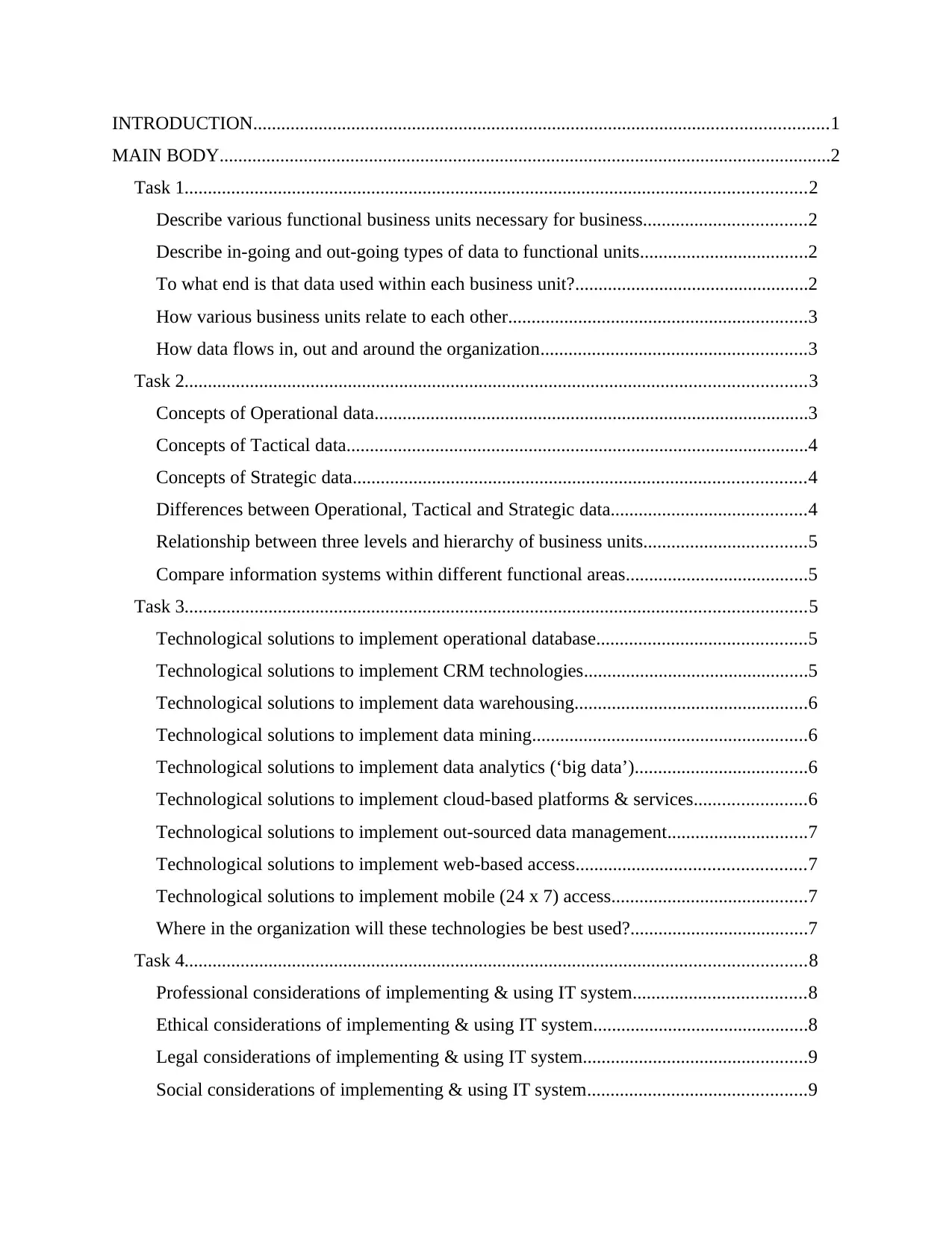
INTRODUCTION...........................................................................................................................1
MAIN BODY...................................................................................................................................2
Task 1.....................................................................................................................................2
Describe various functional business units necessary for business...................................2
Describe in-going and out-going types of data to functional units....................................2
To what end is that data used within each business unit?..................................................2
How various business units relate to each other................................................................3
How data flows in, out and around the organization.........................................................3
Task 2.....................................................................................................................................3
Concepts of Operational data.............................................................................................3
Concepts of Tactical data...................................................................................................4
Concepts of Strategic data.................................................................................................4
Differences between Operational, Tactical and Strategic data..........................................4
Relationship between three levels and hierarchy of business units...................................5
Compare information systems within different functional areas.......................................5
Task 3.....................................................................................................................................5
Technological solutions to implement operational database.............................................5
Technological solutions to implement CRM technologies................................................5
Technological solutions to implement data warehousing..................................................6
Technological solutions to implement data mining...........................................................6
Technological solutions to implement data analytics (‘big data’).....................................6
Technological solutions to implement cloud-based platforms & services........................6
Technological solutions to implement out-sourced data management..............................7
Technological solutions to implement web-based access.................................................7
Technological solutions to implement mobile (24 x 7) access..........................................7
Where in the organization will these technologies be best used?......................................7
Task 4.....................................................................................................................................8
Professional considerations of implementing & using IT system.....................................8
Ethical considerations of implementing & using IT system..............................................8
Legal considerations of implementing & using IT system................................................9
Social considerations of implementing & using IT system...............................................9
MAIN BODY...................................................................................................................................2
Task 1.....................................................................................................................................2
Describe various functional business units necessary for business...................................2
Describe in-going and out-going types of data to functional units....................................2
To what end is that data used within each business unit?..................................................2
How various business units relate to each other................................................................3
How data flows in, out and around the organization.........................................................3
Task 2.....................................................................................................................................3
Concepts of Operational data.............................................................................................3
Concepts of Tactical data...................................................................................................4
Concepts of Strategic data.................................................................................................4
Differences between Operational, Tactical and Strategic data..........................................4
Relationship between three levels and hierarchy of business units...................................5
Compare information systems within different functional areas.......................................5
Task 3.....................................................................................................................................5
Technological solutions to implement operational database.............................................5
Technological solutions to implement CRM technologies................................................5
Technological solutions to implement data warehousing..................................................6
Technological solutions to implement data mining...........................................................6
Technological solutions to implement data analytics (‘big data’).....................................6
Technological solutions to implement cloud-based platforms & services........................6
Technological solutions to implement out-sourced data management..............................7
Technological solutions to implement web-based access.................................................7
Technological solutions to implement mobile (24 x 7) access..........................................7
Where in the organization will these technologies be best used?......................................7
Task 4.....................................................................................................................................8
Professional considerations of implementing & using IT system.....................................8
Ethical considerations of implementing & using IT system..............................................8
Legal considerations of implementing & using IT system................................................9
Social considerations of implementing & using IT system...............................................9
Paraphrase This Document
Need a fresh take? Get an instant paraphrase of this document with our AI Paraphraser
CONCLUSION................................................................................................................................9
REFERENCES..............................................................................................................................11
REFERENCES..............................................................................................................................11
INTRODUCTION
Information system can be defined as the formal and organizational system which is
designed in order to collect and process the data along with the storage and distribution of the
information. Basically the information systems are composed of four components that are the
task and people along with the structure and Technology. It is a type of software which is
formulated as per the needs and requirements of the current issues in the business (Rainer,
Prince, Splettstoesser-Hogeterp and Ebrahimi, 2020. The organization chosen for the scenario is
the secure asset Management which specializes in ultra-high secure data storage and digital asset
Management. The following discussion is made on the different functional business units along
with the ingoing and outgoing types of data and the relationship as for the scenario. Concepts of
operational, optical and strategic data along with the differences and relationships with the
information systems. Technological solutions to implement the operational database, CRM
technologies, data warehousing, data mining, Data analytics, cloud based platforms and services,
outsourced data management, web-based access and mobile access along with the uses and
purposes. Professional, legal, ethical and social considerations of implementing and using IT
systems with proper findings and conclusion.
1
Information system can be defined as the formal and organizational system which is
designed in order to collect and process the data along with the storage and distribution of the
information. Basically the information systems are composed of four components that are the
task and people along with the structure and Technology. It is a type of software which is
formulated as per the needs and requirements of the current issues in the business (Rainer,
Prince, Splettstoesser-Hogeterp and Ebrahimi, 2020. The organization chosen for the scenario is
the secure asset Management which specializes in ultra-high secure data storage and digital asset
Management. The following discussion is made on the different functional business units along
with the ingoing and outgoing types of data and the relationship as for the scenario. Concepts of
operational, optical and strategic data along with the differences and relationships with the
information systems. Technological solutions to implement the operational database, CRM
technologies, data warehousing, data mining, Data analytics, cloud based platforms and services,
outsourced data management, web-based access and mobile access along with the uses and
purposes. Professional, legal, ethical and social considerations of implementing and using IT
systems with proper findings and conclusion.
1
⊘ This is a preview!⊘
Do you want full access?
Subscribe today to unlock all pages.
Trusted by 1+ million students worldwide
MAIN BODY
Task 1
Describe various functional business units necessary for business
There are various functional business units which are necessary for the business to carry
out as for the given scenario such as the management of catastrophic data specialists must be
hired by the company so that they can produce such loss even at one of the sites. It is important
for the management to look at the planning for the future growth so that the better late analysis
can be done for their clients with better profits and future considerations so that the decision
making can be good and not for the complaints about the wrong estimation of the data. The
company must start enacting GDPR data protection legislation so that they can be safe and
secure for the long term if any misconduct happens with the data otherwise it can lead to a great
loss to the clients as well as to their own business. It is essential for the organisation to hire the
information technology specialist and the cost of equipment is a onetime investment for the
people because they can drink the great competition in the market and help in fighting against the
same. Moreover the company must develop a system which can be accessed all the time so that
remote working is possible without any complications.
Describe in-going and out-going types of data to functional units
Outgoing data to functional units in the organisation as for the given scenario is
transmitted out from the computer which includes the file uploads and request for data which
mainly includes the search request and web page request along with the DNS request and more
over the glass fire generally represents the outgoing traffic of data. Incoming data to functional
units in organisation all the data which are assigned by the client and for the human resource
recruitment collection also with the accessing of data which is followed by the GDPR
information for better return analysis in the company (Stair and Reynolds, 2020).
To what end is that data used within each business unit?
All these types of data ingoing and outgoing are used in the different functional units of
the business which is discussed in the previous two sections such as in the human resource
2
Task 1
Describe various functional business units necessary for business
There are various functional business units which are necessary for the business to carry
out as for the given scenario such as the management of catastrophic data specialists must be
hired by the company so that they can produce such loss even at one of the sites. It is important
for the management to look at the planning for the future growth so that the better late analysis
can be done for their clients with better profits and future considerations so that the decision
making can be good and not for the complaints about the wrong estimation of the data. The
company must start enacting GDPR data protection legislation so that they can be safe and
secure for the long term if any misconduct happens with the data otherwise it can lead to a great
loss to the clients as well as to their own business. It is essential for the organisation to hire the
information technology specialist and the cost of equipment is a onetime investment for the
people because they can drink the great competition in the market and help in fighting against the
same. Moreover the company must develop a system which can be accessed all the time so that
remote working is possible without any complications.
Describe in-going and out-going types of data to functional units
Outgoing data to functional units in the organisation as for the given scenario is
transmitted out from the computer which includes the file uploads and request for data which
mainly includes the search request and web page request along with the DNS request and more
over the glass fire generally represents the outgoing traffic of data. Incoming data to functional
units in organisation all the data which are assigned by the client and for the human resource
recruitment collection also with the accessing of data which is followed by the GDPR
information for better return analysis in the company (Stair and Reynolds, 2020).
To what end is that data used within each business unit?
All these types of data ingoing and outgoing are used in the different functional units of
the business which is discussed in the previous two sections such as in the human resource
2
Paraphrase This Document
Need a fresh take? Get an instant paraphrase of this document with our AI Paraphraser
department, the data is required for recruiting and hiring of the IT specialist. In the data analyst
department, the data is required for future considerations and decision-making for the climate. In
the information technology department, the data is used to assess all the technical devices with
better security so that it can be accessed in a remote way. In the software development
department, data is required to develop the software which brings security to other sides of the
organisation in London as well.
How various business units relate to each other
All the business units of the organisation as per the given scenario are related with each
other and this is because its human resource functional unit will not be able to hire and recruit the
experts in information technology that they will not be able to get the good software
development and security of the data along with the good data analyst because these are the
people who can give the productivity to the organisation and they are interdependent on each
other describe the needs and requirements of the client (Pearlson, Saunders and Galletta, 2019).
How data flows in, out and around the organization
As per the given scenario, the data flows in and out along with the round of the
organisation with the help of communication flow hierarchy in the organisation which mainly
uses the information and communication technology and performs and executes such activities
within the organisation for better communication with the help of intranet and internet as well
over the network. This can be possible with the help of email communication and internal
chatbots which are private and confidential along with the electronic circulars and memos.
Task 2
Concepts of Operational data
Operational data is defined as the data which includes the internal as well as the
operational control and environment on the information which are related to the company's
workforce and direct competitors along with the creditors and suppliers which is followed by the
information on customers which means the internal and external stakeholders of the company.
For example, stock quantities and activities of the organisation along with the customer
relationship management transactions and financial operations which is followed by the
3
department, the data is required for future considerations and decision-making for the climate. In
the information technology department, the data is used to assess all the technical devices with
better security so that it can be accessed in a remote way. In the software development
department, data is required to develop the software which brings security to other sides of the
organisation in London as well.
How various business units relate to each other
All the business units of the organisation as per the given scenario are related with each
other and this is because its human resource functional unit will not be able to hire and recruit the
experts in information technology that they will not be able to get the good software
development and security of the data along with the good data analyst because these are the
people who can give the productivity to the organisation and they are interdependent on each
other describe the needs and requirements of the client (Pearlson, Saunders and Galletta, 2019).
How data flows in, out and around the organization
As per the given scenario, the data flows in and out along with the round of the
organisation with the help of communication flow hierarchy in the organisation which mainly
uses the information and communication technology and performs and executes such activities
within the organisation for better communication with the help of intranet and internet as well
over the network. This can be possible with the help of email communication and internal
chatbots which are private and confidential along with the electronic circulars and memos.
Task 2
Concepts of Operational data
Operational data is defined as the data which includes the internal as well as the
operational control and environment on the information which are related to the company's
workforce and direct competitors along with the creditors and suppliers which is followed by the
information on customers which means the internal and external stakeholders of the company.
For example, stock quantities and activities of the organisation along with the customer
relationship management transactions and financial operations which is followed by the
3
computer database and it also attracts the warehouse quantities with the help of operational data
(Beynon-Davies, 2020).
Concepts of Tactical data
Tactical data can be defined as the set of standards in order to control and command the
systems so that the continuous exchange of operational situations and orders along with the
reports can be enabled on platforms such as fighters for ships. It has a purpose to make
accessibility without significant technical tactical data knowledge. It is mainly used by middle
management in order to manage and plan the projects under specific budgets and time scales.
This is data which do not want potential but can be normally used by the middle management for
better operations in an organisation such as market research data or the investments data.
Concepts of Strategic data
Strategic data can be defined as the information which is surrounding the industry which
includes the operations of the business and also called the industrial data. It includes the entry
barriers and suppliers along with the buyer power which is followed by the ability of the
customers so that they cannot substitute the product and fight against the competitors in the
marketplace. Strategic data analysis is the developing plan when the organisation is getting down
to the tactical level so that its progression can be monitored in an efficient manner. Its examples
include highly confidential data which are private in nature and only the managers and leaders
are allowed to access and control the data so that they can direct their employees how they can
work according to the information they have gathered (B Romney, 2018).
Differences between Operational, Tactical and Strategic data
There is a difference between operational, tactical and strategic data in the organization
as per the given scenario. The difference between them is that the operational data is a type of
strategic data which are highly confidential and are used by the higher authorities of the
company to make strategies and direct the employees for the same and in terms of tactical data, it
is used by the middle management which is not confidential and can be used by employees. This
is because it is important to keep the privacy in the organization so that the safety and security
4
(Beynon-Davies, 2020).
Concepts of Tactical data
Tactical data can be defined as the set of standards in order to control and command the
systems so that the continuous exchange of operational situations and orders along with the
reports can be enabled on platforms such as fighters for ships. It has a purpose to make
accessibility without significant technical tactical data knowledge. It is mainly used by middle
management in order to manage and plan the projects under specific budgets and time scales.
This is data which do not want potential but can be normally used by the middle management for
better operations in an organisation such as market research data or the investments data.
Concepts of Strategic data
Strategic data can be defined as the information which is surrounding the industry which
includes the operations of the business and also called the industrial data. It includes the entry
barriers and suppliers along with the buyer power which is followed by the ability of the
customers so that they cannot substitute the product and fight against the competitors in the
marketplace. Strategic data analysis is the developing plan when the organisation is getting down
to the tactical level so that its progression can be monitored in an efficient manner. Its examples
include highly confidential data which are private in nature and only the managers and leaders
are allowed to access and control the data so that they can direct their employees how they can
work according to the information they have gathered (B Romney, 2018).
Differences between Operational, Tactical and Strategic data
There is a difference between operational, tactical and strategic data in the organization
as per the given scenario. The difference between them is that the operational data is a type of
strategic data which are highly confidential and are used by the higher authorities of the
company to make strategies and direct the employees for the same and in terms of tactical data, it
is used by the middle management which is not confidential and can be used by employees. This
is because it is important to keep the privacy in the organization so that the safety and security
4
⊘ This is a preview!⊘
Do you want full access?
Subscribe today to unlock all pages.
Trusted by 1+ million students worldwide
can be maintained which results in the reduction in losses and misconduct in the technical
systems.
Relationship between three levels and hierarchy of business units
Relationship between the three levels and hierarchy of business units can be that the all
the three types of data are used in all the business units because functional areas of the business
requires these type of data that can easily analyse and perform their roles and responsibilities
according to the information provided to them in an efficient and effective manner and this
results the potential way of working of the employees along with the managers as well.
Extraction of private and confidential data from the tactical and operational data which is a
strategic data and therefore all this information are highly utilised in the functional units of
human resource Management and data analyst along with the information technology specialist
and software developer and many more functional units (Abdullayev, 2020).
Compare information systems within different functional areas
There is difference between all the functional areas of the organisation as for the given
scenario such as the roles and responsibilities of them are different and performs the specific jobs
as per the needs and requirements and there can be a similarity but not the same.
Task 3
Technological solutions to implement operational database
Operational database can be defined as the database in which the management and
storage of data is done in the real time and it is a source of data warehouse. These systems are
versatile and can accommodate distributed systems such as SQL databases which support
encryption and auditing along with the protection of Cybercrime. For example, mark logic,
Microsoft SQL server and many more (Ismagilova, Hughes, Dwivedi and Raman, 2019).
Technological solutions to implement CRM technologies
Customer relationship management can be defined as the technology in order to manage
the relationships and interaction among the company and the customers. It improves the business
5
systems.
Relationship between three levels and hierarchy of business units
Relationship between the three levels and hierarchy of business units can be that the all
the three types of data are used in all the business units because functional areas of the business
requires these type of data that can easily analyse and perform their roles and responsibilities
according to the information provided to them in an efficient and effective manner and this
results the potential way of working of the employees along with the managers as well.
Extraction of private and confidential data from the tactical and operational data which is a
strategic data and therefore all this information are highly utilised in the functional units of
human resource Management and data analyst along with the information technology specialist
and software developer and many more functional units (Abdullayev, 2020).
Compare information systems within different functional areas
There is difference between all the functional areas of the organisation as for the given
scenario such as the roles and responsibilities of them are different and performs the specific jobs
as per the needs and requirements and there can be a similarity but not the same.
Task 3
Technological solutions to implement operational database
Operational database can be defined as the database in which the management and
storage of data is done in the real time and it is a source of data warehouse. These systems are
versatile and can accommodate distributed systems such as SQL databases which support
encryption and auditing along with the protection of Cybercrime. For example, mark logic,
Microsoft SQL server and many more (Ismagilova, Hughes, Dwivedi and Raman, 2019).
Technological solutions to implement CRM technologies
Customer relationship management can be defined as the technology in order to manage
the relationships and interaction among the company and the customers. It improves the business
5
Paraphrase This Document
Need a fresh take? Get an instant paraphrase of this document with our AI Paraphraser
relationships and also supports the company in staying connected with the stakeholders which
improves profitability. For example, Apple CRM, Amazon CRM, Tesco CRM and many more.
Technological solutions to implement data warehousing
Data warehousing can be defined as a process of constructing the warehousing of data
with the help of integrating the information from heterogeneous sources which supports
analytical reporting and decision making. For example, product information, sales data, customer
and supplier details and many more (Kavanagh and Johnson, 2020).
Technological solutions to implement data mining
Data mining can be defined as a process of searching the patterns and correlations among
the large data in order to predict the outcomes. It is used to increase the revenues, cut costs and
improve the customer relationship by reducing the risk. For example, analyzing the large amount
of data by scanning from the supermarkets.
Technological solutions to implement data analytics (‘big data’)
Data analytics can be defined as a process of transforming and modelling of data with the
objective of discovering the useful conclusion and information for decision making. It is used for
the research which helps the companies to understand the customers and create strategies for
growth and development. For example, discovering consumer shopping habits, personalized
marketing and many more (Kappelman, Johnson, Torres and McLean, 2019).
Technological solutions to implement cloud-based platforms &
services
Cloud based platforms and services can be defined as cloud computing where the
hardware and software tools are delivered to the users over the internet and they are used for the
application development on its own infrastructure. For example, it is used in banking and
financial services, health care and education, big Data analytics and many more.
6
improves profitability. For example, Apple CRM, Amazon CRM, Tesco CRM and many more.
Technological solutions to implement data warehousing
Data warehousing can be defined as a process of constructing the warehousing of data
with the help of integrating the information from heterogeneous sources which supports
analytical reporting and decision making. For example, product information, sales data, customer
and supplier details and many more (Kavanagh and Johnson, 2020).
Technological solutions to implement data mining
Data mining can be defined as a process of searching the patterns and correlations among
the large data in order to predict the outcomes. It is used to increase the revenues, cut costs and
improve the customer relationship by reducing the risk. For example, analyzing the large amount
of data by scanning from the supermarkets.
Technological solutions to implement data analytics (‘big data’)
Data analytics can be defined as a process of transforming and modelling of data with the
objective of discovering the useful conclusion and information for decision making. It is used for
the research which helps the companies to understand the customers and create strategies for
growth and development. For example, discovering consumer shopping habits, personalized
marketing and many more (Kappelman, Johnson, Torres and McLean, 2019).
Technological solutions to implement cloud-based platforms &
services
Cloud based platforms and services can be defined as cloud computing where the
hardware and software tools are delivered to the users over the internet and they are used for the
application development on its own infrastructure. For example, it is used in banking and
financial services, health care and education, big Data analytics and many more.
6
Technological solutions to implement out-sourced data management
Outsource data management can be defined as the services which are provided to solve
the issues of data management for companies and businesses and it reduces the risk that arise
from the poor quality data and enhances the operational efficiency. For example, Data entry
services, data mining services and many more (Markus and Rowe, 2018).
Technological solutions to implement web-based access
Web- based access can be defined as the control systems which connect all the security
devices with the help of internet connection and allow the users to manage the interface. It
eliminates the complex software installation which supports the organizations in better
functioning. For example, Google applications, Microsoft 365 and many more.
Technological solutions to implement mobile (24 x 7) access
Mobile access can be defined as an electronic device which helps to function anywhere
and anytime because it has a flexibility of time and place. For example, mobile phones,
smartphones and many more (Makhmudov, 2020).
Where in the organization will these technologies be best used?
Operational databases can be used among the employees who are at operational level for
the regular functioning. CRM technologies can be used in the marketing department for better
mentoring relationships with customers. Data warehousing and data mining can be used by the
data analyst to manage and analyse the data. Big data can be used by the strategic managers so
that it can be operated strategically in an efficient manner. Cloud based platforms and services
can be used by the networking department where they are responsible to manage the network and
internet. Outsource data management can be used by the information and communication
Technology department so that they can review the data which is outsourced and manage the
same. Web based and mobile access can be used by the employees who cannot work in the
organisation but are working somewhere else on a remote basis (Siponen and Baskerville, 2018).
7
Outsource data management can be defined as the services which are provided to solve
the issues of data management for companies and businesses and it reduces the risk that arise
from the poor quality data and enhances the operational efficiency. For example, Data entry
services, data mining services and many more (Markus and Rowe, 2018).
Technological solutions to implement web-based access
Web- based access can be defined as the control systems which connect all the security
devices with the help of internet connection and allow the users to manage the interface. It
eliminates the complex software installation which supports the organizations in better
functioning. For example, Google applications, Microsoft 365 and many more.
Technological solutions to implement mobile (24 x 7) access
Mobile access can be defined as an electronic device which helps to function anywhere
and anytime because it has a flexibility of time and place. For example, mobile phones,
smartphones and many more (Makhmudov, 2020).
Where in the organization will these technologies be best used?
Operational databases can be used among the employees who are at operational level for
the regular functioning. CRM technologies can be used in the marketing department for better
mentoring relationships with customers. Data warehousing and data mining can be used by the
data analyst to manage and analyse the data. Big data can be used by the strategic managers so
that it can be operated strategically in an efficient manner. Cloud based platforms and services
can be used by the networking department where they are responsible to manage the network and
internet. Outsource data management can be used by the information and communication
Technology department so that they can review the data which is outsourced and manage the
same. Web based and mobile access can be used by the employees who cannot work in the
organisation but are working somewhere else on a remote basis (Siponen and Baskerville, 2018).
7
⊘ This is a preview!⊘
Do you want full access?
Subscribe today to unlock all pages.
Trusted by 1+ million students worldwide

1 out of 16


Related Documents


Your All-in-One AI-Powered Toolkit for Academic Success.
+13062052269
info@desklib.com
Available 24*7 on WhatsApp / Email
![[object Object]](/_next/static/media/star-bottom.7253800d.svg)
Unlock your academic potential
Copyright © 2020–2026 A2Z Services. All Rights Reserved. Developed and managed by ZUCOL.