Report: Leadership, Management, and Organizational Functions at Wilko
VerifiedAdded on 2022/12/27
|9
|1957
|81
Report
AI Summary
This report provides an in-depth analysis of leadership and management practices within the retail company, Wilko. The report begins by defining the roles and characteristics of leaders and managers, contrasting their approaches to achieving organizational goals. It then delves into various leadership theories, including the Great Man theory, Trait theory, Situational theory, and Contingency theory, explaining their relevance to Wilko's operational context. Furthermore, the report outlines the core functions of management, such as planning, organizing, staffing, directing, and controlling, illustrating how these functions are applied within Wilko to ensure efficient operations and achieve strategic objectives. The conclusion summarizes the key findings, emphasizing the importance of effective leadership and management for organizational success, referencing relevant academic sources throughout the report.
MANAGEMENT &
OPERATIONS
OPERATIONS

Paraphrase This Document
Need a fresh take? Get an instant paraphrase of this document with our AI Paraphraser
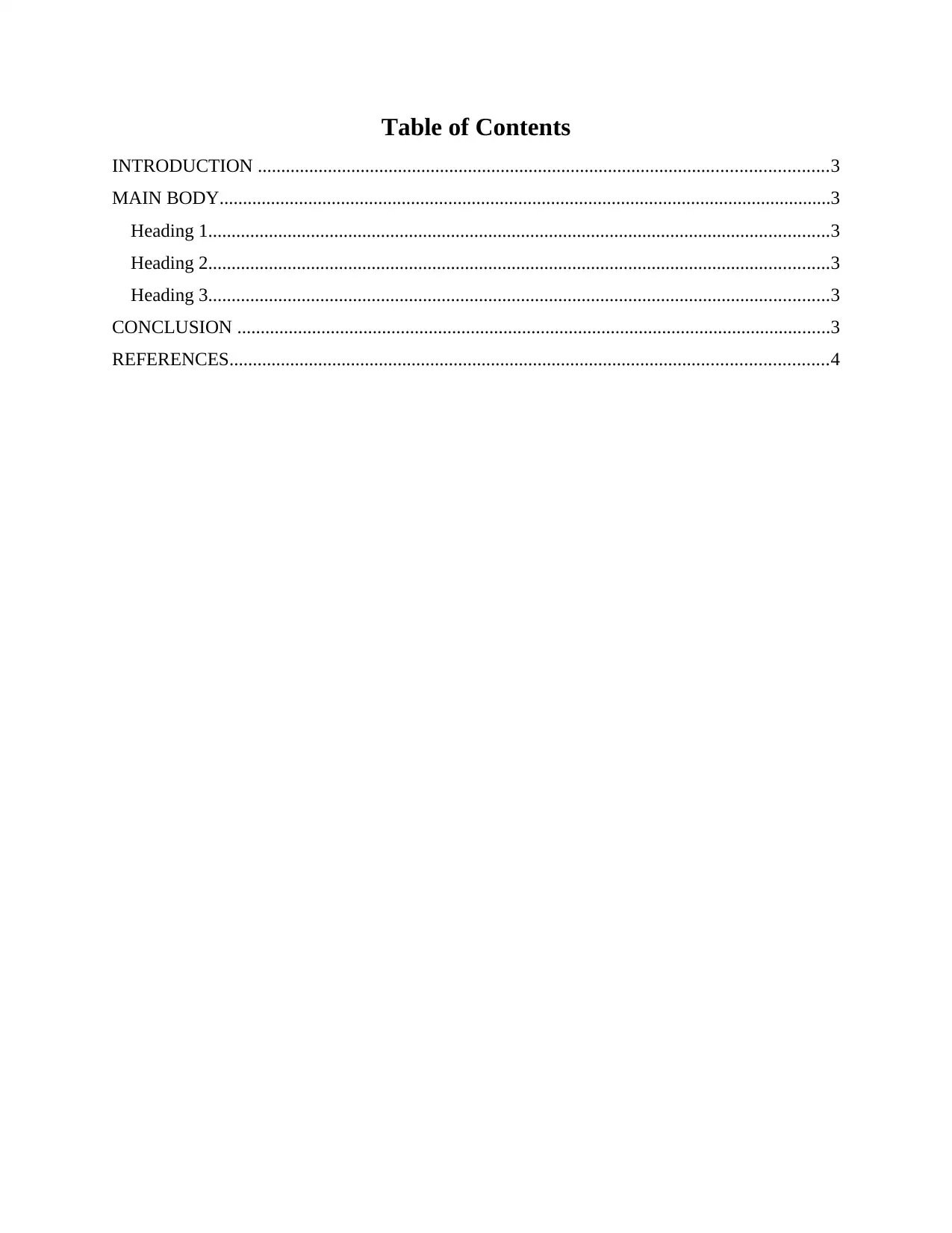
Table of Contents
INTRODUCTION ..........................................................................................................................3
MAIN BODY...................................................................................................................................3
Heading 1.....................................................................................................................................3
Heading 2.....................................................................................................................................3
Heading 3.....................................................................................................................................3
CONCLUSION ...............................................................................................................................3
REFERENCES................................................................................................................................4
INTRODUCTION ..........................................................................................................................3
MAIN BODY...................................................................................................................................3
Heading 1.....................................................................................................................................3
Heading 2.....................................................................................................................................3
Heading 3.....................................................................................................................................3
CONCLUSION ...............................................................................................................................3
REFERENCES................................................................................................................................4
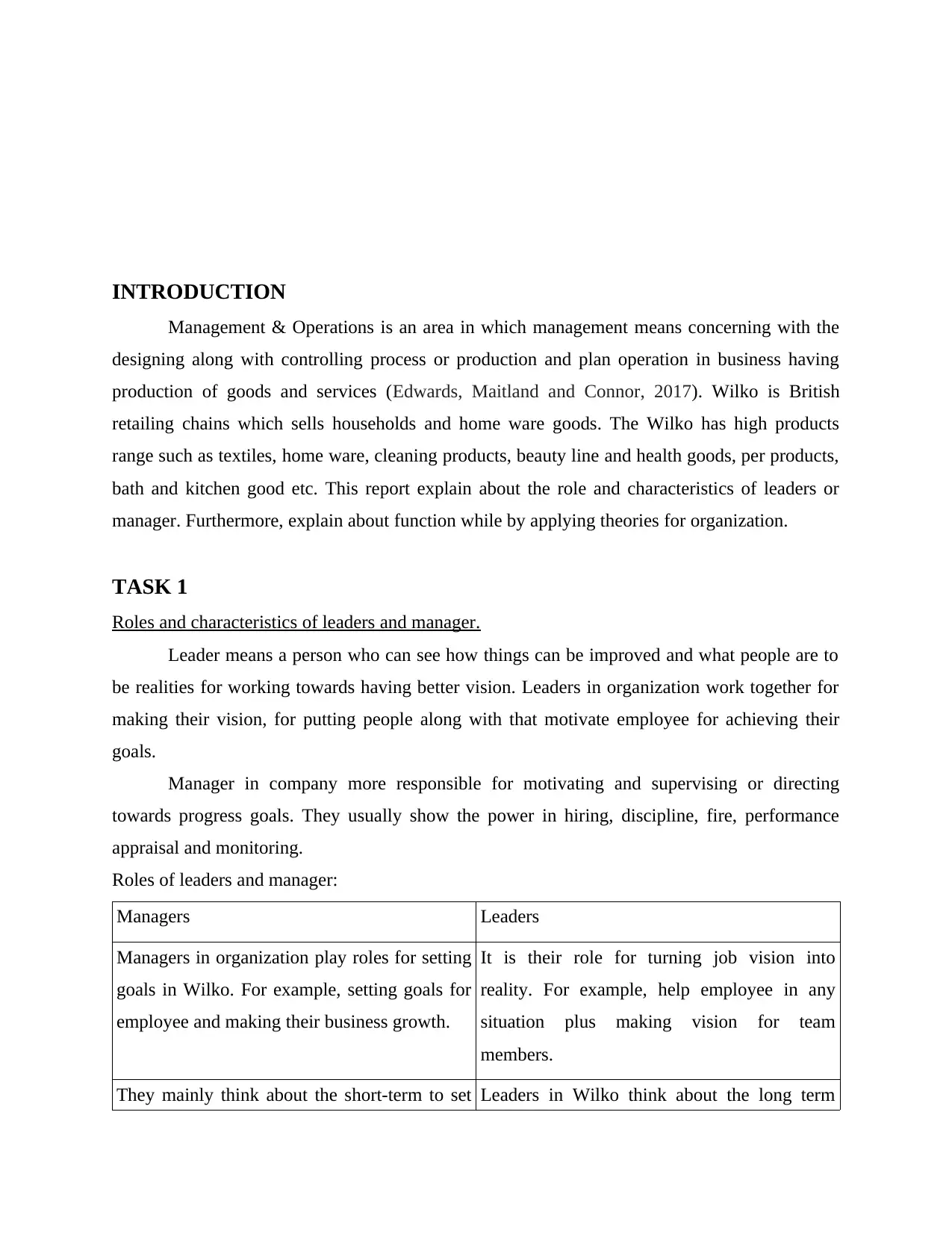
INTRODUCTION
Management & Operations is an area in which management means concerning with the
designing along with controlling process or production and plan operation in business having
production of goods and services (Edwards, Maitland and Connor, 2017). Wilko is British
retailing chains which sells households and home ware goods. The Wilko has high products
range such as textiles, home ware, cleaning products, beauty line and health goods, per products,
bath and kitchen good etc. This report explain about the role and characteristics of leaders or
manager. Furthermore, explain about function while by applying theories for organization.
TASK 1
Roles and characteristics of leaders and manager.
Leader means a person who can see how things can be improved and what people are to
be realities for working towards having better vision. Leaders in organization work together for
making their vision, for putting people along with that motivate employee for achieving their
goals.
Manager in company more responsible for motivating and supervising or directing
towards progress goals. They usually show the power in hiring, discipline, fire, performance
appraisal and monitoring.
Roles of leaders and manager:
Managers Leaders
Managers in organization play roles for setting
goals in Wilko. For example, setting goals for
employee and making their business growth.
It is their role for turning job vision into
reality. For example, help employee in any
situation plus making vision for team
members.
They mainly think about the short-term to set Leaders in Wilko think about the long term
Management & Operations is an area in which management means concerning with the
designing along with controlling process or production and plan operation in business having
production of goods and services (Edwards, Maitland and Connor, 2017). Wilko is British
retailing chains which sells households and home ware goods. The Wilko has high products
range such as textiles, home ware, cleaning products, beauty line and health goods, per products,
bath and kitchen good etc. This report explain about the role and characteristics of leaders or
manager. Furthermore, explain about function while by applying theories for organization.
TASK 1
Roles and characteristics of leaders and manager.
Leader means a person who can see how things can be improved and what people are to
be realities for working towards having better vision. Leaders in organization work together for
making their vision, for putting people along with that motivate employee for achieving their
goals.
Manager in company more responsible for motivating and supervising or directing
towards progress goals. They usually show the power in hiring, discipline, fire, performance
appraisal and monitoring.
Roles of leaders and manager:
Managers Leaders
Managers in organization play roles for setting
goals in Wilko. For example, setting goals for
employee and making their business growth.
It is their role for turning job vision into
reality. For example, help employee in any
situation plus making vision for team
members.
They mainly think about the short-term to set Leaders in Wilko think about the long term
⊘ This is a preview!⊘
Do you want full access?
Subscribe today to unlock all pages.

Trusted by 1+ million students worldwide
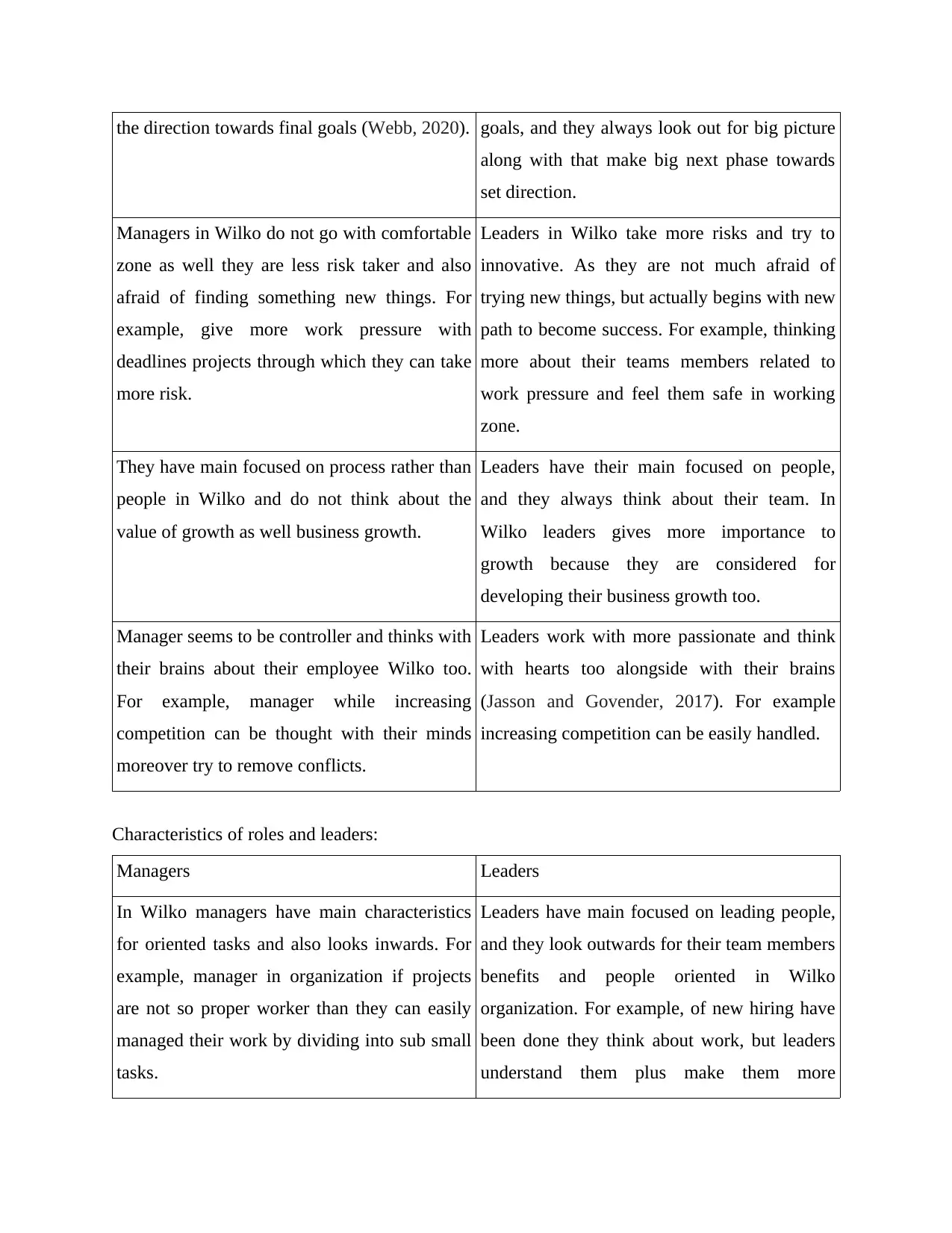
the direction towards final goals (Webb, 2020). goals, and they always look out for big picture
along with that make big next phase towards
set direction.
Managers in Wilko do not go with comfortable
zone as well they are less risk taker and also
afraid of finding something new things. For
example, give more work pressure with
deadlines projects through which they can take
more risk.
Leaders in Wilko take more risks and try to
innovative. As they are not much afraid of
trying new things, but actually begins with new
path to become success. For example, thinking
more about their teams members related to
work pressure and feel them safe in working
zone.
They have main focused on process rather than
people in Wilko and do not think about the
value of growth as well business growth.
Leaders have their main focused on people,
and they always think about their team. In
Wilko leaders gives more importance to
growth because they are considered for
developing their business growth too.
Manager seems to be controller and thinks with
their brains about their employee Wilko too.
For example, manager while increasing
competition can be thought with their minds
moreover try to remove conflicts.
Leaders work with more passionate and think
with hearts too alongside with their brains
(Jasson and Govender, 2017). For example
increasing competition can be easily handled.
Characteristics of roles and leaders:
Managers Leaders
In Wilko managers have main characteristics
for oriented tasks and also looks inwards. For
example, manager in organization if projects
are not so proper worker than they can easily
managed their work by dividing into sub small
tasks.
Leaders have main focused on leading people,
and they look outwards for their team members
benefits and people oriented in Wilko
organization. For example, of new hiring have
been done they think about work, but leaders
understand them plus make them more
along with that make big next phase towards
set direction.
Managers in Wilko do not go with comfortable
zone as well they are less risk taker and also
afraid of finding something new things. For
example, give more work pressure with
deadlines projects through which they can take
more risk.
Leaders in Wilko take more risks and try to
innovative. As they are not much afraid of
trying new things, but actually begins with new
path to become success. For example, thinking
more about their teams members related to
work pressure and feel them safe in working
zone.
They have main focused on process rather than
people in Wilko and do not think about the
value of growth as well business growth.
Leaders have their main focused on people,
and they always think about their team. In
Wilko leaders gives more importance to
growth because they are considered for
developing their business growth too.
Manager seems to be controller and thinks with
their brains about their employee Wilko too.
For example, manager while increasing
competition can be thought with their minds
moreover try to remove conflicts.
Leaders work with more passionate and think
with hearts too alongside with their brains
(Jasson and Govender, 2017). For example
increasing competition can be easily handled.
Characteristics of roles and leaders:
Managers Leaders
In Wilko managers have main characteristics
for oriented tasks and also looks inwards. For
example, manager in organization if projects
are not so proper worker than they can easily
managed their work by dividing into sub small
tasks.
Leaders have main focused on leading people,
and they look outwards for their team members
benefits and people oriented in Wilko
organization. For example, of new hiring have
been done they think about work, but leaders
understand them plus make them more
Paraphrase This Document
Need a fresh take? Get an instant paraphrase of this document with our AI Paraphraser
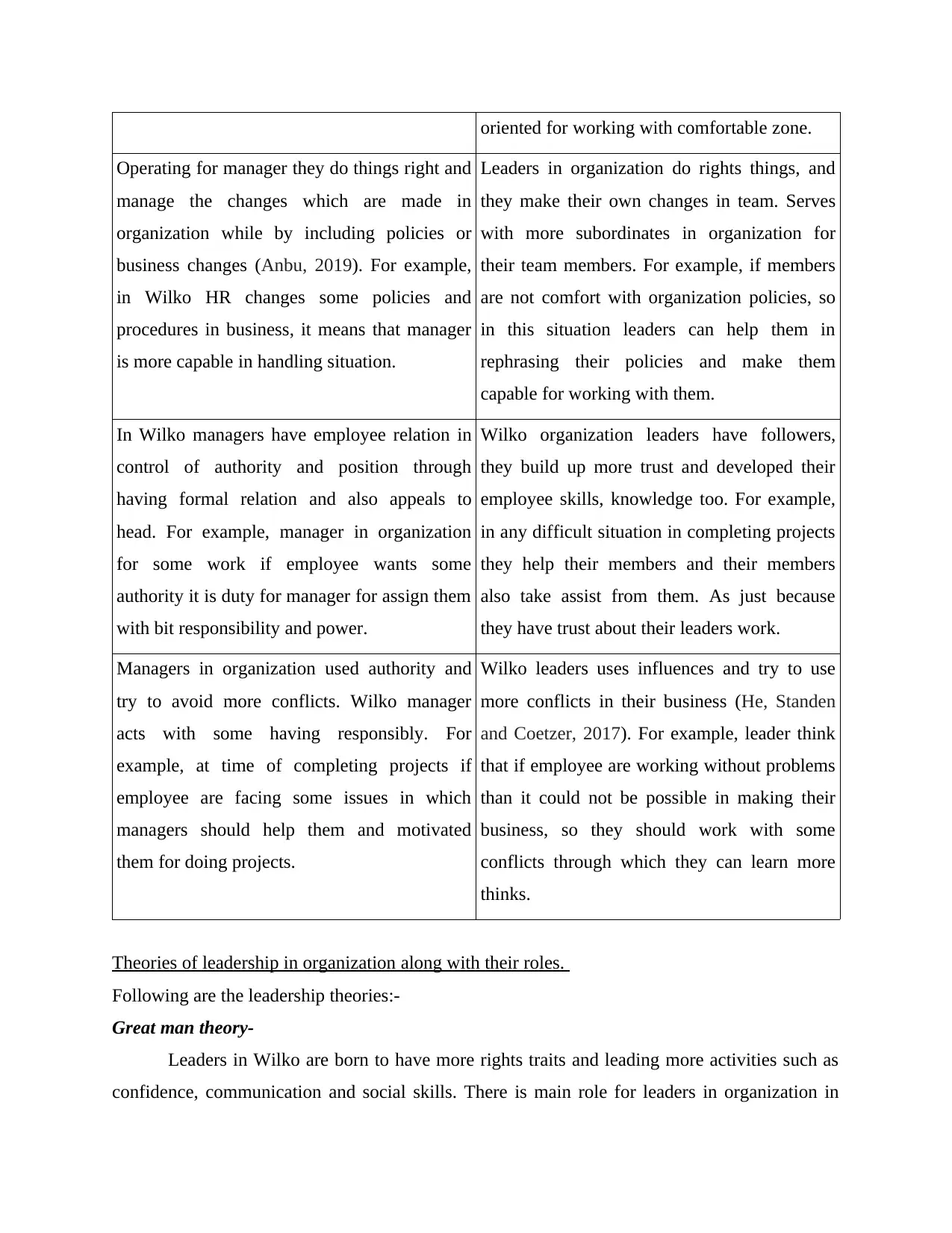
oriented for working with comfortable zone.
Operating for manager they do things right and
manage the changes which are made in
organization while by including policies or
business changes (Anbu, 2019). For example,
in Wilko HR changes some policies and
procedures in business, it means that manager
is more capable in handling situation.
Leaders in organization do rights things, and
they make their own changes in team. Serves
with more subordinates in organization for
their team members. For example, if members
are not comfort with organization policies, so
in this situation leaders can help them in
rephrasing their policies and make them
capable for working with them.
In Wilko managers have employee relation in
control of authority and position through
having formal relation and also appeals to
head. For example, manager in organization
for some work if employee wants some
authority it is duty for manager for assign them
with bit responsibility and power.
Wilko organization leaders have followers,
they build up more trust and developed their
employee skills, knowledge too. For example,
in any difficult situation in completing projects
they help their members and their members
also take assist from them. As just because
they have trust about their leaders work.
Managers in organization used authority and
try to avoid more conflicts. Wilko manager
acts with some having responsibly. For
example, at time of completing projects if
employee are facing some issues in which
managers should help them and motivated
them for doing projects.
Wilko leaders uses influences and try to use
more conflicts in their business (He, Standen
and Coetzer, 2017). For example, leader think
that if employee are working without problems
than it could not be possible in making their
business, so they should work with some
conflicts through which they can learn more
thinks.
Theories of leadership in organization along with their roles.
Following are the leadership theories:-
Great man theory-
Leaders in Wilko are born to have more rights traits and leading more activities such as
confidence, communication and social skills. There is main role for leaders in organization in
Operating for manager they do things right and
manage the changes which are made in
organization while by including policies or
business changes (Anbu, 2019). For example,
in Wilko HR changes some policies and
procedures in business, it means that manager
is more capable in handling situation.
Leaders in organization do rights things, and
they make their own changes in team. Serves
with more subordinates in organization for
their team members. For example, if members
are not comfort with organization policies, so
in this situation leaders can help them in
rephrasing their policies and make them
capable for working with them.
In Wilko managers have employee relation in
control of authority and position through
having formal relation and also appeals to
head. For example, manager in organization
for some work if employee wants some
authority it is duty for manager for assign them
with bit responsibility and power.
Wilko organization leaders have followers,
they build up more trust and developed their
employee skills, knowledge too. For example,
in any difficult situation in completing projects
they help their members and their members
also take assist from them. As just because
they have trust about their leaders work.
Managers in organization used authority and
try to avoid more conflicts. Wilko manager
acts with some having responsibly. For
example, at time of completing projects if
employee are facing some issues in which
managers should help them and motivated
them for doing projects.
Wilko leaders uses influences and try to use
more conflicts in their business (He, Standen
and Coetzer, 2017). For example, leader think
that if employee are working without problems
than it could not be possible in making their
business, so they should work with some
conflicts through which they can learn more
thinks.
Theories of leadership in organization along with their roles.
Following are the leadership theories:-
Great man theory-
Leaders in Wilko are born to have more rights traits and leading more activities such as
confidence, communication and social skills. There is main role for leaders in organization in
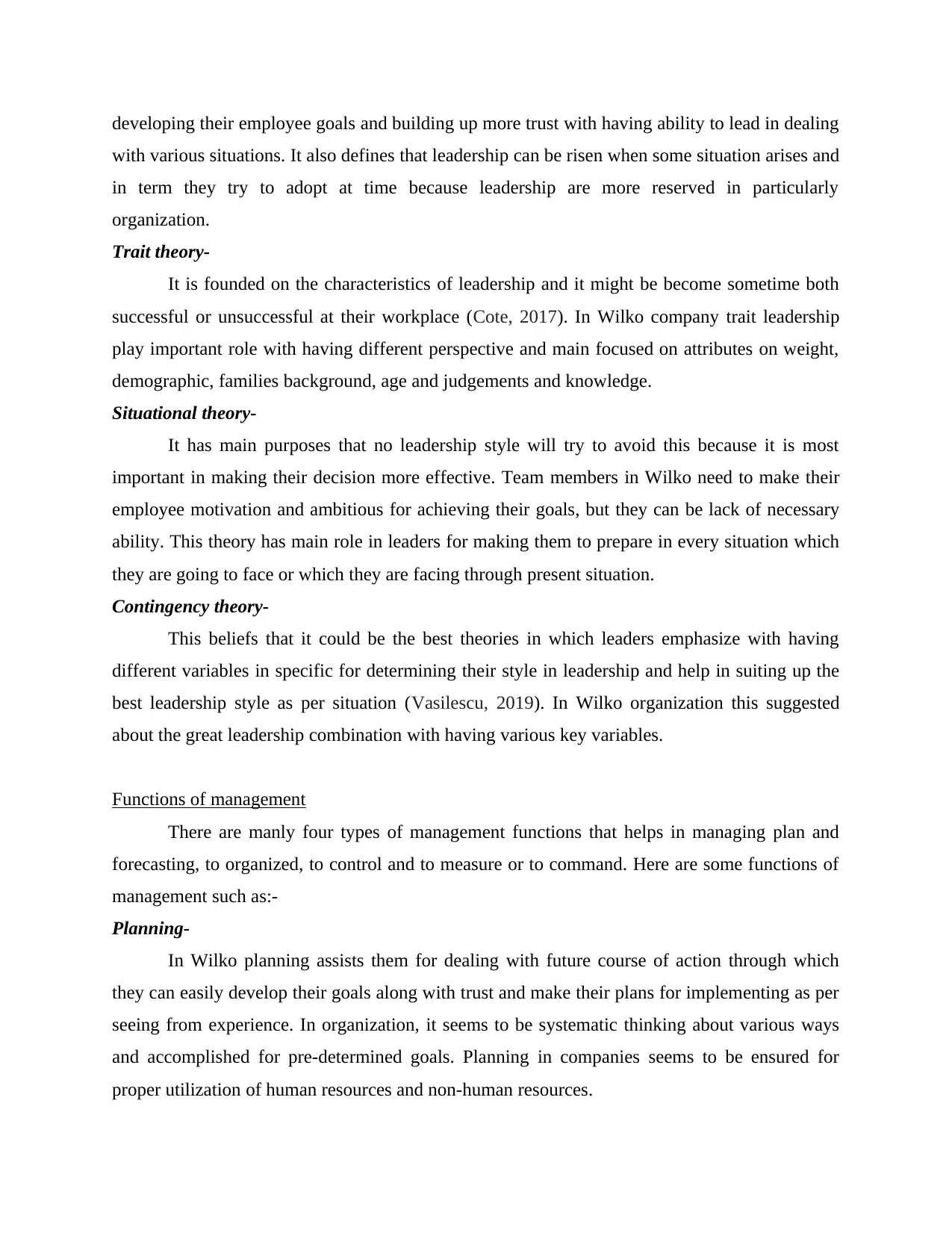
developing their employee goals and building up more trust with having ability to lead in dealing
with various situations. It also defines that leadership can be risen when some situation arises and
in term they try to adopt at time because leadership are more reserved in particularly
organization.
Trait theory-
It is founded on the characteristics of leadership and it might be become sometime both
successful or unsuccessful at their workplace (Cote, 2017). In Wilko company trait leadership
play important role with having different perspective and main focused on attributes on weight,
demographic, families background, age and judgements and knowledge.
Situational theory-
It has main purposes that no leadership style will try to avoid this because it is most
important in making their decision more effective. Team members in Wilko need to make their
employee motivation and ambitious for achieving their goals, but they can be lack of necessary
ability. This theory has main role in leaders for making them to prepare in every situation which
they are going to face or which they are facing through present situation.
Contingency theory-
This beliefs that it could be the best theories in which leaders emphasize with having
different variables in specific for determining their style in leadership and help in suiting up the
best leadership style as per situation (Vasilescu, 2019). In Wilko organization this suggested
about the great leadership combination with having various key variables.
Functions of management
There are manly four types of management functions that helps in managing plan and
forecasting, to organized, to control and to measure or to command. Here are some functions of
management such as:-
Planning-
In Wilko planning assists them for dealing with future course of action through which
they can easily develop their goals along with trust and make their plans for implementing as per
seeing from experience. In organization, it seems to be systematic thinking about various ways
and accomplished for pre-determined goals. Planning in companies seems to be ensured for
proper utilization of human resources and non-human resources.
with various situations. It also defines that leadership can be risen when some situation arises and
in term they try to adopt at time because leadership are more reserved in particularly
organization.
Trait theory-
It is founded on the characteristics of leadership and it might be become sometime both
successful or unsuccessful at their workplace (Cote, 2017). In Wilko company trait leadership
play important role with having different perspective and main focused on attributes on weight,
demographic, families background, age and judgements and knowledge.
Situational theory-
It has main purposes that no leadership style will try to avoid this because it is most
important in making their decision more effective. Team members in Wilko need to make their
employee motivation and ambitious for achieving their goals, but they can be lack of necessary
ability. This theory has main role in leaders for making them to prepare in every situation which
they are going to face or which they are facing through present situation.
Contingency theory-
This beliefs that it could be the best theories in which leaders emphasize with having
different variables in specific for determining their style in leadership and help in suiting up the
best leadership style as per situation (Vasilescu, 2019). In Wilko organization this suggested
about the great leadership combination with having various key variables.
Functions of management
There are manly four types of management functions that helps in managing plan and
forecasting, to organized, to control and to measure or to command. Here are some functions of
management such as:-
Planning-
In Wilko planning assists them for dealing with future course of action through which
they can easily develop their goals along with trust and make their plans for implementing as per
seeing from experience. In organization, it seems to be systematic thinking about various ways
and accomplished for pre-determined goals. Planning in companies seems to be ensured for
proper utilization of human resources and non-human resources.
⊘ This is a preview!⊘
Do you want full access?
Subscribe today to unlock all pages.
Trusted by 1+ million students worldwide
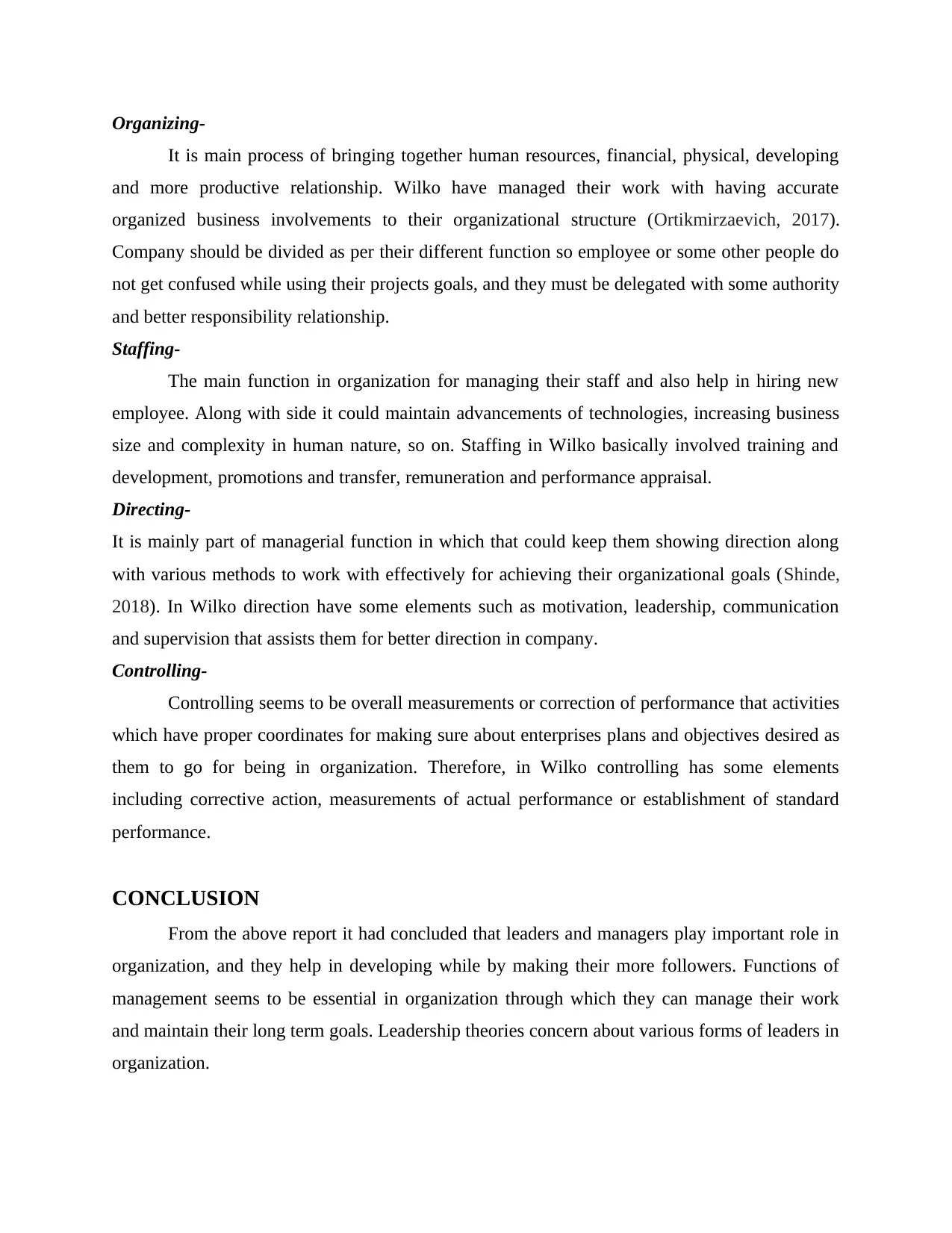
Organizing-
It is main process of bringing together human resources, financial, physical, developing
and more productive relationship. Wilko have managed their work with having accurate
organized business involvements to their organizational structure (Ortikmirzaevich, 2017).
Company should be divided as per their different function so employee or some other people do
not get confused while using their projects goals, and they must be delegated with some authority
and better responsibility relationship.
Staffing-
The main function in organization for managing their staff and also help in hiring new
employee. Along with side it could maintain advancements of technologies, increasing business
size and complexity in human nature, so on. Staffing in Wilko basically involved training and
development, promotions and transfer, remuneration and performance appraisal.
Directing-
It is mainly part of managerial function in which that could keep them showing direction along
with various methods to work with effectively for achieving their organizational goals (Shinde,
2018). In Wilko direction have some elements such as motivation, leadership, communication
and supervision that assists them for better direction in company.
Controlling-
Controlling seems to be overall measurements or correction of performance that activities
which have proper coordinates for making sure about enterprises plans and objectives desired as
them to go for being in organization. Therefore, in Wilko controlling has some elements
including corrective action, measurements of actual performance or establishment of standard
performance.
CONCLUSION
From the above report it had concluded that leaders and managers play important role in
organization, and they help in developing while by making their more followers. Functions of
management seems to be essential in organization through which they can manage their work
and maintain their long term goals. Leadership theories concern about various forms of leaders in
organization.
It is main process of bringing together human resources, financial, physical, developing
and more productive relationship. Wilko have managed their work with having accurate
organized business involvements to their organizational structure (Ortikmirzaevich, 2017).
Company should be divided as per their different function so employee or some other people do
not get confused while using their projects goals, and they must be delegated with some authority
and better responsibility relationship.
Staffing-
The main function in organization for managing their staff and also help in hiring new
employee. Along with side it could maintain advancements of technologies, increasing business
size and complexity in human nature, so on. Staffing in Wilko basically involved training and
development, promotions and transfer, remuneration and performance appraisal.
Directing-
It is mainly part of managerial function in which that could keep them showing direction along
with various methods to work with effectively for achieving their organizational goals (Shinde,
2018). In Wilko direction have some elements such as motivation, leadership, communication
and supervision that assists them for better direction in company.
Controlling-
Controlling seems to be overall measurements or correction of performance that activities
which have proper coordinates for making sure about enterprises plans and objectives desired as
them to go for being in organization. Therefore, in Wilko controlling has some elements
including corrective action, measurements of actual performance or establishment of standard
performance.
CONCLUSION
From the above report it had concluded that leaders and managers play important role in
organization, and they help in developing while by making their more followers. Functions of
management seems to be essential in organization through which they can manage their work
and maintain their long term goals. Leadership theories concern about various forms of leaders in
organization.
Paraphrase This Document
Need a fresh take? Get an instant paraphrase of this document with our AI Paraphraser

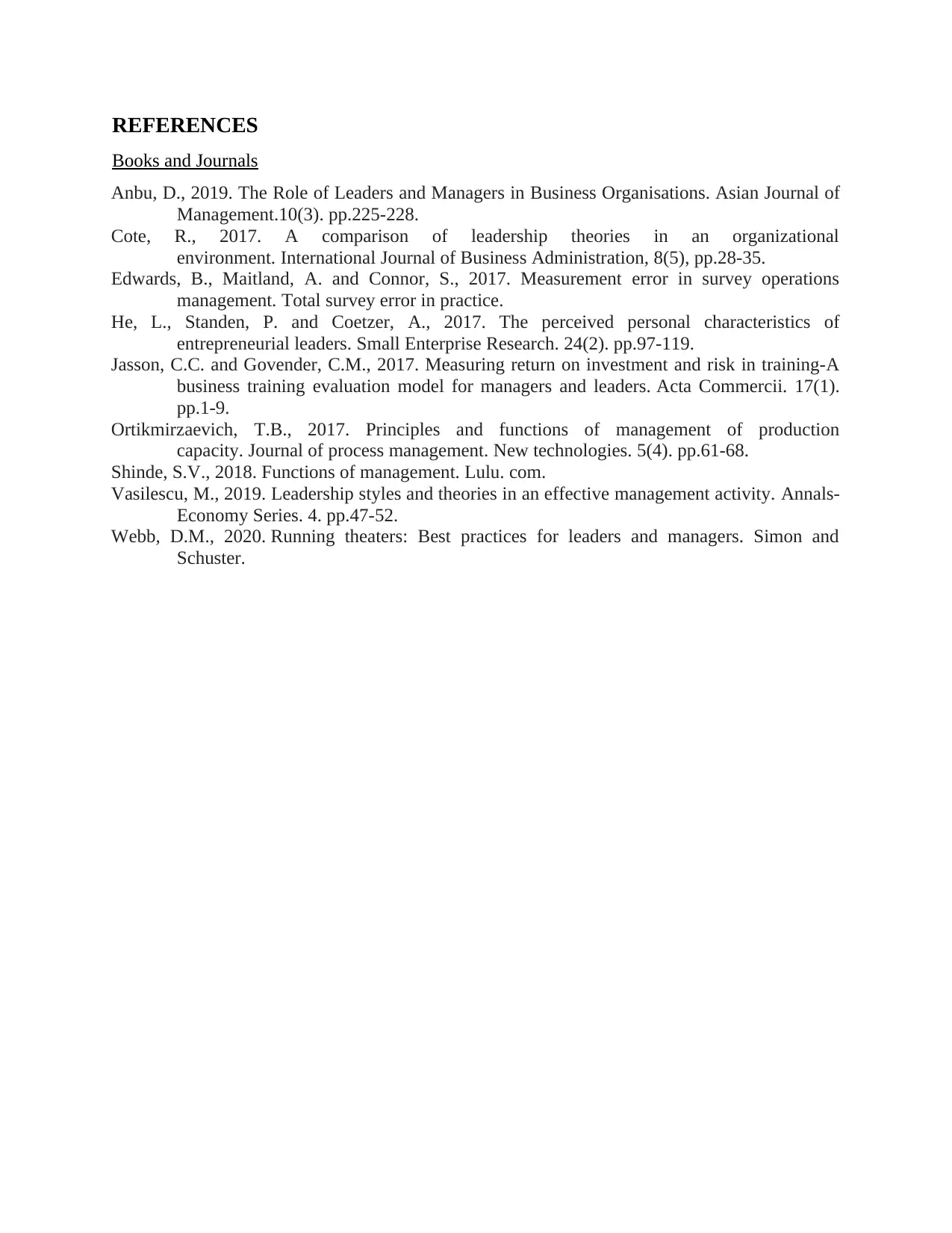
REFERENCES
Books and Journals
Anbu, D., 2019. The Role of Leaders and Managers in Business Organisations. Asian Journal of
Management.10(3). pp.225-228.
Cote, R., 2017. A comparison of leadership theories in an organizational
environment. International Journal of Business Administration, 8(5), pp.28-35.
Edwards, B., Maitland, A. and Connor, S., 2017. Measurement error in survey operations
management. Total survey error in practice.
He, L., Standen, P. and Coetzer, A., 2017. The perceived personal characteristics of
entrepreneurial leaders. Small Enterprise Research. 24(2). pp.97-119.
Jasson, C.C. and Govender, C.M., 2017. Measuring return on investment and risk in training-A
business training evaluation model for managers and leaders. Acta Commercii. 17(1).
pp.1-9.
Ortikmirzaevich, T.B., 2017. Principles and functions of management of production
capacity. Journal of process management. New technologies. 5(4). pp.61-68.
Shinde, S.V., 2018. Functions of management. Lulu. com.
Vasilescu, M., 2019. Leadership styles and theories in an effective management activity. Annals-
Economy Series. 4. pp.47-52.
Webb, D.M., 2020. Running theaters: Best practices for leaders and managers. Simon and
Schuster.
Books and Journals
Anbu, D., 2019. The Role of Leaders and Managers in Business Organisations. Asian Journal of
Management.10(3). pp.225-228.
Cote, R., 2017. A comparison of leadership theories in an organizational
environment. International Journal of Business Administration, 8(5), pp.28-35.
Edwards, B., Maitland, A. and Connor, S., 2017. Measurement error in survey operations
management. Total survey error in practice.
He, L., Standen, P. and Coetzer, A., 2017. The perceived personal characteristics of
entrepreneurial leaders. Small Enterprise Research. 24(2). pp.97-119.
Jasson, C.C. and Govender, C.M., 2017. Measuring return on investment and risk in training-A
business training evaluation model for managers and leaders. Acta Commercii. 17(1).
pp.1-9.
Ortikmirzaevich, T.B., 2017. Principles and functions of management of production
capacity. Journal of process management. New technologies. 5(4). pp.61-68.
Shinde, S.V., 2018. Functions of management. Lulu. com.
Vasilescu, M., 2019. Leadership styles and theories in an effective management activity. Annals-
Economy Series. 4. pp.47-52.
Webb, D.M., 2020. Running theaters: Best practices for leaders and managers. Simon and
Schuster.
⊘ This is a preview!⊘
Do you want full access?
Subscribe today to unlock all pages.
Trusted by 1+ million students worldwide

1 out of 9


Related Documents


Your All-in-One AI-Powered Toolkit for Academic Success.
+13062052269
info@desklib.com
Available 24*7 on WhatsApp / Email
![[object Object]](/_next/static/media/star-bottom.7253800d.svg)
Unlock your academic potential
Copyright © 2020–2026 A2Z Services. All Rights Reserved. Developed and managed by ZUCOL.