Management Styles, Leadership, and Unilever: An Essay Analysis
VerifiedAdded on 2023/02/02
|14
|4661
|76
Essay
AI Summary
This essay delves into the realm of management practices, exploring various styles and their application within the context of Unilever, a prominent British transnational company. The introduction sets the stage by defining management practices as techniques aimed at enhancing company productivity, highlighting the significance of job design, training, and incentives. The essay then proceeds to examine the role of middle managers, emphasizing their functions in human resource management, accounting, R&D, marketing, and manufacturing. It underscores the challenges posed by a dynamic business environment and the importance of middle managers in adapting to changing customer demands and technological advancements. The essay further investigates the interrelation of leadership styles and organizational culture within Unilever, exploring how leadership approaches reinforce the improvement and development of effective organizational culture and how middle managers develop high leadership quality for monitoring and evaluations the performance in regular manner. The essay also discusses the role of managerial skills and the three mandatory skills (conceptual, human relations, and technical skills) for middle managers. Finally, the essay highlights the importance of middle managers in removing or reducing the complexity of work and the load from individuals working for the company to achieve different goals and objectives.
Management
Style
Style

Paraphrase This Document
Need a fresh take? Get an instant paraphrase of this document with our AI Paraphraser
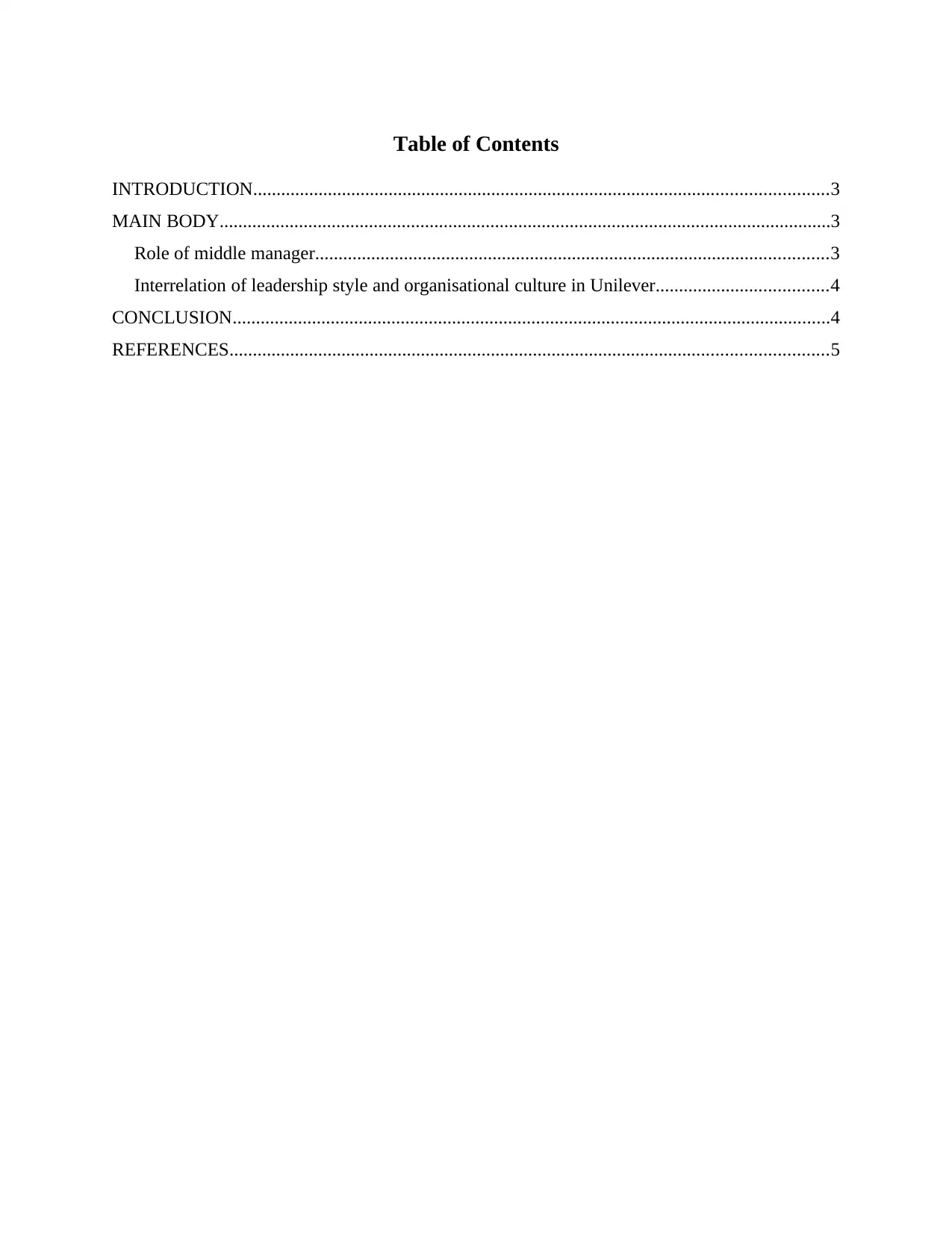
Table of Contents
INTRODUCTION...........................................................................................................................3
MAIN BODY...................................................................................................................................3
Role of middle manager..............................................................................................................3
Interrelation of leadership style and organisational culture in Unilever.....................................4
CONCLUSION................................................................................................................................4
REFERENCES................................................................................................................................5
INTRODUCTION...........................................................................................................................3
MAIN BODY...................................................................................................................................3
Role of middle manager..............................................................................................................3
Interrelation of leadership style and organisational culture in Unilever.....................................4
CONCLUSION................................................................................................................................4
REFERENCES................................................................................................................................5
INTRODUCTION
Management practices can be defined as techniques to improve and enhance productivity of
a company. Design job employment, training procedures, economic incentives, provide
meaningful feedback and more, are such cornerstone of management practices. These would help
in developing tendency of company to gain more profitability and attain high achievements
(Pines and et.al., 2012). The present project is going to make a discussion on different
management style, which are used to resolve a number of situations in a business. For this
purpose, Unilever is taken, which is British transitional company and headquartered in London,
UK. It sells many branded products of consumer goods in more than 190 countries, including
own 400 brands.
To achieve higher competitive advantages, its managers implement various policies to run
business in international market (Brierley and Fryirs, 2013). Here, for enhancing productivity of
business, different role of middle managers and skills require to perform the same are escribed in
this essay. Furthermore, discussion of different leadership style and its link with organisational
culture also made. As the main role of management practices is to achieve higher outcomes in
complex situation. Therefore, range of skills require to accomplish business objectives and
handle situations, a range of managerial skills are also highlighted.
MAIN BODY
Role of middle manager
Middle managers in a company play an important role in managing and performing every
function of business, in best manner. They deal with developing effective goal setting and
concerning on level of decision making of each department, to ensure success of business. The
five typical functions in middle managers are mostly enrolled with are- Human resource
management, Accounting, R&D, Marketing and Manufacturing. Here, to perform each function
in desired way, they provide proper guidance to lower managers how to carry out activities
(Shearer, 2012). They also provide information to each department about what the strategy is and
track progress accordingly. As today in both international and domestic market, competition has
Management practices can be defined as techniques to improve and enhance productivity of
a company. Design job employment, training procedures, economic incentives, provide
meaningful feedback and more, are such cornerstone of management practices. These would help
in developing tendency of company to gain more profitability and attain high achievements
(Pines and et.al., 2012). The present project is going to make a discussion on different
management style, which are used to resolve a number of situations in a business. For this
purpose, Unilever is taken, which is British transitional company and headquartered in London,
UK. It sells many branded products of consumer goods in more than 190 countries, including
own 400 brands.
To achieve higher competitive advantages, its managers implement various policies to run
business in international market (Brierley and Fryirs, 2013). Here, for enhancing productivity of
business, different role of middle managers and skills require to perform the same are escribed in
this essay. Furthermore, discussion of different leadership style and its link with organisational
culture also made. As the main role of management practices is to achieve higher outcomes in
complex situation. Therefore, range of skills require to accomplish business objectives and
handle situations, a range of managerial skills are also highlighted.
MAIN BODY
Role of middle manager
Middle managers in a company play an important role in managing and performing every
function of business, in best manner. They deal with developing effective goal setting and
concerning on level of decision making of each department, to ensure success of business. The
five typical functions in middle managers are mostly enrolled with are- Human resource
management, Accounting, R&D, Marketing and Manufacturing. Here, to perform each function
in desired way, they provide proper guidance to lower managers how to carry out activities
(Shearer, 2012). They also provide information to each department about what the strategy is and
track progress accordingly. As today in both international and domestic market, competition has
⊘ This is a preview!⊘
Do you want full access?
Subscribe today to unlock all pages.

Trusted by 1+ million students worldwide
raised continuously therefore, it creates various challenges and risk for organisation to run
activities efficiently. It includes changing demand of customers to get more innovative services,
emergence of new technologies, rise of competition and more. Therefore, to cope up from such
challenges, it is foremost duty of middle managers to line up business as per dynamic
environment. Here, to gain competitive advantages in both market, mostly 75% companies fails,
due to less support of workers (Hickson and Pugh, 2014). In this regard, it is foremost duty of
managers to develop strategies to gain high commitment of employees to perform at their level
of best. For this purpose, they implement various management practices to increase productivity
of workers and develop job satisfaction in them as well. It includes stress and time management,
design training and incentive schemes, create positive environment to adopt changes in business
etc.
Here, to reduce stress and workload pressure, middle managers line up with top
management to introduce more workers in business. Further, they allot different roles and
responsibilities by determining capabilities and abilities of each worker also. This would help in
ensuring that each activity will complete in desired manner (Anjum, Karim and Bibi, 2014).
Along with this, to resolve complex situations like conflicts, resistivity of workers to work with
new techniques, reduce labour turnover and more, middle managers in an organisation adopt
different style of management. For example, conflict resolution can be approached in various
manners like middle manager can make certain decisions either by including participation of
workers or staying them away for the same. Similarly, they can also act as mediator to bring
employees together and develop collaboration among them. Here, each approach used to handle
an adequate number of complex situation, is totally dependent on managerial tactics and
management style of middle managers as well as the employees, whom they are working with.
As there is no one approach fits for dealing with different-different problems. Therefore,
managers need to adopt various management styles by determining how workers will respond to
them (Khakimova, Zhang and Hall, 2012). This would make such managers more effective
leaders and influence employees to follow their strategies as well. In this regard, management
styles can be defined as a method of leadership to resolve an issue and get contribution of
workers in achievement of business goals and objectives successfully (Cerni, Curtis and Colmar,
2014). It includes democratic, autocratic, laiseez-faire management styles where each style has
certain advantage to resolve an issue.
activities efficiently. It includes changing demand of customers to get more innovative services,
emergence of new technologies, rise of competition and more. Therefore, to cope up from such
challenges, it is foremost duty of middle managers to line up business as per dynamic
environment. Here, to gain competitive advantages in both market, mostly 75% companies fails,
due to less support of workers (Hickson and Pugh, 2014). In this regard, it is foremost duty of
managers to develop strategies to gain high commitment of employees to perform at their level
of best. For this purpose, they implement various management practices to increase productivity
of workers and develop job satisfaction in them as well. It includes stress and time management,
design training and incentive schemes, create positive environment to adopt changes in business
etc.
Here, to reduce stress and workload pressure, middle managers line up with top
management to introduce more workers in business. Further, they allot different roles and
responsibilities by determining capabilities and abilities of each worker also. This would help in
ensuring that each activity will complete in desired manner (Anjum, Karim and Bibi, 2014).
Along with this, to resolve complex situations like conflicts, resistivity of workers to work with
new techniques, reduce labour turnover and more, middle managers in an organisation adopt
different style of management. For example, conflict resolution can be approached in various
manners like middle manager can make certain decisions either by including participation of
workers or staying them away for the same. Similarly, they can also act as mediator to bring
employees together and develop collaboration among them. Here, each approach used to handle
an adequate number of complex situation, is totally dependent on managerial tactics and
management style of middle managers as well as the employees, whom they are working with.
As there is no one approach fits for dealing with different-different problems. Therefore,
managers need to adopt various management styles by determining how workers will respond to
them (Khakimova, Zhang and Hall, 2012). This would make such managers more effective
leaders and influence employees to follow their strategies as well. In this regard, management
styles can be defined as a method of leadership to resolve an issue and get contribution of
workers in achievement of business goals and objectives successfully (Cerni, Curtis and Colmar,
2014). It includes democratic, autocratic, laiseez-faire management styles where each style has
certain advantage to resolve an issue.
Paraphrase This Document
Need a fresh take? Get an instant paraphrase of this document with our AI Paraphraser
Democratic style leads to include participation of each worker in decision making process,
where they get chance to share views for increasing productivity of business. While autocratic
style is characterised in terms of individuals’ control on decision making process. It typically
takes actions as per business requirements and forced workers to accept changes for higher
achievements. Although this style sounds negative but it helps in making quick decisions for
enhancing profitability of business (Reio and Trudel, 2013). Other than this, Laissez-faire style is
considered as the most delegative style, where every employee is allowed to make decisions to
complete their assign roles in own manner. Thus, to perform different roles and responsibilities,
middle managers adopt a number of management styles. For example, for being a proficient
communicator and influencing each workers towards achievement of common goal, they adopt
democratic style of leadership. While to develop core competencies, it is better to adopt the
concept of autocratic management style (Dupuis, 2014). All these styles help middle manager in
becoming a perfect and effective leader, who can influence employees to give higher
contribution in achievement of business objectives.
Interrelation of leadership style and organisational culture in Unilever
Due to higher presence of competitors both in domestic and global market, business
environment of organisations has become more dynamic (Choi, 2013). It assists companies to
make changes in business, organisational culture, leadership and management styles etc. as per
demand of business. Therefore, to ascertain such changes, middle managers play effective role.
They take responsibilities like development of core competencies, improvement of productivity,
maximise performance potential, facilitating knowledge sharing and more. This would help in
operating and managing functions more appropriately. In context with Unilever, it is considered
as one of the largest consumer products companies in international market, which sales every
brands range from shampoo to washing powder (Dung and Florea, 2012). This company deals in
retail sectors in UK and operates business in more than 60 countries worldwide. In terms of
leadership and management, it is a very well organized company also which give advantage to
gain support of every associated people in running business successfully. Currently, approximate
179,000 workers are working in its organisation and all are much talented to give best services to
customers. Therefore, considering the scope and size of business, it is essential for top and
middle management to operate business in a well-defined and organised framework. For this
purpose, they have implement corporate business structure in order to develop a balance between
where they get chance to share views for increasing productivity of business. While autocratic
style is characterised in terms of individuals’ control on decision making process. It typically
takes actions as per business requirements and forced workers to accept changes for higher
achievements. Although this style sounds negative but it helps in making quick decisions for
enhancing profitability of business (Reio and Trudel, 2013). Other than this, Laissez-faire style is
considered as the most delegative style, where every employee is allowed to make decisions to
complete their assign roles in own manner. Thus, to perform different roles and responsibilities,
middle managers adopt a number of management styles. For example, for being a proficient
communicator and influencing each workers towards achievement of common goal, they adopt
democratic style of leadership. While to develop core competencies, it is better to adopt the
concept of autocratic management style (Dupuis, 2014). All these styles help middle manager in
becoming a perfect and effective leader, who can influence employees to give higher
contribution in achievement of business objectives.
Interrelation of leadership style and organisational culture in Unilever
Due to higher presence of competitors both in domestic and global market, business
environment of organisations has become more dynamic (Choi, 2013). It assists companies to
make changes in business, organisational culture, leadership and management styles etc. as per
demand of business. Therefore, to ascertain such changes, middle managers play effective role.
They take responsibilities like development of core competencies, improvement of productivity,
maximise performance potential, facilitating knowledge sharing and more. This would help in
operating and managing functions more appropriately. In context with Unilever, it is considered
as one of the largest consumer products companies in international market, which sales every
brands range from shampoo to washing powder (Dung and Florea, 2012). This company deals in
retail sectors in UK and operates business in more than 60 countries worldwide. In terms of
leadership and management, it is a very well organized company also which give advantage to
gain support of every associated people in running business successfully. Currently, approximate
179,000 workers are working in its organisation and all are much talented to give best services to
customers. Therefore, considering the scope and size of business, it is essential for top and
middle management to operate business in a well-defined and organised framework. For this
purpose, they have implement corporate business structure in order to develop a balance between
organisational flexibility and governance (Boykins and et.al., 2013). Therefore, to inform
workers how they have to work on and give best performances, middle managers collaborate
with top management to develop effective organisational culture.
Organisational Culture can be defined as collection of certain values and norms which are
shared by large number of people and groups, who are associated with an organization. It
controls the ways in which employees within business premises interact with each other as well
as make conversation with company’s stakeholders outside the organisation (Mao and Hale,
2015). In big companies, organisational culture is mostly complex in nature and affected by
various of factors. It includes multi-culture or cross culture environment in business, which
mostly arise when a company operate its business across territorial boundaries. With this regard,
organisational culture of Unilever is derived from cross culture environment due to enrolment of
various workers of other countries within business (Ji, 2012). This culture is mainly emphasized
on enhancing performance both on individual and organisational basis, develop quality of
outputs, efficient work through implementation of latest techniques. As employees belong to
different-different background and have linguistic issues therefore, to influence them to work in
collaboration for achievement of growth and success of business, is really a tough task for
middle managers. For this purpose, they adopt different leadership styles to resolve complexities
of business and influence workers to work as per organisational culture.
Success of business of any company is normally based on the ability of leaders who
influence workers to give to support for developing a culture of high performance and better
quality. Here, middle managers of Unilever use market-based as well as results-based approaches
for managing the business and driving performance of business. In this regard, market-based
management approach takes market based information like new trends, to make changes in
management tactics accordingly. While other than this, results-based management approach
concerns on achievement of higher outcomes in efficient manner. Therefore, these tactics used
by middle managers of Unilever facilitate them in developing workers’ productivity and
enhancing organizational performance in terms of consumer goods business more appropriately.
Henceforth, it has evaluated that leadership and managements styles both links to maintains the
organizational culture of Unilever in best manner.
Leadership approaches mainly reinforces the improvement and development of effective
organizational culture of Unilever. This would affect management practices and organisational
workers how they have to work on and give best performances, middle managers collaborate
with top management to develop effective organisational culture.
Organisational Culture can be defined as collection of certain values and norms which are
shared by large number of people and groups, who are associated with an organization. It
controls the ways in which employees within business premises interact with each other as well
as make conversation with company’s stakeholders outside the organisation (Mao and Hale,
2015). In big companies, organisational culture is mostly complex in nature and affected by
various of factors. It includes multi-culture or cross culture environment in business, which
mostly arise when a company operate its business across territorial boundaries. With this regard,
organisational culture of Unilever is derived from cross culture environment due to enrolment of
various workers of other countries within business (Ji, 2012). This culture is mainly emphasized
on enhancing performance both on individual and organisational basis, develop quality of
outputs, efficient work through implementation of latest techniques. As employees belong to
different-different background and have linguistic issues therefore, to influence them to work in
collaboration for achievement of growth and success of business, is really a tough task for
middle managers. For this purpose, they adopt different leadership styles to resolve complexities
of business and influence workers to work as per organisational culture.
Success of business of any company is normally based on the ability of leaders who
influence workers to give to support for developing a culture of high performance and better
quality. Here, middle managers of Unilever use market-based as well as results-based approaches
for managing the business and driving performance of business. In this regard, market-based
management approach takes market based information like new trends, to make changes in
management tactics accordingly. While other than this, results-based management approach
concerns on achievement of higher outcomes in efficient manner. Therefore, these tactics used
by middle managers of Unilever facilitate them in developing workers’ productivity and
enhancing organizational performance in terms of consumer goods business more appropriately.
Henceforth, it has evaluated that leadership and managements styles both links to maintains the
organizational culture of Unilever in best manner.
Leadership approaches mainly reinforces the improvement and development of effective
organizational culture of Unilever. This would affect management practices and organisational
⊘ This is a preview!⊘
Do you want full access?
Subscribe today to unlock all pages.
Trusted by 1+ million students worldwide
structure as well as develop the corporate culture of performance also. For this purpose, middle
managers develop high leadership quality for monitoring and evaluations the performance in
regular manner. Along with this, it also leads to achieve high commitment and support of
workers for accomplishment of business goals.
PART 2
ESSAY
In present time, every single business organisation goes through Complex situations where a
middle manager and his/her skills plays a crucial role. Person stays responsible for removing or
reducing the complexity of work and the load from individuals that are working for the company.
With the help of this, a middle manager can easily help business organisation in achieving
different goals and objectives even when company is facing complexity. This can be understood
with an example where Unilever, is focusing on gaining competitive advantages when its
competitors are already and good stage. Here, it is the responsibility of middle manager to work
on different things like giving training to staff, offering them with a range of compensatory or
incentive policies through which staff could stay motivated towards their work. Along with this,
a middle manager in company good directly use his/her own skills related to leadership to
improve the working environment through giving suggestions to workers through which they can
easily attend their targets in a smart and efficient way. As mentioned by professor Robert Katz,
there are three managerial skills, which are mandatory for a middle manager or a manager while
working in an organisation and these are conceptual Skills, human Relations Skills, and
technical Skills. he also mentioned that it is not at all easy for a middle manager to have all of
these skills with a degree and they also require proper variations or changes at different
management level based on the complexity of a situation which has been faced by middle
manager. If a middle manager consist with these managerial skills, within a company then it can
easily be said that organisation is going to achieve all the goals and objectives in justified time.
This is being said because, middle manager that has all of these managerial skills can directly
reduce overall complexity of a situation. Let’s take an example where middle manager of
Unilever, faced the situation where employee turnover rate was getting high, here it was required
for middle manager to use concept, technical, and human relations skills. In the same way
middle manager used Technology in order to train employees that for highly skilled ande so that
they could manage the work. On the other hand, if it is talked about concepts then middle
managers develop high leadership quality for monitoring and evaluations the performance in
regular manner. Along with this, it also leads to achieve high commitment and support of
workers for accomplishment of business goals.
PART 2
ESSAY
In present time, every single business organisation goes through Complex situations where a
middle manager and his/her skills plays a crucial role. Person stays responsible for removing or
reducing the complexity of work and the load from individuals that are working for the company.
With the help of this, a middle manager can easily help business organisation in achieving
different goals and objectives even when company is facing complexity. This can be understood
with an example where Unilever, is focusing on gaining competitive advantages when its
competitors are already and good stage. Here, it is the responsibility of middle manager to work
on different things like giving training to staff, offering them with a range of compensatory or
incentive policies through which staff could stay motivated towards their work. Along with this,
a middle manager in company good directly use his/her own skills related to leadership to
improve the working environment through giving suggestions to workers through which they can
easily attend their targets in a smart and efficient way. As mentioned by professor Robert Katz,
there are three managerial skills, which are mandatory for a middle manager or a manager while
working in an organisation and these are conceptual Skills, human Relations Skills, and
technical Skills. he also mentioned that it is not at all easy for a middle manager to have all of
these skills with a degree and they also require proper variations or changes at different
management level based on the complexity of a situation which has been faced by middle
manager. If a middle manager consist with these managerial skills, within a company then it can
easily be said that organisation is going to achieve all the goals and objectives in justified time.
This is being said because, middle manager that has all of these managerial skills can directly
reduce overall complexity of a situation. Let’s take an example where middle manager of
Unilever, faced the situation where employee turnover rate was getting high, here it was required
for middle manager to use concept, technical, and human relations skills. In the same way
middle manager used Technology in order to train employees that for highly skilled ande so that
they could manage the work. On the other hand, if it is talked about concepts then middle
Paraphrase This Document
Need a fresh take? Get an instant paraphrase of this document with our AI Paraphraser
manager used different theories of motivation and human relations skills could help individual in
recruiting more talented people through developing a good relation with them.
On the other side, financial results also plays a crucial role for a middle manager where it
is important for pear to take decisions related to training sessions, targets of employees and
many other situations that could affect overall profitability of a business organisation. For
instance, Unilever is going through a very difficult phase where liquidity ratios of the company
are decreasing regularly. Here, it is not possible for Unilever to give incentives and to entertain
any change which employees are asking within the environment. Decision over here of middle
manager needs to be critical on both the sides because he / she cannot lead company to reduce its
profitability and productivity on the other side it cannot neglect employees demand is well
because due to this market share of Unilever could be reduced. It will be required over here to
pull out a policy where employees could hit the targets with motivation and also high turnover of
employees can also get minimised and this can be done through motivational speech that an
effective hidden manager can give. On the other hand if it is talked about formal authority, than
they are the individuals who mainly takes decision related to bringing a change in operations,
marketing, final score sales or any other department of a company. Here it is the responsibility
of middle manager to directly manage the work based on the changes which has been brought
by senior authorities of a company. This mainly impacts negative upon behaviour of employees
because they do not like change as they have to start from the zero and bring fear of losing job .
Under this Complex situation a middle manager can directly used leadership skills where he / she
may take suggestions from individuals at both the sides (employer and employee) do not get into
problem. Vision the situation a leadership skill can be changed from autocratic to democratic or
transactional to transformational. Suggestions will directly help wedding manager in taking right
decisions are correct time and this will also reduce the complexity among employer and
employee of a business organisation.
It has also been analysed that, a business company which is performing at both domestic
and international level consist with different range of situations and this can be anything from
high level of complex situation to a lower level. But due to an unethical or disturbed
organisation structure directly effect proper working of both employee an organisation. For
example, Unilever has a range of employees which came from different countries that follows
various cultures and these cultures directly affects organisational structure of Unilever. Skill
recruiting more talented people through developing a good relation with them.
On the other side, financial results also plays a crucial role for a middle manager where it
is important for pear to take decisions related to training sessions, targets of employees and
many other situations that could affect overall profitability of a business organisation. For
instance, Unilever is going through a very difficult phase where liquidity ratios of the company
are decreasing regularly. Here, it is not possible for Unilever to give incentives and to entertain
any change which employees are asking within the environment. Decision over here of middle
manager needs to be critical on both the sides because he / she cannot lead company to reduce its
profitability and productivity on the other side it cannot neglect employees demand is well
because due to this market share of Unilever could be reduced. It will be required over here to
pull out a policy where employees could hit the targets with motivation and also high turnover of
employees can also get minimised and this can be done through motivational speech that an
effective hidden manager can give. On the other hand if it is talked about formal authority, than
they are the individuals who mainly takes decision related to bringing a change in operations,
marketing, final score sales or any other department of a company. Here it is the responsibility
of middle manager to directly manage the work based on the changes which has been brought
by senior authorities of a company. This mainly impacts negative upon behaviour of employees
because they do not like change as they have to start from the zero and bring fear of losing job .
Under this Complex situation a middle manager can directly used leadership skills where he / she
may take suggestions from individuals at both the sides (employer and employee) do not get into
problem. Vision the situation a leadership skill can be changed from autocratic to democratic or
transactional to transformational. Suggestions will directly help wedding manager in taking right
decisions are correct time and this will also reduce the complexity among employer and
employee of a business organisation.
It has also been analysed that, a business company which is performing at both domestic
and international level consist with different range of situations and this can be anything from
high level of complex situation to a lower level. But due to an unethical or disturbed
organisation structure directly effect proper working of both employee an organisation. For
example, Unilever has a range of employees which came from different countries that follows
various cultures and these cultures directly affects organisational structure of Unilever. Skill
needed by middle manager is to manage the overall work through developing good relationships
and removal of policies that are benefiting a single community within Unilever. This complex
situation directly impacted upon organisation structure and this was specifically reduced through
developing a policy where every single staff member could be treated equally without any sort of
discrimination. Teaching Employees with collaboration is not at all an easy task but this could
directly affect overall working of employees and of organisation as well. For an example,
Unilever in today’s competitive market has a range of competitors which directly affects
performance level of Unilever. In order to complete every single objective it will be required for
middle manager to focus on employees and need a proper analysis of their capabilities and
designation on which they are performing well at Workstation. Collaboration, in present time
good requires not only requires listening but it also need proper analysis as well. Then only two
employees can effectively work with each other within a business environment if it is filled with
collaborative approach. This could be developed through middle manager who is also required
to manage the environment on the basis of the critical situations that comes in front on a regular
basis.
Alongside this, it has also been analysed that everything good business organisation basically
consists with a range of conflicts which made them strong enough through which they can come
out of any sort of situation in specific time frame. Conflict resolution is a daily occurrence at
work that can either propel or disrupt the momentum for a leader, a team or the entire
organization. The workplace can become a toxic environment when leaders allow conflict to
fester rather than confront it head-on. Managing conflict can be a tricky thing – especially when
a middle manager is not familiar with the larger ecosystem in which the particular individual or
department creating the conflict operates, and how efforts to resolve conflict. The workplace is
fueled with so many concurrent agendas that a middle manager never know which ones may be
affected when peer resolve conflict solely to benefit Organisation in specific time frame. Middle
manager must act responsibly to be respected. Because leadership skill is not a popularity
contest; it is a serious responsibility that primarily involves developing and guiding the full
potential in people, teams and the organization at-large. An important part in the process of
developing potential is knowing how to see conflict and when to seize the opportunity within the
conflict before healthy tension turns into overly disruptive situation. With the help of this it can
easily be said that business organisation like Unilever good directly improve its image in front of
and removal of policies that are benefiting a single community within Unilever. This complex
situation directly impacted upon organisation structure and this was specifically reduced through
developing a policy where every single staff member could be treated equally without any sort of
discrimination. Teaching Employees with collaboration is not at all an easy task but this could
directly affect overall working of employees and of organisation as well. For an example,
Unilever in today’s competitive market has a range of competitors which directly affects
performance level of Unilever. In order to complete every single objective it will be required for
middle manager to focus on employees and need a proper analysis of their capabilities and
designation on which they are performing well at Workstation. Collaboration, in present time
good requires not only requires listening but it also need proper analysis as well. Then only two
employees can effectively work with each other within a business environment if it is filled with
collaborative approach. This could be developed through middle manager who is also required
to manage the environment on the basis of the critical situations that comes in front on a regular
basis.
Alongside this, it has also been analysed that everything good business organisation basically
consists with a range of conflicts which made them strong enough through which they can come
out of any sort of situation in specific time frame. Conflict resolution is a daily occurrence at
work that can either propel or disrupt the momentum for a leader, a team or the entire
organization. The workplace can become a toxic environment when leaders allow conflict to
fester rather than confront it head-on. Managing conflict can be a tricky thing – especially when
a middle manager is not familiar with the larger ecosystem in which the particular individual or
department creating the conflict operates, and how efforts to resolve conflict. The workplace is
fueled with so many concurrent agendas that a middle manager never know which ones may be
affected when peer resolve conflict solely to benefit Organisation in specific time frame. Middle
manager must act responsibly to be respected. Because leadership skill is not a popularity
contest; it is a serious responsibility that primarily involves developing and guiding the full
potential in people, teams and the organization at-large. An important part in the process of
developing potential is knowing how to see conflict and when to seize the opportunity within the
conflict before healthy tension turns into overly disruptive situation. With the help of this it can
easily be said that business organisation like Unilever good directly improve its image in front of
⊘ This is a preview!⊘
Do you want full access?
Subscribe today to unlock all pages.
Trusted by 1+ million students worldwide
competitors and develop again a good reputation in front of the society at international level.
Most of the time middle managers days responsible for developing the behaviour among
individuals to work in an ethical manner through which no conflicts could take place.
Here,building policies, offering training to individuals providing them motivation speech or
filling them with motivation with considering monetary are some of the major factors that could
be used as a tool to reduce conflict and to improve overall working environment of a business
organisation. On the other hand if it is called what organisational culture then this is one of a
crucial element which may impact positively or negatively on a business organisations
reputation. It is being found that, positive organisational culture directly help employees in
sustaining or it also add in improving loyalty of them towards the organisation. Here, the main
role of middle manager stays to improve organisational culture considering a range of situations.
for an example, Unilever is performing its operations in all over the world where people came
from different cultures and backgrounds and this could directly impact negatively upon
performance of other employees as conflicts will directly rise just because of differences among
cultures of staff that are performing task. Most of the time perceptions of staff members that
belongs to two different nations and their issues can never be resolved because of changes
among technology and Trends. This has affected negatively upon performance level of business
organisations like Unilever. A middle manager can develop reports against the needs of
employees and issues that they are facing while performing tasks at workplace. This will directly
Diamond reaching to new Heights where both company and employees could easily perform
well without even going through any sort of conflicts. Along with this, all the different systems
Italy to middle Manager needs to be effective and efficient in nature. All the systems it could be
easily approachable for both business organisation and for staff members as well at the same
time.
CONCLUSION
It has been concluded from this assignment that to enhance productivity of business and
handle each and every situation, a company needs to implement different management practices.
In includes developing effective communication, employment, designing incentive plans,
empowering employees to provide effective customer services, introducing schemes for
improving quality of products and more. These practices help in anticipating every requirement
of business and completing operational procedures more appropriately. For this process, it is
Most of the time middle managers days responsible for developing the behaviour among
individuals to work in an ethical manner through which no conflicts could take place.
Here,building policies, offering training to individuals providing them motivation speech or
filling them with motivation with considering monetary are some of the major factors that could
be used as a tool to reduce conflict and to improve overall working environment of a business
organisation. On the other hand if it is called what organisational culture then this is one of a
crucial element which may impact positively or negatively on a business organisations
reputation. It is being found that, positive organisational culture directly help employees in
sustaining or it also add in improving loyalty of them towards the organisation. Here, the main
role of middle manager stays to improve organisational culture considering a range of situations.
for an example, Unilever is performing its operations in all over the world where people came
from different cultures and backgrounds and this could directly impact negatively upon
performance of other employees as conflicts will directly rise just because of differences among
cultures of staff that are performing task. Most of the time perceptions of staff members that
belongs to two different nations and their issues can never be resolved because of changes
among technology and Trends. This has affected negatively upon performance level of business
organisations like Unilever. A middle manager can develop reports against the needs of
employees and issues that they are facing while performing tasks at workplace. This will directly
Diamond reaching to new Heights where both company and employees could easily perform
well without even going through any sort of conflicts. Along with this, all the different systems
Italy to middle Manager needs to be effective and efficient in nature. All the systems it could be
easily approachable for both business organisation and for staff members as well at the same
time.
CONCLUSION
It has been concluded from this assignment that to enhance productivity of business and
handle each and every situation, a company needs to implement different management practices.
In includes developing effective communication, employment, designing incentive plans,
empowering employees to provide effective customer services, introducing schemes for
improving quality of products and more. These practices help in anticipating every requirement
of business and completing operational procedures more appropriately. For this process, it is
Paraphrase This Document
Need a fresh take? Get an instant paraphrase of this document with our AI Paraphraser
essential to distinguish one corporate’s culture from other. This would help in designing policies
as per organisational culture and retaining workers for longer period. Along with this, to handle
and deal with complex situations like reducing resistivity of employees to accept changes,
developing competitive strategies, attracting customers towards business and more, middle
managers need to enhance managerial skills for performing such roles.
Since middle managers are the central part of organisation who take entire responsibility to
run business effectively. Therefore, they are accountable to provide every information to top
managers for taking timely decisions to manage business, in adequate manner. They also provide
proper guidance to lower management staff to perform their roles as per business requirement.
Thus, to perform such roles and responsibilities, middle managers concern more on development
of effective managerial skills. It includes motivation, problem solving, communication,
professionalism, technical skills, innovation and more. These skills help in developing abilities to
manage entire functions appropriately. Conflict can become something much more complicated
and unmanageable if a middle manager don’t know the limitations and boundaries of his
employees. Everyone deals with conflict differently, so the middle manager must know the
risks and rewards of conflict resolution within the boundaries of each of staff member.
Help others know when they tend to cross the line through careful observation; identify
behavioral tendencies that seem to trigger certain attitudes, provoke mindset shifts, or
demonstrate a lack of self-awareness. This can be accomplished with consistent coaching
sessions where middle manager can begin to set precedence and reinforce performance
expectations for each Staff member. This not only allows middle manager to identity their
conflict boundaries but more importantly to establish standards that will help prevent conflict
from arising.
as per organisational culture and retaining workers for longer period. Along with this, to handle
and deal with complex situations like reducing resistivity of employees to accept changes,
developing competitive strategies, attracting customers towards business and more, middle
managers need to enhance managerial skills for performing such roles.
Since middle managers are the central part of organisation who take entire responsibility to
run business effectively. Therefore, they are accountable to provide every information to top
managers for taking timely decisions to manage business, in adequate manner. They also provide
proper guidance to lower management staff to perform their roles as per business requirement.
Thus, to perform such roles and responsibilities, middle managers concern more on development
of effective managerial skills. It includes motivation, problem solving, communication,
professionalism, technical skills, innovation and more. These skills help in developing abilities to
manage entire functions appropriately. Conflict can become something much more complicated
and unmanageable if a middle manager don’t know the limitations and boundaries of his
employees. Everyone deals with conflict differently, so the middle manager must know the
risks and rewards of conflict resolution within the boundaries of each of staff member.
Help others know when they tend to cross the line through careful observation; identify
behavioral tendencies that seem to trigger certain attitudes, provoke mindset shifts, or
demonstrate a lack of self-awareness. This can be accomplished with consistent coaching
sessions where middle manager can begin to set precedence and reinforce performance
expectations for each Staff member. This not only allows middle manager to identity their
conflict boundaries but more importantly to establish standards that will help prevent conflict
from arising.

⊘ This is a preview!⊘
Do you want full access?
Subscribe today to unlock all pages.
Trusted by 1+ million students worldwide

1 out of 14


Related Documents


Your All-in-One AI-Powered Toolkit for Academic Success.
+13062052269
info@desklib.com
Available 24*7 on WhatsApp / Email
![[object Object]](/_next/static/media/star-bottom.7253800d.svg)
Unlock your academic potential
Copyright © 2020–2026 A2Z Services. All Rights Reserved. Developed and managed by ZUCOL.