Ethical Standards and Managerial Accounting Practices in Aviation

Verified

Added on  2023/06/13

|4
|511
|189
Essay
AI Summary
This essay delves into the critical role of ethical considerations in managerial accounting, particularly within the aviation industry. It highlights the importance of adhering to legal guidelines and regulations, such as those outlined by the Institute of Management Accountants, which emphasize virtues like fairness, honesty, and confidentiality. The essay discusses how firms in the aviation sector address ethical issues through written guidelines, employee evaluations, and consequences for violations. It emphasizes the need for confidentiality and ethical behavior to protect sensitive information in the competitive airline business. Furthermore, it underscores the responsibility of accounting professionals to maintain credibility, objectivity, and fairness in their reporting. The essay also touches on the implementation of induction and refresher courses to reinforce ethical conduct and the potential penalties for unethical behavior, including loss of certification or legal repercussions. Ultimately, the essay emphasizes the significance of ethical codes of conduct in guiding managerial accounting professionals and promoting ethical practices within the organization.
Document Page
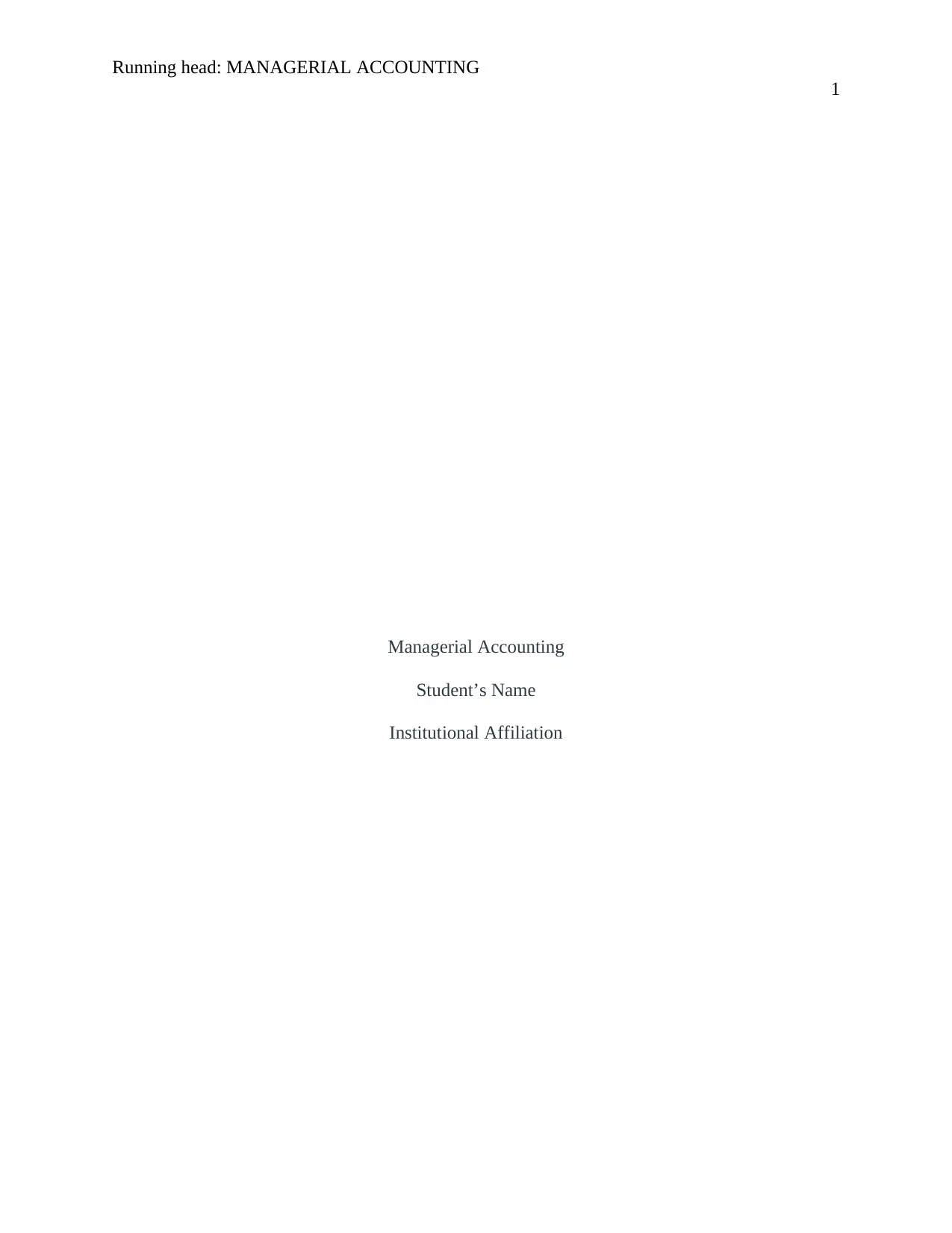
Running head: MANAGERIAL ACCOUNTING
1
Managerial Accounting
Student’s Name
Institutional Affiliation
tabler-icon-diamond-filled.svg

Paraphrase This Document

Need a fresh take? Get an instant paraphrase of this document with our AI Paraphraser
Document Page
MANAGERIAL ACCOUNTING 2
Managerial Accounting
Managerial accounting is a critical part of an organization that requires ethical thinking
and behavior in the process of service dispensation. As such, the organization has legal
guidelines and regulations that are made and linked according to the Institute of Management
Accountants code of ethics. The principles are based on several virtues such as fairness, honesty,
confidentiality, responsibility, and objectivity according to managerial accounting principles
(Edmonds, Edmonds, Tsay & Olds 2016). As such, it allows accountants to only disclose
information at the immediate supervisor’s discretion.
As a firm in the aviation industry, integrity prevents accountants from engaging in
unethical conducts. Every six months, a report on ethical standards status of every individual in
the sector is released followed by appropriate measures and possible consequences or praise for
individuals based on the degree of their acts (Shafer, 2015). The airline business is competitive
thus the need for confidentiality of information and ethical behavior that protects and informs the
inner management circle on the probable actions to take.
Furthermore, it tasks individuals with the responsibility of being credible at all times with
the information delivered or released to the public and other members of an organization.
Credibility calls for the ability of individuals in the firm to communicate such information with
utmost objectivity and fairness that reflects an agreement with the International Code of Ethic for
accounting professionals.
In pursuit of excellence in accounting, the firm makes sure the accounting professionals
report all financial information to the managers and other stakeholders despite the nature of a
report. According to Edmonds, Edmonds, Tsay & Olds (2016), such information ought to remain
Document Page
MANAGERIAL ACCOUNTING 3
confidential and never leak to other departments or the outside environment. A penalty exists for
breaking such ethical codes properly displayed in every corner of the organization.
In preparing individuals, the firm takes the selected professionals through an induction
course as well as refresher courses whenever unethical acts are noted (Shafer, 2015). In cases
where individuals persist with unethical behaviors, several measures remain in place such as lose
of certification, legal penalties, or sacking from a particular profession depending on the
seriousness of a matter. Ethical codes of conduct assist the firm to observe and communicate to
the managerial accounting professional the importance of remaining ethical at all times.
Document Page
MANAGERIAL ACCOUNTING 4
References
Edmonds, T. P., Edmonds, C. D., Tsay, B. Y., & Olds, P. R. (2016). Fundamental managerial
accounting concepts. McGraw-Hill Education.
Shafer, W. E. (2015). Ethical climate, social responsibility, and earnings management. Journal of
Business Ethics, 126(1), 43-60.
chevron_up_icon
1 out of 4
circle_padding
hide_on_mobile
zoom_out_icon
[object Object]