Strategic Change Management Report: Bank of Singapore Analysis
VerifiedAdded on 2019/09/16
|23
|5075
|313
Report
AI Summary
This report provides a comprehensive analysis of strategic change management within the banking industry, specifically focusing on the Bank of Singapore. It begins with a company profile and an overview of the Singaporean banking industry, highlighting significant drivers and trends of change, such as the dominance of foreign banks, liberalization in the banking sector, the rise of competitive investment hubs, and increased focus on the SME sector. The report examines the purpose of change, the reasons why change is not prevented, and the future outlook of the banking industry. It identifies key areas requiring managerial focus, including deposit and capital gain taxes, competitive investment hubs, and the SME sector. The report then delves into the legal aspects of the industry, including regulatory investigations and key legal frameworks. It discusses the challenges faced in change management, particularly developmental challenges. The report also explores various change models, including Lewin’s Force Field Analysis, to facilitate and prepare leaders for change. The report highlights the qualities and skills required for managing change and provides insights into leading and managing change effectively. Finally, the report concludes with a summary of the key findings and recommendations for the Bank of Singapore and the broader banking industry.


Paraphrase This Document
Need a fresh take? Get an instant paraphrase of this document with our AI Paraphraser
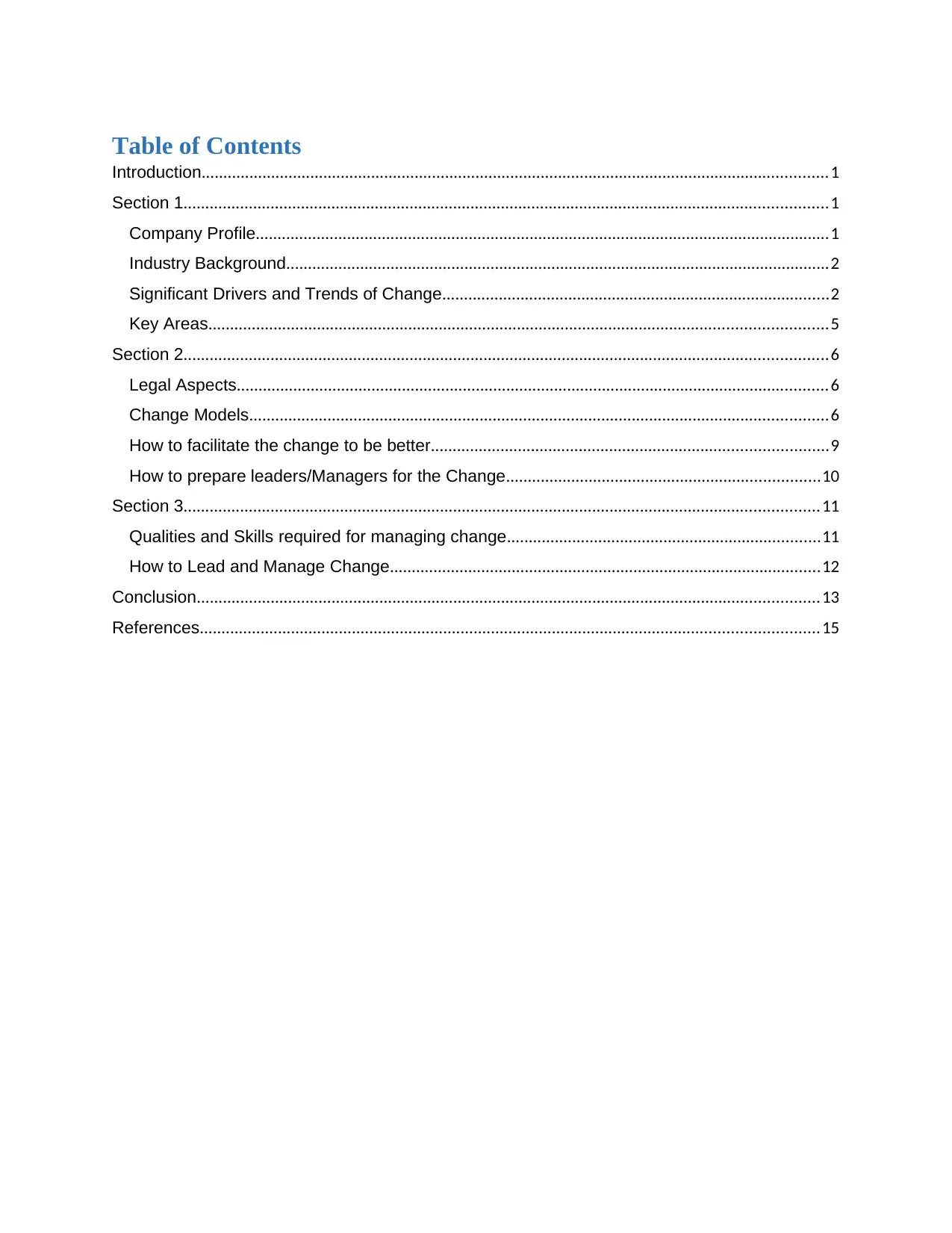
Table of Contents
Introduction................................................................................................................................................1
Section 1....................................................................................................................................................1
Company Profile....................................................................................................................................1
Industry Background.............................................................................................................................2
Significant Drivers and Trends of Change.........................................................................................2
Key Areas..............................................................................................................................................5
Section 2....................................................................................................................................................6
Legal Aspects........................................................................................................................................6
Change Models.....................................................................................................................................6
How to facilitate the change to be better...........................................................................................9
How to prepare leaders/Managers for the Change........................................................................10
Section 3..................................................................................................................................................11
Qualities and Skills required for managing change........................................................................11
How to Lead and Manage Change...................................................................................................12
Conclusion...............................................................................................................................................13
References..............................................................................................................................................15
Introduction................................................................................................................................................1
Section 1....................................................................................................................................................1
Company Profile....................................................................................................................................1
Industry Background.............................................................................................................................2
Significant Drivers and Trends of Change.........................................................................................2
Key Areas..............................................................................................................................................5
Section 2....................................................................................................................................................6
Legal Aspects........................................................................................................................................6
Change Models.....................................................................................................................................6
How to facilitate the change to be better...........................................................................................9
How to prepare leaders/Managers for the Change........................................................................10
Section 3..................................................................................................................................................11
Qualities and Skills required for managing change........................................................................11
How to Lead and Manage Change...................................................................................................12
Conclusion...............................................................................................................................................13
References..............................................................................................................................................15
Introduction
In this paper, we will study about the Banking industry. This has been done by studying
the Bank of Singapore. It is a popular bank of the Singapore which has its own image in
the mind of the people. Here, we will discuss the experience of change within the Bank
of Singapore. It faces a huge number of changes in its life circle such as the
replacement of physical token with the digital token. This change will bring a large
number of challenges in front of the organization. Apart of this, various ways of leading
change also suggested to the organization. This has been done under the light of
certain change model and theories. These give us a significant direction in which we
need to move. On the basis of these models, the change experience of Bank of
Singapore is turned on the positive side. Apart of this, the main focus of this assignment
is change within the Banking industry of Singapore. On the basis of industry study, we
can recommend a better solution for managing change. Therefore, it can be said that
change management is crucial not only for the Bank of Singapore but for the whole
industry.
Section 1
Company Profile
Bank of Singapore is known as the global private bank of the Asia. The headquarters of
the bank is situated in Singapore. It is operating in the strong and open economy. It
mainly offers assured and unrivaled security and stability to its customers. It has
established its brand image on the basis of its high quality and secured services. It has
its own research team which highly involves in producing best financial services for the
In this paper, we will study about the Banking industry. This has been done by studying
the Bank of Singapore. It is a popular bank of the Singapore which has its own image in
the mind of the people. Here, we will discuss the experience of change within the Bank
of Singapore. It faces a huge number of changes in its life circle such as the
replacement of physical token with the digital token. This change will bring a large
number of challenges in front of the organization. Apart of this, various ways of leading
change also suggested to the organization. This has been done under the light of
certain change model and theories. These give us a significant direction in which we
need to move. On the basis of these models, the change experience of Bank of
Singapore is turned on the positive side. Apart of this, the main focus of this assignment
is change within the Banking industry of Singapore. On the basis of industry study, we
can recommend a better solution for managing change. Therefore, it can be said that
change management is crucial not only for the Bank of Singapore but for the whole
industry.
Section 1
Company Profile
Bank of Singapore is known as the global private bank of the Asia. The headquarters of
the bank is situated in Singapore. It is operating in the strong and open economy. It
mainly offers assured and unrivaled security and stability to its customers. It has
established its brand image on the basis of its high quality and secured services. It has
its own research team which highly involves in producing best financial services for the
⊘ This is a preview!⊘
Do you want full access?
Subscribe today to unlock all pages.

Trusted by 1+ million students worldwide
clients. It offers a large range of commercial and consumer banking solutions like
insurance, brokerage services, and financing.
Industry Background
The Banking industry of the Singapore is considered a hub of the banking facilities and
services. It is such a powerful hub that does provide not only the domestic finance
solutions but also a monetary activity of the whole Asia Pacific (Ashkenas, 2013). The
banking industry of Singapore is highly heartened by the stable economic and political
climate, law enforcement against money crimes and fraud, efficient taxation and
legislations. The banking industry of Singapore is the combination of 6 local and 117
Asian financial centers that provides a large range of services from consumer credit to
insurance, and investment operations (Cameron, 2015). The banking industry of the
Singapore contains commercial, consumer, and private banks that offer a wide range of
financial benefits to different customers.
Significant Drivers and Trends of Change
The significant drivers and trends of change within the banking industry of the
Singapore are following:
The Dominance of Foreign Banks
It is an important trend of change in the banking industry of Singapore. This trend drew
Singapore into the scene of the global banking which makes it more competitive player
than prior (Clegg, 2015). This trend will enhance the level of constant competition which
further encourages the development of the different financial products and effective
conductive pricing policies. Apart of this, the dominance of foreign banks trend also
insurance, brokerage services, and financing.
Industry Background
The Banking industry of the Singapore is considered a hub of the banking facilities and
services. It is such a powerful hub that does provide not only the domestic finance
solutions but also a monetary activity of the whole Asia Pacific (Ashkenas, 2013). The
banking industry of Singapore is highly heartened by the stable economic and political
climate, law enforcement against money crimes and fraud, efficient taxation and
legislations. The banking industry of Singapore is the combination of 6 local and 117
Asian financial centers that provides a large range of services from consumer credit to
insurance, and investment operations (Cameron, 2015). The banking industry of the
Singapore contains commercial, consumer, and private banks that offer a wide range of
financial benefits to different customers.
Significant Drivers and Trends of Change
The significant drivers and trends of change within the banking industry of the
Singapore are following:
The Dominance of Foreign Banks
It is an important trend of change in the banking industry of Singapore. This trend drew
Singapore into the scene of the global banking which makes it more competitive player
than prior (Clegg, 2015). This trend will enhance the level of constant competition which
further encourages the development of the different financial products and effective
conductive pricing policies. Apart of this, the dominance of foreign banks trend also
Paraphrase This Document
Need a fresh take? Get an instant paraphrase of this document with our AI Paraphraser
motivates the banking organizations towards merger. It is because the merger has the
full potential of help local banks in the way that they want.
Liberalization in Banking Sector
The second and essential trend of change in today's banking industry of Singapore is
liberalization. It has placed in the banking industry of Singapore during 1999 (Coleman,
2016). Such liberalization comes with a large number of benefits for the banking sector.
Some of them are banking licenses to foreign banks, reconsidering corporate
governance, enhancing the limit of foreign shareholding in local banks, and offering
more freedom to offshore banks. Liberalized banking trend enhance the level of
competition within the banking industry of the Singapore.
Competitive investment hub
Nowadays, Singapore turned into a competitive investment hub due to the presence of
huge government efforts, the success of Singapore exchange, and approved bonds that
lured hordes of overseas organizations (Hallegatte, 2015). A large number of
investment banks demands investors through meditating, and underwriting between the
investor and the issuer, or corporate re-organization services. Therefore, all such
initiatives enhance the competitiveness by promoting mergers, and acquisitions.
Attention towards SME sector
Another trend of today’s Singapore banking industry is that the banks mainly focus more
towards SME sector. This has been done by the banking firms of Singapore to win the
repute of reliable business partners (Hill, 2014). Generally, the SME sector in Singapore
has access to premium bespoke financial, investment, insurance, and loan products.
full potential of help local banks in the way that they want.
Liberalization in Banking Sector
The second and essential trend of change in today's banking industry of Singapore is
liberalization. It has placed in the banking industry of Singapore during 1999 (Coleman,
2016). Such liberalization comes with a large number of benefits for the banking sector.
Some of them are banking licenses to foreign banks, reconsidering corporate
governance, enhancing the limit of foreign shareholding in local banks, and offering
more freedom to offshore banks. Liberalized banking trend enhance the level of
competition within the banking industry of the Singapore.
Competitive investment hub
Nowadays, Singapore turned into a competitive investment hub due to the presence of
huge government efforts, the success of Singapore exchange, and approved bonds that
lured hordes of overseas organizations (Hallegatte, 2015). A large number of
investment banks demands investors through meditating, and underwriting between the
investor and the issuer, or corporate re-organization services. Therefore, all such
initiatives enhance the competitiveness by promoting mergers, and acquisitions.
Attention towards SME sector
Another trend of today’s Singapore banking industry is that the banks mainly focus more
towards SME sector. This has been done by the banking firms of Singapore to win the
repute of reliable business partners (Hill, 2014). Generally, the SME sector in Singapore
has access to premium bespoke financial, investment, insurance, and loan products.
The attention of banking firms towards these SME sectors helps them in launching
comfortable schemes for upgrading and expanding their financial operations.
Deposit and Capital gain Taxes
Another important trend that plays an important role in the success of Singapore
banking industry is a deposit and capital gain taxes (Komives, 2016). The government
of the country frees its banking sector firms from paying the capital gain and deposit
taxes from incomes earned abroad.
The presence of all of these trends makes the whole industry challenging and attractive
for other investors. Such trends will bring positive as well as negative impacts for Bank
of Singapore. Therefore, it can be said that Singapore banking industry is fulfilled with
more growth opportunities that can easily grasp by taking an active initiative.
Purpose of Change
The main purpose behind changes in the Banking industry is to enhance its
attractiveness and efficiency. More change will come with high difficulties which the
existing organizations need to face to survive themselves in the target market. On the
other hand, the change also brings improvement in existing or traditional working
system of banking by launching innovative financial products (Van der Voet, 2014). So,
the purpose behind the change is positive that will prove beneficial for the company as
well as target customers.
Why Change is not prevented
comfortable schemes for upgrading and expanding their financial operations.
Deposit and Capital gain Taxes
Another important trend that plays an important role in the success of Singapore
banking industry is a deposit and capital gain taxes (Komives, 2016). The government
of the country frees its banking sector firms from paying the capital gain and deposit
taxes from incomes earned abroad.
The presence of all of these trends makes the whole industry challenging and attractive
for other investors. Such trends will bring positive as well as negative impacts for Bank
of Singapore. Therefore, it can be said that Singapore banking industry is fulfilled with
more growth opportunities that can easily grasp by taking an active initiative.
Purpose of Change
The main purpose behind changes in the Banking industry is to enhance its
attractiveness and efficiency. More change will come with high difficulties which the
existing organizations need to face to survive themselves in the target market. On the
other hand, the change also brings improvement in existing or traditional working
system of banking by launching innovative financial products (Van der Voet, 2014). So,
the purpose behind the change is positive that will prove beneficial for the company as
well as target customers.
Why Change is not prevented
⊘ This is a preview!⊘
Do you want full access?
Subscribe today to unlock all pages.
Trusted by 1+ million students worldwide
The various changes in the banking industry, as well as functioning of the Bank of
Singapore, do not prevent due to its positive outcomes of the change. For example, the
changes of physical tokens in the digital token will easy the functioning of the
organization by reducing the level of complexities. These complexities may be in terms
of high management and more care of tokens. Therefore, these changes will perform for
the benefit of the organization as well as the customer. That's why these changes do
not prevent by a single organization. With the help of these changes, the organization
and different players like customers will effect in a significant manner. These changes
affect customers by reducing their complexities and easier their functions. On the other
hand, these changes help the organizations in making them digitalized and advanced
as per the current and prevailing trend. Therefore, these changes have important for
everyone.
Banking Industry in Coming Future
All these changes make positive improvements in the performance of the banking
industry. In coming future, all functions of banking industries become digitalized. This
enhances the level of convenience for customers as well as the employees. On the
other hand, the industry becomes more competitive due to freedom in operations. This
gives birth to competition and various other innovative financial products and services.
So, it can be said that future of the Banking industry will bright in coming future.
Key Areas
The key areas that require huge focus from managers of the banking firms like Bank of
Singapore are following:
Singapore, do not prevent due to its positive outcomes of the change. For example, the
changes of physical tokens in the digital token will easy the functioning of the
organization by reducing the level of complexities. These complexities may be in terms
of high management and more care of tokens. Therefore, these changes will perform for
the benefit of the organization as well as the customer. That's why these changes do
not prevent by a single organization. With the help of these changes, the organization
and different players like customers will effect in a significant manner. These changes
affect customers by reducing their complexities and easier their functions. On the other
hand, these changes help the organizations in making them digitalized and advanced
as per the current and prevailing trend. Therefore, these changes have important for
everyone.
Banking Industry in Coming Future
All these changes make positive improvements in the performance of the banking
industry. In coming future, all functions of banking industries become digitalized. This
enhances the level of convenience for customers as well as the employees. On the
other hand, the industry becomes more competitive due to freedom in operations. This
gives birth to competition and various other innovative financial products and services.
So, it can be said that future of the Banking industry will bright in coming future.
Key Areas
The key areas that require huge focus from managers of the banking firms like Bank of
Singapore are following:
Paraphrase This Document
Need a fresh take? Get an instant paraphrase of this document with our AI Paraphraser
Deposit and Capital gain taxes: This trend is quite prevailing nowadays. The
managers should focus on this because it will bring a large number of growth
opportunities for the organization. It does not only helpful in enhancing
profitability but also in plan significant expansion. The managers should adopt
this trend on an immediate basis to grasp the available growth opportunities
without wasting a single time (Uzkurt, 2013).
Competitive Investment Hub: Another trend that requires huge focus from
management of a banking organization is competitive investment hub. This
competition demands more research activities from the management. In order to
survive in the challenging banking environment of Singapore, the organizations
need to come with efficient finance products that do not only enhance the
reputation but also improve the existing competitive advantage in the target
market.
Attention to the SME sector: It is another trend that demands the suitable
attention of the manager. In order to gain competitive advantage, it is necessary
for the banking firms to attract investors (Richter, 2013). This can successfully
perform by enhancing its focus on SME sector. Nowadays, SME sector of
Singapore has placed itself in the eyes of investors. Therefore, in order to win the
support of investors the management of an organization needs to put more
emphasis on SME sector of Singapore.
managers should focus on this because it will bring a large number of growth
opportunities for the organization. It does not only helpful in enhancing
profitability but also in plan significant expansion. The managers should adopt
this trend on an immediate basis to grasp the available growth opportunities
without wasting a single time (Uzkurt, 2013).
Competitive Investment Hub: Another trend that requires huge focus from
management of a banking organization is competitive investment hub. This
competition demands more research activities from the management. In order to
survive in the challenging banking environment of Singapore, the organizations
need to come with efficient finance products that do not only enhance the
reputation but also improve the existing competitive advantage in the target
market.
Attention to the SME sector: It is another trend that demands the suitable
attention of the manager. In order to gain competitive advantage, it is necessary
for the banking firms to attract investors (Richter, 2013). This can successfully
perform by enhancing its focus on SME sector. Nowadays, SME sector of
Singapore has placed itself in the eyes of investors. Therefore, in order to win the
support of investors the management of an organization needs to put more
emphasis on SME sector of Singapore.
Section 2
Legal Aspects
A large number of Singapore banks faced a series of regulatory investigations from
watchdogs and different government agencies. Some of these regulatory investigations
are passed by the Singapore Parliament during 2016.The Monetary Authority of
Singapore is the central bank that operates all the legal policies and functioning
regarding the banking industry of the Singapore It has launched different policies to
govern the banking industry of Singapore. (Renz, 2016) The first and the foremost legal
aspect launched by the MAS is the development of Financial Stability Board and the
Basel Committee on Banking Supervision. Both of these play an important role in
managing the financial aspects of the Banking System. Apart of this, there are some
other legal aspects that are launched by the MAS is Financial Action Task Force,
Banking Act, Securities and Futures Act, and various others. All these legal aspects
ensure adequate functioning of the Singapore banking industry.
Challenges Faced in Change Management Process
The management of banking organizations or others may face five types of challenges
during the implementation of the change within the premise of the organization. These
challenges are; developmental, transitional, maintenance, crisis, and paradigm shift. All
of these challenges have their significant influence on the success of the change
implementation. But the foremost important challenge that needs to focus more on the
management is development. This challenge is associated with the skills, talents,
expertise, knowledge, and technologies. These are the core factors that require high
concern from management. It is the manpower that can do everything with their
Legal Aspects
A large number of Singapore banks faced a series of regulatory investigations from
watchdogs and different government agencies. Some of these regulatory investigations
are passed by the Singapore Parliament during 2016.The Monetary Authority of
Singapore is the central bank that operates all the legal policies and functioning
regarding the banking industry of the Singapore It has launched different policies to
govern the banking industry of Singapore. (Renz, 2016) The first and the foremost legal
aspect launched by the MAS is the development of Financial Stability Board and the
Basel Committee on Banking Supervision. Both of these play an important role in
managing the financial aspects of the Banking System. Apart of this, there are some
other legal aspects that are launched by the MAS is Financial Action Task Force,
Banking Act, Securities and Futures Act, and various others. All these legal aspects
ensure adequate functioning of the Singapore banking industry.
Challenges Faced in Change Management Process
The management of banking organizations or others may face five types of challenges
during the implementation of the change within the premise of the organization. These
challenges are; developmental, transitional, maintenance, crisis, and paradigm shift. All
of these challenges have their significant influence on the success of the change
implementation. But the foremost important challenge that needs to focus more on the
management is development. This challenge is associated with the skills, talents,
expertise, knowledge, and technologies. These are the core factors that require high
concern from management. It is the manpower that can do everything with their
⊘ This is a preview!⊘
Do you want full access?
Subscribe today to unlock all pages.
Trusted by 1+ million students worldwide
knowledge, talent, and skills. With the help of the talented manpower, an organization
can implement the change in the desired manner. Therefore, it is essential for the
management to look more towards developmental challenges and try to take effective
initiatives to resolve and make a control over it.
Change Models
In order to adopt the change in a positive manner, it is necessary for the management
of the organizations to adopt the different change models. These models derive an
effective implementation of change process which leads positive outcomes for the
success of the company as well as the banking industry. Some of these change models
are following:
Lewin’s Force Field Analysis Model
The management of the banking organizations can use Lewin’s Force Field Analysis
model in order to implement the change in the desired manner. This model of the
Lewin’s helps the management in change management by identifying driving and
restraining forces that affect the change in the organization. It described the two
opposite forces which can easily understand by looking the below-mentioned figure:
can implement the change in the desired manner. Therefore, it is essential for the
management to look more towards developmental challenges and try to take effective
initiatives to resolve and make a control over it.
Change Models
In order to adopt the change in a positive manner, it is necessary for the management
of the organizations to adopt the different change models. These models derive an
effective implementation of change process which leads positive outcomes for the
success of the company as well as the banking industry. Some of these change models
are following:
Lewin’s Force Field Analysis Model
The management of the banking organizations can use Lewin’s Force Field Analysis
model in order to implement the change in the desired manner. This model of the
Lewin’s helps the management in change management by identifying driving and
restraining forces that affect the change in the organization. It described the two
opposite forces which can easily understand by looking the below-mentioned figure:
Paraphrase This Document
Need a fresh take? Get an instant paraphrase of this document with our AI Paraphraser
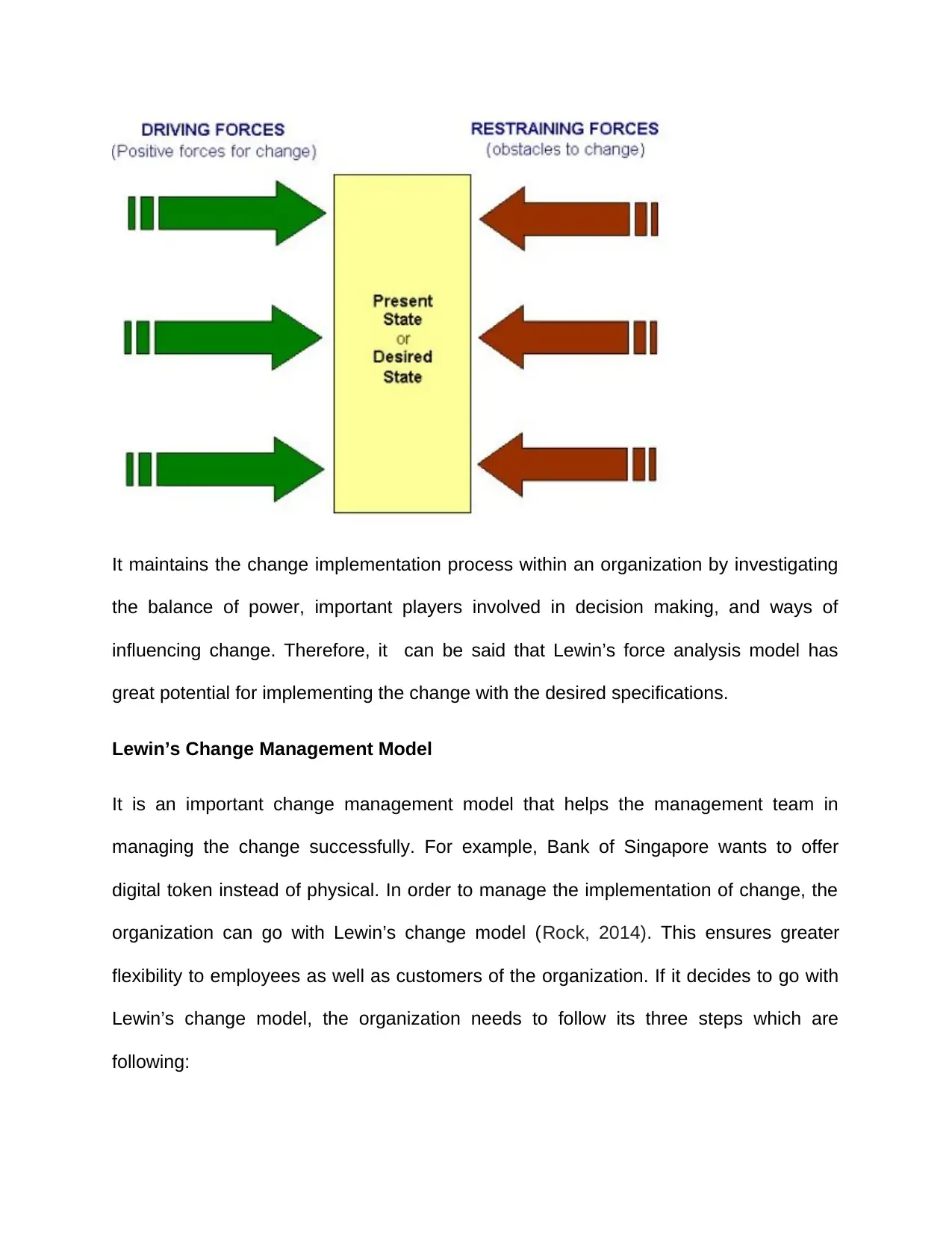
It maintains the change implementation process within an organization by investigating
the balance of power, important players involved in decision making, and ways of
influencing change. Therefore, it can be said that Lewin’s force analysis model has
great potential for implementing the change with the desired specifications.
Lewin’s Change Management Model
It is an important change management model that helps the management team in
managing the change successfully. For example, Bank of Singapore wants to offer
digital token instead of physical. In order to manage the implementation of change, the
organization can go with Lewin’s change model (Rock, 2014). This ensures greater
flexibility to employees as well as customers of the organization. If it decides to go with
Lewin’s change model, the organization needs to follow its three steps which are
following:
the balance of power, important players involved in decision making, and ways of
influencing change. Therefore, it can be said that Lewin’s force analysis model has
great potential for implementing the change with the desired specifications.
Lewin’s Change Management Model
It is an important change management model that helps the management team in
managing the change successfully. For example, Bank of Singapore wants to offer
digital token instead of physical. In order to manage the implementation of change, the
organization can go with Lewin’s change model (Rock, 2014). This ensures greater
flexibility to employees as well as customers of the organization. If it decides to go with
Lewin’s change model, the organization needs to follow its three steps which are
following:
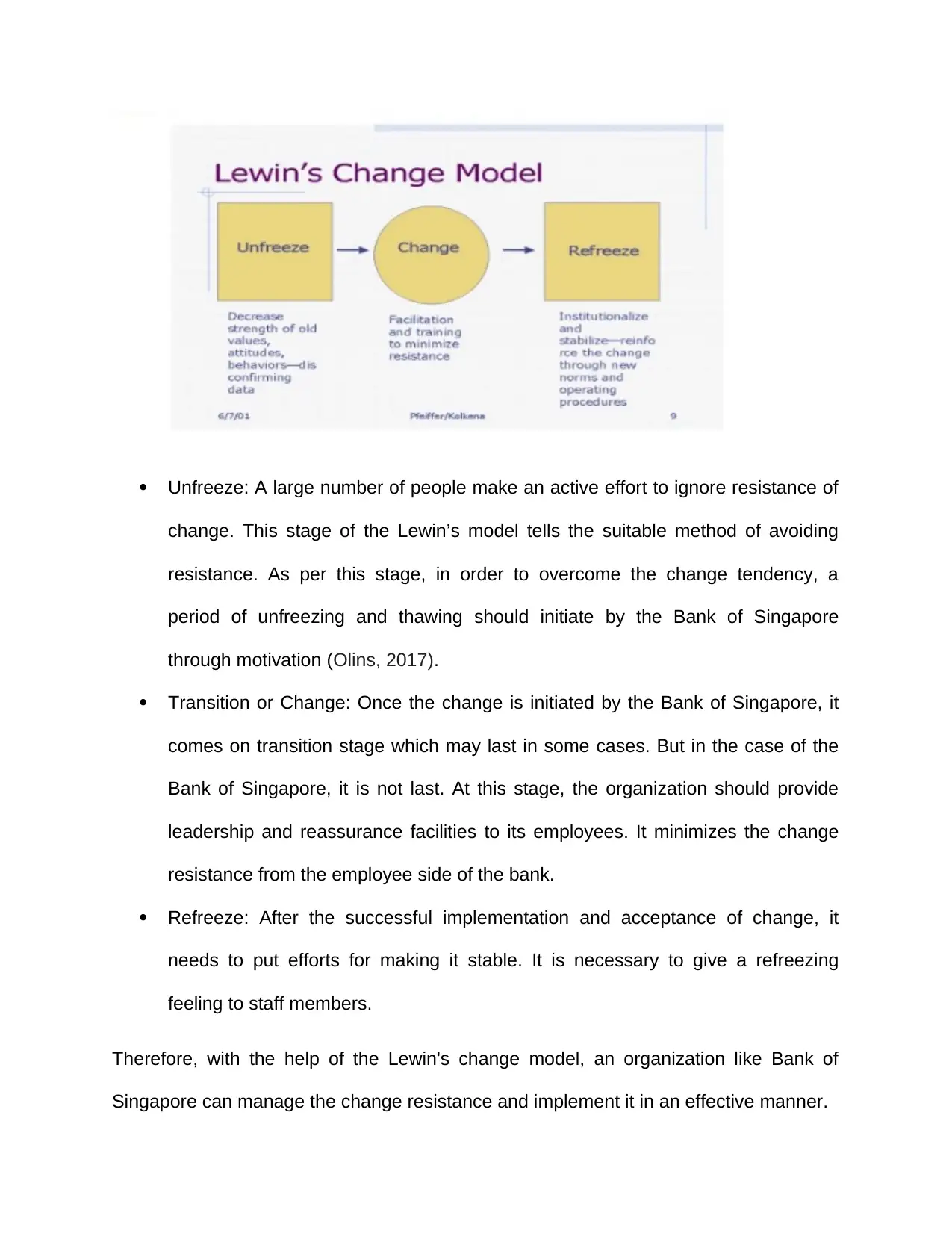
Unfreeze: A large number of people make an active effort to ignore resistance of
change. This stage of the Lewin’s model tells the suitable method of avoiding
resistance. As per this stage, in order to overcome the change tendency, a
period of unfreezing and thawing should initiate by the Bank of Singapore
through motivation (Olins, 2017).
Transition or Change: Once the change is initiated by the Bank of Singapore, it
comes on transition stage which may last in some cases. But in the case of the
Bank of Singapore, it is not last. At this stage, the organization should provide
leadership and reassurance facilities to its employees. It minimizes the change
resistance from the employee side of the bank.
Refreeze: After the successful implementation and acceptance of change, it
needs to put efforts for making it stable. It is necessary to give a refreezing
feeling to staff members.
Therefore, with the help of the Lewin's change model, an organization like Bank of
Singapore can manage the change resistance and implement it in an effective manner.
change. This stage of the Lewin’s model tells the suitable method of avoiding
resistance. As per this stage, in order to overcome the change tendency, a
period of unfreezing and thawing should initiate by the Bank of Singapore
through motivation (Olins, 2017).
Transition or Change: Once the change is initiated by the Bank of Singapore, it
comes on transition stage which may last in some cases. But in the case of the
Bank of Singapore, it is not last. At this stage, the organization should provide
leadership and reassurance facilities to its employees. It minimizes the change
resistance from the employee side of the bank.
Refreeze: After the successful implementation and acceptance of change, it
needs to put efforts for making it stable. It is necessary to give a refreezing
feeling to staff members.
Therefore, with the help of the Lewin's change model, an organization like Bank of
Singapore can manage the change resistance and implement it in an effective manner.
⊘ This is a preview!⊘
Do you want full access?
Subscribe today to unlock all pages.
Trusted by 1+ million students worldwide

1 out of 23


Related Documents


Your All-in-One AI-Powered Toolkit for Academic Success.
+13062052269
info@desklib.com
Available 24*7 on WhatsApp / Email
![[object Object]](/_next/static/media/star-bottom.7253800d.svg)
Unlock your academic potential
Copyright © 2020–2025 A2Z Services. All Rights Reserved. Developed and managed by ZUCOL.