Comprehensive Report on Managing Business Operations Strategies
VerifiedAdded on 2023/06/18
|17
|3595
|117
Report
AI Summary
This report provides a comprehensive overview of managing business operations, starting with the identification of common functions and divisions within organizations, such as operations, marketing, and finance. It describes various organizational structures, including functional, flat, and matrix structures, highlighting their advantages and disadvantages with relevant examples. The report also differentiates between public, private, and voluntary sector organizations. Furthermore, it explains key accounting concepts like turnover, cash flow, and balance sheets, and identifies stakeholders interested in an organization’s financial situation. The importance of budgeting is discussed, emphasizing its role in providing business information for decision-making. The report also underscores the significance of excellent customer service, detailing its elements and benefits, and concludes with an explanation of business planning, the importance of mission and vision statements, and the key elements of a business plan, stressing its importance in guiding businesses and avoiding mistakes.
Managing Business
Operations
Operations

Paraphrase This Document
Need a fresh take? Get an instant paraphrase of this document with our AI Paraphraser
Table of Contents
1.1 Identify common functions and divisions found in organizations.............................................3
1.2 Using examples, describe different structures within organizations.........................................3
1.3 Describe the key differences between public, private, voluntary sector, and public service
organizations....................................................................................................................................6
2.1 Explain key accounting concepts...............................................................................................6
2.2 Describe the stakeholders who wish to understand the organization’s financial situation........7
2.3 Describe the kinds of business information which can be provided by budgets.......................7
3.1 Explain the importance of excellent customer service to organizations....................................8
References......................................................................................................................................16
CONCLUSION .............................................................................................................................19
REFERENCE.................................................................................................................................19
1.1 Identify common functions and divisions found in organizations.............................................3
1.2 Using examples, describe different structures within organizations.........................................3
1.3 Describe the key differences between public, private, voluntary sector, and public service
organizations....................................................................................................................................6
2.1 Explain key accounting concepts...............................................................................................6
2.2 Describe the stakeholders who wish to understand the organization’s financial situation........7
2.3 Describe the kinds of business information which can be provided by budgets.......................7
3.1 Explain the importance of excellent customer service to organizations....................................8
References......................................................................................................................................16
CONCLUSION .............................................................................................................................19
REFERENCE.................................................................................................................................19
1.1 Identify common functions and divisions found in organizations.
A business function may be stated as any collection of tasks performed by the department
initiating an event, changing details, transactions, or business commitments, and processes an
output. Common functions and divisions are
Operations - The operation function is an essential business activity, which involves the
production of goods and services. Goods can be defined as tangible objects that are created from
unfinished goods and components such as a motherboard which is needed components of
computer, as well as a phone..
Marketing - This function involves promotion of goods produced and services offered and
ensuring the attraction of customers to the organisation. This function has many jobs, which
include understand the requirements and needs of customers and ensured that the organization's
produce meet the needs of the customers. (Business Function - CIO Wiki, 2021)
Fig 1: Functions and divisions in the organization
1.2 Using examples, describe different structures within organizations.
Functional Organizational Structure - This structure of an organization divides the business
based on specific use. Business organisation with such type of composition, for example, can
mobilize each of their marketing people in single unit, which put their salesforce in one, and a
customer service team in another.
Advantages:
a) It require a high level of specialization among all workers.
b) It helps to have clear accountability for everyone's work.
Disadvantages:
a) It may not work well if the business produce a variety of products or target
marketplace.
b) Work could be difficult and repetitive, resulting in a loss of enthusiasm and
motivation.
Example - A Fundamental research and development program; this organizational structure can
be used as the project can take full advantage of each department's expertise and specialization to
finish the work under the project.
A business function may be stated as any collection of tasks performed by the department
initiating an event, changing details, transactions, or business commitments, and processes an
output. Common functions and divisions are
Operations - The operation function is an essential business activity, which involves the
production of goods and services. Goods can be defined as tangible objects that are created from
unfinished goods and components such as a motherboard which is needed components of
computer, as well as a phone..
Marketing - This function involves promotion of goods produced and services offered and
ensuring the attraction of customers to the organisation. This function has many jobs, which
include understand the requirements and needs of customers and ensured that the organization's
produce meet the needs of the customers. (Business Function - CIO Wiki, 2021)
Fig 1: Functions and divisions in the organization
1.2 Using examples, describe different structures within organizations.
Functional Organizational Structure - This structure of an organization divides the business
based on specific use. Business organisation with such type of composition, for example, can
mobilize each of their marketing people in single unit, which put their salesforce in one, and a
customer service team in another.
Advantages:
a) It require a high level of specialization among all workers.
b) It helps to have clear accountability for everyone's work.
Disadvantages:
a) It may not work well if the business produce a variety of products or target
marketplace.
b) Work could be difficult and repetitive, resulting in a loss of enthusiasm and
motivation.
Example - A Fundamental research and development program; this organizational structure can
be used as the project can take full advantage of each department's expertise and specialization to
finish the work under the project.
⊘ This is a preview!⊘
Do you want full access?
Subscribe today to unlock all pages.

Trusted by 1+ million students worldwide
Flat Organizational Structure - The flat structure balances management with few levels in
such a manner that all workers are close to this stage of leadership. In such a structure, there are
very few levels between lower-level employees and upper management.
Advantages:
a) Fosters decision-making between different organizational levels.
b) Employees and managers are in a relatively equal position.
Disadvantages:
a) It can create confusion among employees as they are not clear about their jobs and
supervision.
b) It can reduce the long-term growth opportunities of the organization as administration
decides against new opportunities to hold the structure.
Example - It is usually appropriate for start-ups and small businesses in which naturally
there is minor need for hierarchical levels, this structure is effective if the organisation
has some kind of intrinsic creativity in project.
Matrix Organizational Structure -This structure enables all employees to have a dual reporting
system, reporting to two or more manager depending on the condition or project. This is
basically, functional reporting and product-based reporting are the two firms involved in such a
system.
Advantages:
a) It provides flexibility and balance.
b) By working in different departments, employees can expand their knowledge and
skills.
Disadvantages:
a) Reportage to multiple administrators can lead to conflict and create confusion about
what and to whom need to be reported.
b) Such ambivalency can lead to situations like who is accountable for what, and when
things go wrong, it lead to development of a culture of blaming each other as a result.
Example - Matrix organizational structures are well suited for companies with a wide range of
goods and markets and need to accomplished large, complex plans. (5 different types of
organizational structure explained, 2021)
such a manner that all workers are close to this stage of leadership. In such a structure, there are
very few levels between lower-level employees and upper management.
Advantages:
a) Fosters decision-making between different organizational levels.
b) Employees and managers are in a relatively equal position.
Disadvantages:
a) It can create confusion among employees as they are not clear about their jobs and
supervision.
b) It can reduce the long-term growth opportunities of the organization as administration
decides against new opportunities to hold the structure.
Example - It is usually appropriate for start-ups and small businesses in which naturally
there is minor need for hierarchical levels, this structure is effective if the organisation
has some kind of intrinsic creativity in project.
Matrix Organizational Structure -This structure enables all employees to have a dual reporting
system, reporting to two or more manager depending on the condition or project. This is
basically, functional reporting and product-based reporting are the two firms involved in such a
system.
Advantages:
a) It provides flexibility and balance.
b) By working in different departments, employees can expand their knowledge and
skills.
Disadvantages:
a) Reportage to multiple administrators can lead to conflict and create confusion about
what and to whom need to be reported.
b) Such ambivalency can lead to situations like who is accountable for what, and when
things go wrong, it lead to development of a culture of blaming each other as a result.
Example - Matrix organizational structures are well suited for companies with a wide range of
goods and markets and need to accomplished large, complex plans. (5 different types of
organizational structure explained, 2021)
Paraphrase This Document
Need a fresh take? Get an instant paraphrase of this document with our AI Paraphraser
1.3 Describe the key differences between public, private, voluntary sector, and public
service organizations.
Public Sector Organizations - Such organizations operates in a area of supplying government
produce and services to the normal public are categorized as public organizations. Businesses,
bodies and agencies are wholly-owned, run either by a state or by a central government.
Private Sector Organizations – The organizations which are owned managed by individuals or
private groups are known as private sector organizations. The main purpose of private sector
organizations is to gain a profit from selling their products and services. (2021)
Voluntary Sector Organizations - These organizations are not required to give a profit to
shareholders, but they need to make money and earn profits (Differences Between Private Sector
And Voluntary Sector | Bartleby, 2021
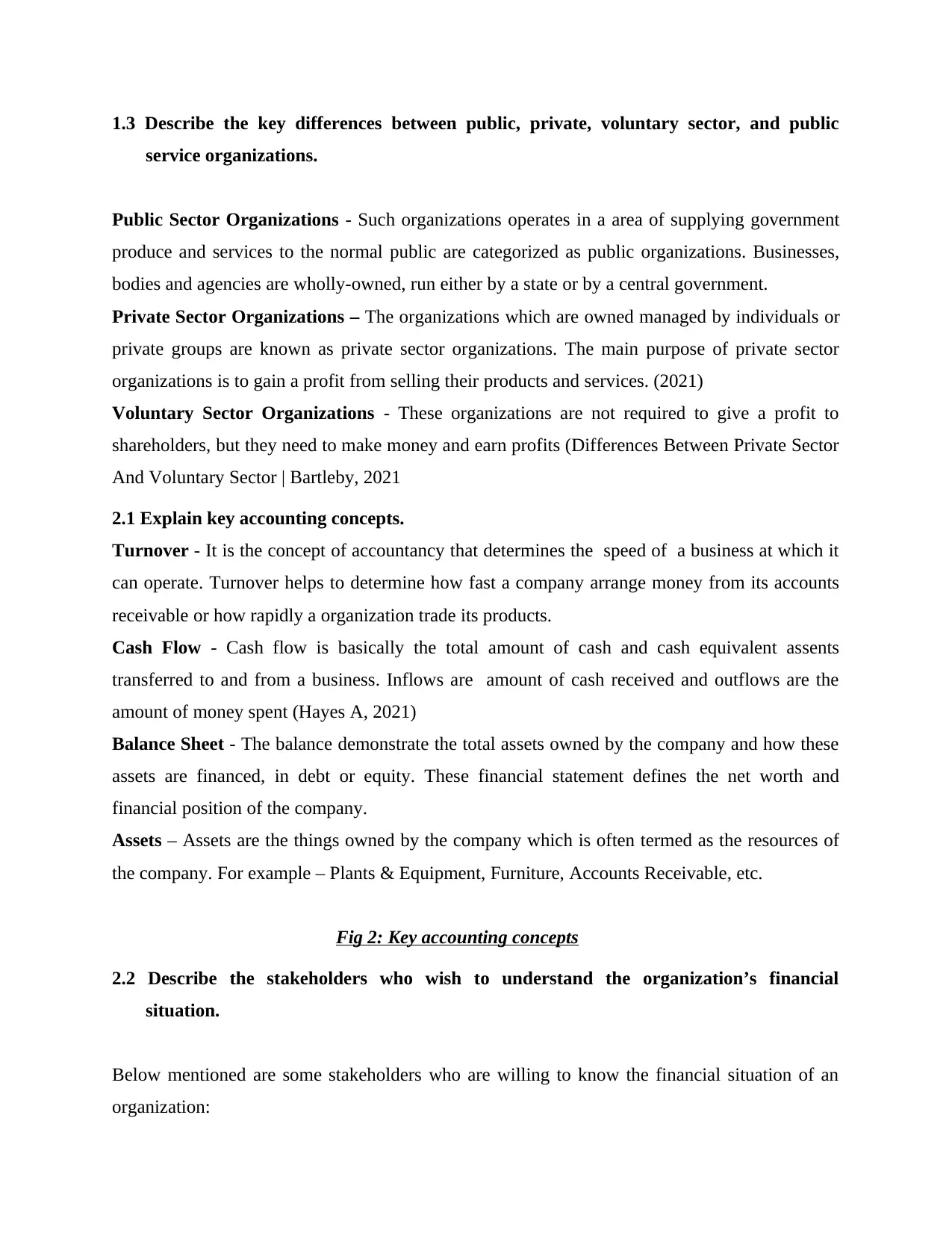
2.1 Explain key accounting concepts.
Turnover - It is the concept of accountancy that determines the speed of a business at which it
can operate. Turnover helps to determine how fast a company arrange money from its accounts
receivable or how rapidly a organization trade its products.
Cash Flow - Cash flow is basically the total amount of cash and cash equivalent assents
transferred to and from a business. Inflows are amount of cash received and outflows are the
amount of money spent (Hayes A, 2021)
Balance Sheet - The balance demonstrate the total assets owned by the company and how these
assets are financed, in debt or equity. These financial statement defines the net worth and
financial position of the company.
Assets – Assets are the things owned by the company which is often termed as the resources of
the company. For example – Plants & Equipment, Furniture, Accounts Receivable, etc.
Fig 2: Key accounting concepts
2.2 Describe the stakeholders who wish to understand the organization’s financial
situation.
Below mentioned are some stakeholders who are willing to know the financial situation of an
organization:
service organizations.
Public Sector Organizations - Such organizations operates in a area of supplying government
produce and services to the normal public are categorized as public organizations. Businesses,
bodies and agencies are wholly-owned, run either by a state or by a central government.
Private Sector Organizations – The organizations which are owned managed by individuals or
private groups are known as private sector organizations. The main purpose of private sector
organizations is to gain a profit from selling their products and services. (2021)
Voluntary Sector Organizations - These organizations are not required to give a profit to
shareholders, but they need to make money and earn profits (Differences Between Private Sector
And Voluntary Sector | Bartleby, 2021
2.1 Explain key accounting concepts.
Turnover - It is the concept of accountancy that determines the speed of a business at which it
can operate. Turnover helps to determine how fast a company arrange money from its accounts
receivable or how rapidly a organization trade its products.
Cash Flow - Cash flow is basically the total amount of cash and cash equivalent assents
transferred to and from a business. Inflows are amount of cash received and outflows are the
amount of money spent (Hayes A, 2021)
Balance Sheet - The balance demonstrate the total assets owned by the company and how these
assets are financed, in debt or equity. These financial statement defines the net worth and
financial position of the company.
Assets – Assets are the things owned by the company which is often termed as the resources of
the company. For example – Plants & Equipment, Furniture, Accounts Receivable, etc.
Fig 2: Key accounting concepts
2.2 Describe the stakeholders who wish to understand the organization’s financial
situation.
Below mentioned are some stakeholders who are willing to know the financial situation of an
organization:
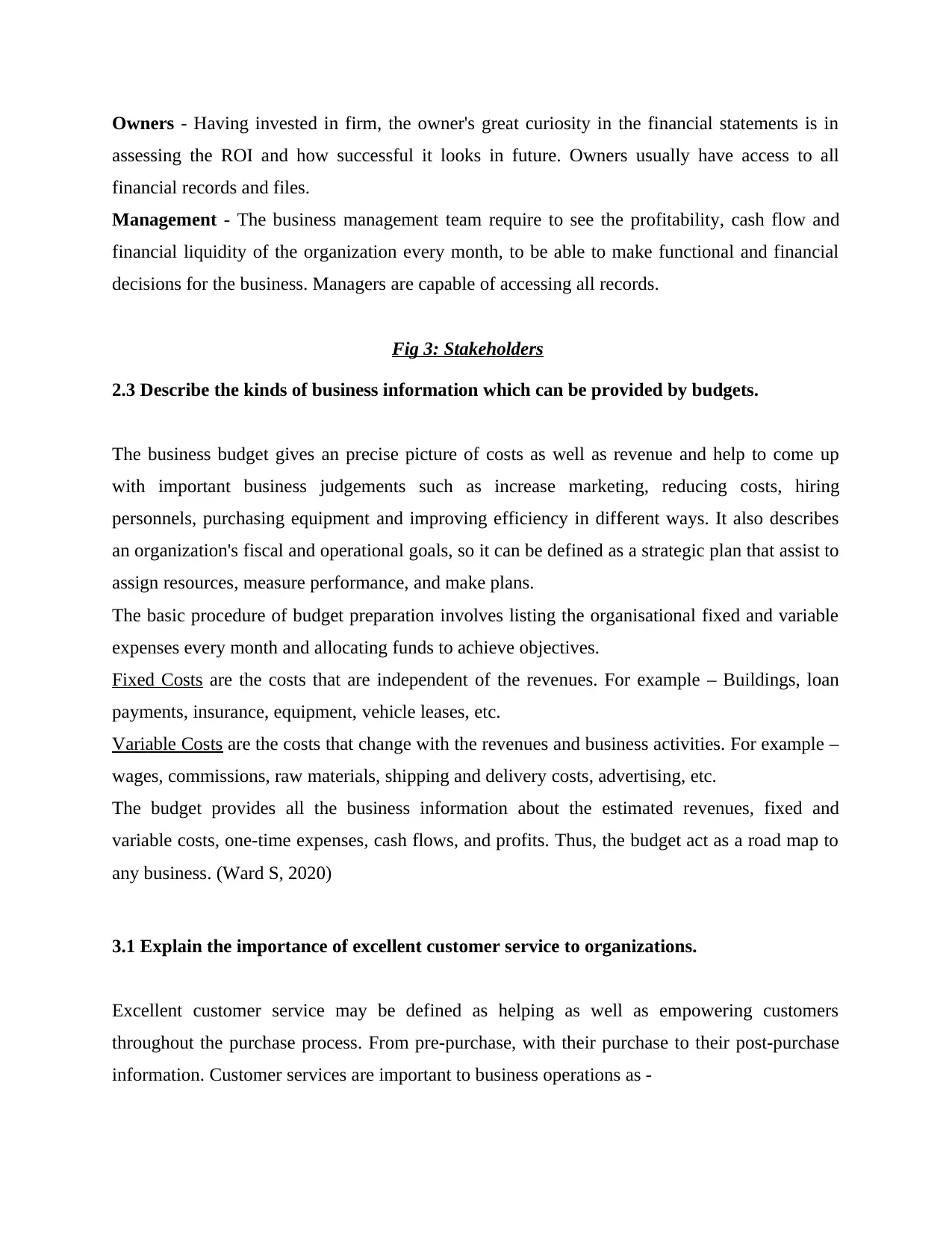
Owners - Having invested in firm, the owner's great curiosity in the financial statements is in
assessing the ROI and how successful it looks in future. Owners usually have access to all
financial records and files.
Management - The business management team require to see the profitability, cash flow and
financial liquidity of the organization every month, to be able to make functional and financial
decisions for the business. Managers are capable of accessing all records.
Fig 3: Stakeholders
2.3 Describe the kinds of business information which can be provided by budgets.
The business budget gives an precise picture of costs as well as revenue and help to come up
with important business judgements such as increase marketing, reducing costs, hiring
personnels, purchasing equipment and improving efficiency in different ways. It also describes
an organization's fiscal and operational goals, so it can be defined as a strategic plan that assist to
assign resources, measure performance, and make plans.
The basic procedure of budget preparation involves listing the organisational fixed and variable
expenses every month and allocating funds to achieve objectives.
Fixed Costs are the costs that are independent of the revenues. For example – Buildings, loan
payments, insurance, equipment, vehicle leases, etc.
Variable Costs are the costs that change with the revenues and business activities. For example –
wages, commissions, raw materials, shipping and delivery costs, advertising, etc.
The budget provides all the business information about the estimated revenues, fixed and
variable costs, one-time expenses, cash flows, and profits. Thus, the budget act as a road map to
any business. (Ward S, 2020)
3.1 Explain the importance of excellent customer service to organizations.
Excellent customer service may be defined as helping as well as empowering customers
throughout the purchase process. From pre-purchase, with their purchase to their post-purchase
information. Customer services are important to business operations as -
assessing the ROI and how successful it looks in future. Owners usually have access to all
financial records and files.
Management - The business management team require to see the profitability, cash flow and
financial liquidity of the organization every month, to be able to make functional and financial
decisions for the business. Managers are capable of accessing all records.
Fig 3: Stakeholders
2.3 Describe the kinds of business information which can be provided by budgets.
The business budget gives an precise picture of costs as well as revenue and help to come up
with important business judgements such as increase marketing, reducing costs, hiring
personnels, purchasing equipment and improving efficiency in different ways. It also describes
an organization's fiscal and operational goals, so it can be defined as a strategic plan that assist to
assign resources, measure performance, and make plans.
The basic procedure of budget preparation involves listing the organisational fixed and variable
expenses every month and allocating funds to achieve objectives.
Fixed Costs are the costs that are independent of the revenues. For example – Buildings, loan
payments, insurance, equipment, vehicle leases, etc.
Variable Costs are the costs that change with the revenues and business activities. For example –
wages, commissions, raw materials, shipping and delivery costs, advertising, etc.
The budget provides all the business information about the estimated revenues, fixed and
variable costs, one-time expenses, cash flows, and profits. Thus, the budget act as a road map to
any business. (Ward S, 2020)
3.1 Explain the importance of excellent customer service to organizations.
Excellent customer service may be defined as helping as well as empowering customers
throughout the purchase process. From pre-purchase, with their purchase to their post-purchase
information. Customer services are important to business operations as -
⊘ This is a preview!⊘
Do you want full access?
Subscribe today to unlock all pages.
Trusted by 1+ million students worldwide
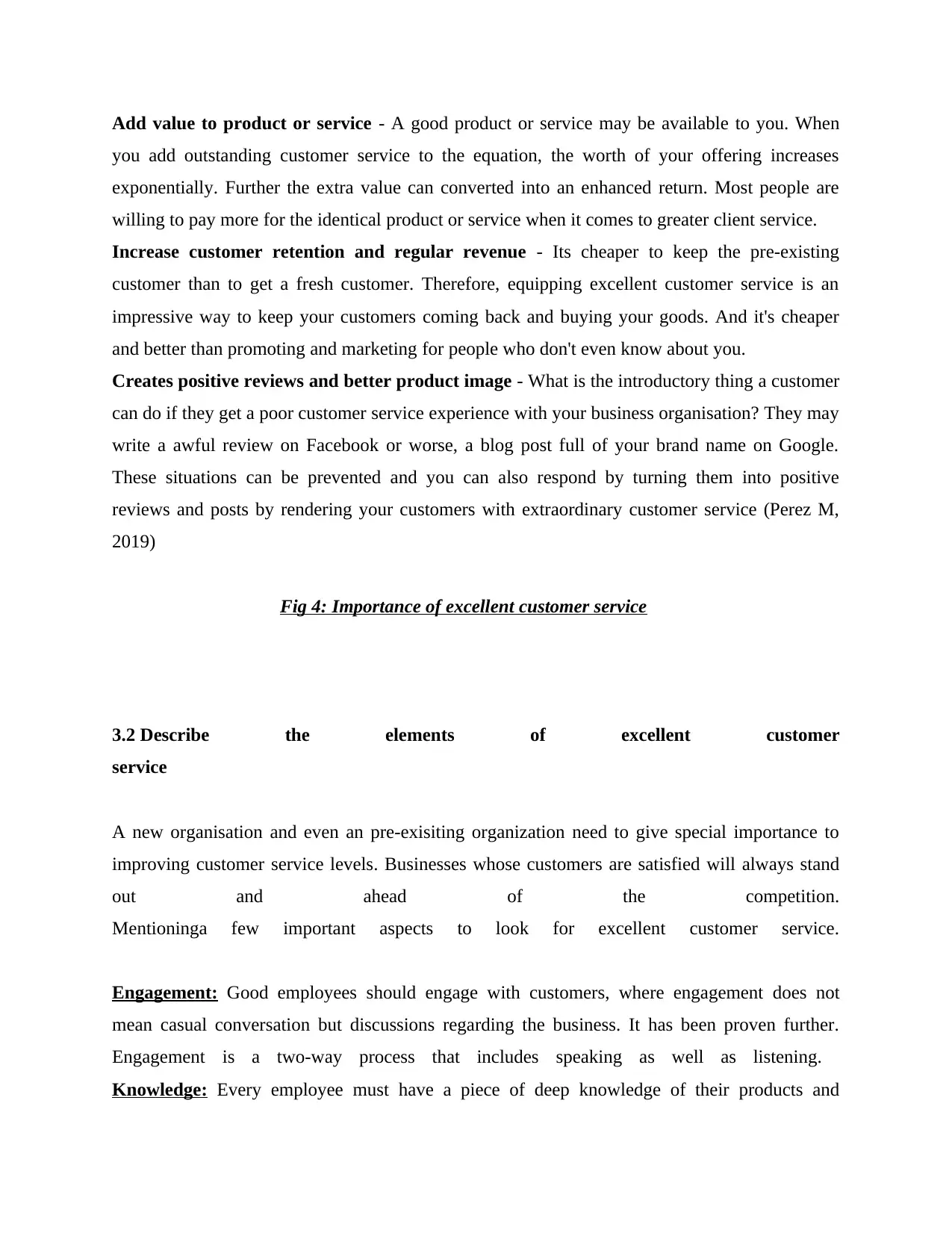
Add value to product or service - A good product or service may be available to you. When
you add outstanding customer service to the equation, the worth of your offering increases
exponentially. Further the extra value can converted into an enhanced return. Most people are
willing to pay more for the identical product or service when it comes to greater client service.
Increase customer retention and regular revenue - Its cheaper to keep the pre-existing
customer than to get a fresh customer. Therefore, equipping excellent customer service is an
impressive way to keep your customers coming back and buying your goods. And it's cheaper
and better than promoting and marketing for people who don't even know about you.
Creates positive reviews and better product image - What is the introductory thing a customer
can do if they get a poor customer service experience with your business organisation? They may
write a awful review on Facebook or worse, a blog post full of your brand name on Google.
These situations can be prevented and you can also respond by turning them into positive
reviews and posts by rendering your customers with extraordinary customer service (Perez M,
2019)
Fig 4: Importance of excellent customer service
3.2 Describe the elements of excellent customer
service
A new organisation and even an pre-exisiting organization need to give special importance to
improving customer service levels. Businesses whose customers are satisfied will always stand
out and ahead of the competition.
Mentioninga few important aspects to look for excellent customer service.
Engagement: Good employees should engage with customers, where engagement does not
mean casual conversation but discussions regarding the business. It has been proven further.
Engagement is a two-way process that includes speaking as well as listening.
Knowledge: Every employee must have a piece of deep knowledge of their products and
you add outstanding customer service to the equation, the worth of your offering increases
exponentially. Further the extra value can converted into an enhanced return. Most people are
willing to pay more for the identical product or service when it comes to greater client service.
Increase customer retention and regular revenue - Its cheaper to keep the pre-existing
customer than to get a fresh customer. Therefore, equipping excellent customer service is an
impressive way to keep your customers coming back and buying your goods. And it's cheaper
and better than promoting and marketing for people who don't even know about you.
Creates positive reviews and better product image - What is the introductory thing a customer
can do if they get a poor customer service experience with your business organisation? They may
write a awful review on Facebook or worse, a blog post full of your brand name on Google.
These situations can be prevented and you can also respond by turning them into positive
reviews and posts by rendering your customers with extraordinary customer service (Perez M,
2019)
Fig 4: Importance of excellent customer service
3.2 Describe the elements of excellent customer
service
A new organisation and even an pre-exisiting organization need to give special importance to
improving customer service levels. Businesses whose customers are satisfied will always stand
out and ahead of the competition.
Mentioninga few important aspects to look for excellent customer service.
Engagement: Good employees should engage with customers, where engagement does not
mean casual conversation but discussions regarding the business. It has been proven further.
Engagement is a two-way process that includes speaking as well as listening.
Knowledge: Every employee must have a piece of deep knowledge of their products and
Paraphrase This Document
Need a fresh take? Get an instant paraphrase of this document with our AI Paraphraser
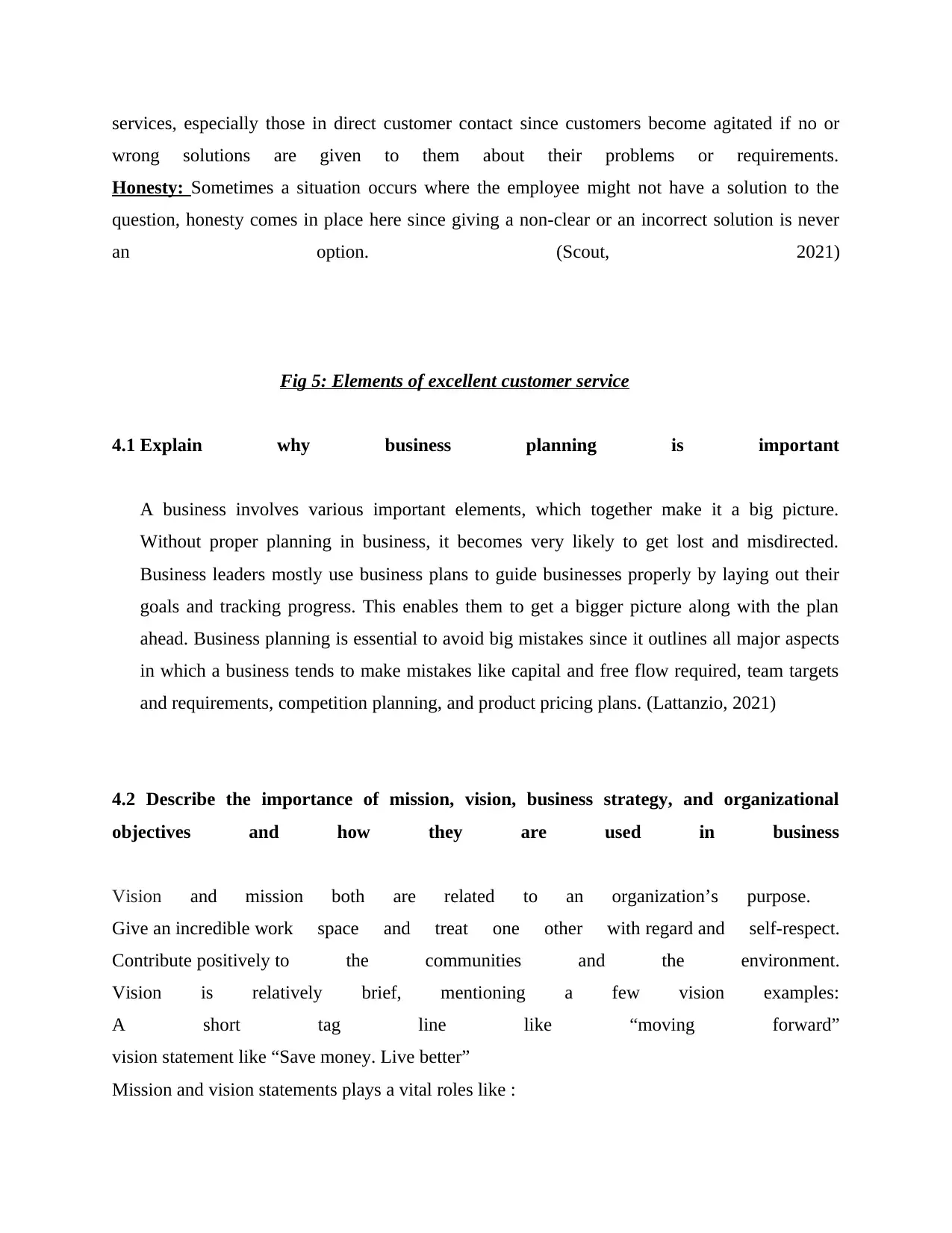
services, especially those in direct customer contact since customers become agitated if no or
wrong solutions are given to them about their problems or requirements.
Honesty: Sometimes a situation occurs where the employee might not have a solution to the
question, honesty comes in place here since giving a non-clear or an incorrect solution is never
an option. (Scout, 2021)
Fig 5: Elements of excellent customer service
4.1 Explain why business planning is important
A business involves various important elements, which together make it a big picture.
Without proper planning in business, it becomes very likely to get lost and misdirected.
Business leaders mostly use business plans to guide businesses properly by laying out their
goals and tracking progress. This enables them to get a bigger picture along with the plan
ahead. Business planning is essential to avoid big mistakes since it outlines all major aspects
in which a business tends to make mistakes like capital and free flow required, team targets
and requirements, competition planning, and product pricing plans. (Lattanzio, 2021)
4.2 Describe the importance of mission, vision, business strategy, and organizational
objectives and how they are used in business
Vision and mission both are related to an organization’s purpose.
Give an incredible work space and treat one other with regard and self-respect.
Contribute positively to the communities and the environment.
Vision is relatively brief, mentioning a few vision examples:
A short tag line like “moving forward”
vision statement like “Save money. Live better”
Mission and vision statements plays a vital roles like :
wrong solutions are given to them about their problems or requirements.
Honesty: Sometimes a situation occurs where the employee might not have a solution to the
question, honesty comes in place here since giving a non-clear or an incorrect solution is never
an option. (Scout, 2021)
Fig 5: Elements of excellent customer service
4.1 Explain why business planning is important
A business involves various important elements, which together make it a big picture.
Without proper planning in business, it becomes very likely to get lost and misdirected.
Business leaders mostly use business plans to guide businesses properly by laying out their
goals and tracking progress. This enables them to get a bigger picture along with the plan
ahead. Business planning is essential to avoid big mistakes since it outlines all major aspects
in which a business tends to make mistakes like capital and free flow required, team targets
and requirements, competition planning, and product pricing plans. (Lattanzio, 2021)
4.2 Describe the importance of mission, vision, business strategy, and organizational
objectives and how they are used in business
Vision and mission both are related to an organization’s purpose.
Give an incredible work space and treat one other with regard and self-respect.
Contribute positively to the communities and the environment.
Vision is relatively brief, mentioning a few vision examples:
A short tag line like “moving forward”
vision statement like “Save money. Live better”
Mission and vision statements plays a vital roles like :
- Communicating the goal of the organization to its stakeholders
- Informing about strategy development
- Creating a target for strategy development.
The strategy flows specifically from the vision since is it critical because it is pointed to attain
the vision and fulfill the organization’s mission strategy gives a special guide, towards objectives
and targets showing success or disappointment of the technique &fulfillment of bigger set of
objectives mentioned within the mission (publisher], 2021)
4.3 Explain the key elements of a business plan and how it is created
The key elements of a business plan are moreover the same, whether it is for a huge scale
business or a small scale one. It should inculcate the similar elements of a business plan opted by
business jumbos such as Flipkart and Samsung.
Executive Summary
An executive summary of the business plan gives the reader with a clear idea of the company's
goals and profile. It must include a mission statement, history of the organization and highlights
of the company's growth rate, products, and services with a sum-up of upcoming aims.
Product Description
The description must include details about the product's life cycle, any research and development
actions planned. Including any patents or trademarked sections to the product or service does
also hold value.
Company Information
This includes details about the company like what it does and what necessities of the company
can fulfill in the marketplace. It also describes how the company's goods or services specifically
meer the market needs.
- Informing about strategy development
- Creating a target for strategy development.
The strategy flows specifically from the vision since is it critical because it is pointed to attain
the vision and fulfill the organization’s mission strategy gives a special guide, towards objectives
and targets showing success or disappointment of the technique &fulfillment of bigger set of
objectives mentioned within the mission (publisher], 2021)
4.3 Explain the key elements of a business plan and how it is created
The key elements of a business plan are moreover the same, whether it is for a huge scale
business or a small scale one. It should inculcate the similar elements of a business plan opted by
business jumbos such as Flipkart and Samsung.
Executive Summary
An executive summary of the business plan gives the reader with a clear idea of the company's
goals and profile. It must include a mission statement, history of the organization and highlights
of the company's growth rate, products, and services with a sum-up of upcoming aims.
Product Description
The description must include details about the product's life cycle, any research and development
actions planned. Including any patents or trademarked sections to the product or service does
also hold value.
Company Information
This includes details about the company like what it does and what necessities of the company
can fulfill in the marketplace. It also describes how the company's goods or services specifically
meer the market needs.
⊘ This is a preview!⊘
Do you want full access?
Subscribe today to unlock all pages.
Trusted by 1+ million students worldwide
Marketing and Sales
This factor of the business plan must talk about the business's marketing participation strategy, a
strategy for growth of the company when market involvement has been achieved.
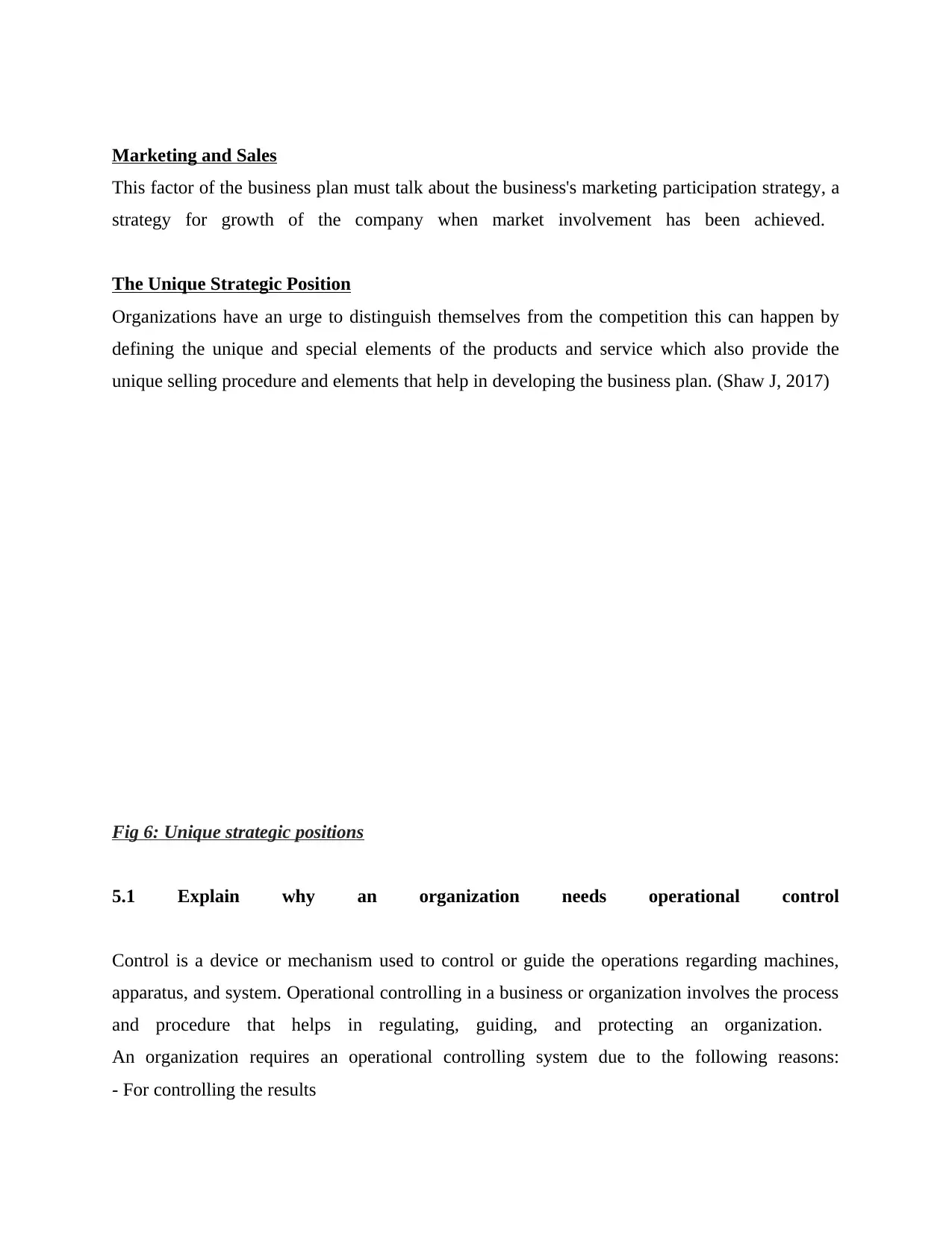
The Unique Strategic Position
Organizations have an urge to distinguish themselves from the competition this can happen by
defining the unique and special elements of the products and service which also provide the
unique selling procedure and elements that help in developing the business plan. (Shaw J, 2017)
Fig 6: Unique strategic positions
5.1 Explain why an organization needs operational control
Control is a device or mechanism used to control or guide the operations regarding machines,
apparatus, and system. Operational controlling in a business or organization involves the process
and procedure that helps in regulating, guiding, and protecting an organization.
An organization requires an operational controlling system due to the following reasons:
- For controlling the results
This factor of the business plan must talk about the business's marketing participation strategy, a
strategy for growth of the company when market involvement has been achieved.
The Unique Strategic Position
Organizations have an urge to distinguish themselves from the competition this can happen by
defining the unique and special elements of the products and service which also provide the
unique selling procedure and elements that help in developing the business plan. (Shaw J, 2017)
Fig 6: Unique strategic positions
5.1 Explain why an organization needs operational control
Control is a device or mechanism used to control or guide the operations regarding machines,
apparatus, and system. Operational controlling in a business or organization involves the process
and procedure that helps in regulating, guiding, and protecting an organization.
An organization requires an operational controlling system due to the following reasons:
- For controlling the results
Paraphrase This Document
Need a fresh take? Get an instant paraphrase of this document with our AI Paraphraser
- For using existing resources to improve
- For better effectiveness
- To transform better internal reporting system
- To have a balanced budgetary control
- For operational planning/budgeting
There are three organizational control types including familiar feedback, proactive, & concurrent
controls. It allows identifying intermediate objectives concerning the objectives set in strategic
planning. Operational controlling gives a wide source of data essential to
control primary economic processes (Milano S, 2019).
5.2 Describe the organizations of the system used to achieve operational control
Separated from making an appropriate organizationalstructure, effectively executing strategy
depends on the skill-full use of the organizational control framework. The common types of
control systems include:
Output Control
Output control mainly centred on measurable outcomes in an organization. Examples of output
control include the figures of hits a particular site acquire daily, the number of microwaves an
assembly line is producing per period of time and the number of automobiles, a car salesman
sells per month.
Behavioural Control
- For better effectiveness
- To transform better internal reporting system
- To have a balanced budgetary control
- For operational planning/budgeting
There are three organizational control types including familiar feedback, proactive, & concurrent
controls. It allows identifying intermediate objectives concerning the objectives set in strategic
planning. Operational controlling gives a wide source of data essential to
control primary economic processes (Milano S, 2019).
5.2 Describe the organizations of the system used to achieve operational control
Separated from making an appropriate organizationalstructure, effectively executing strategy
depends on the skill-full use of the organizational control framework. The common types of
control systems include:
Output Control
Output control mainly centred on measurable outcomes in an organization. Examples of output
control include the figures of hits a particular site acquire daily, the number of microwaves an
assembly line is producing per period of time and the number of automobiles, a car salesman
sells per month.
Behavioural Control
Behavioral control mainly emphasis on regulating the actions that lead to results, various rules
and procedures are explored to bring standards or to dictate behavior. Various examples of
behavior control include posting signs in bathrooms of restaurants notifying the workers that
they need to wash their hands before they return to work
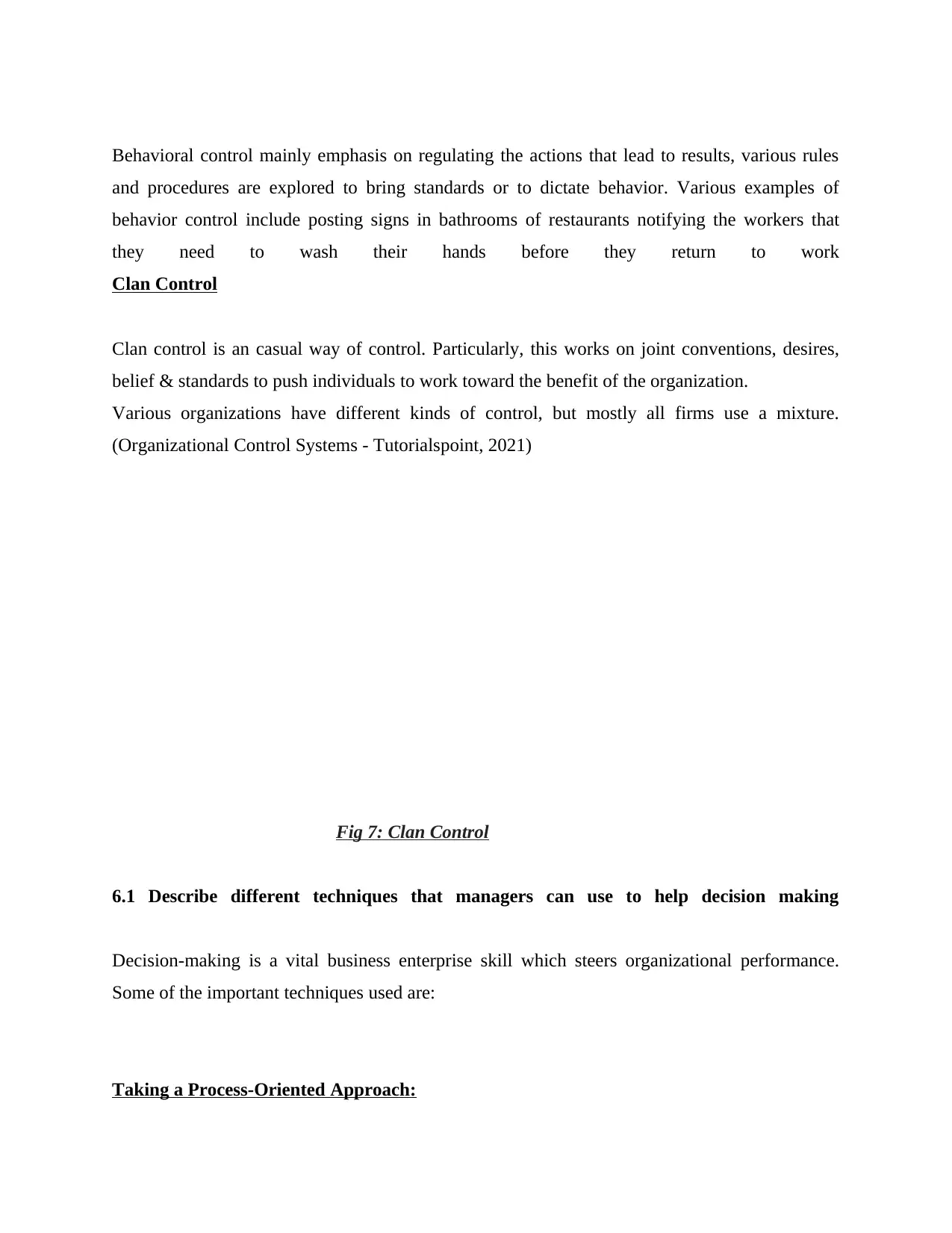
Clan Control
Clan control is an casual way of control. Particularly, this works on joint conventions, desires,
belief & standards to push individuals to work toward the benefit of the organization.
Various organizations have different kinds of control, but mostly all firms use a mixture.
(Organizational Control Systems - Tutorialspoint, 2021)
Fig 7: Clan Control
6.1 Describe different techniques that managers can use to help decision making
Decision-making is a vital business enterprise skill which steers organizational performance.
Some of the important techniques used are:
Taking a Process-Oriented Approach:
and procedures are explored to bring standards or to dictate behavior. Various examples of
behavior control include posting signs in bathrooms of restaurants notifying the workers that
they need to wash their hands before they return to work
Clan Control
Clan control is an casual way of control. Particularly, this works on joint conventions, desires,
belief & standards to push individuals to work toward the benefit of the organization.
Various organizations have different kinds of control, but mostly all firms use a mixture.
(Organizational Control Systems - Tutorialspoint, 2021)
Fig 7: Clan Control
6.1 Describe different techniques that managers can use to help decision making
Decision-making is a vital business enterprise skill which steers organizational performance.
Some of the important techniques used are:
Taking a Process-Oriented Approach:
⊘ This is a preview!⊘
Do you want full access?
Subscribe today to unlock all pages.
Trusted by 1+ million students worldwide

1 out of 17


Related Documents


Your All-in-One AI-Powered Toolkit for Academic Success.
+13062052269
info@desklib.com
Available 24*7 on WhatsApp / Email
![[object Object]](/_next/static/media/star-bottom.7253800d.svg)
Unlock your academic potential
Copyright © 2020–2026 A2Z Services. All Rights Reserved. Developed and managed by ZUCOL.