Managing Barriers: Individual Learning in Group Dynamics

Verified

Added on  2023/06/10

|9
|926
|102
Report
AI Summary
This report delves into the multifaceted aspects of managing class dynamics to facilitate optimal learning and development. It examines the characteristics of group environments that promote effective learning, focusing on creating safe, validating, and encouraging spaces where students can freely express themselves. The report outlines key strategies for managing group dynamics, emphasizing the importance of understanding group members, addressing issues promptly, and adapting to different stages of group development. Furthermore, it explores methods for actively involving learners in managing their own learning within groups, such as setting clear objectives, providing relevant learning experiences, and fostering a supportive learning environment. Lastly, the report addresses common barriers to individual learning in group settings, highlighting the significance of building self-belief and offering relevant context to enhance learner engagement and overall development. This document is available on Desklib, where students can find a wealth of resources, including past papers and solved assignments.
Document Page
MANAGEMENT OF
CLASS DYNAMICS
tabler-icon-diamond-filled.svg

Paraphrase This Document

Need a fresh take? Get an instant paraphrase of this document with our AI Paraphraser
Document Page
TABLE OF CONTENTS
Introduction
The characteristics of group environments that facilitate learning and development.
Strategies to manage group dynamics.
Ways to involve learners in the management of their own learning and development in groups
Managing barriers to individual learning in groups.
Conclusion
REFERENCES
Document Page
INTRODUCTION
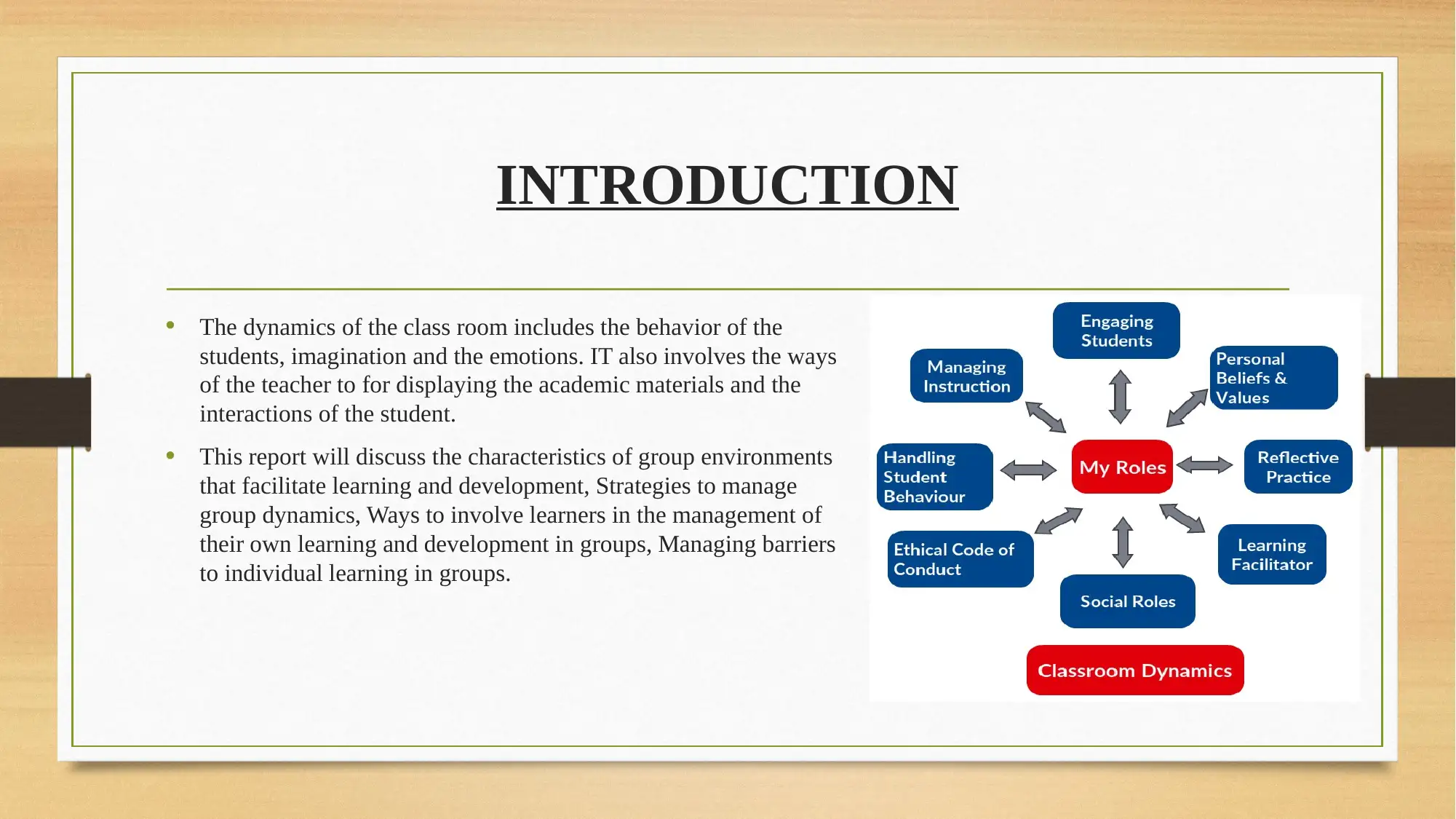
The dynamics of the class room includes the behavior of the
students, imagination and the emotions. IT also involves the ways
of the teacher to for displaying the academic materials and the
interactions of the student.
This report will discuss the characteristics of group environments
that facilitate learning and development, Strategies to manage
group dynamics, Ways to involve learners in the management of
their own learning and development in groups, Managing barriers
to individual learning in groups.
Document Page
1.2 The characteristics of group environments that
facilitate learning and development.
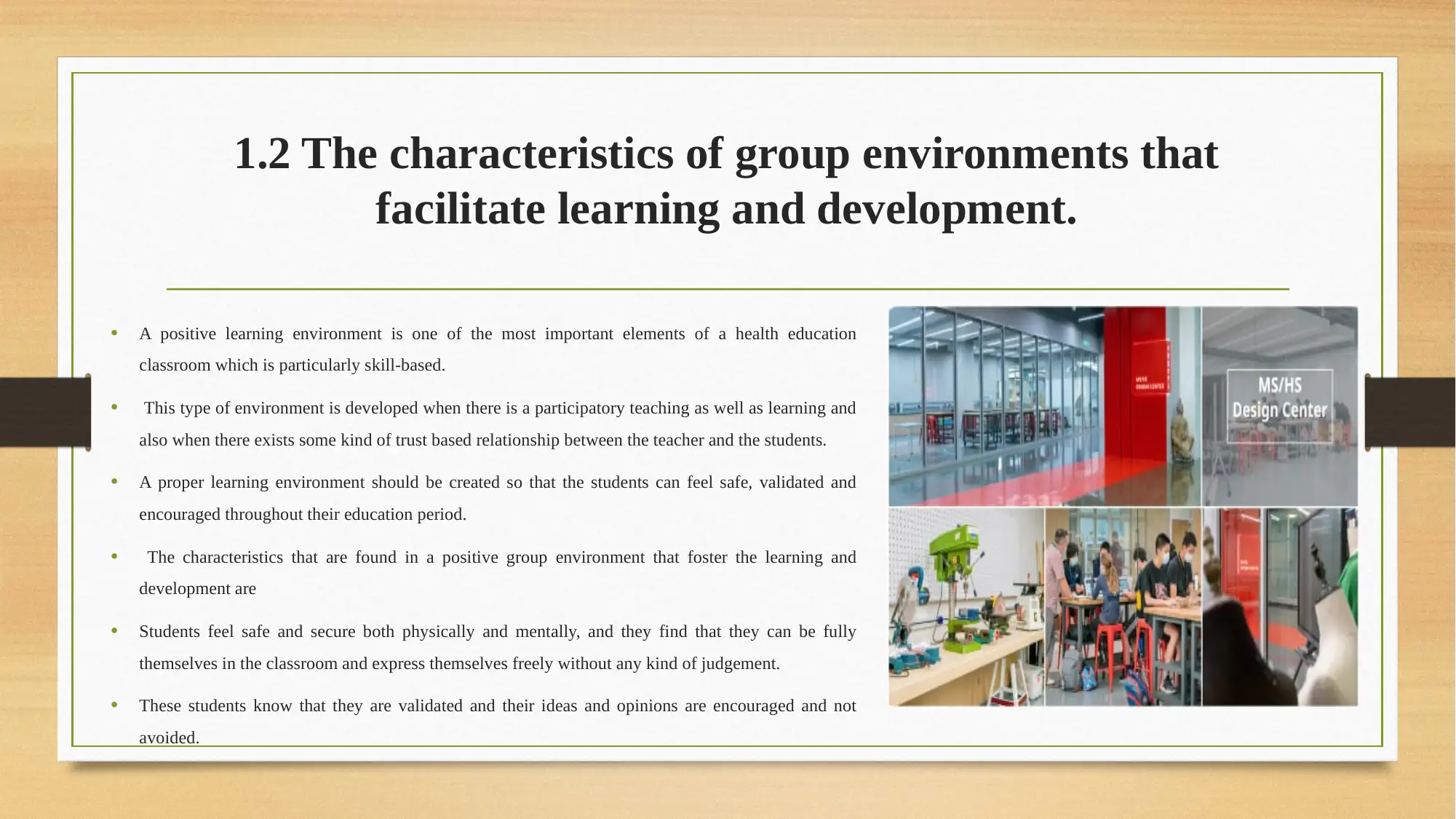
A positive learning environment is one of the most important elements of a health education
classroom which is particularly skill-based.
This type of environment is developed when there is a participatory teaching as well as learning and
also when there exists some kind of trust based relationship between the teacher and the students.
A proper learning environment should be created so that the students can feel safe, validated and
encouraged throughout their education period.
The characteristics that are found in a positive group environment that foster the learning and
development are
Students feel safe and secure both physically and mentally, and they find that they can be fully
themselves in the classroom and express themselves freely without any kind of judgement.
These students know that they are validated and their ideas and opinions are encouraged and not
avoided.
tabler-icon-diamond-filled.svg

Paraphrase This Document

Need a fresh take? Get an instant paraphrase of this document with our AI Paraphraser
Document Page
1.2 Strategies to manage group dynamics.
The first strategy to improve the dynamics of the group is by understanding the people in the group like it
depends upon field of specialization in which a particular group excels and the ways of improving them.
However it totally depends upon the personality type of the members in the group and likewise there should
be a proper understanding of the stages of the group development like the forming, storming, norming,
performing and the adjourning stage and comprehending that which stage is important for the particular type
of group.
This will permit to avoid the chances of the increasing problems that can arise in the future.
Addressing the issues as fast as possible is also one of the best strategy for improving the group dynamics.
Whenever any problems arise it should be solved as soon as possible to avoid any confusion and chaos in the
near future.
Document Page
1.3 Ways to involve learners in the management of their own learning and
development in groups
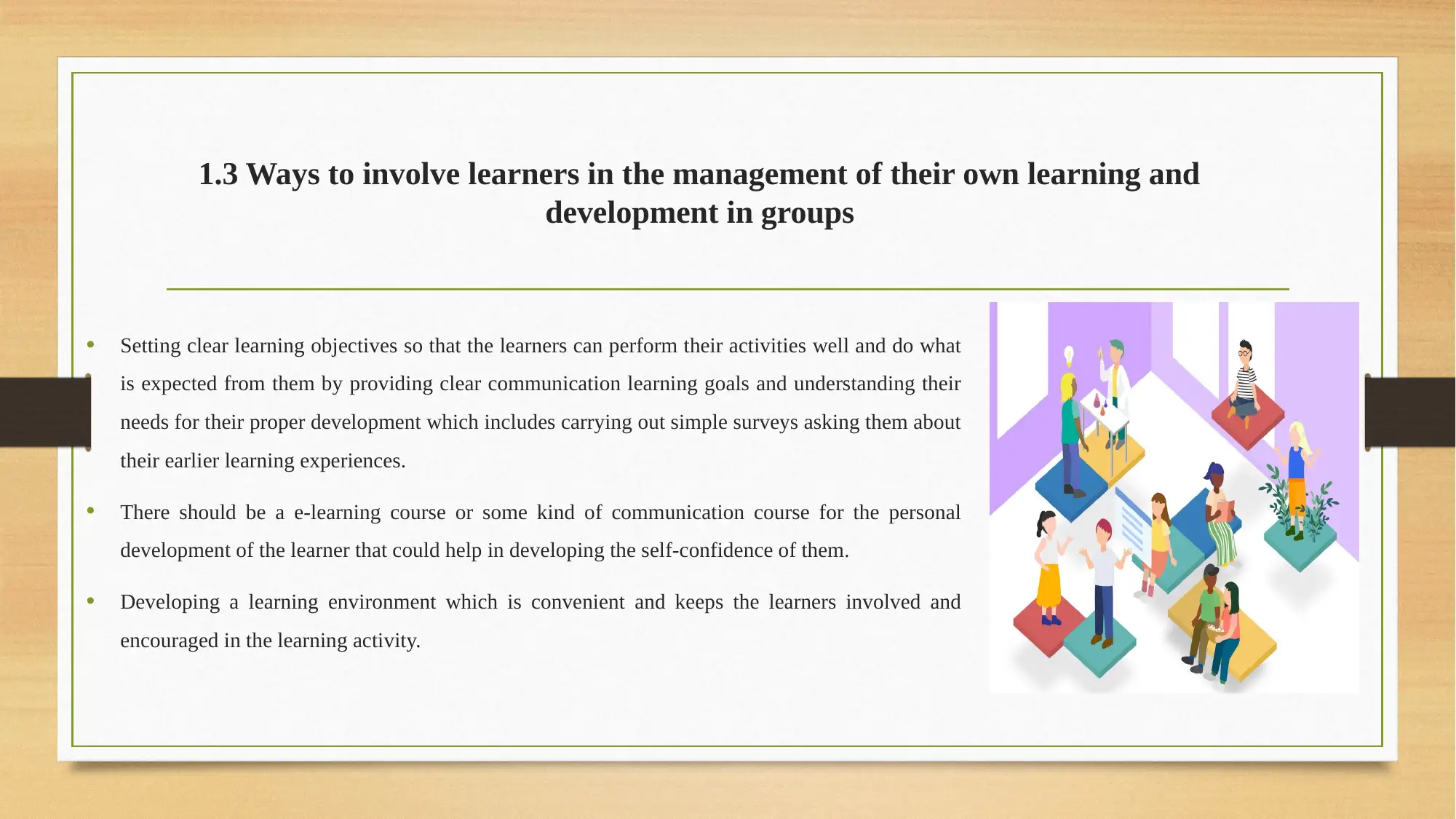
Setting clear learning objectives so that the learners can perform their activities well and do what
is expected from them by providing clear communication learning goals and understanding their
needs for their proper development which includes carrying out simple surveys asking them about
their earlier learning experiences.
There should be a e-learning course or some kind of communication course for the personal
development of the learner that could help in developing the self-confidence of them.
Developing a learning environment which is convenient and keeps the learners involved and
encouraged in the learning activity.
Document Page
1.4 Managing barriers to individual learning in groups.
Start with believing- The learners are more likely to get success when
someone believe in themselves.
Firstly, these learners should start believing in themselves as failure and
struggle are part of the success, but they should never lose hope.
Offering context and relevance- When the learners are able to connect to
something that they feel relevant then the actual learning takes place as
they realise some topic related to their personal interests which leads to
their actual and overall development.
tabler-icon-diamond-filled.svg

Paraphrase This Document

Need a fresh take? Get an instant paraphrase of this document with our AI Paraphraser
Document Page
CONCLUSION
The management of the class dynamics provides the benefits to the success of the
students by which they learn and the way in which they maintain the balance.
This report will discuss the characteristics of group environments that facilitate learning
and development, Strategies to manage group dynamics, Ways to involve learners in the
management of their own learning and development in groups, Managing barriers to
individual learning in groups.
Document Page
REFERENCES
Djenontin, I.N.S. and Meadow, A.M., 2018. The art of co-production of knowledge in environmental sciences and management: lessons
from international practice. Environmental management.61(6), pp.885-903.
Fotaris, P. and Mastoras, T., 2019, October. Escape rooms for learning: A systematic review. In Proceedings of the European Conference
on Games Based Learning(pp. 235-243).
Ibáñez, M.B. and Delgado-Kloos, C., 2018. Augmented reality for STEM learning: A systematic review.Computers & Education.123,
pp.109-123.
Medina, L.C., 2018. Blended learning: Deficits and prospects in higher education. Australasian Journal of Educational Technology.34(1).
Romero, C. and Ventura, S., 2020. Educational data mining and learning analytics: An updated survey.Wiley Interdisciplinary Reviews:
Data Mining and Knowledge Discovery.10(3), p.e1355.
chevron_up_icon
1 out of 9
circle_padding
hide_on_mobile
zoom_out_icon
[object Object]