Financial Information and Decisions in Health and Social Care
VerifiedAdded on 2023/06/07
|12
|3622
|169
Report
AI Summary
This report examines financial management within the health and social care sector, focusing on the Care Quality Commission in the UK. It highlights the importance of financial information in managing health and social care organizations, including the role of accounting and financial management in evaluating performance and planning for future growth. The report discusses various sources of finance available to these organizations, differentiating between long-term sources like government grants and financial institution loans, and short-term sources such as donations and past year profits. It also evaluates the benefits and limitations of these funding sources. Furthermore, the report explores the process of budgetary control and revenue management, emphasizing the comparison between estimated and actual performance, variance calculation, and identifying reasons for budget failures. It also touches upon the utilization of financial software for financial control, cost-saving, decision-making improvement and data security.
Managing Finance in
the Health and Social
Care Sector
the Health and Social
Care Sector

Paraphrase This Document
Need a fresh take? Get an instant paraphrase of this document with our AI Paraphraser
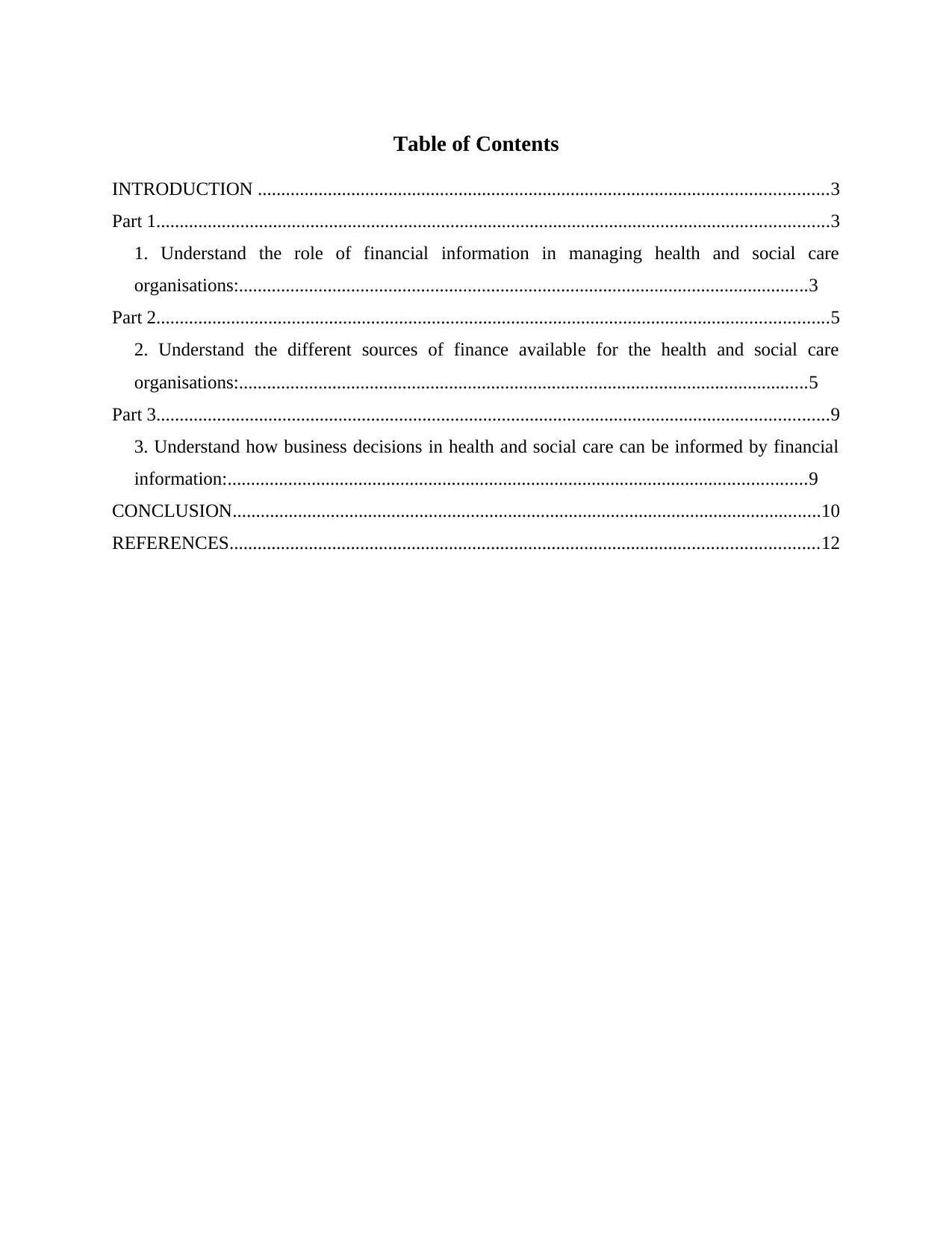
Table of Contents
INTRODUCTION ..........................................................................................................................3
Part 1................................................................................................................................................3
1. Understand the role of financial information in managing health and social care
organisations:..........................................................................................................................3
Part 2................................................................................................................................................5
2. Understand the different sources of finance available for the health and social care
organisations:..........................................................................................................................5
Part 3................................................................................................................................................9
3. Understand how business decisions in health and social care can be informed by financial
information:............................................................................................................................9
CONCLUSION..............................................................................................................................10
REFERENCES..............................................................................................................................12
INTRODUCTION ..........................................................................................................................3
Part 1................................................................................................................................................3
1. Understand the role of financial information in managing health and social care
organisations:..........................................................................................................................3
Part 2................................................................................................................................................5
2. Understand the different sources of finance available for the health and social care
organisations:..........................................................................................................................5
Part 3................................................................................................................................................9
3. Understand how business decisions in health and social care can be informed by financial
information:............................................................................................................................9
CONCLUSION..............................................................................................................................10
REFERENCES..............................................................................................................................12
INTRODUCTION
Financial management refers to function of business by the help of which the
organisations can invest their money so that they can get high rate of returns. Financial activities
are considered as a universal activities. It is because the financial activities are used in every type
of organisation. It can be business , it can be non profit organisation, and can also be social care
organisation. Financial function also include accounting through which the organisations can
easily evaluate their performance in a particular accounting period (Abdel-Basset and et.al.,
2020). This report contains the study of Care Quality Commission which is based UK. The
headquarter of this organisation is situated in England. The importance of financial management
and accounting in the social care organisation are to be explained in the below report. Various
sources of finance for Care Quality commission are going to be discussed in the report.
Part 1
1. Understand the role of financial information in managing health and social care organisations:
Financial information helps the organisation in determining the performance of their
operations which they have done throughout the year. By the help of financial information the
organisation can analyse or evaluate their expenditures for the whole year. Due to this they can
estimate their spending for the next year. By the help of this activity the organisation can also
analyse the sectors where the organisation have spend their most amount of money. Importance
of accounting and financial management are given below.
a) Explain the importance of accounting and finance management in the context of a health
and social care organisation.
Importance of Financial Management in Care Quality Commission.
Financial management helps the organisation in evaluating financial power and
operational activities of the health care organisation. Due to this activity they can plan for future
growth of the business. The next and very important feature of financial management is that it
helps the organisation in taking decisions related to the investments (Aung, Luan and Xu, 2019).
By the help of financial management the organisations are able to analyse the market condition
perfectly.
Importance of Accounting in health and social care organisation-
Financial management refers to function of business by the help of which the
organisations can invest their money so that they can get high rate of returns. Financial activities
are considered as a universal activities. It is because the financial activities are used in every type
of organisation. It can be business , it can be non profit organisation, and can also be social care
organisation. Financial function also include accounting through which the organisations can
easily evaluate their performance in a particular accounting period (Abdel-Basset and et.al.,
2020). This report contains the study of Care Quality Commission which is based UK. The
headquarter of this organisation is situated in England. The importance of financial management
and accounting in the social care organisation are to be explained in the below report. Various
sources of finance for Care Quality commission are going to be discussed in the report.
Part 1
1. Understand the role of financial information in managing health and social care organisations:
Financial information helps the organisation in determining the performance of their
operations which they have done throughout the year. By the help of financial information the
organisation can analyse or evaluate their expenditures for the whole year. Due to this they can
estimate their spending for the next year. By the help of this activity the organisation can also
analyse the sectors where the organisation have spend their most amount of money. Importance
of accounting and financial management are given below.
a) Explain the importance of accounting and finance management in the context of a health
and social care organisation.
Importance of Financial Management in Care Quality Commission.
Financial management helps the organisation in evaluating financial power and
operational activities of the health care organisation. Due to this activity they can plan for future
growth of the business. The next and very important feature of financial management is that it
helps the organisation in taking decisions related to the investments (Aung, Luan and Xu, 2019).
By the help of financial management the organisations are able to analyse the market condition
perfectly.
Importance of Accounting in health and social care organisation-
⊘ This is a preview!⊘
Do you want full access?
Subscribe today to unlock all pages.

Trusted by 1+ million students worldwide
As discussed earlier in the report, accounting can play a vital role with offering numerous
benefits in health and social care centre. Healthcare includes some accounting procedure such as
collecting patient co-pay, patient eligibility, medical facility and payment received through
claims. These standard are applicable to organisation to manage statements, reports and financial
activity (Bohle and Greskovits, 2019). With the proper accounting system, organisation can
ensure a high integrity in performing its operations. To run the operations efficiently the
healthcare centre managers carry out functions like accounting. Through this they can easily
analyse the financial position and ability of the organisation to carry out their activities. By the
help of accounting the healthcare organisations able to get the real value of their assets.
b) Evaluate how financial software is utilised within the accounting functions of
organisations.
Financial control- The very first use of accounting software in the organisation is
financial control. By the help of accounting software the organisation are able to track their
incomes and expenditures. The accounting software did not require a professional person. If any
member of the organisation get small training related to accounting software. Then they will be
able to manage their revenues and expenditures as result the financial of the organisations are
automatically control by the organisation.
Cost Saving- If any member get a training related to the accounting software then they
are able to keep the records by themselves. Due to this action they did not require any third for
maintaining their accounting record which lead to saving of cost of the organisation.
Improving Decision Making- The `next very important benefit of accounting software is
it helps in improving decision making of the organisation. It is because the data provided by the
accounting software in the organisation are accurate. The top level management of the
organisation take their decisions after analysing that data. Due to this they are able to take
effective and efficient decisions.
Ensure Data Security- Accounting software helps the organisation in ensuring the data
security. It is because the data in the software is protected by the firewalls. The software also
provide password security feature through which any third party cannot be able to access the data
of the organisation (Brouder, 2020).
c) Describe how key financial ratios are used by health and social care organisations:
benefits in health and social care centre. Healthcare includes some accounting procedure such as
collecting patient co-pay, patient eligibility, medical facility and payment received through
claims. These standard are applicable to organisation to manage statements, reports and financial
activity (Bohle and Greskovits, 2019). With the proper accounting system, organisation can
ensure a high integrity in performing its operations. To run the operations efficiently the
healthcare centre managers carry out functions like accounting. Through this they can easily
analyse the financial position and ability of the organisation to carry out their activities. By the
help of accounting the healthcare organisations able to get the real value of their assets.
b) Evaluate how financial software is utilised within the accounting functions of
organisations.
Financial control- The very first use of accounting software in the organisation is
financial control. By the help of accounting software the organisation are able to track their
incomes and expenditures. The accounting software did not require a professional person. If any
member of the organisation get small training related to accounting software. Then they will be
able to manage their revenues and expenditures as result the financial of the organisations are
automatically control by the organisation.
Cost Saving- If any member get a training related to the accounting software then they
are able to keep the records by themselves. Due to this action they did not require any third for
maintaining their accounting record which lead to saving of cost of the organisation.
Improving Decision Making- The `next very important benefit of accounting software is
it helps in improving decision making of the organisation. It is because the data provided by the
accounting software in the organisation are accurate. The top level management of the
organisation take their decisions after analysing that data. Due to this they are able to take
effective and efficient decisions.
Ensure Data Security- Accounting software helps the organisation in ensuring the data
security. It is because the data in the software is protected by the firewalls. The software also
provide password security feature through which any third party cannot be able to access the data
of the organisation (Brouder, 2020).
c) Describe how key financial ratios are used by health and social care organisations:
Paraphrase This Document
Need a fresh take? Get an instant paraphrase of this document with our AI Paraphraser
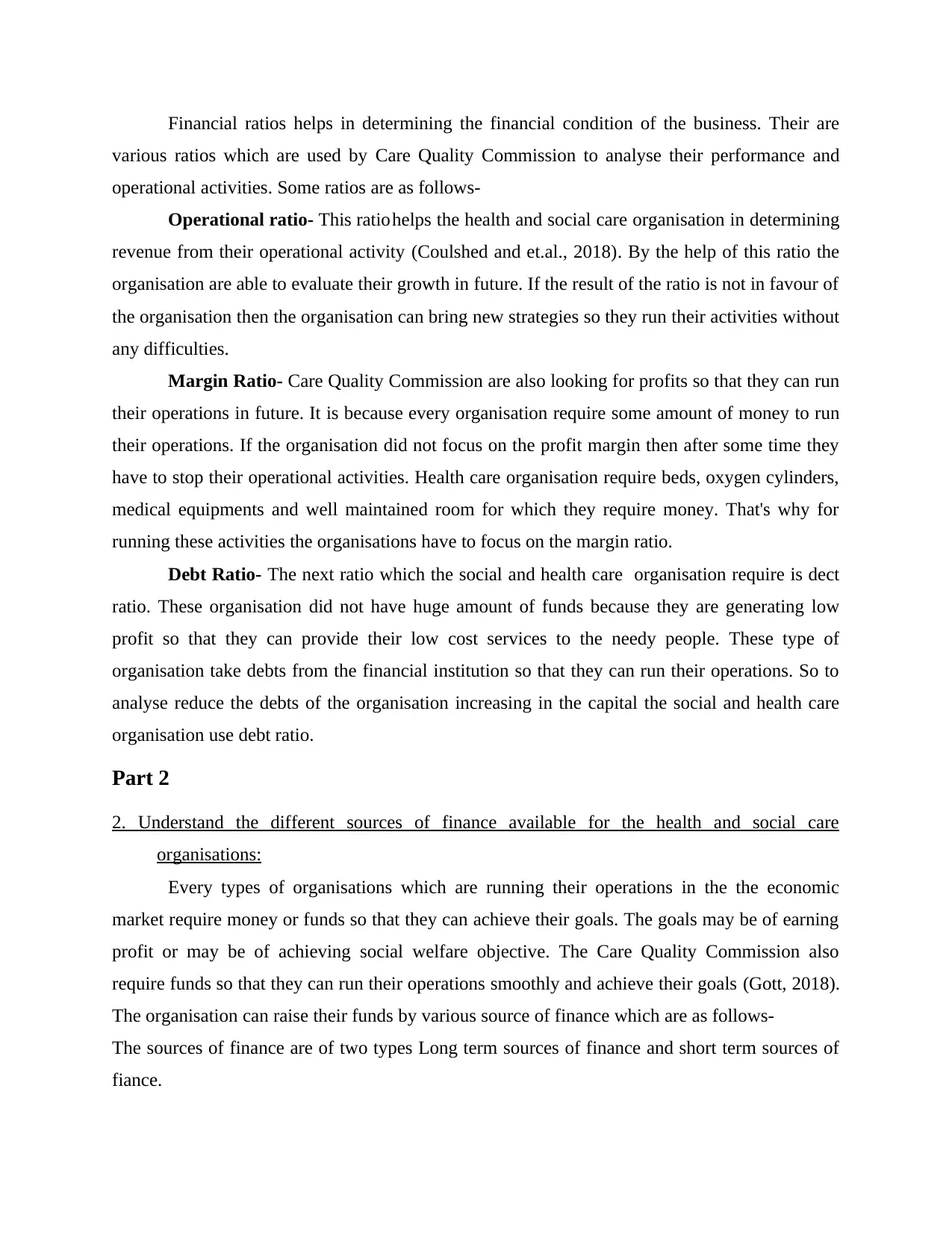
Financial ratios helps in determining the financial condition of the business. Their are
various ratios which are used by Care Quality Commission to analyse their performance and
operational activities. Some ratios are as follows-
Operational ratio- This ratiohelps the health and social care organisation in determining
revenue from their operational activity (Coulshed and et.al., 2018). By the help of this ratio the
organisation are able to evaluate their growth in future. If the result of the ratio is not in favour of
the organisation then the organisation can bring new strategies so they run their activities without
any difficulties.
Margin Ratio- Care Quality Commission are also looking for profits so that they can run
their operations in future. It is because every organisation require some amount of money to run
their operations. If the organisation did not focus on the profit margin then after some time they
have to stop their operational activities. Health care organisation require beds, oxygen cylinders,
medical equipments and well maintained room for which they require money. That's why for
running these activities the organisations have to focus on the margin ratio.
Debt Ratio- The next ratio which the social and health care organisation require is dect
ratio. These organisation did not have huge amount of funds because they are generating low
profit so that they can provide their low cost services to the needy people. These type of
organisation take debts from the financial institution so that they can run their operations. So to
analyse reduce the debts of the organisation increasing in the capital the social and health care
organisation use debt ratio.
Part 2
2. Understand the different sources of finance available for the health and social care
organisations:
Every types of organisations which are running their operations in the the economic
market require money or funds so that they can achieve their goals. The goals may be of earning
profit or may be of achieving social welfare objective. The Care Quality Commission also
require funds so that they can run their operations smoothly and achieve their goals (Gott, 2018).
The organisation can raise their funds by various source of finance which are as follows-
The sources of finance are of two types Long term sources of finance and short term sources of
fiance.
various ratios which are used by Care Quality Commission to analyse their performance and
operational activities. Some ratios are as follows-
Operational ratio- This ratiohelps the health and social care organisation in determining
revenue from their operational activity (Coulshed and et.al., 2018). By the help of this ratio the
organisation are able to evaluate their growth in future. If the result of the ratio is not in favour of
the organisation then the organisation can bring new strategies so they run their activities without
any difficulties.
Margin Ratio- Care Quality Commission are also looking for profits so that they can run
their operations in future. It is because every organisation require some amount of money to run
their operations. If the organisation did not focus on the profit margin then after some time they
have to stop their operational activities. Health care organisation require beds, oxygen cylinders,
medical equipments and well maintained room for which they require money. That's why for
running these activities the organisations have to focus on the margin ratio.
Debt Ratio- The next ratio which the social and health care organisation require is dect
ratio. These organisation did not have huge amount of funds because they are generating low
profit so that they can provide their low cost services to the needy people. These type of
organisation take debts from the financial institution so that they can run their operations. So to
analyse reduce the debts of the organisation increasing in the capital the social and health care
organisation use debt ratio.
Part 2
2. Understand the different sources of finance available for the health and social care
organisations:
Every types of organisations which are running their operations in the the economic
market require money or funds so that they can achieve their goals. The goals may be of earning
profit or may be of achieving social welfare objective. The Care Quality Commission also
require funds so that they can run their operations smoothly and achieve their goals (Gott, 2018).
The organisation can raise their funds by various source of finance which are as follows-
The sources of finance are of two types Long term sources of finance and short term sources of
fiance.
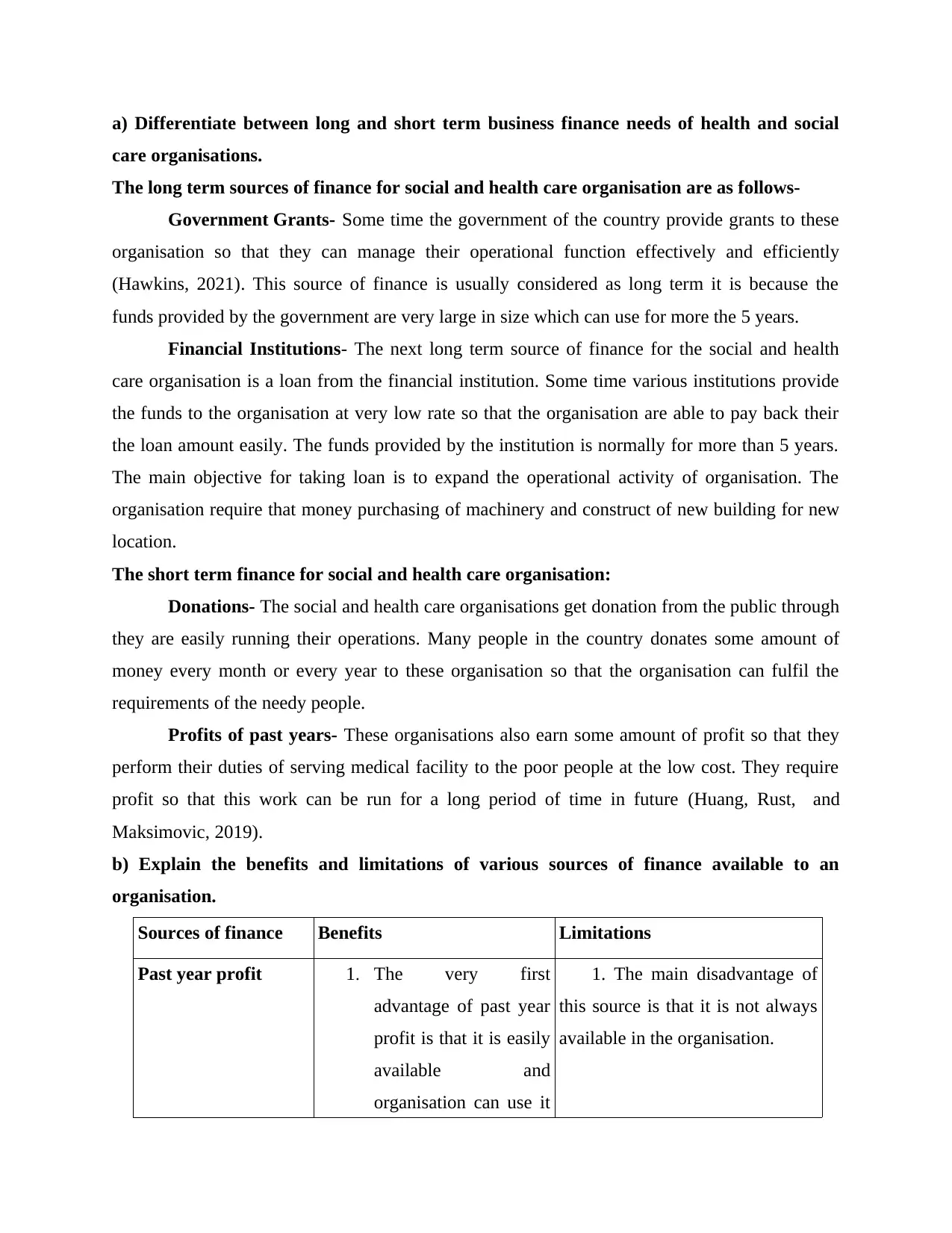
a) Differentiate between long and short term business finance needs of health and social
care organisations.
The long term sources of finance for social and health care organisation are as follows-
Government Grants- Some time the government of the country provide grants to these
organisation so that they can manage their operational function effectively and efficiently
(Hawkins, 2021). This source of finance is usually considered as long term it is because the
funds provided by the government are very large in size which can use for more the 5 years.
Financial Institutions- The next long term source of finance for the social and health
care organisation is a loan from the financial institution. Some time various institutions provide
the funds to the organisation at very low rate so that the organisation are able to pay back their
the loan amount easily. The funds provided by the institution is normally for more than 5 years.
The main objective for taking loan is to expand the operational activity of organisation. The
organisation require that money purchasing of machinery and construct of new building for new
location.
The short term finance for social and health care organisation:
Donations- The social and health care organisations get donation from the public through
they are easily running their operations. Many people in the country donates some amount of
money every month or every year to these organisation so that the organisation can fulfil the
requirements of the needy people.
Profits of past years- These organisations also earn some amount of profit so that they
perform their duties of serving medical facility to the poor people at the low cost. They require
profit so that this work can be run for a long period of time in future (Huang, Rust, and
Maksimovic, 2019).
b) Explain the benefits and limitations of various sources of finance available to an
organisation.
Sources of finance Benefits Limitations
Past year profit 1. The very first
advantage of past year
profit is that it is easily
available and
organisation can use it
1. The main disadvantage of
this source is that it is not always
available in the organisation.
care organisations.
The long term sources of finance for social and health care organisation are as follows-
Government Grants- Some time the government of the country provide grants to these
organisation so that they can manage their operational function effectively and efficiently
(Hawkins, 2021). This source of finance is usually considered as long term it is because the
funds provided by the government are very large in size which can use for more the 5 years.
Financial Institutions- The next long term source of finance for the social and health
care organisation is a loan from the financial institution. Some time various institutions provide
the funds to the organisation at very low rate so that the organisation are able to pay back their
the loan amount easily. The funds provided by the institution is normally for more than 5 years.
The main objective for taking loan is to expand the operational activity of organisation. The
organisation require that money purchasing of machinery and construct of new building for new
location.
The short term finance for social and health care organisation:
Donations- The social and health care organisations get donation from the public through
they are easily running their operations. Many people in the country donates some amount of
money every month or every year to these organisation so that the organisation can fulfil the
requirements of the needy people.
Profits of past years- These organisations also earn some amount of profit so that they
perform their duties of serving medical facility to the poor people at the low cost. They require
profit so that this work can be run for a long period of time in future (Huang, Rust, and
Maksimovic, 2019).
b) Explain the benefits and limitations of various sources of finance available to an
organisation.
Sources of finance Benefits Limitations
Past year profit 1. The very first
advantage of past year
profit is that it is easily
available and
organisation can use it
1. The main disadvantage of
this source is that it is not always
available in the organisation.
⊘ This is a preview!⊘
Do you want full access?
Subscribe today to unlock all pages.
Trusted by 1+ million students worldwide
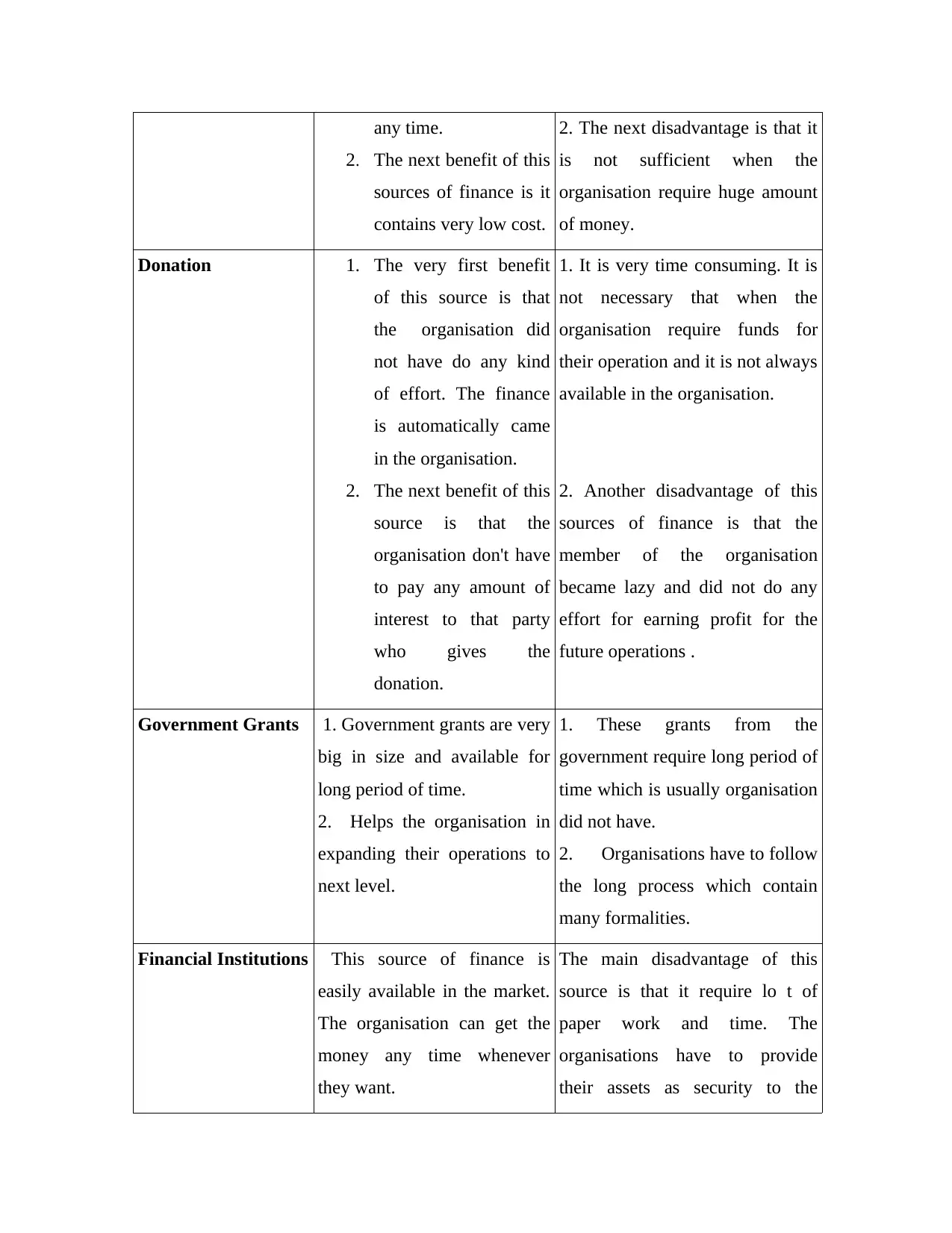
any time.
2. The next benefit of this
sources of finance is it
contains very low cost.
2. The next disadvantage is that it
is not sufficient when the
organisation require huge amount
of money.
Donation 1. The very first benefit
of this source is that
the organisation did
not have do any kind
of effort. The finance
is automatically came
in the organisation.
2. The next benefit of this
source is that the
organisation don't have
to pay any amount of
interest to that party
who gives the
donation.
1. It is very time consuming. It is
not necessary that when the
organisation require funds for
their operation and it is not always
available in the organisation.
2. Another disadvantage of this
sources of finance is that the
member of the organisation
became lazy and did not do any
effort for earning profit for the
future operations .
Government Grants 1. Government grants are very
big in size and available for
long period of time.
2. Helps the organisation in
expanding their operations to
next level.
1. These grants from the
government require long period of
time which is usually organisation
did not have.
2. Organisations have to follow
the long process which contain
many formalities.
Financial Institutions This source of finance is
easily available in the market.
The organisation can get the
money any time whenever
they want.
The main disadvantage of this
source is that it require lo t of
paper work and time. The
organisations have to provide
their assets as security to the
2. The next benefit of this
sources of finance is it
contains very low cost.
2. The next disadvantage is that it
is not sufficient when the
organisation require huge amount
of money.
Donation 1. The very first benefit
of this source is that
the organisation did
not have do any kind
of effort. The finance
is automatically came
in the organisation.
2. The next benefit of this
source is that the
organisation don't have
to pay any amount of
interest to that party
who gives the
donation.
1. It is very time consuming. It is
not necessary that when the
organisation require funds for
their operation and it is not always
available in the organisation.
2. Another disadvantage of this
sources of finance is that the
member of the organisation
became lazy and did not do any
effort for earning profit for the
future operations .
Government Grants 1. Government grants are very
big in size and available for
long period of time.
2. Helps the organisation in
expanding their operations to
next level.
1. These grants from the
government require long period of
time which is usually organisation
did not have.
2. Organisations have to follow
the long process which contain
many formalities.
Financial Institutions This source of finance is
easily available in the market.
The organisation can get the
money any time whenever
they want.
The main disadvantage of this
source is that it require lo t of
paper work and time. The
organisations have to provide
their assets as security to the
Paraphrase This Document
Need a fresh take? Get an instant paraphrase of this document with our AI Paraphraser
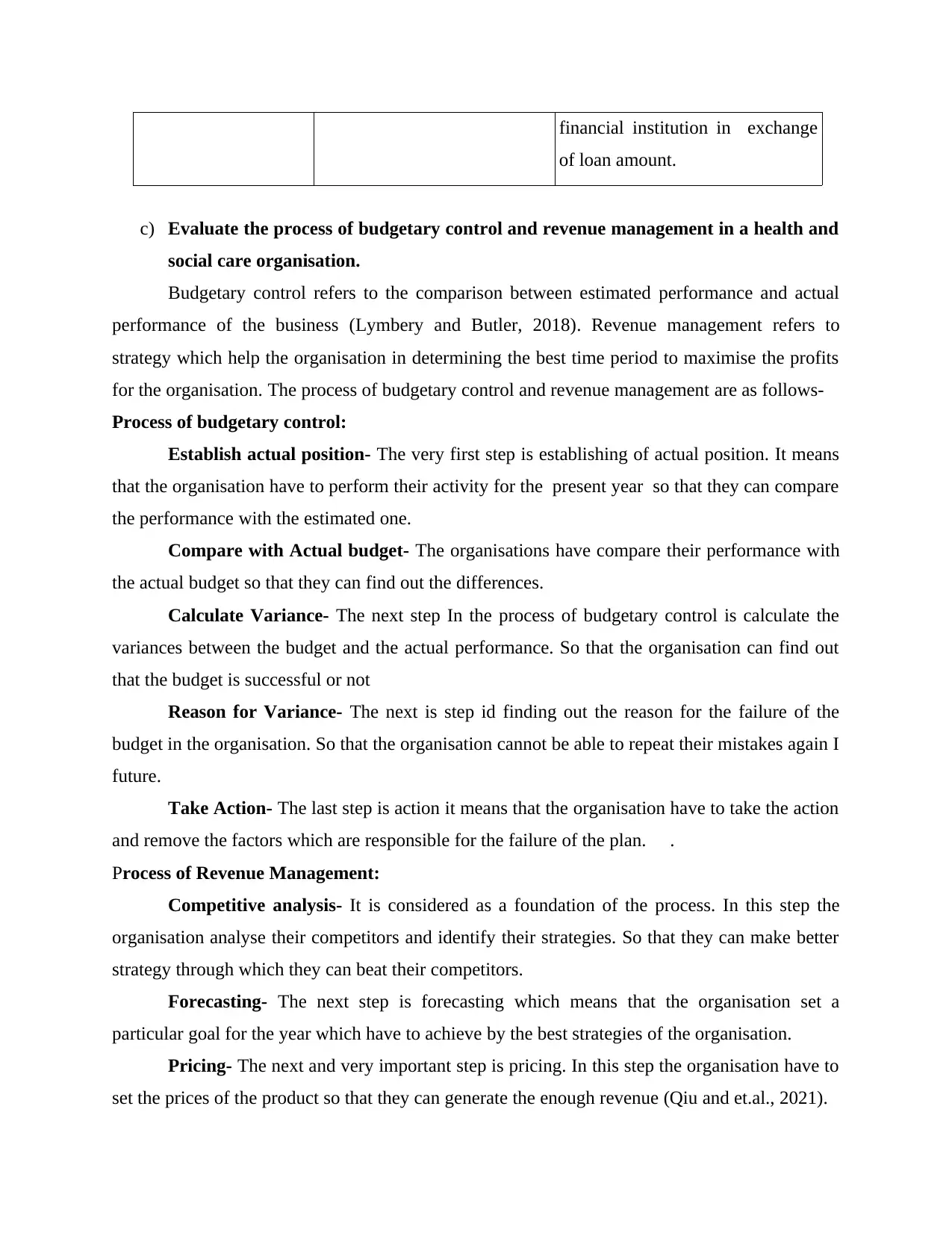
financial institution in exchange
of loan amount.
c) Evaluate the process of budgetary control and revenue management in a health and
social care organisation.
Budgetary control refers to the comparison between estimated performance and actual
performance of the business (Lymbery and Butler, 2018). Revenue management refers to
strategy which help the organisation in determining the best time period to maximise the profits
for the organisation. The process of budgetary control and revenue management are as follows-
Process of budgetary control:
Establish actual position- The very first step is establishing of actual position. It means
that the organisation have to perform their activity for the present year so that they can compare
the performance with the estimated one.
Compare with Actual budget- The organisations have compare their performance with
the actual budget so that they can find out the differences.
Calculate Variance- The next step In the process of budgetary control is calculate the
variances between the budget and the actual performance. So that the organisation can find out
that the budget is successful or not
Reason for Variance- The next is step id finding out the reason for the failure of the
budget in the organisation. So that the organisation cannot be able to repeat their mistakes again I
future.
Take Action- The last step is action it means that the organisation have to take the action
and remove the factors which are responsible for the failure of the plan. .
Process of Revenue Management:
Competitive analysis- It is considered as a foundation of the process. In this step the
organisation analyse their competitors and identify their strategies. So that they can make better
strategy through which they can beat their competitors.
Forecasting- The next step is forecasting which means that the organisation set a
particular goal for the year which have to achieve by the best strategies of the organisation.
Pricing- The next and very important step is pricing. In this step the organisation have to
set the prices of the product so that they can generate the enough revenue (Qiu and et.al., 2021).
of loan amount.
c) Evaluate the process of budgetary control and revenue management in a health and
social care organisation.
Budgetary control refers to the comparison between estimated performance and actual
performance of the business (Lymbery and Butler, 2018). Revenue management refers to
strategy which help the organisation in determining the best time period to maximise the profits
for the organisation. The process of budgetary control and revenue management are as follows-
Process of budgetary control:
Establish actual position- The very first step is establishing of actual position. It means
that the organisation have to perform their activity for the present year so that they can compare
the performance with the estimated one.
Compare with Actual budget- The organisations have compare their performance with
the actual budget so that they can find out the differences.
Calculate Variance- The next step In the process of budgetary control is calculate the
variances between the budget and the actual performance. So that the organisation can find out
that the budget is successful or not
Reason for Variance- The next is step id finding out the reason for the failure of the
budget in the organisation. So that the organisation cannot be able to repeat their mistakes again I
future.
Take Action- The last step is action it means that the organisation have to take the action
and remove the factors which are responsible for the failure of the plan. .
Process of Revenue Management:
Competitive analysis- It is considered as a foundation of the process. In this step the
organisation analyse their competitors and identify their strategies. So that they can make better
strategy through which they can beat their competitors.
Forecasting- The next step is forecasting which means that the organisation set a
particular goal for the year which have to achieve by the best strategies of the organisation.
Pricing- The next and very important step is pricing. In this step the organisation have to
set the prices of the product so that they can generate the enough revenue (Qiu and et.al., 2021).
Inventory Control- In this step the organisations have to keep tracking their inventory
regularly. With this activity the organisation is able to continue their sales for long period of
time.
Performance Review- The last is performance review in which the organisation have
analyse their performance for the whole year so that they can find out their weaknesses
(Rommer, Majerova and Machova, 2020).
Part 3
3. Understand how business decisions in health and social care can be informed by financial
information:
a) Explain the rules of double-entry book-keeping and how it is used to maintain financial
records.
The two basic rules of double entry book keeping are as follows-
1st Rule- The very first rule of double entry bookkeeping is that every transaction which
the organisation have recorded must affect two or more accounts.
2nd Rule- The second rule of double entry bookkeeping is that the total amount of debit
must be equal with total amount of credit.
These two rules maintain the accounting equations in balance. Double entry bookkeeping
is an accounting methods in which all the financial transactions of the business are recorded. By
the help of this method the organisations are able to analyse their payments and receipts
accurately. It is because the transaction are recorded separately and for each account the separate
ledgers are prepared. In this ledger all the transaction related to a particular account are recorded.
b) Interpret organisational budgets in health and social care:
Care Quality Commission is a government based organisation which make their budget
after result of the various market condition analysis. The members of this organisation have
ensure that most of money of the organisation will be spend on medical and health care facility
of the country. The people in UK can get their treatment at a very low cost regularly so the
organisation can achieve their goals (Strandås, Wackerhausen and Bondas, 2019). On some
special occasions the Care Quality Commission in UK provide their free service to the needy
people. All these thing are included in the budget of social and health care organisation.
regularly. With this activity the organisation is able to continue their sales for long period of
time.
Performance Review- The last is performance review in which the organisation have
analyse their performance for the whole year so that they can find out their weaknesses
(Rommer, Majerova and Machova, 2020).
Part 3
3. Understand how business decisions in health and social care can be informed by financial
information:
a) Explain the rules of double-entry book-keeping and how it is used to maintain financial
records.
The two basic rules of double entry book keeping are as follows-
1st Rule- The very first rule of double entry bookkeeping is that every transaction which
the organisation have recorded must affect two or more accounts.
2nd Rule- The second rule of double entry bookkeeping is that the total amount of debit
must be equal with total amount of credit.
These two rules maintain the accounting equations in balance. Double entry bookkeeping
is an accounting methods in which all the financial transactions of the business are recorded. By
the help of this method the organisations are able to analyse their payments and receipts
accurately. It is because the transaction are recorded separately and for each account the separate
ledgers are prepared. In this ledger all the transaction related to a particular account are recorded.
b) Interpret organisational budgets in health and social care:
Care Quality Commission is a government based organisation which make their budget
after result of the various market condition analysis. The members of this organisation have
ensure that most of money of the organisation will be spend on medical and health care facility
of the country. The people in UK can get their treatment at a very low cost regularly so the
organisation can achieve their goals (Strandås, Wackerhausen and Bondas, 2019). On some
special occasions the Care Quality Commission in UK provide their free service to the needy
people. All these thing are included in the budget of social and health care organisation.
⊘ This is a preview!⊘
Do you want full access?
Subscribe today to unlock all pages.
Trusted by 1+ million students worldwide
c) Evaluate capital expenditures and investment projects using different investment
appraisal techniques:
Capital Expenditure- It refers to funds which are used in acquiring or purchasing of
assets in the organisation (Lentz, Benson and Kircher, 2019). The expenditure which increases
the value of assets are known as capital expenditure. Capital expenditure for the Care Quality
Commission are new beds, opening of new emergency ward in the existing building, purchasing
of new machineries like x-ray machines, CT-scan machines, suction devices,
sphygmomanometer, stethoscope and many more.
Project Investment- It is considered as wider term of the capital expenditure because it
include purchasing of a new property, construction of new building and many more. Through
these investment the organisation are able to expand their businesses and earn more profits. Main
examples of project investment for Care Quality Commission are construction of new building
and opening of new branches in different areas of the country.
Different Investment Appraisal Techniques are as follows-
Net present value- It shows the variation between the present cash inflow and cash
outflow of the organisation. If cash inflow is more than outflow of cash then it means that the
organisation is performing efficiently.
Accounting Rate of Return- The next and very crucial appraisal technique is ARR. It
helps the organisation in evaluating the rate of return from the investment project so that they can
take their decision accurately (Knapp and et.al., 2018).
d) Make recommendations for financial management in health and social care
organisations.
Recommendations:
From the above report it can observed that the financial management of the Care Quality
Commission is very effective and efficient. It is observed because the organisation is performing
their business activity effectively and efficiently which lead them to do provide their services in
the different corners of the country. Care quality Commission is using the appraisal techniques
for taking the decision related to investments.
CONCLUSION
From the above report it is concluded that the without financial management and
accounting system any type of organisation cannot be able to run their operation successfully. It
appraisal techniques:
Capital Expenditure- It refers to funds which are used in acquiring or purchasing of
assets in the organisation (Lentz, Benson and Kircher, 2019). The expenditure which increases
the value of assets are known as capital expenditure. Capital expenditure for the Care Quality
Commission are new beds, opening of new emergency ward in the existing building, purchasing
of new machineries like x-ray machines, CT-scan machines, suction devices,
sphygmomanometer, stethoscope and many more.
Project Investment- It is considered as wider term of the capital expenditure because it
include purchasing of a new property, construction of new building and many more. Through
these investment the organisation are able to expand their businesses and earn more profits. Main
examples of project investment for Care Quality Commission are construction of new building
and opening of new branches in different areas of the country.
Different Investment Appraisal Techniques are as follows-
Net present value- It shows the variation between the present cash inflow and cash
outflow of the organisation. If cash inflow is more than outflow of cash then it means that the
organisation is performing efficiently.
Accounting Rate of Return- The next and very crucial appraisal technique is ARR. It
helps the organisation in evaluating the rate of return from the investment project so that they can
take their decision accurately (Knapp and et.al., 2018).
d) Make recommendations for financial management in health and social care
organisations.
Recommendations:
From the above report it can observed that the financial management of the Care Quality
Commission is very effective and efficient. It is observed because the organisation is performing
their business activity effectively and efficiently which lead them to do provide their services in
the different corners of the country. Care quality Commission is using the appraisal techniques
for taking the decision related to investments.
CONCLUSION
From the above report it is concluded that the without financial management and
accounting system any type of organisation cannot be able to run their operation successfully. It
Paraphrase This Document
Need a fresh take? Get an instant paraphrase of this document with our AI Paraphraser

is because both functions are consider as pillars for the successful business. Without financial
management and accounting system the organisations cannot be able to make plan, forecast and
determine objective. Various sources of finance for the Care Quality Commission are mentioned
in the above report. Various capital expenditure of the organisation are mentioned above. From
project investment the organisation can earn maximum profit for long run.
management and accounting system the organisations cannot be able to make plan, forecast and
determine objective. Various sources of finance for the Care Quality Commission are mentioned
in the above report. Various capital expenditure of the organisation are mentioned above. From
project investment the organisation can earn maximum profit for long run.
REFERENCES
Books and Journals
Abdel-Basset, M. and et.al., 2020. An integrated plithogenic MCDM approach for financial
performance evaluation of manufacturing industries. Risk Management. 22(3), pp.192-
218.
Aung, T.S., Luan, S. and Xu, Q., 2019. Application of multi-criteria-decision approach for the
analysis of medical waste management systems in Myanmar. Journal of Cleaner
Production. 222, pp.733-745.
Bohle, D. and Greskovits, B., 2019. Politicising embedded neoliberalism: continuity and change
in Hungary’s development model. West European Politics. 42(5), pp.1069-1093.
Brouder, P., 2020. Reset redux: Possible evolutionary pathways towards the transformation of
tourism in a COVID-19 world. Tourism Geographies. 22(3), pp.484-490.
Coulshed, V. and et.al., 2018. Management in social work. Bloomsbury Publishing.
Gott, M., 2018. Telematics for health: The role of telehealth and telemedicine in homes and
communities. CRC Press.
Hawkins, M., 2021. Cyber-physical production networks, internet of things-enabled
sustainability, and smart factory performance in industry 4.0-based manufacturing
systems. Economics, Management, and Financial Markets. 16(2), pp.73-84.
Huang, M.H., Rust, R. and Maksimovic, V., 2019. The feeling economy: Managing in the next
generation of artificial intelligence (AI). California Management Review. 61(4), pp.43-
65.
Knapp, M. and et.al., 2018. Care in the community: Challenge and demonstration. Routledge.\
Lentz, R., Benson III, A.B. and Kircher, S., 2019. Financial toxicity in cancer care: prevalence,
causes, consequences, and reduction strategies. Journal of surgical oncology. 120(1),
pp.85-92.
Lymbery, M. and Butler, S. eds., 2018. Social work ideals and practice realities. Bloomsbury
Publishing.
Qiu, S.C. and et.al., 2021. Can corporate social responsibility protect firm value during the
COVID-19 pandemic?. International Journal of Hospitality Management. 93, p.102759.
Rommer, D., Majerova, J. and Machova, V., 2020. Repeated COVID-19 pandemic-related
media consumption: Minimizing sharing of nonsensical misinformation through health
literacy and critical thinking. Linguistic and Philosophical Investigations. 19, pp.107-
113.
Strandås, M., Wackerhausen, S. and Bondas, T., 2019. The nurse–patient relationship in the New
Public Management era, in public home care: A focused ethnography. Journal of
advanced nursing. 75(2), pp.400-411.
Books and Journals
Abdel-Basset, M. and et.al., 2020. An integrated plithogenic MCDM approach for financial
performance evaluation of manufacturing industries. Risk Management. 22(3), pp.192-
218.
Aung, T.S., Luan, S. and Xu, Q., 2019. Application of multi-criteria-decision approach for the
analysis of medical waste management systems in Myanmar. Journal of Cleaner
Production. 222, pp.733-745.
Bohle, D. and Greskovits, B., 2019. Politicising embedded neoliberalism: continuity and change
in Hungary’s development model. West European Politics. 42(5), pp.1069-1093.
Brouder, P., 2020. Reset redux: Possible evolutionary pathways towards the transformation of
tourism in a COVID-19 world. Tourism Geographies. 22(3), pp.484-490.
Coulshed, V. and et.al., 2018. Management in social work. Bloomsbury Publishing.
Gott, M., 2018. Telematics for health: The role of telehealth and telemedicine in homes and
communities. CRC Press.
Hawkins, M., 2021. Cyber-physical production networks, internet of things-enabled
sustainability, and smart factory performance in industry 4.0-based manufacturing
systems. Economics, Management, and Financial Markets. 16(2), pp.73-84.
Huang, M.H., Rust, R. and Maksimovic, V., 2019. The feeling economy: Managing in the next
generation of artificial intelligence (AI). California Management Review. 61(4), pp.43-
65.
Knapp, M. and et.al., 2018. Care in the community: Challenge and demonstration. Routledge.\
Lentz, R., Benson III, A.B. and Kircher, S., 2019. Financial toxicity in cancer care: prevalence,
causes, consequences, and reduction strategies. Journal of surgical oncology. 120(1),
pp.85-92.
Lymbery, M. and Butler, S. eds., 2018. Social work ideals and practice realities. Bloomsbury
Publishing.
Qiu, S.C. and et.al., 2021. Can corporate social responsibility protect firm value during the
COVID-19 pandemic?. International Journal of Hospitality Management. 93, p.102759.
Rommer, D., Majerova, J. and Machova, V., 2020. Repeated COVID-19 pandemic-related
media consumption: Minimizing sharing of nonsensical misinformation through health
literacy and critical thinking. Linguistic and Philosophical Investigations. 19, pp.107-
113.
Strandås, M., Wackerhausen, S. and Bondas, T., 2019. The nurse–patient relationship in the New
Public Management era, in public home care: A focused ethnography. Journal of
advanced nursing. 75(2), pp.400-411.
⊘ This is a preview!⊘
Do you want full access?
Subscribe today to unlock all pages.
Trusted by 1+ million students worldwide

1 out of 12


Related Documents


Your All-in-One AI-Powered Toolkit for Academic Success.
+13062052269
info@desklib.com
Available 24*7 on WhatsApp / Email
![[object Object]](/_next/static/media/star-bottom.7253800d.svg)
Unlock your academic potential
Copyright © 2020–2026 A2Z Services. All Rights Reserved. Developed and managed by ZUCOL.