Cudoni's Sustainable Global Value Chains and China Market Entry
VerifiedAdded on 2023/06/18
|11
|3672
|151
Report
AI Summary
This report examines the strategies for managing sustainable global value chains, focusing on Cudoni, an e-commerce company specializing in pre-owned luxury items, and its potential entry into the Chinese market. It begins with an overview of global value chains and their importance for developing nations. The report then introduces Cudoni, detailing its local and global operations, and its competitive standing. It evaluates China as a potential market, highlighting its entrepreneur-friendly policies and stable business environment. Various market entry modes for Cudoni are considered, including exporting, acquisition, and strategic alliances, weighing the pros and cons of each. The report also analyzes international marketing strategies, particularly the STP (Segmentation, Targeting, Positioning) approach, and offers recommendations for Cudoni's successful entry into the Chinese market. The conclusion summarizes the key findings and emphasizes the importance of sustainable practices in global value chain management.

Managing sustainable
global value chains
global value chains

Paraphrase This Document
Need a fresh take? Get an instant paraphrase of this document with our AI Paraphraser
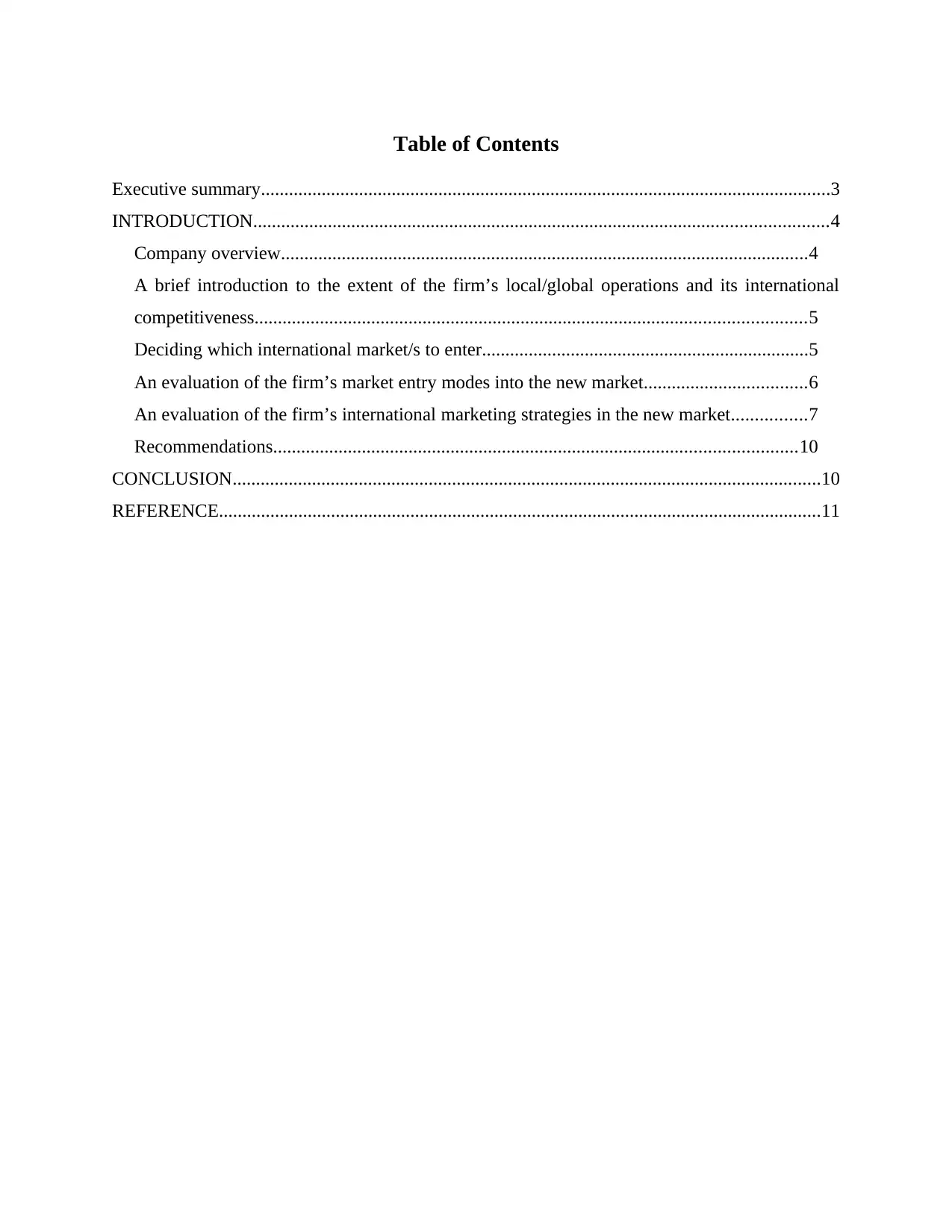
Table of Contents
Executive summary..........................................................................................................................3
INTRODUCTION...........................................................................................................................4
Company overview.................................................................................................................4
A brief introduction to the extent of the firm’s local/global operations and its international
competitiveness......................................................................................................................5
Deciding which international market/s to enter......................................................................5
An evaluation of the firm’s market entry modes into the new market...................................6
An evaluation of the firm’s international marketing strategies in the new market................7
Recommendations................................................................................................................10
CONCLUSION..............................................................................................................................10
REFERENCE.................................................................................................................................11
Executive summary..........................................................................................................................3
INTRODUCTION...........................................................................................................................4
Company overview.................................................................................................................4
A brief introduction to the extent of the firm’s local/global operations and its international
competitiveness......................................................................................................................5
Deciding which international market/s to enter......................................................................5
An evaluation of the firm’s market entry modes into the new market...................................6
An evaluation of the firm’s international marketing strategies in the new market................7
Recommendations................................................................................................................10
CONCLUSION..............................................................................................................................10
REFERENCE.................................................................................................................................11
Executive summary
The nations create growth through global value chain driven development by shifting to
higher-value-added jobs and incorporating more technology and know-how into all agricultural,
industrial and service sectors. Global value chains allow nations to skip forward in their
development process. Participation in global value chains could assist emerging nations in
shifting away from commodities exports and toward fundamental manufacturing. First,
developing nations must accelerate trade and investment reforms while also improving
connectivity. Second, modern economies seek policies that are open and predictable. Third, all
nations must enhance social and environmental protection in order to guarantee that the
advantages of global value chain membership are shared and perpetuated. The aim of the report
is to establish the organisation into Chinese market. For establishing themselves, they could use
many types of entry forms such as exporting, licensing, strategic alliances and many more.
Along with this, this report also states about the recommendation in which the organisation could
chose to enter to international markets.
The nations create growth through global value chain driven development by shifting to
higher-value-added jobs and incorporating more technology and know-how into all agricultural,
industrial and service sectors. Global value chains allow nations to skip forward in their
development process. Participation in global value chains could assist emerging nations in
shifting away from commodities exports and toward fundamental manufacturing. First,
developing nations must accelerate trade and investment reforms while also improving
connectivity. Second, modern economies seek policies that are open and predictable. Third, all
nations must enhance social and environmental protection in order to guarantee that the
advantages of global value chain membership are shared and perpetuated. The aim of the report
is to establish the organisation into Chinese market. For establishing themselves, they could use
many types of entry forms such as exporting, licensing, strategic alliances and many more.
Along with this, this report also states about the recommendation in which the organisation could
chose to enter to international markets.
⊘ This is a preview!⊘
Do you want full access?
Subscribe today to unlock all pages.

Trusted by 1+ million students worldwide
INTRODUCTION
The value chain defines the whole set of operations which a company does to carry out a
product from creation to end usage and well afar. This encompasses representation,
manufacturing, marketing, dispersal and consumer service. A value chain's operations might be
confined inside a single business or split across several enterprises. Value chain operations can
generate products or services and could be concentrated in a single geographic place or dispersed
across a larger region. Cudoni is taken as base company. Cudoni is an e-commerce site that sells
pre-owned luxury items and it was established by James Harford Tyrer in 2015, London, UK. In
this report, it covers the current marketing strategies of an organisation and recommendation an
international market where the firm could enter.
Company overview
Cudoni is an e-commerce company that sells premium items with an emphasis on
outstanding service, an ethical attitude and maximum ease. Owner and operator of an online
marketplace for the acquisition and selling of used luxury items. Cudoni is also notable for its
dedication to environmental sustainability. Cudoni includes selling of premium labels like
Chanel, Gucci and Givenchy, as well as luxury gadgets like Bose, Bang & Olufsen and Apple.
James has always aspired to be the CEO of a creative startup. Cudoni was named after Countess
Antonella Cudone, a luxury connoisseur and one of the company's first and most devoted clients.
Cudoni also completed a round of funding backed by a number of high-profile investors, each a
specialist in their very own area, such as Giles Brook, CEO of the Vita Coco brand and Matt
Cooper, creator of Capital One and Chairman of Octopus Investments. James founded Cudoni as
an alternative tech-driven network to offer luxury items in a worldwide market, influenced by his
original start-up operating through his parents' garage (Mura and et. al., 2018). Using his
knowledge in technology and the start-up industry, James skilfully designed Cudoni to assure
that goods would sell for more than 30% of the typical person's sales price if they sold their
items alone. This significant gain is attained by employing algorithmic valuations to gather data
on each item with the least level of data feasible. Their aim is to eliminate the time and trouble
associated with selling pre-owned luxury items. Selling high-quality products should not be a
chore; rather, it should be a gratifying, simple and enjoyable encounter.
The value chain defines the whole set of operations which a company does to carry out a
product from creation to end usage and well afar. This encompasses representation,
manufacturing, marketing, dispersal and consumer service. A value chain's operations might be
confined inside a single business or split across several enterprises. Value chain operations can
generate products or services and could be concentrated in a single geographic place or dispersed
across a larger region. Cudoni is taken as base company. Cudoni is an e-commerce site that sells
pre-owned luxury items and it was established by James Harford Tyrer in 2015, London, UK. In
this report, it covers the current marketing strategies of an organisation and recommendation an
international market where the firm could enter.
Company overview
Cudoni is an e-commerce company that sells premium items with an emphasis on
outstanding service, an ethical attitude and maximum ease. Owner and operator of an online
marketplace for the acquisition and selling of used luxury items. Cudoni is also notable for its
dedication to environmental sustainability. Cudoni includes selling of premium labels like
Chanel, Gucci and Givenchy, as well as luxury gadgets like Bose, Bang & Olufsen and Apple.
James has always aspired to be the CEO of a creative startup. Cudoni was named after Countess
Antonella Cudone, a luxury connoisseur and one of the company's first and most devoted clients.
Cudoni also completed a round of funding backed by a number of high-profile investors, each a
specialist in their very own area, such as Giles Brook, CEO of the Vita Coco brand and Matt
Cooper, creator of Capital One and Chairman of Octopus Investments. James founded Cudoni as
an alternative tech-driven network to offer luxury items in a worldwide market, influenced by his
original start-up operating through his parents' garage (Mura and et. al., 2018). Using his
knowledge in technology and the start-up industry, James skilfully designed Cudoni to assure
that goods would sell for more than 30% of the typical person's sales price if they sold their
items alone. This significant gain is attained by employing algorithmic valuations to gather data
on each item with the least level of data feasible. Their aim is to eliminate the time and trouble
associated with selling pre-owned luxury items. Selling high-quality products should not be a
chore; rather, it should be a gratifying, simple and enjoyable encounter.
Paraphrase This Document
Need a fresh take? Get an instant paraphrase of this document with our AI Paraphraser
A brief introduction to the extent of the firm’s local/global operations and its international
competitiveness
Cudoni, a premium online fashion marketplace, has obtained £4.6 million in funding from
major international investors, as it is the highest sum ever raised for investment in a UK fashion
resale firm. Cudoni, a luxury fashion resale business, is pursuing males with a new campaign
after achieving 400 % year-on-year growth due to growing interest in men's resale. There are
shipping their products across the globe. AriRobe, Brandfull, Aidingmao and many more are
some of the competitors of Cudoni.
Deciding which international market/s to enter
As Cudoni is catering their customers worldwide, there are still many countries to
penetrate such China. The organisation is planning to enter into the markets of China as it is
considered as the largest as well as most influential emerging market in the world. The Chinese
government has been highly active in implementing entrepreneurially friendly strategies for both
local and foreign firms. Few of these initiatives involves helping young people in incubating
their views, motivating artistry and innovation and supplying corporate allocations to its people.
These policies make China a fantastic place for local and, by extension, international enterprises
(Ruiz-Benitez, López and Real, 2017). Taxation of China and other funding regulations are
unsurpassed around the globe. As a means of attracting multinational corporations to establish
business in rural China, the inland regions of China offer least tax rates for international firms
than the coastal regions. Tariff rules for imported products, on the other side, are improving and
becoming more beneficial to international firms on a daily basis. Furthermore, the seaports and
road transport systems are near ideal here which makes exporting and importing products quite
simple. It is quite easy to locate domestic investors and business partners in China because of
one sided government policies. The youngsters are empowered and the environment of business
is fairly supportive. Both rural and urban China has a lot of assets for development. For the
previous three decades, China's communal, governmental and financial stability has assisted its
continuous development. For ensuring a healthy company climate these three factors are
considered to be important. It keeps the expected market, permitting firms to predict the future
and plan appropriately (Rebs, Brandenburg and Seuring, 2019). China's strategies of business
and guidelines are continually converting. Some industries aren't even managed which indicates
that there would potentially be a fresh opportunity ahead. It is simpler to start a firm in China's
competitiveness
Cudoni, a premium online fashion marketplace, has obtained £4.6 million in funding from
major international investors, as it is the highest sum ever raised for investment in a UK fashion
resale firm. Cudoni, a luxury fashion resale business, is pursuing males with a new campaign
after achieving 400 % year-on-year growth due to growing interest in men's resale. There are
shipping their products across the globe. AriRobe, Brandfull, Aidingmao and many more are
some of the competitors of Cudoni.
Deciding which international market/s to enter
As Cudoni is catering their customers worldwide, there are still many countries to
penetrate such China. The organisation is planning to enter into the markets of China as it is
considered as the largest as well as most influential emerging market in the world. The Chinese
government has been highly active in implementing entrepreneurially friendly strategies for both
local and foreign firms. Few of these initiatives involves helping young people in incubating
their views, motivating artistry and innovation and supplying corporate allocations to its people.
These policies make China a fantastic place for local and, by extension, international enterprises
(Ruiz-Benitez, López and Real, 2017). Taxation of China and other funding regulations are
unsurpassed around the globe. As a means of attracting multinational corporations to establish
business in rural China, the inland regions of China offer least tax rates for international firms
than the coastal regions. Tariff rules for imported products, on the other side, are improving and
becoming more beneficial to international firms on a daily basis. Furthermore, the seaports and
road transport systems are near ideal here which makes exporting and importing products quite
simple. It is quite easy to locate domestic investors and business partners in China because of
one sided government policies. The youngsters are empowered and the environment of business
is fairly supportive. Both rural and urban China has a lot of assets for development. For the
previous three decades, China's communal, governmental and financial stability has assisted its
continuous development. For ensuring a healthy company climate these three factors are
considered to be important. It keeps the expected market, permitting firms to predict the future
and plan appropriately (Rebs, Brandenburg and Seuring, 2019). China's strategies of business
and guidelines are continually converting. Some industries aren't even managed which indicates
that there would potentially be a fresh opportunity ahead. It is simpler to start a firm in China's
online economics and digital well-being industries, for illustration, than in any further
industrialised nation. Minimal regulations additionally allow businesses to be more flexible in
their experimentation with innovations.
An evaluation of the firm’s market entry modes into the new market
For Cudoni to penetrate into Chinese markets, there are various types of entry mode which
are discussed below:
Exporting: As transporting is the most fundamental way to enter a worldwide
marketplace, most firms begin their foreign expansion with this approach. Exporting is the
transportation of goods and services produced in one's own country in other countries. In the
context of the chosen business, the benefit of this form of entry is that the business could save
money on the costs of establishing operational procedures in Chinese marketplaces (Nejati,
Rabiei and Jabbour, 2017). Furthermore, organizations must have a way to trade and market their
services in a new country; lawful agreements with a domestic business or seller are commonly
utilised to do this. While exporting, the company must consider tagging, wrapping and sales
pricing in line with market norms. In the context of promotion and trades, the company must
educate prospective customers about its products or services, whether by advertisements, sale
fairs, or even a geographical sales force. The drawbacks of exporting are the costs of shipping
goods to China that can be significant and have a negative impact on the environment.
Additionally, some countries impose customs duties on entering products, which has an
influence on the profitability of the firm (Mangla, Govindan and Luthra, 2017). Furthermore,
companies that promote and sell items under a contract have considerably less control over some
operations and must finance a fee to its service provider for all of those activities.
Acquisition: An acquisition is a agreement wherein a company buys the stock of another
company, exchanges the capital for its own, or, in the case of a private company, gives the
possession a acquire price. Acquisitions are desirable since they provide a company with
immediate, high exposure to a latest market sector. With the purchase, the selected firm is able to
instantly enter the market of China and product lines with a established brand, a positive identity
and a devoted client base. It could assistance in overcoming previously difficult market entrance
obstacles. The downside of acquisitions is that staff may end up duplicating each other's tasks.
When two comparable businesses join, it is feasible that two departments or individuals will
perform the same function (Zimmer and et. al., 2017). It has the potential to result in exorbitant
industrialised nation. Minimal regulations additionally allow businesses to be more flexible in
their experimentation with innovations.
An evaluation of the firm’s market entry modes into the new market
For Cudoni to penetrate into Chinese markets, there are various types of entry mode which
are discussed below:
Exporting: As transporting is the most fundamental way to enter a worldwide
marketplace, most firms begin their foreign expansion with this approach. Exporting is the
transportation of goods and services produced in one's own country in other countries. In the
context of the chosen business, the benefit of this form of entry is that the business could save
money on the costs of establishing operational procedures in Chinese marketplaces (Nejati,
Rabiei and Jabbour, 2017). Furthermore, organizations must have a way to trade and market their
services in a new country; lawful agreements with a domestic business or seller are commonly
utilised to do this. While exporting, the company must consider tagging, wrapping and sales
pricing in line with market norms. In the context of promotion and trades, the company must
educate prospective customers about its products or services, whether by advertisements, sale
fairs, or even a geographical sales force. The drawbacks of exporting are the costs of shipping
goods to China that can be significant and have a negative impact on the environment.
Additionally, some countries impose customs duties on entering products, which has an
influence on the profitability of the firm (Mangla, Govindan and Luthra, 2017). Furthermore,
companies that promote and sell items under a contract have considerably less control over some
operations and must finance a fee to its service provider for all of those activities.
Acquisition: An acquisition is a agreement wherein a company buys the stock of another
company, exchanges the capital for its own, or, in the case of a private company, gives the
possession a acquire price. Acquisitions are desirable since they provide a company with
immediate, high exposure to a latest market sector. With the purchase, the selected firm is able to
instantly enter the market of China and product lines with a established brand, a positive identity
and a devoted client base. It could assistance in overcoming previously difficult market entrance
obstacles. The downside of acquisitions is that staff may end up duplicating each other's tasks.
When two comparable businesses join, it is feasible that two departments or individuals will
perform the same function (Zimmer and et. al., 2017). It has the potential to result in exorbitant
⊘ This is a preview!⊘
Do you want full access?
Subscribe today to unlock all pages.
Trusted by 1+ million students worldwide
salary expenses. In effort to maximise efficiency, this frequently leads to reorganisation and job
cuts. Job cuts, on the other side, may reduce employee morale and result in worse performance.
Partnerships and strategic alliance: Another strategy for entering a latest market is to
form a tactic partnership with a domestic firm. A tactic partnership is a lawful agreement
connecting two or more firms that specifies the groups would cooperate in a certain way for a
given length of period to achieve a similar mission. To evaluate whether the alliance tactic is
appropriate for the organisation, the selected company should consider the benefits that the
partnership could bring in both concrete and impalpable ways. Interacting with a domestic
corporation provides benefits including such greater knowledge of the domestic ethics, market
and work applications than partnering with an external organisation (Xu and et. al., 2020).
Collaborations are extremely beneficial if they have a established, recognised trademark in the
country or if they already have relationships with clients that the firm want to target. Ethical
conflict is a drawback since it is most likely the much more important challenge that companies
in partnerships encounter in this nation. Language hurdles, egos and differences in business
attitudes all have the potential to complicate things. The first problem they may face is a
linguistic barrier. This is important for the selected organisations that are collaborating to be able
to communicate and comprehend each other extremely effectively, or else they will most likely
collapse. Language barriers might lead to delays and complications sometimes.
An evaluation of the firm’s international marketing strategies in the new market
STP
STP marketing is a three-step process for creating a detailed and efficient marketing plan.
The main premise of the process is to split the audience, target each segmentation group
depending on their preferences and patterns and implement positioning changes in advertising
and marketing techniques to satisfy the needs and expectations (Torabizadeh and et. al., 2020).
The segmentation and targeting procedure is effective because it splits a greater segment of the
market into smaller groups to make it simpler to maintain quality viewpoints for acquiring and
retaining prospective customers instead of having a generic marketing plan which could well not
have been as fascinating or even as effective.
Segmentation: The segmentation method is all about identifying differentiating and
common traits across people in the market, which allows businesses to build much more reactive
marketing campaigns. The chosen business could divide its audience based on factors such as
cuts. Job cuts, on the other side, may reduce employee morale and result in worse performance.
Partnerships and strategic alliance: Another strategy for entering a latest market is to
form a tactic partnership with a domestic firm. A tactic partnership is a lawful agreement
connecting two or more firms that specifies the groups would cooperate in a certain way for a
given length of period to achieve a similar mission. To evaluate whether the alliance tactic is
appropriate for the organisation, the selected company should consider the benefits that the
partnership could bring in both concrete and impalpable ways. Interacting with a domestic
corporation provides benefits including such greater knowledge of the domestic ethics, market
and work applications than partnering with an external organisation (Xu and et. al., 2020).
Collaborations are extremely beneficial if they have a established, recognised trademark in the
country or if they already have relationships with clients that the firm want to target. Ethical
conflict is a drawback since it is most likely the much more important challenge that companies
in partnerships encounter in this nation. Language hurdles, egos and differences in business
attitudes all have the potential to complicate things. The first problem they may face is a
linguistic barrier. This is important for the selected organisations that are collaborating to be able
to communicate and comprehend each other extremely effectively, or else they will most likely
collapse. Language barriers might lead to delays and complications sometimes.
An evaluation of the firm’s international marketing strategies in the new market
STP
STP marketing is a three-step process for creating a detailed and efficient marketing plan.
The main premise of the process is to split the audience, target each segmentation group
depending on their preferences and patterns and implement positioning changes in advertising
and marketing techniques to satisfy the needs and expectations (Torabizadeh and et. al., 2020).
The segmentation and targeting procedure is effective because it splits a greater segment of the
market into smaller groups to make it simpler to maintain quality viewpoints for acquiring and
retaining prospective customers instead of having a generic marketing plan which could well not
have been as fascinating or even as effective.
Segmentation: The segmentation method is all about identifying differentiating and
common traits across people in the market, which allows businesses to build much more reactive
marketing campaigns. The chosen business could divide its audience based on factors such as
Paraphrase This Document
Need a fresh take? Get an instant paraphrase of this document with our AI Paraphraser
demographics, geography, behaviour and psychology. China's geographic segmentation involves
breaking down by nation, provincial area, metropolitan or rural region, population size, or even
weather. The chosen business could serve its clients in all locations and areas of China as they
provide clothing, which everyone need (Alamgir and Alakavuklar, 2020). Demographic
segmentation is the split of a populace depending on variables such as age, gender, income,
education and so on. The company even has the possibility of segmenting their market based on
demographics, as clothing is required by individuals of all ages. Transaction type, brand loyalty,
desired benefits, distribution channels used and reaction to marketing components are all
instances of behaviour segmentation. Psychographics relates to personality and emotions centred
on behaviour that are linked to purchase decisions, such as attitudes, lifestyle, personality and
leadership traits. Also, the company could segment by behavioural and also psychographics,
since the business will gain when they cater to all of the segments.
Targeting: Targeting is deciding that market groups are most appealing. Essentially, the
chosen business would seek to analyse the market attraction of each sector. While evaluating
various market segments, the firm should examine three elements, including segment size and
growth, where they could evaluate current segmentation earnings, growth rates and projected
profits (Hall, 2019). The second is sector structural appeal, that looks at the strength of
competition, alternative goods, buyer power and significant vendors and the third is company
goals and assets, that looks at the company's resources and competencies needed to succeed in
that segment. This adds more value and gains a competitive advantage. The company has the
expertise to pick which and also how many segments to target based on the examination of
numerous segments. The target market consists of customers that have comparable needs or
qualities to those that the company wishes to serve.
One of the most essential elements to discuss when entering a new market is the
standardisation and adaptation. Standardization entails using the same Marketing Mix in all
countries without variation. In this case, the business just duplicates the same approach in each
of the markets it operates, with no modifications.
Standardisation vs Adaptation
Standardisation Adaptation
Firms that use the standardisation method are Adaptation entails each country/market having
breaking down by nation, provincial area, metropolitan or rural region, population size, or even
weather. The chosen business could serve its clients in all locations and areas of China as they
provide clothing, which everyone need (Alamgir and Alakavuklar, 2020). Demographic
segmentation is the split of a populace depending on variables such as age, gender, income,
education and so on. The company even has the possibility of segmenting their market based on
demographics, as clothing is required by individuals of all ages. Transaction type, brand loyalty,
desired benefits, distribution channels used and reaction to marketing components are all
instances of behaviour segmentation. Psychographics relates to personality and emotions centred
on behaviour that are linked to purchase decisions, such as attitudes, lifestyle, personality and
leadership traits. Also, the company could segment by behavioural and also psychographics,
since the business will gain when they cater to all of the segments.
Targeting: Targeting is deciding that market groups are most appealing. Essentially, the
chosen business would seek to analyse the market attraction of each sector. While evaluating
various market segments, the firm should examine three elements, including segment size and
growth, where they could evaluate current segmentation earnings, growth rates and projected
profits (Hall, 2019). The second is sector structural appeal, that looks at the strength of
competition, alternative goods, buyer power and significant vendors and the third is company
goals and assets, that looks at the company's resources and competencies needed to succeed in
that segment. This adds more value and gains a competitive advantage. The company has the
expertise to pick which and also how many segments to target based on the examination of
numerous segments. The target market consists of customers that have comparable needs or
qualities to those that the company wishes to serve.
One of the most essential elements to discuss when entering a new market is the
standardisation and adaptation. Standardization entails using the same Marketing Mix in all
countries without variation. In this case, the business just duplicates the same approach in each
of the markets it operates, with no modifications.
Standardisation vs Adaptation
Standardisation Adaptation
Firms that use the standardisation method are Adaptation entails each country/market having
those that are exporting for the very first time
or those that want to save money with
economies of scale and for whom an
adaptation process would be excessively
expensive (Jabbarzadeh, Fahimnia and
Sabouhi, 2018).
its own Marketing Mix. The adaption approach
is aimed at fulfilling market demands,
organising all company actions with the goal of
successfully meeting unique needs and
honouring local customers' values. As an
example, considering beer firms. While
entering a new market, they could notice that
one country may favour non-alcoholic beer
over alcoholic beer. The firm must then adjust
to the circumstances, for example, by
producing more beer that is desirable for the
specified country/market (Kato and
Charoenrat, 2018).
Product: As selecting which strategy to pursue, there are several factors to consider. The
first would be that the firm delivers an item or a service. When it comes to a product, it is
essential to consider items for certain target markets.
Price: Owing of the possibility of additional expenses, the site of production might have
an impact. Price fluctuations are often caused by market entrance options such as exporting,
licensing and franchising. Local government involvement and limitations, in the form of taxes,
import bans, or tariffs, must be included as external variables. It is also essential to consider the
target market's macroeconomic circumstances, such as inflation and exchange rate fluctuations.
Promotion: When entering a new market, a couple of challenges would arise in terms of
advertising a product or service. It is usually necessary to address the variations that exist
between home and target markets, most notably differences in culture, value systems and
language. Despite the present historical phase, it is also necessary to examine the contrasts
between the major digital channels and users of various forms of media (Weidema and et. al.,
2018). Whenever it comes to promotion, there are so many variations between home and
international markets that it is often necessary to leverage the experience of a local firm.
Place: While introducing a new product, it is critical for the firm to do market research on
the particular geographic characteristics of the nation. For instance, the construction of
or those that want to save money with
economies of scale and for whom an
adaptation process would be excessively
expensive (Jabbarzadeh, Fahimnia and
Sabouhi, 2018).
its own Marketing Mix. The adaption approach
is aimed at fulfilling market demands,
organising all company actions with the goal of
successfully meeting unique needs and
honouring local customers' values. As an
example, considering beer firms. While
entering a new market, they could notice that
one country may favour non-alcoholic beer
over alcoholic beer. The firm must then adjust
to the circumstances, for example, by
producing more beer that is desirable for the
specified country/market (Kato and
Charoenrat, 2018).
Product: As selecting which strategy to pursue, there are several factors to consider. The
first would be that the firm delivers an item or a service. When it comes to a product, it is
essential to consider items for certain target markets.
Price: Owing of the possibility of additional expenses, the site of production might have
an impact. Price fluctuations are often caused by market entrance options such as exporting,
licensing and franchising. Local government involvement and limitations, in the form of taxes,
import bans, or tariffs, must be included as external variables. It is also essential to consider the
target market's macroeconomic circumstances, such as inflation and exchange rate fluctuations.
Promotion: When entering a new market, a couple of challenges would arise in terms of
advertising a product or service. It is usually necessary to address the variations that exist
between home and target markets, most notably differences in culture, value systems and
language. Despite the present historical phase, it is also necessary to examine the contrasts
between the major digital channels and users of various forms of media (Weidema and et. al.,
2018). Whenever it comes to promotion, there are so many variations between home and
international markets that it is often necessary to leverage the experience of a local firm.
Place: While introducing a new product, it is critical for the firm to do market research on
the particular geographic characteristics of the nation. For instance, the construction of
⊘ This is a preview!⊘
Do you want full access?
Subscribe today to unlock all pages.
Trusted by 1+ million students worldwide
infrastructure in the nation enables the movement of labour and capital within/from the economy
(Namany, Al-Ansari and Govindan, 2019).
Recommendations
For Cudoni to enter the Chinese market, the company could choose acquisition market
entrance that allows the chosen firm to serve to consumers already created by the current
company. Along with this, it will help the company in terms of quick revenue growth as well as a
long-term financial position in the market.
CONCLUSION
From the above analysis, it can be concluded that global value chains are significantly
increasing both productivity and profitability in industrialized and developing economies.
Nations that adopt them expand faster, import more people and technology and create more jobs.
In this report, it includes the entry modes that organisation could chose to enter into the Chinese
markets and also includes the evaluation of the firm’s international marketing strategies.
(Namany, Al-Ansari and Govindan, 2019).
Recommendations
For Cudoni to enter the Chinese market, the company could choose acquisition market
entrance that allows the chosen firm to serve to consumers already created by the current
company. Along with this, it will help the company in terms of quick revenue growth as well as a
long-term financial position in the market.
CONCLUSION
From the above analysis, it can be concluded that global value chains are significantly
increasing both productivity and profitability in industrialized and developing economies.
Nations that adopt them expand faster, import more people and technology and create more jobs.
In this report, it includes the entry modes that organisation could chose to enter into the Chinese
markets and also includes the evaluation of the firm’s international marketing strategies.
Paraphrase This Document
Need a fresh take? Get an instant paraphrase of this document with our AI Paraphraser
REFERENCE
Book & journals
Alamgir, F. and Alakavuklar, O. N., 2020. Compliance codes and women workers’(mis)
representation and (non) recognition in the apparel industry of Bangladesh. Journal of
Business Ethics, 165(2), pp.295-310.
Hall, C. M., 2019. Constructing sustainable tourism development: The 2030 agenda and the
managerial ecology of sustainable tourism. Journal of Sustainable Tourism, 27(7),
pp.1044-1060.
Jabbarzadeh, A., Fahimnia, B. and Sabouhi, F., 2018. Resilient and sustainable supply chain
design: sustainability analysis under disruption risks. International Journal of
Production Research, 56(17), pp.5945-5968.
Kato, M. and Charoenrat, T., 2018. Business continuity management of small and medium sized
enterprises: Evidence from Thailand. International journal of disaster risk
reduction, 27, pp.577-587.
Mangla, S.K., Govindan, K. and Luthra, S., 2017. Prioritizing the barriers to achieve sustainable
consumption and production trends in supply chains using fuzzy Analytical Hierarchy
Process. Journal of cleaner production, 151, pp.509-525.
Mura, M., Longo, M., Micheli, P. and Bolzani, D., 2018. The evolution of sustainability
measurement research. International Journal of Management Reviews, 20(3), pp.661-
695.
Namany, S., Al-Ansari, T. and Govindan, R., 2019. Sustainable energy, water and food nexus
systems: A focused review of decision-making tools for efficient resource management
and governance. Journal of Cleaner Production, 225, pp.610-626.
Nejati, M., Rabiei, S. and Jabbour, C. J. C., 2017. Envisioning the invisible: Understanding the
synergy between green human resource management and green supply chain
management in manufacturing firms in Iran in light of the moderating effect of
employees' resistance to change. Journal of cleaner production, 168, pp.163-172.
Rebs, T., Brandenburg, M. and Seuring, S., 2019. System dynamics modeling for sustainable
supply chain management: A literature review and systems thinking approach. Journal
of cleaner production, 208, pp.1265-1280.
Ruiz-Benitez, R., López, C. and Real, J. C., 2017. Environmental benefits of lean, green and
resilient supply chain management: The case of the aerospace sector. Journal of cleaner
production, 167, pp.850-862.
Torabizadeh and et. al., 2020. Identifying sustainable warehouse management system indicators
and proposing new weighting method. Journal of Cleaner Production, 248, p.119190.
Weidema and et. al., 2018. Attributional or consequential life cycle assessment: a matter of
social responsibility. Journal of cleaner production, 174, pp.305-314.
Xu and et. al., 2020. Disruption risks in supply chain management: a literature review based on
bibliometric analysis. International Journal of Production Research, 58(11), pp.3508-
3526.
Zimmer and et. al., 2017. Assessing social risks of global supply chains: a quantitative analytical
approach and its application to supplier selection in the German automotive
industry. Journal of Cleaner Production, 149, pp.96-109.
Book & journals
Alamgir, F. and Alakavuklar, O. N., 2020. Compliance codes and women workers’(mis)
representation and (non) recognition in the apparel industry of Bangladesh. Journal of
Business Ethics, 165(2), pp.295-310.
Hall, C. M., 2019. Constructing sustainable tourism development: The 2030 agenda and the
managerial ecology of sustainable tourism. Journal of Sustainable Tourism, 27(7),
pp.1044-1060.
Jabbarzadeh, A., Fahimnia, B. and Sabouhi, F., 2018. Resilient and sustainable supply chain
design: sustainability analysis under disruption risks. International Journal of
Production Research, 56(17), pp.5945-5968.
Kato, M. and Charoenrat, T., 2018. Business continuity management of small and medium sized
enterprises: Evidence from Thailand. International journal of disaster risk
reduction, 27, pp.577-587.
Mangla, S.K., Govindan, K. and Luthra, S., 2017. Prioritizing the barriers to achieve sustainable
consumption and production trends in supply chains using fuzzy Analytical Hierarchy
Process. Journal of cleaner production, 151, pp.509-525.
Mura, M., Longo, M., Micheli, P. and Bolzani, D., 2018. The evolution of sustainability
measurement research. International Journal of Management Reviews, 20(3), pp.661-
695.
Namany, S., Al-Ansari, T. and Govindan, R., 2019. Sustainable energy, water and food nexus
systems: A focused review of decision-making tools for efficient resource management
and governance. Journal of Cleaner Production, 225, pp.610-626.
Nejati, M., Rabiei, S. and Jabbour, C. J. C., 2017. Envisioning the invisible: Understanding the
synergy between green human resource management and green supply chain
management in manufacturing firms in Iran in light of the moderating effect of
employees' resistance to change. Journal of cleaner production, 168, pp.163-172.
Rebs, T., Brandenburg, M. and Seuring, S., 2019. System dynamics modeling for sustainable
supply chain management: A literature review and systems thinking approach. Journal
of cleaner production, 208, pp.1265-1280.
Ruiz-Benitez, R., López, C. and Real, J. C., 2017. Environmental benefits of lean, green and
resilient supply chain management: The case of the aerospace sector. Journal of cleaner
production, 167, pp.850-862.
Torabizadeh and et. al., 2020. Identifying sustainable warehouse management system indicators
and proposing new weighting method. Journal of Cleaner Production, 248, p.119190.
Weidema and et. al., 2018. Attributional or consequential life cycle assessment: a matter of
social responsibility. Journal of cleaner production, 174, pp.305-314.
Xu and et. al., 2020. Disruption risks in supply chain management: a literature review based on
bibliometric analysis. International Journal of Production Research, 58(11), pp.3508-
3526.
Zimmer and et. al., 2017. Assessing social risks of global supply chains: a quantitative analytical
approach and its application to supplier selection in the German automotive
industry. Journal of Cleaner Production, 149, pp.96-109.

1 out of 11


Related Documents


Your All-in-One AI-Powered Toolkit for Academic Success.
+13062052269
info@desklib.com
Available 24*7 on WhatsApp / Email
![[object Object]](/_next/static/media/star-bottom.7253800d.svg)
Unlock your academic potential
Copyright © 2020–2025 A2Z Services. All Rights Reserved. Developed and managed by ZUCOL.