Assessing High Commitment Human Resource Management at Starbucks
VerifiedAdded on 2021/05/03
|21
|5680
|357
Report
AI Summary
This report examines Starbucks' high commitment Human Resource Management (HRM) practices, focusing on how the company applies various HRM strategies to enhance employee motivation, engagement, and retention. The analysis begins with an overview of HRM, emphasizing its importance in achieving sustainable business success and competitive advantage. It then delves into key theories such as Abraham Maslow's Hierarchy of Needs and Herzberg's Two-Factor Theory, exploring how Starbucks utilizes these concepts to meet employee needs and foster job satisfaction. The report further investigates specific HRM practices, including internal labor markets, job security, recruitment processes, employee training and development, active employee involvement, team working, and performance-based rewards. It also discusses the importance of reducing status differentials within the organization. The report highlights the benefits of high commitment HRM, strategic implementation, and provides recommendations for successful implementation, drawing on examples from Starbucks' operations. The report concludes with an assessment of the effectiveness of Starbucks' HRM approach and its alignment with the company's overall business objectives.
OFFICIAL
MANAGING THE HUMAN RESOURCE
MANAGING THE HUMAN
RESOURCE
Assessment
STUDENT NAME -
COURSE - MBA
MANAGEMENT CONSULTANCY
UNIVERSITY OF WALES
STUDENT NUMBER -
WORD COUNT - 4366
1
MANAGING THE HUMAN RESOURCE
MANAGING THE HUMAN
RESOURCE
Assessment
STUDENT NAME -
COURSE - MBA
MANAGEMENT CONSULTANCY
UNIVERSITY OF WALES
STUDENT NUMBER -
WORD COUNT - 4366
1

Paraphrase This Document
Need a fresh take? Get an instant paraphrase of this document with our AI Paraphraser
OFFICIAL
MANAGING THE HUMAN RESOURCE
INDEX
1.1High Commitment Human Recourse Management……………………………………… 3
1.2 Abraham Maslow’s Hierarchy of needs…………………………………………………. 4
1.3 Herzberg two factors theory………………………………………………………………. 6
2.1 Internal labour markets and job Security……………...………………………………… 8
2.2 Recruitment process; hiring, selection of right candidates..……….….……………... 9
2.3 A learning culture through continuous Training and development.………………….. 11
2.4 Active employee involvement…………………………………………………………….. 12
2.5 Team working and self-management……………………………….……………………. 13
2.6 Reasonable pay and performance based rewards....…………………………………. 14
2.7 Reduction of status differentials/harmonisation……………………………………….. 15
3.1 Best Fit………………………………………………………………………………………. 15
3.2 Effective HRM Planning and advantages of Committed HRM
Strategic Implementation………………………………………………………………….. 17
3.3 Recommendations for a successful High Commitment HRM………………………… 18
Bibliography………………………………………………………………………………………. 20
Abbreviation
HRM………… Human Resource Management
HR…………… Human Resource
2
MANAGING THE HUMAN RESOURCE
INDEX
1.1High Commitment Human Recourse Management……………………………………… 3
1.2 Abraham Maslow’s Hierarchy of needs…………………………………………………. 4
1.3 Herzberg two factors theory………………………………………………………………. 6
2.1 Internal labour markets and job Security……………...………………………………… 8
2.2 Recruitment process; hiring, selection of right candidates..……….….……………... 9
2.3 A learning culture through continuous Training and development.………………….. 11
2.4 Active employee involvement…………………………………………………………….. 12
2.5 Team working and self-management……………………………….……………………. 13
2.6 Reasonable pay and performance based rewards....…………………………………. 14
2.7 Reduction of status differentials/harmonisation……………………………………….. 15
3.1 Best Fit………………………………………………………………………………………. 15
3.2 Effective HRM Planning and advantages of Committed HRM
Strategic Implementation………………………………………………………………….. 17
3.3 Recommendations for a successful High Commitment HRM………………………… 18
Bibliography………………………………………………………………………………………. 20
Abbreviation
HRM………… Human Resource Management
HR…………… Human Resource
2
OFFICIAL
MANAGING THE HUMAN RESOURCE
1.1 High Commitment Human Recourse Management
Comparing to other established academic subjects such as politics, economics, law… etc,
human resource management (HRM) is relatively a new area of study. In the past HRM is
mostly associated with personnel management and industrial relations. There are several
definitions and developments in HRM in the past and is identified as one of the key features
of a sustainable business entity.
Generally HRM is “a philosophy of people management based on the belief that human
resources are uniquely important to sustained business success. An organisation gains
competitive advantage by using its people effectively, drawing on their expertise and
ingenuity to meet clearly defined objectives. HRM is aimed at recruiting capable, flexible and
committed people, managing and rewarding their performance and developing key
competencies” (Price, 2004, p.35).
Selznick (1957) highlights Organisational possession of idiosyncratic competence to
outperform competitors, further supported by Penrose (1959) categorising physical and
human resources as the ‘collection of productive resources’. HRM is an important strategic
element, which drive core competencies to deliver advantages to the organisation. Barney
(1991) used a SWOT analysis to stress the advantages of internal strengths and to reduce
the effect of internal weaknesses.
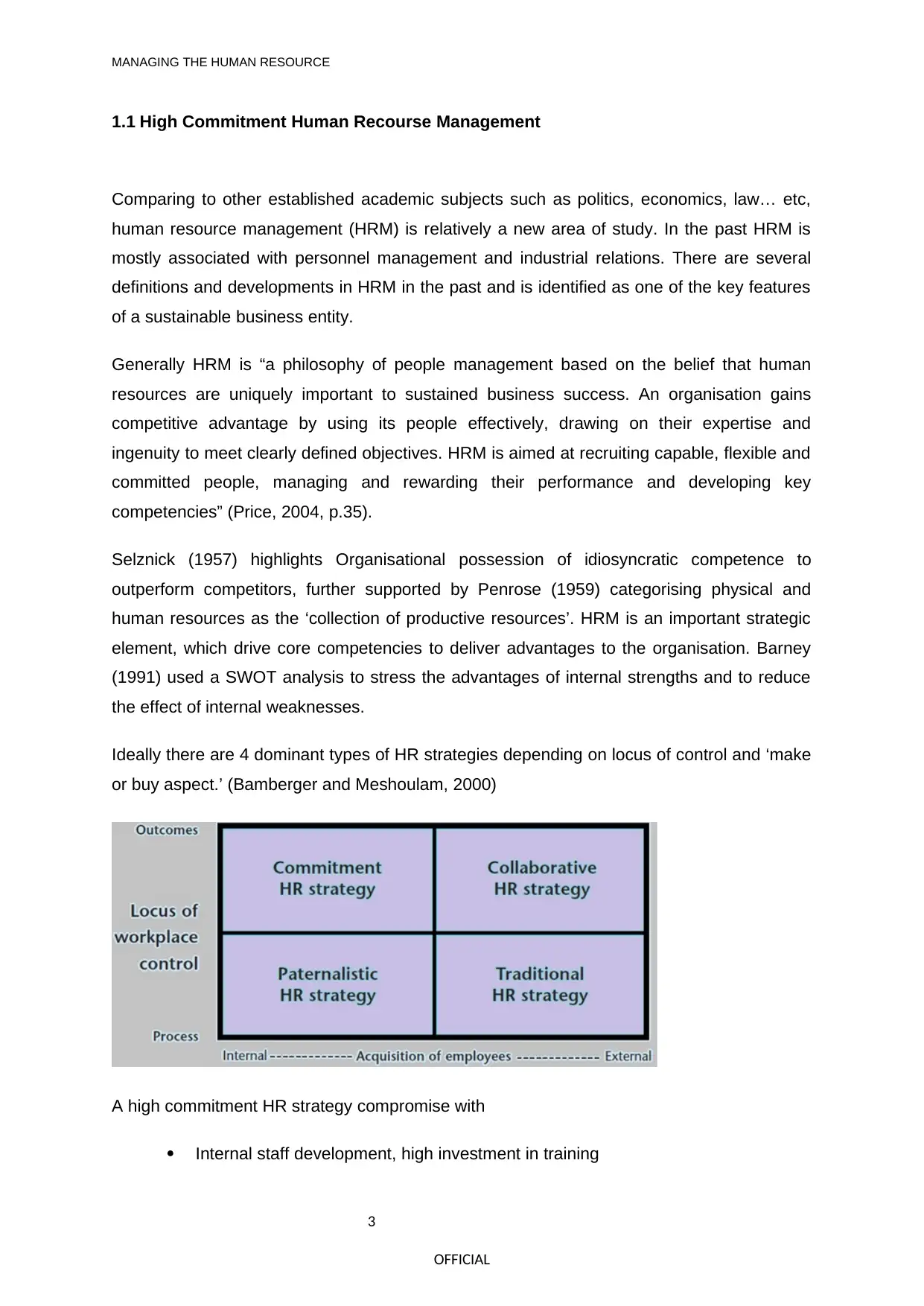
Ideally there are 4 dominant types of HR strategies depending on locus of control and ‘make
or buy aspect.’ (Bamberger and Meshoulam, 2000)
A high commitment HR strategy compromise with
Internal staff development, high investment in training
3
MANAGING THE HUMAN RESOURCE
1.1 High Commitment Human Recourse Management
Comparing to other established academic subjects such as politics, economics, law… etc,
human resource management (HRM) is relatively a new area of study. In the past HRM is
mostly associated with personnel management and industrial relations. There are several
definitions and developments in HRM in the past and is identified as one of the key features
of a sustainable business entity.
Generally HRM is “a philosophy of people management based on the belief that human
resources are uniquely important to sustained business success. An organisation gains
competitive advantage by using its people effectively, drawing on their expertise and
ingenuity to meet clearly defined objectives. HRM is aimed at recruiting capable, flexible and
committed people, managing and rewarding their performance and developing key
competencies” (Price, 2004, p.35).
Selznick (1957) highlights Organisational possession of idiosyncratic competence to
outperform competitors, further supported by Penrose (1959) categorising physical and
human resources as the ‘collection of productive resources’. HRM is an important strategic
element, which drive core competencies to deliver advantages to the organisation. Barney
(1991) used a SWOT analysis to stress the advantages of internal strengths and to reduce
the effect of internal weaknesses.
Ideally there are 4 dominant types of HR strategies depending on locus of control and ‘make
or buy aspect.’ (Bamberger and Meshoulam, 2000)
A high commitment HR strategy compromise with
Internal staff development, high investment in training
3
⊘ This is a preview!⊘
Do you want full access?
Subscribe today to unlock all pages.

Trusted by 1+ million students worldwide
OFFICIAL
MANAGING THE HUMAN RESOURCE
Less compliance with process based standards, develop psychological contract
with mutual respect, trust focusing on outcomes.
High commitment HRM practices are “commitment oriented HRM practices not only
encourage employees’ motivation and willingness to contribute but also help forge a stronger
psychological connection between employees and organisations” (Arthur, 1994, p.677)
1.2 Abraham Maslow’s Hierarchy of needs
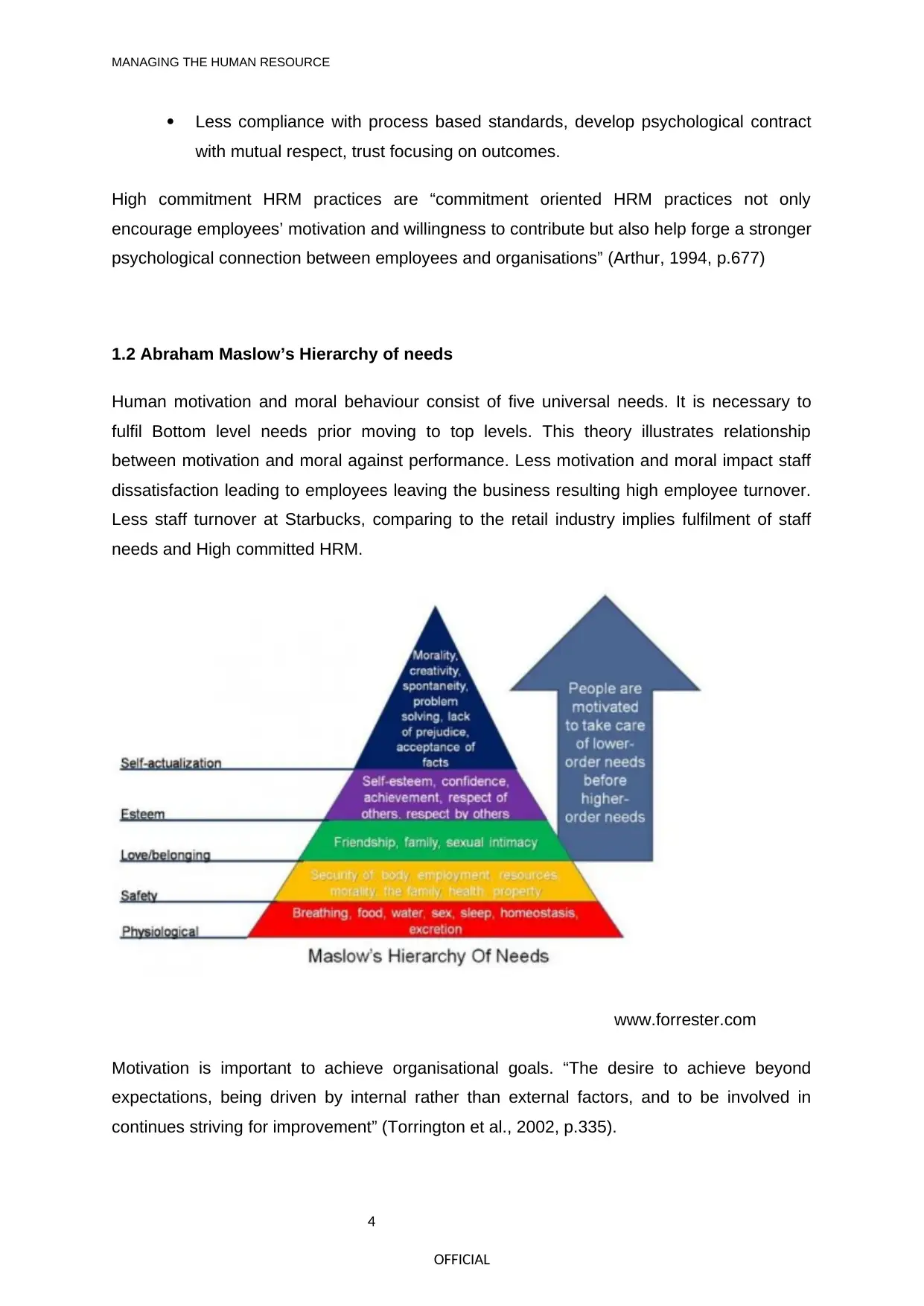
Human motivation and moral behaviour consist of five universal needs. It is necessary to
fulfil Bottom level needs prior moving to top levels. This theory illustrates relationship
between motivation and moral against performance. Less motivation and moral impact staff
dissatisfaction leading to employees leaving the business resulting high employee turnover.
Less staff turnover at Starbucks, comparing to the retail industry implies fulfilment of staff
needs and High committed HRM.
www.forrester.com
Motivation is important to achieve organisational goals. “The desire to achieve beyond
expectations, being driven by internal rather than external factors, and to be involved in
continues striving for improvement” (Torrington et al., 2002, p.335).
4
MANAGING THE HUMAN RESOURCE
Less compliance with process based standards, develop psychological contract
with mutual respect, trust focusing on outcomes.
High commitment HRM practices are “commitment oriented HRM practices not only
encourage employees’ motivation and willingness to contribute but also help forge a stronger
psychological connection between employees and organisations” (Arthur, 1994, p.677)
1.2 Abraham Maslow’s Hierarchy of needs
Human motivation and moral behaviour consist of five universal needs. It is necessary to
fulfil Bottom level needs prior moving to top levels. This theory illustrates relationship
between motivation and moral against performance. Less motivation and moral impact staff
dissatisfaction leading to employees leaving the business resulting high employee turnover.
Less staff turnover at Starbucks, comparing to the retail industry implies fulfilment of staff
needs and High committed HRM.
www.forrester.com
Motivation is important to achieve organisational goals. “The desire to achieve beyond
expectations, being driven by internal rather than external factors, and to be involved in
continues striving for improvement” (Torrington et al., 2002, p.335).
4
Paraphrase This Document
Need a fresh take? Get an instant paraphrase of this document with our AI Paraphraser
OFFICIAL
MANAGING THE HUMAN RESOURCE
Morris (1981) defined morale as the individuals’ (groups) spirit and willingness to perform
assigned tasks. High morale of Starbucks staff positively associates with productivity, state
of mind, efficiency, psychological condition, performance and effectiveness.
Despite limitations, Maslow attempted listing human needs in a systematic order. Such
attempts have been a key to the development of High Commitment HRM. According to
Maslow's, achieving satisfaction is fulfilling needs.
Maslow’s theory reflects,
1. How needs group associate with different levels. Maslow underpins existence of
a standardised way in which these needs group and common solutions are
available. Author argues employee’s motivation, morale and attitudes are
influenced by external factors and depend on personal circumstance.
Another factor is individuals’ attitudes towards work and how high level of needs
can be satisfied through work. This is common in organisations practicing
Traditional HRM and adopts a ‘one-size-fits-all’ approach.
2. What is the most important level of need and its distinction between other levels
of needs? A solution through such ambiguous prediction is not possible.
3. A universal theory. Needs hierarchy fails to differentiate needs of individuals and
different cultures.
In high committed HRM employees require flexibility of choosing their own bespoke bundle
of benefits. Starbucks unique ‘your special blend’ compensation package is an example of
High committed HRM providing staff to decide what set of benefits they need.
Employee motivators are the needs on higher levels at Maslow’s hierarchy. They consist of
recognition, opportunities, responsibility and certain job specific factors which decide neither
the satisfaction nor the dissatisfaction for growth towards self-actualisation.
Starbucks provides low and middle level needs; by restricting existence of a staff Union,
implies restrictions to self-actualisation and social equality as part of High Commitment
HRM.
5
MANAGING THE HUMAN RESOURCE
Morris (1981) defined morale as the individuals’ (groups) spirit and willingness to perform
assigned tasks. High morale of Starbucks staff positively associates with productivity, state
of mind, efficiency, psychological condition, performance and effectiveness.
Despite limitations, Maslow attempted listing human needs in a systematic order. Such
attempts have been a key to the development of High Commitment HRM. According to
Maslow's, achieving satisfaction is fulfilling needs.
Maslow’s theory reflects,
1. How needs group associate with different levels. Maslow underpins existence of
a standardised way in which these needs group and common solutions are
available. Author argues employee’s motivation, morale and attitudes are
influenced by external factors and depend on personal circumstance.
Another factor is individuals’ attitudes towards work and how high level of needs
can be satisfied through work. This is common in organisations practicing
Traditional HRM and adopts a ‘one-size-fits-all’ approach.
2. What is the most important level of need and its distinction between other levels
of needs? A solution through such ambiguous prediction is not possible.
3. A universal theory. Needs hierarchy fails to differentiate needs of individuals and
different cultures.
In high committed HRM employees require flexibility of choosing their own bespoke bundle
of benefits. Starbucks unique ‘your special blend’ compensation package is an example of
High committed HRM providing staff to decide what set of benefits they need.
Employee motivators are the needs on higher levels at Maslow’s hierarchy. They consist of
recognition, opportunities, responsibility and certain job specific factors which decide neither
the satisfaction nor the dissatisfaction for growth towards self-actualisation.
Starbucks provides low and middle level needs; by restricting existence of a staff Union,
implies restrictions to self-actualisation and social equality as part of High Commitment
HRM.
5
OFFICIAL
MANAGING THE HUMAN RESOURCE
1.3 Herzberg two factors theory
Frederick Herzberg argued there are two factors influencing motivation; Hygiene factors and
Motivator factors. Herzberg’s theory does not directly debate motivation or morale; theory
discusses job satisfaction at work providing the right working environment. From a
contemporary view, Motivator-Hygiene theory is based on factors contributing employees’
behaviour at work. Hygiene factors prevent dissatisfaction and pain. Example - working
conditions, company policies, administration and interpersonal relationships. Author’s
argument is that existences of such factors provide limited motivation.
Herzberg two factors theory (www.wordpress.com)
Bowen (1980) identified recognition, achievement, work-life balance, possibility of growth,
advancement, salary, policy and administration, interpersonal relations, supervision,
responsibility, working conditions and the work itself as motivator-hygiene factors.
Starbucks has created a great place to work environment even providing informal social
networking within the organisation using schemes such as ‘partner connection’, on-site
fitness programmes, ‘the wonderful world of food’ and ‘the new parent network’.
Importantly the flexible work schedules enable employees a greater degree of work-life
balance. Enhanced health treatment schemes are motivators for employees to retain in the
organisation. Author argues about the work flexibility at Starbucks. Starbucks provide part
time working opportunities. Comparatively to which extend Starbucks is actually flexible?
Flexible work categorically differ from part time working to flexitime, home-working, term-time
working, structured time off in lieu, compressed hours, annualised hours, job share and
staggered hours.(www.direct.gov.uk).
6
MANAGING THE HUMAN RESOURCE
1.3 Herzberg two factors theory
Frederick Herzberg argued there are two factors influencing motivation; Hygiene factors and
Motivator factors. Herzberg’s theory does not directly debate motivation or morale; theory
discusses job satisfaction at work providing the right working environment. From a
contemporary view, Motivator-Hygiene theory is based on factors contributing employees’
behaviour at work. Hygiene factors prevent dissatisfaction and pain. Example - working
conditions, company policies, administration and interpersonal relationships. Author’s
argument is that existences of such factors provide limited motivation.
Herzberg two factors theory (www.wordpress.com)
Bowen (1980) identified recognition, achievement, work-life balance, possibility of growth,
advancement, salary, policy and administration, interpersonal relations, supervision,
responsibility, working conditions and the work itself as motivator-hygiene factors.
Starbucks has created a great place to work environment even providing informal social
networking within the organisation using schemes such as ‘partner connection’, on-site
fitness programmes, ‘the wonderful world of food’ and ‘the new parent network’.
Importantly the flexible work schedules enable employees a greater degree of work-life
balance. Enhanced health treatment schemes are motivators for employees to retain in the
organisation. Author argues about the work flexibility at Starbucks. Starbucks provide part
time working opportunities. Comparatively to which extend Starbucks is actually flexible?
Flexible work categorically differ from part time working to flexitime, home-working, term-time
working, structured time off in lieu, compressed hours, annualised hours, job share and
staggered hours.(www.direct.gov.uk).
6
⊘ This is a preview!⊘
Do you want full access?
Subscribe today to unlock all pages.
Trusted by 1+ million students worldwide
OFFICIAL
MANAGING THE HUMAN RESOURCE
Bowen (1980) states Herzberg's theory cannot be applied worker groups as the initial study
was conducted based on Accountants and Engineers. Author’s criticisms are,
1. Theory is less likely applies for unskilled and non-professional workers where the
majority of jobs are repetitive and monotonous though often presented with least
job satisfaction. Also some employees do not like the contents of their job
regardless of motivating factors.
Starbucks high commitment HRM provides high degree of Motivator-Hygiene
factors, though majority of staff are employed at sales positions conducting a
routine job function.
2. Methodology employed by Herzberg had influences on the responding
interviewers. Motivator-Hygiene factors of Accountants and Engineers cannot be
compared with front line sales persons.
Theoretically actions and practices of Starbucks provides clear adherence to
improve motivation and hygiene factors but still not practical in the long term due
to high HRM costs.
Mullins (2005) stated favourable reflections of peoples’ performances are likely to attribute
motivating incidents at work. External influences and efforts of other people are attributing to
dissatisfying hygiene. Notwithstanding criticisms of Herzberg's theory, Herzberg illustrated
worker motivation by drawing attention to job design and job enrichment.
Starbucks conducted staff surveys to analyse, evaluate and review HRM practices and with
the high ratio of staff satisfaction concludes employees’ appreciation and acceptance,
proving high commitment HRM at Starbucks. ‘MUG’, ‘Bravo’ and ‘Spirit of Starbucks Awards’
are several recognitions and rewards through employee achievements.
There are five principles embedded to Starbucks corporate strategy to drive high
commitment HRM.
1. HRM Planning
2. Staffing (selection, recruiting)
3. Staff development, Review and evaluation
4. Compensation
5. Managing effective work-force relations
7
MANAGING THE HUMAN RESOURCE
Bowen (1980) states Herzberg's theory cannot be applied worker groups as the initial study
was conducted based on Accountants and Engineers. Author’s criticisms are,
1. Theory is less likely applies for unskilled and non-professional workers where the
majority of jobs are repetitive and monotonous though often presented with least
job satisfaction. Also some employees do not like the contents of their job
regardless of motivating factors.
Starbucks high commitment HRM provides high degree of Motivator-Hygiene
factors, though majority of staff are employed at sales positions conducting a
routine job function.
2. Methodology employed by Herzberg had influences on the responding
interviewers. Motivator-Hygiene factors of Accountants and Engineers cannot be
compared with front line sales persons.
Theoretically actions and practices of Starbucks provides clear adherence to
improve motivation and hygiene factors but still not practical in the long term due
to high HRM costs.
Mullins (2005) stated favourable reflections of peoples’ performances are likely to attribute
motivating incidents at work. External influences and efforts of other people are attributing to
dissatisfying hygiene. Notwithstanding criticisms of Herzberg's theory, Herzberg illustrated
worker motivation by drawing attention to job design and job enrichment.
Starbucks conducted staff surveys to analyse, evaluate and review HRM practices and with
the high ratio of staff satisfaction concludes employees’ appreciation and acceptance,
proving high commitment HRM at Starbucks. ‘MUG’, ‘Bravo’ and ‘Spirit of Starbucks Awards’
are several recognitions and rewards through employee achievements.
There are five principles embedded to Starbucks corporate strategy to drive high
commitment HRM.
1. HRM Planning
2. Staffing (selection, recruiting)
3. Staff development, Review and evaluation
4. Compensation
5. Managing effective work-force relations
7
Paraphrase This Document
Need a fresh take? Get an instant paraphrase of this document with our AI Paraphraser
OFFICIAL
MANAGING THE HUMAN RESOURCE
Many contemporary organisations including Starbucks adopt high commitment HRM. Pfeffer
(1994) developed a list of 16 best practices and later (Pfeffer, 1998) concise to 7 factors.
Seven components to of high commitment HRM (Pfeffer, 1998)
Employment security and internal labour markets
Selective hiring and sophisticated selection
Extensive training, learning and development
Employee involvement, information sharing and worker voice
Self-managed teams/team working
High compensation contingent on performance
Reduction of status differentials/harmonisation
2.1 Internal labour markets and job Security
Pfeffer (1998) identified employment security is the principal expectation of employees about
their employment security, promotions and career development. High commitment HRM
avoids job losses by possible internal transfers, redeployment and TUPE transfers while
expecting no compulsory redundancy; only use temporary staff to protect the core workforce
& corporate HR vision of employing new starters until they retire.
Author argues about job security guarantee in high commitment HRM. Job security is a high
commitment HRM objective but organisation’s has a corporate financial objective of
maximise corporate profits. Job security relies on corporate strategy, demand and supply
forecast of workforce regardless of HRM commitments.
Starbucks had to increase their premium price to cover HRM costs. Author argues about
Starbucks’ contingency plan for rising HR costs. There is a cap that the consumer prepared
to pay for a product regardless of its optimum service. Alternatively Starbucks can introduce
staff benefits packages based on corporate performance to reduce fixed HR costs.
Additionally outsourcing of functions such as HR, pay-roll, logistics and process automation,
re-engineering can be used to minimise operating costs.
Starbuck’s staff matching model for a better HR cycle
Traditional HRM used to match job requirements with the abilities, skills and experience
(Person-job fits). Contemporary practice is towards hiring people who fits for the
organisation’s culture (Person-Organisational fit). Most companies believe that the skills and
experience can be developed using trainings, but peoples’ attitudes cannot be changed
8
MANAGING THE HUMAN RESOURCE
Many contemporary organisations including Starbucks adopt high commitment HRM. Pfeffer
(1994) developed a list of 16 best practices and later (Pfeffer, 1998) concise to 7 factors.
Seven components to of high commitment HRM (Pfeffer, 1998)
Employment security and internal labour markets
Selective hiring and sophisticated selection
Extensive training, learning and development
Employee involvement, information sharing and worker voice
Self-managed teams/team working
High compensation contingent on performance
Reduction of status differentials/harmonisation
2.1 Internal labour markets and job Security
Pfeffer (1998) identified employment security is the principal expectation of employees about
their employment security, promotions and career development. High commitment HRM
avoids job losses by possible internal transfers, redeployment and TUPE transfers while
expecting no compulsory redundancy; only use temporary staff to protect the core workforce
& corporate HR vision of employing new starters until they retire.
Author argues about job security guarantee in high commitment HRM. Job security is a high
commitment HRM objective but organisation’s has a corporate financial objective of
maximise corporate profits. Job security relies on corporate strategy, demand and supply
forecast of workforce regardless of HRM commitments.
Starbucks had to increase their premium price to cover HRM costs. Author argues about
Starbucks’ contingency plan for rising HR costs. There is a cap that the consumer prepared
to pay for a product regardless of its optimum service. Alternatively Starbucks can introduce
staff benefits packages based on corporate performance to reduce fixed HR costs.
Additionally outsourcing of functions such as HR, pay-roll, logistics and process automation,
re-engineering can be used to minimise operating costs.
Starbuck’s staff matching model for a better HR cycle
Traditional HRM used to match job requirements with the abilities, skills and experience
(Person-job fits). Contemporary practice is towards hiring people who fits for the
organisation’s culture (Person-Organisational fit). Most companies believe that the skills and
experience can be developed using trainings, but peoples’ attitudes cannot be changed
8
OFFICIAL
MANAGING THE HUMAN RESOURCE
easily. Therefore it is highly vital to select and retain the staff to match the organisational
culture. Starbuck’s recruitment and selection model sifts new recruits to match the Starbucks
culture.
Selection of best staff
- Required qualities and competencies posted on Starbucks job adverts
- Enable prospective employees to self-select them to a certain extend in the
Starbucks application process
Recruitment process
Induction “facilitate transition of persons in to social roles and statuses that are new for
them” (Trice and Beyer, 1993. p.111). Trainings are focused on different components of
the individual’s requirements to fulfil the organisational requirements.
Starbucks is heavily investing on their overall recruitment process. It is a common aspect in
high commitment HRM. Starbucks Induction and training are inclusive of,
- High investments
- Comprehensive for all employees
- First Impression (24 hour Induction at regional office)
When recruiting management trainees, they are required participating a lengthy extensive
training to familiarise them to the Starbucks culture.
2.2 Recruitment process; hiring and selection of right candidates
Planning for hiring involves obtaining right people in right numbers. Recruits need to possess
right knowledge (skills and experience) to effectively do the right job. At all the time,
recruitment functions need to conduct at the right place incurring the right cost. High
commitment HRM tends to recruit the best people to match the organisational socio-culture,
interpersonal skills, attitudes and commitment to drive the Organisational objectives in a
team environment to accomplish goals and objectives. The technical skills and experience
can be provided by a committed learning culture within the organisation. Starbucks applies a
systematic well defined process which uses sophisticated selection techniques to attract and
retain the targeted employees as it is a non-negotiable key aspect of high commitment HRM.
Redman and Wilkinson (2009) presents a balanced selection process consists of
organisational goals, macro and micro environments, applicants and outcomes. External
9
MANAGING THE HUMAN RESOURCE
easily. Therefore it is highly vital to select and retain the staff to match the organisational
culture. Starbuck’s recruitment and selection model sifts new recruits to match the Starbucks
culture.
Selection of best staff
- Required qualities and competencies posted on Starbucks job adverts
- Enable prospective employees to self-select them to a certain extend in the
Starbucks application process
Recruitment process
Induction “facilitate transition of persons in to social roles and statuses that are new for
them” (Trice and Beyer, 1993. p.111). Trainings are focused on different components of
the individual’s requirements to fulfil the organisational requirements.
Starbucks is heavily investing on their overall recruitment process. It is a common aspect in
high commitment HRM. Starbucks Induction and training are inclusive of,
- High investments
- Comprehensive for all employees
- First Impression (24 hour Induction at regional office)
When recruiting management trainees, they are required participating a lengthy extensive
training to familiarise them to the Starbucks culture.
2.2 Recruitment process; hiring and selection of right candidates
Planning for hiring involves obtaining right people in right numbers. Recruits need to possess
right knowledge (skills and experience) to effectively do the right job. At all the time,
recruitment functions need to conduct at the right place incurring the right cost. High
commitment HRM tends to recruit the best people to match the organisational socio-culture,
interpersonal skills, attitudes and commitment to drive the Organisational objectives in a
team environment to accomplish goals and objectives. The technical skills and experience
can be provided by a committed learning culture within the organisation. Starbucks applies a
systematic well defined process which uses sophisticated selection techniques to attract and
retain the targeted employees as it is a non-negotiable key aspect of high commitment HRM.
Redman and Wilkinson (2009) presents a balanced selection process consists of
organisational goals, macro and micro environments, applicants and outcomes. External
9
⊘ This is a preview!⊘
Do you want full access?
Subscribe today to unlock all pages.
Trusted by 1+ million students worldwide
OFFICIAL
MANAGING THE HUMAN RESOURCE
environment can be broadly assessed by– political, economic, socio-cultural, technological,
environmental and legal factors a (PESTEL framework).
Especially the economic factors are influencing the labour markets and the supply of skilled
labour. Demographic changes such as diverse work forces, changing priorities of job
applicants and legal requirements such as discrimination, equal opportunity, disability
(Guaranteed Interview schemes) has to be adhered unless can be objectively justified.
Therefore the External environment impacting the high commitment HRM and organisational
HR strategy with,
Skills needs (demand) and supply
Monitoring, segmenting and targeting the suitable employees
Use of attractive incentives
Efficient integrated systematic approach.
The high commitment HRM systematic recruitment process includes pre-recruitment
activities such as job analysis (task based or worker based attributes), applications,
psychometric tests, reasoning tests, structured interviews (telephone and followed by a face-
to-face), role plays, work sampling to increase the possibility of hiring the right candidate to
fit for the job. Person specifications, positive behaviour, ‘can do’ attitudes, cognitive ability,
performance, competencies are assessed in a high commitment HRM other than skills and
mere qualifications.
Redman and Wilkinson’s Recruitment Framework
Organisation is an element of this framework. Organisation’s size, culture and HR strategy is
pressured by industry, growth level, financial stability; geographical operational location(s)
which impacts the recruiting process. Large and most multinational companies continuously
recruit and formally use specialist consultants on HR strategy.
There is a functional shift of traditional HR towards line management, centralisation of
divisional HRM to a central unit and even the recruitment processes are outsourced to
external organisations (agencies and head hunters, specialise in recruitment). These
strategies are in place to attract high quality employees, to shorten lengthy recruitment
processes and reduce costs to improve efficiencies. Starbucks need to adopt such strategies
to minimise costs and to recruit best fitting staff.
High commitment HRM encourages internal recruitment for the jobs. This strategy has to be
only implemented if the position requires high skills and knowledge unique to the
10
MANAGING THE HUMAN RESOURCE
environment can be broadly assessed by– political, economic, socio-cultural, technological,
environmental and legal factors a (PESTEL framework).
Especially the economic factors are influencing the labour markets and the supply of skilled
labour. Demographic changes such as diverse work forces, changing priorities of job
applicants and legal requirements such as discrimination, equal opportunity, disability
(Guaranteed Interview schemes) has to be adhered unless can be objectively justified.
Therefore the External environment impacting the high commitment HRM and organisational
HR strategy with,
Skills needs (demand) and supply
Monitoring, segmenting and targeting the suitable employees
Use of attractive incentives
Efficient integrated systematic approach.
The high commitment HRM systematic recruitment process includes pre-recruitment
activities such as job analysis (task based or worker based attributes), applications,
psychometric tests, reasoning tests, structured interviews (telephone and followed by a face-
to-face), role plays, work sampling to increase the possibility of hiring the right candidate to
fit for the job. Person specifications, positive behaviour, ‘can do’ attitudes, cognitive ability,
performance, competencies are assessed in a high commitment HRM other than skills and
mere qualifications.
Redman and Wilkinson’s Recruitment Framework
Organisation is an element of this framework. Organisation’s size, culture and HR strategy is
pressured by industry, growth level, financial stability; geographical operational location(s)
which impacts the recruiting process. Large and most multinational companies continuously
recruit and formally use specialist consultants on HR strategy.
There is a functional shift of traditional HR towards line management, centralisation of
divisional HRM to a central unit and even the recruitment processes are outsourced to
external organisations (agencies and head hunters, specialise in recruitment). These
strategies are in place to attract high quality employees, to shorten lengthy recruitment
processes and reduce costs to improve efficiencies. Starbucks need to adopt such strategies
to minimise costs and to recruit best fitting staff.
High commitment HRM encourages internal recruitment for the jobs. This strategy has to be
only implemented if the position requires high skills and knowledge unique to the
10
Paraphrase This Document
Need a fresh take? Get an instant paraphrase of this document with our AI Paraphraser
OFFICIAL
MANAGING THE HUMAN RESOURCE
organisation, as this process may require lengthy and costly trainings than recruiting a
suitable external candidate. If the recruitment is conducted externally it is more beneficial if
the vacancy is a short-term relationship. Ex – temporary and short term contracts.
As described by Redman and Wilkinson (2009) in high commitment HRM there are 5
indicators of psychometric quality.
1. Reliable and valid assessment tools
2. High validity assessment tools for a low adverse impact
3. Assessment of non-cognitive quality
4. Bespoke simulations
5. Online delivery of assessments
Nevertheless these selection practices and decisions are biased and influenced by
economic pressure (short term and long term), social pressure and stakeholder pressure. On
the other hand the applicant should identify the organisation is a positive place to work. From
the organisations perspective it is important to recruit the right candidate resulting positive
post-hire outcomes.
If the organisational culture is not fitting with the candidate it is very likely that the recruits’
leaving the job and the organisation has to complete another cycle of recruitment, costly
trainings to fill the HR gaps. Long serving staff at Starbucks reflects the credibility of their
recruitment process to acquire people to fits with the culture.
2.3 A learning culture through continuous training and development
Providing comprehensive quality trainings and development to staff is a responsibility of the
employer which develops the work place skills portfolios, integrated to the way work is
designed (on-the-job trainings) and to gain competitive advantages.
Sloman (1994) introduced a high committed logical systematic series of training and learning
adding competitive advantage to organisations.
Training policy
Methodical identification of training requirements
Training objective and training plan
Implementation of training plan and continuously validate, update, evaluate and
review training as a whole process
11
MANAGING THE HUMAN RESOURCE
organisation, as this process may require lengthy and costly trainings than recruiting a
suitable external candidate. If the recruitment is conducted externally it is more beneficial if
the vacancy is a short-term relationship. Ex – temporary and short term contracts.
As described by Redman and Wilkinson (2009) in high commitment HRM there are 5
indicators of psychometric quality.
1. Reliable and valid assessment tools
2. High validity assessment tools for a low adverse impact
3. Assessment of non-cognitive quality
4. Bespoke simulations
5. Online delivery of assessments
Nevertheless these selection practices and decisions are biased and influenced by
economic pressure (short term and long term), social pressure and stakeholder pressure. On
the other hand the applicant should identify the organisation is a positive place to work. From
the organisations perspective it is important to recruit the right candidate resulting positive
post-hire outcomes.
If the organisational culture is not fitting with the candidate it is very likely that the recruits’
leaving the job and the organisation has to complete another cycle of recruitment, costly
trainings to fill the HR gaps. Long serving staff at Starbucks reflects the credibility of their
recruitment process to acquire people to fits with the culture.
2.3 A learning culture through continuous training and development
Providing comprehensive quality trainings and development to staff is a responsibility of the
employer which develops the work place skills portfolios, integrated to the way work is
designed (on-the-job trainings) and to gain competitive advantages.
Sloman (1994) introduced a high committed logical systematic series of training and learning
adding competitive advantage to organisations.
Training policy
Methodical identification of training requirements
Training objective and training plan
Implementation of training plan and continuously validate, update, evaluate and
review training as a whole process
11
OFFICIAL
MANAGING THE HUMAN RESOURCE
Addressing skills gaps (At Starbucks - general awareness of retail business, Coffee
making skills and its history…etc)
Starbucks recruits the best fitting, outstanding, talented, skilled employees. Then ensure,
demonstrate and facilitate continues learning and development as it is an important element
of high commitment HRM. There are different but common types of measures for training
and development in quantitative (financial) aspect,
Number of worker trained
Number of training hours
Training Budget (Amount spent)
According to high commitment HRM, the time and effort devoted for training, quality (focus,
delivery) and amount of training received by workers are important. In the same time if the
worker is overqualified, trainings may not additionally improve the worker or organisational
performance; in that scenario the aim of learning and development objectives are failed.
Author suggests that the measurement of learning and development drives the organisation
to improve continuous performance. On-the-job trainings such as cash register, coffee
recipes conducted by experienced store managers at Starbucks are example of high
performance orientated high committed HRM.
Author criticise the lengthy extended training of 8-12 weeks for the Management trainees.
Instead of such costly, lengthy training schedule, Starbucks can offer on-the-job training
while maintaining required standards and training curriculum.
2.4 Active employee involvement
Organisations need to involve employees actively and allow worker to raise their voice and
share information. Employee engagement is a main component of high commitment HRM.
Marchington and Wilkinson (2005) developed a framework on the depth of employee
participation. The two ends demonstrate high and low level employee participation.
At Information level, employees are simply informed of the management decisions. First
level of participation starts at the communication level and its peak is the control level, where
employees can influence decisions (In normal circumstances decision making is dependent
on the management).
12
MANAGING THE HUMAN RESOURCE
Addressing skills gaps (At Starbucks - general awareness of retail business, Coffee
making skills and its history…etc)
Starbucks recruits the best fitting, outstanding, talented, skilled employees. Then ensure,
demonstrate and facilitate continues learning and development as it is an important element
of high commitment HRM. There are different but common types of measures for training
and development in quantitative (financial) aspect,
Number of worker trained
Number of training hours
Training Budget (Amount spent)
According to high commitment HRM, the time and effort devoted for training, quality (focus,
delivery) and amount of training received by workers are important. In the same time if the
worker is overqualified, trainings may not additionally improve the worker or organisational
performance; in that scenario the aim of learning and development objectives are failed.
Author suggests that the measurement of learning and development drives the organisation
to improve continuous performance. On-the-job trainings such as cash register, coffee
recipes conducted by experienced store managers at Starbucks are example of high
performance orientated high committed HRM.
Author criticise the lengthy extended training of 8-12 weeks for the Management trainees.
Instead of such costly, lengthy training schedule, Starbucks can offer on-the-job training
while maintaining required standards and training curriculum.
2.4 Active employee involvement
Organisations need to involve employees actively and allow worker to raise their voice and
share information. Employee engagement is a main component of high commitment HRM.
Marchington and Wilkinson (2005) developed a framework on the depth of employee
participation. The two ends demonstrate high and low level employee participation.
At Information level, employees are simply informed of the management decisions. First
level of participation starts at the communication level and its peak is the control level, where
employees can influence decisions (In normal circumstances decision making is dependent
on the management).
12
⊘ This is a preview!⊘
Do you want full access?
Subscribe today to unlock all pages.
Trusted by 1+ million students worldwide

1 out of 21


Related Documents


Your All-in-One AI-Powered Toolkit for Academic Success.
+13062052269
info@desklib.com
Available 24*7 on WhatsApp / Email
![[object Object]](/_next/static/media/star-bottom.7253800d.svg)
Unlock your academic potential
Copyright © 2020–2026 A2Z Services. All Rights Reserved. Developed and managed by ZUCOL.