Managerial Economics: Cost-Benefit Analysis and Hiring Decisions
VerifiedAdded on 2023/04/25
|9
|2130
|466
Report
AI Summary
This report delves into the application of cost-benefit analysis within managerial economics, focusing on marginal costs and marginal benefits to optimize business decisions. It graphically represents these concepts, determining the optimal level of activity at 400 units where marginal benefit equals marginal cost. The report also addresses hiring strategies, specifically evaluating candidates for a sales position based on their potential contribution to company revenue versus their salary expectations. The analysis emphasizes the importance of considering long-run benefits over short-run gains in hiring decisions, ultimately aiming to enhance resource utilization and improve overall business performance. Desklib provides access to this and similar solved assignments for students.
Running head: Managerial Economics
Managerial Economics
Course ID:
Course name:
Student Name:
Student ID:
Managerial Economics
Course ID:
Course name:
Student Name:
Student ID:

Paraphrase This Document
Need a fresh take? Get an instant paraphrase of this document with our AI Paraphraser

1
Managerial Economics
Table of Contents
Introduction................................................................................................................................2
Graphical representation............................................................................................................3
2) Hiring for the sale position....................................................................................................4
Conclusion..................................................................................................................................5
Reference list..............................................................................................................................6
Managerial Economics
Table of Contents
Introduction................................................................................................................................2
Graphical representation............................................................................................................3
2) Hiring for the sale position....................................................................................................4
Conclusion..................................................................................................................................5
Reference list..............................................................................................................................6
2
Managerial Economics
Introduction
The above study is going to highlight the development of the marginal cost and
marginal benefit that the economy will be having in order to determine the development of
the costs and the benefits that the economy will be getting so that they can understand the
development of the business in an effective way. Through the identification of the marginal
costs and benefits, it will be easy for the government as well as economy to understand the
development of the business. It is important to understand the costs and benefits that are
related so that the overall project can be easily classified so that the decision makers can take
decisions based on the costs and benefits. Through the development of the cost benefit
analysis the policymakers will be keen to identify the areas that will require more attention in
the form of investment so that costs can be minimised and benefits can be increased.
Managerial Economics
Introduction
The above study is going to highlight the development of the marginal cost and
marginal benefit that the economy will be having in order to determine the development of
the costs and the benefits that the economy will be getting so that they can understand the
development of the business in an effective way. Through the identification of the marginal
costs and benefits, it will be easy for the government as well as economy to understand the
development of the business. It is important to understand the costs and benefits that are
related so that the overall project can be easily classified so that the decision makers can take
decisions based on the costs and benefits. Through the development of the cost benefit
analysis the policymakers will be keen to identify the areas that will require more attention in
the form of investment so that costs can be minimised and benefits can be increased.
⊘ This is a preview!⊘
Do you want full access?
Subscribe today to unlock all pages.

Trusted by 1+ million students worldwide
3
Managerial Economics
Graphical representation
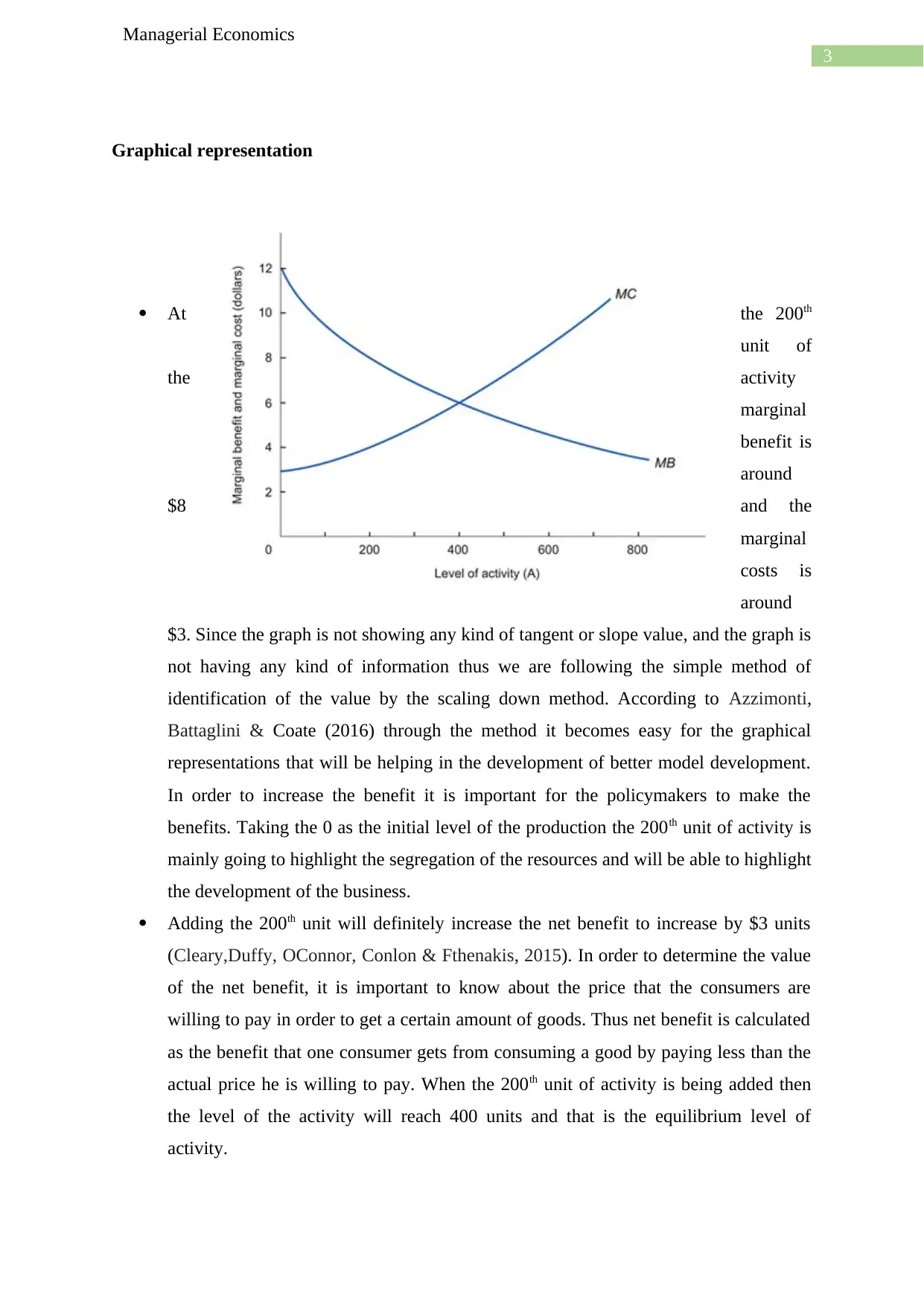
At the 200th
unit of
the activity
marginal
benefit is
around
$8 and the
marginal
costs is
around
$3. Since the graph is not showing any kind of tangent or slope value, and the graph is
not having any kind of information thus we are following the simple method of
identification of the value by the scaling down method. According to Azzimonti,
Battaglini & Coate (2016) through the method it becomes easy for the graphical
representations that will be helping in the development of better model development.
In order to increase the benefit it is important for the policymakers to make the
benefits. Taking the 0 as the initial level of the production the 200th unit of activity is
mainly going to highlight the segregation of the resources and will be able to highlight
the development of the business.
Adding the 200th unit will definitely increase the net benefit to increase by $3 units
(Cleary,Duffy, OConnor, Conlon & Fthenakis, 2015). In order to determine the value
of the net benefit, it is important to know about the price that the consumers are
willing to pay in order to get a certain amount of goods. Thus net benefit is calculated
as the benefit that one consumer gets from consuming a good by paying less than the
actual price he is willing to pay. When the 200th unit of activity is being added then
the level of the activity will reach 400 units and that is the equilibrium level of
activity.
Managerial Economics
Graphical representation
At the 200th
unit of
the activity
marginal
benefit is
around
$8 and the
marginal
costs is
around
$3. Since the graph is not showing any kind of tangent or slope value, and the graph is
not having any kind of information thus we are following the simple method of
identification of the value by the scaling down method. According to Azzimonti,
Battaglini & Coate (2016) through the method it becomes easy for the graphical
representations that will be helping in the development of better model development.
In order to increase the benefit it is important for the policymakers to make the
benefits. Taking the 0 as the initial level of the production the 200th unit of activity is
mainly going to highlight the segregation of the resources and will be able to highlight
the development of the business.
Adding the 200th unit will definitely increase the net benefit to increase by $3 units
(Cleary,Duffy, OConnor, Conlon & Fthenakis, 2015). In order to determine the value
of the net benefit, it is important to know about the price that the consumers are
willing to pay in order to get a certain amount of goods. Thus net benefit is calculated
as the benefit that one consumer gets from consuming a good by paying less than the
actual price he is willing to pay. When the 200th unit of activity is being added then
the level of the activity will reach 400 units and that is the equilibrium level of
activity.
Paraphrase This Document
Need a fresh take? Get an instant paraphrase of this document with our AI Paraphraser
4
Managerial Economics
At the 700 units of activities, marginal benefit is $3 and the marginal costs is around
$10. This is one of the important aspect in the sense that at the 700 units of activities
the marginal cost is increasing than the marginal benefit. On the other hand, the 700
level of activity is not all justified in the sense that cost is more for one unit of benefit
that the policymaker is facing. This activity is out of the list from the budget. If the
consumer is assumed to purchase the goods then consuming 700 units of activities
will be out of budget line. Now taking the matter of consumer, consuming 700 units
of activities are out of the budget line that is not involving the development of
business.
Subtracting the 700 units of activities will cause the net benefit to increase. This is
important in the sense that it will cost marginal benefit of $4 and marginal cost is $9
when the level of activity is 600. When the activity is 700 then the marginal benefit is
$5 and the marginal costs is $9. The net benefit will increase in the sense that
consumer is paying equal amount of price he is getting one unit extra benefit. This
will bring the party back to the previous situations that will minimise the marginal
costs and that will increase the marginal benefit which will increase the surplus. The
study cannot define whose surplus it is because it is not defined who is the party
involved in the business.
The optimal level of activity is 400 units. At this level of output, the marginal benefit
is $6 and the marginal cost is around $6. This is the optimal level of activity where the
marginal costs is getting intersected with the marginal benefits curve. In this marginal
costs and marginal benefits, the policymakers will be looking to use the resource
utilisation and will be able to increase their production (Lo, Blumsack, Hines &
Meyn, 2019). This is the optimal condition in the sense that the party that is enjoying
the optimal condition and will not tend to move from that position. On the
development of this optimal position, the party will not try to move to new position.
This will automatically increase the marginal cost if they move to right of the
marginal benefit curve. In this level of output, the companies supply will be equalling
with the demand of the customers and the marginal costs and marginal benefits are
passing through same point. On the development of
Managerial Economics
At the 700 units of activities, marginal benefit is $3 and the marginal costs is around
$10. This is one of the important aspect in the sense that at the 700 units of activities
the marginal cost is increasing than the marginal benefit. On the other hand, the 700
level of activity is not all justified in the sense that cost is more for one unit of benefit
that the policymaker is facing. This activity is out of the list from the budget. If the
consumer is assumed to purchase the goods then consuming 700 units of activities
will be out of budget line. Now taking the matter of consumer, consuming 700 units
of activities are out of the budget line that is not involving the development of
business.
Subtracting the 700 units of activities will cause the net benefit to increase. This is
important in the sense that it will cost marginal benefit of $4 and marginal cost is $9
when the level of activity is 600. When the activity is 700 then the marginal benefit is
$5 and the marginal costs is $9. The net benefit will increase in the sense that
consumer is paying equal amount of price he is getting one unit extra benefit. This
will bring the party back to the previous situations that will minimise the marginal
costs and that will increase the marginal benefit which will increase the surplus. The
study cannot define whose surplus it is because it is not defined who is the party
involved in the business.
The optimal level of activity is 400 units. At this level of output, the marginal benefit
is $6 and the marginal cost is around $6. This is the optimal level of activity where the
marginal costs is getting intersected with the marginal benefits curve. In this marginal
costs and marginal benefits, the policymakers will be looking to use the resource
utilisation and will be able to increase their production (Lo, Blumsack, Hines &
Meyn, 2019). This is the optimal condition in the sense that the party that is enjoying
the optimal condition and will not tend to move from that position. On the
development of this optimal position, the party will not try to move to new position.
This will automatically increase the marginal cost if they move to right of the
marginal benefit curve. In this level of output, the companies supply will be equalling
with the demand of the customers and the marginal costs and marginal benefits are
passing through same point. On the development of
5
Managerial Economics
2) Hiring for the sale position
In the above problem, the Jack can sell 64 widgets per day, Jill can sell 50 widgets per
day, and John can sell 100 widgets per day and the daily salary is daily salary each person is
asking is as follows: Jack, $100; Jill, $100; and John, $300. Now looking into the following
situation, in order to rank the following candidates while hiring for the position of one sales
job, the John will be automatically chosen candidates (Gächter, Huang & Sefton, 2016). This
is because the selling capacity of this seller, is more than other sellers. Looking into this
matter the company will be looking to increase the revenue of the company. However,
looking into the salary structure of the John, the company will be looking to give him less
salary. On the other hand, the development two other sellers was claiming same amount of
salary and they are unable to give the equal level of productions (Jochem, Doll & Fichtner,
2016). Through the development of costs and benefits, the companies will be able to
highlight the development of better policies that will be able to increase the quality of the
production. Most of the companies will be looking to minimise the salary of the employees
and they will be looking to increase the development of the production. On the other hand,
the development of costs and benefit is important in the sense that it will be helping in the
development of the policies that will definitely increase the position and the production of the
policies (Lee, Miguel & Wolfram, 2016). Calculation of the net benefit and net costs are
important in the sense that it will be highlighting the development of the policies that the
policymakers are looking forward to increase the long run production ability.
Through the development of better innovations in the policymakers, it is important to
allocate the resources in an effective way. This will definitely increase the resource utilisation
and the company will be able to identify the resources that will be able to increase the
development of resource utilisation. On the contrary in the case of hiring, the companies will
be looking mostly for the development of the long run benefits compared to the short run
benefits. Through the development of long run costs and the long run benefits that the
companies will be getting from the employee if the employee is hired.
Conclusion
The study is going to conclude regarding the marginal costs and benefits that each
party is going to consume. Through the analysis of the given graph, the development of each
marginal costs and marginal benefits can be calculated so that the each party indulged in the
business can identify the long run costs that is regarded with the development of long run
Managerial Economics
2) Hiring for the sale position
In the above problem, the Jack can sell 64 widgets per day, Jill can sell 50 widgets per
day, and John can sell 100 widgets per day and the daily salary is daily salary each person is
asking is as follows: Jack, $100; Jill, $100; and John, $300. Now looking into the following
situation, in order to rank the following candidates while hiring for the position of one sales
job, the John will be automatically chosen candidates (Gächter, Huang & Sefton, 2016). This
is because the selling capacity of this seller, is more than other sellers. Looking into this
matter the company will be looking to increase the revenue of the company. However,
looking into the salary structure of the John, the company will be looking to give him less
salary. On the other hand, the development two other sellers was claiming same amount of
salary and they are unable to give the equal level of productions (Jochem, Doll & Fichtner,
2016). Through the development of costs and benefits, the companies will be able to
highlight the development of better policies that will be able to increase the quality of the
production. Most of the companies will be looking to minimise the salary of the employees
and they will be looking to increase the development of the production. On the other hand,
the development of costs and benefit is important in the sense that it will be helping in the
development of the policies that will definitely increase the position and the production of the
policies (Lee, Miguel & Wolfram, 2016). Calculation of the net benefit and net costs are
important in the sense that it will be highlighting the development of the policies that the
policymakers are looking forward to increase the long run production ability.
Through the development of better innovations in the policymakers, it is important to
allocate the resources in an effective way. This will definitely increase the resource utilisation
and the company will be able to identify the resources that will be able to increase the
development of resource utilisation. On the contrary in the case of hiring, the companies will
be looking mostly for the development of the long run benefits compared to the short run
benefits. Through the development of long run costs and the long run benefits that the
companies will be getting from the employee if the employee is hired.
Conclusion
The study is going to conclude regarding the marginal costs and benefits that each
party is going to consume. Through the analysis of the given graph, the development of each
marginal costs and marginal benefits can be calculated so that the each party indulged in the
business can identify the long run costs that is regarded with the development of long run
⊘ This is a preview!⊘
Do you want full access?
Subscribe today to unlock all pages.
Trusted by 1+ million students worldwide
6
Managerial Economics
benefits. This is important in the sense that through the development of long run costs and
benefits it will easy for companies when hiring for the employees. It is important for all the
companies to identify the long run growths and will be looking forward to increase the
resource distribution. On the other hand, it is important for the HR to look into the long run
that will definitely increase long run benefits. Through the development of better ranking of
the hiring process, the company will benefit the development in the long run. Through the
development of better long run benefits, the companies will be able to improve the business.
Managerial Economics
benefits. This is important in the sense that through the development of long run costs and
benefits it will easy for companies when hiring for the employees. It is important for all the
companies to identify the long run growths and will be looking forward to increase the
resource distribution. On the other hand, it is important for the HR to look into the long run
that will definitely increase long run benefits. Through the development of better ranking of
the hiring process, the company will benefit the development in the long run. Through the
development of better long run benefits, the companies will be able to improve the business.
Paraphrase This Document
Need a fresh take? Get an instant paraphrase of this document with our AI Paraphraser
7
Managerial Economics
Reference list
Azzimonti, M., Battaglini, M., & Coate, S. (2016). The costs and benefits of balanced budget
rules: Lessons from a political economy model of fiscal policy. Journal of Public
Economics, 136, 45-61.
Cleary, B., Duffy, A., OConnor, A., Conlon, M., & Fthenakis, V. (2015). Assessing the
economic benefits of compressed air energy storage for mitigating wind
curtailment. IEEE Transactions on Sustainable Energy, 6(3), 1021-1028.
Gächter, S., Huang, L., & Sefton, M. (2016). Combining “real effort” with induced effort
costs: the ball-catching task. Experimental economics, 19(4), 687-712.
Jochem, P., Doll, C., & Fichtner, W. (2016). External costs of electric
vehicles. Transportation Research Part D: Transport and Environment, 42, 60-76.
Lee, K., Miguel, E., & Wolfram, C. (2016). Experimental evidence on the demand for and
costs of rural electrification(No. w22292). National Bureau of Economic Research.
Litman, T. (2015). Evaluating public transit benefits and costs. Victoria, BC, Canada:
Victoria Transport Policy Institute.
Lo, H., Blumsack, S., Hines, P., & Meyn, S. (2019). Electricity rates for the zero marginal
cost grid. The Electricity Journal, 32(3), 39-43.
Oates, W. E., Portney, P. R., & McGartland, A. M. (2018). The net benefits of incentive-
based regulation: a case study of environmental standard setting. The Theory and
Practice of Command and Control in Environmental Policy, 273-282.
Pope III, C. A., Cropper, M., Coggins, J., & Cohen, A. (2015). Health benefits of air
pollution abatement policy: role of the shape of the concentration–response
function. Journal of the Air & Waste Management Association, 65(5), 516-522.
Schlachtberger, D. P., Brown, T., Schramm, S., & Greiner, M. (2017). The benefits of
cooperation in a highly renewable European electricity network. Energy, 134, 469-
481.
Wiser, R., Millstein, D., Mai, T., Macknick, J., Carpenter, A., Cohen, S., ... & Heath, G.
(2016). The environmental and public health benefits of achieving high penetrations
of solar energy in the United States. Energy, 113, 472-486.
Managerial Economics
Reference list
Azzimonti, M., Battaglini, M., & Coate, S. (2016). The costs and benefits of balanced budget
rules: Lessons from a political economy model of fiscal policy. Journal of Public
Economics, 136, 45-61.
Cleary, B., Duffy, A., OConnor, A., Conlon, M., & Fthenakis, V. (2015). Assessing the
economic benefits of compressed air energy storage for mitigating wind
curtailment. IEEE Transactions on Sustainable Energy, 6(3), 1021-1028.
Gächter, S., Huang, L., & Sefton, M. (2016). Combining “real effort” with induced effort
costs: the ball-catching task. Experimental economics, 19(4), 687-712.
Jochem, P., Doll, C., & Fichtner, W. (2016). External costs of electric
vehicles. Transportation Research Part D: Transport and Environment, 42, 60-76.
Lee, K., Miguel, E., & Wolfram, C. (2016). Experimental evidence on the demand for and
costs of rural electrification(No. w22292). National Bureau of Economic Research.
Litman, T. (2015). Evaluating public transit benefits and costs. Victoria, BC, Canada:
Victoria Transport Policy Institute.
Lo, H., Blumsack, S., Hines, P., & Meyn, S. (2019). Electricity rates for the zero marginal
cost grid. The Electricity Journal, 32(3), 39-43.
Oates, W. E., Portney, P. R., & McGartland, A. M. (2018). The net benefits of incentive-
based regulation: a case study of environmental standard setting. The Theory and
Practice of Command and Control in Environmental Policy, 273-282.
Pope III, C. A., Cropper, M., Coggins, J., & Cohen, A. (2015). Health benefits of air
pollution abatement policy: role of the shape of the concentration–response
function. Journal of the Air & Waste Management Association, 65(5), 516-522.
Schlachtberger, D. P., Brown, T., Schramm, S., & Greiner, M. (2017). The benefits of
cooperation in a highly renewable European electricity network. Energy, 134, 469-
481.
Wiser, R., Millstein, D., Mai, T., Macknick, J., Carpenter, A., Cohen, S., ... & Heath, G.
(2016). The environmental and public health benefits of achieving high penetrations
of solar energy in the United States. Energy, 113, 472-486.
8
Managerial Economics
Zhang, S., Worrell, E., & Crijns-Graus, W. (2015). Evaluating co-benefits of energy
efficiency and air pollution abatement in China’s cement industry. Applied
Energy, 147, 192-213.
Managerial Economics
Zhang, S., Worrell, E., & Crijns-Graus, W. (2015). Evaluating co-benefits of energy
efficiency and air pollution abatement in China’s cement industry. Applied
Energy, 147, 192-213.
⊘ This is a preview!⊘
Do you want full access?
Subscribe today to unlock all pages.
Trusted by 1+ million students worldwide

1 out of 9


Your All-in-One AI-Powered Toolkit for Academic Success.
+13062052269
info@desklib.com
Available 24*7 on WhatsApp / Email
![[object Object]](/_next/static/media/star-bottom.7253800d.svg)
Unlock your academic potential
Copyright © 2020–2026 A2Z Services. All Rights Reserved. Developed and managed by ZUCOL.