Marketing Principles Report
VerifiedAdded on 2020/02/03
|13
|4193
|439
Report
AI Summary
This report delves into the marketing principles utilized by McDonald's, focusing on their strategies for market segmentation, targeting, and positioning. It outlines the importance of understanding consumer behavior and the marketing mix elements that contribute to the company's success in a competitive environment. The report also discusses the differences between domestic and international marketing strategies, emphasizing the need for effective marketing activities to attract and retain customers.
Marketing Principle
1
1

Paraphrase This Document
Need a fresh take? Get an instant paraphrase of this document with our AI Paraphraser
TABLE OF CONTENTS
INTRODUCTION......................................................................................................................4
TASK 1......................................................................................................................................4
1.1..........................................................................................................................................4
1.2..........................................................................................................................................5
2.1..........................................................................................................................................5
2.2..........................................................................................................................................6
2.3..........................................................................................................................................6
2.4..........................................................................................................................................7
2.5..........................................................................................................................................7
3.1..........................................................................................................................................8
3.2..........................................................................................................................................8
3.3..........................................................................................................................................9
3.4..........................................................................................................................................9
3.5........................................................................................................................................10
TASK 2....................................................................................................................................10
4.1........................................................................................................................................10
4.2........................................................................................................................................11
4.3........................................................................................................................................12
CONCLUSION........................................................................................................................12
REFERENCES.........................................................................................................................13
2
INTRODUCTION......................................................................................................................4
TASK 1......................................................................................................................................4
1.1..........................................................................................................................................4
1.2..........................................................................................................................................5
2.1..........................................................................................................................................5
2.2..........................................................................................................................................6
2.3..........................................................................................................................................6
2.4..........................................................................................................................................7
2.5..........................................................................................................................................7
3.1..........................................................................................................................................8
3.2..........................................................................................................................................8
3.3..........................................................................................................................................9
3.4..........................................................................................................................................9
3.5........................................................................................................................................10
TASK 2....................................................................................................................................10
4.1........................................................................................................................................10
4.2........................................................................................................................................11
4.3........................................................................................................................................12
CONCLUSION........................................................................................................................12
REFERENCES.........................................................................................................................13
2
INTRODUCTION
Marketing consists of different activities of a company that is associated with
exchanging of goods and services to the varied customers and it also aware the customers
regarding their range of offerings (Rad, Akbari and Motevaselian, 2014). Therefore, it is said
that marketing plays significant role for the organization to attain success in the competitive
environment. It has been also stated that marketing activities also covers different aspects
such as advertising, promotion of goods and services as well as increases the sales. For the
present report chosen organization is McDonald's which is known for serving range of food
items to the different segment customers all over the world.
The report will also discuss different elements existing in the marketing process along
with gaining the information related with benefit and cost associated with market orientation.
While the researcher will also focuses on understanding the concept of segmentation,
targeting and positioning related with the cited organization that is McDonald's. Along with
this, it also understand the extended marketing mix in the context of McDonald's so that they
can easily meet the requirement of their customers.
TASK 1
1.1
In order to ensure successful marketing, manager of McDonald's focuses on different
steps so that they can easily promote their products and services to the desired customers
(Akaka, Vargo and Lusch, 2013). The different steps in the marketing process include-
1. The first step in marketing process is to conduct the market research where marketing
manager of McDonald is required to measure different market condition with the help
of proper framework.
2. After that marketing manager must focuses on formulating the marketing strategies
that basically include all the facets that are affiliated with segmentation, targeting and
positioning (Akehurst, Afonso and Martins Gonçalves, 2012). With the help of
selecting effective marketing strategies they can easily target their customer base and
position their range of food products in the market.
3. After that marketing manager must also include all the elements of marketing mix so
that they can easily market and promote their range of food items and products.
3
Marketing consists of different activities of a company that is associated with
exchanging of goods and services to the varied customers and it also aware the customers
regarding their range of offerings (Rad, Akbari and Motevaselian, 2014). Therefore, it is said
that marketing plays significant role for the organization to attain success in the competitive
environment. It has been also stated that marketing activities also covers different aspects
such as advertising, promotion of goods and services as well as increases the sales. For the
present report chosen organization is McDonald's which is known for serving range of food
items to the different segment customers all over the world.
The report will also discuss different elements existing in the marketing process along
with gaining the information related with benefit and cost associated with market orientation.
While the researcher will also focuses on understanding the concept of segmentation,
targeting and positioning related with the cited organization that is McDonald's. Along with
this, it also understand the extended marketing mix in the context of McDonald's so that they
can easily meet the requirement of their customers.
TASK 1
1.1
In order to ensure successful marketing, manager of McDonald's focuses on different
steps so that they can easily promote their products and services to the desired customers
(Akaka, Vargo and Lusch, 2013). The different steps in the marketing process include-
1. The first step in marketing process is to conduct the market research where marketing
manager of McDonald is required to measure different market condition with the help
of proper framework.
2. After that marketing manager must focuses on formulating the marketing strategies
that basically include all the facets that are affiliated with segmentation, targeting and
positioning (Akehurst, Afonso and Martins Gonçalves, 2012). With the help of
selecting effective marketing strategies they can easily target their customer base and
position their range of food products in the market.
3. After that marketing manager must also include all the elements of marketing mix so
that they can easily market and promote their range of food items and products.
3
⊘ This is a preview!⊘
Do you want full access?
Subscribe today to unlock all pages.

Trusted by 1+ million students worldwide
4. The last step in the process include monitoring and controlling of all the marketing
activities and steps so that in case of arising any issues marketing manager can easily
modify the changes.
1.2
Market orientation is defined as model or approach that is related with determining
the desired needs and requirement of customers and designed products and services accordant
with that in order to satisfy the customers (Aloia and et.al., 2013). Marketing manager of
McDonald focuses on this business approach in identifying the food requirement of their
different segment customers and creating new food products to meet their requirement. It has
been evaluated that benefit of market orientation to McDonald focuses on determining the
actual need and requirement of the target audiences so that they can amend their food
services accordant with the requirement. In addition to this, another benefit of marketing
orientation is that it help the food company in gaining competitiveness over their competitors
through providing them quality food services and products. On the contrary to this, it also
evaluated the cost associated with the marketing orientation is that it requires huge
investment by the marketing manager of McDonald in order to carry out proper market
research (Anderson and Mirosa, 2014). Along with this, another cost associated with
marketing orientation include changing preferences and taste of customers.
2.1
There are different micro and macro environmental factors which directly influences
the marketing decisions of McDonald. The macro factors are consider as PEST that is
political, economical, social and technological factors that need to be addressed properly by
the senior level authority (Assiouras, Ozgen and Skourtis, 2013). The food company need to
abide various government regulations and rules related with hygiene so that while operating
its activities in different countries they must comply with all these regulations in order to
avoid any health issue. Another factor is economic factor it ensure that McDonald would
engage in charging low or affordable prices for their products when there is low inflation rate
thus, it will impact the marketing decisions of company. Another macro factor include social
factor with the changing preferences and taste of customers company change their activities.
For instance, in the India majority of customers prefer to eat vegetarian food item as compare
to non-veg. Therefore, this change in the preferences results in influencing the marketing
decisions of the company (Bublitz and Peracchio, 2015). The last macro factor that influences
4
activities and steps so that in case of arising any issues marketing manager can easily
modify the changes.
1.2
Market orientation is defined as model or approach that is related with determining
the desired needs and requirement of customers and designed products and services accordant
with that in order to satisfy the customers (Aloia and et.al., 2013). Marketing manager of
McDonald focuses on this business approach in identifying the food requirement of their
different segment customers and creating new food products to meet their requirement. It has
been evaluated that benefit of market orientation to McDonald focuses on determining the
actual need and requirement of the target audiences so that they can amend their food
services accordant with the requirement. In addition to this, another benefit of marketing
orientation is that it help the food company in gaining competitiveness over their competitors
through providing them quality food services and products. On the contrary to this, it also
evaluated the cost associated with the marketing orientation is that it requires huge
investment by the marketing manager of McDonald in order to carry out proper market
research (Anderson and Mirosa, 2014). Along with this, another cost associated with
marketing orientation include changing preferences and taste of customers.
2.1
There are different micro and macro environmental factors which directly influences
the marketing decisions of McDonald. The macro factors are consider as PEST that is
political, economical, social and technological factors that need to be addressed properly by
the senior level authority (Assiouras, Ozgen and Skourtis, 2013). The food company need to
abide various government regulations and rules related with hygiene so that while operating
its activities in different countries they must comply with all these regulations in order to
avoid any health issue. Another factor is economic factor it ensure that McDonald would
engage in charging low or affordable prices for their products when there is low inflation rate
thus, it will impact the marketing decisions of company. Another macro factor include social
factor with the changing preferences and taste of customers company change their activities.
For instance, in the India majority of customers prefer to eat vegetarian food item as compare
to non-veg. Therefore, this change in the preferences results in influencing the marketing
decisions of the company (Bublitz and Peracchio, 2015). The last macro factor that influences
4
Paraphrase This Document
Need a fresh take? Get an instant paraphrase of this document with our AI Paraphraser
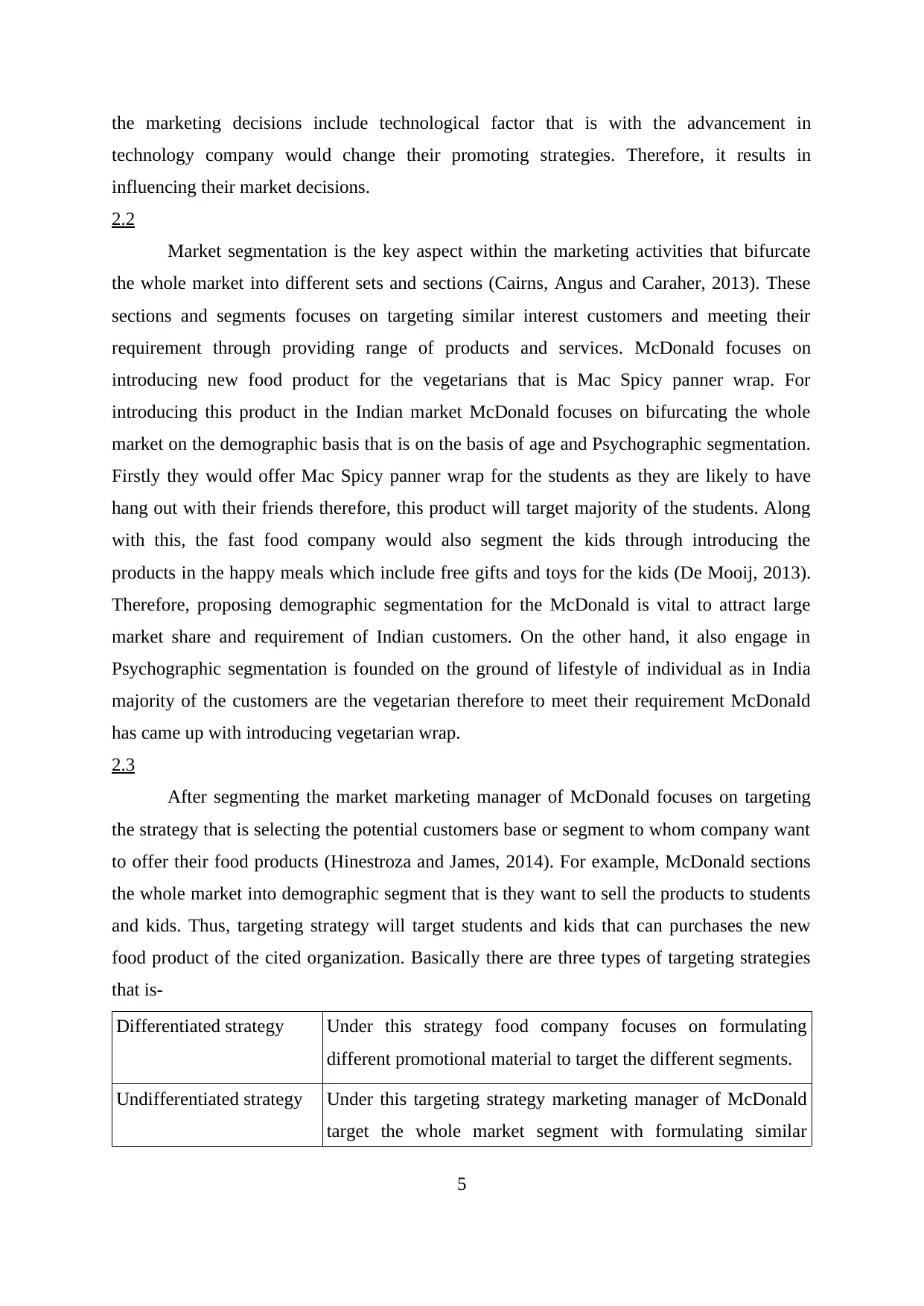
the marketing decisions include technological factor that is with the advancement in
technology company would change their promoting strategies. Therefore, it results in
influencing their market decisions.
2.2
Market segmentation is the key aspect within the marketing activities that bifurcate
the whole market into different sets and sections (Cairns, Angus and Caraher, 2013). These
sections and segments focuses on targeting similar interest customers and meeting their
requirement through providing range of products and services. McDonald focuses on
introducing new food product for the vegetarians that is Mac Spicy panner wrap. For
introducing this product in the Indian market McDonald focuses on bifurcating the whole
market on the demographic basis that is on the basis of age and Psychographic segmentation.
Firstly they would offer Mac Spicy panner wrap for the students as they are likely to have
hang out with their friends therefore, this product will target majority of the students. Along
with this, the fast food company would also segment the kids through introducing the
products in the happy meals which include free gifts and toys for the kids (De Mooij, 2013).
Therefore, proposing demographic segmentation for the McDonald is vital to attract large
market share and requirement of Indian customers. On the other hand, it also engage in
Psychographic segmentation is founded on the ground of lifestyle of individual as in India
majority of the customers are the vegetarian therefore to meet their requirement McDonald
has came up with introducing vegetarian wrap.
2.3
After segmenting the market marketing manager of McDonald focuses on targeting
the strategy that is selecting the potential customers base or segment to whom company want
to offer their food products (Hinestroza and James, 2014). For example, McDonald sections
the whole market into demographic segment that is they want to sell the products to students
and kids. Thus, targeting strategy will target students and kids that can purchases the new
food product of the cited organization. Basically there are three types of targeting strategies
that is-
Differentiated strategy Under this strategy food company focuses on formulating
different promotional material to target the different segments.
Undifferentiated strategy Under this targeting strategy marketing manager of McDonald
target the whole market segment with formulating similar
5
technology company would change their promoting strategies. Therefore, it results in
influencing their market decisions.
2.2
Market segmentation is the key aspect within the marketing activities that bifurcate
the whole market into different sets and sections (Cairns, Angus and Caraher, 2013). These
sections and segments focuses on targeting similar interest customers and meeting their
requirement through providing range of products and services. McDonald focuses on
introducing new food product for the vegetarians that is Mac Spicy panner wrap. For
introducing this product in the Indian market McDonald focuses on bifurcating the whole
market on the demographic basis that is on the basis of age and Psychographic segmentation.
Firstly they would offer Mac Spicy panner wrap for the students as they are likely to have
hang out with their friends therefore, this product will target majority of the students. Along
with this, the fast food company would also segment the kids through introducing the
products in the happy meals which include free gifts and toys for the kids (De Mooij, 2013).
Therefore, proposing demographic segmentation for the McDonald is vital to attract large
market share and requirement of Indian customers. On the other hand, it also engage in
Psychographic segmentation is founded on the ground of lifestyle of individual as in India
majority of the customers are the vegetarian therefore to meet their requirement McDonald
has came up with introducing vegetarian wrap.
2.3
After segmenting the market marketing manager of McDonald focuses on targeting
the strategy that is selecting the potential customers base or segment to whom company want
to offer their food products (Hinestroza and James, 2014). For example, McDonald sections
the whole market into demographic segment that is they want to sell the products to students
and kids. Thus, targeting strategy will target students and kids that can purchases the new
food product of the cited organization. Basically there are three types of targeting strategies
that is-
Differentiated strategy Under this strategy food company focuses on formulating
different promotional material to target the different segments.
Undifferentiated strategy Under this targeting strategy marketing manager of McDonald
target the whole market segment with formulating similar
5
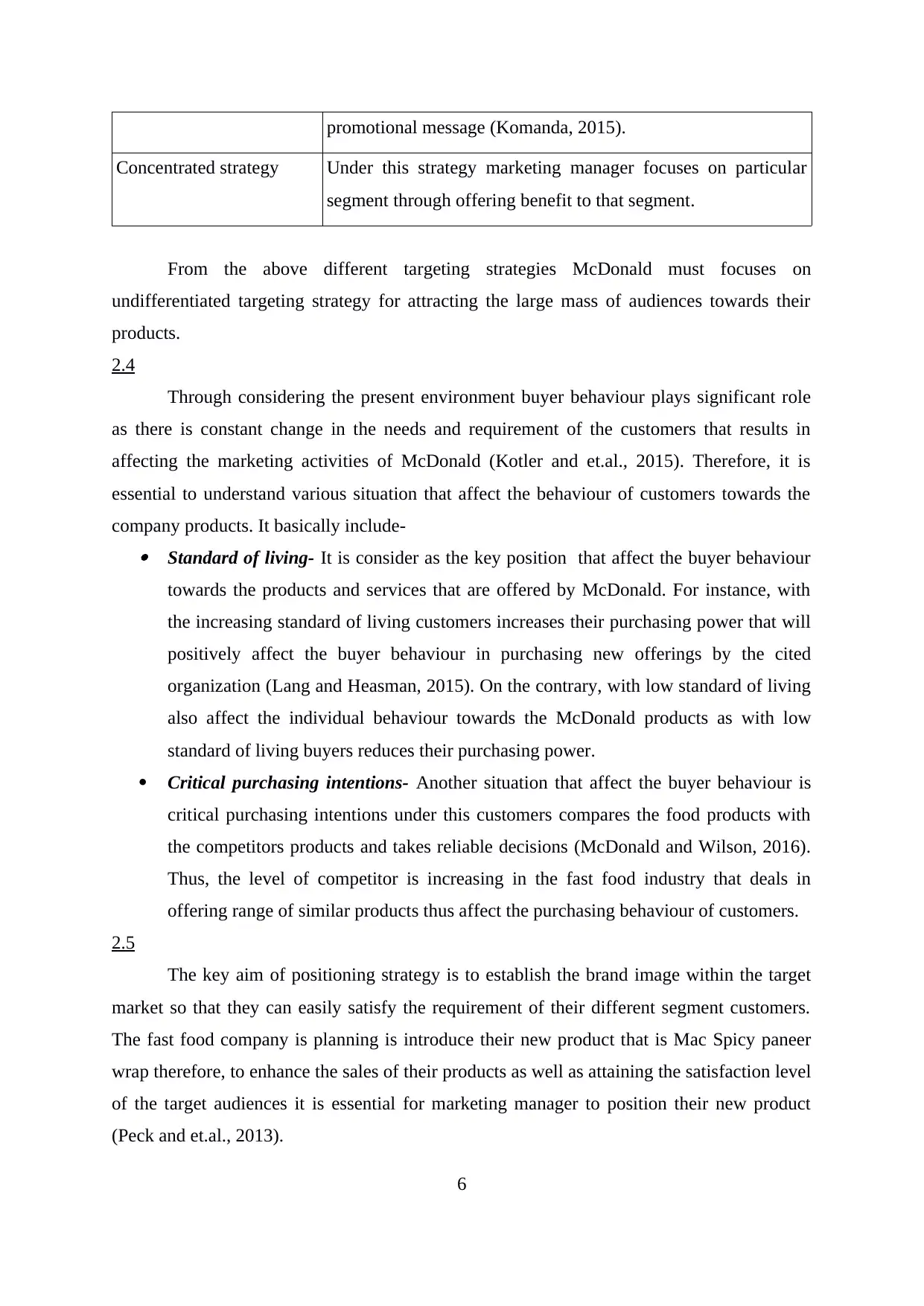
promotional message (Komanda, 2015).
Concentrated strategy Under this strategy marketing manager focuses on particular
segment through offering benefit to that segment.
From the above different targeting strategies McDonald must focuses on
undifferentiated targeting strategy for attracting the large mass of audiences towards their
products.
2.4
Through considering the present environment buyer behaviour plays significant role
as there is constant change in the needs and requirement of the customers that results in
affecting the marketing activities of McDonald (Kotler and et.al., 2015). Therefore, it is
essential to understand various situation that affect the behaviour of customers towards the
company products. It basically include- Standard of living- It is consider as the key position that affect the buyer behaviour
towards the products and services that are offered by McDonald. For instance, with
the increasing standard of living customers increases their purchasing power that will
positively affect the buyer behaviour in purchasing new offerings by the cited
organization (Lang and Heasman, 2015). On the contrary, with low standard of living
also affect the individual behaviour towards the McDonald products as with low
standard of living buyers reduces their purchasing power.
Critical purchasing intentions- Another situation that affect the buyer behaviour is
critical purchasing intentions under this customers compares the food products with
the competitors products and takes reliable decisions (McDonald and Wilson, 2016).
Thus, the level of competitor is increasing in the fast food industry that deals in
offering range of similar products thus affect the purchasing behaviour of customers.
2.5
The key aim of positioning strategy is to establish the brand image within the target
market so that they can easily satisfy the requirement of their different segment customers.
The fast food company is planning is introduce their new product that is Mac Spicy paneer
wrap therefore, to enhance the sales of their products as well as attaining the satisfaction level
of the target audiences it is essential for marketing manager to position their new product
(Peck and et.al., 2013).
6
Concentrated strategy Under this strategy marketing manager focuses on particular
segment through offering benefit to that segment.
From the above different targeting strategies McDonald must focuses on
undifferentiated targeting strategy for attracting the large mass of audiences towards their
products.
2.4
Through considering the present environment buyer behaviour plays significant role
as there is constant change in the needs and requirement of the customers that results in
affecting the marketing activities of McDonald (Kotler and et.al., 2015). Therefore, it is
essential to understand various situation that affect the behaviour of customers towards the
company products. It basically include- Standard of living- It is consider as the key position that affect the buyer behaviour
towards the products and services that are offered by McDonald. For instance, with
the increasing standard of living customers increases their purchasing power that will
positively affect the buyer behaviour in purchasing new offerings by the cited
organization (Lang and Heasman, 2015). On the contrary, with low standard of living
also affect the individual behaviour towards the McDonald products as with low
standard of living buyers reduces their purchasing power.
Critical purchasing intentions- Another situation that affect the buyer behaviour is
critical purchasing intentions under this customers compares the food products with
the competitors products and takes reliable decisions (McDonald and Wilson, 2016).
Thus, the level of competitor is increasing in the fast food industry that deals in
offering range of similar products thus affect the purchasing behaviour of customers.
2.5
The key aim of positioning strategy is to establish the brand image within the target
market so that they can easily satisfy the requirement of their different segment customers.
The fast food company is planning is introduce their new product that is Mac Spicy paneer
wrap therefore, to enhance the sales of their products as well as attaining the satisfaction level
of the target audiences it is essential for marketing manager to position their new product
(Peck and et.al., 2013).
6
⊘ This is a preview!⊘
Do you want full access?
Subscribe today to unlock all pages.
Trusted by 1+ million students worldwide
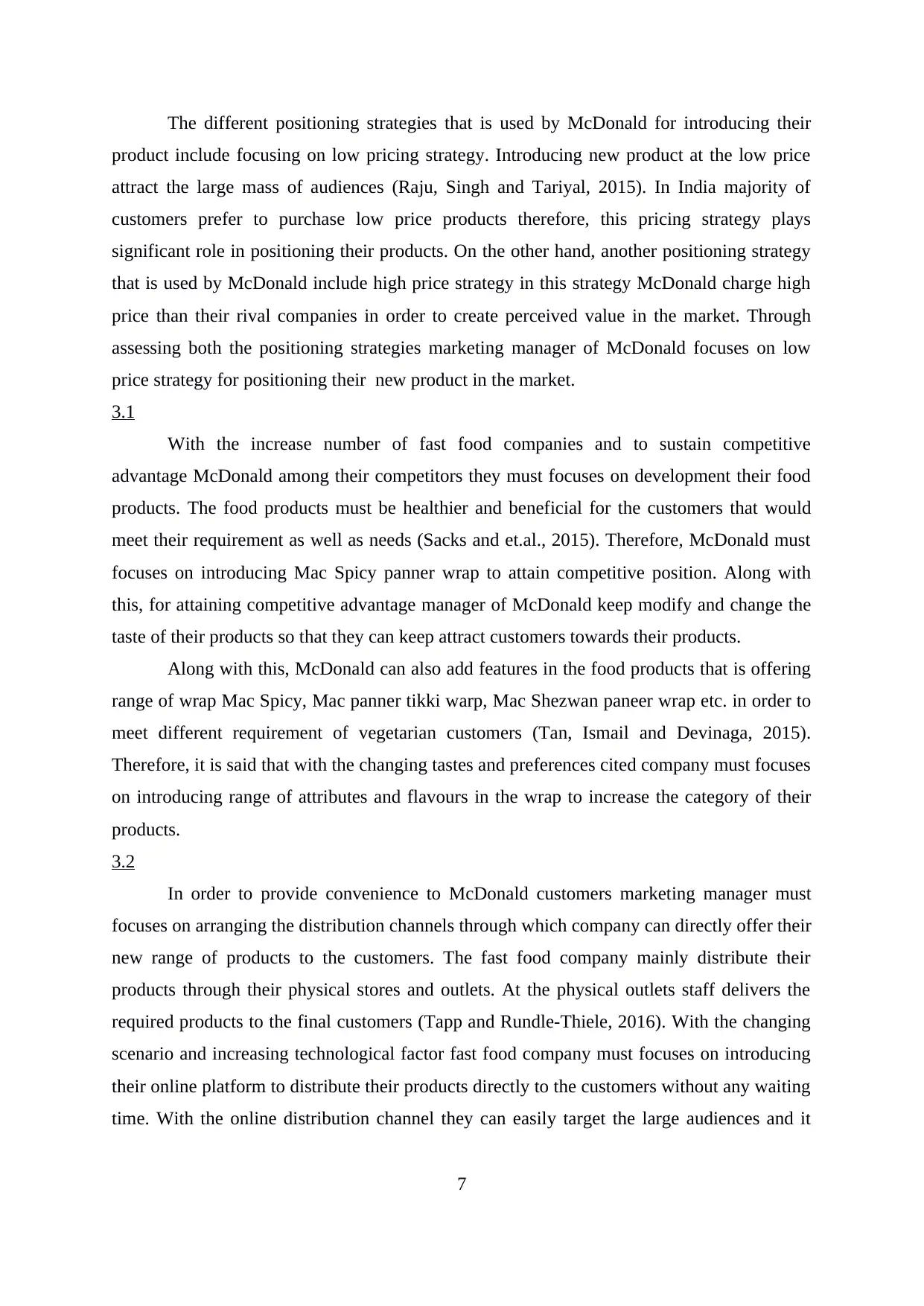
The different positioning strategies that is used by McDonald for introducing their
product include focusing on low pricing strategy. Introducing new product at the low price
attract the large mass of audiences (Raju, Singh and Tariyal, 2015). In India majority of
customers prefer to purchase low price products therefore, this pricing strategy plays
significant role in positioning their products. On the other hand, another positioning strategy
that is used by McDonald include high price strategy in this strategy McDonald charge high
price than their rival companies in order to create perceived value in the market. Through
assessing both the positioning strategies marketing manager of McDonald focuses on low
price strategy for positioning their new product in the market.
3.1
With the increase number of fast food companies and to sustain competitive
advantage McDonald among their competitors they must focuses on development their food
products. The food products must be healthier and beneficial for the customers that would
meet their requirement as well as needs (Sacks and et.al., 2015). Therefore, McDonald must
focuses on introducing Mac Spicy panner wrap to attain competitive position. Along with
this, for attaining competitive advantage manager of McDonald keep modify and change the
taste of their products so that they can keep attract customers towards their products.
Along with this, McDonald can also add features in the food products that is offering
range of wrap Mac Spicy, Mac panner tikki warp, Mac Shezwan paneer wrap etc. in order to
meet different requirement of vegetarian customers (Tan, Ismail and Devinaga, 2015).
Therefore, it is said that with the changing tastes and preferences cited company must focuses
on introducing range of attributes and flavours in the wrap to increase the category of their
products.
3.2
In order to provide convenience to McDonald customers marketing manager must
focuses on arranging the distribution channels through which company can directly offer their
new range of products to the customers. The fast food company mainly distribute their
products through their physical stores and outlets. At the physical outlets staff delivers the
required products to the final customers (Tapp and Rundle-Thiele, 2016). With the changing
scenario and increasing technological factor fast food company must focuses on introducing
their online platform to distribute their products directly to the customers without any waiting
time. With the online distribution channel they can easily target the large audiences and it
7
product include focusing on low pricing strategy. Introducing new product at the low price
attract the large mass of audiences (Raju, Singh and Tariyal, 2015). In India majority of
customers prefer to purchase low price products therefore, this pricing strategy plays
significant role in positioning their products. On the other hand, another positioning strategy
that is used by McDonald include high price strategy in this strategy McDonald charge high
price than their rival companies in order to create perceived value in the market. Through
assessing both the positioning strategies marketing manager of McDonald focuses on low
price strategy for positioning their new product in the market.
3.1
With the increase number of fast food companies and to sustain competitive
advantage McDonald among their competitors they must focuses on development their food
products. The food products must be healthier and beneficial for the customers that would
meet their requirement as well as needs (Sacks and et.al., 2015). Therefore, McDonald must
focuses on introducing Mac Spicy panner wrap to attain competitive position. Along with
this, for attaining competitive advantage manager of McDonald keep modify and change the
taste of their products so that they can keep attract customers towards their products.
Along with this, McDonald can also add features in the food products that is offering
range of wrap Mac Spicy, Mac panner tikki warp, Mac Shezwan paneer wrap etc. in order to
meet different requirement of vegetarian customers (Tan, Ismail and Devinaga, 2015).
Therefore, it is said that with the changing tastes and preferences cited company must focuses
on introducing range of attributes and flavours in the wrap to increase the category of their
products.
3.2
In order to provide convenience to McDonald customers marketing manager must
focuses on arranging the distribution channels through which company can directly offer their
new range of products to the customers. The fast food company mainly distribute their
products through their physical stores and outlets. At the physical outlets staff delivers the
required products to the final customers (Tapp and Rundle-Thiele, 2016). With the changing
scenario and increasing technological factor fast food company must focuses on introducing
their online platform to distribute their products directly to the customers without any waiting
time. With the online distribution channel they can easily target the large audiences and it
7
Paraphrase This Document
Need a fresh take? Get an instant paraphrase of this document with our AI Paraphraser
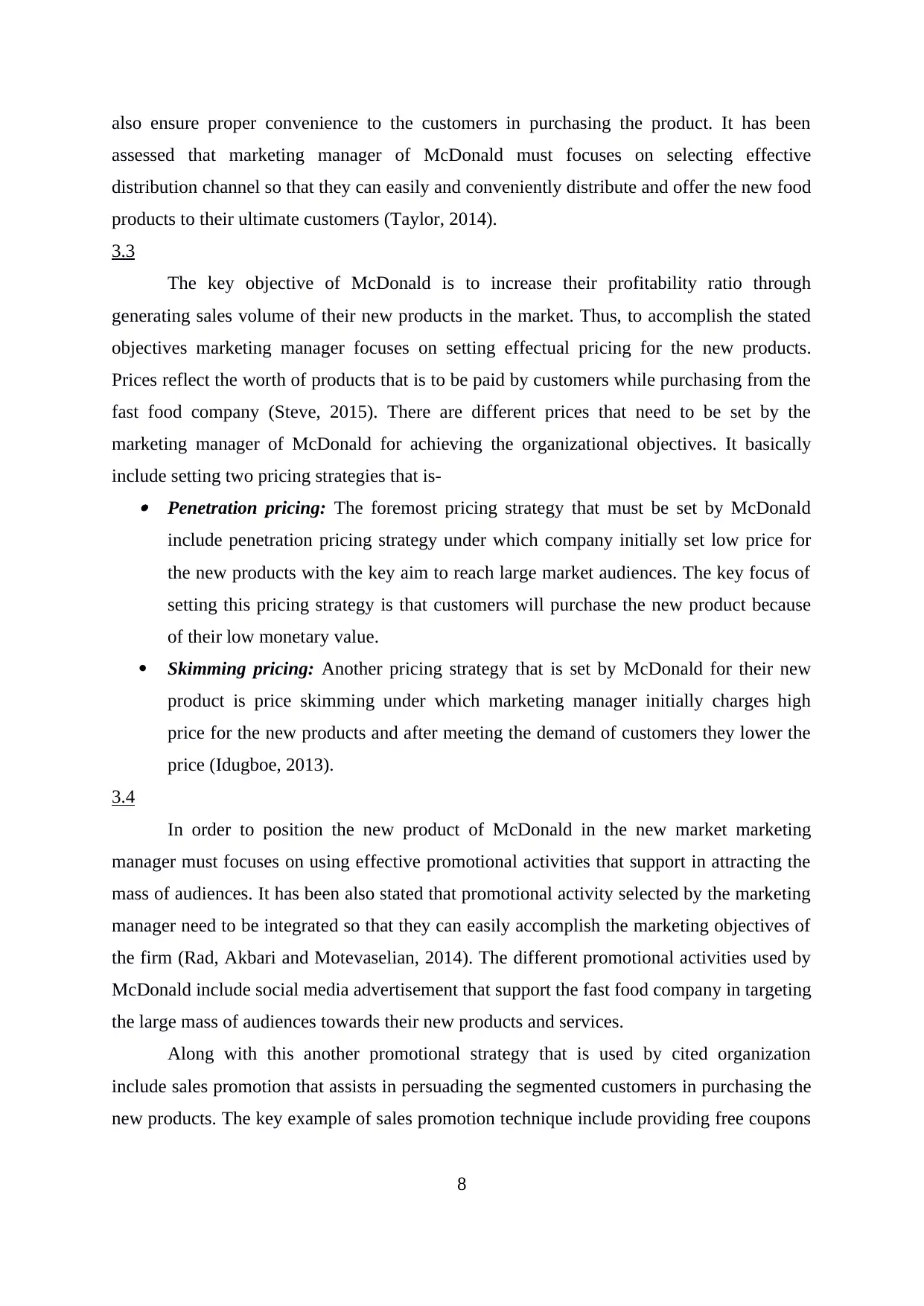
also ensure proper convenience to the customers in purchasing the product. It has been
assessed that marketing manager of McDonald must focuses on selecting effective
distribution channel so that they can easily and conveniently distribute and offer the new food
products to their ultimate customers (Taylor, 2014).
3.3
The key objective of McDonald is to increase their profitability ratio through
generating sales volume of their new products in the market. Thus, to accomplish the stated
objectives marketing manager focuses on setting effectual pricing for the new products.
Prices reflect the worth of products that is to be paid by customers while purchasing from the
fast food company (Steve, 2015). There are different prices that need to be set by the
marketing manager of McDonald for achieving the organizational objectives. It basically
include setting two pricing strategies that is- Penetration pricing: The foremost pricing strategy that must be set by McDonald
include penetration pricing strategy under which company initially set low price for
the new products with the key aim to reach large market audiences. The key focus of
setting this pricing strategy is that customers will purchase the new product because
of their low monetary value.
Skimming pricing: Another pricing strategy that is set by McDonald for their new
product is price skimming under which marketing manager initially charges high
price for the new products and after meeting the demand of customers they lower the
price (Idugboe, 2013).
3.4
In order to position the new product of McDonald in the new market marketing
manager must focuses on using effective promotional activities that support in attracting the
mass of audiences. It has been also stated that promotional activity selected by the marketing
manager need to be integrated so that they can easily accomplish the marketing objectives of
the firm (Rad, Akbari and Motevaselian, 2014). The different promotional activities used by
McDonald include social media advertisement that support the fast food company in targeting
the large mass of audiences towards their new products and services.
Along with this another promotional strategy that is used by cited organization
include sales promotion that assists in persuading the segmented customers in purchasing the
new products. The key example of sales promotion technique include providing free coupons
8
assessed that marketing manager of McDonald must focuses on selecting effective
distribution channel so that they can easily and conveniently distribute and offer the new food
products to their ultimate customers (Taylor, 2014).
3.3
The key objective of McDonald is to increase their profitability ratio through
generating sales volume of their new products in the market. Thus, to accomplish the stated
objectives marketing manager focuses on setting effectual pricing for the new products.
Prices reflect the worth of products that is to be paid by customers while purchasing from the
fast food company (Steve, 2015). There are different prices that need to be set by the
marketing manager of McDonald for achieving the organizational objectives. It basically
include setting two pricing strategies that is- Penetration pricing: The foremost pricing strategy that must be set by McDonald
include penetration pricing strategy under which company initially set low price for
the new products with the key aim to reach large market audiences. The key focus of
setting this pricing strategy is that customers will purchase the new product because
of their low monetary value.
Skimming pricing: Another pricing strategy that is set by McDonald for their new
product is price skimming under which marketing manager initially charges high
price for the new products and after meeting the demand of customers they lower the
price (Idugboe, 2013).
3.4
In order to position the new product of McDonald in the new market marketing
manager must focuses on using effective promotional activities that support in attracting the
mass of audiences. It has been also stated that promotional activity selected by the marketing
manager need to be integrated so that they can easily accomplish the marketing objectives of
the firm (Rad, Akbari and Motevaselian, 2014). The different promotional activities used by
McDonald include social media advertisement that support the fast food company in targeting
the large mass of audiences towards their new products and services.
Along with this another promotional strategy that is used by cited organization
include sales promotion that assists in persuading the segmented customers in purchasing the
new products. The key example of sales promotion technique include providing free coupons
8
with exceeding the limit of purchase, free additional item in the meals, rebates etc. that act as
the major activity to increase the sales of new products.
3.5
The extended marketing mix include: Process: The foremost element in the extended marketing mix include process that
ensure activity that support the McDonald in meeting the demand of customers that is
from entering into the store to the leaving of store (Akaka, Vargo and Lusch, 2013).
Therefore, it need to carried into the effective manner so that customers satisfaction
level must be increased. Physical evidence: Another element in the extended marketing include physical
evidence these are the tangible elements that offer pleasant and great experience to the
customers.
People: The last element of the extended marketing mix include people these are the
key assets within the company that deals with the customers through taking their
orders with delivering the ordered food services (Akehurst, Afonso and Martins
Gonçalves, 2012). Along with this, they are the one who directly interact with the
customers and provide them quality and friendly environment that results in re-
visiting of the company.
TASK 2
4.1
Following are the marketing mix for 2 different consumer market segment such as-
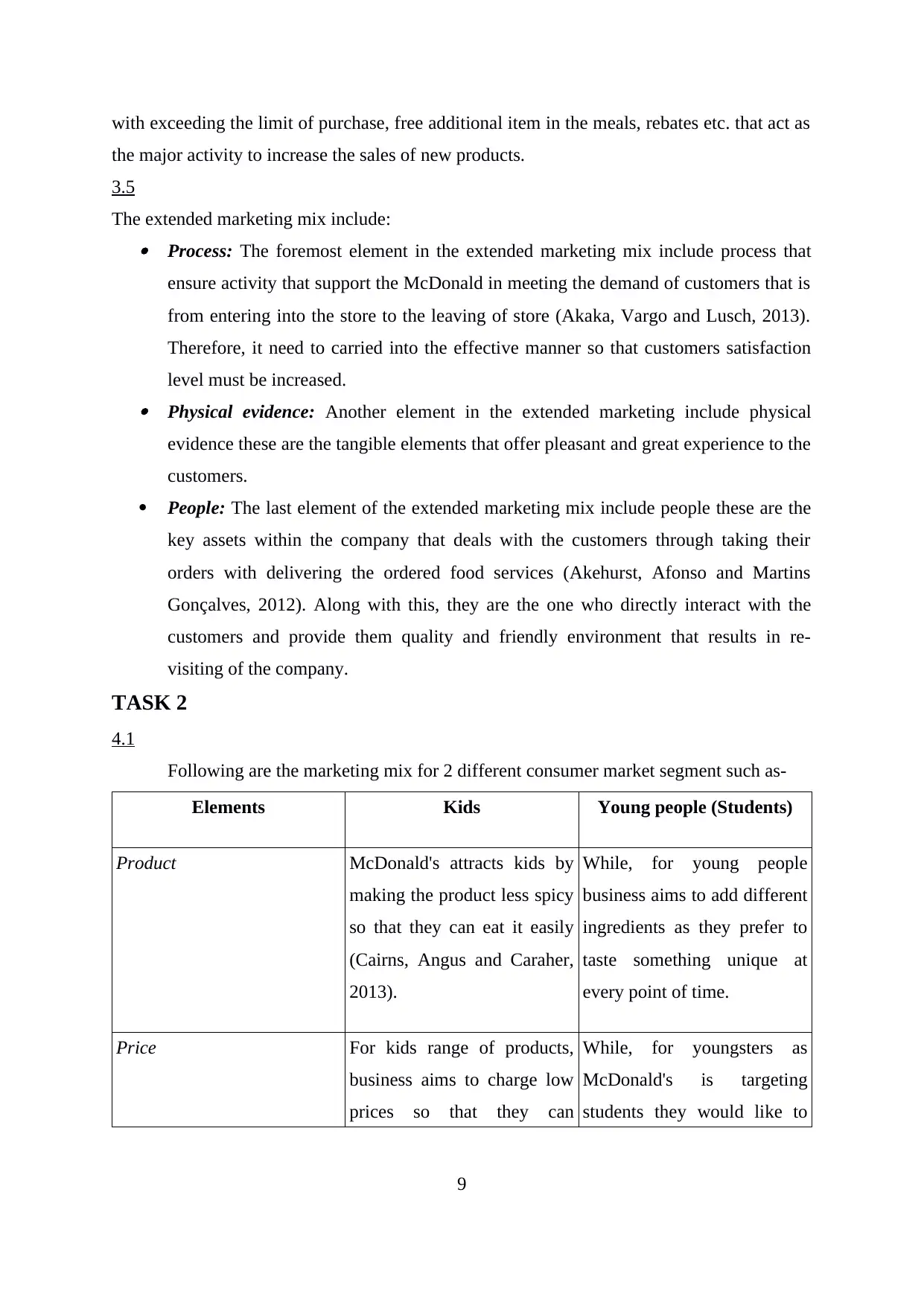
Elements Kids Young people (Students)
Product McDonald's attracts kids by
making the product less spicy
so that they can eat it easily
(Cairns, Angus and Caraher,
2013).
While, for young people
business aims to add different
ingredients as they prefer to
taste something unique at
every point of time.
Price For kids range of products,
business aims to charge low
prices so that they can
While, for youngsters as
McDonald's is targeting
students they would like to
9
the major activity to increase the sales of new products.
3.5
The extended marketing mix include: Process: The foremost element in the extended marketing mix include process that
ensure activity that support the McDonald in meeting the demand of customers that is
from entering into the store to the leaving of store (Akaka, Vargo and Lusch, 2013).
Therefore, it need to carried into the effective manner so that customers satisfaction
level must be increased. Physical evidence: Another element in the extended marketing include physical
evidence these are the tangible elements that offer pleasant and great experience to the
customers.
People: The last element of the extended marketing mix include people these are the
key assets within the company that deals with the customers through taking their
orders with delivering the ordered food services (Akehurst, Afonso and Martins
Gonçalves, 2012). Along with this, they are the one who directly interact with the
customers and provide them quality and friendly environment that results in re-
visiting of the company.
TASK 2
4.1
Following are the marketing mix for 2 different consumer market segment such as-
Elements Kids Young people (Students)
Product McDonald's attracts kids by
making the product less spicy
so that they can eat it easily
(Cairns, Angus and Caraher,
2013).
While, for young people
business aims to add different
ingredients as they prefer to
taste something unique at
every point of time.
Price For kids range of products,
business aims to charge low
prices so that they can
While, for youngsters as
McDonald's is targeting
students they would like to
9
⊘ This is a preview!⊘
Do you want full access?
Subscribe today to unlock all pages.
Trusted by 1+ million students worldwide
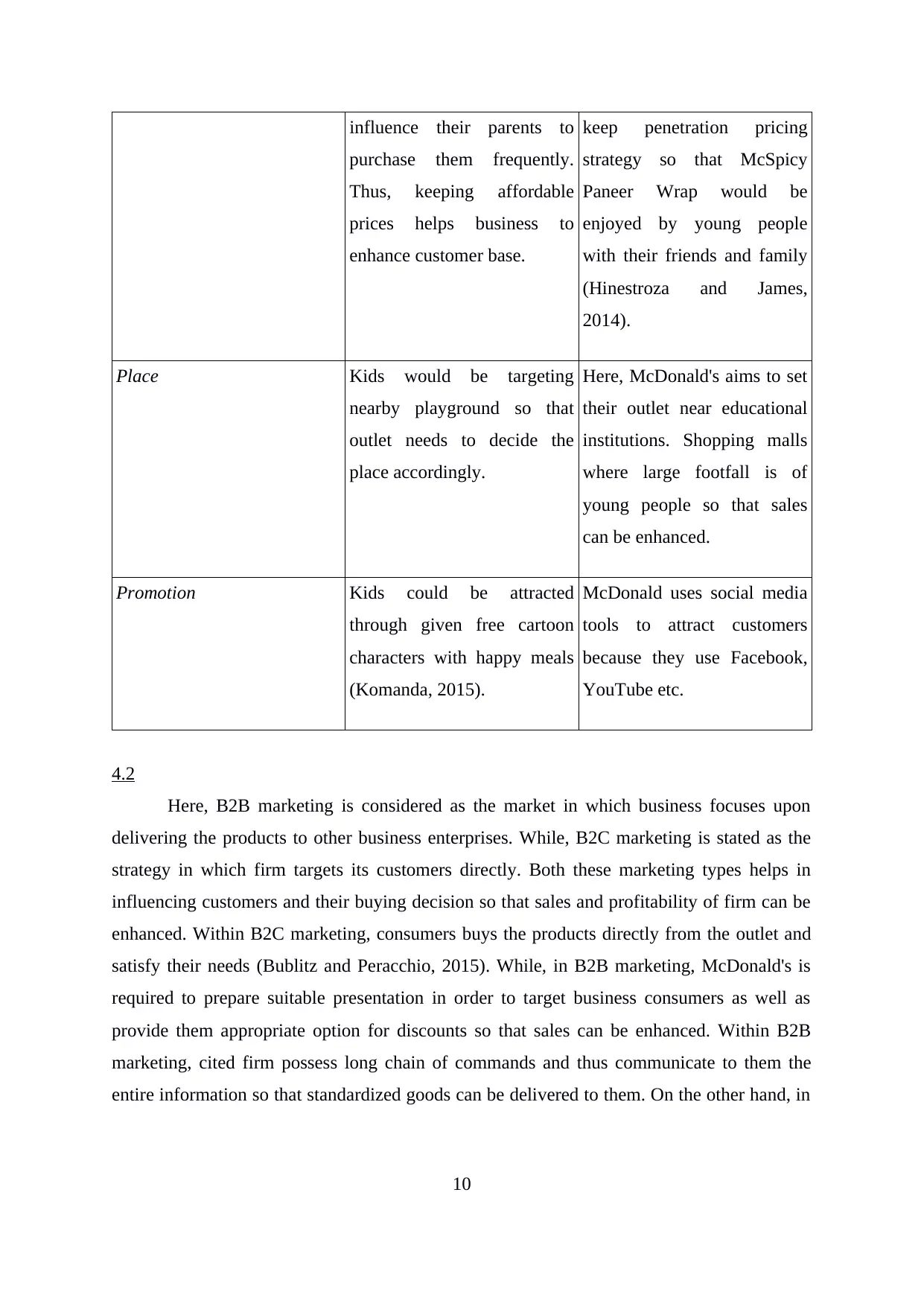
influence their parents to
purchase them frequently.
Thus, keeping affordable
prices helps business to
enhance customer base.
keep penetration pricing
strategy so that McSpicy
Paneer Wrap would be
enjoyed by young people
with their friends and family
(Hinestroza and James,
2014).
Place Kids would be targeting
nearby playground so that
outlet needs to decide the
place accordingly.
Here, McDonald's aims to set
their outlet near educational
institutions. Shopping malls
where large footfall is of
young people so that sales
can be enhanced.
Promotion Kids could be attracted
through given free cartoon
characters with happy meals
(Komanda, 2015).
McDonald uses social media
tools to attract customers
because they use Facebook,
YouTube etc.
4.2
Here, B2B marketing is considered as the market in which business focuses upon
delivering the products to other business enterprises. While, B2C marketing is stated as the
strategy in which firm targets its customers directly. Both these marketing types helps in
influencing customers and their buying decision so that sales and profitability of firm can be
enhanced. Within B2C marketing, consumers buys the products directly from the outlet and
satisfy their needs (Bublitz and Peracchio, 2015). While, in B2B marketing, McDonald's is
required to prepare suitable presentation in order to target business consumers as well as
provide them appropriate option for discounts so that sales can be enhanced. Within B2B
marketing, cited firm possess long chain of commands and thus communicate to them the
entire information so that standardized goods can be delivered to them. On the other hand, in
10
purchase them frequently.
Thus, keeping affordable
prices helps business to
enhance customer base.
keep penetration pricing
strategy so that McSpicy
Paneer Wrap would be
enjoyed by young people
with their friends and family
(Hinestroza and James,
2014).
Place Kids would be targeting
nearby playground so that
outlet needs to decide the
place accordingly.
Here, McDonald's aims to set
their outlet near educational
institutions. Shopping malls
where large footfall is of
young people so that sales
can be enhanced.
Promotion Kids could be attracted
through given free cartoon
characters with happy meals
(Komanda, 2015).
McDonald uses social media
tools to attract customers
because they use Facebook,
YouTube etc.
4.2
Here, B2B marketing is considered as the market in which business focuses upon
delivering the products to other business enterprises. While, B2C marketing is stated as the
strategy in which firm targets its customers directly. Both these marketing types helps in
influencing customers and their buying decision so that sales and profitability of firm can be
enhanced. Within B2C marketing, consumers buys the products directly from the outlet and
satisfy their needs (Bublitz and Peracchio, 2015). While, in B2B marketing, McDonald's is
required to prepare suitable presentation in order to target business consumers as well as
provide them appropriate option for discounts so that sales can be enhanced. Within B2B
marketing, cited firm possess long chain of commands and thus communicate to them the
entire information so that standardized goods can be delivered to them. On the other hand, in
10
Paraphrase This Document
Need a fresh take? Get an instant paraphrase of this document with our AI Paraphraser
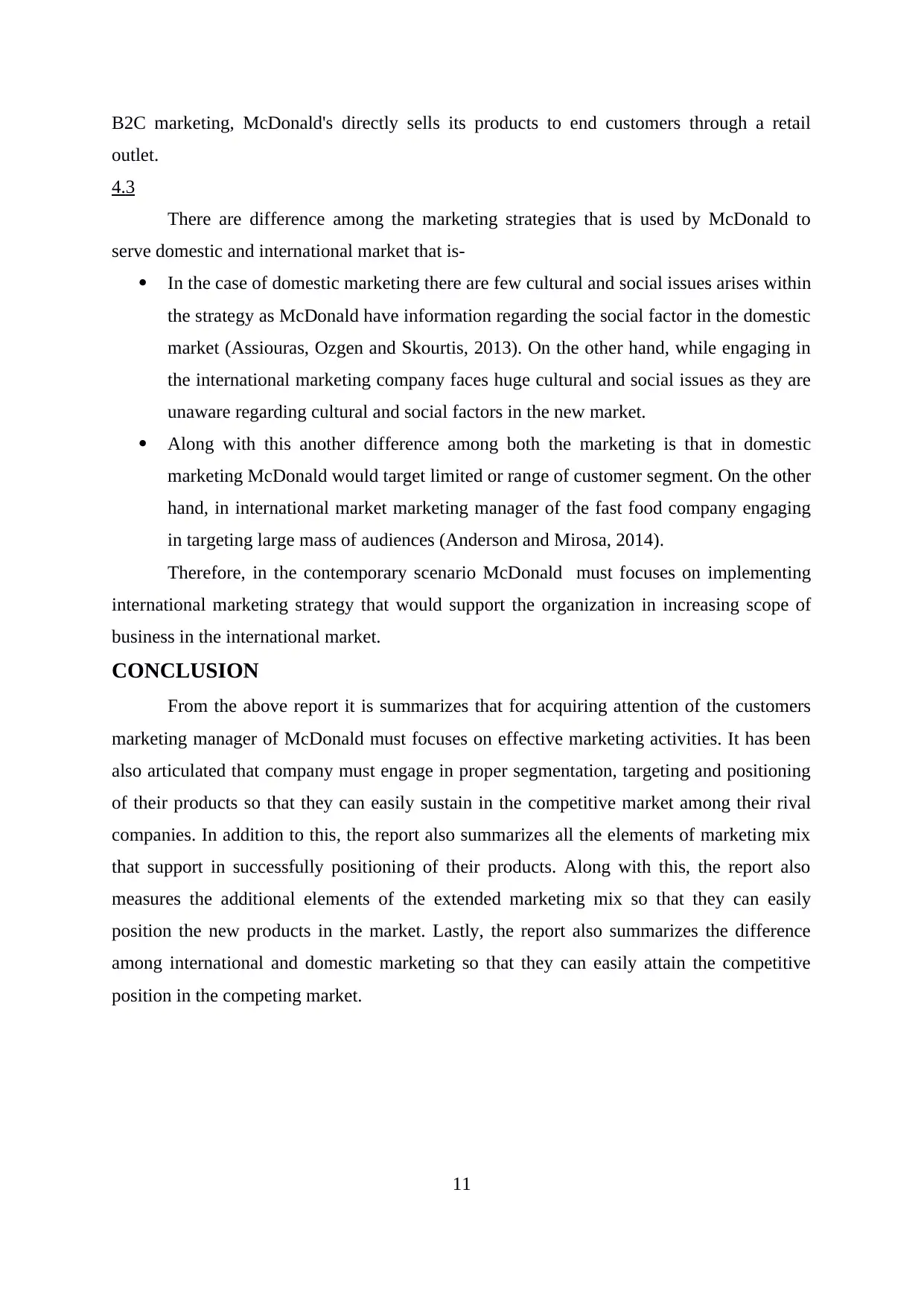
B2C marketing, McDonald's directly sells its products to end customers through a retail
outlet.
4.3
There are difference among the marketing strategies that is used by McDonald to
serve domestic and international market that is-
In the case of domestic marketing there are few cultural and social issues arises within
the strategy as McDonald have information regarding the social factor in the domestic
market (Assiouras, Ozgen and Skourtis, 2013). On the other hand, while engaging in
the international marketing company faces huge cultural and social issues as they are
unaware regarding cultural and social factors in the new market.
Along with this another difference among both the marketing is that in domestic
marketing McDonald would target limited or range of customer segment. On the other
hand, in international market marketing manager of the fast food company engaging
in targeting large mass of audiences (Anderson and Mirosa, 2014).
Therefore, in the contemporary scenario McDonald must focuses on implementing
international marketing strategy that would support the organization in increasing scope of
business in the international market.
CONCLUSION
From the above report it is summarizes that for acquiring attention of the customers
marketing manager of McDonald must focuses on effective marketing activities. It has been
also articulated that company must engage in proper segmentation, targeting and positioning
of their products so that they can easily sustain in the competitive market among their rival
companies. In addition to this, the report also summarizes all the elements of marketing mix
that support in successfully positioning of their products. Along with this, the report also
measures the additional elements of the extended marketing mix so that they can easily
position the new products in the market. Lastly, the report also summarizes the difference
among international and domestic marketing so that they can easily attain the competitive
position in the competing market.
11
outlet.
4.3
There are difference among the marketing strategies that is used by McDonald to
serve domestic and international market that is-
In the case of domestic marketing there are few cultural and social issues arises within
the strategy as McDonald have information regarding the social factor in the domestic
market (Assiouras, Ozgen and Skourtis, 2013). On the other hand, while engaging in
the international marketing company faces huge cultural and social issues as they are
unaware regarding cultural and social factors in the new market.
Along with this another difference among both the marketing is that in domestic
marketing McDonald would target limited or range of customer segment. On the other
hand, in international market marketing manager of the fast food company engaging
in targeting large mass of audiences (Anderson and Mirosa, 2014).
Therefore, in the contemporary scenario McDonald must focuses on implementing
international marketing strategy that would support the organization in increasing scope of
business in the international market.
CONCLUSION
From the above report it is summarizes that for acquiring attention of the customers
marketing manager of McDonald must focuses on effective marketing activities. It has been
also articulated that company must engage in proper segmentation, targeting and positioning
of their products so that they can easily sustain in the competitive market among their rival
companies. In addition to this, the report also summarizes all the elements of marketing mix
that support in successfully positioning of their products. Along with this, the report also
measures the additional elements of the extended marketing mix so that they can easily
position the new products in the market. Lastly, the report also summarizes the difference
among international and domestic marketing so that they can easily attain the competitive
position in the competing market.
11
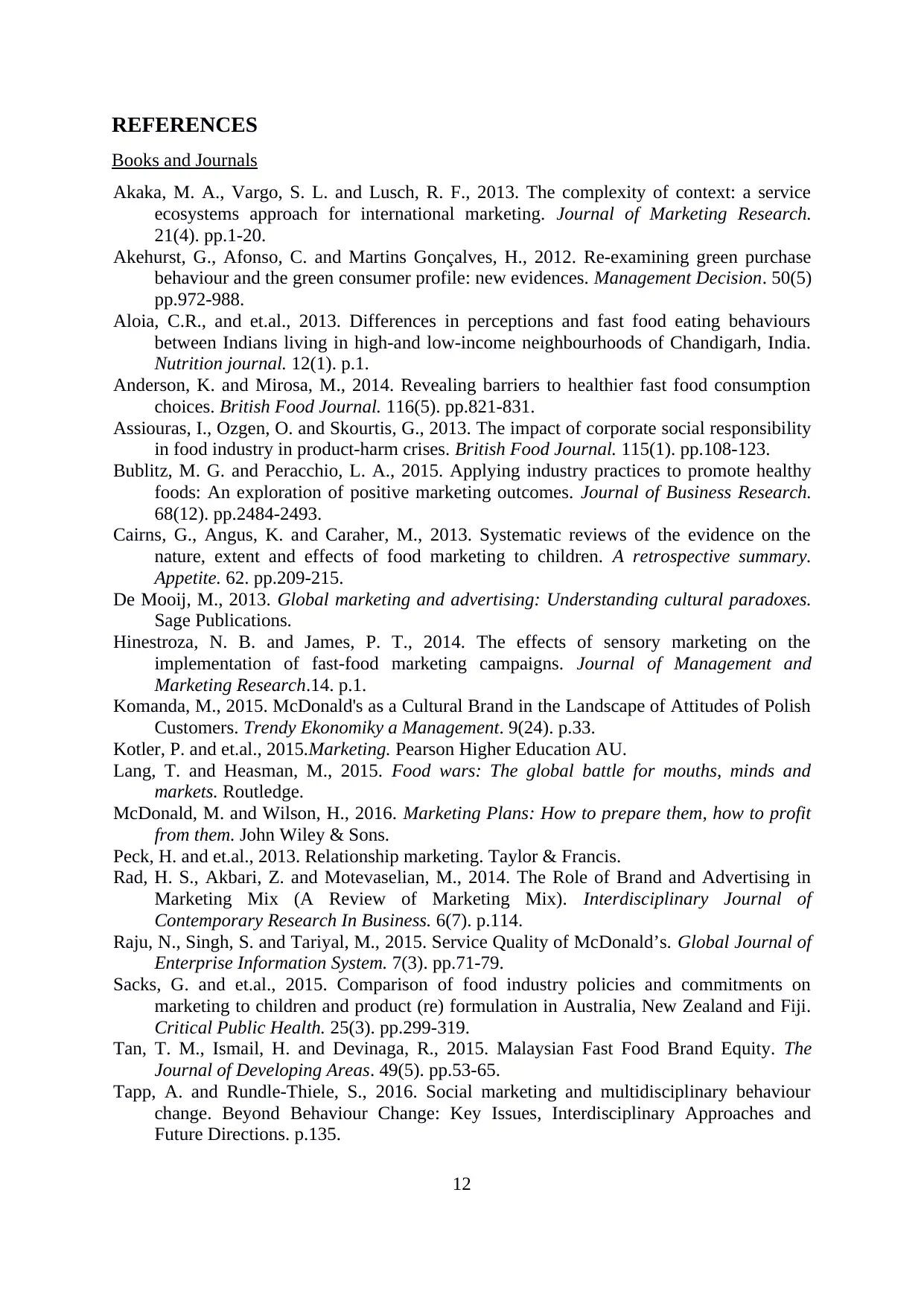
REFERENCES
Books and Journals
Akaka, M. A., Vargo, S. L. and Lusch, R. F., 2013. The complexity of context: a service
ecosystems approach for international marketing. Journal of Marketing Research.
21(4). pp.1-20.
Akehurst, G., Afonso, C. and Martins Gonçalves, H., 2012. Re-examining green purchase
behaviour and the green consumer profile: new evidences. Management Decision. 50(5)
pp.972-988.
Aloia, C.R., and et.al., 2013. Differences in perceptions and fast food eating behaviours
between Indians living in high-and low-income neighbourhoods of Chandigarh, India.
Nutrition journal. 12(1). p.1.
Anderson, K. and Mirosa, M., 2014. Revealing barriers to healthier fast food consumption
choices. British Food Journal. 116(5). pp.821-831.
Assiouras, I., Ozgen, O. and Skourtis, G., 2013. The impact of corporate social responsibility
in food industry in product-harm crises. British Food Journal. 115(1). pp.108-123.
Bublitz, M. G. and Peracchio, L. A., 2015. Applying industry practices to promote healthy
foods: An exploration of positive marketing outcomes. Journal of Business Research.
68(12). pp.2484-2493.
Cairns, G., Angus, K. and Caraher, M., 2013. Systematic reviews of the evidence on the
nature, extent and effects of food marketing to children. A retrospective summary.
Appetite. 62. pp.209-215.
De Mooij, M., 2013. Global marketing and advertising: Understanding cultural paradoxes.
Sage Publications.
Hinestroza, N. B. and James, P. T., 2014. The effects of sensory marketing on the
implementation of fast-food marketing campaigns. Journal of Management and
Marketing Research.14. p.1.
Komanda, M., 2015. McDonald's as a Cultural Brand in the Landscape of Attitudes of Polish
Customers. Trendy Ekonomiky a Management. 9(24). p.33.
Kotler, P. and et.al., 2015.Marketing. Pearson Higher Education AU.
Lang, T. and Heasman, M., 2015. Food wars: The global battle for mouths, minds and
markets. Routledge.
McDonald, M. and Wilson, H., 2016. Marketing Plans: How to prepare them, how to profit
from them. John Wiley & Sons.
Peck, H. and et.al., 2013. Relationship marketing. Taylor & Francis.
Rad, H. S., Akbari, Z. and Motevaselian, M., 2014. The Role of Brand and Advertising in
Marketing Mix (A Review of Marketing Mix). Interdisciplinary Journal of
Contemporary Research In Business. 6(7). p.114.
Raju, N., Singh, S. and Tariyal, M., 2015. Service Quality of McDonald’s. Global Journal of
Enterprise Information System. 7(3). pp.71-79.
Sacks, G. and et.al., 2015. Comparison of food industry policies and commitments on
marketing to children and product (re) formulation in Australia, New Zealand and Fiji.
Critical Public Health. 25(3). pp.299-319.
Tan, T. M., Ismail, H. and Devinaga, R., 2015. Malaysian Fast Food Brand Equity. The
Journal of Developing Areas. 49(5). pp.53-65.
Tapp, A. and Rundle-Thiele, S., 2016. Social marketing and multidisciplinary behaviour
change. Beyond Behaviour Change: Key Issues, Interdisciplinary Approaches and
Future Directions. p.135.
12
Books and Journals
Akaka, M. A., Vargo, S. L. and Lusch, R. F., 2013. The complexity of context: a service
ecosystems approach for international marketing. Journal of Marketing Research.
21(4). pp.1-20.
Akehurst, G., Afonso, C. and Martins Gonçalves, H., 2012. Re-examining green purchase
behaviour and the green consumer profile: new evidences. Management Decision. 50(5)
pp.972-988.
Aloia, C.R., and et.al., 2013. Differences in perceptions and fast food eating behaviours
between Indians living in high-and low-income neighbourhoods of Chandigarh, India.
Nutrition journal. 12(1). p.1.
Anderson, K. and Mirosa, M., 2014. Revealing barriers to healthier fast food consumption
choices. British Food Journal. 116(5). pp.821-831.
Assiouras, I., Ozgen, O. and Skourtis, G., 2013. The impact of corporate social responsibility
in food industry in product-harm crises. British Food Journal. 115(1). pp.108-123.
Bublitz, M. G. and Peracchio, L. A., 2015. Applying industry practices to promote healthy
foods: An exploration of positive marketing outcomes. Journal of Business Research.
68(12). pp.2484-2493.
Cairns, G., Angus, K. and Caraher, M., 2013. Systematic reviews of the evidence on the
nature, extent and effects of food marketing to children. A retrospective summary.
Appetite. 62. pp.209-215.
De Mooij, M., 2013. Global marketing and advertising: Understanding cultural paradoxes.
Sage Publications.
Hinestroza, N. B. and James, P. T., 2014. The effects of sensory marketing on the
implementation of fast-food marketing campaigns. Journal of Management and
Marketing Research.14. p.1.
Komanda, M., 2015. McDonald's as a Cultural Brand in the Landscape of Attitudes of Polish
Customers. Trendy Ekonomiky a Management. 9(24). p.33.
Kotler, P. and et.al., 2015.Marketing. Pearson Higher Education AU.
Lang, T. and Heasman, M., 2015. Food wars: The global battle for mouths, minds and
markets. Routledge.
McDonald, M. and Wilson, H., 2016. Marketing Plans: How to prepare them, how to profit
from them. John Wiley & Sons.
Peck, H. and et.al., 2013. Relationship marketing. Taylor & Francis.
Rad, H. S., Akbari, Z. and Motevaselian, M., 2014. The Role of Brand and Advertising in
Marketing Mix (A Review of Marketing Mix). Interdisciplinary Journal of
Contemporary Research In Business. 6(7). p.114.
Raju, N., Singh, S. and Tariyal, M., 2015. Service Quality of McDonald’s. Global Journal of
Enterprise Information System. 7(3). pp.71-79.
Sacks, G. and et.al., 2015. Comparison of food industry policies and commitments on
marketing to children and product (re) formulation in Australia, New Zealand and Fiji.
Critical Public Health. 25(3). pp.299-319.
Tan, T. M., Ismail, H. and Devinaga, R., 2015. Malaysian Fast Food Brand Equity. The
Journal of Developing Areas. 49(5). pp.53-65.
Tapp, A. and Rundle-Thiele, S., 2016. Social marketing and multidisciplinary behaviour
change. Beyond Behaviour Change: Key Issues, Interdisciplinary Approaches and
Future Directions. p.135.
12
⊘ This is a preview!⊘
Do you want full access?
Subscribe today to unlock all pages.
Trusted by 1+ million students worldwide

1 out of 13


Related Documents


Your All-in-One AI-Powered Toolkit for Academic Success.
+13062052269
info@desklib.com
Available 24*7 on WhatsApp / Email
![[object Object]](/_next/static/media/star-bottom.7253800d.svg)
Unlock your academic potential
Copyright © 2020–2026 A2Z Services. All Rights Reserved. Developed and managed by ZUCOL.