Marketing Essentials Report: Roles, Trends, and Tactics in Marketing
VerifiedAdded on 2023/02/02
|11
|3527
|74
Report
AI Summary
This report delves into the core principles of marketing, examining the key roles and responsibilities within a business organization, with a focus on marketing's interrelation with other functional units. It explores the evolution of marketing concepts, highlighting both current and future trends. The report also analyzes the marketing environment, discussing the importance of market research, segmentation, and brand equity. Furthermore, it outlines the key elements of marketing functions such as research, strategy, planning, and tactics, illustrating their connections with departments like finance and production. The report then compares the application of the marketing mix in different organizations, using examples like Tesco and Marshfield ice creams, to showcase how various tactics are employed to achieve business objectives. It emphasizes the significance of customer satisfaction and strategic planning in the overall success of a marketing strategy.
Marketing Essentials

Paraphrase This Document
Need a fresh take? Get an instant paraphrase of this document with our AI Paraphraser

INTRODUCTION
Marketing is the most important tool in the developed industries. It includes
the knowledge of market place, demands of consumers, building profitable
relations, customer driven market strategy and provide quality among the
customers. The business organizations have analyzed the importance of customer
relationships and they are taking initiative to get a creative approach towards
marketing strategy in the business. The knowledge related to marketing essentials
is too high in the recent market environment around the world. The key concepts of
marketing startegy include situational analysis of the company, competitive
analysis, market research, marketing mix etc. This report focuses on the marketing
essentials in business organization. It describes the roles of marketing and their
interrelations with the other functions of business organization.
TASK 1
a) Key roles and responsibilities of marketing function
Marketing function can be described as the roles of the business organization which helps
in identifying and source potentially successful products in the market and also helps in
promotion. They are the common functions in the organization and include marketing research,
product plan, development process, promotion, sales, etc. The functions are responsible for the
growth of the organization and involve strategy management, marketing research, sales support
system, distribution system, etc. The key roles and responsibilities of marketing function are
market research, finance, product development, communication, etc. They have the important
role in the business organization. Marketing functions have a close link with other organization
function within the workplace. Universal functions of marketing are buying, selling,
transporting, storing, standardization and grading, financing, risk taking and market information.
The relation between the market functions and other functions shows the connections of
functional unit with each other. This can be described as marketing are required to backup by the
other operational departments as well as to perform effectively. When a company formulates a
plan they need the help of the production department, human resource department and sales
department of the organisation. Further more if the Tesco team want to give a discount offer on
larger quantity of purchase of the product for example buy 3 get 1 free scheme, then the
organisation needs to coordinate with the production department and finance department first.
The marketing functions are treated as separate identity within the organisation but to increase
the productivity the organisational departments connects together. The main objective of the
firm is to increase its profit and it can be achieved only if the departments of the company work
Marketing is the most important tool in the developed industries. It includes
the knowledge of market place, demands of consumers, building profitable
relations, customer driven market strategy and provide quality among the
customers. The business organizations have analyzed the importance of customer
relationships and they are taking initiative to get a creative approach towards
marketing strategy in the business. The knowledge related to marketing essentials
is too high in the recent market environment around the world. The key concepts of
marketing startegy include situational analysis of the company, competitive
analysis, market research, marketing mix etc. This report focuses on the marketing
essentials in business organization. It describes the roles of marketing and their
interrelations with the other functions of business organization.
TASK 1
a) Key roles and responsibilities of marketing function
Marketing function can be described as the roles of the business organization which helps
in identifying and source potentially successful products in the market and also helps in
promotion. They are the common functions in the organization and include marketing research,
product plan, development process, promotion, sales, etc. The functions are responsible for the
growth of the organization and involve strategy management, marketing research, sales support
system, distribution system, etc. The key roles and responsibilities of marketing function are
market research, finance, product development, communication, etc. They have the important
role in the business organization. Marketing functions have a close link with other organization
function within the workplace. Universal functions of marketing are buying, selling,
transporting, storing, standardization and grading, financing, risk taking and market information.
The relation between the market functions and other functions shows the connections of
functional unit with each other. This can be described as marketing are required to backup by the
other operational departments as well as to perform effectively. When a company formulates a
plan they need the help of the production department, human resource department and sales
department of the organisation. Further more if the Tesco team want to give a discount offer on
larger quantity of purchase of the product for example buy 3 get 1 free scheme, then the
organisation needs to coordinate with the production department and finance department first.
The marketing functions are treated as separate identity within the organisation but to increase
the productivity the organisational departments connects together. The main objective of the
firm is to increase its profit and it can be achieved only if the departments of the company work
⊘ This is a preview!⊘
Do you want full access?
Subscribe today to unlock all pages.

Trusted by 1+ million students worldwide
together. Thus all, the functional departments of the company works together to create a
successful market plan in the organisation.
b) Concept of marketing, including the current and future trends
The marketing concept is subdivided into five concepts which describe the centre of
marketing at Tesco. These markets concepts include the current and future trends for a successful
market plan. The concepts of marketing are: production, product, selling, marketing and societal
responsibility.
Production concept: This concept is based on the thinking of the customer, which shows
that the customers are bended towards the low cost products with high quality.
Product concept: Under this concept the customers choose a product which is easily
affordable, quality and innovation.
Selling concept: Promotion is the major tool for selling a product and customers
purchases products which are assertively promoted in the market.
Marketing Concept: The marketing concept elaborates the need of concentration over the
targeted customer for the distribution of goods and services. Moreover to have a competitive
advantage, the company needs to produce better value of products and services.
Societal Marketing concept: This concept depicts the focus on the targeted customer
needs so that the consumer will choose their product over the other products brand in the market.
c) Roles and responsibilities of marketing with respect to marketing environment
The marketing management refers to the process of planning and implementation of the
different concepts of marketing. The marketing concept includes pricing, promotion, distribution,
sales, etc. The roles of marketing are discussed.
Market strategies: The major role of the marketing shows the development of marketing
strategies and planning for the organisation. The needs and requirements of targeted customers
must be analysed by the manager of the company so as to give satisfaction to the customers.
Marketing information system: The marketing information system provides information
related to different factors such as product, planning, implementation, controlling of the
marketing strategies.
Monitoring of market environment: Marketing have a major role in the determination of
new innovations in the marketing environment, these innovations provide a good response to do
innovation in the products and services of the firm.
successful market plan in the organisation.
b) Concept of marketing, including the current and future trends
The marketing concept is subdivided into five concepts which describe the centre of
marketing at Tesco. These markets concepts include the current and future trends for a successful
market plan. The concepts of marketing are: production, product, selling, marketing and societal
responsibility.
Production concept: This concept is based on the thinking of the customer, which shows
that the customers are bended towards the low cost products with high quality.
Product concept: Under this concept the customers choose a product which is easily
affordable, quality and innovation.
Selling concept: Promotion is the major tool for selling a product and customers
purchases products which are assertively promoted in the market.
Marketing Concept: The marketing concept elaborates the need of concentration over the
targeted customer for the distribution of goods and services. Moreover to have a competitive
advantage, the company needs to produce better value of products and services.
Societal Marketing concept: This concept depicts the focus on the targeted customer
needs so that the consumer will choose their product over the other products brand in the market.
c) Roles and responsibilities of marketing with respect to marketing environment
The marketing management refers to the process of planning and implementation of the
different concepts of marketing. The marketing concept includes pricing, promotion, distribution,
sales, etc. The roles of marketing are discussed.
Market strategies: The major role of the marketing shows the development of marketing
strategies and planning for the organisation. The needs and requirements of targeted customers
must be analysed by the manager of the company so as to give satisfaction to the customers.
Marketing information system: The marketing information system provides information
related to different factors such as product, planning, implementation, controlling of the
marketing strategies.
Monitoring of market environment: Marketing have a major role in the determination of
new innovations in the marketing environment, these innovations provide a good response to do
innovation in the products and services of the firm.
Paraphrase This Document
Need a fresh take? Get an instant paraphrase of this document with our AI Paraphraser
Marketing research: It is one of the important concepts of marketing. This marketing
research includes the particular awareness about the product, price and costumers so that they
can deliver the best products and services in the market.
Market segmentation: The business needs to have a accurate market segmentation due to
the modern era of globalisation. This process helps the organisation to increase their sales within
the market as it creates a strong value of the brand and company between the customers.
Brand equity: Products and services which provides added value to their products and
services attracts the customers. Therefore marketing helps in building a goowill and creates a
brand of the product in the market among the customers. This process helps the organisation to
increase their sales.
d) Key elements of marketing functions and interrelations with other functional units of the
organisation
Marketing functions includes a various different functions such as advertising, finance,
distribution, etc. The key elements of marketing function are explained below..
Research: In any organisation research place a vital role in an organisation. A successful
market research leads to a successful business of any organisation. Research helps in gaining the
knowledge of all the useful information about the business processes. It also help in other
prospectus like logistics, finance, raw materials, resources and more can be achieved by
marketing research. That is why it is treated as the most important function of the organisation in
marketing.
Strategy: After doing the research, the data is being collected, the next step is to analyse
the advantages and disadvantages of the information or data being collected in the operation of
the business. This data helps to make an idea of the procedures which can be implemented in the
organisation. These procedures give the advantage and guidance to the organisation to get
succeeded or face the competition in the market. The results of which are measurable through
research are created by the possibilities in the realistic state.
Planning: The next step after doing research and making strategy is to make a plan. The
marketing function includes financial planning, distribution, forecasting of sales figures,
communication and other factors of the business. The departments do planning for the successful
achievement of the goals and objectives of the company.
Tactics: Tactics is the next key of elements of marketing. Tactics refers to the plans
which are for shorter duration to attract the targeted customers. These involves the short plans
which is applicable for a limited period of time to do the promotion of the brand or marketing
plan like buy 3 get 1 free or discounted offers.
research includes the particular awareness about the product, price and costumers so that they
can deliver the best products and services in the market.
Market segmentation: The business needs to have a accurate market segmentation due to
the modern era of globalisation. This process helps the organisation to increase their sales within
the market as it creates a strong value of the brand and company between the customers.
Brand equity: Products and services which provides added value to their products and
services attracts the customers. Therefore marketing helps in building a goowill and creates a
brand of the product in the market among the customers. This process helps the organisation to
increase their sales.
d) Key elements of marketing functions and interrelations with other functional units of the
organisation
Marketing functions includes a various different functions such as advertising, finance,
distribution, etc. The key elements of marketing function are explained below..
Research: In any organisation research place a vital role in an organisation. A successful
market research leads to a successful business of any organisation. Research helps in gaining the
knowledge of all the useful information about the business processes. It also help in other
prospectus like logistics, finance, raw materials, resources and more can be achieved by
marketing research. That is why it is treated as the most important function of the organisation in
marketing.
Strategy: After doing the research, the data is being collected, the next step is to analyse
the advantages and disadvantages of the information or data being collected in the operation of
the business. This data helps to make an idea of the procedures which can be implemented in the
organisation. These procedures give the advantage and guidance to the organisation to get
succeeded or face the competition in the market. The results of which are measurable through
research are created by the possibilities in the realistic state.
Planning: The next step after doing research and making strategy is to make a plan. The
marketing function includes financial planning, distribution, forecasting of sales figures,
communication and other factors of the business. The departments do planning for the successful
achievement of the goals and objectives of the company.
Tactics: Tactics is the next key of elements of marketing. Tactics refers to the plans
which are for shorter duration to attract the targeted customers. These involves the short plans
which is applicable for a limited period of time to do the promotion of the brand or marketing
plan like buy 3 get 1 free or discounted offers.
The interrelations of the key marketing function with the other functional units of
organisation are discussed:
The connection of the marketing functions with other departments can be elaborated with
an example of marketing department connection with the finance department. The marketing
function requires money for the implementation, planning and measuring of the marketing
strategy which is given by the finance department of the organisation. Marketing Function
cannot resist in the organisation without having interaction with the financial department within
the organisation. Likewise the marketing function is related to other functions of the department
as well. The marketing function needs the correct information about the product from the
production department. As the production department have the knowledge about the good and
services they produce and it also help in making a effective marketing plan. They also require
the need of human resource department for the human resource to work in plan, logistics from
the distribution system etc. The marketing operations are needed to be delivered and
implemented which is possible only through the link of the other departments within the
organisation. For example the HR policies is linked with the marketing department to increase
the volume of sales, collaborating to them production department also needs to spread
knowledge about the product and services so that they can build a effective marketing plan.
TASK 2
a) Comparison of application of marketing mix in marketing planning
process in different organisations
The marketing mix is implemented in the planning process of marketing for the achievement the
group as well organisational objectives and targets. Various methods are being used by the company for
the application of marketing mix in the organisation. It is based on the market demographics, products
and services of the firm, market size and company’s size. With the help of marketing mix the marketers
understand the product. This approach involves 7P’s of marketing which are: Product, Price, Place,
Promotion, People, Process and Physical Evidence.
The customer centric approach of the company Tesco helped the firm to make its brand popular in
the international market, because of the implementation of the marketing mix approach in the firm and
was focused on the satisfaction of the customer. Many business organisations spend a lot of money in
the marketing process and research and development and promotional and advertisement strategies
yet they are not able to get a positive as Tesco. The reason behind the success of the company is using
the marketing tools for analysing the market and the customers and creating objectives in regard to
customer satisfaction approach. The implementation of the marketing mix strategy in the marketing
plan concentrates on the activities of the firm such as product dimensions, place where the product
needs to be sold out, pricing structure, promotional strategies, delivery processes, delivering physical
evidence to the customer and concentrates on the people.
organisation are discussed:
The connection of the marketing functions with other departments can be elaborated with
an example of marketing department connection with the finance department. The marketing
function requires money for the implementation, planning and measuring of the marketing
strategy which is given by the finance department of the organisation. Marketing Function
cannot resist in the organisation without having interaction with the financial department within
the organisation. Likewise the marketing function is related to other functions of the department
as well. The marketing function needs the correct information about the product from the
production department. As the production department have the knowledge about the good and
services they produce and it also help in making a effective marketing plan. They also require
the need of human resource department for the human resource to work in plan, logistics from
the distribution system etc. The marketing operations are needed to be delivered and
implemented which is possible only through the link of the other departments within the
organisation. For example the HR policies is linked with the marketing department to increase
the volume of sales, collaborating to them production department also needs to spread
knowledge about the product and services so that they can build a effective marketing plan.
TASK 2
a) Comparison of application of marketing mix in marketing planning
process in different organisations
The marketing mix is implemented in the planning process of marketing for the achievement the
group as well organisational objectives and targets. Various methods are being used by the company for
the application of marketing mix in the organisation. It is based on the market demographics, products
and services of the firm, market size and company’s size. With the help of marketing mix the marketers
understand the product. This approach involves 7P’s of marketing which are: Product, Price, Place,
Promotion, People, Process and Physical Evidence.
The customer centric approach of the company Tesco helped the firm to make its brand popular in
the international market, because of the implementation of the marketing mix approach in the firm and
was focused on the satisfaction of the customer. Many business organisations spend a lot of money in
the marketing process and research and development and promotional and advertisement strategies
yet they are not able to get a positive as Tesco. The reason behind the success of the company is using
the marketing tools for analysing the market and the customers and creating objectives in regard to
customer satisfaction approach. The implementation of the marketing mix strategy in the marketing
plan concentrates on the activities of the firm such as product dimensions, place where the product
needs to be sold out, pricing structure, promotional strategies, delivery processes, delivering physical
evidence to the customer and concentrates on the people.
⊘ This is a preview!⊘
Do you want full access?
Subscribe today to unlock all pages.
Trusted by 1+ million students worldwide
b) Different tactics applied by the organisation to achieve business objective
Tactics are being applied to the different organisation culture. Tesco uses the 7 P’s of marketing mix in
their marketing planning process to achieve the objective of the organisation other organisation. Other
organisation such as Marshfield ice creams uses the market segmentation process to achieve the
objective of the company. The marketing segmentation process of Marshfield follows the discussed
process.
First they describe the market for the company for example target market. Secondly, creation of
market segments is done. Evaluations of different segments are done for specific criteria. Segment
process is constructed. The attractiveness of the segments is measured. The target markets are then
selected. Positional Strategy of the company, is created and taken into action. At last the feedback and
evaluation process of segmentation takes place.
Tesco utilise the marketing mix within the company for the achievement of the targets and
goals, the process is as follows:
Product: Customer satisfaction is the main priority of the company. The company produces
products and services which are according to the requirements of the cunsumers.
Place: The products and services of the company must be purchased by the customers with an
ease. Therefore the stores must be located near or at a approachable location for the targeted
customers. The delivery of the products should be at the door steps of the customers.
Price: The customer should get a wide range of products at a affordable prices. They should give
offers in the products and services for the seasonal periods and should provide a value for money
experience to the consumers of the product and services.
Promotion: This involves advertising, sales promotion, social media promotion and more.
Tesco is a retail industry which concentrates on personal selling apart from sales promotion and
advertisement.
Process: The process includes the way the products and services are rendered by the
organisation. For example Tesco produces the products keeping in mind the customer requirements
and satisfaction.
People: The person includes management; employees, organisational culture and customer
service of Tesco are important part of the company.
Physical Environment: It includes the facilities, rundown, comfort and user interface in the
organisation.
a) Basic marketing plan of Tesco
Marketing plan is a written document related to business for describing the marketing position of the
company. It also involves the procedures and strategies of marketing which a company adopts for
achieving its goals and objectives. A plan usually covers a period of approx one to four years. The main
Tactics are being applied to the different organisation culture. Tesco uses the 7 P’s of marketing mix in
their marketing planning process to achieve the objective of the organisation other organisation. Other
organisation such as Marshfield ice creams uses the market segmentation process to achieve the
objective of the company. The marketing segmentation process of Marshfield follows the discussed
process.
First they describe the market for the company for example target market. Secondly, creation of
market segments is done. Evaluations of different segments are done for specific criteria. Segment
process is constructed. The attractiveness of the segments is measured. The target markets are then
selected. Positional Strategy of the company, is created and taken into action. At last the feedback and
evaluation process of segmentation takes place.
Tesco utilise the marketing mix within the company for the achievement of the targets and
goals, the process is as follows:
Product: Customer satisfaction is the main priority of the company. The company produces
products and services which are according to the requirements of the cunsumers.
Place: The products and services of the company must be purchased by the customers with an
ease. Therefore the stores must be located near or at a approachable location for the targeted
customers. The delivery of the products should be at the door steps of the customers.
Price: The customer should get a wide range of products at a affordable prices. They should give
offers in the products and services for the seasonal periods and should provide a value for money
experience to the consumers of the product and services.
Promotion: This involves advertising, sales promotion, social media promotion and more.
Tesco is a retail industry which concentrates on personal selling apart from sales promotion and
advertisement.
Process: The process includes the way the products and services are rendered by the
organisation. For example Tesco produces the products keeping in mind the customer requirements
and satisfaction.
People: The person includes management; employees, organisational culture and customer
service of Tesco are important part of the company.
Physical Environment: It includes the facilities, rundown, comfort and user interface in the
organisation.
a) Basic marketing plan of Tesco
Marketing plan is a written document related to business for describing the marketing position of the
company. It also involves the procedures and strategies of marketing which a company adopts for
achieving its goals and objectives. A plan usually covers a period of approx one to four years. The main
Paraphrase This Document
Need a fresh take? Get an instant paraphrase of this document with our AI Paraphraser
motive of a making a marketing plan is to analyse the course of actions which needed for the
organisation for achieving its goals and objectives. For instance, the marketing plan of Tesco might
involve the plans to be used for improvising or modifying their business to achieve a higher market
share. The plan than determines the procedures to be used for achieving the targets of the company.
Overview of the company
Tesco is one of the multinational food retailers across the globe and was founded in 1929. The company
follows the plans which insisted the suppliers to sell their goods and services at a set price. There are
over 2318 stores and over 326000 employees working at Tesco and has the largest market in UK. It
operates under four banners of Tesco extra, Tesco superstore, Tesco Metro and Tesco express. The
company also produces grocery products which include clothing and non-food items. The three levels at
which Tesco sale their own branded products are value, normal and finest.
Vision: The vision is described by the five key elements
Global wants and needs.
Increasing opportunities because of the expanding business environment.
Innovation and great deals of ideas
Great market share
Inspiration and winning the loyalty of the consumers.
Mission statement: It maintains the sustainability of the loyal people. It requires the need for
determining the loyal customers in order to achieve its mission.
Marketing objectives: The objectives of the company are connected with each other. These are goals of
the company and are for short period of time.
Segmentation: It is the process is which market is being divided into smaller sections which involve a set
of targeted customers. This helps in giving satisfaction to the customers by delivering products
according to their requirements. With context to Tesco, the segmentation is done on the basis:
Demographic, Physcographic, Behavioural and demographic.
SWOT analysis of Tesco
Strengths
Strong brand name
Valued customer services
Weakness
Finance were affected through bad debts
and credit card arrears
Grocer outlets are not set up to operate as
specialist retailers
Opportunities
To develop in Asia, having many value
added services and premium brand name.
Development of Tesco direct through
online and catalogue.
Threats
Global economic decline
Frequent changes in customer’s mentality
Marketing budget
organisation for achieving its goals and objectives. For instance, the marketing plan of Tesco might
involve the plans to be used for improvising or modifying their business to achieve a higher market
share. The plan than determines the procedures to be used for achieving the targets of the company.
Overview of the company
Tesco is one of the multinational food retailers across the globe and was founded in 1929. The company
follows the plans which insisted the suppliers to sell their goods and services at a set price. There are
over 2318 stores and over 326000 employees working at Tesco and has the largest market in UK. It
operates under four banners of Tesco extra, Tesco superstore, Tesco Metro and Tesco express. The
company also produces grocery products which include clothing and non-food items. The three levels at
which Tesco sale their own branded products are value, normal and finest.
Vision: The vision is described by the five key elements
Global wants and needs.
Increasing opportunities because of the expanding business environment.
Innovation and great deals of ideas
Great market share
Inspiration and winning the loyalty of the consumers.
Mission statement: It maintains the sustainability of the loyal people. It requires the need for
determining the loyal customers in order to achieve its mission.
Marketing objectives: The objectives of the company are connected with each other. These are goals of
the company and are for short period of time.
Segmentation: It is the process is which market is being divided into smaller sections which involve a set
of targeted customers. This helps in giving satisfaction to the customers by delivering products
according to their requirements. With context to Tesco, the segmentation is done on the basis:
Demographic, Physcographic, Behavioural and demographic.
SWOT analysis of Tesco
Strengths
Strong brand name
Valued customer services
Weakness
Finance were affected through bad debts
and credit card arrears
Grocer outlets are not set up to operate as
specialist retailers
Opportunities
To develop in Asia, having many value
added services and premium brand name.
Development of Tesco direct through
online and catalogue.
Threats
Global economic decline
Frequent changes in customer’s mentality
Marketing budget
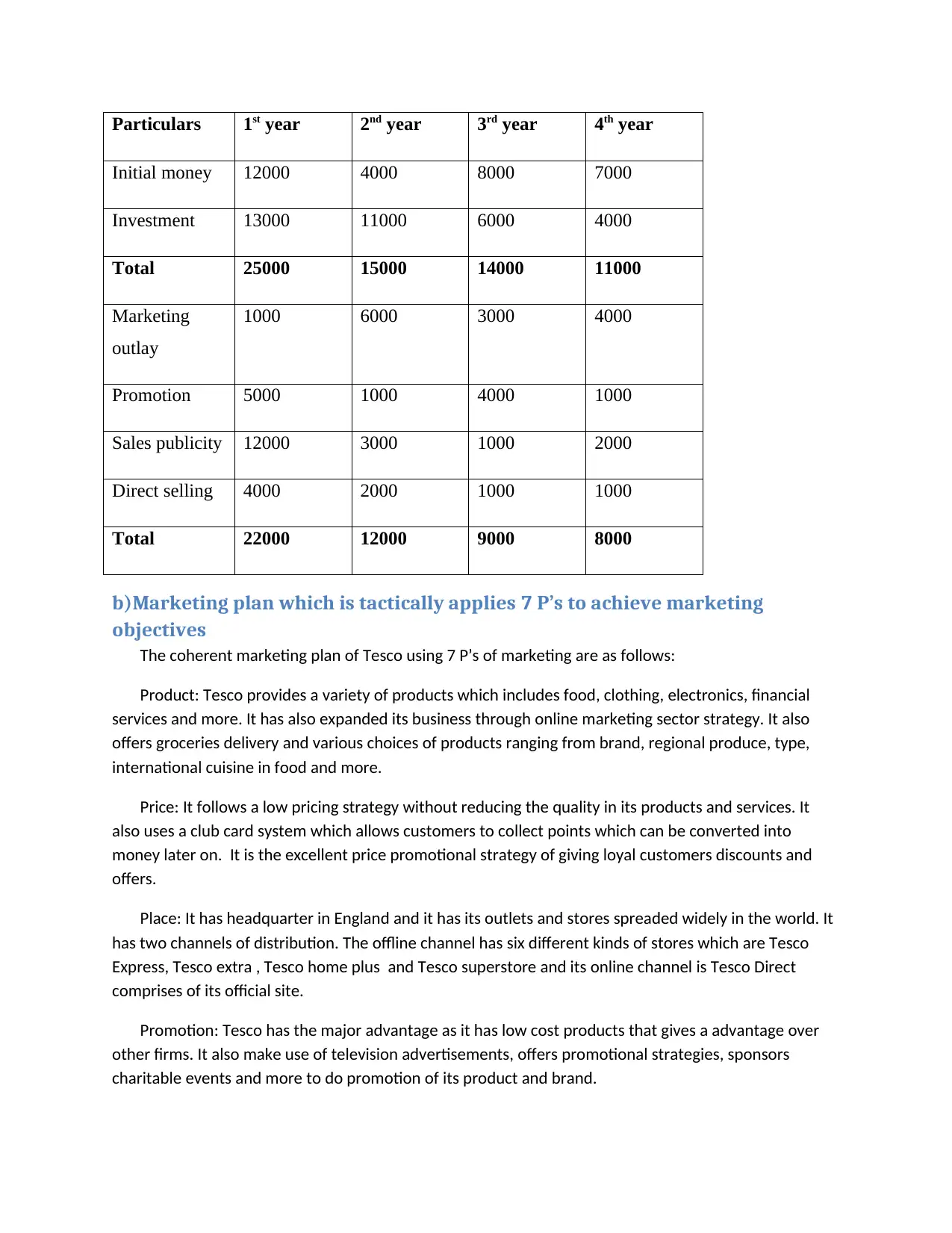
Particulars 1st year 2nd year 3rd year 4th year
Initial money 12000 4000 8000 7000
Investment 13000 11000 6000 4000
Total 25000 15000 14000 11000
Marketing
outlay
1000 6000 3000 4000
Promotion 5000 1000 4000 1000
Sales publicity 12000 3000 1000 2000
Direct selling 4000 2000 1000 1000
Total 22000 12000 9000 8000
b)Marketing plan which is tactically applies 7 P’s to achieve marketing
objectives
The coherent marketing plan of Tesco using 7 P’s of marketing are as follows:
Product: Tesco provides a variety of products which includes food, clothing, electronics, financial
services and more. It has also expanded its business through online marketing sector strategy. It also
offers groceries delivery and various choices of products ranging from brand, regional produce, type,
international cuisine in food and more.
Price: It follows a low pricing strategy without reducing the quality in its products and services. It
also uses a club card system which allows customers to collect points which can be converted into
money later on. It is the excellent price promotional strategy of giving loyal customers discounts and
offers.
Place: It has headquarter in England and it has its outlets and stores spreaded widely in the world. It
has two channels of distribution. The offline channel has six different kinds of stores which are Tesco
Express, Tesco extra , Tesco home plus and Tesco superstore and its online channel is Tesco Direct
comprises of its official site.
Promotion: Tesco has the major advantage as it has low cost products that gives a advantage over
other firms. It also make use of television advertisements, offers promotional strategies, sponsors
charitable events and more to do promotion of its product and brand.
Initial money 12000 4000 8000 7000
Investment 13000 11000 6000 4000
Total 25000 15000 14000 11000
Marketing
outlay
1000 6000 3000 4000
Promotion 5000 1000 4000 1000
Sales publicity 12000 3000 1000 2000
Direct selling 4000 2000 1000 1000
Total 22000 12000 9000 8000
b)Marketing plan which is tactically applies 7 P’s to achieve marketing
objectives
The coherent marketing plan of Tesco using 7 P’s of marketing are as follows:
Product: Tesco provides a variety of products which includes food, clothing, electronics, financial
services and more. It has also expanded its business through online marketing sector strategy. It also
offers groceries delivery and various choices of products ranging from brand, regional produce, type,
international cuisine in food and more.
Price: It follows a low pricing strategy without reducing the quality in its products and services. It
also uses a club card system which allows customers to collect points which can be converted into
money later on. It is the excellent price promotional strategy of giving loyal customers discounts and
offers.
Place: It has headquarter in England and it has its outlets and stores spreaded widely in the world. It
has two channels of distribution. The offline channel has six different kinds of stores which are Tesco
Express, Tesco extra , Tesco home plus and Tesco superstore and its online channel is Tesco Direct
comprises of its official site.
Promotion: Tesco has the major advantage as it has low cost products that gives a advantage over
other firms. It also make use of television advertisements, offers promotional strategies, sponsors
charitable events and more to do promotion of its product and brand.
⊘ This is a preview!⊘
Do you want full access?
Subscribe today to unlock all pages.
Trusted by 1+ million students worldwide
Physical Evidence: The Company find a waste in expending money on furbishing its stores. All the
stores are clean and hygienic. Navigation of the products is easy and are being kept in well categorised
manner.
People: the people involved in the sales department are responsible for increasing productivity and
profit of the company. It uses different programs such as Save as you earn, colleague privilege card, etc
for their workers. They have a highly skilled staff which contributes to the success of Tesco.
Process: It refers to the way of keeping people happy by doing speedy billing services and easy
procurements of the products and services in its online as well as offline stores.
Conclusion
This report concludes the role of the marketing function and connection of it with the other
functional departments. The main aim of the company is to provide efforts to the customers to excel in
their business. The ways in which the elements of marketing mix can be used in the overall business
strategy and to create a marketing plan. It also shows the development and evaluation of marketing
plan.
stores are clean and hygienic. Navigation of the products is easy and are being kept in well categorised
manner.
People: the people involved in the sales department are responsible for increasing productivity and
profit of the company. It uses different programs such as Save as you earn, colleague privilege card, etc
for their workers. They have a highly skilled staff which contributes to the success of Tesco.
Process: It refers to the way of keeping people happy by doing speedy billing services and easy
procurements of the products and services in its online as well as offline stores.
Conclusion
This report concludes the role of the marketing function and connection of it with the other
functional departments. The main aim of the company is to provide efforts to the customers to excel in
their business. The ways in which the elements of marketing mix can be used in the overall business
strategy and to create a marketing plan. It also shows the development and evaluation of marketing
plan.
Paraphrase This Document
Need a fresh take? Get an instant paraphrase of this document with our AI Paraphraser
REFERENCES
Online and Journal
Baker, M. J. and Saren, M. eds., 2016. Marketing theory: a student text. Sage.
William, K. and Zikmund, B. J., 2012. Essentials of marketing research. London: Cengage
Learning.
Baack, D. W., Harris, E. G. and Baack, D., 2013. International marketing (Vol. 3). Sage.
Silberschatz, A., Galvin, P. B. and Gagne, G., 2014. Operating system concepts essentials. John
Wiley & Sons, Inc..
Joshi, M., 2012. Essentials of marketing. Bookboon.
Silver, L and et al, 2012. The essentials of marketing research. Routledge.
Lovelock, C., 2011. Services marketing: People, technology, strategy. Pearson Education India.
Babin, B. J. and Zikmund, W. G., 2015. Essentials of marketing research. Nelson Education.
Armstrong, G and et al, 2015. Marketing: an in
Ahmed, P.K. and Rafiq, M., 2013. Internal marketing. Routledge.
Brady, D. L., 2014. Essentials of international marketing. Routledge.
Rossi, P. E., Allenby, G. M. and McCulloch, R., 2012. Bayesian statistics and marketing. John
Wiley & Sons.
Clow, K. E. and James, K. E., 2013. Essentials of marketing research: Putting research into
practice. Sage.
Online
Functions and Responsibilities of Marketing Manager. 2016. [Online]. Available
through:<https://www.gktoday.in/gk/functions-and-responsibilities-of-marketing-manager/
>.
Online and Journal
Baker, M. J. and Saren, M. eds., 2016. Marketing theory: a student text. Sage.
William, K. and Zikmund, B. J., 2012. Essentials of marketing research. London: Cengage
Learning.
Baack, D. W., Harris, E. G. and Baack, D., 2013. International marketing (Vol. 3). Sage.
Silberschatz, A., Galvin, P. B. and Gagne, G., 2014. Operating system concepts essentials. John
Wiley & Sons, Inc..
Joshi, M., 2012. Essentials of marketing. Bookboon.
Silver, L and et al, 2012. The essentials of marketing research. Routledge.
Lovelock, C., 2011. Services marketing: People, technology, strategy. Pearson Education India.
Babin, B. J. and Zikmund, W. G., 2015. Essentials of marketing research. Nelson Education.
Armstrong, G and et al, 2015. Marketing: an in
Ahmed, P.K. and Rafiq, M., 2013. Internal marketing. Routledge.
Brady, D. L., 2014. Essentials of international marketing. Routledge.
Rossi, P. E., Allenby, G. M. and McCulloch, R., 2012. Bayesian statistics and marketing. John
Wiley & Sons.
Clow, K. E. and James, K. E., 2013. Essentials of marketing research: Putting research into
practice. Sage.
Online
Functions and Responsibilities of Marketing Manager. 2016. [Online]. Available
through:<https://www.gktoday.in/gk/functions-and-responsibilities-of-marketing-manager/
>.

1 out of 11


Related Documents


Your All-in-One AI-Powered Toolkit for Academic Success.
+13062052269
info@desklib.com
Available 24*7 on WhatsApp / Email
![[object Object]](/_next/static/media/star-bottom.7253800d.svg)
Unlock your academic potential
Copyright © 2020–2026 A2Z Services. All Rights Reserved. Developed and managed by ZUCOL.